“Shoot Like a Champion”. Bryan Litz, author of Applied Ballistics for Long-Range Shooting, says he often sees notes like this tucked in shooter’s gear (or taped to an ammo box) at matches. What “marksmanship mantras” do you use? Do you have a favorite quote that you keep in mind during competition?
On the Applied Ballistics Facebook Page, Bryan invited other shooters to post the motivating words (and little reminders) they use in competition. Here are some of the best responses:
“Shoot 10s and No One Can Catch You…” — James Crofts
“You Can’t Miss Fast Enough to Win.” — G. Smith
“Forget the last shot. Shoot what you see!” — P. Kelley
“Breathe, relax, you’ve got this, just don’t [mess] up.” — S. Wolf
“It ain’t over ’til the fat lady sings.” — J. McEwen
“Keep calm and shoot V-Bull.” — R. Fortier
“Be still and know that I am God[.]” (PS 46:10) — D.J. Meyer
“Work Hard, Stay Humble.” — J. Snyder
“Shoot with your mind.” — K. Skarphedinsson
“The flags are lying.” — R. Cumbus
“Relax and Breathe.” — T. Fox
“Zero Excuses.” — M. Johnson
“SLOW DOWN!” — T. Shelton
“Aim Small.” — K. Buster
“Don’t Forget the Ammo!” (Taped on Gun Case) — Anonymous
PARTING SHOT: It’s not really a mantra, but Rick Jensen said his favorite quote was by gunsmith Stick Starks: “Them boys drove a long ways to suck”. Rick adds: “I don’t want to be that guy”, i.e. the subject of that remark.
Share the post "Elevate Your “Mental Game” with Marksmanship Mantras"
This report is from Bryan Litz and the ScienceofAccuracy.com website.
As long as there have been rifles, there has been a debate as to how much – if any – the rifle moves prior to the bullet exiting the bore. The first video below shows a Barrett MRAD chambered in .338 Lapua Magnum firing a 300gr Lapua Scenar bullet. Capturing projectiles at 100k+ frames per second allows us to visualize aspects of the firing sequence that are otherwise invisible to the human eye.
Click Video to see barrel with suppressor (on right) move with recoil before bullet exits.
What is clear from this video is that the rifle system is moving rearward while the bullet is traveling through barrel and subsequently through the suppressor. During the “in-bore” portion of bullet travel, any deviation of the muzzle orientation from the initial point of aim can cause a point of impact change. This is because the bullet will exit while the barrel is pointed somewhere different than when the shot was initially fired. Much of the shot’s point-of-aim orientation can be maintained through consistent marksmanship fundamentals and recoil management techniques. However, most shooters are not likely capable of managing it to less than 0.001″ for EVERY shot, especially given on lightweight magnum rifles.
Here’s another example with a 180gr bullet in a Rem 700 BDL .30-06 rifle. “Every time we watch a video like this it reminds us that guns like this, the majority of accuracy and precision come from the gun/sight/support system, not the ammo. When you consider that 0.005″ of muzzle deflection, (orthogonal to the bore) results in ~1.5 moa of dispersion (.75 in any direction) and you see this massive barrel movement prior to bullet exit, it’s clear that the vast majority of dispersion [for typical rifles] is coming from this movement”.
Precision rifle systems, such as benchrest, PRS, and F-Class rifles, tend to minimize the movement away from the bore axis prior to bullet exit to achieve the best possible precision. A common theme among the most precision systems is higher-weight rifles with lower-weight projectiles. This relates to basic physics: Newton’s Third of Motion “For every action, there is an equal and opposite reaction.” With all else held equal, if the rifle weighs more and the bullet weighs less, there is a lower magnitude of motion prior to the bullet leaving the barrel.
In our latest book, Modern Advancements in Long Range Shooting Volume III, Chapter 3 covers the Theory of Precision for Rifles which mathematically describes and estimates the precision potential of rifles based on rifle mass and kinetic energy of the bullet. The chapter includes all the live fire test data to support the theory and great discussion on the testing performed can be found on our podcast at the Science of Accuracy Academy website.
GunsAmerica Digest has a new Suppressor Academy webpage that provides host of helpful information about suppressors (aka “silencers” and “cans”). The Suppressor Academy online resource page features in-depth articles with important information for anyone considering acquiring a suppressor. The articles explain the key benefits of suppressors, how to choose a suppressor, and how to comply with Federal and state laws regulating suppressors. Below we link to four Suppressor Academy articles. Click the title for each topic to read the full-length article.
Suppressors are now legal in 42 U.S. States. There are certain legal requirements for obtaining a suppressor, including paying a $200 Tax Stamp. To own a suppressor you must be legally eligible to purchase a firearm, pass a BATFE background check, pay a one time $200 Transfer Tax, and satisfy age requirements. (SEE ALL Requirements). In most (but not all) of those states you can use a suppressor for hunting. The eight (mostly blue) states which still prohibit civilian suppressor ownership are: California, Delaware, Hawaii, Illinois, Massachusetts, New Jersey, New York, and Rhode Island. READ FULL ARTICLE on GunsAmerica Digest.
Suppressors serve one main purposes — to reduce the sound levels produced when firing pistol or rifle rounds. But GunsAmerica Digest editor True Pearce notes there are many other reasons to own a suppressor. A suppressor can reduce muzzle blast and felt recoil. The suppressor may prevent hearing damage that occurs through bone conduction better than earplugs and muffs because it reduces the noise energy at the source. When hunting, the reduced shot noise can help avoid spooking game. Having a suppressor also makes it easier to communicate when working as a team on a hunt. And, when compared to a muzzle BRAKE, suppressors are much less likely to kick up dust, dirt, sand, and snow when you shoot prone. READ FULL ARTICLE on GunsAmerica Digest.
There is some confusion surrounding the laws concerning suppressors, which are now legal in 42 U.S. States. In most jurisdictions that allow suppressor ownership, no additional state permit or license is required. But you do have to comply with Federal requirements when acquiring the suppressor. You may wish to create a trust to own the suppressor — there are some important practical advantages to having a suppressor trust. The Traditional NFA Gun Trust allows multiple responsible parties, i.e. “trustees”, to legally have possession of the suppressor. Each trustee must be verified and for each suppressor owned by the trust there will be a $200 Tax Stamp. READ FULL ARTICLE on GunsAmerica Digest.
When shopping for a suppressor there are many factors to consider: price, build quality, materials, sound level reduction effectiveness, weight, ease of mounting, and ease of cleaning and maintenance. We recommend that all suppressor buyers research the options. Check the manufacturer’s reputation, check diagrams for disassembly and maintenance. There are always trade-offs. Shorter suppressors may save some weight, but if they don’t cut the decibels as well you may be disappointed. You also need to consider the caliber — will your suppressor be used on multiple firearms? If so then get one that fits the largest caliber you will shoot. READ FULL ARTICLE on GunsAmerica Digest.
Share the post "Need Suppressor INFO? Suppressor Academy Is Great Resource"
by Sierra Bullets Ballistic Technician Paul Box
One thing that plays a major role in building an accuracy load is neck tension [one of the factors that controls the “grip” on a bullet]. I think a lot of reloaders pretty much take this for granted and don’t give that enough thought.
So, how much neck tension is enough?
Through the years and shooting both a wide variety of calibers and burn rates of powder, I’ve had the best accuracy overall with .002″ of neck tension. Naturally you will run into a rifle now and then that will do its best with something different like .001″ or even .003″, but .002″ has worked very well for me. So how do we control the neck tension? Let’s take a look at that.
First of all, if you’re running a standard sizing die with an expander ball, just pull your decapping rod assembly out of your die and measure the expander ball. What I prefer [for starters] is to have an expander ball that is .003″ smaller than bullet diameter. So for example in a .224 caliber, run an expander ball of .221″. If you want to take the expander ball down in diameter, just chuck up your decapping rod assembly in a drill and turn it down with some emery cloth. When you have the diameter you need, polish it with three ought or four ought steel wool. This will give it a mirror finish and less drag coming through your case neck after sizing.
Tips for Dies With Interchangeable Neck Bushings
If you’re using a bushing die, I measure across the neck of eight or ten loaded rounds, then take an average on these and go .003″ under that measurement. There are other methods to determine bushing size, but this system has worked well for me.
Proper Annealing Can Deliver More Uniform Neck Tension
Another thing I want to mention is annealing. When brass is the correct softness, it will take a “set” coming out of the sizing die far better than brass that has become too hard. When brass has been work hardened to a point, it will be more springy when it comes out of a sizing die and neck tension will vary. Have you ever noticed how some bullets seated harder than others? That is why.
Paying closer attention to neck tension will give you both better accuracy and more consistent groups.
Share the post "Optimize Case Neck Tension with Bushings, Expanders, Annealing"
Over the past month, many of the world’s best long range shooters competed in South Africa. First was the South African Open Championship, held March 9-15, 2024 for “Target Rifles”. This was followed by the 32nd World Long Range Championships for Fullbore/Palma rifles, with individual and team competitions held March 16-23, 2024. The World LR Championships event was for “hard-holders”, shooting iron-sighted rifles prone with sling. There were shooters from at least 12 countries: Australia, Canada, Channel Islands, Germany, Great Britain, Japan, Kenya, Ireland, N. Ireland, New Zealand, South Africa, and the USA.
The World LR Championships and the South African Open Championships were held at the Genl De Wet range West of Bloemfontein in South Africa. Conditions were very challenging — with very hot temperatures on the range and challenging winds.
Individual Top 20 Results 32nd World Long Range Championships
Australian Ash Bidgood won the Individual World Championship with an impressive 739-92V score. Great Britain’s Glyn Barnett was a close second (on V-Count) with 739-86V. In third place was another Brit, J.C. Underwood, who tallied 738-78V.
Two Americans finished in the top 15, Brandon Green (733-82V, 8th place) and Amanda Elsenboss (659-59V, 11th place). Both Brandon and Amanda are past USA National Champions who previously served in the U.S. Army and shot with the USAMU Team.
Other Grand Aggregate Divisional Winners include:
Veterans: B. Carter, New Zealand, 661-60V
Ladies: R.L. Furniss, Great Britain, 662-73V
Veterans Over 70: J. Jeffrey, Australia 548-51V
Under 25-21 Age: M. Baily, Australia, 661-84V
Under 21: T. McGowen, USA, 648-61V
Team Results: 32nd World Long Range Championships
1. Australia Total: 7172.996 | Day 1: 3580.474 Day 2: 3592.522
2. Great Britain Total: 7168.1005 | Day 1: 3578.469 Day 2: 3590.536
3. South Africa Total: 7153.869 | Day 1: 3562.405 Day 2: 3591.464 Click HERE for All Team Scores
4. United States Total: 7140.876
5. New Zealand Total: 7030.703
6. Canada Total: 6946.592
7. Germany Total: 6683.465
Team Australia won the Long Range World Championship with leading scores on both days of competition. The Aussies shot well, earning the Gold medal with a 7172.996 total vs. 7159.1004 for the Brits. Team Australia reported on its Facebook page: “We’d like to summarize how the 2024 Palma in South Africa evolved and highlight just how extraordinary it was. World records were repeatedly smashed and, while Australia defended and retained our world championship title earned in 2019, this was only the 4th time Australia has won the Palma since its inception in 1876.”
All four leading teams smashed the old full match Palma record of 7106.825 set by Great Britain in 2015, with Australia setting the new Palma world record with 7172.995. On Day 2, Australia set a new single-day world Team world record of 3592.521. That’s 37 points higher than the previous team record of 3555.424 set by GB in 2015.
The new individual World Record (during team competition) went to Australia’s Brett McCauley with 450-73V — breaking the world record of 449-55V set by Toby Raincock of GB in 2015. And, on Day 2, Great Britain’s Theo Dodds set a one-day individual world record with 225-40V.
USA’s Brandon Green Wins South African Open Championship
Former USAMU shooter Brandon Green topped the field in the South African Open Championship, which took place before the World Championships. Brandon won the SA Open individual title in a dramatic shoot-off. Congratulations to Brandon Green for an impressive come-from-behind victory to win the South African Nationals. Brandon finished with 924-93V, edging out Great Britain’s M.J. Ensor (923-101V) by a single point. Now that’s close!
Photo credit Chris Wheeden, GB Veterans Team
Shooter’s Report from South Africa by Paula Crenshaw
The first week of competition was the South African National Championships which was (for some) a warm-up to the World Long Range Championships. The U.S. National Rifle Team had five teams there. These were: Palma Team, the Veterans Team (those over 60), Goodwill Team, Junior Under 25, and Junior Under 21 teams. Competitions included team competitions and individual competitions.
I was not happy with my performance but I’m not particularly disappointed either. I know what I need to do. My .223 Rem caliber Palma rifle was also not ideal, and I’m eager to shoot my new .308 Win rifle. My Goodwill Team did take second in the Chairman’s Match.
Photo from last day of individual World Championship. The heat was tough.
The entire experience was amazing. It was also incredibly challenging with the heat wave and the winds. My teammates are outstanding people and I met many wonderful fellow shooters from other countries. Shooting while wildebeests and ostriches roamed the range (see above) was … interesting! Captain Bob’s wild dash to get me my forgotten bolt from the hotel was one for the storybooks … and his comment that he’d do it again despite being banned from the range warmed my heart. To my teammates John, Mark, Seth, and our coach Yvonne: Thank you!
The USA women competitors. Right to left: Trudy Fay, Paula Crenshaw, Yvonne Roberts, Kacie McGowan, Amanda Elsenboss, Jessica Hudson.
Here is a cool overhead photograph of the Genl De Wet shooting range outside Bloemfontein, South Africa.
Photo credit Chris Wheeden, GB Veterans Team
About the Long Range World Championship — Rifles and Course of Fire by Paula Crenshaw
Fullbore and Palma are different courses of fire, but both shot with similar rifles. The 87th South African Open Bisley Championships was a fullbore event held March 9-15, 2024. There were individual and team matches. The 32nd World Long Range Championships was a Palma event held March 16-23, 2024. A Palma match is shot at 800, 900, 1000 yards (or 700, 800, 900 meters) and has 15 shots for record at each distance using a .223 Rem or .308 Win (7.62×51) caliber iron-sighted rifle. A Palma rifle is always shot with a sling and iron sights.
Fullbore competition has 2-3 shooters to the mound (except in the USA where sometimes string fire is allowed at 1000 yards), 10 shots (sometimes 15) and shot at 300, 500, 600, 900, 1000 yards (or the equivalent in meters).
The Palma discipline has evolved into the “The World Long Range Championships, Individual and Palma Team Matches”. It has gone through many changes since 1876 and has developed its own set of rules and requirements for target, rifle, and cartridge. The match is now held at 4-year intervals. Teams consist of 16 firing members and two alternates along with a support group of a team captain, adjutant, five coaches, and a non-firing armorer, with total team size not to exceed 26 members. The match in South Africa was shot at 700, 800, and 900 meters.
The Palma is a match of great distinction. While the long range championships include individual matches and a nation’s other teams such as the Veterans teams, Under 25, Under 21, and USA’s Goodwill team, it is the Palma teams that hold the highest honor. The World Long Range Championships culminate with the Palma teams competing from each country. For an excellent detailed history I recommend A History of the Palma Match by Hap Rocketto, first published in 1996 (CLICK HERE FOR PDF).
Photo Credits: Credit top image, range flags image, and Brandon Green Chair image Great Britain Rifle Team. Other images credit Paula Crenshaw, Team USA, Team Australia, Chris Wheeden.
Share the post "Sunday GunDay: World LR (Palma) Championships in South Africa"
With the New Year approaching, we thought our readers might enjoy some historical background on the National Rifle Association, an organization which has served American firearms owners and marksmen for over 150 years.
Shooting Sports USA (SSUSA) has a good article on the origins and history of the National Rifle Association. This feature story covers the first 36 years of NRA history from 1871 to 1907. The NRA was founded in 1871, and 1907 marked the first year of Matches at Camp Perry, Ohio.
SSUSA explains the NRA’s original mission: “The NRA’s program during its youthful years centered mainly on improving marksmanship among the military. Rifle tournaments at ranges in Creedmoor (NY), Sea Girt (NJ), and Camp Perry (OH) captured the country’s spirit of nationalism and resulted in key improvements in rifles and target scoring. NRA also set standards for military rifle training and even inspired the federal government to form its own segment within the War Department to focus on promoting rifle practice among soldiers as well as civilians.”
1871 — A group of New York National Guardsmen founded the National Rifle Association to promote marksmanship training. Figures such as Capt. George Wingate had called for better rifle marksmanship to support the nation’s defense.
1872 — The NRA acquires Creed’s Farm in Long Island, New York for $26,250. Renamed “Creedmoor”, this becomes the NRA’s first range. The first match was held in 1873.
1874 — The NRA hosts its first International Match, shot at the Creedmoor Range in New York.
The First-Ever Creedmoor Challenge Match in 1874
The Irish International Shooting team arrived in New York on the 16th of September and proceeded to “take in the sights”, which was understandable, before some practice at the Creedmoor range. On September 26th they presented themselves for the match with confidence and in high spirits. The crowds that day were reported to be between 5,000 and 10,000 strong, which showed the huge support already growing for the fledgling sport in America.
The course of fire was 15 shots to each man at 800, 900, and 1000 yards. Unfortunately, the details of each mans scores at the individual distances have been lost to time but we do know that the Americans were well ahead after the 800-yard shoot. The Irish then caught up after the 900-yard and finished the 1000-yard shoot ahead by 1 point. The Americans still had one man left to shoot and it came down to his very last shot with which he scored a 4 giving the American team the win over the Irish by 3 points.
1892 — The NRA moves its Annual Matches to the Sea Girt Range in New Jersey, which was less than 60 Miles from New York City, NY. The Sea Girt Range was maintained by the New Jersey State Rifle Association, founded in 1878.
1903 — The U.S. War Department sets up a National Board for the Promotion of Rifle Practice (NBPRP). In 1903, an amendment to the War Dept. Appropriations Bill established the NBPRP to promote both Military and Civilian marksmanship. This government advisory board became the predecessor to today’s Corporation for the Promotion of Rifle Practice and Firearms Safety that now governs the CMP.
1907 — The NRA commences National Matches at Camp Perry, Ohio.
History of Camp Perry
The National Matches have been held at Camp Perry since 1907. The range is located along the shores of Lake Erie in northern Ohio near Port Clinton. The site was first acquired in 1906, in response to the need for a larger facility for military training and the NRA’s shooting programs. In 1906 Gen. Ammon B. Crichfield, Adjutant General of Ohio, ordered construction of a new shooting facility on the shores of Lake Erie, 45 miles east of Toledo, Ohio. The original land for Camp Perry was purchased in 1906, and the reservation was named after Commodore Oliver Hazard Perry, the American naval commander who won the Battle of Put-in-Bay during the War of 1812.
On August 19, 1907, Cpl. L. B. Jarrett fired the first shot at the new Camp Perry Training Site. And that year, 1907, Camp Perry held its first National Pistol and Rifle Championship events. This location has hosted the annual NRA National Matches ever since. Today, over 4,000 competitors attend the National Matches each year, making it the most popular shooting competition in the western hemisphere.
Federal legislation originally launched the National Matches. The 1903 legislation also established the National Matches, commissioned the National Trophy and provided funding to support the Matches.
Share the post "The Early History of the National Rifle Association — 1871-1907"
Can sustained rapid-fire shooting with no cool-down period wear out a quality barrel more quickly? The answer is “Yes” according to Forum member LCazador, who did an interesting comparison test with two .243 Winchester barrels. He started off with two, identical, match-grade HV taper stainless barrels. Both were NEW at the start of testing, and LCazador shot the same load through each: 95gr match bullets with 38 grains of Hodgdon Varget. After giving both barrels the same, gentle 20-round break-in, 300 rounds were then fired through each barrel — in very different ways. Barrel condition and wear were monitored with a borescope.
Barrel One — Slow Fire, Cool Down Periods, Cleaning Every 50 Rounds
At the end of the 300-round test, Barrel One looked brand new. There was none of the severe fire cracking found in Barrel Two. This barrel was shot no more than 10 times without a cool down and firing was done at a much slower pace. Cleaning for this barrel was done every 50 shots.
Barrel Two — Fast Firing, No Waiting, Cleaning Every 100 Rounds
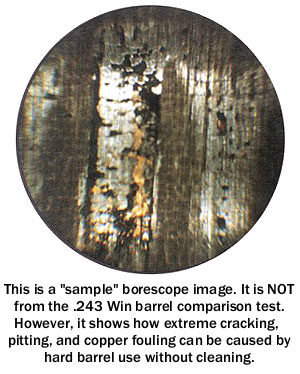
The second barrel, which received hard use and minimal cleaning, was severely damaged with severe fire cracking at the leade and throat. As a result, the barrel had to be re-chambered. This barrel was shot 100 rounds at time without cleaning and was shot up to 20 times in succession without a cool down.
LESSON LEARNED — Heat Kills Barrel Life
Don’t let your barrel get too hot, and keep it clean. One afternoon can ruin a barrel!
Monitoring Barrel Wear with Borescope
Some folks worry too much about what their borescopes reveal — many barrels do not have to be “squeaky clean” to perform well. In fact some barrels run better after ten or more fouling shots. However, a borescope can be very helpful when your barrel starts losing accuracy for no apparent reason. Forum member FdShuster writes:
“A borescope is a positive way of backing up your suspicions when the rifle starts to throw an occasional (soon followed by more frequent) wild shot. Using the scope is also an excellent way to determine that the cause is barrel wear and not simply a need for a concentrated cleaning session to remove built up copper and more importantly, carbon fouling.
I’ve had a few barrels that gave every indication of being shot out. But I ‘scoped them out and found the cause to be nothing more than requiring a good cleaning. They then returned to their usual performance. There’s no guessing involved when you are able to get ‘up close and personal’ using the scope. The borescope also provides an excellent view of the all-important condition of the crown. My borescope is one of the most valuable investments I’ve ever made.”
Share the post "Firing Rate and Heat — How to Kill a Barrel in One Afternoon"
If you have ever competed in NRA High Power, Silhouette, or Long Range disciplines, you know the name David Tubb. Arguably the greatest rifle marksman in American history, David has recorded 11 High Power Rifle Championships, 6 Long Range National Championships, and 7 High Power Silhouette National Championships. Over his career David has won 130 NRA trophies for various competitions. No one has even come close to that number of Championships and honors in rifle competition.
David Tubb Biography Video
Click the video above to view a great new documentary which covers David Tubb’s career in competitive shooting. Called America’s Rifleman, this fine documentary by filmmaker Sheldon Charron takes you inside the life and mind of legendary shooting champion David Tubb.
Learn how David evolved into the most successful rifleman in the history of competitive shooting, the challenges he faced, and how he overcame them on his road to success, both at the range and in his business, Superior Shooting Systems.
David Tubb Interview Podcast with Erik Cortina
In this very recent 3/22/24 Podcast, David Tubb was interviewed by ace F-Class shooter Erik Cortina, creator of Cortina Precision products — tuners, muzzle brakes, reloading dies and more. This 66-minute video is worth watching start to finish. David covers a wide range of topics include match strategies, marksmanship training, ELR competition, and cartridges he has developed including the 6mm XC (6XC), 338 XC, and 375 XC.
David Tubb Competition Shooting Accomplishments:
11 Time – NRA National High Power Rifle Champion – Camp Perry
6 Time – NRA Long Range Rifle (600-1000 yard) National Champion
7 Time (Consecutive) – NRA National High Power Rifle Silhouette Champion
6 Time – NRA National High Power Hunting Rifle Silhouette Champion
4 Time – NRA National Smallbore Hunting Rifle Silhouette
7 Sportsmen’s Team Challenge Championships
2 Time – Wimbledon Cup Winner
2019 ELR World Record Holder recognized by 50 Cal. Shooters Association
2019 NRA ELR Heavy Gun Winner
Over 130 NRA Championship Event Trophies (Individual Match Winner)
David Tubb with the ELR Adaptive Target Rifle (ATR) he designed which has set ELR records. You can see David shoot this rig in the video below:
David Tubb Shoots ELR Adaptive Target Rifle at KO2M
For the Extreme Long Range discipline, David Tubb developed a .375-caliber, long-barreled ELR version of his famous Tubb rifle, called the Adaptive Target Rifle (ATR). A version of this rifle, piloted by David’s son-in-law Nate Stallter, set the current ELR World Record in January 2018.
The TUBB 2000 — Innovative Modular Bolt Gun
David Tubb is arguably the greatest High-Power Across-the-Course rifle competitor in American history. He won many of his championships shooting a modular rifle of his own design — the Tubb 2000, aka T2K. In this video, David shows the features of the Tubb 2000 rifle which makes it adaptable to multiple shooting positions — prone, sitting/kneeling, and standing.
David Tubb Talks about KO2M and Extreme Long Range Shooting
David Tubb’s long-range rifles have performed well in Extreme Long Range shooting. AT the 2019 NRA Extreme Long Range Championship, David Tubb won the Heavy Gun Division. In this video, created during the King of 2 Miles (K02M) competition at the Whittington Center in New Mexico, David talks about the challenges of ELR shooting, and cartridge selection. Big, heavy, large-caliber bullets with ultra-high BCs are favored for the ELR game, but recoil and cost must also be considered.
David Tubb’s Approach to Load Development
In this 27-minute video, David talks about case prep and loading with both regular and progressive presses. David shares his methods. He recommends weighing your brass and segregating them in one grain increments. He then does an initial test with powder charge weights in half-grain increments (for smaller BR cases we recommend 0.3 grain increments). He then also experiments with seating depths.
“America’s Rifleman” Movie Credits:
Production Company: Enter360 Media
Producer/Director/Editor: Sheldon Charron
Production Assistant: Christie Tubb
Share the post "Sunday Gunday: David Tubb — Legendary American Champion"
Enjoy the Shooting Sports USA Archives
As we head into spring, many Americans will be spending more time at the range. And competitors will be shooting in rimfire and centerfire rifle matches throughout the country. Here’s an opportunity to learn competition skills, gun tuning methods, and reloading techniques from leading experts. A vast resource of great gun-related content available online for FREE. Check out the Shooting Sports USA Articles Archive. SSUSA maintains a vast digital library with hundreds of articles going back to June 2009.
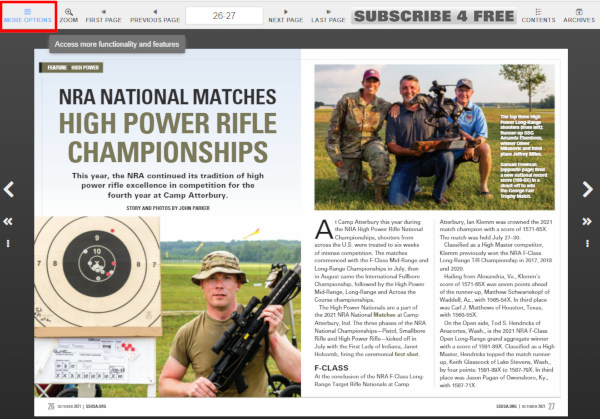
It’s easy to find back issues of Shooting Sports USA magazine. Here’s how: First, navigate to the latest SSUSA Online Issue (March 2024). Then click on the “ARCHIVES” icon in the upper right area (indicated with red arrow). When you click on “ARCHIVES”, a window will open with a selection of Shooting Sports USA magazine covers/dates in a vertical column. The most recent issue (March 2024) will appear at the top left. You can then scroll down — use the vertical scroll bar to go from March 2024 all the way back to June 2009. Click any issue cover to read.
How to Find and Save Articles
To search back issues, select “MORE OPTIONS” from the toolbar (top left). Then click the “SEARCH” button. When that opens, select either “Search Archives” for ALL back issues or “Search Only this Issue”. When you’ve made your choice, enter your search term(s). For example, you can search for “Camp Perry” or “Palma” or “F-Class Championship”. You can also save any archived issue as a PDF for viewing offline. Just click “SAVE” to download the article you’re currently viewing/reading.
Read Sample Articles
Here are a three of our favorite SSUSA feature stories from recent years. There are hundreds of other informative articles worth reading.
F-Class fans will enjoy the coverage of the 2023 F-Class World Championships in the June 2023 issue of Shooting Sports USA. On the cover is our friend and Forum member Erik Cortina.
Share the post "Access 15 Years of Shooting Sports USA Articles for FREE"
Want to improve your understanding of Ballistics, Bullet Design, Bullet Pointing, and other shooting-related tech topics? Well here’s a treasure trove of gun expertise. Applied Ballistics offers dozens of FREE tech articles on its website. Curious about Coriolis? — You’ll find answers. Want to understand the difference between G1 and G7 BC? — There’s an article about that.
“Doc” Beech, technical support specialist at Applied Ballistics says these articles can help shooters working with ballistics programs: “One of the biggest issues I have seen is the misunderstanding… about a bullet’s ballistic coefficient (BC) and what it really means. Several papers on ballistic coefficient are available for shooters to review on the website.”
Credit Shooting Sports USA Editor John Parker for finding this great resource. John writes: “Our friends at Applied Ballistics have a real gold mine of articles on the science of accurate shooting on their website. This is a fantastic source for precision shooting information[.] Topics presented are wide-ranging — from ballistic coefficients to bullet analysis.”
Here are six (6) of our favorite Applied Ballistics articles, available for FREE to read online. There are dozens more, all available on the Applied Ballistics Education Webpage. After Clicking link, select Plus (+) Symbol for “White Papers”, then find the article(s) you want in the list. For each selection, then click “Download” in the right column. This will send a PDF version to your device.
Share the post "Access Great Applied Ballistics Tech Articles for FREE"
Are you a do-it-yourself kind of guy with a creative eye? Then you’ll love the FREE Target Generator from the folks at ShooterShed.com. This FREE, interactive webpage allows you to design a variety of fun targets, including grids, benchrest-type Score/Group Shooting targets, sight-in targets, and even playing card targets. Choose the paper size and orientation (vertical or horizontal), then select the number of target elements on the page. For example, you could have four (4) bulls or a dozen playing cards. Then click the Style TAB to choose your target style. Use the OPTIONS TAB to overlay a grid on the target, choose squares or diamonds, or include load information blocks. For bullseye targets, you can control the number, color, and spacing (diameter) of the rings. LINK to TARGET GENERATOR.
QWIK TIP: For Super-Quick Target Creation, click the “Target Style” tab, then select a design from the list on the left. Then go to OPTIONS.
Click the TARGET STYLE TAB to select one of many target styles, including NBRSA Benchrest targets and 20+ types of NRA bullseye targets, scaled to distance:
Benchrest
Bullseye
Shapes
NRA High Power
NRA Pistol
NRA Rimfire
Images
Playing Cards
Load Test Blocks
Creating new targets is fast and easy. No computer graphics skills required! We created this green diamonds grid target in just five minutes using the ShooterShed Target Generator:
And here is a handy target with short-range range Benchrest competition-style box/circle aiming points, along with fields for entry of gun/load data:
The program provides a preview of each target you generate. There are controls to choose border and fill colors. If you like a particular design, save the file, and then print as many targets as you want. Check it out, this program is fun and handy to use. Here are four (4) targets your Editor created just for this article. With a bit of practice, you can be generating your own custom targets in minutes.
About the Creator of the Target Generator
The Target Generator program was created by Rod Brown of Sheridan, Wyoming. Rod tells us: “I build custom rifles… I’ve got a 100-yard range out my back door. I shoot short- and long-range benchrest competitively around the country. I’m a full-time software development consultant and an FFL holder. When I’m not developing custom software for my clients, I’m usually fiddling in the shop, building a custom benchrest rifle, traveling to a match, chambering a barrel, or reloading some ammunition.”
Story tip from Boyd Allen. We welcome reader submissions.
Share the post "Make Your Own Custom Targets with FREE Target Generator"
Peterson Cartridge Company (“Peterson”) has released a lengthy, authoritative guide to the 22 Creedmoor cartridge, a popular wildcat based on the 6.5 Creedmoor or 6mm Creedmoor necked down to .224 caliber. We think the .22 Creedmoor would be a great long-range varmint cartridge, similar to the .22-250 Rem, but with a more modern, efficient cartridge design. In addition, some PRS/NRL competitors may turn to the .22 Creedmoor because it has less recoil and is flatter-shooting than the 6mm Creedmoor. In addition, .224-caliber match bullets are typically less expensive than heavier 6mm and 6.5mm projectiles. Less recoil, and less cost — what’s not to like?*
Along with load data, this article has specific sections dedicated to: Primers, Rifling Twist Rates, and Reloading Supplies. If you are considering building a .22 Creedmoor, we recommend you download the full Peterson .22 Creedmoor article, which is available in PDF format.
Peterson states, “Since its inception in 2007… the 6.5 Creedmoor has seen some pretty meteoric growth in popularity. That growth continues as of this writing, as the cartridge has now gone mainstream with hunters and shooters alike. As the popularity of the 6.5 Creedmoor has increased, so has the number of wildcat cartridges based off of it. Some of those popular wildcat cartridges are the 6mm Creedmoor, the .25 Creedmoor, and now the .22 Creedmoor. This data sheet will cover the .22 Creedmoor.
To help our customers, and anyone else who shoots .22 Creedmoor, we decided to create this Data Sheet and distribute it. [In this LOAD DATA Document] you will find four (4) common bullets, and four (4) common rifle powders used when handloading the .22 Creedmoor cartridge. We then took the different bullet and powder combinations and loaded them up to the SAAMI Maximum Average Pressure (MAP) for the 6.5 Creedmoor and 6mm Creedmoor cartridges, which is 62,000 PSI. [O]ur goal was to provide a wide spectrum of bullet weights and the powders used with them.
All of the following data was gathered by our ballistician in our indoor ballistics lab located in our factory in Pennsylvania. Although we were able to gather pressure and velocity data in our lab, we have NOT tested these loads for accuracy. Again, these loads are just designed to give shooters information regarding what velocity, a given bullet and powder charge combination, will produce the SAAMI Maximum Average Pressure (MAP) of 62,000 psi.”
Sample 22 Creedmoor LOAD DATA
IMPORTANT — Pressures can vary significantly with different Cartridge Overall Lengths (COAL). In addition, ANY change to ANY load components — primers, bullets, brass, powder — can affect pressure. Always load conservatively. In addition, because of variances in bore dimensions, some barrels may show higher pressures than others. Again, always start with conservative loads, well below MAX pressures.
*Actually there IS a potential downside — reduced barrel life. We expect that a .22 Creedmoor running hot varmint loads would experience shorter useful barrel life compared to a 6.5 Creedmoor. This is based on what we’ve observed with .22-250 and .22-250 Ackley barrels compared to our 6.5 CM barrels.
Share the post ".22 Creedmoor LOAD DATA and INFO from Peterson Cartridge"


 “Shoot Like a Champion”. Bryan Litz, author of Applied Ballistics for Long-Range Shooting, says he often sees notes like this tucked in shooter’s gear (or taped to an ammo box) at matches. What “marksmanship mantras” do you use? Do you have a favorite quote that you keep in mind during competition?




 Monitoring Barrel Wear with Borescope
 David Tubb Biography Video