Last month, Orangeburg, South Carolina became the epicenter of rifle competition on November 4-5, 2023 as the Mid-Carolina Gun Club hosted the widely-acclaimed Tack Driver IV. The Tack Driver has rapidly grown in popularity and stature, becoming a yearly must-attend event. The match’s rise in popularity can be attributed to several factors, including its organizer, the spirited Jim Cline, renowned for his quick wit, larger-than-life persona, and affinity for pranks. The Tack Driver’s popularity and status is further boosted by its unique format: shooting a mix of group and score targets at 300 meters. It has a generous 22-pound rifle weight limit and extends an invitation to all precision shooting disciplines. Competitors get the opportunity to compete with some of the world’s best shooters, have a great time, enjoy fantastic food, and see if they have what it takes to earn the title of “Tack Driver”.
What is the Tack Driver Match
For the uninitiated, the Tack Driver is a 300-meter “take-all-comers” match designed to answer the age-old question of which combination of caliber and shooting discipline is the most accurate. The rules are simple: all rifles will be fired from a bench, 22-pound weight limit, caliber must be .338 or smaller, and no one-piece rest is allowed. Each competitor will alternate shooting 5 group targets and 5 score targets over the course of two days. There are a few more rules, but those are the basics.
The Tack Driver’s course of fire alternates between score targets and group targets. So competitors must demonstrate both precision and accuracy. The group targets test precision, measuring only the group size for 5 record shots. Meanwhile, the score targets demand accuracy with a goal of hitting 5 separate 1″-diameter bullseyes, each with a single shot (ideally obliterating the dot in the center). Each target has a designated area for unlimited sighters during the 7-minute match. At the end of the match, the shooter with the best combination of the highest score and smallest group aggregate wins.
Beginning of Tack Driver IV — Cool Temps and Light Winds
Bright blue skies, light winds, and cool temperatures greeted the 99 competitors in attendance to compete for the title of Tack Driver Champion. The match, since its inception, has attracted a deep list of “Who’s Who” in the world of precision shooting. In attendance are World Record Holders, National Champions, Hall of Famers, Shooters of the Year, and World Team members. Literally the “best of the best” from UBR, Score, Group, 600-yard, 1000-yard, and Ground Hog competitions, were competing in this unique contest of “precision and accuracy.”
Tack Driver IV Video — Many Images from Match
Wayne Campbell’s Tack Driver-Winning 6 PPC Rifle
Wayne Campbell won The Tackdriver IV with a modern 6 PPC rifle. The components included: BAT 3-Lug action, Bartlein 5-groove barrel, Scarborough stock, Nightforce 42x44mm fixed-power scope, Bix ‘N Andy trigger. Notably, Wayne did most of the gunsmithing himself.
Results of The Tack Driver IV — Combined Grand Aggregate
The Tack Driver IV Grand Aggregate Winner is Wayne Campbell! Congratulations to Wayne who was also the Tack Driver Group Shooting Champion with a .7028 Aggregate! This is Wayne’s second year in a row to win this honor.
The “agony of defeat” award goes to Jeff Thompson. Jeff lead in group after targets 3 and 4 and appeared untouchable. However on target 5, Jeff shot an uncharacteristic 1.031″ group, which allowed both Greg Ellis and Wayne Campbell to surge past.
Top 5 Group Results
1. Wayne Campbell .7028
2. Greg Ellis .759
3. Jeff Thompson .7758
4. Jeff Summers .794
5. Dewey Hancock .804
Fun Group Fact: Jeff Summers and Wayne Campbell were the only competitors to keep all 5 groups below an inch.
Top 5 Score Results
1. Derick Loflin 245-2X
2. Stevie Salter 244-3X
3. Rober Seeman 244-3X
4. Dave “SuperMan” Way 244-1X
5. Gavin Peinhardt 243-2X
A big congratulations goes to Derick Loflin, the new Tack Driver Score Champion with a 245-2X. Once Derick moved into 1st place (after target 4 was posted) he never relinquished the lead.
Chambering Selections of Competitors — 6 PPC Most Popular
Of the 98 recorded chambering types for participants, the 6 PPC was the most popular with 39 entries. Next was the 30 BR with 27 entries. There were a dozen 6 BRAs (aka 6mmBR Ackley), plus 11 6mmBRs. There were three 22 PPCs and two each 30 Dasher and 6.5×47, with one Grinch and one 30 WW.
Saturday Morning Tack Driver Interviews with Top Shooters
Click NAME to view YouTube Interview Video:
Jeff Peinhardt, Tack Driver I Champion Hall of Fame Member
Samuel Hall, 600-Yard Shooter 3-Time National Champion
Here is the 0.337″ group shot by George Cabrera. George was shooting a 6mmBR rifle with Panda action (right bolt, left port, no ejector), Kelbly stock, Krieger 1:10″-twist barrel, Jewell trigger, Nightforce 12-42x56mm BR scope. George loaded his 6mmBR rifle with H4895 powder and Berger 90gr HPBT bullets. At 300 meters this 0.337″ group works out to 0.098 MOA (one MOA is 3.435″ at 300 meters).
Saturday Night Cookout with Smoked Prime Rib
With the range closed and targets hung, shooters and family members began gathering at the pavilion (on top of the hill) for the 6:30 feed. With a main course of Smoked Prime Rib, it was a packed house. Previous nights the shooters were treated to a low country boil and grilled chicken. The food throughout the event, lunch and supper is simply amazing. It’s a 5-Star dining experience served with paper plates and napkins. Here is a video of folks enjoying the festivities.
Prime Rib Night Video
Prelude — Tack Driver Lite (November 2, 2023)
This year started with a new event, “The Tack Driver Lite,” held on Thursday morning. two days prior to the regular Tack Driver. The match has two goals: first, to give early-arriving competitors something to do, and second to get the match director, Jim Cline, out from behind his computer and see how he stacks up against the competition. The Tack Driver Lite format is similar to the regular Tack Driver but with a couple of twists. The match consists of 4 targets (2 Score & 2 Group) instead of the usual 10 (5 Score & 5 Group). Each competitor was allowed to put out one flag. Prior to drawing a bench the shooter had to state at what range he would put his flag. Competitors have 7 minutes to shoot one Score and one Group target. The next twist is the targets were hung sideways, one on top of the other, instead of the normal straight up and down. It really shouldn’t make a difference, but visually and mentally it did. With the temperature in the low 30s and light and variable winds, twenty shooters took to the line.
Results of Tack Driver Lite
When the dust had settled Roy “The Renaissance Man” Hunter (photo below) found himself the winner of the score portion of the match, shooting clean with a perfect score of 100. Top dog was Billy Stevens who won both the Overall Grand Aggregate (combined score and group) and the Group Aggregate with a 0.689.
Target by Target Progress of the Main Tack Driver IV Match
Christmas is 22 days away. If you are looking for a great gift for a shooting buddy, books have always been popular holiday gifts. Here are some recommended titles that should please the serious shooters and firearms enthusiasts on your shopping list. For shooting clubs, books also make great end-of-season member awards. Most of us would rather have a useful book than one more piece of wood to toss in a box in the closet. Check out these ten titles — for yourself or your shooting buddies.
Here Are TEN Great BOOKS Recommended for Serious Shooters:
If you’re a serious long-range shooter, consider adding this book to your library. Relying on extensive ballistics testing, Modern Advancements, Volume II is a great successor to Volume I that contains some fascinating research results. UK gun writer Laurie Holland notes: “Volume II of the Modern Advancements series is as fascinating as Volume I and if anything even more valuable given a series of ‘mythbusters’ tests including: case fill-ratio, primer flash-hole uniforming, neck tension, annealing, and much more. The work also addresses that perennial discussion of a bullet ‘going to sleep’ and shooting smaller groups (in MOA) at longer distances than 100 yards.” The amount of testing done for this Volume II work, with a staggering amount of rounds sent downrange, makes this book unique among shooting resources. There is a ton of “hard science” in this book — not just opinions.
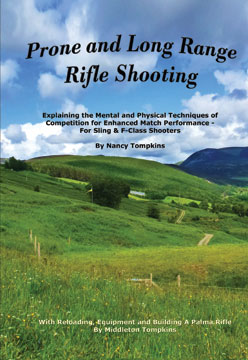
Nancy Tompkins is one of the greatest long-range shooters in American history. She has won five National Long-range Championships. Tompkins’ treatise is a must-read for serious Palma, F-Class, and High Power shooters. The revised Second edition includes F-Class equipment and techniques, and newly updated information. Color pictures. Topics include Mental & Physical training, Reading Wind & Mirage Shooting Fundamentals, International Competition, and Loading for Long Range. Nancy Tompkins is a 4-time winner of the National Long Range Championships, and has won countless other major events. Nancy has been on six Palma Teams (as both a shooter and a coach).
The lastest edition of The Wind Book was released in 2020. The updates make this very helpful 144-page book even better. The Wind Book for Rifle Shooters by Linda Miller and Keith Cunningham, first published in 2007, is a very informative resource. But you don’t have to take our word for it. If you click this link, you can read book excerpts on Amazon.com. This lets you preview the first few chapters, and see some illustrations. Other books cover wind reading in a broader discussion of ballistics or long-range shooting. But the Miller & Cunningham book is ALL about wind reading from cover to cover, and that is its strength. The book focuses on real world skills that can help you accurately gauge wind angle, wind velocity, and wind cycles. Readers have praised the book, earning it 93% 4- and 5-star reviews on Amazon.
Ryan Cleckner is noted for his ability to explain complex topics in an easy-to-comprehend manner. Now Cleckner has authored a book, the Long Range Shooting Handbook, which expands on the topics covered in Cleckner’s popular NSSF video series. The Long Range Shooting Handbook is divided into three main categories: What It Is/How It Works, Fundamentals, and How to Use It. “What It Is/How It Works” covers equipment, terminology, and basic principles. “Fundamentals” covers the theory of long range shooting. “How to Use It” gives practical advice on implementing what you’ve learned, so you can progress as a skilled, long range shooter. You can view Sample Chapters from Ryan’s Book on Amazon.com.
Visualization is a process of mental preparation that is done before you get to the range. Many of the greatest shooting champions have used this technique to get ready for big matches, and to optimize their performance during record fire. If you want to enhance your “mental game” through pre-match visualization, we strongly recommend Lanny Bassham’s book, With Winning in Mind. As a competitive smallbore 3P shooter, Bassham developed a mental management system. Using this system, Lanny Bassham won 22 world individual and team titles, set four world records, and captured an Olympic Gold Medal in Montreal in 1976. His techniques have been embraced by professional and Olympic athletes in many sports. With Winning in Mind covers a complete system of “mental management” techniques used by Olympians and elite champions.
Thinking of getting started in the Practical/Tactical shooting game? Looking for ways to be more stable when shooting from unconventional positions? Then you may want to read Marcus Blanchard’s Practical Shooter’s Guide (A How-To Approach for Unconventional Firing Positions and Training). Unlike almost every “how to shoot” book on the market, Blanchard’s work focuses on the shooting skills and positions you need to succeed in PRS matches and similar tactical competitions. Blanchard provides clear advice on shooting from barricades, from roof-tops, from steep angles. Blanchard says you need to train for these types of challenges: “I believe the largest factor in the improvement of the average shooter isn’t necessarily the gear; it’s the way the shooter approaches obstacles and how they properly train for them.”
Tony Boyer, the most successful shooter in the history of short-range benchrest competition, shares match-winning tips in this 323-page book. The book covers all aspect of the benchrest discipline: loading, windflags, rest set-up, addressing the rifle, and match strategies. This is a high-quality publication, filled with valuable insights. Every serious benchrest shooter should read Tony’s book. Boyer has dominated registered benchrest in a fashion that will never be duplicated, having amassed 142 U.S. Benchrest Hall of Fame points. The next closest shooter, Allie Euber, has 47 Hall of Fame points. This handsome, full-color book is 323 pages long, with color photos or color illustrations on nearly every page.
This book by 11-time National High Power Champion David Tubb focuses on position shooting and High Power disciplines. Section One covers fundamentals: position points, natural point of aim, breathing, triggering mechanics and follow-through, sling selection and use, getting started, getting better, avoiding obstacles. Section Two covers mechanics of offhand, sitting, and prone positions. Section Three covers shooting skills, including wind reading and mental preparation. Section Four covers the technical side of shooting, with extensive discussions of rifle design, load development, reloading barrel maintenance, and rifle fitting. We consider this book a “must-read” for any sling shooter, and there is plenty of good advice for F-Class shooters too.
Another fine book for PRS/NRL shooting is Precision Rifle Marksmanship: The Fundamentals by Frank Galli, founder of SnipersHide.com. Former USMC scout-sniper Frank Galli explains techniques will benefit any PRS/NRL competitor. Along with position shooting tips, Galli offers great wind-reading advice. Published in 2020, Galli’s treatise is four years newer than Blanchard’s book, so it includes more of the latest gear and equipment. Galli’s book covers the fundamentals of precision marksmanship with easy-to-understand methodology. The book follows the same instruction process Galli uses in his live marksmanship classes. Published in 2020, this well-illustrated, 272-page book covers the latest equipment (scopes, LRFs, chassis systems, magazines, bags, bipods, tripods) favored by tactical competitors in PRS/NRL type matches.
Cartridges of the World (17th Edition, 2022), belongs in every serious gun guy’s library. This massive 704-page reference contains illustrations and basic load data for over 1500 cartridges. If you load for a wide variety of cartridges, or are a cartridge collector, this book is a “must-have” resource. The latest edition includes dozens of new cartridges and boasts 1500+ photos. The 17th Edition of Cartridges of the World includes cartridge specs, plus tech articles on Cartridge identification, SAAMI guidelines, wildcatting, and new cartridge design trends. In scope and level of detail, Cartridges of the World is the most complete cartridge reference guide in print. Cartridges of the World now includes a full-color section with feature articles.
Ryan Cleckner is a former U.S. Army sniper instructor, and a highly respected outdoor journalist and firearms industry attorney with GunUniversity.com. Cleckner is also the author of the outstanding Long Range Shooting Handbook resource. A skilled shooter, and a very effective communicator, Ryan Cleckner is the host of a great 2023 series of NSSF videos about rifle optics.
There are 14 videos in the Cleckner NSSF Optics series, all worth watching. Among the 14 Ryan Cleckner Optics videos, here are our “pick six” of the most informative and helpful videos, which range in length from one to fifteen minutes. Key topics covered include: First Focal Plane vs. Second Focal Plane, Parallax Correction, Ocular (eyepiece) Focus, and Reticle Options.
First Focal Plane vs. Second Focal Plane Scopes
With a First Focal Plane (FFP) scope, the reticle grows and shrinks as magnification is adjusted up and down. This means that hash marks on the FFP reticle always cover the same angular scale (in MOA or Mils). That’s useful for PRS/NRL shooters and hunters who must shoot at multiple distances and quickly calculate hold-offs and hold-overs. With a Second Focal plane scope, the reticle is always the same size/thickness in the field of view no matter what the magnification. SFP Reticle hash marks define a particular defined angular division (such as 2 MOA), at one specific magnification level (such as 25X). At high magnifications, a SFP scope is less “busy” and so is generally preferred by target and benchrest shooters, who take a string of shots at a specific distance.
Parallax Explained and How to Use Parallax Controls
Parallax occurs when the target and reticle are on different planes within the scope. It is detectable when you move your head or eye around while looking through the scope, and the reticle appears to move or swim around the object at which you are aiming. To correct for parallax, you want to adjust the parallax control, commonly located on the left side of the scope. CLICK HERE for Nightforce tips on how to avoid parallax errors.
Understanding the Features of Modern Riflescopes
Modern riflescopes have multiple controls that alter focus, magnification, and reticle placement relative to the viewed target. Typically on top is an elevation control knob with clicks in 0.1 Mils or one-eighth or one-quarter MOA. On the right side (from shooter’s perspective), is a windage control, again with MIL or MOA-segmented clicks. On most current scopes, there will be a parallax control on the left side. In the rear, on zoom scopes, there will be a magnification control. Finally, many scopes will have a rotating eyepiece section for ocular focus.
Scope Reticle Types for FFP and SFP Optics
There are a wide variety of reticle types for both FFP and SFP scopes and for different applications (short range, long range, hunting, benchrest, F-Class, PRS/NRL, handguns). A 3-9x40mm hunting scope may have a very simple reticle with medium thickness lines and a couple vertical hold-over marks. By contrast, a 45X optic for short-range benchrest may have razor-thin lines and a very small, central target dot.
At the other end of the spectrum a modern FFP PRS/NRL optic may have a very complex reticle that looks like a Christmas tree — check out the Horus H425 reticle at right. This will have multiple hold-over and windage marks for multiple distances. That helps a shooter nail a 500m target just seconds after engaging a plate at 100m.
How to Adjust Eyepiece to Optimize Ocular Focus
Ocular focus refers to the sharpness of the reticle image you see through the eyepiece. Typically you’ll see a plus/minus marking near the rear part of the scope. This allows the eyepiece section to rotate clockwise and counter-clockwise. The purpose of this ocular focus is to help tailor the scope optimally for the particular shooter’s vision. March Scopes explains: “By adjusting the eyepiece, you will be setting the right diopter value which differs by person. The goal of adjusting the eyepiece to the proper diopter setting, is to see the reticle clearly and crisply.” For March scopes: “If you are near-sighted, rotate the eyepiece body counter-clockwise. If you are far-sighted, rotate the eyepiece body in the + direction, clockwise.”
Four of the 14 Ryan Cleckner optics videos cover scope mounting. Above is the main video of the four. This major 15-minute video covers the basics of scope mounting, including ring placement, fastener torque control, and reticle alignment. The additional three Cleckner scope mounting videos are:
Part 1: How to Mount a Scope — Components
Part 2: How to Mount a Scope — Tools
Part 4: How to Mount a Scope — Trouble Shooting
You have to admire someone with serious do-it-yourself skills. Not just hammer and nail skills, but formidable design and fabrication skills. Well Forum Member Dave D. (aka “AKShooter”) has a DIY skill set that might put some trained machinists to shame. You see, “DIY Dave” crafted his own pedestal front rest from scratch, using his own design and about $100.00 in materials (not counting the Edgewood front bag). Dave estimates he put 20 hours of labor into the project, but the end result was worth it: “This Do-It-Yourself rest drives like a dream. I’ve played with the Caldwell and a Sinclair, they have nothing on this one.”
Dave tells us: “Here is my Do-It-Yourself front rest. I wanted to show other folks who are handy that a solid front rest is doable with a bit of time — and you don’t need to spend $1000.00. (You could say this is a design for shooters with more time than money.) This is for F-Class. I was originally overwhelmed by the equipment needed, so I decided to make my own rest. I didn’t have the money for a SEB or Farley Coaxial. This is what I’ll run this season (my second as an F-Class competitor).”
We asked Dave what equipment was used to make the rest. He explained: “My brother has a CNC cutter. But most water-jet outfits would do the work for $100 or less. All the plates are tapped and screwed. I found small machine screws on eBay.” Dave says there are other ways to build a front rest: “You could do the same with a welder and plate stock for base. It’s easier to do the top out of aluminum though, with all the tapping.”
Dave enjoys fabricating his own gear, but he admits the process can be time-consuming: “I’m a DIY guy. Sometimes I wrap up a project and wonder why the heck I just spent X amount of time on it.” Dave has other projects in the works: “Another option we are making for a friend is taking a cheap front rest and bolting to a 3/4″ thick, wide MDF base and adding additional adjustment screws. The hardware store is your friend!”
On the competition front, Dave is tuning up a 6mm Dasher: “My rifle last year was a .260 Rem Savage repeater. I was about middle of the pack in my group of shooters. Just went with unsorted Bergers and Lapua brass, and had a ton of fun. Now I’m in — hook, line, and sinker. I have an unfired 6 Dasher barreled action from the folks at Kelbly’s to break in. I’m cheap, so I ended up with a Do-It-Yourself stock for the Dasher.” Hopefully Dave will send us a photo of his DIY-stocked Dasher when the gun is dialed-in and “ready to rumble”.
Vista Outdoor Inc. (NYSE: VSTO) announced that its Board of Directors, following consultation with its financial and legal advisors, has rejected the unsolicited proposal received on November 22, 2023 from Colt CZ Group SE to combine Colt CZ and Vista Outdoor. It appears that the main reason the Colt CZ proposal was rejected is that the proposed $30.00 share price was too low and “did not take into account the value created by splitting the outdoor and sporting divisions” (Reuters). Vista Outdoor will continue to move forward with sale of its sporting products operations to the Czechoslovak Group A.S. (CSG), as announced this past October.
“The Board of Directors has determined that the (Colt CZ proposal) would not be more favorable to Vista stockholders from a financial point of view than the transactions contemplated by the CSG (agreement) and does not provide a basis for engagement with Colt CZ,” Vista Chief Executive Gary McArthur said in a letter posted on the company’s website.
Vista Outdoor will continue to proceed to sell its outdoor sporting products business to Czechoslovak Group (CSG) for $1.91 billion. This will involve transfer of some of the biggest names in the shooting/reloading world including: Federal, CCI, Remington Ammo, Speer, and Hevi-Shot. The sale and take-over is expected to be completed in 2024. CSG stated: “From the outset, we have believed that, compared to Colt’s offer, our agreement with Vista makes much more sense for Vista shareholders and for the future success of both (Vista) segments.”
Vista Outdoor’s Board of Directors stated that the determination to reject the Colt CZ proposal was made based on a number of factors, including:
The “purported value of $30 per Vista share in the November 22 [Colt CZ] Proposal significantly undervalues Vista”;
The November 22 Colt CZ Proposal “does not provide adequate details relating to the debt and equity financing contemplated thereby and does not include any binding commitments with respect to such financing”;
The November 22 Colt CZ Proposal “does not take into account the significant stockholder value that is expected to be created by the separation of the Outdoor Products and Sporting Products segments of Vista into two independent companies, each with its own dedicated strategic focus, enhanced ability to attract and retain top talent, tailored capital allocation philosophy, and set of competitive advantages.”
An official release stated: “The Vista Outdoor Board continues to recommend the acquisition of the Sporting Products business by Czechoslovak Group a.s. (“CSG”) and remains committed to acting in the best interests of Vista Outdoor stockholders.” And CSG has stated: “From the outset, we have believed that, compared to Colt’s offer, our agreement with Vista makes much more sense for Vista shareholders and for the future success of both (Vista) segments.”
The acquisition of the Sporting Products business by Czechoslovak Group is expected to close in calendar year 2024, subject to approval of Vista Outdoor’s stockholders, receipt of necessary regulatory approvals and other customary closing conditions.
The NSSF First Shots program helps ranges get new participants involved in the shooting shorts. First Shots provides free targets, eye and ear protection, rimfire ammo, and other resources. In addition, the NSSF recently announced that it can provide enhanced direct funding. Participating ranges will get $15 for each new shooter, up to $1500 maximum. To qualify, ranges must host at least 3 First Shots events, and provide event reports. More information about First Shots is available at NSSF.org/firstshots.
New Direct Funding for Ranges — up to $1500
NSSF funding for First Shots partners, which was previously limited to marketing co-op efforts, is now available to qualifying NSSF member ranges, instructors, and shooting sports organizations to help cover expenses related to First Shots hosting efforts. Hosts are eligible to receive $15 per First Shots participant, up to a maximum of $1,500.
To enroll as a First Shots host and sign up for the new First Shots incentives program, contact Ann Gamauf at agamauf@nssf.org or Zach Snow at zsnow@nssf.org.
Traditional First Shots Program Support In addition to the new incentives listed above, First Shots host ranges can receive the program’s regular no-cost support materials, including:
— Eye and ear protection
— Rimfire ammunition
— Birchwood Casey Shoot-N-C targets
— Up to $500 annually in monetary support for clay target and shotgun ammunition expenses
— First Shots handbooks and other firearm safety literature for each student
— $25 rewards coupon for each student for completing a survey, cost covered by NSSF, to use at the host range
— Up to $3000 in annual co-op advertising funds to promote your First Shots event offerings
Many guys getting started in long range shooting are confused about what kind of scope they should buy — specifically whether it should have MIL-based clicks or MOA-based clicks. Before you can make that decision, you need to understand the terminology. This article, with a video by Bryan Litz, explains MILS and MOA so you can choose the right type of scope for your intended application.
You probably know that MOA stands for “Minute of Angle” (or more precisely “minute of arc”), but could you define the terms “Milrad” or “MIL”? In a helpful video, Bryan Litz of Applied Ballitics explains MOA and MILs (short for “milliradians”). Bryan defines those terms and explains how they are used. One MOA is an angular measurement (1/60th of one degree) that subtends 1.047″ at 100 yards. One MIL (i.e. one milliradian) subtends 1/10th meter at 100 meters; that means that 0.1 Mil is one centimeter (1 cm) at 100 meters. Is one angular measurement system better than another? Not necessarily… Bryan explains that Mildot scopes may be handy for ranging, but scopes with MOA-based clicks work just fine for precision work at known distances. Also because one MOA is almost exactly one inch at 100 yards, the MOA system is convenient for expressing a rifle’s accuracy. By common parlance, a “half-MOA” rifle can shoot groups that are 1/2-inch (or smaller) at 100 yards.
What is a “Minute” of Angle?
When talking about angular degrees, a “minute” is simply 1/60th. So a “Minute of Angle” is simply 1/60th of one degree of a central angle, measured either up and down (for elevation) or side to side (for windage). At 100 yards, 1 MOA equals 1.047″ on the target. This is often rounded to one inch for simplicity. Say, for example, you click up 1 MOA (four clicks on a 1/4-MOA scope). That is roughly 1 inch at 100 yards, or roughly 4 inches at 400 yards, since the target area measured by an MOA subtension increases with the distance.
MIL vs. MOA for Target Ranging
MIL or MOA — which angular measuring system is better for target ranging (and hold-offs)? In a recent article on his PrecisionRifleBlog.com website, Cal Zant tackles that question. Analyzing the pros and cons of each, Zant concludes that both systems work well, provided you have compatible click values on your scope. Zant does note that a 1/4 MOA division is “slightly more precise” than 1/10th mil, but that’s really not a big deal: “Technically, 1/4 MOA clicks provide a little finer adjustments than 1/10 MIL. This difference is very slight… it only equates to 0.1″ difference in adjustments at 100 yards or 1″ at 1,000 yards[.]” Zant adds that, in practical terms, both 1/4-MOA clicks and 1/10th-MIL clicks work well in the field: “Most shooters agree that 1/4 MOA or 1/10 MIL are both right around that sweet spot.”
The 44th Edition of the Blue Book of Gun Values is now on sale for just $29.98, over 50% off the original price, and $17.02 less than the current $47.00 Amazon price. To get this $29.98 deal, purchase this popular price guide through Blue Book Publications.
The Blue Book of Gun Values by S.P. Fjestad is the leading gun valuation resource. There are now over 1.8 million copies in circulation worldwide. This book continues to be the “Bible” for buyers, sellers, collectors, and connoisseurs in the firearms industry.
Blue Book of Gun Values, 44th Edition, May 2023
The 44th Edition contains 2,528 pages covering over 1,800 manufacturers/trademarks, with over 35,000 gun model descriptions, and over 180,000 values, with new-for-2023 data!
Review by Tom Gresham, Gun Talk Radio Host
“At some point, every gun owner asks the question, ‘What’s it worth?’ The leading reference for decades has been the Blue Book of Gun Values. Whether you are a seller, a buyer, a shopper, or just curious, this constantly-updated gold mine of research is your friend.”
Features of the new Blue Book of Gun Values:
· Includes the new 2023 makes and models, with many new handguns and rifles, and important pricing updates.
· 2,528 pages covering over 1,800 manufacturers and trademarks, with over 35,000 gun model descriptions.
· 180,000+ up-to-date values are provided — most complete resource in print.
· Important pricing updates on major trademark current, antique, and discontinued models, including Colt, Winchester, Smith & Wesson, and Ruger.
· Color Photo Percentage Grading System (PPGS) makes firearms grading even easier and more accurate.
· More information, more values, more illustrations, and more history than any other gun price guide on the market.
Sample Page from Blue Book of Gun Values:
Book tip from EdLongrange. We welcome reader submissions.
The NRL Precision Hunter Challenge features a multi-distance, walk-around shooting course similar in some ways to PRS/NRL, but limitations on weight and cost of equipment make this more affordable and more practical. This relatively new discipline is catching on — the 2023 NRL Hunter Challenge match, held June 16-18, 2023, in Price, Utah, drew nearly 150 competitors. Hornady was the title sponsor of the event.
Shooting USA SHOW TIMES:
The 2023 Hornady NRL Hunter Challenge is featured this week on Shooting USA television. This Shooting USA Episode airs Wednesday, November 29, 2023 at 9:00 PM Eastern and Pacific; 8:00 PM Central. If you miss the regular broadcast, you can stream the show online on Vimeo for $0.99 per episode.
Shooters from all over the country competed in 20 challenging stages. The course of fire consisted of 160 rounds with hiking between stages at the North Springs Shooting Complex. The Precision Hunter Challenge featured target distances from 200-850 yards, and angled shots between 0-10°. At the North Springs Shooting Complex, there were natural terrain obstacles and tree stands. Competitors had to navigate the terrain to establish their shooting positions — very much the opposite of a benchrest match!
“The NRL HUNTER Series is designed to help educate new and seasoned hunters about their skills, gear, and personal limitations. The Hornady Precision Hunter Challenge did just that!” said Travis Ishida, President of the NRL. “With a well-designed course of fire that was both challenging and fun, this match encompassed everything we are looking for. With over 50% new faces at this match the NRL HUNTER Series is growing faster than we ever imagined” he added. Verl Dallin, Match Director, added: “With the help of the staff and ROs, the Hornady Precision Hunter Match turned out simply fantastic”.
This video features highlights from the 2022 Hornady Precision Hunter Challenge:
At the NRA Annual Meetings last year (2022), Colt’s Manufacturing introduced an impressive new rimfire revolver — the King Cobra Target 22 LR. Colt states: “From competition to plinking and small game hunting, this baby Cobra does it all and packs 10-rounds of .22 LR in its cylinder”. The King Cobra Target 22 LR is available with 4.25-inch and 6-inch barrel lengths, both with 1:16″ RH rifling twist. MSRP is $999.00.
The King Cobra Target 22 LR features USA-forged stainless steel construction. Designed and crafted for outstanding accuracy, new King Cobra Target 22 LR features a one-piece barrel/shroud with fiber optic front sight. The cylinder holds ten (10) rounds. The frame is fitted with an adjustable target rear sight and Hogue overmolded rubber grips.
This TFB Showtime episode examines the new .22 LR rimfire Colt King Cobra Target. The King Cobra Target 22 LR features a 10-shot cylinder, and the same adjustable target sights as the .357 Magnum version.
Last May, Justin Baldini, Colt’s VP of Product Strategy stated: “We are very excited to debut this new Baby Snake to our customers[.] Shooting .22 LR is such an important part of shooting sports. It’s where we come to learn as a beginner; and where we return as seasoned shooters to cost-effectively enjoy more time at the range. We’re confident that new and old Colt fans will love what we’ve done with the new King Cobra 22 LR.”
All-American built, the King Cobra Target 22 LR was designed and made to be shot — a lot! It should deliver exceptional accuracy and good reliability. Expect to see these revolvers at formal and informal rimfire competitions at gun clubs around the nation.
Click image to go to vendor site with Colt King Cobra Target 22 LR in stock:
Commentary: We applaud Colt for introducing this new .22 LR wheelgun. Rimfire revolvers are great. This Editor owns a Smith & Wesson Model 617 ten-shot rimfire revolver that has easily fired more rounds than all his other handguns combined. A .22 LR revolver is great for training and fun for plinking. Like the Model 617, this new Colt .22 LR wheelgun offers minimal recoil, great reliability, a nice sight radius, and affordable shooting. In addition, if you shoot single-action slow-fire, the trigger pull is light and crisp — better than the vast majority of semi-auto pistols. We think this new “Baby Snake” will be a great addition to any shooter’s collection.


Click NAME to view YouTube Interview Video:




 Ryan Cleckner is a former U.S. Army sniper instructor, and a highly respected outdoor journalist and firearms industry attorney with
  There are a wide variety of reticle types for both FFP and SFP scopes and for different applications (short range, long range, hunting, benchrest, F-Class, PRS/NRL, handguns). A 3-9x40mm hunting scope may have a very simple reticle with medium thickness lines and a couple vertical hold-over marks. By contrast, a 45X optic for short-range benchrest may have razor-thin lines and a very small, central target dot.

 You have to admire someone with serious do-it-yourself skills. Not just hammer and nail skills, but formidable design and fabrication skills. Well Forum Member Dave D. (aka “AKShooter”) has a DIY skill set that might put some trained machinists to shame. You see, “DIY Dave” crafted his own pedestal front rest from scratch, using his own design and about $100.00 in materials (not counting the Edgewood front bag). Dave estimates he put 20 hours of labor into the project, but the end result was worth it: “This Do-It-Yourself rest drives like a dream. I’ve played with the Caldwell and a Sinclair, they have nothing on this one.”


