NRA F-Class National Championships 2026
Sunday, October 25 – Sunday, November 1, 2026
Sponsored by the Desert Sharpshooters Rifle Club and the National Rifle Association
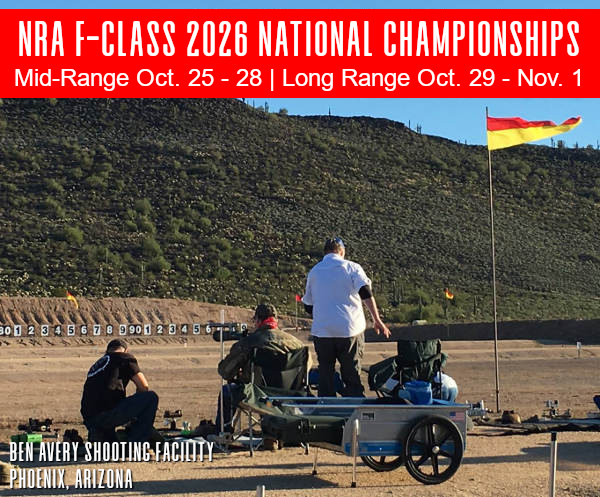
The 2026 United States F-Class National Championships commence Sunday, October 25, 2026 at the Ben Avery Shooting Facility (BASF) in Phoenix. For 2026, the Nationals combine both Mid-Range and Long-Range competitions in one extended mega-match. The Mid-Range U.S. F-Class Nationals take place October 29 – November 1, 2026, with all shooting at 600-yard targets. The Long Range F-Class National Championships then run Thursday, October 20 through Sunday October 23, 2022. All Long Range matches are at 1000 yards. The competitions will have two different divisions: F-Open and F-TR (Target Rifle). Registration is now closed for both Mid-Range and Long-Range Championships.*
NRA F-Class Mid-Range National Championship 25 October – 28 October, 2026
NRA F-Class Long Range National Championship 29 October – 1 November, 2026
The range should be open for practice on Saturday 10/24/2026.
Located on 1,650 acres in north Phoenix, Ben Avery is one of the nation’s largest publicly operated shooting facilities. A City of Phoenix “Point of Pride,” the facility has received a five-star rating from the National Association of Shooting Ranges. A camping area is available for competitors. Contact Ben Avery Shooting Range Camping to reserve a camping spot.
You’ll see some serious hardware on the firing line at Ben Avery. Here’s a modern F-Open rig with a handsome maple stock. The gun, belonging to David Mann of Texas, shoots as good as it looks.
Eligibility: Any competitive shooter. NRA membership is not required to compete in this match. However, non-NRA members cannot set National Records.
* Advance Entries are required: All entries must be paid in advance. Entries Closed 4:00 PM on 10/19/26. Entries after 10/19/26 are considered late entries and may be accepted to fill vacancies on existing relays only. An additional $20.00 will be charged for late entries.
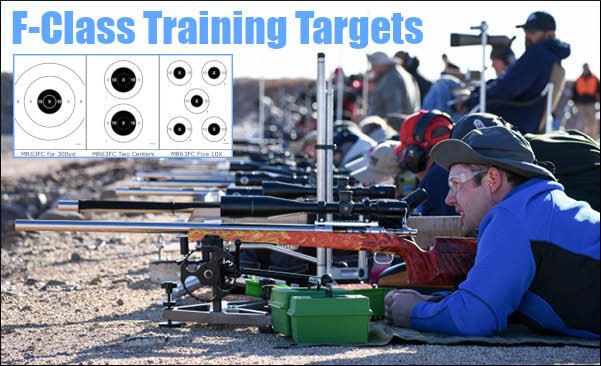
The 2026 F-Class National Championships run October 25 through November 1, 2026 at the Ben Avery Range outside Phoenix, Arizona. SEE F-Class Nationals 2026 INFO Page. With inflation and the high price of gasoline we know some F-Class shooters can’t make it to Nationals this year. For them, and other folks who are getting started in the sport, here are some special targets that let you train at your home range, even if it does not have target bays at 600 and 1000 yards. These special 300-yard Target Centers let you duplicate the exact MOA size of the official longer range F-Class targets, but at closer range.
F-Class Nationals
• F-Class Mid-Range Nationals: October 25–28, 2026 (Ben Avery)
• F-Class Long Range Nationals: October 29 – November 1, 2026 (Ben Avery)
Here is the sleek, carbon-stocked .308 Win rifle Bryan Litz used to win both the 2015 Mid-Range AND Long-Range F-TR Championship at the Ben Avery Range in Phoenix, Arizona.
These reduced-size target centers were created by Forum member SleepyGator, an F-Class competitor who needed practice targets he could use at 300 yards. There is an official reduced-distanced standard for 300-yard F-Class matches. This utilizes the NRA No. MR-63FC – F-Class Target Center which is pasted over the MR-63 target. It provides a 1.42″ X-Ring, 2.85″ 10-Ring, and 5.85″ Nine-Ring. (The dimensions of F-Class targets are found in the NRA F-Class Highpower Rules, Sec. 4, part 4.1-4.7, pages 13-14 — link below.)
To duplicate the 300-yard target, SleepyGator has prepared a printable version of the MR-63FC Target Center, along with a pair of training targets with two bulls and five bulls. The two-bull and five-bull targets mirror the scoring rings on the MR-63FC, but they display only the innermost three rings and two rings respectively. All three targets are Adobe Acrobat (PDF) files that can be easily printed. You may need to adjust the scale (sizing) on your printer to get the dimensions exactly correct. As noted above, when printed, the 10-Ring on all three targets should measure 2.85″. This should provide some handy practice targets you can use between matches. Thanks to SleepyGator for providing these targets. You can download all three as a .Zip archive. After downloading the .Zip file, just click on the .Zip archive to extract the individual targets.
Today we share some smart tips from a past F-Class and Sling Champion who is both a great shooter AND a ballistics wizard. Founder of Applied Ballistics LLC, Bryan Litz is the author of multiple books and creator of advanced Ballistics Software.
Bryan is also a highly skilled competitor. In 2015, Bryan Litz won the F-TR Mid-Range AND Long-Range National Championships hosted at Ben Avery. And at the 2014 Berger SW Nationals (SWN), Bryan took top honors among all sling shooters. If you only know Bryan Litz from his Applied Ballistics Books and DVDs, you may not realize that this guy is a also great marksman along with being an actual rocket scientist!
Given his impressive track record in both F-Class and Palma (Fullbore) out to 1000 yards, we asked Bryan if he had any advice for other long-range competitors.
First Bryan provided three tips concerning Ballistics, his special area of expertise. Next Bryan offered three more general tips about long-range competition — how to analyze your shooting, how to choose your ‘wind strategy’, and how to avoid the most costly mistakes, i.e. how to avoid the “train-wrecks”.
Bryan Litz won the 2015 F-TR Mid-Range and Long-Range Championships with this sleek rig:
Litz Ballistics Tips
Ballistics TIP ONE. If you’re having trouble getting your ballistic software to match actual drops, you need to look at a number of possible reasons. Here are some common issues that can cause problems.
Click Values Are Not Exact. Scopes and iron sights don’t always produce accurate adjustments. In other words, if your ballistics program predicts 30 MOA of drop, and you dial 30 MOA but hit low, it might be that your sight actually only moved 28 MOA (for example). To see if your sight is adjusting accurately, shoot a tall target at 100 yards and measure group separation when dialing your sight.
Barometric vs. Station Pressure. This is a commonly misunderstood input to ballistics programs. You can avoid this pitfall by remembering the following: station pressure is the actual measured pressure at your location, and you don’t need to tell the program your altitude when using station pressure. Barometric pressure is corrected for sea level. If you’re using barometric pressure, you also have to input your altitude.
Muzzle Velocity. Chronographs are not always as accurate as shooters think they are — your true MV may be off by 10-20 fps (or more). If your drop is different than predicted at long range, it might be because your muzzle velocity input is wrong.
Mixing Up BC (G1 vs. G7). Knowledgeable long range shooters know that the G7 standard is a more representative standard for modern LR bullets. However, using G7 BCs isn’t just a matter of clicking the ‘G7′ option in the program. The numeric value of the BC is different for G1 and G7. For example, the G1 BC of the Berger 155.5 grain Fullbore bullet is .464 but the G7 BC is .237. If you were to enter .464 but click on G7, the results would be way off.
Ballistics TIP TWO. A properly installed level is absolutely essential for long range shooting. Without a good level reference, your long range wind zero will be off due to minor canting of the rifle from side to side. You can verify that your level is installed correctly on a 100-yard ‘tall target’. Draw a plumb line straight up the target and verify that your groups track straight up this line as you go up in elevation.
Ballistics TIP THREE. If your long range ballistic predictions aren’t tracking, always come back and verify your 100-yard zero. Sometimes a simple zero shift can be misconstrued as errors in long range ballistics predictions.
Litz Competition Shooting Tips
Competition TIP ONE. Improving your scores in long range competition is a constant process of self-assessment. After each match, carefully analyze how you lost points and make a plan to improve. Beginning shooters will lose a lot of points to fundamental things like sight alignment and trigger control. Veteran shooters will lose far fewer points to a smaller list of mistakes. At every step along the way, always ask yourself why you’re losing points and address the issues. Sometimes the weak links that you need to work on aren’t your favorite thing to do, and success will take work in these areas as well.
Competition TIP TWO. Select your wind shooting strategy carefully. For beginners and veterans, most points are typically lost to wind. Successful shooters put a lot of thought into their approach to wind shooting. Sometimes it’s best to shoot fast and minimize the changes you’ll have to navigate. Other times it’s best to wait out a condition which may take several minutes. Develop a comfortable rest position so you have an easier time waiting when you should be waiting.
Competition TIP THREE. Actively avoid major train wrecks. Sounds obvious but it happens a lot. Select equipment that is reliable, get comfortable with it and have back-ups for important things. Don’t load on the verge of max pressure, don’t go to an important match with a barrel that’s near shot out, physically check tightness of all important screws prior to shooting each string. Observe what train wrecks you and others experience, and put measures in place to avoid them.
Looking down-range with F-TR rifle at Ben Avery Shooting Facility in Phoenix, Arizona.
Bullet Stability and Twist Rates
In this video, Bryan Litz talks about bullet in-flight stability and how to calculate barrel twist-rate requirements for long-range bullets. Bryan explains that bullet stability (for conventional projectiles) is basically provided by the spinning of the bullet. But this spin rate is a function of BOTH the nominal twist rate of the barrel AND the velocity of the projectile. Thus, when shooting the same bullet, a very high-speed cartridge may work with a slower barrel twist rate than is required for a lower-speed (less powerful) cartridge. For match bullets, shot at ranges to 1000 yards and beyond, Bryan recommends a twist rate that offers good stability.
You’ll find more expert information on long-range shooting and ballistics on the Applied Ballistics website and the Bryan Litz Ballistics Facebook page. Bryan’s most recent Facebook post talks about the Coriolis effect — the apparent drift of a rifle trajectory due to the rotation of the earth.
To learn more, we recommend you subscribe to the Applied Ballistics Science of Accuracy — with in-depth articles, brilliant podcasts, exclusive videos and more.
Leveraging the incredible success of the 6.5 Creedmoor cartridge, ammo-makers and rifle manufacturers have teamed up to produce a bigger Creedmoor cartridge — the 7.6 Creedmoor. The latest addition to the Creedmoor line gets its name from its 7.62mm bullet dimension. Yep, that makes it a .30-cal cartridge, but the creators stuck with the metric title for consistency. Makes sense. We like the way “7.6 Creedmoor” sounds and we bet consumers will too. The 6.5 Creedmoor has been a singular success — it is by far the most popular new cartridge introduced in the last decade. We think the 7.6 Creedmoor could become equally successful in short order.
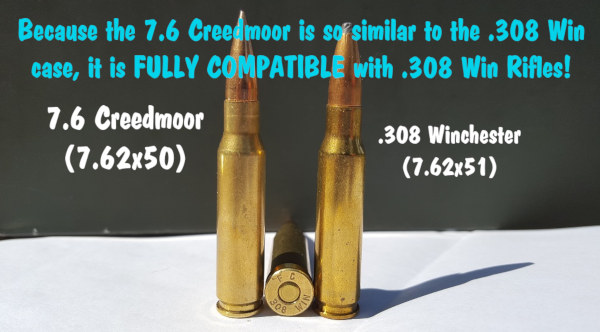
In creating the new 7.6 Creedmoor, the product engineers were primarily concerned with accuracy, reliability, and compatibility. In a brilliant marketing stroke, the 7.6 Creedmoor’s designers crafted this cartridge to be 100% compatible with existing .308 Winchester and 7.62×51 rifles. So you can shoot the 7.6 Creedmoor safely in your existing .308 Win deer rifle or F-TR rig. As one ammo-maker’s marketing manager told us: “The 7.6 Creedmoor gives you everything you liked about the .308 Win, with a trendy name and the undeniable Creedmoor cachet. The 6.5 Creedmoor has become hugely popular. We expect the new 7.6 Creedmoor to do as well, or better!” We agree. Consider this — the 7.6 Creedmoor offers much better barrel life than the 6.5 Creedmoor, along with better bullet selection, particularly for hunters. With these advantages, how could the 7.6 Creedmoor not become a huge hit? The Creedmoor name alone should ensure success.
We discussed the new 7.6 Creedmoor with Dennis DeRille, one of the “founding fathers” of the 6.5 Creedmoor. Dennis said — “The Creedmoor name is synonymous with innovation and tactical success. This new 7.6 should live up to its name as it delivers .308 Win performance in a package for the 21st Century.”
Reassuring .308 Win Ballistics and Die Compatibility
Another great feature of the new 7.6 Creedmoor is that you can use existing .308 Win dies and reloading components. That excited one PRS shooter: “I had all this old .308 brass and .30-Cal bullets sitting around. When I heard about the 7.6 Creedmoor I said ‘Wow this is great, I can use this stuff in a Creedmoor now’. I know it will be accurate based on the name alone. That’s cool — tacticool!”
Because the new 7.6 Creedmoor shares case capacity and design details with the venerable .308 Win, it also shares the .308 Win’s impressive ballistics performance. “Whatever you can do with a .308 Win, you can do with the 7.6 Creedmoor… and then some!” says Hornady. Here is a chart showing projected velocities for the 7.6 Creedmoor with various barrel lengths and bullet weights.
NRA Approves 7.6 Creedmoor for F-TR Competition
Currently, NRA competition rules restrict F-TR rifles to the .308 Win (7.62×51) and .223 Rem (5.56×45) chamberings. But that’s going to change. Starting in June 2026, the NRA will allow 7.6 Creedmoor rifles in all F-TR matches. In addition, the 7.6 Creedmoor can be used in service rifles such as the popular M1A. It’s great to see this old battle rifle updated with Creedmoor accuracy and performance.
USA and Foreign Ammo Makers will Produce 7.6 Creedmoor Ammo
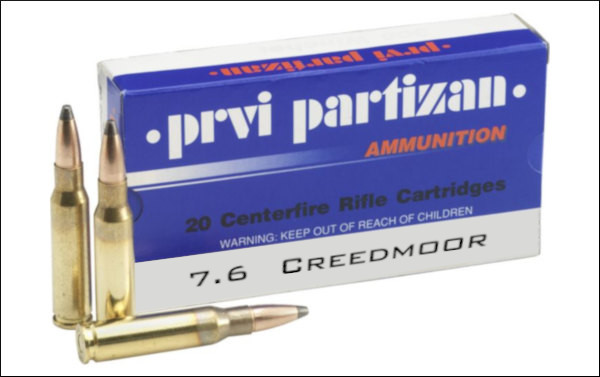
7.6 Creedmoor factory-loaded ammunition will be available from all major USA ammo-makers including Federal, Hornady, CCI, and Remington. As well, foreign ammo-makers Hirtenberger, Sellier & Bellot, and Prvi Partizan have pledged to produce 7.6 Creedmoor ammunition. That’s good news for shooters who want affordable Creedmoor ammo. One ammo-maker told us: “The whole industry is excited about the 7.6 Creedmoor. To be honest, .308 Win ammo sales have been declining for a number of years. Now we can repackage those same great components and market them to a new set of consumers reared on the 6.5 Creedmoor. This is a great deal for ammo-makers, who know how excitable Creedmoor fan-boys can be!”
The folks at F-TR Ireland send greetings from the Emerald Isle: “Wishing all our friends … around the globe all the very best. Beannachtai na Féile Phádraig! (that means “St. Patrick’s Day Blessing”.) Hope you all have a great St. Patrick’s Day … whether be you Irish by birth, heritage, or aspiration!”
Your Editor sends a Happy St. Patrick’s Day greeting to all our AccurateShooter.com Bulletin readers. As an Irish-American whose great-grandfather was born in County Donegal, I’m proud to wear green today. But lest readers think that Ireland is only a land of shamrocks, lucky leprechauns, and Riverdancers, be aware that Ireland has an active community of precision shooters. In 2011, the National Rifle Association of Ireland unveiled the beautiful new 1200-yard range in Tullamore, at the Midlands National Shooting Centre. Also in 2011 Tullamore was was the site of the first modern-era Creedmoor Cup Challenge Match between Irish and American Teams. The Yanks won that year, but that was just the beginning of a great rivalry.
Midlands National Shooting Centre of Ireland In the year 2000, the National Rifle Association of Ireland (NRAI) was formed. One of its primary goals was to promote fullbore target shooting in Ireland. The NRAI needed a home and that home was found on the bog of Derrymore in Blueball just outside Tullamore in County Offaly. In 2000, a 400-yard range was built on the site. Three years later the 600-yard “Windmill” range, the first of its kind in modern Ireland, was also built to allow for mid-range target shooting. The site was christened the Midlands National Shooting Centre of Ireland (MNSCI) and with it the story of Irish F-Class began. No sooner had the 600-yard range been built at the MNSCI, when the NRAI formed a national F-Class league bringing together like-minded shooters from all over Ireland.
Irish Rifle (Crafted by Enda Walsh of Custom and Precision Rifles Ireland)
Irish Shooting Range (National Shooting Center, Tullamore, Ireland)
Benchrest Competition in Ireland
Along with long-range and F-Class shooting, benchrest shooting (both rimfire and centerfire) is also popular on the Emerald Isle. Here are images from a major rimfire match sponsored by the National Rimfire Benchrest Association of Ireland (NRBAI).
This video shows a variety of .22 LR rifles shooting Ireland rimfire matches from the bench. It’s great to see the many different rifle types and front/rear rests.
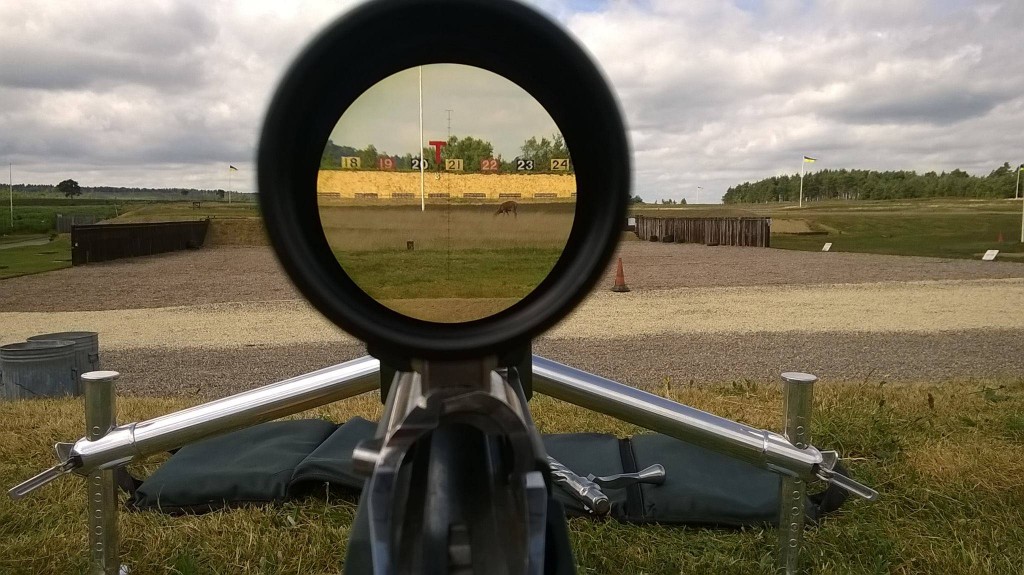
What’s wrong (or right?) with this picture? Does the “F” in F-class refer to “Fauna”? Look carefully at this Bisley Range photo taken by Australian R. Hurley while looking downrange through his March 8-80X scope. The photo was taken in 2015 at the Bisley National Shooting Centre in the UK.
The Story Behind the Photo
British shooter T. Stewart reports: “I was there when this photos was taken. All I can say was that Mr. Hurley was firmly reminded that should said deer accidentally jump in front of his bullet … he would spend five years ‘At Her Majesty’s Pleasure’.”
“That morning we had five deer moving across the targets, literally blocking the V-Bull. Since we were on the 900-yard Firing Point, and elevated for such, obviously the bullet would pass well above them. But they do NOT move or flinch at the noise or passing bullets since they are not hunted on the Bisley Ranges. Earlier this year we saw a herd of 20 or so deer grazing slowly across the Range.”
More Fauna Findings…
Apparently Bisley is not the only place were “the deer and the antelope play”. In Canada, on the Connaught Ranges near Ottawa, Ontario, shooters often encounter a variety of wildlife. William McDonald from Ontario says: “Animals are a common sight on the Range. Along with deer we see geese, turkeys, and coyotes on a daily basis.”
Likewise, E. Goodacre from Queensland, Australia often sees ‘Roos on his home range: “I shoot at Ripley, Australia, and shooting is regularly interrupted by kangaroos. Our last silhouette match was delayed by an hour while 30 ‘Roos dawdled across — silly buggers!”
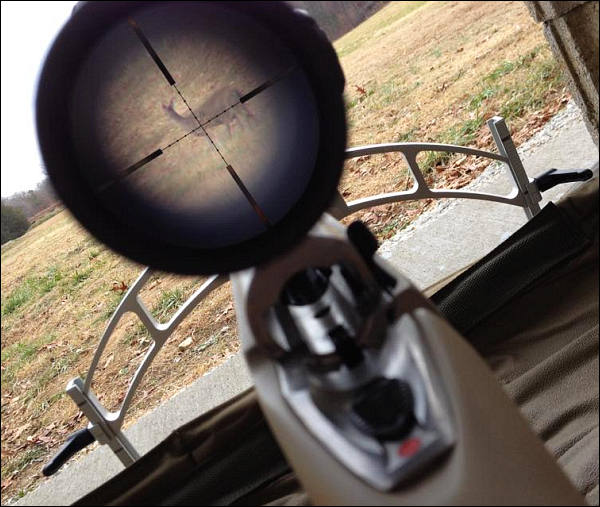
R. Hurley wasn’t the first fellow to view deer through his F-Class rifle’s scope. After seeing Hurley’s photo from Bisley, B. Weeks posted this image, saying: “Been there, done that!”
Just last week hundreds of F-Class shooters competed at the 2026 Southwest Nationals in Phoenix, Arizona. The vast majority of F-TR shooters had rifles chambered for the .308 Winchester cartridge (7.62×51), but F-TR rules also allow the .223 Rem (5.56×45). There are some advantages to the smaller .223 Rem round — there’s notably less recoil, bullets and brass are significantly cheaper, and a lot less powder is required. For those who are considering campaigning a .223 Rem F-TR rifle, this story explains how an accurate .223 Rem load was developed. This load development was done by a father for his daughter who was getting started in F-Class competition.
Dad builds an F-TR Rifle for his Daughter and Develops Load
Jeremy Rowland decided to put together an F-TR rifle for his eldest daughter, who enjoys competitive shooting. For his daughter, Rowland chose the .223 Rem option because it has less recoil and components are less costly than the .308 Win. Here is Rowland’s account of how he developed a .223 Rem load. For more details (with data charts), read Jeremy’s FULL STORY on Sierra Bullets Blog.
Journey to Find a .223 Rem F-Class Load
by Jeremy Rowland, Reloading Podcast
My oldest daughter has been to several matches with me, and has even competed in several, using her .243. [A few seasons back] I decided, she would compete with a .223 Rem in F-TR. Looking for a good starter rifle, I settled on the Savage Axis Heavy Barrel since it has a 1:9″ twist. This would be a great little rifle for her to learn on. The rifle was shot unmodified, as it came from the factory. A Sinclair F-Class Bipod w/micro elevation adjustment was fitted to the front.
Next came finding the components I wanted to use for her match loads. After spending hours and hours running numbers on JBM stability calculator as well as in my iPhone Ballistic AE app, the 69 gr Sierra Tipped MatchKing® (TMK) looked really good. So that’s what I decided to go with. I jumped in head first and ordered a bulk pack of the Sierra 69 gr TMKs. I had settled on Hodgdon CFE 223 powder since it shows good velocity. I decided to go with once-fired Lake City brass with CCI BR4 primers.
Next came the testing. I decided to run a ladder test (one shot per charge from min to max looking for the accuracy node). The ladder test ranged from 23.5 grains to 25.6 grains, in 0.3 grain increments.
Bullet: 69 gr Sierra Tipped MatchKing®
Case: Lake City (mixed years, sorted by case capacity)
Primer:CCI BR4
Powder: Hodgdon CFE 223 (one round each from 23.5 to 25.6 grains)
Cartridge OAL: 2.378″
Base to Ogive: 1.933″ (.020″ off lands)
After his ladder test, Rowland settled on a load of 25.2 grains of Hodgdon CFE 223. He then fine-tuned his load with different seating depths: “I loaded up 5 rounds each at .020″ off lands, .015″ off lands, .010″ off lands, and .005″ off the lands. Here are the results from the best group for OAL/Ogive fine tuning. As you can see, I think I’ve found a winner in these 69 gr Sierra Tipped MatchKings.”
The 2026 Southwest Nationals (SWN) have concluded. Held at the impressive Ben Avery range in Arizona, the 2026 SWN was a very successful event with good conditions (for the most part) and impressive scores by shooters in all three divisions: Sling, F-Open, and F-TR. We congratulate the new SWN Grand Agg Champions: Bobby Gill (Sling), Ryan Mitchell (F-Open), and Brad Sauve (F-TR). This was familiar territory for Sauve who has won the SWN F-TR title before.
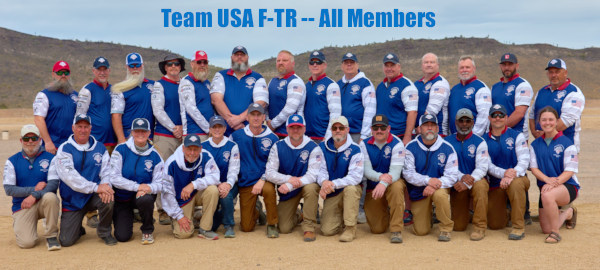
The SWN has both individual and team competition in all three classes. The winning team in the Sling Division was Team USAMU 2564-124X (Capt.: Jarrod McGaffic / Coach: Verne Conant). The top F-Open team was LOS CHINGONES 2590-153X (Capt.: Dennis Ray / Coach: Brian Bowling). The F-TR team competition was dominated by Team USA F-TR VORTEX 2575-123X (Capt.: Ian Klemm / Coach: Keith Trapp).
The 2026 SWN had very high participation in all classes. Observers said that 2026 may have rivaled the highest total turn-out in many years. Weather-wise, we’re told that conditions were “very manageable” for most of the week until the final day of individual competition. Wind angles and velocities became quite hard to diagnose on that last day. As a result many top shooters dropped multiple points in the last individual relay and this created major shake-ups in the leaderboard, with some very skilled shooters dropping out of the Top 20 after an otherwise impressive week.
A special congrats to our friend Gary Eliseo who actually ended up with the highest Sling Division overall score, 1240-64X. But because he used a scope throughout the match he could not win the Sling Grand Aggregate.* Gary Eliseo reported: “I had a great time at SWN 2026. It was a privilege to catch up with so many friends from around the country, managed to shoot a PB too! My UMRS/6.5 El-Mo did everything it could to make me look good.”
SLING TEAM Top 3
Team 44 USAMU HM 2564-124X
Team 49 USNMT VFB MRNAK HM 2564-115X
Team 46 USNRT GILL HM 2562-122X
F-OPEN Grand Aggregate Top 10
1. Ryan Mitchell, 1245-83X, Match Winner
2. Joe Traylor, 1245-74X
3. Tim Vaught, 1245-69X
4. Jason Simes, 1243-73X
5. Gwen Basalla, 1243-66X
6. Brad Johnson, 1242-78X
7. Pat Scully, 1242-74X
8. Erik Cortina, 1242-71X
9. Emil Kovan, 1242-64X
10. Brian Bowling 1241-78X
F-TR TEAM Top 3
Team 23 USA F-TR VORTEX HM 2575-123X
Team 21 USA F-TR BERGER HM 2568-118X
Team 13 CREEDMOOR SPORTS GOLD MA 2556-111X
Report from F-Open Competitor John Masek (F-Class John)
This year’s Southwest Nationals appeared to have the highest attendance I’ve ever seen. The Mid-Range match on Wednesday isn’t usually all that full but this year every firing position was used which is something I’ve never seen before in Mid-Range. Long range was also sold out which I believe is around 365 shooters with the majority being in the F-Open category. I don’t know the exact count, but there were nearly three full pages of F-Open shooters listed — that means there could’ve been close to 200 F-Open shooters. Overall there was beautiful weather with mostly gorgeous conditions during the week, and it was great seeing everyone from across the country and even the world.
Conditions were manageable for a lot of the shooters throughout the week with some of the highest scores I’ve ever seen — 16 F-Open shooters all shot a perfect 450 points on the Palma day Friday. Saturday got just a little trickier, but still many of the top shooters were managing to only have dropped a couple points over the two days. Sunday started with mild conditions again, but the final relay on Sunday afternoon completely shook the leaderboard up. While there were certainly top shooters who were able to hold their positions… but just as many dropped quite a few places down. It was one of the trickiest conditions I’ve ever seen that didn’t involve giant winds.
* Scopes help older sling rifle shooters whose eyes are starting to wear out. But, Gary Eliseo explains: “In this event, the match director dictates that a Palma rifle be used on the first day, and if you want to shoot an ‘any rifle’ on Day Two it also must have iron sights with the third day being ‘any sights’ so ‘F-sling’ is a category where ‘any sights’ are allowed to be used on all three days but that makes us ineligible to win the Grand Aggregate.”
Today marks the third day of competition at the 2026 Berger Southwest Nationals (SWN). And yes, it’s Friday the 13th — causing some concerns among competitors. The superstitious types among the competitors viewed the day with some trepidation. But most shooters didn’t worry too much about the date — they were more concerned about calling the wind correctly. As Bryan Litz said at the SWN a decade ago: “I don’t believe in superstition. We make our own luck”.
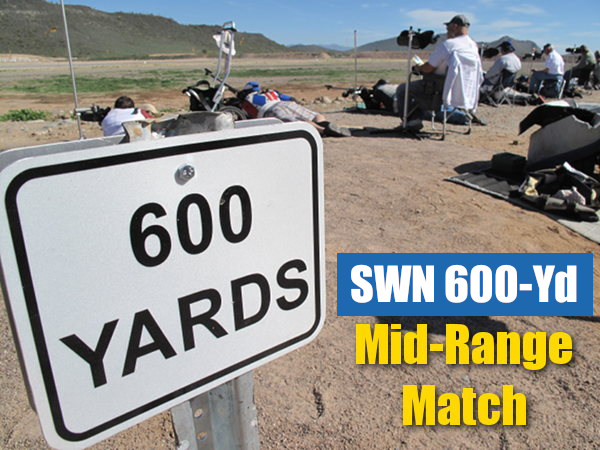
On Wednesday, February 11th, the 600-yard competition was held for all three competition classes: Sling (Palma), F-Open, and F-TR. 600-Yard match results for all three classes are shown below for the Top 10 in each class. For F-Open, F-TR, and Sling Divisions there were three relays, each with 20 rounds for score. Thus, the maximum possible score was 600-60X. There were some very impressive performances with the top 9 F-Open Shooters, top 5 F-TR Shooters, and Sling Winner Fazal Mohideen not dropping a single point. Congrats to the winners — Fazal Mohideen, Sling P 600-34X; Cal Waldner, F-Open 600-49X; and Brad Sauve, F-TR 600-44X. CLICK HERE for full 600-yard results for all competitors.
600-Yard SWN Top 10 Results
Here are the Top TEN 600-Yard Competitors for each Division:
Sling (Two Divisions, “P” and “A”) 600-yard Top 10
The Southwest Nationals is one of the few American events where sling shooters compete on the same firing line as F-Class competitors (though in separate groups). At the SWN this sling division has two sub-classes: “A” for “Any Rifle, Any Sight” and “P” for Palma rifles.
F-Open 600-yard Top 10
1. Cal Waldner 600-49X (Match Winner, MA)
2. Antun Kovacevic — 600-48X (MA)
3. Joe Traylor — 600-44X (HM)
4. Jason Simes — 600-42X (HM)
5. Dan DiLeva — 600-40X (HM)
6. Brian Bowling — 600-39X (HM)
7. Ryan Pierce — 600-37X (HM)
8. Eric Houser — 600-36X (HM)
9. Martin Tardif — 600-31X (HiGS)
10HM. Peter Johns — 599-47X (HM)
10MA. Noah Burleson — 599-47X (MA)
Modern F-Open Rifle with SEB Mini front rest with Blake Machine accessories.
F-TR 600-yard Top 10
1. Brad Sauve — 600-44X (Match Winner, HM)
2. Keith Trapp — 600-43X (HM)
3. Alan Barnhart — 600-39X (HiGS)
4. Alton Johnson — 600-35X (HiSr)
5. Anthony Jordan — 600-34X (HM)
6. Tracy Hogg — 599-42X (HM)
7. Adam Husted — 599-38X (MA)
8. Ryan Crozier — 599-36X (MA)
9. Benoit Vautour — 598-42X (MA)
10. Jeremy Newell — 598-39X (HM)
F-TR Rifle looking downrange at the targets.
Palma Format Multi-Distance Matches on Friday the 13th
Today, Friday is the Palma format match. This is not limited to “hard-hold” sling Palma rifles, but the match utilizes a multi-distance target sequence similar to Palma rifle matches. All three rifle classes will be shooting: Sling, F-Open, and F-TR. There will be three target distances with 15 shots for record at 800, 900, and 1000 yards.
In the video below, you’ll see highlights from last year’s SW Nationals from the break of dawn throughout the day. This also features new products on display. This video was created by our friend F-Class John, who is competing right now at the 2026 SWN event.
Yes, as we start 2026, there’s snow on the ground in many parts of the nation. There have been some big snow-storms in the northeast, with very cold weather in many parts of the country.
Rifle Transformed from Ordinary Varmint Rig to a Stunning F-TR Machine
As an antidote to these weather-related worries, for this Sunday GunDay we’re offering a bit of beauty amidst snow — a handsome rifle showcased in a white winter wonderland. This handsome rifle started life as a rather ordinary .204 Ruger Rem VSSF varmint rig. With a new barrel, a new stock, and a stunning flame-pattern hydro-dip coating, this is now an ultra-accurate .223 Rem F-TR competition rifle.
Flames in the Snow…
Forum Member Brandon Schlund (aka “Bois Blanc Boy”), photographed this handsome flame-themed F-TR rifle against the snowy background of Michigan’s Bois Blanc Island. Brandon posted this to our long-running Pride and Joy Rifle Forum thread. He notes: “This is my first F-TR build, which started out as a stock Remington .204 Ruger. I had the action blue-printed, firing pin was bushed by Speedy, and I had a new bolt handle and knob installed by John Pierce.” This rifle is now fitted with a 3-groove Pac-Nor 1:6.5″-twist barrel chambered in .223 Remington to shoot the 90gr Bergers. Other components are: Kelbly KTS stock, Phoenix bipod, and Sightron 8-32x56mm SIII scope. Brandon says: “It took a long time to get this gun where it is now but I’m truly happy with it!” Here’s the “before” photo:
The Transformation — F-TR Comp Rig Made from Rem .204 Ruger Varminter Report by Brandon Schlund
This rifle started out as a “plain Jane”, factory Remington VSSF II. I shot it on varmint hunts in factory configuration. Then I decided to transform the rifle into a .223 Rem F-TR gun. As the .204 has the same bolt face as a .223 made sense to go in that direction since I would be able to use the gun for varmint hunting as well as F-TR.
While I had shot some F-Class matches with my dad (Joe Schlund aka Bench on AccurateShooter) it wasnt much. When we did a PD hunt in Wyoming I primarily shot my .204 but I decided I wanted a cartridge that could reach out a little further and also do double duty — competition and varminting.
The first step in transforming this rifle was selecting a barrel. We ordered a Pac-Nor, 1:6.5″-twist, 3 groove, 30.5″ heavy Palma contour. This was then chambered with a PTG .223 ISSF reamer with 0.169″ freebore to run the .224 caliber heavies. I went with Pac-Nor because both my father and my brother Mark (aka Labrador2 on AccurateShooter) owned Kelbly-built F-TR rifles with the same barrels. Mark and my father couldn’t be happier with the results. Pac-Nor has great customer service along with a short wait time.
I sent the barrel and the factory Remington 700 action down to Kelbly’s where they did the chambering and cut the threads. While Kelbly’s had my action I had them blueprint it. A Kelbly KTS stock with the three-way buttplate and adjustable cheek piece came next. After getting behind Dad’s rifle and Mark’s gun there was no reason to look any further. With all its adjustments, the KTS stock fits very comfortably.
Loading for the .223 Rem with H4895 and 90gr Bergers
As a .223 Rem, this rifle has proven very accurate — it’s a bullet-hole cutter at 100 yards (low twos easy). Our best load is with Hodgdon H4895, 90gr Berger VLDs, CCI BR4 primers. This load is running at about 2835 FPS but YMMV (remember this is a LONG 30.5″ barrel). The Bergers are loaded .008″ into the lands with base-to-ogive of 2.035″.
Our loading technique may be tedious — with lots of sorting and measuring. But brother Mark, father Joe, and I all enjoy the steps. Our three .223 Rem match guns all love the same load which makes loading much easier. Believe it or not we use a Hornady Lock-N-Load progressive ammo plant, which is great when loading for three guns. Our consistency is fantastic with run-out a mere .001-.0015.
We also turn necks and weigh our primers. Does neck-turning and primer weighing really make a difference? Who knows but we try to eliminate more variables since we have to the time to do it, and we actually enjoy the procedures.
Pierce Engineering Installed Action and Modified Bolt
Being from Michigan, Pierce Engineering has done a lot of work for my family’s guns. For this project the Pierce team bedded the action and glued in a single-shot follower. The stock bolt handle/knob was too short for comfort in the KTS stock. Pierce added a longer handle and tactical knob to the bolt. I then installed a .223 Rem Lapua case base into the knob.
The complete .223 Rem rifle ready to shoot F-TR, as fitted with 8-32X56mm Sightron and Phoenix Bipod, weighs 17 pounds, 15 ounces.
Flame Graphics by Camo Creek Hydrographics
After the action was bedded by Pierce, the stock was sent to Camo Creek Hydrographics in Fenton, Michigan. I selected a flame-style design which Camo Creek applied through hydro-dipping. The stock went back to Pierce’s shop, which applied three coats of clear over the entire stock. The clear-coating really enhanced the flame graphics.
Firing Pin Bushed by Speedy
I sent the bolt to Thomas “Speedy” Gonzalez to have the firing pin hole bushed as otherwise the load could crater the primers pretty bad. Knowing I’d be shooting heavy-weight .22-Cal bullets with a stout load this was a good idea. Speedy also cut his trademark grooves into the bolt shroud which looks amazing. His work is top notch! There is zero cratering now, even with the hottest of loads.
Competition Components — 8-32x56mm Sightron and Phoenix Bipod
For an F-TR rig you need a quality high-magnification optic and a premium, wide-base bipod. I installed a 8-32x56mm SIII Sightron. This was another easy choice because of the attractive price and because my family has four other Sightrons that work great.
I installed a fore-end Picatinny rail to attach a Phoenix Bipod. I extended the Mariners wheel handles by adding short sections from an aluminum arrow shaft. This lets me adjust elevation without stretching forward. I also installed a Calvin Elite Timney Trigger set at 6 ounces.
$2500.00 Invested in Rifle Transformation and Upgrade
How much did this all cost? Brandon tells us “I have roughly $2500 into the rebuild of the gun from a .204 Ruger to the .223 Rem.”
Bois Blanc Island in Michigan
Here on Bois Blanc Island we don’t have many amenities, but we do have the ability to shoot 550 yards at our local gravel pit on state land. It’s snow-bound right now as you can see. But later in the year this will be our close-to-home training center.
Winter at Bois Blanc Island, Michigan — Here’s the gravel pit where we can load test during warmer weather. When I took this photo, it was a “balmy” 10-degree day.










 In the year 2000, the




 The 2026 Southwest Nationals (SWN) have concluded. Held at the impressive Ben Avery range in Arizona, the 2026 SWN was a very successful event with good conditions (for the most part) and impressive scores by shooters in all three divisions: Sling, F-Open, and F-TR. We congratulate the new SWN Grand Agg Champions: Bobby Gill (Sling), Ryan Mitchell (F-Open), and Brad Sauve (F-TR). This was familiar territory for Sauve who has won the SWN F-TR title before.








 Flame Graphics by Camo Creek Hydrographics


