At the request of our readers, we provide select “Deals of the Week”. Every Sunday afternoon or Monday morning we offer our Best Bargain selections. Here are some of the best deals on firearms, hardware, reloading components, optics, and shooting accessories. Be aware that sale prices are subject to change, and once clearance inventory is sold, it’s gone for good. You snooze you lose.
NOTE: All listed products are for sale to persons 18 years of age or older. No products are intended for use by minors.
Brownells — Early Black Friday Sale plus FREE Shipping $49+
⏺️ » Major savings on gun components, optics, ammo, reloading gear
Definitely check out the big Early Black Friday Sale at Brownells. You’ll find great deals on optics, gun components, barrels, triggers, reloading presses, ammo and more. NOTE: Along with the hundreds of Early Black Friday Deals, Brownells is also running a FREE SHIPPING deal now. Use Code FREESHIP49 for free shipping on all orders over $49.00.
Sportsman’s Warehouse — Early Black Friday Deal Drop, Part 3
⏺️ » Pre-Black Friday deals on rifles, pistols optics, ammo and
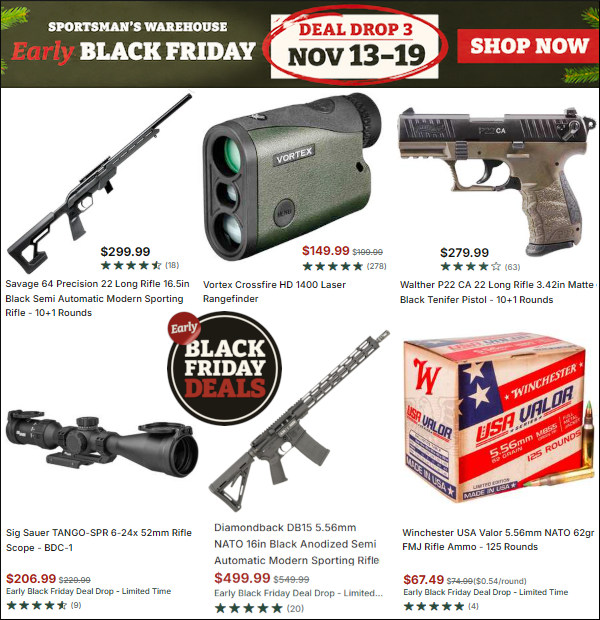
You can save big bucks right now at Sportsman’s Warehouse with the Early Black Friday Deal Drop 3 SALE. Popular products are discounted up to 30%. You’ll find major savings on rifles, shotguns, Vortex optics, and quality factory rifle, pistol, and shotgun ammo. If you need a hunting rifle scope or a laser rangefinder, you can save hundreds this week. And there are great savings on factory ammunition.
As an Amazon affiliate, this site can earn revenues through sales commissions.
The type of targets you use can make a difference during load development and training — helping you align your crosshairs, estimate group size visually, and also record load data/gun type. Here we provide selection of FREE printable precision and training targets. This selection includes popular load development targets AccurateShooter created as well as other useful grid targets. You can download ALL these targets as PDF files and then print them out on 8.5×11″ heavy paper.
AccurateShooter.com offers a cool page with over 50 FREE downloadable targets. You’ll find all types or FREE targets — sight-in targets, varmint targets, rimfire targets, bullseye targets, tactical targets, load development targets and more. CLICK HERE for all our free targets, including our LOAD DEV target.
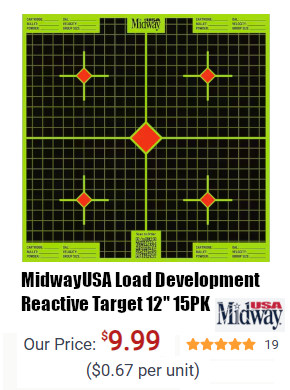
We created the above target a decade ago. Since then it has been used by tens of thousands of shooters. It has proven very popular as a load development target, since all your load data fits neatly in the boxes under each target. In fact this target is being employed by both rifle-makers and barrel-makers (including Criterion) to test their products. The target was designed for aiming efficiency. The diamonds have 1/2″ sides and you can align your cross-hairs on the horizontal and vertical lines. It is a clean design that is easy to see even at 200 yards with a 20X scope. When we test, we usually crank in a little elevation, setting the point-of-impact higher, so that our shots fall in the gray circles. That way you leave the squares intact for precise aiming.
Versatile Targets with Multiple Aiming Points
We use the two targets below for load development and precision practice. For the left target, use the corners of the diamonds to align your cross-hairs precisely. The circle dot target (on the right) can also be used for informal rimfire competition at 50 yards. Right-Click Each Target to Download Printable PDFs.
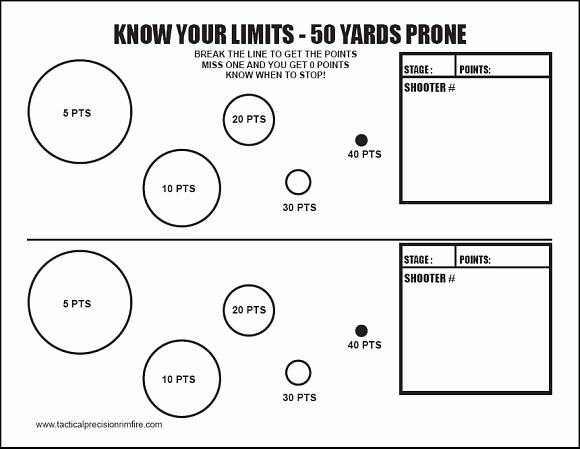
Know-Your-Limits Target for Rimfire Training & Fun Matches
Here’s a rimfire training target with “big to small” target circles. Start with the largest circles, then move to the smaller ones in sequence. This systematic drill provides increasing challenge shot-by-shot. Novices often are quite surprised to see their accuracy improve as they move from bigger to smaller aiming points. That provides positive feedback — always a good thing.
Right Click and “Save as” to download printable PDF versions of target.
Five Diamond Grid Targets
Here’s a popular grid target with multiple red diamond aiming points. The background includes a grid pattern with 1″ squares — that helps to quickly estimate group size through your scope. We recommend using a color printer for this target so the diamonds and grid lines are bright red.
On this 11th day of the 11th month, MidwayUSA is running a major Veterans Day Sale. Hundreds of high-quality products are on sale, with discounts up to 70%. Here are ten notable deals — good products at great prices. Mind you, this is just a small sample of the many Veterans Day discounts. Visit the MidwayUSA Sale Page to see dozens of other great deals. As an added incentive, MidwayUSA is offering FREE Shipping with purchases over $100.00.
At the request of our readers, we provide select “Deals of the Week”. Every Sunday afternoon or Monday morning we offer our Best Bargain selections. Here are some of the best deals on firearms, hardware, reloading components, optics, and shooting accessories. Be aware that sale prices are subject to change, and once clearance inventory is sold, it’s gone for good. You snooze you lose.
NOTE: All listed products are for sale to persons 18 years of age or older. No products are intended for use by minors.
Brownells — Veteran’s Day Huge Sale 17.76% OFF
⏺️ » 17.76% discount on gun components, optics, ammo, reloading gear
Definitely check out the big Veteran’s Day Sale at Brownells. You’ll find great deals on optics, gun components, barrels, reloading presses, ammo and more. NOTE: Apply Code HONOR1776 for 17.76% savings for eligible regular-priced items. And if you need a chrono, the Athlon RangeCraft Electronic Chronograph is just $328.96 with Code HONOR1776. The deals featured above are good through 11:59 pm on November 12.
KYGUNCO — Major Fall Discount Programs
⏺️ » Good deals on rifles, pistols, optics, and ammunition
KYGUNCO is already running a November Sale in advance of Black Friday. And along with the Black November Sale, there are other many other ongoing sales at KYGUNCO. We noted major deals on ammunition, and there are some big discounts on handguns and hunting rifles. If you’re looking for a nice camo-finish hunting rifle, the Savage Axis 2 Pro is a very good deal at $491.60, a 15% savings.
As an Amazon affiliate, this site can earn revenues through sales commissions.
When shooting any match that requires moving back and forth between multiple target distances it is very handy to have your ballistics data, i.e. your “come-ups”, placed within easy view. That way you can instantly see your elevation for various target distances in seconds. This can really help a PRS/NRL competitor on timed stages. And having a convenient “Dope” display of elevation at various distances can also benefit varminters who are shooting critters. In our varmint hunters we targeted p-dogs from about 80 yards out to 500+.
PRC DOPE Roller QD Ballistic Data Turret
The PRC DOPE Roller QD Ballistic Data Turret provides a handy, low profile display of windage and elevation data. You can see your “dope” without breaking position from behind the rifle. Then simply rotate the knob to display data from various distances. The ballistic data is placed by wrapping a simple 1″ x 3″ adhesive address label around the outside surface of the DOPE Roller. This handy quick-detach roller retails for $64.95 from Precision Rifle Components.
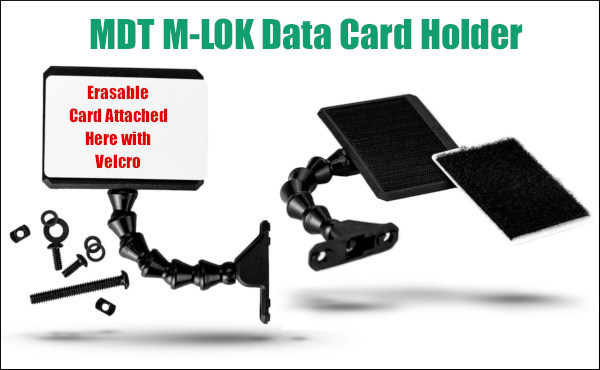
MDT M-LOK Data Card Holder
The MDT M-LOK Data Card Holder has an adjustable neck allowing you to easily position your ballistics data for optimal viewing. Data entries are written on on a reusable card that attaches with Velcro. The Data Card Holder Kit comes with hardware to mount to any M-Lok rail. In addition the card holder fits directly to an MDT ACC chassis attachment point. This MDT kit includes: M-LOK Data Card Holder, Wet Erase Data Card, Wet Erase Marker, and installation hardware. NOTE: The Card Holder sticks out about 6.7″ when fully extended, but arm links can be removed to make the arm shorter. The unit folds flat for storage. This complete kit is $59.95 at Creedmoor Sports.
Warne Universal Data Card Holder
The Warne Universal Data Card Holder easily attaches to the scope tube, in left or right configurations, for a universal fit. Data is displayed in a convenient location to make quick and accurate target transitions, and the articulating arm allows for low profile storage while not in use. The Warne Universal Data Card Holder retails for $88.49 at Warnescopemounts.com. Three ring sizes are offered: 30mm, 34mm, 35mm. A 50-pack of Warne Data Card label refills is currently $16.99 from Warne.
Scope-Cover Mounted Ballistics Table
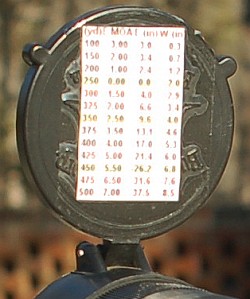
Another option is to place your ballistics card on the back of the front flip-up scope cover. This set-up is used by Forum member Greg C. (aka “Rem40X”).
With your ‘come-up’ table on the flip-up cover you can check your windage and elevation drops easily without having to move out of shooting position.
Greg tells us: “Placing my trajectory table on the front scope cover has worked well for me for a couple of years and thought I’d share. It’s in plain view and not under my armpit. And the table is far enough away that my aging eyes can read it easily. To apply, just use clear tape on the front objective cover.”
Cheap But Effective — Tape on the Stock with Ballistics Data
At the 2021 Nightforce ELR Steel Challenge, Applied Ballistics guru Bryan Litz wrote his come-ups on blue masking tape applied to his stock. He did this based on a tip from Chase Stroud. With the tape applied behind the action, the numbers are easily visible. This “cheap trick” does work apparently — Bryan won the match with a convincing victory over 220 other shooters. READ Match Report.
Cheap But NOT So Effective — Numbers on Hand
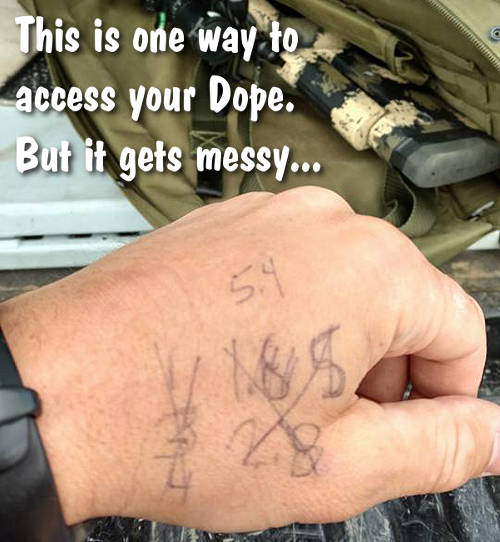
Many of us have scribbled some come-ups on the back of a hand or on our forearm using a marking pen. That can work if you only have a couple distances to deal with — say 100 and 300 yards. But if you want a more complete Come-up table, get one of the card-holders shown above. Writing numbers on the skin is generally not such a good idea….
A good riflescope is essential for many types of competition, and the vast majority of hunters have scoped rifles. Some F-Class and benchrest competitors are now using optics with up to 60X magnification. Over the past 30 years, scopes have continued to evolve with improved glass, more reticle types, vastly increased elevation travel, bigger main tubes, FFP and SFP options, and even built-in electronics.
When shopping for a riflescope, it’s useful to understand how scopes work — how the internal mechanisms control windage and elevation, how parallax controls work, and how magnification levels are controlled. For today’s Saturday Showcase we feature seven videos that explain, in detail, how modern optics are constructed, and how scope components (body, lenses, controls, eyepiece etc.) function.
Scope Body Tube Engineering
The scope’s body tube is responsible for holding all riflescope components in place, and needs to be manufactured to very tight tolerances to ensure that everything lines up correctly. It is important that the body tube is crafted very uniformly and is weatherproof. Most scope tubes are aluminum for weight savings. The most common material is 6061-T6 aluminum. This offers a good balance of lightweight strength, corrosion resistance, and machinability. Schmidt & Bender and some other premium brands use 7075-T6 aluminum. This higher-grade alloy provides higher tensile and yield strength, making it more rugged under heavy recoil or harsh tactical use.
The Functions of the Many Lenses Inside a Riflescope
Riflescopes require multiple lenses, each performing a specific task. Most standard riflescopes contain at least six lens groups/elements, though complex or high-magnification tactical scopes can boast 10 to 18 individual lens elements. From front objective to rear eyepiece, a typical scope lens set includes:
• Objective Lens (Front): Gathers light (and image from the target) and forms the initial (upside-down and reversed) focal image.
• Focus / Parallax Lens: Adjusts position (often via a side-focus or adjustable objective turret) to bring the image and reticle onto the same focal plane.
• Erector Tube Lenses: Located inside the central erector assembly, these lenses flip the inverted image back to right-side up and handle zoom/magnification adjustments.
• Ocular Lens (Rear Eyepiece): Final lens closest to your eye that magnifies and focuses the finished image.
Scope Turrets — Features and Function
Turrets have come a long way over the years, but at their core, they are all responsible for the same thing — moving your erector tube to shift your point of aim via the reticle crosshairs. Elevation turrets can be set up to rotate a single time or multiple times, depending on the total elevation offered by the scope. Most scopes have perceptible clicks, which are typically set at 1/4 MOA, 1/8 MOA, or 1/10 milliradian (MIL). Recently some benchrest or extreme long-range (ELR) competition scopes have 0.05 MIL clicks.
Reticle Design, Properties, and Illumination
When choosing a scope, along with magnification, one of the most important things to consider is the reticle design — how the lines and circles appear, and whether it is a First Focal Plane (FFP) or Second Focal Plane (SFP) configuration. With a SFP scope, the lines/divisions in the reticle appear constant (unchanged) at ALL magnifications. With a FFP scope, the reticle lines/marks change in size as the scope magnification is increased or descreased. So when you zoom a FFP scope to higher magnification, the reticle will appear thicker, and importantly, the marked divisions will remain constant relative to the target.
FFP Design: A FFP reticle is placed in front of (before) the magnification erector assembly. As you increase or decrease the magnification, the reticle scales (grows or shrinks) right along with the target image. The subtensions (hash marks) remain accurate (in angular measurement) at all magnification level.
SFP Design: The SFP reticle is placed behind (after) the magnification erector assembly, near the eyepiece. As you zoom in or out, the target image changes size, but the reticle stays the same size. The hask mark subtensions (angular divisions) are only precise at one specific, manufacturer-calibrated magnification setting. This SFP design is commonly favored for benchrest and F-Class shooting at fixed distances.
Milrad vs. MOA — Key Differences
This video explains the functional differences between Milrad and MOA optics. One Milrad (milliradian or “MIL”) is about 3.3 inches height at 100 yards, so 0.1 MIL is roughly a third of an inch. One MOA is abou 1.047 inches at 100 yards, so one-quarter MOA is very close to a quarter inch at 100 yards. For benchrest, F-Class, and target shooting, MOA-based scope are most commonly used. For tactical and PRS/NRL applications, Milrad scopes are favored. Both reticle types are now popular for hunting applications. In precision shooting, the terms MIL, Milrad, MRAD, and milliradian are generally used interchangeably.
Understanding Parallax and How to Minimize Parallax Errors
The video first defines what is riflescope parallax. Then the video shows how to correct parallax and minimize it in the field. The video also explains why and how parallax errors can cause missed shots on target. After watching this video you should have a much better understanding of parallax, and how to minimize parallax issues.
How to Utilize the Diopter and Optimize the Setting
This video explains the function of a scope’s diopter control, explaining how the diopter works. The video then explains what you should be seeing through the scope and how to optimize the diopter setting quickly and efficiently. Starting at 1:40 time the video explains a 5-step process for setting the diopter properly.
0:00 – Your Reticle Is Blurry (Here’s Why)
0:15 – What the Diopter Actually Does
0:25 – Reticle vs Target Focus (Critical Difference)
0:40 – Why Most Shooters Get This Wrong
0:55 – What a Bad Diopter Setting Looks Like
1:12 – Quick Process for setting the diopter
1:40 – Step 1: Max Magnification
1:48 – Step 2: Use a Blank Background
2:05 – Step 3: The 1-Second Glance Trick
2:30 – Step 4: Adjust for Instant Sharpness
2:58 – Step 5: Repeat and Lock it in
3:09 – Diopter locking ring
3:30 – Tweaking for 1x performance
3:50 – Diopter marking trick
4:20 – Final Result is Faster + Clearer
Bonus READ: Nightforce Turret Tracking Tips
What Is Turret Tracking?
The term “turret tracking” refers to the precision with which a riflescope translates turret adjustments into actual point-of-impact changes. Even the smallest inconsistency in tracking can lead to missed shots, wasted ammunition, or lost opportunities in the field. Without accurate turret tracking, even a perfectly calculated firing solution won’t translate to hits on target.
Turret tracking is the relationship between what you dial on your scope’s elevation or windage turrets and how the bullet point of impact shifts downrange. This precise mechanical function is what allows shooters to make repeatable adjustments based on ballistic data. For example, if you dial 1 MRAD or 4 MOA, the bullet should land at the exact calculated offset. Any deviation means your turret isn’t tracking perfectly.
With hunting season well underway, we know that many readers will be out in the field — with a set of binoculars. On most game hunts, you’ll spend a lot more time glassing with binocs than looking through your riflescope. With wide field of view and extended low-light capability, a good set of binoculars will be your most important game-finder. And with premium LRF binoculars, such as the ZEISS Victory series, one tool serves both for spotting and laser ranging.
“Without the stabilization of your binoculars [provided by] a tripod … you will be missing a majority of the game you are glassing for.” — Outdoorsmans.com
In this article, Vortex Optics’ Mark Boardman, an experienced hunter, explains the benefits of using a tripod with high-magnification binoculars. Everybody knows that powerful spotting scopes work best when mounted to a stable tripod or otherwise secured to a steady mount. Yet when most folks use binoculars, they never even think of using a tripod, despite the fact that tripod adapters are available for many premium binoculars.
Outdoorsmans Tripod Adapters Outdoorsmans.com sells tripod adapters for various kinds of binoculars. These really work: “Mounting your binoculars to a quality tripod is a must for the serious western hunter. Without the stabilization of your binoculars [by] mounting them to a tripod … you will be missing a majority of the game you are glassing for.”
A serious hunter should learn how to glass with tripod support, using methods outlined here. With binoculars offering more that 8X magnification, you can really benefit from a steady mount. You’ll be amazed at the difference the tripod will make.
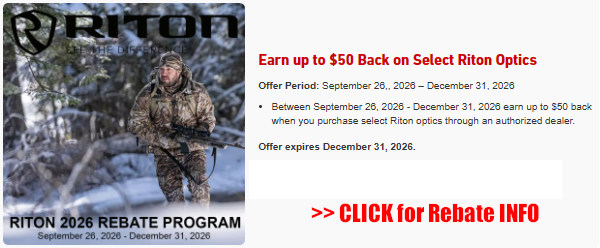
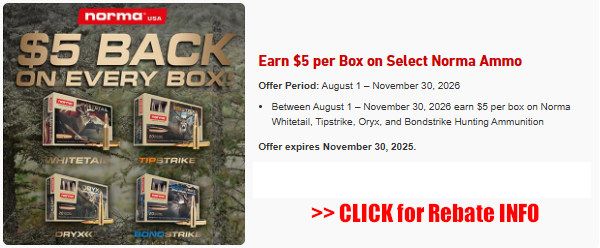
Natchez has a page dedicated to current manufacturer rebates and special offers. With these deals you can save up to 25% on some products, as well as get free bonus products with a purchase. For example you can get a free suppressor with the purchase of a rifle, and/or you can get a free set of binoculars with the purchase of an optic. The Natchez Rebate Page has 23 money-saving offers. Here are our five (5) favorites.
You’ll find these five great discount/rebate programs below. These specials and rebates can save you big bucks on optics and ammo. Three of these rebates are good through December 31, 2026, while the two ammo rebates expire at the end of this month — November 30, 2026.
At the request of our readers, we provide select “Deals of the Week”. Every Sunday afternoon or Monday morning we offer our Best Bargain selections. Here are some of the best deals on firearms, hardware, reloading components, optics, and shooting accessories. Be aware that sale prices are subject to change, and once clearance inventory is sold, it’s gone for good. You snooze you lose.
NOTE: All listed products are for sale to persons 18 years of age or older. No products are intended for use by minors.
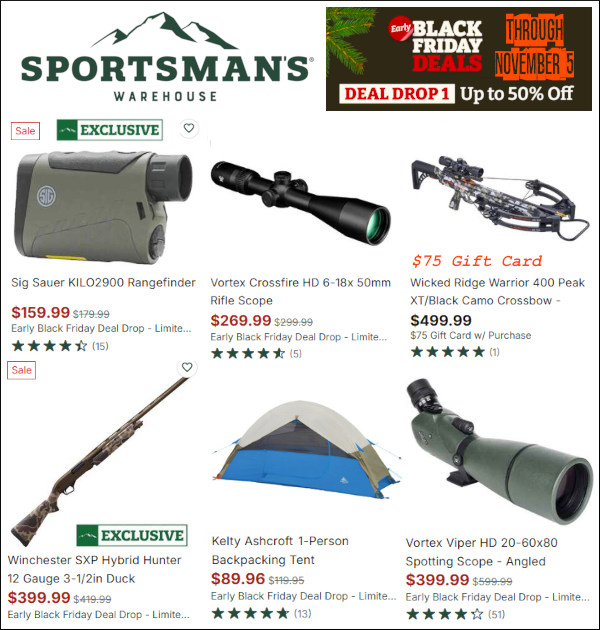
Sportsman’s Warehouse — Early Black Friday Deals
⏺️ » Major discounts on guns, optics, ammo, camping gear
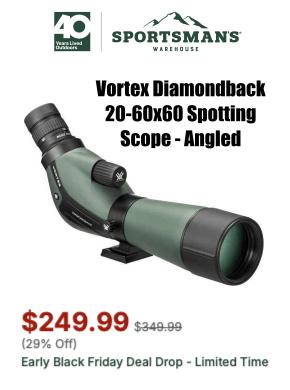
Now through November 5, 2026, check out the big Early Black Friday Sale at Sportsman’s Warehouse. You’ll find great deals on rifles, pistols, shotguns, scopes, spotting scopes, and ammo. In addition there are major discounts on hunter’s camo gear, trail cams, crossbows, and more. The deals featured above are good through 11:59 pm on November 5. Then Deal Drop 2 runs November 6-12.
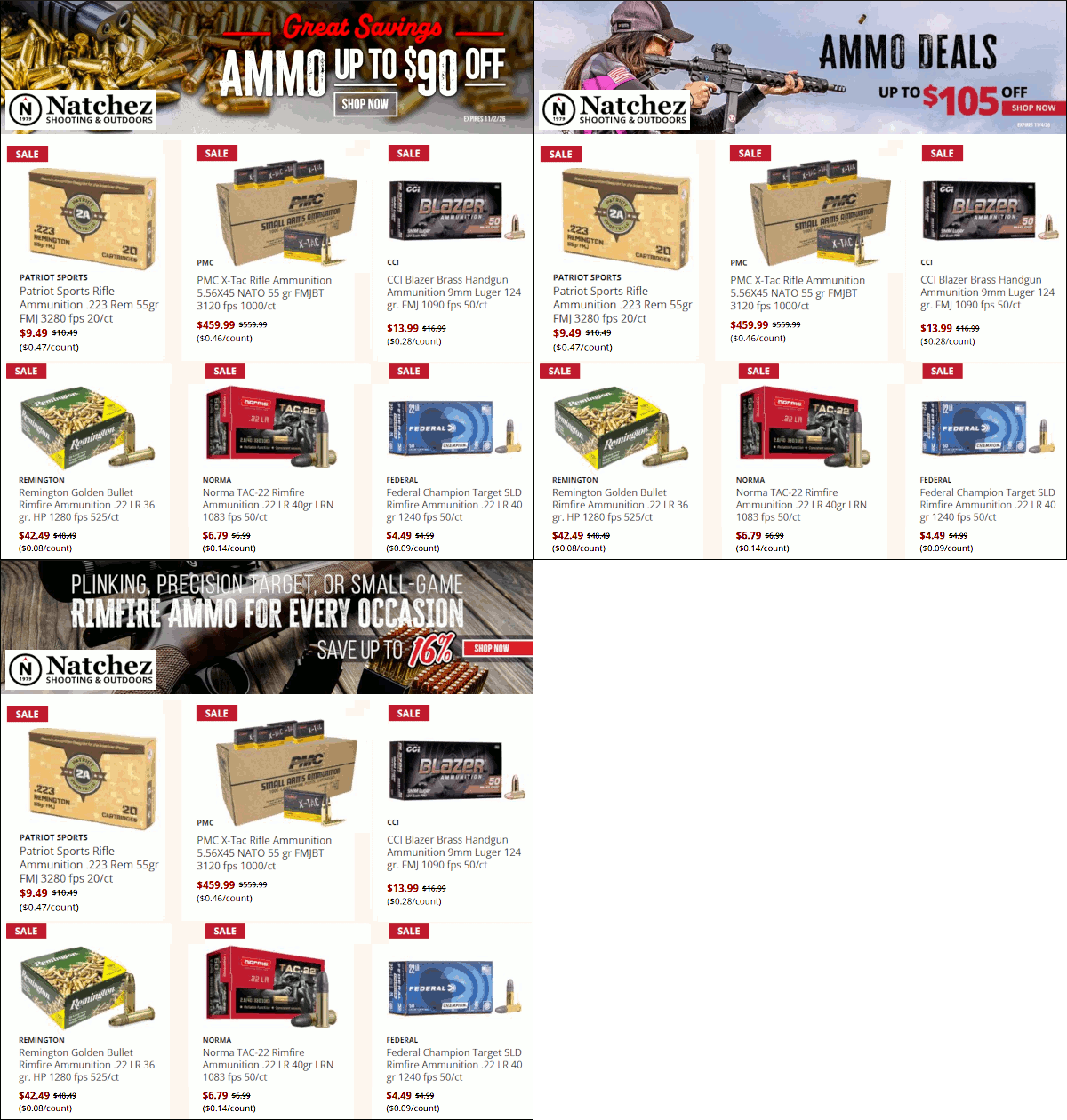
Natchez — Rimfire and Centerfire Ammo Deals
⏺️ » Great deals on .22 LR, hunting ammo, and pistol ammo
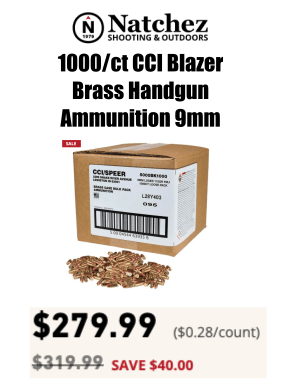
Natchez is offering major discounts on a wide variety of rimfire and centerfire ammo. You can save up to 16% on a wide variety of .22 LR rimfie ammo and save $50-$90 on 1000-ct cases of pistol ammo, such as CCI .45 ACP FMJ. In addition there are huge discounts on centerfire rifle ammo. For example, you can save $100 on a 1000ct case of PMC 5.56×45 X-Tac Ammo.
As an Amazon affiliate, this site can earn revenues through sales commissions.
Do you know which one of your eyes is dominant? It’s easy to determine eye dominance with a simple exercise. Pick an object about 6-10 feet away (a light switch or door knob works well). Make an “OK” sign with your right hand (see photo) and hold that about 18″ from your face. Now, with both eyes open, look through the circle formed by your thumb and index finger. Center the circle on the object, so you can see the object in the middle.
Now, here’s the important part — while still holding your hand up, centered on the object of choice, first close your right eye. If you don’t see the object anymore, then your right eye is dominant. If you still see the object, then repeat the procedure with the left eye shut and right eye open. If you don’t see the object when your left eye (only) is closed, then you are left-eye dominant.
The digital archives of Shooting Sports USA contain many interesting articles. A while back, Shooting Sports USA featured a “must-read” expert Symposium on Eye Dominance, as it affects both rifle and pistol shooting. No matter whether you have normal dominance (i.e. your dominant eye is on the same side as your dominant hand), or if you have cross-dominance, you’ll benefit by reading this excellent article. The physiology and science of eye dominance is explained by Dr. Norman Wong, a noted optometrist. In addition, expert advice is provided by champion shooters such as David Tubb, Lones Wigger, Dennis DeMille, Julie Golob, Jessie Harrison, and Phil Hemphill.
NOTE: If the story doesn’t open at the links, go to the SSUSA.org home page first, indicate you are over 18, and then CLICK HERE. Also, if the August 2011 issue just opens to the cover page, just click the page-turning arrow on the right until you reach the story on page 20.
Top Rifle Champions Talk About Eye Dominance:
David Tubb — 11-Time National High Power Champion
I keep both eyes open, always. Some use an opaque blinder in rifle or shotgun shooting. If you close your non-dominant eye, you will not get as good a sight picture. If your aiming eye is not your dominant eye, you have even more of a problem to overcome. [Editor’s NOTE: Sadly David Tubb passed away in July 2026. See Memorial Article.]
Lones Wigger — World, National and Olympic Champion Rifleman
Shooters should try to use the dominant eye unless the vision is impaired and the non-dominant eye has better vision. You should always shoot with both eyes open since this will allow the shooting eye to function properly.
Dennis DeMille — National Service Rifle Champion
I close my non-shooting eye initially. Once I pick up my sight picture, it’s not something I focus on. For those that use a patch, I recommend that they use something white to block their view, rather than cover the eye.
Bruce Piatt — 2025 World Action Pistol Team Championship — Member of Winning Team CMP-USA
Some shooters, especially those with nearly equal or cross-dominance, will naturally find themselves squinting one eye. When anyone does this, you are also closing your dominant eye to some extent and adding stress to your face.


















 Scope-Cover Mounted Ballistics Table




 Outdoorsmans Tripod Adapters






 Do you know which one of your eyes is dominant? It’s easy to determine eye dominance with a simple exercise. Pick an object about 6-10 feet away (a light switch or door knob works well). Make an “OK” sign with your right hand (see photo) and hold that about 18″ from your face. Now, with both eyes open, look through the circle formed by your thumb and index finger. Center the circle on the object, so you can see the object in the middle.


