Today we share some smart tips from a past F-Class and Sling Champion who is both a great shooter AND a ballistics wizard. Founder of Applied Ballistics LLC, Bryan Litz is the author of multiple books and creator of advanced Ballistics Software.
Bryan is also a highly skilled competitor. In 2015, Bryan Litz won the F-TR Mid-Range AND Long-Range National Championships hosted at Ben Avery. And at the 2014 Berger SW Nationals (SWN), Bryan took top honors among all sling shooters. If you only know Bryan Litz from his Applied Ballistics Books and DVDs, you may not realize that this guy is a also great marksman along with being an actual rocket scientist!
Given his impressive track record in both F-Class and Palma (Fullbore) out to 1000 yards, we asked Bryan if he had any advice for other long-range competitors.
First Bryan provided three tips concerning Ballistics, his special area of expertise. Next Bryan offered three more general tips about long-range competition — how to analyze your shooting, how to choose your ‘wind strategy’, and how to avoid the most costly mistakes, i.e. how to avoid the “train-wrecks”.
Bryan Litz won the 2015 F-TR Mid-Range and Long-Range Championships with this sleek rig:
Litz Ballistics Tips
Ballistics TIP ONE. If you’re having trouble getting your ballistic software to match actual drops, you need to look at a number of possible reasons. Here are some common issues that can cause problems.
Click Values Are Not Exact. Scopes and iron sights don’t always produce accurate adjustments. In other words, if your ballistics program predicts 30 MOA of drop, and you dial 30 MOA but hit low, it might be that your sight actually only moved 28 MOA (for example). To see if your sight is adjusting accurately, shoot a tall target at 100 yards and measure group separation when dialing your sight.
Barometric vs. Station Pressure. This is a commonly misunderstood input to ballistics programs. You can avoid this pitfall by remembering the following: station pressure is the actual measured pressure at your location, and you don’t need to tell the program your altitude when using station pressure. Barometric pressure is corrected for sea level. If you’re using barometric pressure, you also have to input your altitude.
Muzzle Velocity. Chronographs are not always as accurate as shooters think they are — your true MV may be off by 10-20 fps (or more). If your drop is different than predicted at long range, it might be because your muzzle velocity input is wrong.
Mixing Up BC (G1 vs. G7). Knowledgeable long range shooters know that the G7 standard is a more representative standard for modern LR bullets. However, using G7 BCs isn’t just a matter of clicking the ‘G7′ option in the program. The numeric value of the BC is different for G1 and G7. For example, the G1 BC of the Berger 155.5 grain Fullbore bullet is .464 but the G7 BC is .237. If you were to enter .464 but click on G7, the results would be way off.
Ballistics TIP TWO. A properly installed level is absolutely essential for long range shooting. Without a good level reference, your long range wind zero will be off due to minor canting of the rifle from side to side. You can verify that your level is installed correctly on a 100-yard ‘tall target’. Draw a plumb line straight up the target and verify that your groups track straight up this line as you go up in elevation.
Ballistics TIP THREE. If your long range ballistic predictions aren’t tracking, always come back and verify your 100-yard zero. Sometimes a simple zero shift can be misconstrued as errors in long range ballistics predictions.
Litz Competition Shooting Tips
Competition TIP ONE. Improving your scores in long range competition is a constant process of self-assessment. After each match, carefully analyze how you lost points and make a plan to improve. Beginning shooters will lose a lot of points to fundamental things like sight alignment and trigger control. Veteran shooters will lose far fewer points to a smaller list of mistakes. At every step along the way, always ask yourself why you’re losing points and address the issues. Sometimes the weak links that you need to work on aren’t your favorite thing to do, and success will take work in these areas as well.
Competition TIP TWO. Select your wind shooting strategy carefully. For beginners and veterans, most points are typically lost to wind. Successful shooters put a lot of thought into their approach to wind shooting. Sometimes it’s best to shoot fast and minimize the changes you’ll have to navigate. Other times it’s best to wait out a condition which may take several minutes. Develop a comfortable rest position so you have an easier time waiting when you should be waiting.
Competition TIP THREE. Actively avoid major train wrecks. Sounds obvious but it happens a lot. Select equipment that is reliable, get comfortable with it and have back-ups for important things. Don’t load on the verge of max pressure, don’t go to an important match with a barrel that’s near shot out, physically check tightness of all important screws prior to shooting each string. Observe what train wrecks you and others experience, and put measures in place to avoid them.
Looking down-range with F-TR rifle at Ben Avery Shooting Facility in Phoenix, Arizona.
Bullet Stability and Twist Rates
In this video, Bryan Litz talks about bullet in-flight stability and how to calculate barrel twist-rate requirements for long-range bullets. Bryan explains that bullet stability (for conventional projectiles) is basically provided by the spinning of the bullet. But this spin rate is a function of BOTH the nominal twist rate of the barrel AND the velocity of the projectile. Thus, when shooting the same bullet, a very high-speed cartridge may work with a slower barrel twist rate than is required for a lower-speed (less powerful) cartridge. For match bullets, shot at ranges to 1000 yards and beyond, Bryan recommends a twist rate that offers good stability.
You’ll find more expert information on long-range shooting and ballistics on the Applied Ballistics website and the Bryan Litz Ballistics Facebook page. Bryan’s most recent Facebook post talks about the Coriolis effect — the apparent drift of a rifle trajectory due to the rotation of the earth.
To learn more, we recommend you subscribe to the Applied Ballistics Science of Accuracy — with in-depth articles, brilliant podcasts, exclusive videos and more.
Jason Cohen’s “We the People” patriotic .284 Shehane F-Class rifle. It has already demonstrated great promise, scoring second place in its very first match, a 3×20 at 1000 yards in Wyoming.
With the United States of America’s 250th birthday coming on July 4, 2026, just six days from now, we are featuring a handsome F-Class rifle with a patriotic theme. This rifle has the historic “We the People” phrase painted on its handsome Cerus stock. The phrase “We the People” is the famous opening to the Preamble of the U.S. Constitution. Adopted on September 17, 1787, this preamble indicates the government derives its political power directly from its citizens rather than from a monarch or government officials. This cool rig also features the U.S. Stars and Stripes flag on the buttstock.
Rifle Report by Jason Cohen
The rifle began its life as a Will McClosky Cerus stock. I approached Will at the Berger SW Nationals about a rifle I wanted to build. I wanted to do something different — PAINT it. He said he had just the stock that I could use, and sent that to Bryan Blake at Blake Machine. I chose Bryan for two reasons — first, I have shot with him a few times at National matches and he is approachable and very helpful. Second I visited his shop during the SWN in February and liked what I observed and how he approached things. Bryan never seems to be happy with the status quo. He is always trying new ideas.
I noticed that Bryan had been adding aluminum rails to the front of Cerus stocks to lower the center of gravity and improve tracking. I asked him to modify my stock and fit it with the new forearm rails, shown in the photo below. I sent him a Panda F-Class action with a +20 MOA Picatinny rail. Bryan did all the stock work and fitted the action, rails, and RAD recoil pad. Everything turned out flawless.
The barrel is a Blake Machine 1:8″-twist finished at 32 inches. It was fitted to my action by Dale Woolum of Woolum Accuracy. Dale chambers all my barrels on all my rifles. Dale also threaded the barrel for a Woolum Accuracy tuner. This has proven to be a valuable tool in my load development. On this build, I am trying a Bix’N Andy trigger for the first time.
The 284 Shehane has a proven record of accomplishments and that is why I have chosen it. I use Lapua brass (6.5-284 necked-up), CCI BR-2 primers, Hodgdon H4350 powder, and Berger 184gr bullets. All these components have been a successful combination that has worked flawlessly in my other rifle.
.284 Shehane Load Development
Load development for me starts with each new barrel. I screw on the new barrel, fire 25 rounds of whatever I have left over and then clean it. I push out to 600 yds and do a ladder test in round-robin format. I start 0.6 grains lower than my last charge that worked. I work up from that reduced charge weight in increments of 0.3 grains. The paper tells the rest of the story. Once I get something that works well at 600 yards I go back in work around that by 0.1 grains. After that I play a little with seating depth and look for a change. I will occasionally mess with the tuner and tighten things up if possible.
About the Patriotic Paint Job
So I had the idea of painting the stock because there are so many wood stocks with clear coat these days. Unless you really get some exotic woods they all seem to blend together. I have nothing against clear-coated wood, but I wanted something different, as this was my first all-wood rifle. (For short-range benchrest, I was shooting a Bob Scoville carbon stock and Terry Leonard laminate).
We started with all white on the stock and came up with the idea of an American Flag on the buttstock. I was thinking of ribbons on the front in red and blue but we could not get the layout right. Then the idea of “We the People” popped into the head. My painter said “awesome!” and he was able to airbrush the stock with a little yellow and brown to give it that vintage paper look.
The front rest is a SEB Max (see above). I chose the Max because I was shooting Group Benchrest first then made the transition to F-Class. This rest proves to be versatile in all my shooting — Short- and Long-Range Benchrest AND F-Class. The rear bag is a Edgewood EDGEbag Gator. The gun gets transported in a Pelican Hard case when I travel. Locally, I use a Champions Choice soft bag.
Jason Jumped to Open Class after Starting with F-TR
This “We the People” rifle will be one of my primary rifles for F-Open competition. I will run it through its paces shortly and see how well it does. I have high hopes of it being an great gun. I shoot primarily local and regional matches — Colorado, Wyoming, and possibly Nebraska this summer. I will travel to the F-Class Nationals in Raton as well. I used to shoot F-TR before this and made the transition to Open last season. This is my second season shooting F-Open. 2018 was my first National event and was a learning experience for me. But I was hooked after that match.
Tips for F-Class Competitors
Get some good equipment and eliminate having issues that can be caused by budget builds. It’s OK to be frugal, but sometimes cutting corners will cause you more problems and have you chasing your tail. If you’re looking for the “recipe for success”, get a good action plus a top-tier barrel and great glass.
The .284 Shehane — Accurate and Forgiving Wildcat
The 284 Shehane is amazing, very forgiving and not temperamental. I choose this because I really did not know otherwise and was steered to the Shehane by a friend. Its proven track record helped as well. Straight .284 or Shehane — you cannot go wrong. I run a 184gr Berger at about 2850 FPS and get great brass life in my other rifles. I usually start to consider tossing the brass around 15 firings. Primer pockets start to get a little looser and the brass seems to need more sizing than the newer brass with less firings.
Mike Kurtz’s Competition Machine F1 “Pro-Mod” F-Open Rifle
Today’s Sunday GunDay article showcases a modern F-Open Rifle built on a Competition Machine Aluminum Chassis. This is quite a bit different than a typical F-Open rifle with a laminated wood or wood/carbon stock. But the rifle shoots extremely well, and has already won some mid-range F-Open matches.
The rifle’s owner, a highly respected vehicle mechanic, explained his objective with this rifle: “I wanted to build a second F-Open rifle to shoot primarily 600-yard Mid-Range and also serve as my back-up long range rifle. That way I can use the same brass, bullets, and primers. So it would be chambered in 7mm-6.5 PRC, the same as my other F-Open rifle. That rig is a 7mm-6.5 PRC with Cerus XR stock, BAT Neuvo action, and Bartlein 1:9-8.7″ gain-twist barrel. I absolutely love that rifle and it has achieved several top honors. But for this project, I wanted to try some different rifle components to see how they performed in this same caliber. So I decided to go with Brux barrels, BAT Neuvo aluminum action (but see below), and an Eliseo Competition Machine F1 aluminum alloy chassis.”
BARREL SPECIFICATIONS: I ordered two Brux 7mm x 33″ barrels with 1:8.5″ twist. The contour was supposed to be 1.350″ diameter for 5″, tapered-down to 1.150″ diameter at the muzzle end. However, when the barrels arrived they were tapered down to 1.050″, a bit smaller. The folks at Brux admitted the work order was mis-read and offered to take back the barrels and make me two more. Or, I could keep the barrels with nice discount. I contacted my gunsmith, Omar Alonzo, for his advice and he said to keep them, they would shoot just fine. That turned out to be a blessing because the total rifle weight is now just three ounces under 22 pounds with one of these barrels. Omar chambered it with his 7mm-6.5PRC “no-turn” reamer that was used on my Cerus rifle. The Brux barrel was finished at 32″ with the muzzle end threaded for a V2 tuner.
ACTION and TRIGGER: I intended to use an aluminum BAT Neuvo action because I anticipated weight may be a concern, but they were on back-order with no lead time in sight. So for now I went with a used steel BAT Model M, 1.47 Octagon action that I acquired via the AccurateShooter Forum marketplace. This is a RBLP Right Eject action with magnum bolt face and 20 MOA integral Picatinny rail. The trigger is a Bix’N Andy Competition also scored on the Forum, set at 3 ounces. [NOTE: I now have an aluminum Neuvo AL in my possession. However, the F1 rifle is shooting so well, I’ll save the aluminum Neuvo for a future build.]
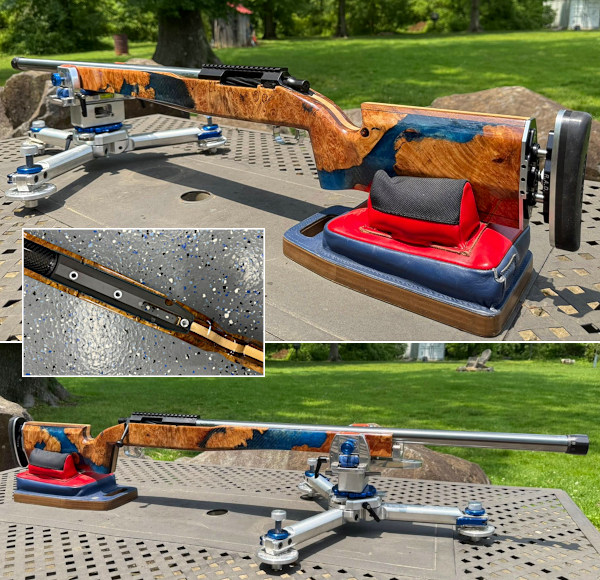
STOCK and FINISH: When I was planning my second F-Open 7mm-6.5 PRC rifle build, Gary Eliseo’s F1 aluminum chassis was my immediate choice. I was already familiar with Gary’s products since I started out three years ago with a used 6BR-chambered R1 tube gun. I purchased it from a Forum member and I adapted it for Mid-Range F-Open very successfully. Being a long-time drag racer and fabricator piqued my interest in these aluminum chassis combos. I contacted Gary Eliseo at Competition Machine and ordered his F1 F-Open Chassis System with one of his custom-machined bedding blocks for the Bat M action I acquired off the Forum.
Video of F1 Chassis Rifle in Action
Turn-around time was just about eight weeks, including aligning and epoxying the action bedding block into the chassis. Gary Eliseo offers full custom Cerakote services for his customers but I had something else in mind so I had the chassis sent to me “raw”, i.e. with a bare aluminum finish. At first I thought about polishing some or all the entire chassis but that would be too high maintenance. I decided to go with anodizing as I have done in the past with many race car components. Anodizing is an electrochemical process that converts the metal surface into a decorative, very durable, corrosion-resistant, anodic oxide finish that’s pretty tough and looks great!. This finish is available in many colors and in clear.
While I was surfing the internet looking for some color/combo ideas I stumbled on a local custom anodizer who had dozens of some really wild and crazy anodizing patters and color mash-ups. I messaged Stephen @ Caustic Customs and told him about my project. He replied that his specialty is paint-ball guns and this would be his first long gun but, hey, it’s aluminum! I gave him all the pieces of my F1 chassis. There were a couple of his patterns I really liked so I asked his opinion which he thought might look best for my project. He replied why not both? So I instructed him take both patterns and “run with it”. The end result is the Icy-Hot blue/red finish as seen in the pictures.
It all came together at Alonzo’s Custom Rifles in Pasadena, Texas. Omar hand-lapped the action bedding block surface to smooth-out some tiny high spots. He then skim-bedded the action with an epoxy filler to make sure the action made 100% contact with the bedding block. Barrel chambering, action fitting, trigger tuning, and final assembly was performed by Omar.
I finished the rifle with a hydraulic recoil pad from Falcon Strike and Anarchy Outdoor’s Penguin Precision Grip. Gary designed the F1 to utilize AR15-style grips. The Falcon Strike pad is not as sexy as the R.A.D. unit I have on my Cerus-stocked rifle, but I think its recoil-absorbing performance is up there with the R.A.D. unit. So, if a RAD is not in your budget or if weight is a concern, you can’t go wrong with a Falcon Strike recoil pad.
SCOPE/RINGS: My intention was to switch my March-X 8-80x56mm Majesta High Master scope between my two rifles. However the hefty stainless Bat M action nixed that idea. So to ensure the new rifle would be F-Open legal weight I went with a used March-X 10-60x56mm High Master scope that I acquired through the AccurateShooter Forum Marketplace. That 10-60X March, shown in the video, is almost 11 oz. lighter that my 8-80X March-X Majesta HM. NOTE: In some of the photos here, the rifle is fitted with an older March 8-80X scope (NOT the latest Majesta). The rings are March Superlight Titanium Ghost Rings — under 5 oz. for the set, the lightest I could find.
F-Open F1 Chassis Rifle Specifications
Chambered for: 7mm-6.5 PRC Wildcat
Stock: Competition Machine F1, F-Open Chassis, Falcon Strike Recoil Pad, Anarchy Outdoors Penguin Grip. Custom anodizing by Caustic Customs.
Trigger: Bix’N Andy Competition trigger
Action: Bat Model M — Right Bolt, Left Port, Right Eject with 20 MOA scope rail
Barrel: Brux 7mm, 1:8.5″ twist, 32″ overall, 1.350″ x 5″, tapering down to 1.050″, V2 Tuner
Scope: March-X 10-60 High Master, MTR-1 reticle. March Ultra-Lite Titanium Ghost scope rings.
Gunsmith: Alonzo Custom Rifles
CARTRIDGE COMPONENTS and LOADING METHOD: I use Lapua 6.5 PRC brass, Berger 180gr Hybrid bullets and Federal 210M primers. New brass necks are expanded to 7mm and skim-turned to get a consistent .014″ neck thickness. I use a 35-degree cutter and go just a slight bit into the shoulder to ward off donuts. I then chamfer the flash holes, uniform the primer pockets, full-length size the cases, then expand and trim/chamfer the necks. My fired brass gets annealed, wet-tumble cleaned, full-length sized/expanded, and trimmed in that order. Bullets are pointed and then sorted by OAL. Primers are sorted by height and then by weight. I apply Neo-Lube to the inside of the necks with a foam Q-Tip for consistent seating psi.
This is from a 600-yard match shot with the F1 rifle a few months ago. Despite a strong wind from behind constantly switching right to left, I scored a 200-12X — good enough for Second Place.
LOAD DEVELOPMENT PROCESS: Thanks to some good 7mm-6.5 PRC load data posted on AccurateShooter.com, it helped me with a starting point to find a nice velocity node at 2865 fps using Hodgdon H4350. I did this by shooting some 2-shot groups seated .010″ off the lands. my focus was to find a node where the velocity leveled-out in at least two 0.5 grain increments in the 2850-2880 fps range. I then did a seating depth test at 100 yards to find my ideal seating depth which ended up at .024″ jumped. Next, I did some 3-shot groups at 100 yards to dial-in he barrel tuner until I got at least two consecutive ultra-tight groups. I verified that setting with a one-hole, three-shot group.
About Mike Kurtz
Michael Kurtz is owner/operator of Century Automotive & Transmission. An ASE Master L1 Technician since 1983, Mike has been an avid drag racer over the last 40 years. Mike notes: “I never owed any kind of rifle until I retired from racing. Got bit by the accuracy bug and learned about F-Class in 2021. I read several reloading and long range shooting books while I scoured the AccurateShooter Forum Marketplace for a rifle, scope, rests, and reloading equipment for my first F-Open rig. Most all of my major components I acquired via online Forums. I have to attribute the early success of my F-Open accomplishments to the vast content found on AccurateShooter.com.
I am also a member at Bayou Rifles Inc. in Houston Texas where I’ve learned from some of the best shooters in the country. The competition here is fierce but the camaraderie is second to none!”
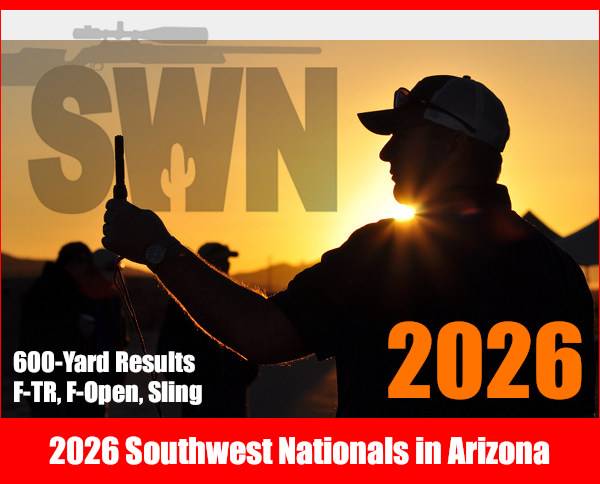
The 2026 Southwest Nationals (SWN) have concluded. Held at the impressive Ben Avery range in Arizona, the 2026 SWN was a very successful event with good conditions (for the most part) and impressive scores by shooters in all three divisions: Sling, F-Open, and F-TR. We congratulate the new SWN Grand Agg Champions: Bobby Gill (Sling), Ryan Mitchell (F-Open), and Brad Sauve (F-TR). This was familiar territory for Sauve who has won the SWN F-TR title before.
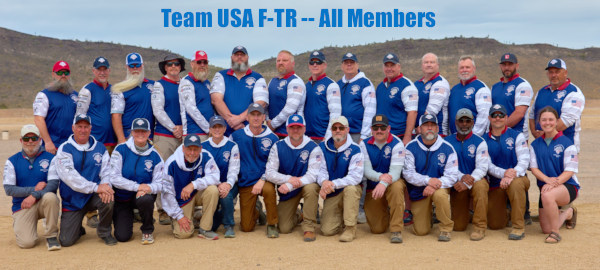
The SWN has both individual and team competition in all three classes. The winning team in the Sling Division was Team USAMU 2564-124X (Capt.: Jarrod McGaffic / Coach: Verne Conant). The top F-Open team was LOS CHINGONES 2590-153X (Capt.: Dennis Ray / Coach: Brian Bowling). The F-TR team competition was dominated by Team USA F-TR VORTEX 2575-123X (Capt.: Ian Klemm / Coach: Keith Trapp).
The 2026 SWN had very high participation in all classes. Observers said that 2026 may have rivaled the highest total turn-out in many years. Weather-wise, we’re told that conditions were “very manageable” for most of the week until the final day of individual competition. Wind angles and velocities became quite hard to diagnose on that last day. As a result many top shooters dropped multiple points in the last individual relay and this created major shake-ups in the leaderboard, with some very skilled shooters dropping out of the Top 20 after an otherwise impressive week.
A special congrats to our friend Gary Eliseo who actually ended up with the highest Sling Division overall score, 1240-64X. But because he used a scope throughout the match he could not win the Sling Grand Aggregate.* Gary Eliseo reported: “I had a great time at SWN 2026. It was a privilege to catch up with so many friends from around the country, managed to shoot a PB too! My UMRS/6.5 El-Mo did everything it could to make me look good.”
SLING TEAM Top 3
Team 44 USAMU HM 2564-124X
Team 49 USNMT VFB MRNAK HM 2564-115X
Team 46 USNRT GILL HM 2562-122X
F-OPEN Grand Aggregate Top 10
1. Ryan Mitchell, 1245-83X, Match Winner
2. Joe Traylor, 1245-74X
3. Tim Vaught, 1245-69X
4. Jason Simes, 1243-73X
5. Gwen Basalla, 1243-66X
6. Brad Johnson, 1242-78X
7. Pat Scully, 1242-74X
8. Erik Cortina, 1242-71X
9. Emil Kovan, 1242-64X
10. Brian Bowling 1241-78X
F-TR TEAM Top 3
Team 23 USA F-TR VORTEX HM 2575-123X
Team 21 USA F-TR BERGER HM 2568-118X
Team 13 CREEDMOOR SPORTS GOLD MA 2556-111X
Report from F-Open Competitor John Masek (F-Class John)
This year’s Southwest Nationals appeared to have the highest attendance I’ve ever seen. The Mid-Range match on Wednesday isn’t usually all that full but this year every firing position was used which is something I’ve never seen before in Mid-Range. Long range was also sold out which I believe is around 365 shooters with the majority being in the F-Open category. I don’t know the exact count, but there were nearly three full pages of F-Open shooters listed — that means there could’ve been close to 200 F-Open shooters. Overall there was beautiful weather with mostly gorgeous conditions during the week, and it was great seeing everyone from across the country and even the world.
Conditions were manageable for a lot of the shooters throughout the week with some of the highest scores I’ve ever seen — 16 F-Open shooters all shot a perfect 450 points on the Palma day Friday. Saturday got just a little trickier, but still many of the top shooters were managing to only have dropped a couple points over the two days. Sunday started with mild conditions again, but the final relay on Sunday afternoon completely shook the leaderboard up. While there were certainly top shooters who were able to hold their positions… but just as many dropped quite a few places down. It was one of the trickiest conditions I’ve ever seen that didn’t involve giant winds.
* Scopes help older sling rifle shooters whose eyes are starting to wear out. But, Gary Eliseo explains: “In this event, the match director dictates that a Palma rifle be used on the first day, and if you want to shoot an ‘any rifle’ on Day Two it also must have iron sights with the third day being ‘any sights’ so ‘F-sling’ is a category where ‘any sights’ are allowed to be used on all three days but that makes us ineligible to win the Grand Aggregate.”
Today marks the third day of competition at the 2026 Berger Southwest Nationals (SWN). And yes, it’s Friday the 13th — causing some concerns among competitors. The superstitious types among the competitors viewed the day with some trepidation. But most shooters didn’t worry too much about the date — they were more concerned about calling the wind correctly. As Bryan Litz said at the SWN a decade ago: “I don’t believe in superstition. We make our own luck”.
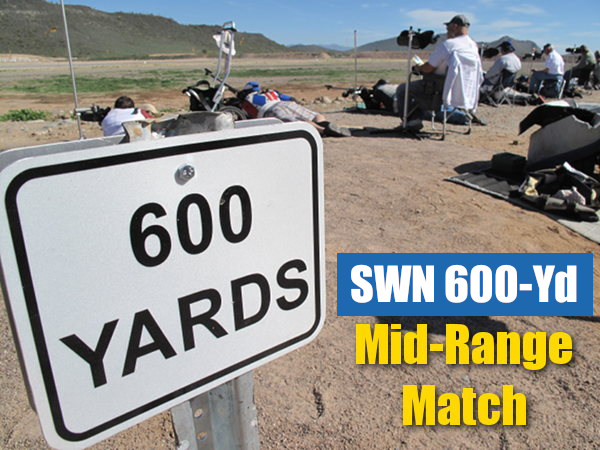
On Wednesday, February 11th, the 600-yard competition was held for all three competition classes: Sling (Palma), F-Open, and F-TR. 600-Yard match results for all three classes are shown below for the Top 10 in each class. For F-Open, F-TR, and Sling Divisions there were three relays, each with 20 rounds for score. Thus, the maximum possible score was 600-60X. There were some very impressive performances with the top 9 F-Open Shooters, top 5 F-TR Shooters, and Sling Winner Fazal Mohideen not dropping a single point. Congrats to the winners — Fazal Mohideen, Sling P 600-34X; Cal Waldner, F-Open 600-49X; and Brad Sauve, F-TR 600-44X. CLICK HERE for full 600-yard results for all competitors.
600-Yard SWN Top 10 Results
Here are the Top TEN 600-Yard Competitors for each Division:
Sling (Two Divisions, “P” and “A”) 600-yard Top 10
The Southwest Nationals is one of the few American events where sling shooters compete on the same firing line as F-Class competitors (though in separate groups). At the SWN this sling division has two sub-classes: “A” for “Any Rifle, Any Sight” and “P” for Palma rifles.
F-Open 600-yard Top 10
1. Cal Waldner 600-49X (Match Winner, MA)
2. Antun Kovacevic — 600-48X (MA)
3. Joe Traylor — 600-44X (HM)
4. Jason Simes — 600-42X (HM)
5. Dan DiLeva — 600-40X (HM)
6. Brian Bowling — 600-39X (HM)
7. Ryan Pierce — 600-37X (HM)
8. Eric Houser — 600-36X (HM)
9. Martin Tardif — 600-31X (HiGS)
10HM. Peter Johns — 599-47X (HM)
10MA. Noah Burleson — 599-47X (MA)
Modern F-Open Rifle with SEB Mini front rest with Blake Machine accessories.
F-TR 600-yard Top 10
1. Brad Sauve — 600-44X (Match Winner, HM)
2. Keith Trapp — 600-43X (HM)
3. Alan Barnhart — 600-39X (HiGS)
4. Alton Johnson — 600-35X (HiSr)
5. Anthony Jordan — 600-34X (HM)
6. Tracy Hogg — 599-42X (HM)
7. Adam Husted — 599-38X (MA)
8. Ryan Crozier — 599-36X (MA)
9. Benoit Vautour — 598-42X (MA)
10. Jeremy Newell — 598-39X (HM)
F-TR Rifle looking downrange at the targets.
Palma Format Multi-Distance Matches on Friday the 13th
Today, Friday is the Palma format match. This is not limited to “hard-hold” sling Palma rifles, but the match utilizes a multi-distance target sequence similar to Palma rifle matches. All three rifle classes will be shooting: Sling, F-Open, and F-TR. There will be three target distances with 15 shots for record at 800, 900, and 1000 yards.
In the video below, you’ll see highlights from last year’s SW Nationals from the break of dawn throughout the day. This also features new products on display. This video was created by our friend F-Class John, who is competing right now at the 2026 SWN event.
For this 2026 Super Bowl Sunday, we celebrate the beauty of highly-figured wood with a collection of custom rifles. In our Shooters’ Forum, there is a long-running Gun Glamour thread that showcases many beautiful wood-stocked rifles. Today we feature some very handsome rifles from that Forum Thread as well as other rifles we’ve featured in the Daily Bulletin.
Two F-Open Beauties with Walnut Laminates
Cerus-stocked Special from Cigarcop
Forum member Keith W. (aka “Cigarcop”) of KW Precision LLC is a talented riflesmith whose projects display outstanding finish work and attention to detail. Keith does some of the best bedding work we’ve ever seen. Back in 2018, Keith built a stunning .284 Win F-Class rig for a shooter in Delaware. It’s a beauty, that’s for sure.
Check out the stunning Cerus F-Open stock. This features multiple laminations with highly-figured Walnut on the sides. This certainly ain’t your “off-the-shelf” laminated stock. This just shows the beauty that can be achieved with carefully-chosen lamination layers (plus 12 coats of clear).
This beautiful F-Open rig features a laminated wood stock with stunning figured walnut on the outside.
Another KW Precision F-Open Beauty
Here’s another stunning F-Open rig crafted by Keith of KW Precision. This features a BAT M action with BixN’Andy trigger. The 1:9″-twist Brux barrel is chambered in 7-6.5 PRC and fitted with a Cortina V2 Tuner. The handsome laminated Dennis Ray stock carries a Hart R.A.D. 2A recoil reduction system.
A Beauty for the Boss (of Grizzly.com)
This F-Class rifle belongs to Shiraz Balolia, Chairman/CEO of Grizzly Industrial. Shiraz finished the stock himself: “I installed the bottom wider track for my rear bag and also carved out the finger grooves in the grip. The blank was quite long so I cut off approximately two inches from the front end of each stock and also deepened the large tracking cavity under the fore-end. I went ahead and inlaid my name in Mother-of-Pearl on the Walnut stock.” The stock was then sent to Sims Guitar Finishing for clear coating with “wet look” finish. This rifle is chambered for the .300 Shiraz wildcat, an improved .300 WSM.
F-0pen Stock made of highly-figured Walnut with Curly Maple inner laminations.
Beautiful Rifles from our Forum Gun Glamour Thread
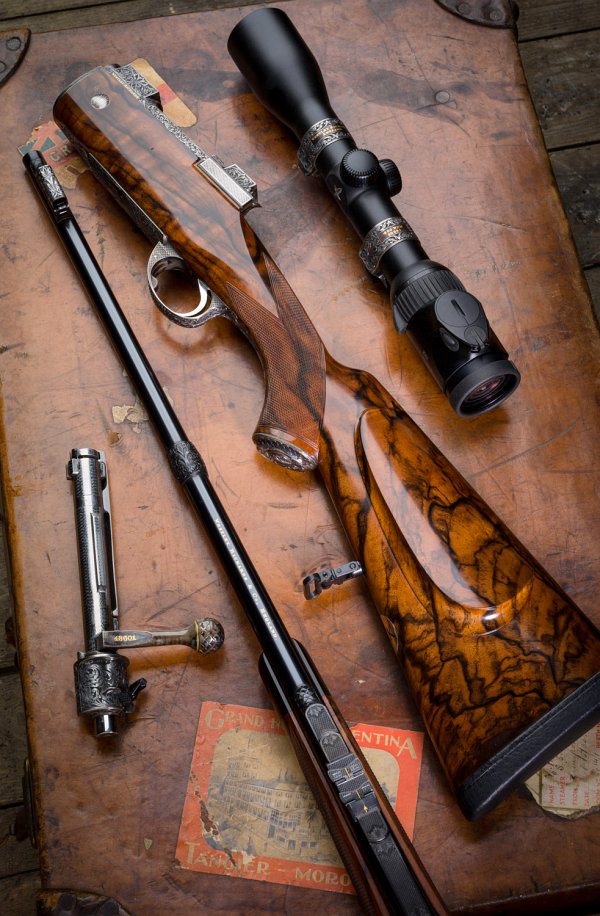
Here are a variety of handsome wood-stocked rifles from our Forum Gun Glamour thread. In that thread, member Kurz posted a dream gun owned by a friend in England. Kurz included a quote from a book created by the rifle’s owner: “There, with my father’s words ringing in my ears, I shall take that ‘step forward’ and order a perfect machine based on the Mauser ’98 action, built from metal and wood by master craftsmen who truly understand that ‘reliable’ and ‘mechanical integrity’ have as much relevance today as they did all those years ago.”
A gun can “shoot dots” and still be handsome. Here is a short-range benchrest rifle with a stunning, exhibition-grade Walnut stock. Forum member Josh B found this beauty.
Forum member JRS submitted a stunner from Europe. This beauty features a truly exquisite piece of wood with elaborately engraved receiver. It also has escutcheons and special metal work on the grip.
Lever-action Falling Block rifles can be beautiful too. This one features a color case-hardened receiver and handsome two-piece fancy wood stock. This was submitted by Forum member Kurz who notes: “Besides exhibition grade walnut, I like the variations available in spalted maple for rifle stocks.”
Here is member Oldduc’s Stevens 44 1/2, .38-55 Black Powder Cartridge Rifle, with an extra .218 Mashburn Bee barrel. Very nice blueing along with the figured wood stocks and fore-arms.
A competition rifle must be “performance first”. But that doesn’t mean they can’t be handsome too. Forum member XTR’s rifle, an F-TR rig, features Maple wood with Bubinga tips.
And wood can work for Benchrest rifles too, when cleverly fashioned in thin carbon-reinforced laminates. Photo from member mdman352.
“Wood is Good” — as demonstrated by all the rifles showcased above. In the photo below, master stock-builder Doan Trevor handcrafts a highly-figured wood stock.
New .300 WSM F-Class rifle, with stock finished by Forum member Cigar Cop.
One of the most popular features of our Shooters’ Forum is the ongoing Pride and Joy Rifle thread. Since 2009, Forum members have posted photos and descriptions of their most prized firearms. Here are some of our favorite “Pride and Joy” rifles recently showcased in our Forum. Do you have a gun you’d like to see featured there? Register for the Forum and you can add your favorite gun to the list.
We hope these “Pride and Joy” rifles may provide inspiration for our readers, whetting their appetite for their next competition, varminting, or hunting rifle project.
Ultra-Low Profile 6 PPC for Short-Range Benchrest
This handsome rifle, which belongs to Forum member J.J.Coe, represents the state-of-the-art for 100/200-yard benchrest rifles. It is chambered (no surprise) for the 6 PPC cartridge, which dominates the short-range game. In features a super-low profile carbon composite stock. Note how the vertical centerline of the stock is very close to the barrel. This keeps the center of gravity low and helps the rifle recoil smoothly with less hop in the bags. Note also the tuner on the barrel.
22 BR Savage Varminter — Accuracy on a Budget
This 22 BR Savage, with upgrades from Sharpshooter Supply, is the “pride and joy” of Forum member Maynard. Note the heavy-contour custom barrel with brake. That 22 BR cartridge is a very effective choice for varmint work, as the ground hog in the photo proves. The 22 BR and 22 Dasher are capable of outstanding accuracy with a large variety of bullets and powders. A 22 Dasher can rival the ballistics of a 6mmBR out to 500+ yards, but with reduced recoil.
Eliseo Tubegun in 7mm SAUM with Pierce Action, Bartlein Barrel
Here is a striking camo-finished Elesio (Competition Machine) Tubegun chambered for 7mm SAUM. Note the block fitted to the tubular fore-end so the rifle rides smooth and steady on the Rodzilla T-Rex joystick front rest. The proud owner, Forum member Aeon, tells us: “This is a Gary Eliseo RTM chassis with pickle forks. It has a custom Ceracoat paint job to match my sling gun.” Key components are: Pierce Engineering long action tube receiver, Bartlein 1:8.5″-twist barrel, Jewell trigger set at 2 oz., and Vortex Golden Eagle scope in Vortex rings. Aeon adds: “The chamber was cut by Mark Chesesbro of Chesebro Rifles. Mark throated it very long so the the 180gr and 184gr Bergers would sit where they belong.”
Tuning the 7mm SAUM and Recoil Reduction
Owner Aeon tells us: “The 7 SAUM was as easy a gun as I have ever shot to find a good load for — H1000 gave great consistency and tuning was not hard. However, the challenge in shooting this rifle was recoil management. The 7 SAUM has a punch to it and I found myself having trouble finishing three relays without form problems in the last relay. I considered getting a RAD Pad but that would have required expensive machine work. I stumbled on a recoil pad that is uniquely effective, the Falcon Strike. Sent the pad to Gary Eliseo and he sent it back with the butt plate machined to fit. Complete game changer! The rifle is a dream to shoot now with a big reduction in felt recoil.”
This gray and blue beauty belongs to Forum member Farmer Dave. He posted: “Got this 6.5×47 Lapua back from my smith about six months ago. It’s the most accurate rifle I have ever owned.” This rifle features: AG Composites CF stock, Stiller TAC 30 action, Bartlein 5R barrel, TriggerTech Diamond trigger. On top is a Trijicon Accupower riflescope.
Henry .45-70 with Modern Buttstock and M-LOK Handguard
Here is member Quest45’s handsome lever-action Henry .45-70 Gov and Glock 40 10mm. About his two guns he posted: “All I need is a can of bear spray”. The rifle is fitted with a red dot sight, ammo caddies, Ranger Point M-LOK handguard, and a modernized modular buttstock. These upgrades make it a thoroughly-modern Henry lever gun for the 21st Century.
A .243 Winchester Hunting Rig that Nailed Scottish Roe Buck
Forum member John V. from Scotland showcased a successful hunt with his .243 Winchester rifle. This sports a suppressed, 26″ MTU 1:7.5″-twist barrel. He loaded Sierra 100gr Pro-Hunter bullets, and took this nice Roe Buck at 240 yards through a gap in the foliage.
Mauser M96 with Quilted Maple Stock — for the Wife
We like this handsome quilted Maple-stocked Mauser belonging to Forum member Steel Mover. He posted: “Some like synthetic and some like wood — I have both. Here is the wife’s quilted Maple 96 Mauser 6.5×55. I was working in the shop, wife walked through and said ‘You are building that for me aren’t you?’ Well ‘Yes, dear’ I said of course … so I Lost my rifle.”
Patriotic .284 Shehane F-Open Rig
Forum member 1shot is proud of this new F-Classer: “Just got my first F-Open rifle finished chambered in .284 Shehane. It features a Kelbly stock w/RAD system, Shilen 1:8″-twist ratchet-rifled barrel with EC Tuner, and X-treme 2-stage trigger — all mated up to a Kelbly Panda action. I think this dog will hunt!”
Bill Goad’s 6PPC Hunter “Ranch Rifle”
Forum member Grimstod tells us: “This is the personal rifle of Bill Goad. He has been experimenting with it on several levels. It is shooting great and has several matches on it now. Please enjoy these photos. More can be found on the website www.PremierAccuracy.com. We like the subtle barbed wire effect on the stock.
Do-it-Yourself Paint Job, Done in the Bathroom at Home
Many eye-catching rifles start with a great paint job. Forum member JHN did this job himself. He posted: “Went to local paint shops, some cost a two-month work income, some said guns were a ‘no-no’. So I did it myself — my first Candy Apple red. Base collar is gold metallic, followed by the red. I didn’t have a good paintwork place so I had to improvise. Our bathroom has nice concealing in the summer — a perfect paint booth. So I only have to apologize about some red flakes in our bathroom.”
The 6mm GT (aka 6GT) cartridge was conceived as a “bigger Dasher” for PRS and NRL competition. The 6mm GT’s creators wanted 6mm Dasher accuracy and moderate recoil delivered via a cartridge with a slightly longer case body for better mag-feeding, longer neck for seating flexibility, and more moderate pressures. So far the 6GT has performed very well in PRS competition. Today’s story is a bit different — this is about an experiment — running a 6mm GT in an F-TR type rifle. Understand that, under current NRA rules, you may only shoot .223 Rem (5.56×45) or .308 Win (7.62×51), in official, sanctioned F-TR competition, but the 6GT is fine for F-Open. Mike McCasland wanted to see the potential of the cartridge for long-range target shooting, so he put a 6mm GT-chambered Bartlein barrel on a nice custom rifle with McMillan XIT stock and Kelbly F-Class Panda action. The results were impressive.
6mm GT — New Cartridge with Multi-Discipline Potential
Story by Mike McCasland, Texas Precision
The 6mm GT began garnering attention within PRS circles in early 2019. It promised to shoot 105-110gr 6mm bullets at 2950-3000 FPS, yet not suffer from mag-feed issues sometimes found with 6mmBR variants such as the 6 Dasher, 6BRX, and 6BRA. Moreover, since it burned less powder, the 6mm GT promised increased barrel life compared to the 6mm Creedmoor or 6XC. The 6mm GT case size should still work with the accurate powders in the Varget burn-range. I found the 6GT also worked great with H4350.
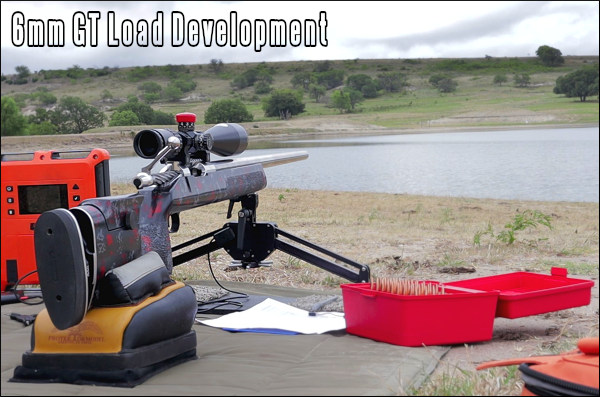
As someone who aspired to building a repeater and jumping into the PRS game, and had a spare F-TR rifle sitting around, I thought it would be fun to build up a 6mm GT to see if there was any merit to the hype. My smith, Wes Ripley of RIP Precision in Texas, builds a lot of PRS rigs, and already had the reamer on hand (a 0.120″ freebore variant).
Whidden Gunworks had some 6mm GT FL bushing die kits in stock, so I figured why not see what all the fuss was about? At the very least I could play around with the 6mm GT in F-Open Class at local club matches to see how it compared to the 6BRA, 6 Dasher, and other popular 6mm cartridges.
Click image to see video comparison of multiple 6mm cartridges by Quarter Minute Magnums.
How the Project Got Started with Backup F-TR Rig
My 6mm GT build really started as a project spawned purely from COVID-19 Isolation boredom. This rifle primarily serves as a backup F-TR gun, and it had been relegated to performing some load development on .308 barrels, so I could spin new ones on my main match rifle. The only problem was, I had run out of .308 barrels that needed load development. So, I basically had an ideal test platform just collecting dust in the safe. All I needed was a 6mm GT-chambered barrel, since (like the 6mmBR) the 6mm GT works in a short action with a .308 Win-sized bolt-face.
6mm GT Rifle Specifications:
Action: Kelbly Panda F-Class SA RB/RP
Stock: McMillan XIT with RAD 2A
Barrel: 30″ 5R Bartlein 1:7.5″-Twist, HV Contour
Scope: Vortex Golden Eagle 15-60x52mm
Trigger: Jewell Benchrest, about 2 ounces
Bipod: Phoenix Precision
Mike McCasland reports: “I have used both Hornady and Alpha brass in this rifle and haven’t noticed much difference between the two. I will say that my batch of Alpha brass was slightly softer than Alpha brass I’ve used in other calibers; you could feel a difference when neck turning cases. I’m unsure if that’s a batch issue, or something specific to their 6mm GT brass as a whole. As far as performance, there was little discernable difference. Oddly enough, the Hornady brass seemed to have slightly less case capacity than the Alpha; with most other cartridges it’s the other way around.”
In this video, George Gardner of GA Precision talks about the 6mm GT cartridge which he helped develop.
POWDERS — The 6mm GT was designed with Hodgdon Varget in mind, and that popular powder works exceedingly well in this platform. That said, the 6mm GT can work with a wide variety of powders, some yielding better performance than Varget.
I’ve tried a multitude of powders during my initial 6mm GT load development: Varget, Shooters World Precision, RL16, VV N140, H4350, and RL-15 to name a few. In my barrel, Hodgdon H4350 seems to deliver the best velocity/accuracy combination. SD and ES also seemed to be the lowest with H4350.
Load Development for the 6mm GT — Many Powders Tested
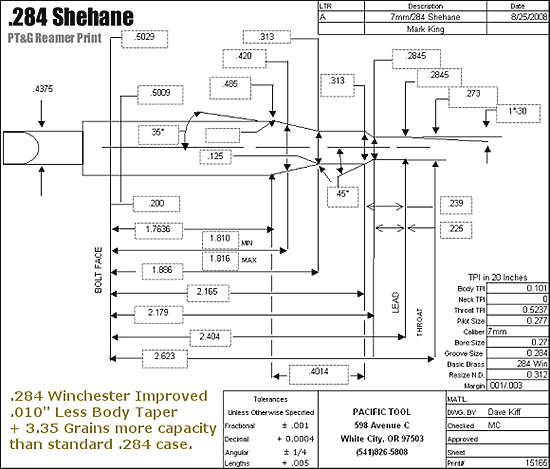
BULLETS — The most common 0.120″ freebore chamber allows for the majority of high-BC 6mm projectiles found in both F-Class and PRS. I had good luck with the pointed 107gr Sierra Match Kings (SMK), as well as the 110gr Hornady A-Tips in my rifle. For those looking to run the heavier 112-115 grain 6mm offerings, I believe GAP designed a 0.160″ freebore reamer that gets those bullets out of the neck/shoulder junction. Shown below is the 0.120″ freebore JGS reamer print:
SUMMARY — Good Cartridge with Much Potential
Generally speaking, I think the 6mm GT is a good little round. Some may not subscribe to this theory, but I believe some cartridges are inherently easier to tune than others. I’m not sure the 6mm GT is as easy-to-tune as a 6mmBR, 6 Dasher, or 6 BRA, but I don’t think it lags that far behind.
With relatively little trouble, I was able to find loads with both Varget and H4350 that would consistently shoot very well — 0.2 to 0.3 MOA. Moreover, I found the 6GT cartridge lives up to the velocity claims made by G.A. Precision. I was easily able to push the 110gr A-Tips to 2950 FPS, and the 107gr SMKs to low 3000 FPS range without any pressure signs, or unnecessary wear and tear on the brass.
As a fun test, I ran my 6mm GT rifle in a local 1000-yard F-Class match with the 110gr A-Tips, just to see just how well they would perform. Although wind conditions of the day and some E-Target issues prevented my 6mm GT rig from getting the better of the larger 7mm and .30-Cal rifles, the 6mm GT proved itself an accurate little round at distance. Here is a 1000-yard ShotMarker target:
After putting several hundred rounds through my 6mm GT rifle, I anticipate building another 6GT on a repeater action to give PRS a try. I think if you are looking for a dual-purpose rifle that can run tactical matches (with 100% feeding reliability), and can also be used for mid-range, F-Open Class competition, the 6mm GT would be a very good option.
About the author, Mike McCasland:
Mike McCasland is an avid shooter who competes regularly in F-Class matches. Based in Texas, Mike is the creator of the Texas Precision YouTube Channel. There you’ll find many videos covering reloading, gun projects, and marksmanship. Mike has done some notable product reviews including a comparison test of Micrometer Competition Seating Dies. To access Mike’s YouTube Channel, CLICK HERE.
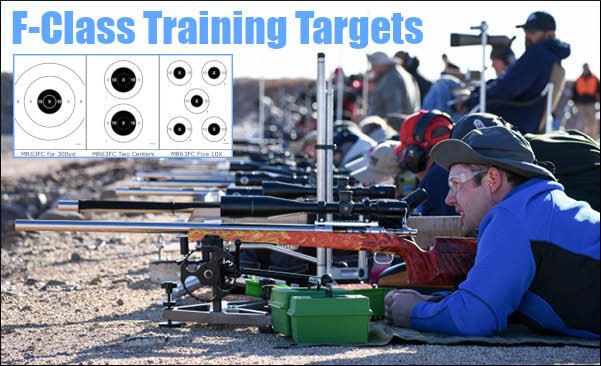
Here’s a handy training option for F-Class shooters. Forum member SleepyGator is an F-Class competitor, but there are no long-distance ranges close to his home. Accordingly, he wanted some “reduced-distance” targets he could use at 300 yards for practice. There IS an official reduced-distanced standard for 300-yard F-Class matches. This utilizes the NRA No. MR-63FC – F-Class Target Center which is pasted over the MR-63 target. It provides a 1.42″ X-Ring, 2.85″ 10-Ring, and 5.85″ Nine-Ring. We offer some free targets you can print out for use at 300 yards. The dimensions of F-Class targets are found in the NRA High Power Rules, Sec. 22, part 4, page 70-71 — see sample below.
To duplicate the 300-yard target, SleepyGator made a printable version of the MR-63FC Target Center, along with a pair of training targets with two bulls and five bulls. The two-bull and five-bull targets mirror the scoring rings on the MR-63FC, but they display only the innermost three rings and two rings respectively. All three targets are Adobe PDF files that can be easily printed.
NOTE: You may need to adjust the scale (sizing) on your printer to get the dimensions exactly correct. As noted above, when printed, the 10-Ring on all three targets should measure 2.85″. This should provide some handy practice targets you can use between matches. Thanks to SleepyGator for providing these targets. You can download all three as a .Zip archive. After downloading the .Zip file, just click on the .Zip archive to extract the individual targets.
Note the owner’s name, “S. Limbourne” was engraved on the bolt release (and trigger guard, see below).
Competition rifles don’t need to be beautiful, as long as they shoot. But who doesn’t like a spectacular figured-wood stock, particularly when it is combined with a superb custom action and a tack-driving barrel. This custom .284 Winchester F-Class Open division rig was crafted by gunsmith Thomas “Speedy” Gonzalez for competitive shooter Scott Limbourne. The handsome Bacote wood stock comes from Cerus Rifleworks, while the action is a polished Borden RBRP BRMXD. Two Brux 1:9″-twist barrels were chambered for the project, both finished at 32″. The stock is also fitted with a R.A.D. Recoil System. This rig has top-of-the-line hardware all around.
Action: Borden BRMXD – Polished
Rail: 20 MOA Polished
Chambering: .284 Winchester
Trigger: Jewell BR – Blueprinted
Barrel: (2x) Brux 32″ 1:9″ Twist
Stock: Cerus F-Open in Exhibition Grade Bacote
Recoil System: R.A.D. System
Extras: Carbon Fiber Tunnel Plate, Custom Engraving Work on Action, Trigger Guard, and Bolt Release.
You’ll find other impressive rigs on Speedy’s Facebook Page. If you’d like a superb custom rifle like this, call Thomas “Speedy” Gonzalez at 972-672-6630, or send email to: speedy.godzilla [at] msn.com.


 With the United States of America’s 250th birthday coming on July 4, 2026, just six days from now, we are featuring a handsome F-Class rifle with a patriotic theme. This rifle has the historic “We the People” phrase painted on its handsome Cerus stock. The phrase “We the People” is the famous opening to the Preamble of the U.S. Constitution. Adopted on September 17, 1787, this preamble indicates the government derives its political power directly from its citizens rather than from a monarch or government officials. This cool rig also features the U.S. Stars and Stripes flag on the buttstock.




 I am also a member at
 The 2026 Southwest Nationals (SWN) have concluded. Held at the impressive Ben Avery range in Arizona, the 2026 SWN was a very successful event with good conditions (for the most part) and impressive scores by shooters in all three divisions: Sling, F-Open, and F-TR. We congratulate the new SWN Grand Agg Champions: Bobby Gill (Sling), Ryan Mitchell (F-Open), and Brad Sauve (F-TR). This was familiar territory for Sauve who has won the SWN F-TR title before.













 As someone who aspired to building a repeater and jumping into the PRS game, and had a spare F-TR rifle sitting around, I thought it would be fun to build up a 6mm GT to see if there was any merit to the hype. My smith, Wes Ripley of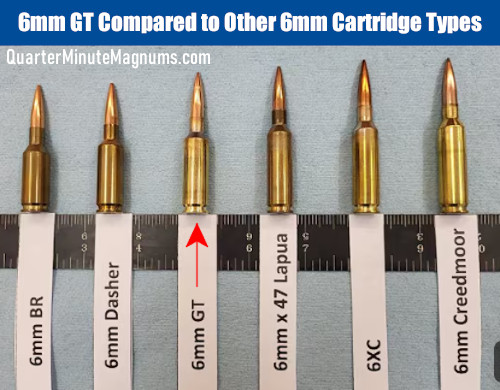


 BRASS — Editor’s Report: Lapua now offers excellent

 SUMMARY — Good Cartridge with Much Potential