At the request of our readers, we provide select “Deals of the Week”. Every Sunday afternoon or Monday morning we offer our Best Bargain selections. Here are some of the best deals on firearms, hardware, reloading components, optics, and shooting accessories. Be aware that sale prices are subject to change, and once clearance inventory is sold, it’s gone for good. You snooze you lose.
1. Amazon — The Wind Book for Rifle Shooters, $22.99
This is the NEW May 2020 Edition, Just Released!
Readers often ask: “Is there a good, easy-to-comprehend book that can help my wind-reading?” Many of our Forum members have recommended The Wind Book for Rifle Shooters by Linda Miller and Keith Cunningham. Other books cover wind reading in a broader discussion of ballistics or long-range shooting. But the Miller & Cunningham book is ALL about wind reading from cover to cover, and that is its strength. The book focuses on real world skills that can help you accurately gauge wind angle, wind velocity, and wind cycles. Here’s a video review explaining what makes this book so good.
2. Bullet Central — Farley Classic Edition Coaxial Rest, $1085
Whether for benchrest matches or F-Open, a well-made front rest is vital. Farley still makes quality, well-built rests that are favorites of benchrest shooters. Farleys are smooth-operating and match-proven.
The best way to get a Farley is to order from Bullet Central. Right now the Classic Edition Farley Rest is in stock for $1085 — nearly $300 less than some other well-known coaxial competitors.
If you want some more “bling” in your rest, Bullet Central also sells the exclusive Gold-finish Limited Edition Farley Rests. The Gold Coaxial II BR is $1265.00, while the Ltd. Edition Gold Coaxial II F-Class model is $1407.00.
3. Midsouth Shooters — All Berger Bullets on Sale
Time to stock up on projectiles! Right now Midsouth is running a big sale on Berger bullets. Pretty much all Berger competition and hunting bullets are on sale, including popular LRHT and Hybrid match bullets. You’ll find all your favorite calibers: .223, 6mm, 6.5mm, 7mm (.284), and .30 Caliber. Midsouth even has the new High-BC 109gr 6mm, 153.5gr 6.5mm, 190gr 7mm, and 208gr .30-Cal Long Range Hybrid Target bullets on sale. Go to SALE HERE.
4. MidwayUSA — Rem 700 Magpul 6mm Creedmoor, $724.99
This Rem 700 rifle qualifies for $75 Mfg. Mail-in Rebate. Net Price $649.99 with rebate.
Here’s a very impressive rifle in a fun, accurate caliber. Check out this Remington 700 Magpul Enhanced Rifle in 6mm Creedmoor. On sale now at MidwayUSA for $724.99, this rig features a 20″ Heavy Barrel (threaded muzzle) and Magpul Flat Dark Earth stock with internal chassis. Note, this rifle ships complete with M-Lok bipod mount and folding bipod PLUS an X-Mark Pro externally adjustable trigger. IMPORTANT: This rifle qualifies for a $75 Remington Rebate. That lowers your net cost to $649.99 (after rebate).
5. Midsouth Shooters — Hornady A-Tip Bullet Sale
Hornady A-Tip bullets have intrigued shooters with their unique design featuring an elongated aluminum tip. Hornady claims the A-Tips provide high, ultra-consistent BCs for every bullet in the box. These A-Tip bullets are packaged from small sequential production runs, again to ensure uniformity. Right now at Midsouth, you can grab these modern A-Tip bullets at some of the lowest prices we’ve seen.
6. Grizzly Industrial — Gun Case and Range Bag Clearance
It’s great when you can find high-quality gun cases and range bags at a serious discounts. Head over to Grizzly.com for the Bald Eagle gun case and range bag clearance Sale. You will some really great deals on rifle cases and very functional stiff-sided range bags. Please check the sizes. Most of the rifle cases are 45″. For a long-barrel match or PRS rifle you may prefer the 50″ model, offered for $37.77 in blue or red, or $41.97 in black. The range bags are high quality, with stiffening foam in the sides plus padded internal dividers. We use these range bags to carry our spotting scopes and other valuable gear.
7. Cabela’s — Garmin Portable GPS units with SatComs
The biggest fear many hunters or hikers have is being lost/stranded with no way to communicate for help. Quell those fears with Garmin’s satellite-enabled GPS units. The Garmin inReach Explorer and Garmin 66i GPS both feature interactive SOS, connecting you to the GEOS 24/7 search-and-rescue monitoring center. They also allow you to send and receive text messages, no matter where you are, via advanced inReach satellite technology. Yes you can communicate even if you are miles from the nearest cell tower. Cabela’s sale prices are quite a bit cheaper than other vendors.
8. Natchez Shooters Supplies — Hornady Ammo Sale
Hornady makes quality target and hunting ammunition in an amazingly large selection of calibers. Whether for hunting, PRS, target practice, or just fun shooting you’ll find appropriate Hornady ammunition on SALE at Natchez. This is a great chance to pick up some quality ammo at very attractive prices. But don’t hesitate — the most popular cartridge types may sell out quickly.
9. Amazon – Arctic Zone Cooler, $29.99
Being truly prepared for a long match or range day requires more than just bringing guns, ammo, rests, and targets. You also need to stay hydrated and eat properly. Accordingly, a smart shooter will have a quality cooler to hold food and beverages. We were impressed with the Arctic Zone hardbody cooler. This features a clever zipperless design that provides easy access while keeping your food chilled all day long even in the summer heat.
Here’s a great set of stick-on (adhesive) splatter targets. Shots appear as bright neon yellow halos — providing easy-to-see instant feedback. The $7.99 target packs include 10 sheets of black circles, 3″ in diameter, for shooting out to 300 yards and beyond. In addition, each sheet includes 8 smaller red center bulls plus 22 stick-on black dots. You can shoot the entire target sheet, or peel off one or more circles to stick on a target backer. These also work great indoors with pistols.
Today’s Sunday GunDay story features a beautiful F-Open rifle from Ireland. This was crafted a few years back, but it’s still one of our favorites. It has a handsome thumbhole custom stock, and it boasts an unusual chambering — the .300 Blaser Magnum. This impressive rig carries its barreled action in a massive barrel block — not often found in F-Class rigs.
Here’s a very impressive F-Class project from Enda Walsh of Custom & Precision Rifles in Ireland. This rifle features a free-floated BAT Machines ‘M’ action with a Benchmark barrel chambered in .300 Blaser Magnum (300 BM). The barreled action is secured with a large barrel block. This handsome, long-wheelbase F-Class rig demonstrated some stunning accuracy at 1000 yards when it was brand new. Enda tells us: “I couldn’t wait until the rifle was fully polished before testing. I went to MNSCI (Midlands National Shooting Centre of Ireland) to shoot my new barrel block rifle. I came home with a huge smile on my face after shooting a five-shot group with 1.5″ vertical and 3″ horizontal at 1000 yards in an 8 mph wind.”
Click Photo for full-screen version
AUDIO FILE: Enda Walsh Talks about his New .300 BM Barrel Block F-Open Rifle.
Below you can see the barrel block in the handsome Padouk wood and carbon fiber stock. Enda uses high-spec epoxy layered between the barrel and the aluminum barrel block. Yes, those three “super-sized” cartridges are .300 Blaser Magnums loaded with with 230gr Berger Hybrids. The smaller cartridge is a .308 Win (with 150gr bullet), provided for comparison. This .300 BM drives the 230s at 3140 FPS.
.300 BM Runs 230-grainers at 3140 FPS!
Enda tells us: “I wanted something to beat the 300 WSM. After studying the .300 Blaser Magnum, I decided this was the [chambering] that could deliver high accuracy consistently and be able to shoot the 230gr Bergers at 3140 FPS. Using H1000 powder, they do very well but the case life is short at these speeds. We have backed them off a little and retained the accuracy and extended case life considerably.”
Enda says the 230gr Hybrids at 3140 fps drift much less in the wind than do 7mm 180gr Hybrids launched from a 7mm WSM. A quick run through JBM Ballistics for a 10 mph, full-value crosswind at 1000 yards (sea-level) tells the tale. JBM predicts 4.2 MOA horizontal deflection for the .30-caliber 230s at 3140 fps vs. 5.0 MOA for the 7mm 180s at 3050 fps. That 0.8 MOA difference represents more than 8 inches at 1000 yards. When you consider the small size of the F-Open X-Ring, you can see how the enhanced ballistics could be a game-changer in the wind.
Note the metal bag-rider “keel” on the underside of the buttstock.
Barrel Block Acts as Heat Sink
Enda needed a way to beat the heat, with this big case. He explains: “Because of the large case volume (roughly 82 grains of usable capacity) there are two issues. Firstly, throat wear, and secondly heat. To combat this I have a new reamer on order with slight alterations which will help the throat wear. To combat the heat affecting a 34″ barrel I decided to build a barrel block rifle. It was previously mounted in a standard stock, and when the barrel got too hot accuracy was an issue. The barrel block acts as a heat sink and also shortens the overhanging barrel considerably, which has greatly improved accuracy over a complete string. The block is made from aircraft grade aluminium.” As a final note, Enda wanted to thank Pacific Tool & Gauge for the special-order reamers.
More .300 Blaser Magnum F-Classers from Enda Walsh in Ireland
Here are three more .300 Blaser Magnum F-Class rifles Enda built for the 2014 European Championships at the Bisley Range in the UK. The color scheme comes from the Irish Flag.
And here is Enda Walsh himself shooting of of these rifles in Ireland:
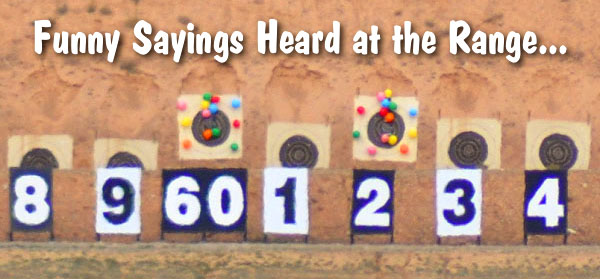
Shooting can be a frustrating sport at times, prompting shooters to say some funny things in the heat of the moment. Here’s a collection of humorous range ripostes, supplied by Shooters’ Forum members (who are listed after each quote). Enjoy. (CLICK HERE for full Forum Funny Saying Thread).
“I paid to use all of the target and I’m getting value for money on all of the real estate!” (Macropod)
“How did I do?” “Well the gun went off and nobody got hurt, we can build on that….” (Mr. Majestic)
“Treat that trigger likes it’s your first date, not like you’ve been married to it for 20 years.” (Jet)
“It’s a good thing broad sides of barns aren’t at many shooting ranges.” (Rocky F.)
“At 65 years of age, 1000-yard benchrest is better than sex, because a relay lasts 10 minutes!” (The Viper)
“If you chase the wind, it will always win.” (Boltline13)
“It’s not the arrow, it’s the Indian.” (Rocky F.)
“It was an 0.2″ group! Well, err, except for that flyer….” (Dsandfort, photo by RyanJay11)
“I can’t understand it. That load worked good in my other barrel”. (Hogpatrol)
“You bakin a biscuit?” Said to me as I was sitting at the bench ready to shoot with a cartridge in the chamber of a hot gun, taking longer than necessary. (Ebb)
“Shooting groups is easy. Just put the last three between the first two.” (Uthink)
“There is no Alibi for Stupid” (Seen at Berger SWN — Erik Cortina)
Shooter 1: “Hey you cross-fired on my target!” Shooter 2: “Well you cross-fired on mine first.”
Shooter 1: “Yeah but you could have at least shot an X like I did on yours.” (At Raton — Rocky F.)
“I had a bughole going and my second shot dropped straight down!” (JDMock)
“The nut came loose on the end of my stock.” (TXDan)
Quoting James Crofts: “That’s a pretty eight.” (REastman)
Because of the COVID-19 pandemic, many private and public shooting ranges have been closed. Thankfully many of those range closure orders have been lifted. This coincides with the easing of stay-at-home restrictions in many states. We know our readers want to get out of the house, and get to the range again. Plus experts say that being outdoors and getting Vitamin D exposure can help general immune system health — though you should still observe safe social distancing at public ranges.
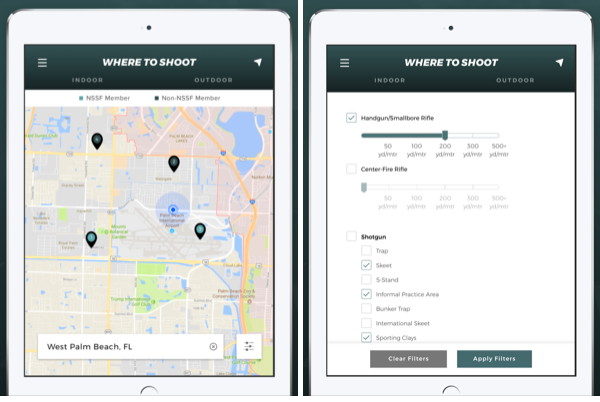
If you are looking for a nearby range, you can quickly find shooting facilities on the NSSF’s WhereToShoot.org website. There is also a handy Mobile App that lists ranges. NOTE — because range facility policies are changing on a day-by-day basis, you should always CALL the range before you pack your vehicle and hit the road. Also, find out the health policies in effect — are masks required, are there limits on group size, is social distancing mandatory?
A service of the NSSF (Nat’l Shooting Sports Foundation), WhereToShoot.org offers a Searchable Database of pistol, rifle, and shotgun ranges around the country. You can search by state, or select a particular distance from any zip code. The database is very complete. The individual range pages also include web addresses, phone numbers, and map links. The example below shows the results of a search for shooting ranges near Boulder, Colorado:
Where to Shoot Mobile App
The NSSF also offers a Where To Shoot Mobile App. Available for both iOS and Android devices, this App quickly locates shooting ranges near you, drawing on North America’s most comprehensive range directory. Users can search by current location, state, or zip code. Once you locate a range, you can view activities offered along with a summary of range facilities. You can even get driving directions.
The app is modeled after NSSF’s popular WhereToShoot.org® website and is updated frequently with range information for every U.S. state and Canadian province. Once you’ve located a place to shoot, the App can provide directions to the range. The App also includes video tips for shooters, news, and firearm-safety information.
There’s a good episode of Gun Talk Radio this Sunday 6/7/2020. In recent days we have witnessed mass protests, rioting, arson, looting, and even murder in the streets. We have also seen business owners successfully defending their property. The unfolding crisis of urban unrest and violence have certainly caused Americans to consider armed self-defense.
Protecting your family, home, and property during crisis is the focus of Tom Gresham’s Gun Talk® Radio this week. This Sunday, Tom talks with security expert Wayne Black about current events — the rioting and violence. Black talks about training for first-time owners, and explains how best to protect yourself and your family in the case of a riot. Notably, some armed business owners have had success defending their stores — much like the Korean store owners did during the Rodney King riots in Los Angeles. Listeners can call to talk with Wayne and Tom about self-defense and armed security. Call 866-TALK-GUN with your comments and questions, and range reports.
Gun Talk Radio — Podcast Archive
If you miss the live show broadcast or Live Streaming, past broadcasts can be heard online via the GUNTALK PODCAST Site and Apple iTunes. The Gun Talk Podcast Archive has hundreds of past shows you can access via the internet. Listen via your home computer or mobile device. Here’s a recent podcast focusing on firearms selection for self-defense.
Gun Talk Podcast from 5/31/2020 — Security, Riots, and Gun Choices:
All Gun Talk shows are also archived as podcasts for download or online listening. Gun Talk is also available on YouTube, Roku, Apple TV, Amazon Fire TV, and GunTalk.com.
What will a pandemic combined with social unrest do to gun sales? Drive them through the roof. Last month’s gun sales are up 75% compared to May of 2019, based on Criminal Background Check System (NICS) data, as adjusted by NSSF. Look at that spike in the chart!
NSSF explains that the May 2020 1,595,790 checks figure represents an increase of 75.2 percent compared to the May 2019 NSSF-adjusted NICS figure of 910,910. What does “adjusted” mean? The adjusted NICS data were derived by subtracting out NICS purpose-code permit checks and permit rechecks used by states for CCW permit application checks as well as checks on active CCW permit databases. For comparison, the unadjusted May 2020 FBI NICS figure 3,066,740 reflects a 32.1 percent increase from the unadjusted FBI NICS figure of 2,320,918 in May 2019.
Though not a direct correlation to firearms sales, the NSSF-adjusted NICS data provide an good picture of current market conditions. It should be noted that these statistics represent the number of firearm background checks initiated through the NICS. They do not represent the number of firearms sold or sales dollars. Based on varying state laws and purchase scenarios, a one-to-one correlation cannot be made between a firearm background check and a firearm sale. For more NICS information or to view the current monthly reports, visit the NICS website.
How to Receive Regular Data Reports from NSSF
Want to get regular sales reports? Then consider joining the NSSF. All NSSF members are able to access historical monthly NICS data by logging in and clicking on “Industry Research” then “NICS Data”. Questions concerning NSSF-adjusted NICS data should be directed to NSSF at 203-426-1320 or research@nssf.org.
A decade-and-a-half ago, our friend Robert Whitley created the 6mmAR, a wildcat based on the 6.5 Grendel necked down to 6mm. The great thing about the 6mmAR cartridge is that is offers superb accuracy with high-BC 6mm bullets, while working in AR15-platform rifles. The 6mmAR feeds and functions using 6.8 SPC or 6.5 Grendel AR magazines. We provided a full report on the 6mmAR way back in 2006.
Hornady Introduces the 6mm ARC Cartridge for AR15 Platform
Now Hornady, with no apparent credit to Whitley’s 6mmAR, has announced a copycat cartridge, which it calls the 6mm ARC (Advanced Rifle Cartridge). Hornady will offer loaded 6mm ARC ammunition and also cartridge brass. In addition Hornady will produce reloading dies, shell plates, modified case, and other accessories. SEE 6mm ARC SAAMI Specification.
Hornady states: “Hornady® is proud to introduce the new 6mm ARC (Advanced Rifle Cartridge). Recently tested, selected and fielded by a specialized group within the U.S. Department of Defense for its multipurpose combat rifle program, the 6mm ARC is a truly versatile cartridge that maximizes the potential of the AR-15 platform.” Hornady Ballistician Jayden Quinlan adds: “We subsequently modeled and tested a variety of designs in different calibers until we were able to produce the most flexible cartridge possible within the limits of the AR-15 system. The 6mm ARC does much of what larger cartridges can and everything that smaller cartridges can’t.”
NOTE: The rim diameter (0.441) and thickness of the 6mm ARC appear to be identical to the 6.5 Grendel as illustrated on page 40 of the SAAMI Industry Standards. From all we can tell, in other dimensions as well, this is a very close copy of Robert Whitley’s 6mmAR, a 6-6.5 Grendel wildcat. For example, 6mm ARC case length is 1.49″ vs. 1.51″ for 6mmAR. The Guns&Ammo report on the 6mm ARC states: “The 6mm ARC is based on the 6.5 Grendel. Hornady started by necking down the cartridge to 6mm and then pulled the shoulder back closer to the case head .030-inch. … Hornady also set maximum chamber pressure low at 52,000 pounds PSI. This slows extraction and makes it much less violent, prolonging the bolt’s life.”
There is an extensive discussion of the 6mm ARC on the Gun University website. You’ll find dimensions and performance numbers for the new cartridge along with videos showing the 6mm ARC cartridge tested in a Barrett AR-type REC7 DI rifle. Read Gun University Story HERE.
More Velocity Than a .223 Rem, Less Weight and Recoil Than a .308 Win
Hornady says the 6mm ARC “delivers substantially better ballistics than the [.223 Rem] and offers a much lighter gun/ammo system with 30% less weight than the AR-10/308 Win system. This new cartridge delivers less felt recoil than larger short-action-based cartridges, yet takes full advantage of modern, heavy-for-caliber 6mm bullets that provide excellent accuracy and ballistic performance at extended range.”
You can see a ballistic comparison between 6mm ARC, .223 Remington, and .308 Winchester in this Hornady chart:
Notably, a large number of AR gun-makers have committed to producing rifles or uppers chambered for the 6mm ARC. Some of these are: Adams Arms, Barrett, Brownells, Christensen Arms, GAP, Howa, Mossberg, Noveske, Odin Works, Radical Firearms, and Wilson Combat. In addition Geissele and CMC Triggers are listed as suppliers on Hornady’s 6mm ARC webpage.
The Proven Lapua Brass Alternative — 6mmAR and 6mmAR Turbo
If you want 6mm ARC performance in your AR15 with superior case life and consistency, consider doing the 6mmAR or 6mmAR Turbo instead. These are proven designs with winning records in high power competition. Redding produces dies, and complete uppers (with proper Grendel-sized bolt face) are available from 6mmAR.com.
Superior Accuracy with Impressive Ballistics
Robert explained to us: “Lapua’s Grendel brass is of exceptional quality, very hard at the back, with a well-annealed neck area, and it has a small primer pocket and small flash hole. When you start with this kind of brass, you have all the ingredients of great accuracy. Necked down to 6mm, it is like a long-bodied 6 PPC, that feeds and shoots well out of an AR-15. This gives you a case that can handle high pressures, with the accuracy pedigree of the 6PPC. It doesn’t get much better than that.”
To create the 6mmAR simply neck-down parent Lapua 6.5 Grendel brass, which has small primer pocket and small flash hole. Case capacity is 36.0 grains of water, filled to over-flowing. (For comparison the 6mm PPC holds about 32.5 grains). To prepare cases, simply run the 6.5 Grendel brass through a Redding 6mmAR full-length sizing die. The FL die’s internal neck diameter (0.267″) is spec’d to deliver about .004″ tension on the bullet–just right for a gas gun. Redding’s 6mmAR dies were built to Whitley’s specs and closely match the actual dimensions of the Lapua brass. This video from Robert Whitley shows how to form 6mmAR cases from Lapua 6.5 Grendel brass.
Velocities: With the recommended medium-burn-rate powders, bullets in the 85- to 90-grain range can be pushed to the 2800 to 2850 fps range. In most 6mmAR rifles, the 105- to 107-grain bullets can be driven to velocities of 2700 to 2750 fps in a 24″ or longer barrel. More speed is possible, but don’t count on it with the average barrel. If you want more speed the 6mmAR Turbo offers additional case capacity. This allows the 6mmAR Turbo to drive the heavier 6mm bullets at velocities close to 6mmBR Norma cartridge levels.
Magazines: The correct magazines are the key to a reliable, competition-worthy system. For best results with the 6mmAR or 6mmAR Turbo, use special 6.8 SPC mags or Alexander Arms Grendel mags. Those specialized mags will provide better reliability than standard .223 Rem/5.56 mags for the AR15.
In a preceding story, we revealed the 6mm ARC cartridge from Hornady. This is VERY similar to the 6mmAR cartridge based on the 6.5 Grendel, which was developed by Robert Whitley a decade and a half ago. Hornady developed the 6mm ARC is cooperation with the U.S. Department of Defense (DOD), and now the first run of 6mm ARC black rifles is heading to DOD testers. Barrett Firearms Manufacturing, Inc. (“Barrett”) has announced that it has partnered with Hornady to chamber the REC7 rifle series in the new 6mm ARC offering. The first production run of these rifles has been delivered to the U.S. DOD, fulfilling a contract that was awarded to Barrett late last year. READ MORE HERE.
Barrett states: “The combination of the proven REC7 DI gas system and the potent 6mm ARC cartridge creates a product that is consistently accurate and easy to shoot. Carrying 24 rounds in the magazine, the 108 gr. ELD Match bullets leave the 18″ Proof Research match grade stainless steel or carbon fiber barrel at over 2630 fps. This easily gives the rifle supersonic capabilities past 1000 yards.”
In this video Ryan Cleckner (Former U.S. Army Ranger) tests the Barrett REC7 chambered in 6mm ARC:
Jewell triggers are still the most-used triggers on competition benchrest and F-Class rifles and they are also popular for hunting, varmint, and tactical rifles (with or without safeties). While a Jewell trigger can work for years with minimal maintenance, if the trigger becomes gunked up, it may be necessary to disassemble the trigger for a thorough cleaning. Our friends Ed and Steve, aka the 6.5 Guys, have produced a helpful video that shows how to disassemble and then reassemble a Jewell trigger.
Why You May Need to Disassemble Your Jewell Trigger — the 6.5 Guys
Jewell triggers are a popular choice in the sport of long range precision shooting, and like everything else require regular cleaning and maintenance. In most cases they can be cleaned with charcoal lighter fluid or dropped into an ultrasonic cleaner. Should the situation require, they can be completely disassembled according to the Jewell Trigger Manual.
We ran into a situation where we had to dissemble a trigger due to the entrapment of some sticky dirt that couldn’t be removed with an ultrasonic cleaner. Our first step was to find some step-by-step instructions but we couldn’t find anything.
Recognizing that other shooters might be in the same situation we produced a step-by-step guide and video, published in full on 65Guys.com. These instructions will work with a left- or right-handed trigger. In our case we worked with a left-handed BR model trigger with safety and bolt release.
Step-by-Step Instructions are provided on 65Guys.com website. We recommend you read all the instructions carefully before you even think about disassembling your trigger. This video explains the process so you can get a sense of what is involved.
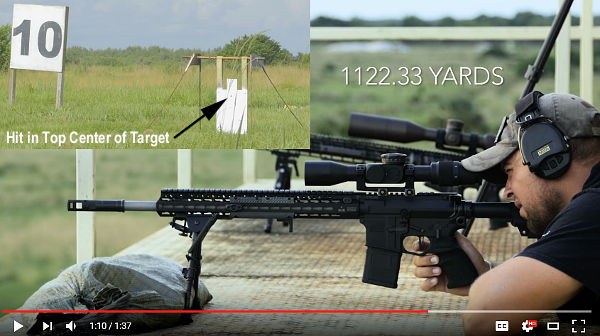
Many of our readers have never had a chance to shoot much past 600 yards. How far away does a 1000-yard+ target really seem to the naked eye? Well this short video answers that question. Gorilla Ammo, the video’s producers, used a camera-carrying aerial drone to fly downrange from the firing line all the way out to 1122 yards (and back again). Watch the drone footage at 0:00-0:07 and especially 0:48-1:03. The “bird’s-eye view” really gives you a sense of the distance. The “fly-back” at 0:48-1:03 time-mark is what makes this video worth watching.
The video features prone shooting at steel targets placed at 750 and 1122 yards. We do apologize for the lame, “oh so serious” voice-over which attempts to make this rather ordinary range session seem like some kind of life-changing experience. (Frankly, you may just want to turn the sound off — it’s that annoying.) It’s really not that big a deal to hit steel at 750 yards with a quality AR-15, chambered in .223 Rem, shooting Sierra 77 grain MatchKings.
Hitting Steel at 1122 Yards with 2540 FPS Ammo Can Be Challenging
The 1122-yard hits are a bit more impressive. Gorilla Ammo lists a relatively sedate 2540 fps Muzzle Velocity for its .223 Rem 77gr SMK ammunition. According to JBM Ballistics, at 1125 yards, that 2540 fps load has 68.3 MOA of drop from a 100-yard zero (firing at sea level and 80° F ambient). Morever the bullet goes trans-sonic around 750 yards (losing stability) and is traveling just 933 fps at impact. And the wind’s the killer — at 1125 yards, with this bullet/load, a mere 2 mph, full-value wind change can move the Point of Impact over three feet!


 The best way to get a Farley is to order from Bullet Central. Right now the Classic Edition Farley Rest is in stock for $1085 — nearly $300 less than some other well-known coaxial competitors.


 Here’s a very impressive F-Class project from Enda Walsh of

 .300 BM Runs 230-grainers at 3140 FPS!