Today is election day. Make sure you get out and vote. Let your voice be heard. These are challenging times for firearms owners. There are many groups and politicians in this country who want to ban all handguns, ban all semi-automatic rifles, and yes, even repeal the Second Amendment. If you believe in the Constitution, believe in the Second Amendment, it is vital that you get to the polls and cast your vote.
There are many other important issues at stake in this election — control of Congress, infrastructure spending, foreign policy, immigration policy, Federal Lands policies, and that’s just on the national level. State and local elections are important too. So be an involved citizen and exercise your right to vote.
Your Vote Is Your Voice
The NRA Institute for Legislative Action states: “Our Second Amendment rights are being threatened by the anti-gun forces like never before. If you have been following the news, more than likely you have seen the fervor with which our opponents are pushing their agenda.
We need America’s Second Amendment supporters to speak out by using their vote on Election Day to reject this anti-freedom agenda and elect lawmakers to office who support the Second Amendment.”
Readers who have just recently discovered the Daily Bulletin may not realize that AccurateShooter.com has hundreds of reference articles in our archives. These authoritative articles are divided into mutiple categories, so you can easily view stories by topic (such as competition, tactical, rimfire, optics, shooting skills etc.). One of the most popular categories is our Technical Articles Collection. On a handy index page (with thumbnails for every story), you’ll find over 120 articles covering technical and gunsmithing topics. These articles can help you with major projects (such as stock painting), and they can also help you build more accurate ammo. Here are five popular selections from our Technical Articles archive.
Stress-Free Pillar Bedding. Richard Franklin explains how to do a top-quality bedding job, start to finish.
OnTarget Software Review. Our Editors test free software that measures shot groups with great precision. We explain how to use the program and configure advanced features.
Savage Action Tuning. Top F-TR shooter Stan Pate explains how to enhance the performance of your Savage rifle by optimizing the torque settings of the action screws.
Complete Precision Case Prep. Jake Gottfredson covers the complete case prep process, including brass weight sorting, case trimming, primer pocket uniforming, neck-sizing, and, case-neck turning.
Stock Painting Instructions. Step-by-step guide for stock painting by expert Mike Ricklefs. Mike shows both simple coverage and fancy effects.
At the request of our readers, we provide select “Deals of the Week”. Every Monday morning we offer our Best Bargain selections. Here are some of the best deals on firearms, hardware, reloading components, optics, and shooting accessories. Be aware that sale prices are subject to change, and once clearance inventory is sold, it’s gone for good. You snooze you lose.
1. RCBS — Save 25% on Select Dispenser/Scales, Progressive Presses, Prep Centers, and Ultrasonic Machines
RCBS wants you to “buy green” in November. Now through November 30, 2018 you can get 25% Instant Savings on a variety of RCBS’s most popular products, including the ChargeMaster Lite, ProChucker Progressive Presses, and both the Trim Mate and Universal Case Prep Centers. Ultrasonic cleaning machines are also discounted. This is easy-peasy — no forms to fill out and no waiting on rebates. Just shop at your favorite retailer, and you’ll find qualifying products 25% cheaper than last month.
Looking for an out of the box sub-MOA rifle for under $1000? CDNN has the Weatherby Vanguard Chassis Rifle on sale for $899.99. This features a Vanguard action affixed to a CNC-machined, 6061 aluminum chassis with a black, hard-anodized finish in two great calibers for only $899.99. You can also pick up the .223 Rem version $899.99 as well. This price probably won’t last long so grab it while you can.
Need a practical mid-power, milrad scope at 60% off? Here’s a deal you don’t want to pass up. Natchez has the Burris MTAC 4.5-14x42mm tactical scope for just $219.99. The scope’s Ballistic Milling Reticle is a milrad-based reticle with .5 mil and 1 mil hash marks on the horizontal crosshair and top half of the vertical crosshair. These hash marks allow for precise distance measurement, and assist in proper hold-off for wind. At a savings of nearly $330, this is a steller optics bargain for anyone looking for a milrad scope.
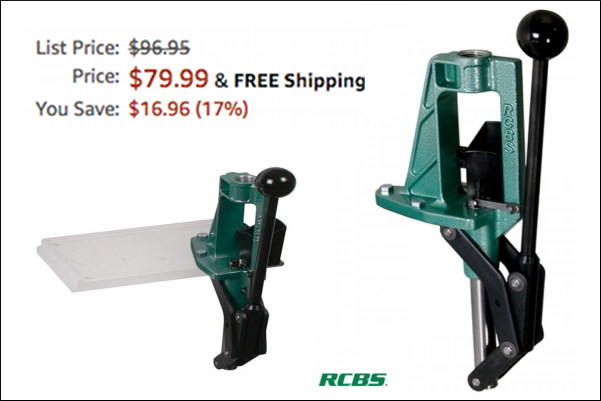
4. Amazon — RCBS Partner Press, $79.99
Wish you had a partner when you reload? Now you do when you pick up this RCBS Partner Press from Amazon for just $79.99. The Partner Press is easy to use and incredibly durable, yet is the most affordable press in the RCBS line. It’s perfect as a second press for different operations or a portable press for use at the range. You can also pick up an entire RCBS Master Reloading Kit on Amazon for $319.49
5. Bruno’s — CCI BR-4 Small Rifle Benchrest Primers, $47.95
Screaming deal? Well, no. But when you need them you’ll wish you had stocked up at this price. Bruno’s has the hard-to-find CCI BR-4 small rifle primers marked down to $47.95. An independent researcher identified the use of CCI Benchrest primers as one of two factors that were the most significant contributors to tiny groups. If you’re not using these already and are looking to tighten your groups this just might be the answer. While not on sale you can also find the CCI BR-2 Large Rifle Primers for $54.60.
6. EuroOptic — Leica CRF 2000-B, $399.00
This may be the best deal we’ve seen on the vaunted Leica 2000-B Laser Rangefinder (LRF) with 7-power optic. This unit is rated out to 2000 yards on reflective objects (in real-world use it will laze a deer well past 800 if you can hold steady). The Leica 2000-B features air pressure and temperature sensors, plus on-board inclinometer. Angle correction works out to 1200 horizontal yards equivalent, with the true hold-over displayed in both MILs and MOA. The compact Leica CRF 2000-B weighs just 6.5 ounces and measures 4.5″ L x 2.25″ H x 1.25″ W. It has a waterproof outer shell.
7. Brownells — RCBS Trim Mate Case Prep Center, $93.99
Case prep can take forever, so why not save time and your hands with the Trim Mate Case Prep Center. Five gear-driven rotating heads turn the tasks of chamfering, deburring, primer pocket cleaning, military crimp removal, and flash hole deburring into a much easier job. Brownells now has the Trim Mate Case Prep Center on sale for just $93.99 marked down from $124.99, a 25% savings. A power case prep center speeds up tedious tasks dramatically, and your brass will probably come out more consistent. IMPORTANT: This savings is part of an RCBS November Promotion.
8. Midsouth — SALE on Nosler Bullets and Brass
We like Nosler products. The brass is good, the hunting bullets are legendary, and Nosler match bullets display impressive performance for the price. Right now at Midsouth there are substantial discounts on a wide variety of Nosler brass and bullets. Hey 6.5 Creedmoor shooters — take note: 6.5 Creedmoor brass and the excellent 130gr and 140gr 6.5mm RDF HPBT bullets are on sale now.
9. Amazon — Neiko Digital Calipers, $17.85
Even if you have a good set of calipers, you may want to get one of these Neiko 01407A Digital Calipers. The #1 best-selling digital caliper on Amazon.com, this Neiko tool features a large LCD Screen and measures up to 6.0 inches. With over 3000 customer reviews, this product has earned an overall rating of 4.4 out of 5 stars. It’s hard to go wrong for $17.85, even if you just use these as a spare set for measuring group sizes and case trim lengths.
10. Midsouth — 250 Adhesive Precision Targets on Roll, $12.49
Midsouth offers 250 self-adhesive Benchrest Targets on a convenient roll. These stick-on targets work great for load development. The aiming diamond helps align the cross hairs of your scope for consistent shot placement. If you set your Point of Impact to the 1/4″ grid pattern at the top it’s easy to eyeball your group size. At the bottom are fields for your load info. Each Target sticker measures 6″ x 4″ with a 4.5″ x 2.5″ printed area. Midsouth sells the 250-target roll for $12.49, discounted this week from $14.99.
Credit our Bargain Hunter, Forum member F-Class John, who found most of the deals this week.
The First Shot, the CMP’s online magazine, features a well-written article on Prone Shooting Technique by SPC Matthew Sigrist of the U.S. Army Marksmanship Unit (USAMU). The article covers all the major points of gun hold and body position: hand position, elbow position, stock weld, buttstock placement, and sling position/tension.
Keep it Steady — The Elements of a Good Prone Position
Part 1 — Building the Position By SPC Matthew Sigrist
Imagine the following scenario: You are at the last stage of fire in the National Trophy Individual Match, firing at the 600 yard line in the prone position and every point matters. What should you reflect on as you prepare to shoot this final string? As your eyes cloud from sweat, you realize that all you have to rely on is your experience and knowledge of the fundamentals.
During the National Trophy Individual Match, you will fire 60 percent of your shots from the prone position. This article will address the fundamentals of a good prone position and help you learn the techniques required to be successful in both the slow and rapid-fire stages of National Match competition.
This article will be divided into two parts. In part one, we will discuss the elements of a good prone position. In part two, we will cover the techniques you will in the rapid-fire and slow-fire stages.
The Fundamentals
The fundamentals are the building blocks of a position. Much like the framework of a house, a correct application of the fundamentals ensures a solid and stable structure. Since each person’s position will depend on their particular body build and shape, there is no “perfect position” that applies to everyone. Experience, practice and knowledge of the correct fundamentals will dictate the best position for you.
There are six key elements of any position. The purpose for these six points is to achieve a solid platform that allows for consistent sight alignment using the least amount of muscle tension.
1. Placement of the Firing Hand (the hand that pulls the trigger)
The firing hand needs to be placed high on the pistol grip. This high hand position will give you better control of the rifle. Combined with a firm grip there will be a reduced amount of hand movement when pulling the trigger. Wrap your thumb over the three fingers on the pistol grip (excluding the trigger finger). This will help isolate the movement of the trigger finger.
2. Placement of the Non-firing Hand (the hand supporting the rifle).
The non-firing hand should grip the handguard or stock in the flat portion of the hand between the thumb and forefinger. The fingers should curl naturally around the stock, but they should not grip it tightly. The position of the hand on the stock will depend on the physical size of the shooter. Generally speaking, taller shooters with longer arms will grip the rifle further out, near the sling swivel, while shorter shooters will need to pull their hand rearward. This is sometimes referred to as “short-stocking” the rifle.
3. Stock Weld
Stock weld is the contact that the face makes with the stock. It is important because it directly effects your sight alignment. Consistent head placement will help you achieve consistent sight alignment. The human head weighs an average of 8 to 10 pounds. The full weight of the head must rest on the stock. In doing this you achieve two things, a relaxed neck and reduced recoil because of the pressure of the head.
4. Placement of the Rifle (the contact that is made in the firing shoulder)
The rifle butt placement needs to be consistent. If this changes between shots, it effects your sight alignment and the effect of recoil. In the prone position the rifle will sit lower in the shoulder compared to other shooting positions. This allows for a more forward head and a lower position as a whole.
5. Position of the Sling
The sling should be high on the arm, above the bicep. This way the sling will have less leverage on the arm so it doesn’t cut off the circulation.
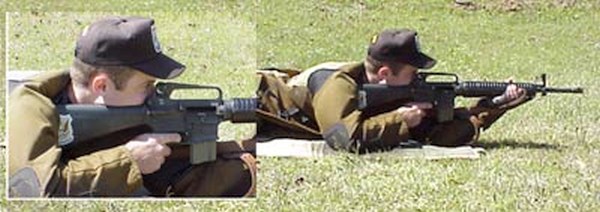
Demonstration of the placement of the firing elbow (left) and non-firing elbows (right).
6. Placement of both the firing, and non-firing elbows
A guideline for non-firing elbow placement is that there should be 1 ½’’ to 2’’ gap between your non-firing arm and the rifle’s magazine. (NOTE: this references the AR-15 service rifle) Your arm should be almost straight up and down; this will transfer the weight directly down the arm and not to the side (see picture above). Think of the firing arm as only a kind of kickstand, it doesn’t support weight it only holds the firing hand in position.
Variations of the Prone Position
There are two main variations of the prone position; open/spread legged, and bent-legged. The two types will be discussed below.
Open/Spread Leg Position
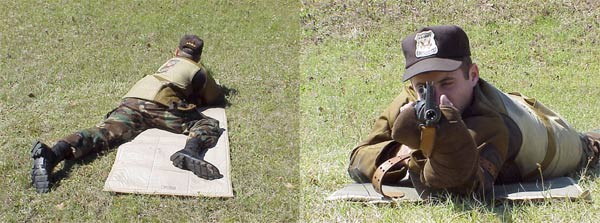
Demonstration of the Open/Spread Leg Position.
The first position is the open/spread legged position. This is when the shooter spreads their legs shoulder width or more apart. This allows for a more forward pressure on the sling and elbows. This position requires a tighter sling and solid elbow placement. The rifle should sit tight in the shoulder. With this position, your body will be farther behind the rifle compared to the bent leg position, allowing for minimum disturbance from recoil.
Bent Leg Position
Demonstration of the Bent Leg Position.
The bent leg position is when the shooter bends the firing side leg up towards the firing hand making the knee at a rough 90 degree angle to the body. The non-firing leg will remain straight and inline with the body. This will take pressure off the lungs and heart minimizing the pulse from the chest as well as easing the pressure on the lungs which will allow for easy breathing and control.
Summary
You now know the fundamentals of a good prone position, as well as the two types most commonly used. Extensive dry-firing will reveal which is the best position for you. If possible, have a friend take pictures of you in position. This will enable you to better diagnose and correct your errors. Remember, a position must be both fundamentally sound and comfortable. Practice frequently to learn your new position and to develop the conditioning required to endure long days on the range.
Here at AccurateShooter.com, we’re more about rifles than pistols. But we know that the majority of our regular readers own handguns, and many also have concealed carry (CCW) permits. Our editors also enjoy shooting pistols, both rimfire and centerfire. Accordingly, we try to provide helpful insights for the pistoleros out there. We found a great article on the Shooting Illustrated website that showcases a huge variety of holsters — 30 in fact. Each holster is illustrated, with pros and cons explained. These are all EDC holsters, meaning those designed for “Every Day Carry”.
Shooting Illustrated calls this article “HolsterPallooza” and it really does provide a ton of helpful information. Most other holster reviews on the web may feature a half-dozen holsters at the most. In this Holsterpallooza article you can see 30 holsters, with a wide variety of materials, designs, and applications. There are small molded IWB holsters for CCW, conventional on the belt holsters, leather shoulder holster rigs, and even ankle holsters. This is a great place to start if you are in the market for a holster.
Here’s sample of the many holster options reviewed, an innovative hybrid IWB holster constructed with leather over Kydex. That gives you the “best of both worlds” — the secure fit/retention of a molded Kydex shell, with an attractive leather exterior.
Shooting Illustrated explains: “As the interface between your gun and your body, the holster is a vital component of your carry rig. In many cases, the circumstances of your daily life will determine the method of carry you choose. This, in turn, will determine what type of holster you need, which may end up determining the handgun you carry. Therefore, choosing the method and type of holster may be as, or even more important than, choosing a firearm.”
Hickok 45 Reviews CCW Holsters:
If you want to see even MORE holsters for “Every Day Carry” (EDC), check out this video from Hickok 45. This popular YouTube host looks at 15 different IWB holsters from a number of manufacturers. Hickok 45 examines many hybrid holsters that combine Kydex or plastic with leather for increased comfort. He has his favorites… and they might not be what you’d expect. NOTE: As this video has been watched over 810,000 times, you may also want to read the viewer comments. There are many helpful suggestions from CCW holders who carry daily.
In the wintertime, it’s common to encounter problems with static electricity when throwing your powder charges. The static can cause powder kernels to cling to the surface of reloading components, and can cause powder clumping. Clumped or sticky powder may make your measure bind or grab in the middle of the cycle, which can throw off your charge weight. Here are a couple simple ways you can minimize the effects of static electricity and improve the consistency of your powder measuring.
Ground Your Powder Measure — If you’re throwing powder charges in the fall or winter and have problems with bridging or sticking powder, use a ground wire. Bullet-smith Victor Johnson (Johnson Precision Bullets) tells us: “I have a 25-foot piece of real small wire with alligator clips on each end. It’s that long so I can run it down the hall to a water pipe. Use the wire tie from a bread bag to hold it in a small roll to put in the range box. When using it at the range use a 6″ nail from the co-op or Lowe’s / Home Depot and just push it into the ground.”
Use Bounce Dryer Sheets — A quick pass with the thin sheets used in dryers will eliminate “static cling” on your plastic reloading parts like powder throwers, powder funnels, and reloading press guides. Thanks to Doc76251 for this tip.
Reduce Electronic Scales’ Drift with Anti-Static Spray
Reloading Tip by GS Arizona from Riflemans Journal
Apparently reducing static charges on and around electronic scales can reduce their propensity to drift, lessening the problem of “wandering zero”. Just how and why static charges interfere with scale performance is unclear, but many shooters have noticed that static electricity can cause electronic scales to behave strangely. So how do you reduce static charges around your digital balance? GS Arizona has found a very simple solution — an anti-static aerosol spray — that, by all indications, actually works. When this “spray-can solution” was suggested by a fellow shooter, GS was skeptical. However, he tried the stuff and he says that it really does help the scale maintain zero over time, with much less observed drift.
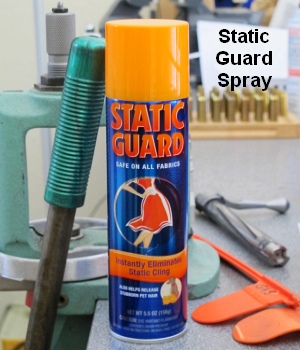
GS explains that the use of “Static Guard” spray helped mitigate the problem of a drifting zero on his Ohaus electronic scale: “My electronic scale… suffers from drifting zero (as they all seem to). I’ve read dozens of forum posts about drift and how to minimize its occurrence, so I know this problem isn’t limited to my scale or my workshop. Sometime last year, John Lowther mentioned the use of anti-static spray as a solution to the drift problem. John stated that the spray had virtually eliminated drift for him.”
GS found that the Static Guard actually worked: “The spray works great, just as John said it would. I spray all surfaces that I touch with my hands and arms as well as the pan (top and bottom), the metal tray on which the pan rests and the table under the scale. In six months or so of using the spray I’ve re-applied it about two or three times; it certainly isn’t something that you need to do each time you sit down to load. Before using the spray, it was not uncommon for me to re-zero the scale 10 times in the course of loading 72 rounds; now it might need it once during a session.”
Mossberg has a pretty nice rifle that would work well for varminting and tactical/practical games out to 1000 yards. You may not have seen this before, but we think it offers a decent turn-key solution for around $700. Mossberg’s MVP Long Range (LR) boasts a nice adjustable stock and some innovative features. The LR model comes with a 20″ or 22″ (6.5CM) barrel in three popular chamberings: .223 Remington, 6.5 Creedmoor, and .308 Winchester. All barrels are threaded for suppressors or muzzle-brakes and come with a protective thread cap. Street price, without optics, is about $695.00 for 6.5 CM version. The .223 Rem accepts AR15 magazines while the .308 Win accepts AR10 and/or M1A mags. The LBA trigger adjusts from 3-7 pounds — we’d like to see it go a little lower for varmint work.
The MVP Long Range feature an adjustable-comb stock that’s comfortable and strong. The bottom (“toe”) of the rear stock is flat and straight, so it works well in a bag — that’s notably different than most factory rifles in this price range. We like this stock for shooting prone or from a portable bench on a varmint hunt. Gun weight is pretty light, 8 pounds (without optics) for the 6.5 Creedmoor version with 22″ barrel.
The MVP LR model features a pillar-bedded OD green stock with push-button adjustable Mosscote™ cheekpiece, patented LBA Adjustable Trigger (3-7 lbs.), oversized bolt handle, and Picatinny rail. All barrels are threaded for suppressors or muzzle brakes and come with a protective thread cap.
Mossberg’s MVP also comes in a shorter-barreled version with a more conventional stock and back-up iron sights. See that version in Mossberg’s article about Long Range shooting.
Function and Accuracy Field Testing
So how does it shoot? Sniper Central did a full review of the rifle, chambered in .308 Win. They praised the gun’s general build quality and liked the stock. Bench testing yielded 0.8 to 1.5 MOA groups with four kinds of factory ammo. In fairness, Sniper Central’s set-up looked very wobbly, with cheap sandbags front and rear. We bet the MVP LR would shoot better with a proper front rest, or even a quality bipod.
Sniper Central did complain about feeding from the magazine: “The most glaring [fault was] the stiffness with which the rifle feeds from the magazine when there is more than one round in it. The feeding process is rough and stiff, which we think can be attributed to those two protrusions on the bottom of the bolt that aide in feeding from the double stack AR-style magazines.” (See photo below.) Sniper Central also was not impressed with the trigger: “As we mentioned earlier, the trigger has some take up before let-off and that take up is notchy and not very smooth, so there is some improvement to be had there.” The trigger did come in about 2.5 lbs on the test rifle, “light for a factory installed trigger”.
Here’a useful article by Sierra Bullets Media Relations Manager Carroll Pilant. This story, which originally appeared in the Sierra Blog, covers some of the more common ammo problems that afflict hand-loaders. Some of those issues are: excessive OAL, high primers, and improperly sized cases. Here Mr. Pilant explains how to avoid these common problems that lead to “headaches at the range.
I had some gentlemen at my house last fall getting rifle zeros for an upcoming elk hunt. One was using one of the .300 short mags and every 3rd or 4th round would not chamber. Examination of the case showed a bulge right at the body/shoulder junction. These were new cases he had loaded for this trip. The seating die had been screwed down until it just touched the shoulder and then backed up just slightly. Some of the cases were apparently slightly longer from the base to the datum line and the shoulder was hitting inside the seating die and putting the bulge on the shoulder. I got to thinking about all the gun malfunctions that I see each week at matches and the biggest percentage stem from improper handloading techniques.
One: Utilize a Chamber Gage
Since I shoot a lot of 3-gun matches, I see a lot of AR problems which result in the shooter banging the butt stock on the ground or nearest solid object while pulling on the charging handle at the same time. I like my rifles too well to treat them that way (I cringe every time I see someone doing that). When I ask them if they ran the ammo through a chamber gage, I usually get the answer, “No, but I need to get one” or “I didn’t have time to do it” or other excuses. The few minutes it takes to check your ammo can mean the difference between a nightmare and a smooth running firearm.
A Chamber Gauge Quickly Reveals Long or Short Cases
Size Your Cases Properly
Another problem is caused sizing the case itself. If you will lube the inside of the neck, the expander ball will come out a lot easier. If you hear a squeak as the expander ball comes out of a case neck, that expander ball is trying to pull the case neck/shoulder up (sometimes several thousandths). That is enough that if you don’t put a bulge on the shoulder when seating the bullet, like we talked about above, it can still jam into the chamber like a big cork. If the rifle is set up correctly, the gun will not go into battery and won’t fire but the round is jammed into the chamber where it won’t extract and they are back to banging it on the ground again (with a loaded round stuck in the chamber). A chamber gage would have caught this also.
Oversizing cases also causes problems because the firing pin doesn’t have the length to reach the primer solid enough to ignite it 100% of the time. When you have one that is oversized, you usually have a bunch, since you usually do several cases at a time on that die setting. If the die isn’t readjusted, the problem will continue on the next batch of cases also. They will either not fire at all or you will have a lot of misfires. In a bolt action, a lot of time the extractor will hold the case against the face of the breech enough that it will fire. The case gets driven forward and the thinner part of the brass expands, holding to the chamber wall and the thicker part of the case doesn’t expand as much and stretches back to the bolt face. If it doesn’t separate that time, it will the next time. When it does separate, it leaves the front portion of the case in the chamber and pulls the case head off. Then when it tries to chamber the next round, you have a nasty jam. Quite often range brass is the culprit of this because you never know how many times it has been fired/sized and in what firearm.’Back to beating it on the ground again till you figure out that you have to get the forward part of the case out.
Just a quick tip — To extract the partial case, an oversized brush on a cleaning rod [inserted] and then pulled backward will often remove the case. The bristles when pushed forward and then pulled back act like barbs inside the case. If you have a bunch of oversized case that have been fired, I would dispose of them to keep from having future problems. There are a few tricks you can use to salvage them if they haven’t been fired though. Once again, a case gage would have helped.
Two: Double Check Your Primers
Another thing I see fairly often is a high primer, backwards primer, or no primer at all. The high primers are bad because you can have either a slam fire or a misfire from the firing pin seating the primer but using up its energy doing so. So, as a precaution to make sure my rifle ammo will work 100% of the time, I check it in a case gage, then put it in an ammo box with the primer up and when the box is full, I run my finger across all the primers to make sure they are all seated to the correct depth and you can visually check to make sure none are in backwards or missing.
Three: Check Your Overall Cartridge Length
Trying to load the ammo as long as possible can cause problems also. Be sure to leave yourself enough clearance between the tip of the bullet and the front of the magazine where the rounds will feed up 100%. Several times over the years, I have heard of hunters getting their rifle ready for a hunt. When they would go to the range to sight in, they loaded each round single shot without putting any ammo in the magazine. On getting to elk or deer camp, they find out the ammo is to long to fit in the magazine. At least they have a single shot, it could be worse. I have had hunters that their buddies loaded the ammo for them and then met them in hunting camp only to find out the ammo wouldn’t chamber from either the bullet seated to long or the case sized improperly, then they just have a club.
Four: Confirm All Cases Contain Powder
No powder in the case doesn’t seem to happen as much in rifle cartridges as in handgun cartridges. This is probably due to more handgun ammo being loaded on progressive presses and usually in larger quantities. There are probably more rifle cartridges that don’t have powder in them than you realize though. Since the pistol case is so much smaller internal capacity, when you try to fire it without powder, it usually dislodges the bullet just enough to stick in the barrel. On a rifle, you have more internal capacity and usually a better grip on the bullet, since it is smaller diameter and longer bearing surface. Like on a .223, often a case without powder won’t dislodge the bullet out of the case and just gets ejected from the rifle, thinking it was a bad primer or some little quirk. For rifle cases loaded on a single stage press, I put them in a reloading block and always dump my powder in a certain order. Then I do a visual inspection and any case that the powder doesn’t look the same level as the rest, I pull it and the one I charged before and the one I charged after it. I inspect the one case to see if there is anything visual inside. Then I recharge all 3 cases. That way if a case had powder hang up and dump in the next case, you have corrected the problem.
On progressive presses, I try to use a powder that fills the case up to about the base of the bullet. That way you can usually see the powder as the shell rotates and if you might have dumped a partial or double charge, you will notice as you start to seat the bullet if not before. On a progressive, if I don’t load a cartridge in one smooth stroke (say a bullet tipped over sideways and I raised the ram slightly to reset it) Some presses actually back the charge back adding more powder if it has already dumped some so you have a full charge plus a partial charge. When I don’t complete the procedure with one stroke, I pull the case that just had powder dumped into it and check the powder charge or just dump the powder back into the measure and run the case thru later.
I could go on and on but hopefully this will help some of you that are having these problems cure them. A case gage really can do wonders. Stay tuned for Easy Easy Ways to Save Yourself Headaches at the Range Part 2!
By Ashley Brugnone, CMP Writer
At the 2018 National Matches at Camp Perry this past summer, the Civilian Marksmanship Program (CMP) introduced a new series of Long Range events. Three days of long range rifle matches, held at 800, 900 and 1,000 yards, were added to the summer 2018 schedule to allow long range marksmen the opportunity to fire on the Camp Perry grounds following the NRA’s decision to move the NRA High Power Long Range Championship (and HP Championship) to Camp Atterbury, Indiana. Long Range matches will be held again at Camp Perry next year, from August 6-9, 2019 — put those dates on your calendar.
Camp Perry Photo by Scott McKenna from past event.
Competitors at the 2018 Long Range Matches at Camp Perry fired in Service, Match, and Palma rifle classes. Six matches were fired during the Long Range series. Those who participated in the inaugural LR matches were pleased that Long Range was featured again at Camp Perry after a two-year absence:
“Camp Perry is one of the best ranges in the U.S. with a long and proud history. Thank you, CMP, for all of the work expended on the 2018 season.”
“The matches were well-organized and went smoothly.”
“I liked the fact that they were held at Camp Perry. That’s where the National Matches should be.”
“Good job! I enjoyed the matches. It was great being back at Perry for long range.”
“Overall a very positive and fun championship for me. I applaud your efforts in bringing long range back to Camp Perry….”
Winning the overall Aggregate was USAMU shooter SFC Shane Barnhart with 1244-71X. Teammate SGT Lane Ichord won the service rifle division with 1228-48X, while Robert Steketee topped the Palma rifle class with 1233-56X. As the “top gun” for the match, SFC Barnhart was the first recipient of the Coats Brown Memorial Trophy – donated to the CMP by the Military Marksmanship Association. Chief Warrant Officer 4 Coats Brown, was a repeat National Matches champion and became the head coach of the newly-formed Army Marksmanship Unit in 1956.
John Whidden cleaned the Viale Memorial event with the match rifle, with a score of 200-12X. Robert Gill, 59, of Visalia, CA, led the Palma rifle portion. The Bataan Memorial 4-person Team Match, which included 20 shots by each member at 1,000 yards, saw wins from the AMU in both the match and service rifle categories. Members of AMU Green (SFC Barnhart, SFC Brandon Green, SGT Ben Cleland, and SSG Amanda Elsenboss), each dropped only one point in the match rifle class to record an Aggregate score of 796-54x.
Major Sponsors for Camp Perry Long Range Matches
Geissele Automatics served as a generous sponsor for the new Long Range events, donating a prize to every winner in each category. Capstone Precision, the parent company of Berger, Lapua, SK and Vihtavuori, also donated prizes to several winners during the National Long Range Matches.
SAVE THE DATE in 2019: The CMP’s Long Range Matches will take place August 6-9 at Camp Perry, in Port Clinton, Ohio. Events include three days of Individual Long Range Matches, two days of Team Matches, the Camp Perry Palma Match, Shooter’s Reception and Long Range Awards Ceremony.
Hornady has opened a second production facility in Nebraska, 6 miles down the road from the main Hornady plant in Grand Island, NE. The new 150,000-square-foot production and shipping facility was christened with a ceremony featuring politicians and 1000 guests. Nebraska Governor Pete Ricketts commended Hornady during the facility’s grand opening, thanking the company for its significant investments in the state of Nebraska.
Hornady was founded by J.W. Hornady in 1949. The company started in a small shop on Fourth Street in Grand Island. Hornady opened its main plant just west of Grand Island in 1958. The new Hornady ‘West’ facility showcases the company’s growth over nearly 70 years. The Hornady West facility has already started shipping, with products heading out its doors in early October.
Hornady broke ground on the project in 2017 and finally unveiled Hornady West in late October. The 150,000 square-foot building will house Hornady ammunition production, packaging, and inspection, as well as the distribution center. Nestled on 320 acres on the former Cornhusker Army Ammunition Plant, Hornady intends to augment the facility over time, eventually introducing R&D capabilities as well as other support services for production operations.
Bullet and Brass Production Unchanged
The new plant will produce loaded ammo. Hornady bullets and cartridge brass will continue to be made at Hornady headquarters in Grand Island. According to Guns.com: “The company has no intention of abandoning any current manufacturing facilities, instead just moving services such as ammo, loading, packaging and its distribution center to Hornady West.”
Big Time Investments in the Nebraska Economy
“Over the last five years, Hornady has spent nearly a half a billion dollars in Nebraska through payroll and all the other investments they make here in our state. They’ve, over the last several years, contributed $1.7 million to state and local charities. Again, continuing to invest to make Nebraska a great place,” said Governor Ricketts.
“We are extremely excited for this new building, this new facility. It’s a great operation for our employees,” V.P. Jason Hornady told local news outlet KSNB. “It is going to make us a far more efficient company.”
Founded in 1949, Hornady® Manufacturing Company is a family-owned business headquartered in Grand Island, Nebraska, that manufactures reloading tools, ammunition, bullets, shooting accessories, and security products.







 Apparently reducing static charges on and around electronic scales can reduce their propensity to drift, lessening the problem of “wandering zero”. Just how and why static charges interfere with scale performance is unclear, but many shooters have noticed that static electricity can cause electronic scales to behave strangely. So how do you reduce static charges around your digital balance? GS Arizona has found a very simple solution — an anti-static aerosol spray — that, by all indications, actually works. When this “spray-can solution” was suggested by a fellow shooter, GS was skeptical. However, he tried the stuff and he says that it really does help the scale maintain zero over time, with much less observed drift.


 Oversizing cases also causes problems because the firing pin doesn’t have the length to reach the primer solid enough to ignite it 100% of the time. When you have one that is oversized, you usually have a bunch, since you usually do several cases at a time on that die setting. If the die isn’t readjusted, the problem will continue on the next batch of cases also. They will either not fire at all or you will have a lot of misfires. In a bolt action, a lot of time the extractor will hold the case against the face of the breech enough that it will fire. The case gets driven forward and the thinner part of the brass expands, holding to the chamber wall and the thicker part of the case doesn’t expand as much and stretches back to the bolt face. If it doesn’t separate that time, it will the next time. When it does separate, it leaves the front portion of the case in the chamber and pulls the case head off. Then when it tries to chamber the next round, you have a nasty jam. Quite often range brass is the culprit of this because you never know how many times it has been fired/sized and in what firearm.’Back to beating it on the ground again till you figure out that you have to get the forward part of the case out.


