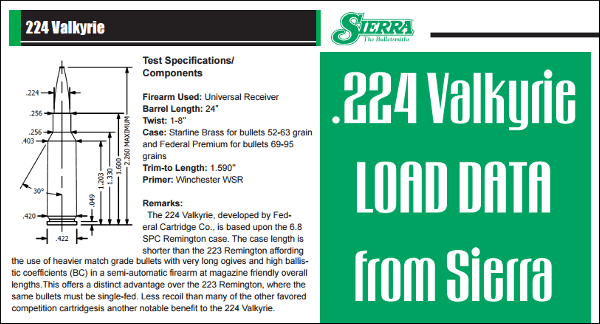
Shorter, Fatter, Faster, Flatter. The new .224 Valkyrie is the hot new cartridge for the AR15 platform. With a shorter, fatter cartridge based on the 6.8 SPC case, the .224 Valkyrie delivers high muzzle velocities for a flatter trajectory at long range. With the latest high-BC projectiles, the .224 Valkyrie can stay supersonic to 1300 yards and beyond.
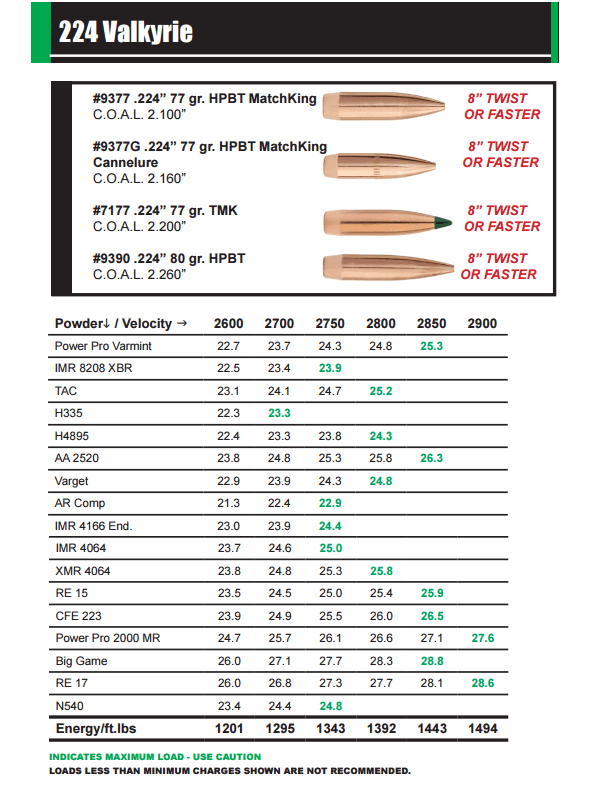
Sierra Bullets recently provided new load data and twist info for the .224 Valkyrie: “Sierra recommends a 1:6.5″-twist barrel for the #9290 22 cal 90 gr HPBT bullet. However, for cartridges like the Valkyrie, that can push them over 2650 fps muzzle velocity, a 1:7″-twist barrel will stabilize the bullet correctly.”
Shown below is Sierra’s load data for bullet weights from 77 grains to 90 grains. Values in green indicate MAXIMUM loads — use CAUTION. NOTE: This is only a partial sample, less than a third of the data Sierra has published. Download Sierra’s Full 4-page PDF to view all the data, including load information for Sierra’s new 95gr .224-caliber MatchKing with claimed 0.600 G1 BC.
About the .224 Valkyrie Cartridge
Basically a 6.8 SPC necked down to .22, the Valkyrie has a shorter case than the .223 Remington (and 5.56×45 NATO). This allows you to load the longest, heaviest .224-caliber bullets and still feed reliably from an AR15-type magazine. With Sierra’s remarkable new 95-grain MatchKing, this gives the little Valkyrie long-range performance that can rival some much larger cartridge types. Sierra Bullets states: “The [Valkyrie] case length is shorter than the 223 Remington affording the use of heavier match-grade bullets with very long ogives and high ballistic coefficients. This offers … super-sonic velocities at ranges greater than the .223 Remington and the 6.5 Grendel can achieve at magazine length”.
Each Wednesday, the U.S. Army Marksmanship Unit publishes a reloading “how-to” article on the USAMU Facebook page. This USAMU “Handloading Hump Day” article, the second in a series on improving concentricity, has many useful tips. If you use standard (non-micrometer) seating dies when loading some cartridge types, this article is worth reading. And visit the USAMU Facebook page next Wednesday for the next installment.
Once again, it’s time for USAMU’s “Handloading Hump-Day!” Last week, we addressed achieving very good loaded-cartridge concentricity (AKA “TIR”, or Total Indicator Runout) using standard, “hunting grade” reloading dies.
We explained how to set up the Full-Length Size die to float slightly when correctly adjusted for desired case headspace. We also cited a study in which this method loaded ammunition straighter than a set of [higher grade] match dies from the same maker. [One of the keys to reducing TIR with both sets of dies was using a rubber O-ring below the locking ring to allow the die to float slightly. READ Full-Length Sizing Die TIP HERE.]
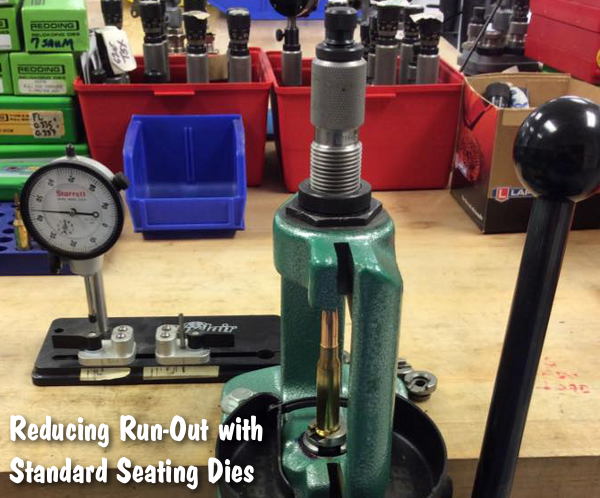
Now, we’ll set up a standard seating die to minimize TIR — the other half of the two-die equation. As before, we’ll use a single-stage press since most new handloaders will have one. A high-quality runout gauge is essential for obtaining consistent, accurate results.
Having sized, primed and charged our brass, the next step is bullet seating. Many approaches are possible; one that works well follows. When setting up a standard seating die, insert a sized, trimmed case into the shell-holder and fully raise the press ram. Next, back the seating stem out and screw the die down until the internal crimping shoulder touches the case mouth.
Back the die out one-quarter turn from this setting to prevent cartridge crimping. Next, lower the press ram and remove the case. Place a piece of flat steel on the shellholder and carefully raise the ram. Place tension on the die bottom with the flat steel on the shellholder. This helps center the die in the press threads. Check this by gently moving the die until it is well-centered. Keeping light tension on the die via the press ram, secure the die lock ring.
If one were using a micrometer-type seating die, the next step would be simple: run a charged case with bullet on top into the die and screw the seating stem down to obtain correct cartridge OAL.
However, with standard dies, an additional step can be helpful. When the die has a loosely-threaded seating stem, set the correct seating depth but don’t tighten the stem’s lock nut. Leave a loaded cartridge fully raised into the die to center the seating stem. Then, secure the stem’s lock nut. Next, load sample cartridges and check them to verify good concentricity.
One can also experiment with variations such as letting the seating stem float slightly in the die to self-center, while keeping correct OAL. The runout gauge will show any effects of changes upon concentricity. However, the first method has produced excellent, practical results as evidenced by the experiment cited previously. These results (TIR Study 2) will reproduced below for the reader’s convenience.
TIR Study 2: Standard vs. Match Seating Dies
50 rds of .308 Match Ammo loaded using carefully-adjusted standard dies, vs. 50 using expensive “Match” dies from the same maker.
Standard dies, TIR:
0.000” — 0.001” = 52%;
0.001”– 0.002” = 40%;
0.002”– 0.003” = 8%. None greater than 0.003”.
AccurateShooter Comment: This shows that, with careful adjustment, the cheaper, standard dies achieved results that were as good (or better) than the more expensive “Match” Dies.
These tips are intended to help shooters obtain the best results from inexpensive, standard loading dies. Especially when using cases previously fired in a concentric chamber, as was done above, top-quality match dies and brass can easily yield ammo with virtually *no* runout, given careful handloading.
If you are looking for popular Alliant powders, now’s a good time to buy. Midsouth Shooters Supply has discounted its inventory of Alliant powders, plus there is a $2 per pound factory rebate. So, for example, the sale price might be $1.50 off regular retail, and then Alliant gives you another $2.00 back for every pound you buy (up to 10 pounds or $20 total rebate). But act soon — this Powder Promotion ends June 30, 2018. Here are some of Midsouth’s current prices on Alliant powders
Alliant AR Comp — $27.45 1 lb.
Alliant Power Pro Varmint — $25.45 1 lb.
Alliant Power Pro 2000 MR — $25.45 1 lb.
Alliant American Select — $21.99 1 lb.
Alliant Unique — $21.99 1 lb.
Alliant Reloder 16 — Great Powder for Match Cartridges
Alliant Reloder 16 is used now by many top shooters for cartridges that work well with Hodgdon H4350. In fact, we’d say that Reloder 16 is the best substitute for H4350 on the market. Alliant’s RL 16 is very temp stable, offers good velocity, and the accuracy is top tier. Some guys report slightly better accuracy than H4350 in the .284 Win, .260 Rem, 6.5 Creedmoor, 6mm Creedmoor, and 6XC cartridges. If you currently use H4350, you should give Alliant Reloder 16 a try. The powder also boasts excellent lot-to-lot consistency and contains a proprietary de-coppering additive.
This is NOT just a slower version of Alliant’s double-based Reloder 15 (which words great in the 6mmBR and Dasher cartridges). Reloder 16 is a completely new formulation, produced in Sweden by Bofors for Alliant. Reloder 16 utilizes TZ technology, which manipulates the response of the propellant and resists the natural tendency to generate more pressure at higher temperatures and less pressure at lower temperatures. As a result, Reloder 16 offers outstanding temperature stability.
Match and Hunting Cartridge Applications:
Alliant tells us that Reloder 16 “is ideal for traditional hunting cartridges, such as .30-06 Springfield and .270 Winchester, as well as 6.5mm target loads and tactical applications wherein temperature stability is required.” We also think the powder may work very well in these popular match cartridges: 6XC, .243 Win, 6.5×47 Lapua, 6.5 Creedmoor, .260 Rem, .284 Win, and .300 WSM. For example, Alliant’s Load Data Sheet shows a 2772 FPS load with 142gr SMKs in the .260 Rem.
Our friend Anette Wachter (aka 30CalGal) is profiled this month on the NRA Family website. Annette talks about how she got into the shooting sports (though a challenge from her ex-husband), and how she has advanced along the way. She is now one of the top female Palma shooters in the nation. She also now competes regularly in Precision Rifle matches — tactical style competitions. She enjoys the challenge of PRS events, and she also competes in 3-Gun matches, with pistol, rifle, and shotgun.
Anette writes about the shooting sports for many publications. She also offers tips and gear reviews through her popular website, 30CalGal.com.
NRA: What type of shooting do you do, and what makes you like it so much?
Anette: Mostly long-range rifle disciplines. I don’t shoot High Power much anymore, but of course I am on the U.S. National Rifle Team and the Palma Team, so that occupies much of my time. My new love is Precision Rifle. This is the new hot and trendy shooting sport that is taking over the industry. It is like a sniper challenge. All unknown distances and usually the matches are out in the field. I also compete in 3-Gun, which is a ton of fun.
NRA: What advice do you have for new shooters who want to get into these sports?
Anette: If you want to get in to any discipline of competition I always suggest going to a local match to watch first. With the Internet you can find out your state competition information. Look for local organizations like the USPSA. See the type of equipment shooters are using and how the sport is run. Ask a lot of questions. Shooters are a very generous culture as well, in my experience. When I started out I was loaned almost everything to try it out.
NRA: From what you have seen, are there a lot more women getting involved in the shooting sports these days?
Anette: I started shooting and competing in 2006. I remember going to NRA Nationals at Camp Perry and, out of almost a thousand competitors, I was one of maybe 20 to 30 women. At local matches I would be one of two. In the past five or six years and especially in the last three, I have seen the numbers jump like crazy. Three years ago a few women in the 3-Gun market decided to put on the first Ladies 3-Gun ProAm in Georgia. We were wondering if anyone would show up. Over 200 women competed. Any of us that had extra guns and equipment were loaning them out. For many of the women it was their first match ever. It changed lives.
In this video Anette offers smart tips for shooting with bipod:
About the 30 Cal Gal Life is short. Go Shoot! — Anette Wachter
Along with being a talented competitive shooter, Anette has her own Gun Blog, 30CalGal.com, and she writes for several gun publications including GunUp Magazine, Shooting Sports USA, Sure Shots Magazine, and Wide Open Spaces. She also designs and crafts custom jewelry items, many of which utilize cartridge cases or other shooting-themed components. You can purchase Anette’s jewelry through her AW Collections webstore.
Shopping for gun parts, ammo, or reloading supplies? You will want to check out Brownells this month. There are Discount Codes that will qualify you for significant savings plus FREE Shipping. Use these Codes during check-out and the savings will reduce your net cost. Get up to $25 off on a $200 purchase — that’s a 12.5% savings. The best Discount Codes expire at the end of the month, June 30, 2018 at 11:59 pm, so don’t delay.
Watch the video below to learn about the kneeling position, as explained by National Paralympic Coach Bob Foth and 2012 Olympian Amanda Furrer. Three-time Olympian and Silver Medalist Bob Foth details the proper techniques (both body position and gun-handling) for kneeling position shooting. Putting Foth’s coaching tips into practice, three-Position smallbore shooter Amanda Furrer demonstrates how to properly shoot from a kneeling position using a .22LR match rifle.
Amanda, a member of the 2012 U.S. Olympic team, shows how to set up the right body position when kneeling, how to support the rifle, and how to relax breathing to steady the shot. This takes practice, but remarkable accuracy can be achieved from the kneeling position by top-level shooters. This is a great video, well worth watching.
The video uses superimposed graphics and diagrams to show rifle hardware/sights, and key aspects of the head position, sling set-up, and hold. If you are a position shooter, this is a “must-watch” video. Narrated by Olympian Bob Foth, it is very informative.
Watch Kneeling Position Video
As a member of the U.S. Olympic Team, Amanda Furrer competed in the Womens 3P 50m event at the 2012 Olympics, finishing 15th. Amanda first started shooting at 11 years old with the Spokane Junior Rifle Team. Shooting is a family sport and all compete and shoot guns together. Furrer’s father shoots tactical matches and her mom shoots pistols. Amanda qualified for the national team as a member of the 2007 Pan American Team at the age of 16. She won bronze in the 2011 National Championships. Amanda is currently a student at Ohio State’s Fisher College of Business, majoring in Finance and competing on the Rifle Team.
We see comparison tests of cars, cameras, and other hardware. But how about chronographs? What could we learn by setting up three different chronographs, and running a 20-shot string over all three at the same time. One of our Forum members, Randy S. (aka AAA) did that very test with three of the best chronographs you can buy: LabRadar, MagnetoSpeed, and an Oehler model 35P. The MagnetoSpeed was attached to the barrel of an F-Class rig, with the LabRadar placed on the left side of the shooting bench. The Oehler 35P was positioned about 23 feet downrange. The photo above shows the set-up. A 20-shot string was recorded with the results in a spreadsheet.
AAA talks about this interesting experiment in a Shooters’ Forum Thread. Here is his report:
Comparison Testing Three Chronographs
We all have our favorite chronograph. Each gives a number, but how would that number compare to the same round fired with another chronograph? I wanted to know so a friend and I set up the following test with three chronographs: LabRadar, MagnetoSpeed V3, and Oehler Model 35P.
For the test we fired Berger 105gr VLDs over the three chronographs simultaneously. The test rifle was my 6mm BR Ackley (BRA) F-class rig with fire-formed brass and 200 rounds on the new barrel.
Chronogaphs Tested
LabRadar
MagnetoSpeed V3
Oehler Model 35P
Temperature: 86 deg. F
Elevation: 854 feet
Cartridge: 6mm BRA (105gr Berger VLD)
Time between shots: 45 seconds
To start off, five rounds were fired to make sure all systems were recording and to warm the barrel. Then the test was 20 shots fired across all three instruments with 45 seconds between shots. The Oehler was set 7.5 yards from the muzzle so 12 FPS was added to the recorded value.
We were using the internal trigger on the LabRadar. The manual says the Vo indicated is the actual muzzle velocity when using the internal trigger, but not if using the Doppler. The 12 FPS Oehler adjustment (back to MV) was based on the Berger Ballistics Calculator.
Results of the Triple Chronograph Shoot-Out:
LR-M is FPS variance between LabRadar and MagnetoSpeed V3. LR-O is FPS variance between LabRadar and distance-adjusted Oehler 35P. You can see all three chronos were very consistent. SD was identical with the LabRadar and MagnetoSpeed.CLICK HERE for spreadsheet.
The tester, Randy S. (aka AAA) says: “Judge for yourself, but I was impressed by all.”
Comments by Forum Members
Our Forum members expressed interest in this Triple Chronograph test. Some confirmed that the LabRadar and Magnetospeed give very similar FPS numbers, based on their own tests:
“Great test and thanks for sharing. I’ve tested my MagnetoSpeed and LabRadar together and results are always within 2-4 FPS of one another.” — Big D
“Very happy to see your numbers support my decision to buy a MagnetoSpeed. Had read reports comparing it to the Oehler and the numbers I get seem to be supported by my long range shooting results. Many thanks for taking the time and effort [to perform] this comparative test. Always good to get actual test results.” — Texas10
“I did a 4-shot test with my MagnetoSpeed and another shooter’s LabRadar a couple of days ago. The results were within 4 fps with the LabRadar being optimistic.” — Pat Miles
Forum Member Powderbreak studied AAA’s original spreadsheet from the chronograph trio test, then figured out the shot-by-shot FPS variance between the machines. He concluded that all the machines performed very well. Powderbreak posted:
Analyzing the Triple Chronograph Test — What Can We Conclude?
AAA did a great job of comparing the 3 chronos. What conclusions can be drawn?
1) I have not checked the manufacturer’s claims of accuracy, but the three chronos are very close to one another. There is no way for us to determine the actual true velocities, but we do not need to do so. Any of the chronos would be more than adequate for an accurate shooter.
2) The resolution of the three chronographs is actually pretty astounding. One foot per second (FPS) is a resolution of 0.033%.
3) AAA did a great job of reloading a very consistent round. With an extreme spread of 33 fps out of 3014 for 20 rounds, that is only 1.09% total spread of velocities.
4) There is a closer velocity match between the MagnetoSpeed and the LabRadar, but that does not mean the Oehler is less accurate. There is simply an offset between the Oehler and the other two. This could be due to the greater distance, the location, or the internal working of the Oehler.
5) Believe your chronograph, it is probably the most accurate reloading tool that you own.
Brian Litz of Applied Ballistics carefully explained the operation, set-up, accuracy and comparison of AB’s chronographs in his books. [Those books] are well worth the money, and give great insight into the workings of chronographs.” — Powderbreak
On some internet shooting forums, self-declared “experts” advise new rifle shooters to stick to low-end factory rifles. These “experts” (many of whom don’t own a single really accurate rifle), claim that it will take years for a new shooter to learn how to shoot a rifle accurately. So, the argument goes, the accuracy offered by a precision-chambered rifle, with a custom barrel, is “wasted” on a new shooter.
We disagree with that viewpoint, at least when it comes to rifles shot from a rest. We’ve seen relatively new shooters, with help from a skilled mentor, do remarkably well with precision rifles right from the start. With a good bench gun, many new shooters can shoot well under 1 MOA on the first day. Certainly it takes time for a complete novice to learn how to handle the gun and to work the trigger smoothly. However, this editor has personally seen some inexperienced shooters try their hand at benchrest shooting, and within few month they are doing very well indeed at club shoots.
Accurate Rifles Reward Progress As Novices Build Skills
For bench shooting, we think a highly accurate rifle is a much better training device for a new shooter than a typical, cheap factory sporter. With a gun capable of 1.5-2.0 MOA at best, you can never really determine if a “flyer” is you or the gun. Conversely, when a novice shoots a gun that can put 5 shots through one ragged hole, if a shot goes way high or low, the shooter knows his aim, trigger control, or gun-handling is to blame. He (or she) can then correct the problem. And when the shooter does everything right, he or she will see a nice tight group on the target. The accurate rifle provides more meaningful feedback and it rewards progress. That helps the novice become a better shooter in a shorter period of time.
A while back, Forum Member Preacher and his “bunny hugger” niece from California proved this point. The young lady, with almost no shooting experience, took Preacher’s 6-6.5×47 and shot a sub-quarter-MOA, 3-shot group at 350 yards. Don’t tell her she needs to stick to a cheap factory rifle. Preacher reports: “My niece flew in from the west coast and came up to visit. When she saw a few of my full-blown varmint rifles, she wanted to shoot one. She did a super job even if she IS a ‘bunny hugger’. She pulled the 1.5 ounce Jewell on a few fired cases to check out the trigger pull and then got in behind the gun and put three shots into a 350-yard target with a one-inch circle.” We measured her group at 0.822″ (0.224 MOA). Don’t tell Preacher that accuracy is “wasted” on novices. He joked: “I sure don’t want her shooting at me ….”
Rifle Features BAT Action, Krieger Barrel, and Russo Laminated Stock:
For those who are interested, Preacher’s rifle features a BAT 3-lug action, 30″ Krieger 7.5-twist heavy contour barrel, and Russo stock (with clear coat by Preacher). Chambered in 6-6.5×47 Lapua, this gun “shoots the 108gr Bergers very well” according to Preacher. Yep, we agree with that — even when a novice “bunny-hugger” does the trigger-pulling.
In the PRS game, the 6.5 Creedmoor has ruled the roost. However more and more serious competitors are moving to the 6mm Creedmoor cartridge because it offers lower recoil and a flatter trajectory (with some bullets). If you are a fan of the 6mm Creedmoor — take heart. Lapua has started production of 6mm Creedmoor cartridge brass, which should hit American shores later in the year. Yes this 6mm Creedmoor brass has small primer pocket and small flash hole — allowing it to stand up to repeated loading cycles with stout pressures.
Here is the official announcement…
Lapua 6mm Creedmoor Cartridge Brass
Lapua is pleased to announce the new 6mm Creedmoor case, a necked down version of the extremely popular 6.5mm Creedmoor designed to produce higher velocities, flatter trajectories, and reduced recoil.
Customer demand for a 6mm version followed almost immediately after the release of the original Creedmoor case. Aside from the neck dimensions, our new 6mm Creedmoor cases shares the same features and characteristics that make Lapua the standard for 6.5 Creedmoor brass. It is a beautifully-drawn case, properly annealed at the neck and shoulder, with head metallurgy specifically chosen for durability, and the same small rifle primer, small flash-hole design that delivers the ultimate accuracy edge. The smaller 6mm bore diameter offers an excellent selection of proven low-drag match bullets that offer outstanding long range performance with even less recoil.
While the original 6.5 Creedmoor was designed with NRA High Power competition in mind, other disciplines, including the Precision Rifle Series (PRS), were quick to see the positive attributes of this cartridge. We know Lapua’s latest offering will find a niche with discerning shooters in demanding competitive disciplines.
We expect Lapua’s new 6mm Creedmoor cartridge brass to be favored by High Power shooters and serious varminters as well as tactical competitors. The Lapua 6mm Creedmoor cases will be available in the USA later in 2018.
The new Lapua 6mm Creedmoor Brass will definitely be a hit with PRS Competitors…
Photo from Ramia Whitecotton’s GAP GRIND 2016 photo album.
New product tip from Boyd Allen. We welcome reader submissions.
You have probably never seen a handgun like this before. This ain’t no compact pistol that’s for sure. The new Model 48 Nosler Custom Handgun (NCH), designed for handgun hunting/varminting and long-range silhouette duties, features a rifle-size bolt action, combined with a 15″ barrel. The billet aluminum stock takes AR-type pistol grips. The fore-end is long enough to work well on a front rest. We like the rakish lines of Nosler’s new Model 48 but the $2495.00 MSRP is not inexpensive.
Still, the compact size (21″ OAL) and relatively light weight (5.4 lbs.) make this an interesting option for hunters and varminters who venture far afield.
Early production versions have been well-reviewed: “Over the last 40 years, I have shot every conceivable configuration of single-shot handguns including high-end custom rigs. The new Nosler handgun will keep up with the very best of them. In my experience, I have found this handgun to be extremely accurate, well-designed, and user-friendly. The Nosler handgun will be most welcome with handgun hunters, target and steel shooters, or anyone looking to add an exciting dimension to their shooting experience.” — Mark Hampton
The new Nosler Model 48 handgun is offered in a variety of versatile chamberings: 22 Nosler, 24 Nosler, 6mm Creedmoor, 6.5 Creedmoor, 7mm-08 Rem, and .308 Winchester. CLICK HERE for a discussion of M48 NCH options in our Shooters’ Forum.
Nosler Custom Handgun Model 48 Features
1. Shilen Barrel — The M48 NCH features a free-floated Shilen 416R stainless heavy-contour barrel threaded at the muzzle, and supplied with a thread protector. Standard barrel length is 15″ with other lengths between 12″-18″ available on request. Barrel fluting is also available for an additional charge.
2. Aluminum Stock — The CNC-milled billet 6061-T6 aluminum stock will take any grip that fits an AR15. We suggest adding a grip with a broad flat base to provide more stability.
3. Size and Weight — The M48 NCH is 21″ long with 15″ barrel (no brake) and weighs 5.4 pounds — quite a bit lighter than typical hunting rifles.
4. Cerakote Finish — The M48 NCH barreled action and stock both feature Cerakote® finishes. The barreled action and stock are coated separately, allowing for a wide variety of color combinations.
5. Muzzle Brake Option — A Harrell’s Precision Tactical 4-Port Brake (shown below) is available as an extra-cost addition.







 Watch the video below to learn about the kneeling position, as explained by National Paralympic Coach Bob Foth and 2012 Olympian Amanda Furrer. Three-time Olympian and Silver Medalist Bob Foth details the proper techniques (both body position and gun-handling) for kneeling position shooting. Putting Foth’s coaching tips into practice, three-Position smallbore shooter Amanda Furrer demonstrates how to properly shoot from a kneeling position using a .22LR match rifle.


 Customer demand for a 6mm version followed almost immediately after the release of the original Creedmoor case. Aside from the neck dimensions, our new 6mm Creedmoor cases shares the same features and characteristics that make Lapua the standard for 6.5 Creedmoor brass. It is a beautifully-drawn case, properly annealed at the neck and shoulder, with head metallurgy specifically chosen for durability, and the same small rifle primer, small flash-hole design that delivers the ultimate accuracy edge. The smaller 6mm bore diameter offers an excellent selection of proven low-drag match bullets that offer outstanding long range performance with even less recoil.


