Scientists at the Oak Ridge National Laboratory (ORNL) have developed a system that uses lasers and fiber optics to measure very small changes (deflections) in a rifle barrel. These deflections are recorded with laser sensors, and then algorithms are used to compute the resultant changes in bullet trajectory. Using computer-calculated trajectories, the digital sighting system’s “virtual” reticle automatically adjusts to compensate for barrel deflection, as well as changing environmental conditions. The microprocessor-controlled digital reticle can adjust to 1/1000th of a Minute of Angle (MOA). That makes it far more precise than any conventional riflescope reticle.
ORNL Barrel Sensor with Compensating Reticle
Shown below is a laboratory prototype of Oak Ridge National Laboratory’s Reticle Compensating Rifle Barrel Reference Sensor. This system precisely measures the deflection of the barrel relative to the sight and then electronically makes the necessary corrections. The system was developed by a team led by Oak Ridge National Laboratory’s Slobodan Rajic, shown in the photo.
The Reticle Compensating Rifle Barrel Reference Sensor takes the guesswork out of shooting by shifting the burden of knowing the relative position between the barrel and the weapon sight axes from the shooter to an electronic sensor. The system precisely measures the deflection of the barrel relative to the sight and then electronically realigns the moving reticle, or crosshairs, with the true position of the barrel, or bore axis.
“When a weapon is sighted in, the aim point and bullet point of impact coincide,” Rajic said. “However, in the field, anything that comes into contact with the barrel can cause perturbation of the barrel and induce errors.”
With modern high-caliber rifles boasting ranges of up to two miles, even very small barrel disruptions can cause a shooter to miss by a wide margin. That makes this technology indispensable from a marksman’s perspective, Rajic said.
From a technological standpoint, the approach is straightforward. ORNL starts with fluted barrels (the flutes play a key role). With the ORNL technology, glass optical fibers are placed into the flutes. The sensor system contains a laser diode that sends a signal beam into the optical fibers parallel to the bore axis of the barrel.
“The optical fibers are designed to split the laser beam twice, sending one beam along the top of the rifle barrel and another light beam along the side of the barrel,” Rajic said. “Thus, we can measure both the vertical and horizontal barrel deflection.”
Through a combination of algorithms, optics and additional sensor inputs, the system can take into account distance and other factors affecting the bullet trajectory. Ultimately, the whole optical/laser/digital system provides the shooter with crosshairs that automatically adjust for conditions in real time.
A Compensating Reticle with 1/1000 MOA Precision
Skeptics of electronic sighting systems have complained that the resolution of a digital rifle-sight is too crude to allow precise aiming. There simply aren’t enough pixels on a viewscreen to allow ultra-precise aiming at long-range targets, shooters have said. In fairness, the existing commercially-available digital rifle sighting systems HAVE been crude — with a lo-rez screens like you might find in a portable GPS.
Well you can forget all that. ORCL has achieved a break-through in digital sighting. The bar has been raised — by an order of magnitude. The resolution of ORNL’s digital, sensor-informed Compensating Reticle is 125 times better than that of traditional target reticles, which can normally be adjusted by one-eighth Minute of Angle (MOA) (at best). Now get this — the ORNL sensor can sense angular displacement and shift the reticle by 1/1,000th of a minute of angle. While this system is expensive, and designed (at this point) for the military, this technology could eventually benefit sport shooters. A decade from now, we would not be surprised if long-range civilian shooters commonly use electronically-enhanced optics, with digital reticles that automatically compensate for bullet drop (and maybe even windage).
ORNL scientists are also working on technology that could yield much more precise and accurate plots of bullet trajectories. We will no longer have to rely on “guesstimated” data inputs, and certain assumptions about bullet drag factors. Rajic and colleagues are developing a laser-based, bullet tracking system that would record plot the bullet’s actual flight path while the bullet is in the air. In other words, this tracking system would be able to plot the bullet’s true trajectory from muzzle to target. That is much differerent than current ballistic “solvers” which merely draw a predicted arc based on muzzle velocity, wind and temp inputs, and a reference BC value.
Oak Ridge National Laboratory is a multi-program science and technology laboratory managed for the U.S. Department of Energy by UT-Battelle, LLC. Over 3000 scientists and engineers at ORNL conduct basic and applied research and development to create scientific knowledge and new technology in key areas of science, energy, the environment, and national security.
Every year, the third Sunday in June is Fathers’ Day. In 2012 this is June 17, so mark your calendars. If your father enjoys the shooting sports, we suggest planning a day at the range with him. And if you’re looking for a gift that will surely be appreciated, consider a Sinclair Int’l Gift Card. These are available in a variety of money values, and Sinclair can mail them directly to your father’s residence. If you’re running short on time, you can get an “eGift Card” sent directly to you father via email. Click the link below to learn more about Sinclair Gift Cards.
Take Your Daughter to the Range Day
This month, along with Father’s Day, there’s another special day to mark on your calendar. June 9th, 2012 is National Take Your Daughter to the Range Day. This is a great way to spend “quality time” with your daughter, and teach her the basics of firearms safety.
The organizers of this event explain: “Boys learn to shoot in Scouts, or with their Dads. Often the girls are left behind, because shooting isn’t ‘girly.’ Well, young ladies can, and do, shoot, and they often do it very well indeed. Learning to shoot gives young women confidence, helps to build self-esteem, and introduces them to a sport they can participate in their whole lives. This event will promote firearms safety and education, as well as family bonding through participation in an exciting and fun sport.”
Crimson Trace (CTC) is extending its popular FREE Batteries for Life promotion. CTC customers will receive free replacement batteries for the lifetime of their laser sights, in exchange for registering their Crimson Trace products with the company’s customer service department.
“There are very few things in life that are truly free,” said Nate Hoke, Director of Customer service for Crimson Trace. “This is one of them. Just register online or via our 800 number and every year, we’ll send a fresh set of batteries for your Lasergrips® or Laserguard® product for as long as you own it.”
Hoke reported that many customers were still using the original batteries in their sights after six or seven years. “While Crimson Trace products have the longest run times in the industry, laser sights are safety devices and as such, should have regular battery changes.”
Gary Elesio of Competition Machine has come up with a new product for smallbore shooters. Gary has a new H1 Tubegun Chassis for the Hall custom rimfire action, a very high-quality, single-shot action that can be fitted with a Jewell trigger. The new H1 Chassis, like other Elesio tubegun kits, features a fully-adjustable skeleton-style stock, and a tubular forearm. The forearm can be rotated so a sling-shooter can “dial in” the best angle for his hand-stop. We think this new H1 action should be popular with rimfire prone and position shooters who are looking for an affordable, all-American alternative to expensive European match rifles. Below is a “sneak peek” at Elesio’s new H1. This shows the H1 receiver housing fitted with a Picatinny-style rail. MSRP for the H1 has yet to be announced.
About the Hall Action
The $1075.00 Hall action is a high-quality, custom-crafted design built to benchrest standards. The action is 1 3/8″ diameter by 7 ” long and is made of 416 stainless steel, with heat-treated, tool steel locking lugs. The action features an Anschutz-type feed ramp, and it comes with a trigger housing which uses 40X Remington-type triggers (Jewell Remington triggers will work). The Hall action is currently available with either right or left port, but only right bolt.
Product Tip from EdLongrange. We welcome reader submissions.
Building your own portable shooting bench is a great winter do-it-yourself project. You can build a sturdy bench for well under $100 in materials. Compare that to some deluxe factory-built benches which may cost $450.00 or more.
A wide assortment of home-built shooting bench designs have been featured on the internet. Renovation Headquarters has put together a web page with plans for eleven (11) different shooting benches. Each bench is illustrated with a photo and link to FREE Plans and building instructions. You’ll find all-wood designs as well as benches that combine a wood top with a metal sub-frame or legs.
A two-time NCAA Champion from TCU, and member of the 2012 U.S. Olympic Shooting Team, Sarah Scherer is profiled in the current USA Shooting News eZine. Her story makes compelling reading because Sarah had to overcome a family tragedy to achieve her goals in the shooting sports. Sarah’s older brother, Stephen, a member of the 2008 Olympic Shooting Team, took his own life in October, 2010. Brother and sister grew up shooting together. Early on, Stephen was her training partner and role model. Losing her brother was very tough, but she has not faltered in her drive to be the best, and honor Stephen’s memory.
Sarah’s coach, two-time World Champion Karen Monez, explains: “[Sarah] has the work ethic to accomplish just about anything she wants to. She doesn’t let adversity and the hardship she’s had define her. It really is more of an inspiration to others if you look at how humble she is with the success she has had, and what’s she’s had to deal with [after her brother’s death].”
We will be following Sarah’s peformance in London this July, where she is one of the favorites in air rifle shooting. She has “risen to the challenge” at every stage of her shooting career so far. She has won five National Junior Olympics Shooting Medals and won gold in her first-ever World Cup Match. An All-American in both smallbore rifle and air rifle, Sarah captured the individual smallbore National Championship in 2010, and she was a member of TCU’s NCAA Championship-Winning Team in 2010 and 2012. This past winter, Sarah set a new National Record with a perfect score of 400 in the 10m Air Rifle event. We wish Sarah success, and hope she can continue her winning ways.
Stan Ware of SGR Custom Rifles, is one of the finest gunsmiths with whom we’ve worked. He’s also a talented shooter and an innovative wildcatter who’s not afraid to think “outside the box”. Stan competes in both Hunter Benchrest (HBR) and Varmint for Score (VFS) disciplines. In his quest to build the ultimate Hunter Benchrest cartridge, Stan created the radical “Wolfpup” wildcat, based on a 6mmBR parent case. Noting the dominance of 30 BRs in VFS matches, Stan wondered if a stretched 30 BR could work in HBR competition. The challenge was case capacity. Under HBR rules the cartridge must hold at least 45.0 grains of water, equal to the capacity of the classic 30/30 case.
To get the requisite HBR case capacity, Stan figured he needed to boost the volume of a 30 BR case significantly, so he would have to move the shoulder forward — a lot. He did this by running a 30 BR reamer deeper and deeper, test-firing brass along the way. After three reamer passes, he ended up with the capacity he needed (the Wolfpup holds 45.3 grains of water). But then he looked at the finished product — a case with almost no neck, and he wondered “how could this possibly work?”.
From Trashbin to Winner’s Circle
Ware’s prototype Wolfpup ended up so short-necked, so unlike any “normal” cartridge, that Stan figured it was “dead on arrival”. Stan told us: “I said ‘this ain’t going to work’ and I threw the brass in the trash can. Honest. But later I thought I better shoot it and see what it does.” There was one problem — Stan didn’t have a seating die. He noticed the short neck provided a bit of tension after fire-forming, so he literally seated some bullets, BIB 118s and 125s, with his fingers. For powder he used H4198 and started with 35 grains, one grain more than a 30 BR load. Stan then did a pressure work-up: “I actually went up to 41.0 grains and didn’t have a sticky bolt. I ended up at 37.9 grains of Hodgdon 4198 — that gave 3150 fps, where the sweet spot is.” (Later testing revealed a second accuracy node at about 3020 fps, using 36.4 grains of H4198).
Stan’s radical short-necked Wolfpup shot great from the get-go. Once he found the right velocity node, the gun shot in the ones and zeros with both 7-ogive and 10-ogive bullets, both 118s and 125s. The Wolfpup proved easy to tune — it’s not finicky at all. And it’s a winner. Stan began shooting the Wolfpup in 2006 in both VFS and HBR matches and the ‘Pup’ started winning matches right away. In 2007, Stan won the Wisconsin State VFS Championship shooting the Wolfpup. Most recently, in June 2010 at a Webster City, Iowa VFS match, Stan won the Grand Agg and posted high X-Count for the match, while placing first at 100 yards and second at 200 yards. How’s that for a cartridge that almost ended up in the trash bin?
Does Stan deserve an award for “most innovative benchrest cartridge design”? Stan chuckles at that notion: “I’m not a hero, not a genius. I really didn’t do anything. The fun part is thinking outside the box — for me anyway. Shooting is an age-old process of experimentation. You never learn it all.”
Why Does It Work?
How can such a radical case design perform so well? “That’s a good question,” Stan admitted. He then explained: “The 30 BR is inherently accurate, so I figured something based on the 30 BR should be accurate too. My personal belief is that the short neck doesn’t hurt you. Plus if the throat in the barrel is straight, the bullet can self-align. If the chamber is good, the bullet will self-center in the throat. In a regular case there’s not much room to do that, so a bullet can start off-center, and you don’t get the same results every time. A bullet in a conventional case is stopped from self-centering by the stiffer neck, particularly in a tight-clearance BR gun.”
Reloading the .30 Wolfpup
Stan’s Wolfpup chamber has a neck dimension of 0.330″. He turns his necks for a 0.327″ loaded round. Bullets are jammed .020″ forward of first contact with the lands. When he closes the bolt it pushes the bullet back in the case — almost a soft seat. Stan notes: “To start with I normally bump the shoulder .0005-.001″ so they go in easy. Just by doing that I get a little neck tension. I also use a bushing. Right now I’m running a .322, but it’s not particularly sensitive. I’ve tried one-thousandths increments up to a .325 bushing and couldn’t tell a lot of difference.”
Currently there are no production sizing dies for the Wolfpup. Stan uses two dies to size his fired brass: “I use a 30 BR bushing full-length die after each firing, but that doesn’t size the bottom half of the case. But I can shoot the brass four or five times with no problems.” After four to five firings Stan hits the bottom of the brass with a modified 6mmBR body die. Stan hogged out the top half of the body die so it doesn’t contact the top of the brass. For bullet seating, Stan uses a Wilson 30 BR seater die into which he ran the chamber reamer. This gives perfect case fit during seating operations.
If You Want a Wolfpup Rifle
Stan has received a number of requests to chamber Wolfpups for Hunter Benchrest shooters, and he will be building some for next season. Stan charges $300.00 for chambering, crowning, and headspacing a barrel. He also sells Wilson micrometer-top seater dies, customized for the Wolfpup, for about $110.00. If there is sufficient demand, he may start producing “one-pass” full-length sizing dies for the cartridge. Stan can also build complete benchrest, hunting, and long-range rifles in your choice of calibers. Visit SGRCustomRifles.com, or call (507) 274-5649.
About the Illustrated Gunstock
You’ll notice Stan’s stock contains scenes from Vietnam and a quotation. Here’s the story. A Vietnam combat veteran, Stan served “in-country” with the Army’s 509th Non-Divisional Combat Unit (out of Fort Riley) from 1965-1966. Shortly before he left Vietnam, Stan went to a shop to have a souvenir lighter engraved. He asked the vendor for an appropriate inscription. The shop’s metal-worker engraved: “War is a tragedy. It takes mans’ best to do mans’ worst.” That message, along with the combat scenes, were hand-painted on Stan’s rifle by his wife Susan, a talented artist. She spent more than 20 hours painting the rifle stock.
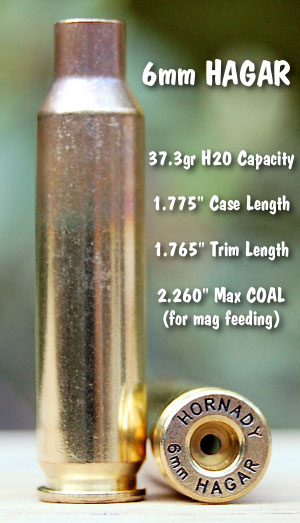
Here’s good news for AR shooters looking for a 6mm option. 6mm HAGAR brass is now available from Hornady, and it looks like this brass is quite good. Those of you who follow the National Matches at Camp Perry know that Carl Bernosky won multiple National High Power Championships shooting the 6mm HAGAR cartridge from an AR Platform rifle. The 6mm HAGAR was derived from the 30 Remington cartridge, and it has the same case head diameter as the 6.8 SPC, also a 30 Remington derivative.
The 30°-shoulder 6mm HAGAR is just about the longest 6mm cartridge that can be loaded in a two-column AR15 magazine and still feed reliably. The advantage of the 6mm HAGAR is that it offers enough “boiler room” to drive 6mm bullets to impressive velocities, yet it can still fit and function well in AR mags. But note, if you are restrained to a mag-length COAL, you can pretty much rule out using 95-108 grain bullets, because they would have to be seated too deep in the HAGAR case. That actually means that the “advantage” of the 6mm HAGAR’s case capacity is lost to some degree — at least when using long, heavy bullets. On the other hand, when loaded with shorter varmint and hunting bullets, such as Hornady’s 75gr V-Max, you can load to 2.260″ mag length and use nearly all of the HAGAR’s case capacity.
For this reason, we think the 6mm HAGAR may ultimately prove more popular with varminters than with the High Power crowd (at least those who do not want to modify their mags to allow heavy 6mm bullets to be seated longer.) If you’re using shorter bullets, you can fill up the HAGAR case and drive 60-75 grain projectiles at serious velocities.
6mm HAGAR Basics
The 6mm HAGAR uses a 6.8 SPC AR-15 bolt and 6.8 SPC magazines and a conventional upper receiver, barrel extension, and bolt carrier assembly. Typically this cartridge has been used for varminting, hunting, and High Power competition. We think the 6mm HAGAR should be a kick-ass cartridge for varminters shooting ARs with shorter varmint bullets.
On the other hand, because the 1.775″-long HAGAR case takes up so much space in an AR magazine, the 100-108gr bullets aren’t well-suited for mag-fed 6mm HAGAR applications (unless the mags are modified). These same 100-108 grainers DO work well in single-load situations provided the chamber is properly throated for such bullets.
NOTE: Some High Power shooters have slotted AR mags to allow loading of long bullets up to 2.340″ max, i.e. beyond normal mag length. See modified magazine at right.
Hornady’s 6mm HAGAR Brass Is Shipping Now
Until recently, 6mm HAGAR brass was hard to obtain. Cases could be formed from 30 Rem brass, but this was a tedious, time-consuming process. Now, however, quality 6mm HAGAR brass is available from Hornady. An initial run of 150,000 pieces of 6mm HAGAR brass was produced. Vendors who got some of the first run of HAGAR brass include AR-X Enterprises LLC (Robert Whitley) and Creedmoor Sports.
Robert Whitley reports: “We’ve received our first shipment of factory 6mm HAGAR brass from Hornady. This Hornady 6mm HAGAR brass is hard at the base but well annealed at the neck. The brass has a small primer pocket and a small flash hole. All of these features enable the brass to hold pressures well and to remain serviceable and usable for multiple re-loadings. Internal H20 capacity of the brass case is right around 37.0 – 37.5 grains of water weight. With its larger case capacity the 6mm HAGAR can accurately push the bigger 105gr to 108gr bullets in the range of 2800 fps (when these bullets are seated long and single-loaded, not mag-fed). However, because of its rather long case length (1.775″) relative to max mag-fed cartridge OAL of 2.260″, the 6mm HAGAR may work best with the smaller and lighter 6mm bullets (75gr and under).” [Editor: Do the math … 2.260″ minus 1.775″ leaves only 0.485″ clearance for a bullet to extend beyond the case mouth.]
Loading Long Bullets to Mag-Limited 2.260″ COAL Is Neither Practical Nor Wise:*
6mm HAGAR Brass, Dies, Mags and Complete Uppers Offered
Along with 6mm HAGAR brass (at $84.00 per hundred), ARX Enterprises has 6mm HAGAR dies, and magazines. ARX Enterprises is also building complete match and varmint AR-platform uppers chambered for the 6mm HAGAR. You can find out about all these products on Robert Whitley’s 6mm HAGAR web page. To order 6mm HAGAR uppers, die sets, brass, magazines and related products contact:
AR-X Enterprises, LLC (Attn: Robert Whitley)
199 North Broad Street
Doylestown, PA 18901
(215) 348-8789
e-mail: rcw3 [at] erols.com
*Left = 75gr Hornady V-Max at 2.260″ OAL (bullet diameter at mouth of case is .243″.)
Left Center = Berger 100gr BT at 2.260″ OAL (bullet diameter at mouth of case is only .225″.)
Right Center = Sierra 107gr MatchKing at 2.260″ OAL (bullet diameter at mouth of case is only .222″.)
Right = Hornady 105gr A-Max at 2.260″ OAL (bullet diameter at mouth of case is only .225″.)
For those who enjoy reactive targets that explode with a big bang and a cloud of smoke, binary compounds are available from a variety of vendors, including Midsouth Shooters Supply.
These binary compounds, when mixed together, will explode when hit by a projectile of sufficient velocity. When used with proper safety precautions, binary target compounds such as Tannerite and Shockwave can create crowd-pleasing “special effects” at fun shoots. (But be sure to place the target at safe distances and never encase the exploding targets inside boxes, cans or other containers which can create flying shrapnel.) The video below shows the inventor of Tannerite, Daniel J. Tanner, hitting a 1-pound Tannerite target at 500 meters. Projectile was a .308 caliber 180gr Hornady HPS.
Federal Laws Apply Once You Mix the Binary Elements!
While separated binary explosives are currently legal to own and use (with minimal restrictions), there are some important legal considerations involved in the storage, distribution, and use of MIXED binary explosives. Individuals, shooting club directors, and range operators must ensure binary explosives are used in compliance with all local, state, and Federal Regulations. These issues are covered in a recent notice from the Bureau of Alcohol, Tobacco, Firearms & Explosives (ATF). Anyone who plans to use Binary Exploding target compounds should read this notice carefully:
ATF Notice Re Binary Exploding Target Compounds
ATF has recently received inquiries about the applicability of the Federal explosives law to binary exploding targets.
The components of these binary targets (typically an oxidizer like ammonium nitrate and a fuel such as aluminum or another metal-based powder) are not separately listed on the List of Explosive Materials and do not meet the definition of “Explosives” in 27 CFR 555.11. Therefore, ATF does not regulate the sale and distribution of these component chemicals, even when sold together in binary target “kits.”
However, when the binary components are combined, the resulting mixture is an explosive material subject to all requirements of 18 U.S.C. Chapter 40 and 27 CFR Part 555. Accordingly, all such exploding targets must be stored in an explosives storage magazine as prescribed in the regulations found in 27 CFR, Part 555, Subpart K — Storage, unless they are in the process of being used.
Further, mixing the binary components together constitutes manufacturing explosives. Persons manufacturing explosives for their own personal, non-business use only (e.g., personal target practice) are not required to have a Federal explosives license or permit. However, individuals or companies must obtain a Federal explosives manufacturing license if they intend to engage in the business of manufacturing explosives for sale or distribution, or for their own business use. Such business uses include manufacturing binary targets for demonstration or product testing purposes.
Licensed manufacturers of exploding targets are subject to Federal recordkeeping requirements and must comply with regulations concerning records of manufacture or acquisition, distribution, exportation, use, inventory and daily summaries of magazine transactions found in 27 CFR, Part 555, Subpart G—Records and Reports.
In addition, a Federal explosives license or permit is required for the transport of explosive materials. Therefore, a person must obtain a Federal explosives license or permit if they mix binary exploding targets and subsequently transport them to a shooting range or to any other location. For further information, please contact the Explosives Industry Programs Branch at eipb [at] atf.gov or (202) 648-7120.
Tannerite Informational Video — Shooting Demos Start at 6:34 Mark
In our Shooters’ Forum you’ll find a thread in which readers can post photos of their “pride and joy” — their favorite rifle. You’ll find a wide range of guns, from “big boomers” to .17-caliber varminters. Here are some of our favorite entries in the “Pride and Joy” Gallery.
Brad’s 6CM Long-Range Match Rifle
Chambered in the 6mm Competition match cartridge, this handsome rig features a Surgeon RSR Action, Bartlein Barrel, and LRB stock. Barrel work was done by Chad Dixon at LongRifles, Inc. and paint by AT Custom Painting. Brad says: “If you need a custom paint job, Adam is your man. His work is amazing and prices can’t be beat.”
The Bear’s Barbed-Wire Barnard
BarryO, aka ‘the Blue-eyed Bear’, posted his beautiful 6mm Dasher, with its unique barbed wire 3D finish. (There’s a story behind that design.) This rifle was smithed by John King in Montana, with stock bedding work by Leo Anderson. The gun features a Barnard ‘P’ action (with trigger), and 28″ Broughton 5C fluted barrel with VAIS muzzle brake. The Barnard sits in a Tom Manners carbon fiber BR stock decorated with amazing graphics by Mad Shadow Custom Paint.
Sebastian’s Radical Swallowtail 6PPC
Sebastian Lambang is the designer and builder of SEB Coaxial Rests. He’s a smart, creative guy, so you knew when he designed a short-range benchrest stock it would be something special. It needed to be lightweight, yet very rigid. Using “out of the box” thinking, Seb employs a truss-style structure to provide great strength with minimal weight. The rear section is equally radical. There are two splayed “keels” in the rear, forming what this Editor calls a “swallowtail” rear design. Others have called it a “catamaran buttstock.” Below is a side-view of the prototype SEB stock before painting.
Flaming PPC from Oz
ChrisT, a diesel fitter from Australia, submitted this image of his stunning flame-painted PPC. Whoever did those flames is a true artist — the gun really looks like it’s on fire. This rifle features a Stiller Viper action, Speedy (Robertson) BRX stock, and Maddco (Australian) 14-twist barrel chambered in 6PPC.
And here are a couple more cool BR rifles posted on the Forum. First, from Walter in Belguim, is the “Lion of Flanders”, an Anschutz BR 250, with Kelbly’s stock and matching SEB front rest. Walter did the paintwork himself:
And here is Mark Walker’s amazing Zebra-skin BR rifle. Now that will turn heads on any bench:


 The Reticle Compensating Rifle Barrel Reference Sensor takes the guesswork out of shooting by shifting the burden of knowing the relative position between the barrel and the weapon sight axes from the shooter to an electronic sensor. The system precisely measures the deflection of the barrel relative to the sight and then electronically realigns the moving reticle, or crosshairs, with the true position of the barrel, or bore axis.



 A two-time NCAA Champion from TCU, and member of the 2012 U.S. Olympic Shooting Team, Sarah Scherer is profiled in the current

 Stan Ware of
 From Trashbin to Winner’s Circle
 Why Does It Work?
 Here’s good news for AR shooters looking for a 6mm option. 6mm HAGAR brass is now available from Hornady, and it looks like this brass is quite good. Those of you who follow the National Matches at Camp Perry know that Carl Bernosky won multiple National High Power Championships shooting the 6mm HAGAR cartridge from an AR Platform rifle. The 6mm HAGAR was derived from the 30 Remington cartridge, and it has the same case head diameter as the 6.8 SPC, also a 30 Remington derivative.
 6mm HAGAR Basics
 For those who enjoy reactive targets that explode with a big bang and a cloud of smoke, binary compounds are available from a variety of vendors, including





