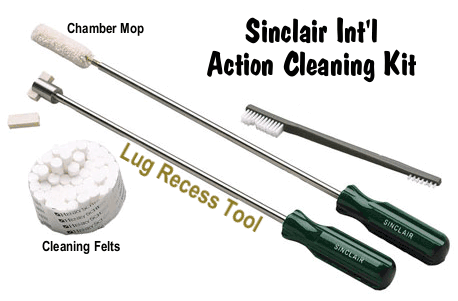
Most competitive shooters are pretty good about bore cleaning (some may even clean their bores too aggressively). However, we’ve found that many shooters neglect the chamber area and the bolt lug recesses. It’s too easy to clean the bore, slip out the guide rod and say “I’m done.” Sinclair Int’l explains why it’s important to clean the action interior: “Shooters use a lot of grease and oil on their bolts to reduce friction and to prevent wear[.] Unfortunately, both of these compounds attract grit, powder and primer residues. Cleaning your receiver is especially critical [with] custom actions where the fit between the action and bolt is held to very tight tolerances. Routine cleaning of the action will prevent unnecessary wear on the bolt body, locking lugs, and the action raceways/guide rails. Frequent action cleaning is also essential to keeping the trigger area free of debris which can cause trigger hang-ups and failures.” Below, we present action cleaning advice from Sinclair’s Reloading Press Newsletter.
Cleaning the Chamber
Combustion by-products, lubricants, and solvent residues can collect in your chamber. Severe build-up of grease and carbon can interfere with chambering. Also some solvents will promote corrosion. You need to keep your chambers clean.
1) Install a clean cotton mop of the correct size on the end of a chamber rod and insert the mop into the chamber. Rotate the mop several times to remove any brush bristles left behind and any excess solvent that was between the rod guide snout and the end of the chamber. Make sure the chamber is dry. Prior to storing a rifle you can oil the chamber but make sure the oil is removed prior to firing the rifle.
2) Alternatively, install an old bore brush on a chamber rod, overlap a couple of patches on the brush bristles, and wrap them around the brush completely. Then insert the patch-covered brush into the chamber while rotating it to remove the excess solvent and debris. Push it firmly into the neck area of the chamber. A similar method is to pierce a large patch on the end of the brush loop and insert it into the action, again rotating the brush as you push the patch up against the breech.
Cleaning the Lug Recess Area
The action lug recess area is one of the dirtiest places on a bolt-action rifle. To properly clean this area, always use a tool designed for the task, such as the $21.50 Sinclair Action Cleaning Tool (part # ACT1) which is part of the Sinclair Action Cleaning Tool Kit (now on sale for $29.99, part #ACT2).
1) Insert a cotton roll or cleaning felt into your lug recess cleaning tool and wet both ends and the face of the cotton roll/felt with solvent.
2) Insert the tool into the action and push it forward until it is positioned fully in the lug recess area and rotate the tool head several times. Then reverse the rotation for another few turns. While rotating the tool move it slightly in and out to cover the entire recess area and to also clean the breech face.
3) Remove the tool from the action and inspect the surface of the felt or cotton roll. If there is quite a bit of residue on both sides of the felt/roll, then repeat with another wet felt/roll.
4) When you feel the recess area is completely clean, insert a dry cotton roll into the tool and rotate the tool head to remove any remaining solvent and debris. If necessary, use a second dry cotton roll.
5) You can follow this step up with another pass of a mop or patches into the chamber to get any debris or solvent that pushed forward out of the lug recess area.
Cleaning Tips from The Reloading Press, used courtesy Sinclair Int’l, All Rights Reserved.
Today, AR-platform rifles are hugely popular. Dozens of manufacturers sell AR-type rifles, in a wide variety of configurations and calibers. But before there were M16s and AR-15s, ArmaLite produced a 7.62×51 caliber rifle, the AR-10. Yes before there were millions of 5.56 black rifles, there was a .30-caliber big brother with reddish-brown furniture. Invented by Eugene (‘Gene’) Stoner for the Armalite company in the late 1950s, this is the father of all of today’s AR-platform rifles. Way ahead of its time, this remarkable, select-fire battle rifle weighed just 7.25 pounds as first developed.
If you’re curious about the AR-10, in this video, Jerry Miculek puts an original 1957-vintage AR-10 through its paces on the range. This extremely rare, early-production rifle was provided by Mr. Reed Knight and the Institute of Military Technology. (The gun in the video was actually produced in the Netherlands under license, see video at 4:40.) This AR-10 is the direct ancestor of the AR-15, M16, and many of the modern sporting rifles that we use today.
The AR-10 was slim and light, weighing in at around 7 pounds. Some folks might argue that the original “old-school” AR10 is actually better that some of today’s heavy, gadget-laden ARs. The AR-10’s charging “lever” was under the carry handle — that made it easier to manipulate with the gun raised in a firing position.
You’ll notice there is no “forward assist”. Inventor Gene Stoner did not believe a separate “bolt-pusher” was necessary. The forward assist was added to solve problems encountered in Viet Nam. Some critics say the forward assist “only takes a small problem and makes it a big problem.” For today’s competition ARs (that are never dragged through the mud) the forward assist probably is superfluous. It is rarely if ever needed.
Note also that the handguards are fairly slim and tapered. Today, six decades after the first AR-10 prototypes, we are now seeing these kind of slim handguards (made from aluminum or lightweight composites) used on “full race” ARs campaigned in 3-gun competition.
History of the AR-10
The AR-10 is a 7.62 mm battle rifle developed by Eugene Stoner in the late 1950s at ArmaLite, then a division of the Fairchild Aircraft Corporation. When first introduced in 1956, the AR-10 used an innovative straight-line barrel/stock design with phenolic composite and forged alloy parts resulting in a small arm significantly easier to control in automatic fire and over one pound lighter than other infantry rifles of the day. Over its production life, the original AR-10 was built in relatively small numbers, with fewer than 9,900 rifles assembled.
In 1957, the basic AR-10 design was substantially modified by ArmaLite to accommodate the .223 Remington cartridge, and given the designation AR-15. ArmaLite licensed the AR-10 and AR-15 designs to Colt Firearms. The AR-15 eventually became the M16 rifle.
AR-10 photos from Arms Izarra, a Spanish company specializing in de-militarized, collectible firearms. Interestingly, this particular AR-10 was produced in the Netherlands under license.
A striker-fired 9mm 1911, with a lower bore axis. That’s how we’d describe the brand-new Hudson H9 pistol, which debuted at SHOT Show 2017. The feel in the hand will be familiar to model 1911 owners — this single-stack pistol shares the ergonomics of the classic J.M. Browning 1911. It also has a trigger feel similar to a 1911 (but there is more take-up than on a 1911).
The big news is up front — that bulky section in the front of the frame below the muzzle allows the guide rod and recoil spring to be carried very low. That permits the slide to be placed lower relative to the web of the hand. This, combined with the striker firing mechanism, all translates to a lower bore axis and lower Center of Gravity. In practice this does reduce muzzle flip and perceived recoil.
We shot the Hudson H9 at Media Day at the Range, and it did seem to be have less muzzle flip than a typical 9x19mm pistol of similar weight. However, we would stop short of calling this revolutionary. To be honest, we think some other gun journalists have gone a bit overboard. The Hudson H9 is an innovative pistol to be sure, but honestly it wasn’t shockingly good. This Editor has shot probably 40 different 9mm pistols, including custom 9x19mm 1911s. The Hudson H9 is good, but, to be honest, my H&K P7m8 is better (in terms of muzzle flip). And HK’s P7 series pistols were designed 40 years ago!
From Russia with Low Bore Axis
If you want to get excited about a low bore axis, check out this Kalashnikov PL-14, introduced in 2015. Note the very low-profile slide, with a grip design that allows the web of the hand to be carried very high. We think this is actually a more advanced design than the Hudson H9. Still, for 1911 fans yearning for a striker-fired option, the Hudson will feel familiar, and it does seem to be well-made and sturdy.
At SHOT Show 2017, we had the chance to chat extensively with Eric Mayer, head honcho of Varminter.com. An avid shooter and hunter, Eric loves small, efficient cartridges. Eric told us his current favorite rimfire cartridge is the 17 WSM. “Winchester has continued to improve this cartridge since its introduction. We are seeing very good accuracy now, and performance is impressive in the varmint fields”. Eric notes that the 3000 fps 17 WSM 20-grain ammo (photo above) delivers way more punch downrange than a typical 17 HMR load. In this article, you’ll find the highlights of Varminter.com’s review of the 17 WSM round in the Ruger 77/17 cartridge.
The 17 Winchester Super Magnum Rimfire (aka Win Super Mag or WSM) is the fastest, most potent modern rimfire round you can buy. This cartridge, which uses a modified nail gun casing, drives 20gr bullets at 3000 fps. The 17 WSM offers superior ballistics to all .22 rimfires, and is a clear step ahead of the 17 HMR. That makes this round a potential “game-changer” in the varmint fields. To gauge the capabilities of the 17 WSM, Varminter.com tested the cartridge in the new Ruger 77/17 bolt-action rifle. Click HERE for Varminter.com Ruger 77/17, 17 WSM Review.
17 WSM shoots faster than the 17 HMR, so the 20gr bullets don’t drift as much in the wind:
Varminter.com reports: “The much-anticipated Ruger 77/17 chambered in the 17 Winchester Super Magnum (17WSM) has been released. Our Review Editor, William Chambers, put it through a full range test with all four currently-available ammunition loads. Afterwards, he took it on a short groundhog hunt[.] We put a lot of rounds through the guns we test, at targets, through chronographs and out in the field. This report includes all currently available 17 WSM ammunition and a sneak peek of the really nice Nikon Prostaff 5 riflescope.” READ REVIEW.
As part of its review, Varminter.com tested four different types of 17 WSM ammo for accuracy: American Eagle (20gr V-Max); Hornady (20gr V-Max), Winchester HV (20gr V-Max); Winchester HE (25gr V-Max). In the little Ruger, which suffered from a very heavy trigger, the most accurate ammo, by far, was the American Eagle, with an average 5-shot group size of 1.135 MOA at 100 yards. The Winchester HV was the worst, with a 2.304 MOA average for three, 5-shot groups. CLICK HERE for full accuracy test results.
After accuracy testing, Varminter.com Review Editor Chambers took the Ruger 77/17 on a Groundhog hunt in Northern Ohio. Chambers was successful, bagging this ‘hog’ at 127 yards. The American Eagle 17 WSM ammo did quick work — the groundhog dropped without a twitch (watch video).
By Gary Anderson, DCM Emeritus
The 2017 CMP competition rules are now approved and posted on the CMP website. The 2017 CMP Highpower Rifle and Pistol Competition Rules and the 2017 CMP Games Rifle and Pistol Competition Rules can be downloaded on the CMP Competition Rules Page.
2017 marks the third consecutive year with major CMP competition rule changes. The 2015 Rules opened Service Pistol shooting to a wider variety of pistols and introduced the popular 22 Rimfire Pistol Distinguished Badge. The 2016 rules authorized limited power optical sights for service and modern military rifles and opened Service Rifle shooting to a wider variety of M16/AR-type rifles.
AR Alternative Rifles Allowed in Highpower Service Rifle Competitions
The 2017 rules authorize residents in states where AR ownership is prohibited to use an Alternative Rifle that is legal in that state. The introduction of an Alternative Rifle rule exemplifies the CMP’s determination to take whatever steps are legally possible to ensure that all competitors in the USA can continue to compete in CMP Highpower Service Rifle competitions.
The new Highpower Alternative Rifle will allow competitors in states where the ownership or possession of M16/AR-type rifles is prohibited to use a rifle that has the same capabilities as an M16/AR-type rifle. Alternative Rifles may be either semi-auto or manually operated and must be chambered for the 5.56 x 45mm NATO cartridge (.223). Optical sights with a manufactured maximum of 4.5X are permitted. These rifles must have a 4.5-pound trigger pull, a maximum barrel length of 20 inches and a fixed sling swivel on their fore-ends. Alternative Rifles may have stocks with the same adjustment capabilities as Service Rifles, that is butt-stock length may be adjustable, but the cheek-piece and butt-plate must be fixed. Stock design and magazine configuration is flexible according to what is permitted in the competitor’s state.
Match Rifles Will Be Allowed in Highpower Matches
The 2017 CMP Rules will also open the door for Match Rifle competitors to shoot in CMP-sanctioned highpower events. Due to the advantages these rifles have (more cartridge options, no trigger limitation, infinite stock adjustments and unlimited optical sight power), competitors with Match Rifles will usually compete in a separate or Open Individual Category, but they will now be welcomed in CMP Highpower Matches. Traditional EIC and National Trophy Match events will still be restricted to Service and Alternative Rifles, but match sponsors can now invite Match Rifle competitors to shoot in CMP-sanctioned events. Except for EIC and National Trophy Matches, which will continue to be no-sighter matches, the 2017 Rules will permit sighters in other matches.
Most Match Rifle competitors have already competed in CMP Matches with Service Rifles and are familiar with CMP requirements that shooters must start rapid-fire series from standing. The CMP regards this requirement to quickly go from standing to sitting or prone and place the natural point of aim on the target as a vital skill that highpower rifle shooters should be able to perform. However, some Match Rifle competitors who have never competed in CMP Matches will find this to be a new … challenge.
New Competition Classification System
The CMP will develop and introduce a new competitor classification system in 2017. The system will be similar to traditional classification systems where competitors are divided into five classes according to current match score averages. CMP classifications will initially be available for use by Highpower and Service Rifle match sponsors. The CMP system will provide for instant, electronic updates of match score data. Match sponsors will be able to confirm competitor classifications through online look-ups.
For those competitors who are over 70 or who have physical impairments, the CMP has lots of experience in making it possible for those competitors to start rapid-fire series in position. Everyone who is able is expected to start rapid-fire from standing, but those who cannot are allowed to start in position. These competitors can win special and class awards as well as CMP Achievement Awards; they just cannot win the match.
Use of Electronic Devices (Airplane Mode OK)
The new rules clarify that the use of “electronic devices such as cell phones, tablets or other hand-held communication devices only to keep time, record shots, or compute sight adjustments” is permitted. However, those devices must not be capable of communicating with other electronic devices (must be placed in airplane mode).
Below are summaries of other rule changes in the 2017 CMP Competition Rules.
On January 19, 2017, the last day of the Obama Administration, Daniel Ashe, Director of the U.S. Fish and Wildlife Service (FWS), issued a surprise Director’s Order calling for a ban on traditional ammunition and tackle in National Wildlife Refuges. FWS Director’s Order No. 219, issued on January 19th, directs the Fish and Wildlife Service to phase in a ban on the use of traditional lead ammunition and fishing tackle for all activities on National Wildlife Refuge lands and waters. According to the NRA, this last-minute “unilateral action was taken without scientific evidence to support it and without consulting state fish and wildlife agencies.”
In response to this eleventh-hour “back-stabbing” by the FWS, the National Rifle Association (NRA) yesterday called on the U.S. Senate to swiftly confirm Congressman Ryan Zinke (R. Montana) as Secretary of the Interior. The FWS operates under the Department of the Interior. Presumably, FWS Director’s Order no. 219 would not have been issued if Zinke was in charge of the Interior Department. Hopefully Zinke can reverse the damage done, once he is confirmed as Secretary.
“It is more important than ever that we have a Secretary of the Interior who respects the Second Amendment and will stand up for our rights,” said Chris W. Cox, executive director of the NRA’s Institute for Legislative Action. “On behalf of the NRA’s five million members, I urge the Senate to swiftly confirm President Trump’s nominee for Secretary of the Interior, Congressman Ryan Zinke. The NRA looks forward to working with the Trump administration to reverse this government overreach.”
Operative Provisions of FWS Director’s Order No. 219:
Sec. 5 What steps will the Service take to phase in the use of nontoxic ammunition and fishing tackle?
a. The Service will continue to support targeted research to understand the human, fish, and wildlife health benefits of using nontoxic ammunition and fishing tackle.
b. The Service will continue to work with states and other partners on education efforts regarding the benefits and effectiveness of nontoxic ammunition and fishing tackle.
c. To ensure the public experiences a consistent approach to nontoxic ammunition and fishing tackle requirements, over the next 24 months, each Regional Director, in coordination with relevant Assistant Directors, should work with individual states, regional state fish and wildlife associations, and tribes to identify opportunities to expand existing state, Federal, or tribal requirements for use of nontoxic ammunition and fishing tackle on Service lands, waters and facilities.
i. Where states have enacted nontoxic ammunition or fishing tackle requirements for certain forms of hunting and fishing on state lands such requirements should be expanded to national wildlife refuges in those states through amendments to state or Service regulations, as appropriate.
ii. Where states have enacted nontoxic ammunition or fishing tackle requirements for certain forms of hunting and fishing that apply to state, private, and Federal lands throughout their states, Regions should ensure these requirements are enacted and enforced on Service lands, waters, and facilities in those states.
iii. Where individual Federal land units administered by other Federal agencies including the National Park Service, the National Forest Service, the Bureau of Land Management, the Department of Defense, or other agencies, have enacted requirements for the use of nontoxic ammunition or fishing tackle, Regions should adopt such requirements on Service lands, waters and facilities in the same states as those units through amendments to Service hunting and fishing regulations, as appropriate.
iv. Where individual tribes have enacted requirements for the use of nontoxic ammunition or fishing tackle, the Regions should adopt such requirements on Service lands, waters and facilities in the same states as those tribal lands through amendments to Service hunting and fishing regulations, in consultation with the appropriate tribe and state.
d. When available information indicates negative impacts of lead ammunition or fish tackle on sensitive, vulnerable or Service trust resources, the appropriate Regional Director, in coordination with the appropriate Assistant Director(s), will take steps to expeditiously require the use of nontoxic ammunition or fishing tackle to the fullest extent practical under Service jurisdiction to benefit such species or resources.
e. The Assistant Director, Migratory Birds, in consultation with National Flyway Councils and individual states, will establish a process to phase in a requirement for the use of nontoxic ammunition for recreational hunting of mourning doves and other upland game birds.
Sec. 6 When is this Order effective? This Order is effective immediately. It remains in effect until we incorporate it into the Fish and Wildlife Service Manual, or until we amend, supersede, or revoke it, whichever comes first. If we do not amend, supersede, or revoke it, the provisions of this Order will terminate on July 31, 2018.
Graf & Sons, Inc., “The Reloading Authority”, is kicking off the official celebration of its 60th Anniversary in business with its Ultimate Reloading Give-Away Contest. Act soon — today’s the last day to sign up for Graf.com’s 60th Anniversary Reloading Give-Away.
Graf & Sons Founded in 1957
For 60 years, Graf & Sons has been devoted to providing knowledge, product and support to all enthusiasts of shooting and reloading. In 1957, Arnold Graf, his wife Velma, and their son Bob purchased a gasoline service station in Mexico, MO. With the Graf family’s love for shooting, they naturally expanded into reloading and now stock over 20,000 products.
“We’re proud of our history and know that our philosophy of treating everyone like family has allowed us to achieve this important milestone,” said Paul Siegfried, President. “This goes for our customers, our employees and our vendors, all of whom we invite to celebrate with us.”
The kick-off for the 60th Anniversary celebration kicks off January 27, 2017 for the drawing for the Ultimate Reloading package. The Winner Winner gets a Hornady Classic Reloading Kit plus a $400 Graf’s gift certificate. NOTE: Thursday, January 26, 2017 is the last day to enter!!
To enter submit a photo of your current reloading set-up or tell us why this package would be perfect for you via Graf’s Social Media Channels: Facebook, Twitter, and Instagram. Graf’s will pick the winner at random on January 27th. You must enter before January 26th, 11:59 p.m. CST on January 26, 2017. CLICK HERE for Contest Rules
On-Going Graf’s 60th Anniversary Promotions Throughout 2017
Graf’s year-long 60th Anniverary celebration will showcase 60 for 60 monthly saving specials (with featured products at 60% off), monthly give-a-ways of reloading supplies, t-shirts, and other swag, and more.
Customers, vendors and media are all invited throughout the year to join Graf & Sons in celebrating their 60th Anniversary. For more information, visit grafs.com or call 800-531-2666. Follow @grafandsons on Facebook, Twitter and Instagram.
At SHOT Show 2017, Nosler showcased a new .22-caliber cartridge designed for AR-platform rifles. Called the 22 Nosler, the new cartridge resembles a 6.8 SPC necked down to .22 caliber. Comparing Nosler’s ammo specs with Hodgdon load data, it looks like the 22 Nosler can deliver about 250-300 fps more velocity than the standard .223 Rem cartridge. That’s significant for varminters looking for higher performance from an AR15-type rifle. With a 55-grain bullet, highest possible velocity is 3500+ fps with a max load of Hodgdon CFE 223 powder, based on this Nosler Load Chart:
Nosler will produce 22 Nosler ammunition in various bullet weights, starting with 55 grain and 77 grain. To run the 22 Nosler, an AR owner will need a new upper and 6.8 SPC type magazines. This video explains how to convert your AR-platform rifle to run the 22 Nosler.
“Everything Old Is New Again…”
Examining the 22 Nosler cartridge, our friend Grant Ubl had a case of “deja vu”. He thinks the new 22 Nosler bears a striking resemblance to a wildcat from the 1960s: “The .22 Nosler looks like a throwback to the 1963-vintage .224 Winchester E5 experimental cartridge, right down to the rebated rim.” Here is an old Winchester print:
Another poster said this cartridge resembles the “.220 Thunderbolt” a wildcat devised by John Scandale in 2004. Posting on Facebook, Mr. Scandale said the designs were very similar. According to Keystone Accuracy, the .220 Thunderbolt’s “design origin came from the now largely popular 6mm Hagar in its infancy stage back in 2003.” While it looks very similar to a 6.8 SPC necked to .224, the .220 Thunderbolt is different because the 6mm Hagar brass is 0.100″ longer than 6.8 SPC. Read History of .220 Thunderbolt.
Neck-up the 22 Nosler to .25 Caliber?
Dan Z. has inspected in the 22 Nosler ammunition and he’d like to see a .25 Caliber version. On Facebook, Dan posted: “I got my hands on some of the ammo a couple weeks ago. It does look like a .223 that has its body diameter expanded to that of a 6.8. Consequently, it is longer than the 6.8 overall and in the body. I necked a piece of fired brass to 6.8 and it looked like it would provide some improvement in velocity. A more interesting idea might be to neck it to .25 as a .250 Savage performance clone in an AR-15 platform.”
Hornady® Manufacturing is sponsoring free reloading clinics on Thursday, February 2, 2017, during the Safari Club International (SCI) Convention in Las Vegas, NV. The clinics will include introductory and advanced reloading techniques. Hornady reloading specialist, Ben Syring, is the instructor for both classes. The clinics are free-of-charge, but participant space is available on a first-come first-served basis.The clinics will be held at the Mandalay Bay Convention Center, Lagoon Room A:
Hornady Reloading Clinic Schedule/Descriptions
Thursday, February 2, 2017 – Mandalay Bay, Lagoon Room A
Intro to Reloading Clinic, 9:30-11:00 p.m., discusses basic rifle and pistol reloading techniques, with an overview of the Hornady Classic reloading kit.
Advanced Reloading Clinic, 12:00-2:00 p.m., focuses on advanced techniques, with demonstrations of Hornady® precision tools including the headspace gauge, concentricity tool, and more.
SCI Convention Draws 18,000 Visitors
Widely considered as one of the premiere hunting-related events in the country, the Safari Club International Convention takes place February 1-4, 2017 at the Mandalay Bay Convention Center in Vegas, and features “six continents under one roof,” where attendees can book hunts, converse with hunting and shooting celebrities, and shop for the latest in hunting tools and equipment. The convention covers 650,000 square feet of exhibit space, and draws approximately 18,000 visitors from around the world.
For further information regarding Hornady® products visit www.Hornady.com.
Sen. Jeff Sessions photo by Gage Skidmore, Wikipedia, CC-BY-SA-3.0 attribution.
U.S. Senator Jeff Sessions (R-Alabama) took a firm position on Second Amendment rights during Congressional hearings on his nomination to be the next Attorney General of the United States. Sessions testified before the Senate Judiciary Committee on a wide range of topics. The former Attorney General for Alabama and U.S. Attorney for the Southern District of Alabama was clear that the Second Amendment would be respected as an individual right by the Trump administration.
“Well, I do believe the Second Amendment is a personal right,” Sessions said in response to questions. “It’s an historic right of the American people, and the Constitution protects that and explicitly states that. It’s just as much a part of the Constitution as any of the other great rights and liberties that we value. So my record is pretty clear on that.”
The National Shooting Sports Foundation urged Sessions’ confirmation based on his commitment to gun ownership rights and his strong track record as a U.S. Attorney. NSSF Senior VP and general counsel Lawrence Keane stated: “Through numerous attacks on our Second Amendment liberties, Senator Sessions has worked tirelessly to protect the rights of law-abiding citizens, including through his staunch support of the Protection of Lawful Commerce in Arms Act. We are confident that with Senator Sessions as the top law enforcement officer in the nation that our public will be safer, that criminals will be taken off the streets, that justice will be served, law enforcement priorities will take precedence over politics and the Second Amendment rights of law-abiding Americans will be respected.”
Sessions vowed to the Senate committee that scapegoating the firearms industry and lawful gun owners for the use of guns in crimes committed by individuals would come to an end: “The first and foremost goal I think of law enforcement would be to identify persons who are dangerous, who have a tendency or have been proven to be law breakers and been convicted and those who are caught carrying guns during the commission of a crime,” he explained.
“If I am confirmed, we will systematically prosecute criminals who use guns in committing crimes,” Sessions added. “As United States attorney, my office was a national leader in gun prosecutions nearly every year. We were partners with state and local law enforcement to take down these major drug trafficking cartels and dismantle criminal gangs.”
Biography of Sen. Jeff Sessions
Jess Sessions received a J.D. degree from the University of Alabama in 1973. Sessions served in the U.S. Army Reserve from 1973 to 1986, attaining the rank of Captain.
Sessions has had a distinguished legal career, first as a practicing attorney in Russellville, Alabama, and then in Mobile. Following a two-year stint as Assistant United States Attorney for the Southern District of Alabama (1975-1977), Sessions was nominated by President Reagan in 1981 and confirmed by the Senate to serve as the United States Attorney for Alabama’s Southern District, a position he held for 12 years. Sessions was elected Alabama Attorney General in 1995, serving as the state’s chief legal officer until 1997, when he entered the United States Senate.
As a United States Senator, Sessions has focused his energies on maintaining a strong military, upholding the rule of law, limiting the role of government, and providing tax relief to stimulate economic growth.