Brownells is providing real-time coverage of SHOT Show on its SHOT Show Web Page. Starting Tuesday, January 17th, you can tune in to see videos filmed at the SHOT Show Convention Center. Brownells will spotlight new products and interview firearms industry experts.
All during SHOT Show week, Brownells will unveil new products. In addition, Brownells will interview industry notables such as Larry Vickers, Taran Butler, Bill Gieselle, and Frank Brownell. Along with video demos, dozens of new-for-2017 products will be spotlighted in a photo showcase.
Watch New Product Demos from the Brownells Booth at SHOT Show.
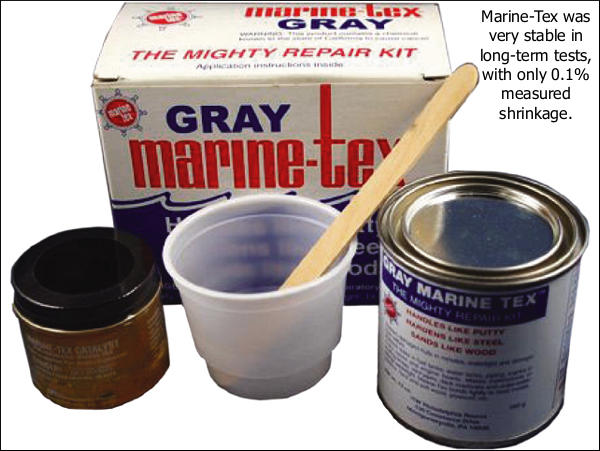
A customer of well-known gunsmith (and Hall-of-Fame shooter) Thomas “Speedy” Gonzalez recently asked Speedy about bedding compounds. Speedy offered some interesting advice based on long-term testing of various materials. Speedy favors Marine-Tex because it is very stable over time, while other materials can shrink up to 6% dimensionally. A good bedding job should be a perfect fit to your barreled action. If the bedding material shrinks over time, that is NOT a good thing….
Speedy’s customer asked: “I know you’re not a Devcon man in regards to bedding compounds but I respect your input in such matters and my question is this in regard to aluminum actions. If Devcon was considered, for an aluminum action, would you prefer aluminum compound formula or steel formula? I personally prefer Devcon steel and Marine-Tex for steel receivers but my experience with aluminum is limited. Also do you have a release agent preference that works better with aluminum?”
Speedy answered: “My only preference of one epoxy over another is their stability over time. My buddy who works for the Texas State Weights and Measures Department had me cast several of the most common types of epoxies used for bedding into 1.000″ machined blocks. After one year of being kept in a controlled climate and measured for shrinkage monthly, the Marine Tex shrunk only 1/10th of 1% (i.e. 0.1%) whereas almost all the others (including Devcon Steel formula, Devcon Aluminum formula…) shrunk 3% to 6%. The only other compounds that matched the Marine Tex were Araldite 1253 and Araldite 2014, with the latter being quite expensive for daily use.”
Speedy added: “The Marine Tex Grey has no atomized metal in its makeup even though it appears that it does. This can be proven by the use of a strong neodymium magnet. What is humorous to me is that people don’t like aluminum yet will bed their actions atop aluminum pillars that have twice the coefficient of expansion (COE) of steel. Like Devcon, it is what people have always done and used. Thus [they] perpetuate the same old stuff. That’s my two cents’ worth. But as I tell everyone, ‘I’ll tell you what I know or do, but it’s not my job to convince anyone to do it my way’.”
Release Agents — Try Shoe Polish
Regarding release agents, Speedy stated: “I use Kiwi Neutral or Tan shoe polish. This works great and you can find it anywhere. Do NOT use the black or brown as it will stick.”
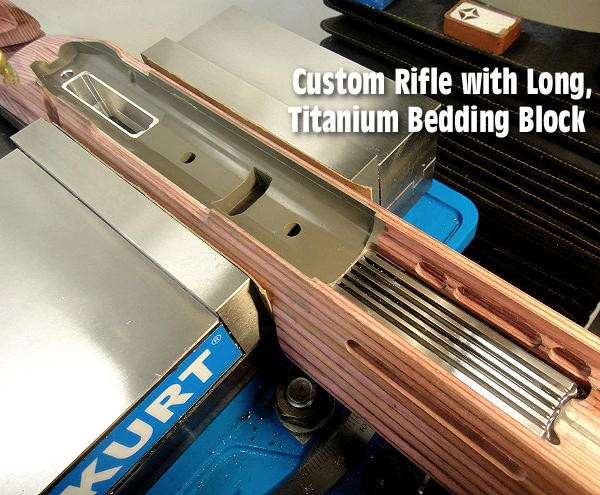
View More Photos of Speedy Inletting and Bedding Job CLICK HERE to see an interesting bedding job done by Speedy using a custom titanium bedding block. Speedy notes, “The stock was a raw blank requiring full inletting for the action to fit properly plus the titanium block. All the loading ports, bolt handle cut, bolt stop, and trigger guard cuts were done with diamond tooling to eliminate fraying and/or delamination of the wood.” You’ll find more projects by Speedy on his Facebook Page. Speedy is in San Antonio, Texas now, and accepting new projects with his company S.G. Rifles LLC.
We like binoculars with built-in Laser Rangefinding capability. With rangefinding binoculars, you can carry one less piece of gear, and a binocular optic is much more effective in the field than the monocular on a typical dedicated laser rangefinder (LRF). The stereo view gives better definition and depth perception, and the larger, binocular lenses give better low-light performance than the smaller-diameter monocular optic found in a conventional LRF.
Leica and Swarovski make excellent rangefinding binoculars, with great glass and impressive laser performance. But these European LRF Binoculars are very expensive — the latest Leica 10×42 Geovid is $2600.00 and the Swarovski 10×42 EL hits the three grand ($3000.00) mark. Frankly, that’s just too expensive for the vast majority of consumers.
New Vortex Rangefinding Binoculars at $1199.00 Street Price
Enter Vortex into the HD rangefinding binoculars marketplace with a quality, life-time “unconditional” guaranteed product at less than HALF the price of the Leica Geovid. MSRP of the Vortex’s new Fury HD Laser Rangefinder Binoculars is $1599.00, but “street price” will be hundreds less. Vortex says “expect to pay about $1199.00 at dealers for the Fury HD”. A lot more guys can afford $1200.00 than $2600.00, that’s for sure.
The Vortex Fury has some very cool features. It offers angle compensation as well as line-of-site modes. Scan mode gives readings as you pan or track a moving animal. You can set the distance output to yards or meters. All the controls are on the right side so you can operate the Fury HD easily with one hand. Check out the Fury’s features in the promo video below:
The Fury HD has good glass — fully multicoated HD lenses with good lowlight performance. The armored housing seems pretty tough. We like the fact that Vortex has provided a left eye diopter adjustment so users can fine-tune image focus for their vision.
Vortex says the Fury HD will range “reflective targets to 1600 yards with an ultra-fast readout”. That may be a bit generous. In the real world, we expect the hand-held Fury HD to range deer-sized objects out to 800 yards or so, and larger objects (such as vehicles) out to 1200. This is based on our testing of other similar rangefinding binoculars.
A beefy, new BAT action will debut at SHOT Show 2017. The new BAT TR Tactical action will be showcased by BulletCentral.com at Booth #2963. Notably, Bruce Thom, founder of BAT Machine, will be at the booth on Wednesday, January 18, 2017. Stop by to meet Bruce and learn more about this action.
Designed from the ground up for tactical and PRS shooters, the new TR action features a very stiff, robust body that still fits a Remington 700 inlet. The TR’s bolt is different than on BAT’s benchrest actions, so the TR runs better in dusty conditions and with extended strings of fire. This new action is fully compatible with Accuracy International double-stack magazines.
Story idea from EdLongrange. We welcome reader submissions.
There are many reasons you might want to make a chamber cast. You may have acquired an older rifle and need to verify the chamber dimensions. Or, if you have a new reamer, you may want to check the exact “cut” dimensions against the blueprint specs. A chamber casting is also valuable if you run across a firearm that you believe has a custom barrel on it and you want to find out the dimensions of the chamber. Lastly, you may want to prepare a chamber casting to be used in the making of custom dies. (Most reloading die makers know how to work from Cerrosafe chamber casts.)
Cerrosafe is a metal alloy that has some unique properties which make it ideal for chamber casting. First, it has a relatively low melting point of 158 to 190° Fahrenheit. This makes it easy for the handloader to melt the Cerrosafe in his home shop. Second, it shrinks slightly during cooling which allows it to be extracted from the chamber easily. It then re-expands to the chamber’s original size after about one hour at room temperature. After cooling for about 200 hours, the chamber cast will expand to about .0025″ larger than the actual chamber size.
One of our Forum members has done many Cerrosafe castings and he offers this smart advice:
1. Remove the barrel from the action to make the pour much easier. If you don’t remove the barrel, it can be hard to pour through the action (even with a funnel) and can make a mess if you’re not careful.
2. Pre-heat the barrel for 5-10 minutes in the oven on the very lowest setting (170° F in my oven). (DON’T overdo it!). Allow to cool for a couple minutes so you can pick it up and it is under 120° F. Pre-heating the barrel helps the Cerrosafe stay liquid as you pour the casting. This helps ensure a good, complete fit to the chamber.
How to Use Cerrosafe for Chamber Casting
The basic ingredient of Cerrosafe is bismuth. Bismuth is a heavy, coarse, crystalline metal which expands when it solidifies, up to 3.3% of its volume. When bismuth is alloyed with other metals, such as lead, tin, cadmium and indium, this expansion is modified according to the relative percentages of bismuth and other components present. As a general rule, bismuth alloys of approximately 50% bismuth exhibit little change of volume during solidification. Alloys containing more than this tend to expand during solidification and those containing less tend to shrink during solidification.
What all this means for the gunsmith is that you can make chamber castings using only Cerrosafe and a few, simple hand tools. To make a chamber casting, first clean and degrease the chamber. Use a tight-fitting, cotton patch that’s wrapped around a bore mop or brush to plug the bore just ahead of the throat. I usually leave the cleaning rod attached to the plug until it’s time to remove the plug. Melt the entire bar of Cerrosafe in a heatproof container that you can easily pour the hot Cerrosafe out of. You can use a propane torch or heat over a hot plate or the burner of a stove. Cerrosafe melts easily at 158°-195° F. While the casting metal is still liquid, stir very well, skim off the dross, and pour your chamber. The real trick with Cerrosafe is not to overheat it. If you heat the solid slowly, and keep it within the required temperature range, you shouldn’t get any dross.
Note the time the casting was poured. The casting will take only a very short time to solidify, usually within a minute. Wait 30 minutes and then remove the plug from the bore. Turn the muzzle upward and the casting will fall from the chamber. At 30 minutes after initial solidification, Cerrosafe shrinks slightly, so removal is very easy. Allow the new casting to cool thoroughly then measure the casting exactly one hour from the time it was cast. The casting will give you an exact measurement of the chamber. Cerrosafe casting metal can be used over and over. Remelt the entire amount back together and pour the Cerrosafe into a small mold of the appropriate size. Always melt the entire Cerrosafe ingot to make a chamber casting. For best results, never cut off, or use, just a part of the ingot.
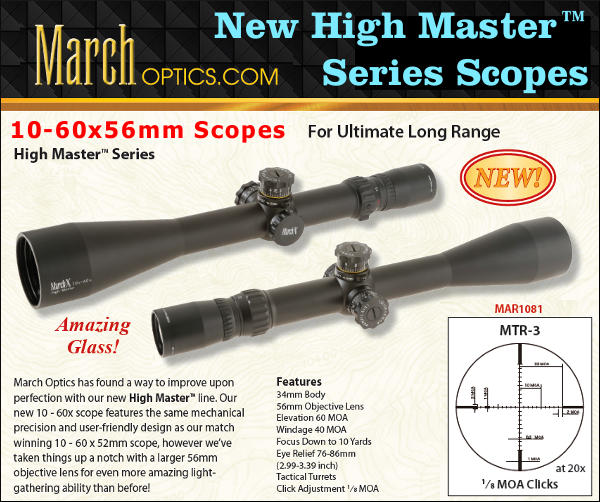
At SHOT Show in Las Vegas, March Optics will unveil its new “High Master” series scopes. These top-of-the line optics are designed for Benchrest and Long-Range Competition. We’ve always been impressed with the clarity and sharpness of March optics, and now they are even better. The High Master line of scopes boast class-leading, state-of-the-art ED glass that delivers outstanding sharpness with near-zero chromatic aberration.
The March engineers tell us: “We’ve found a way to improve upon perfection with our new High Master™ line. Meticulously designed and individually hand-assembled by the expert engineers at March, these scopes feature our new Super-ED, high-refractive glass for unparalleled quality and exceptional clarity. This high-tech glass greatly reduces chromatic aberration for a previously unheard-of level of sharpness and brilliance.”
New March High Master Scopes
March 10-60x56mm Zoom Scopes for Ultimate Long Range
(Five Versions: MAR1078 3⁄32 MOA DOT Reticle, MAR1079 1⁄8 MOA DOT Reticle, MAR1080 MTR-1 Reticle, MAR1081 MTR-3 Reticle, MAR1082 MTR-4 Reticle)
NOTE: The new 10-60x56mm scope features the same mechanical precision and user-friendly design as March’s match-winning 10-60x52mm zoom scope, but with a larger 56mm objective lens and enhanced glass.
March 40–60x52mm EP Zoom Scopes for Benchrest Competition
(Three Versions: MAR1083 CH Reticle, MAR1084 3⁄32 MOA DOT Reticle, MAR1085 1⁄8 MOA DOT Reticle)
NOTE: For shooters seeking “one-hole” accuracy in the Benchrest game, this is the scope. The new High Master 40-60x52mm EP Zoom scope gives serious Benchrest shooters an ultra-sharp, high-magnification variable scope with zero POI shift when changing magnification.
March 48 x 52mm Fixed Power Scopes for Benchrest Competition
(Three versions: MAR1075 Cross-Hair Reticle, MAR1076 3⁄32 MOA DOT Reticle, MAR1075 1⁄8 MOA DOT Reticle)
NOTE: These new March 48-power scopes look to set new quality standards among high-magnification, fixed power scopes for benchrest competition. Fixed-power scopes are lighter and simpler than variable scopes of equal magnification. In weight-limited Benchrest classes this fixed 48X will be a top choice.
Randy Robinett, founder of BIB Bullets, is a highly respected custom bullet-maker. In recent years, Randy’s 30-caliber projectiles have won countless benchrest-for-score matches, and captured many National titles. If you want to “run with the big dogs” in score competition, campaigning a 30BR with BIB bullets is a very smart way to go. In this article, Randy talks about the process of creating highly uniform cores for benchrest bullets.
This article originally started as an exchange of posts in Stan Ware’s Bench-Talk Forum. Stan, a gifted gunsmith, converted the Forum posts into an article, which first appeared on Stan’s Bench-Talk.com Website.
How to Make Benchrest-Quality Bullet Cores by Randy Robinett, BIB Bullets
OK, Stan “made me do it”! A while back, Stan Ware asked if I’d submit a ditty on bullet-making. Here is the “picture is worth a few words” version. Below is a photo of a spool of lead wire. This is the first step in making benchrest-quality bullets. This spool of .250″ diameter lead wire will be cut into approximately 130 pieces, each about thirty inches long.
The Core Cutter
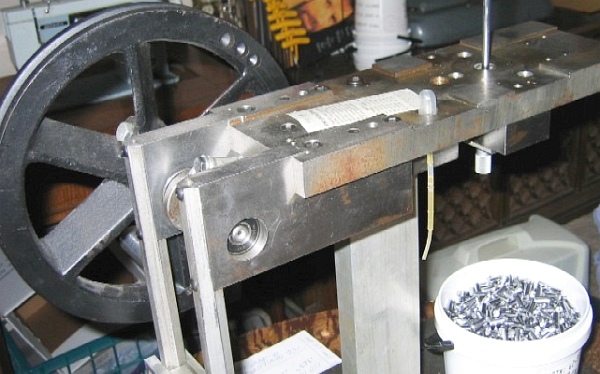
Here’s a really neat machine built by my Uncle and BIG MIKE. This is the core cutter. We made it using scrap steel and borrowed the crank shaft out of a 1966 Yamaha motorcycle to get the desired reciprocating-motion slide. When properly “juiced”, this machine can cut more than 3000 cores per hour.
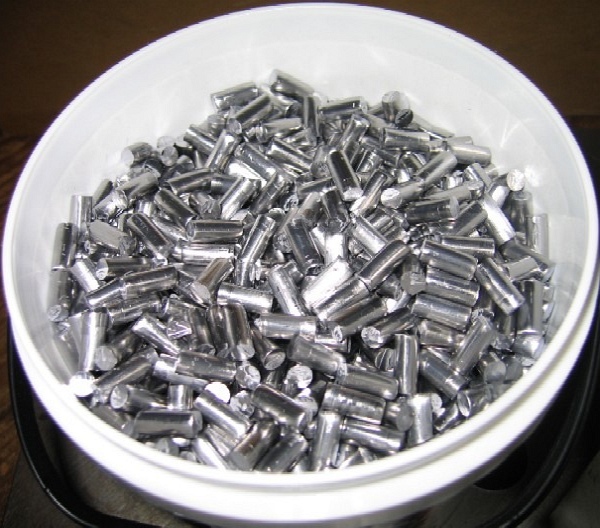
As you doubtless deduced, the “sticks” are inserted, then fed via gravity — straightness is a virtue here! The crank, for now, is powered by the human hand. The bucket contents are the result of loading the cutter and turning the crank wheel. This photo shows cores for 112 grain, .30-caliber bullets. There are about 2500 cores to the bucket.
Here’s a close-up of the business end of the core cutter. Using recorded micrometer settings, this clever design allows us to get very repeatable length when changing through the length/weight cycle.
The photo below provides a closer look at the just-cut cores. Note the relatively clean shanks and square, unflared ends. This bucket contains roughly 2500 cores. By contrast, a tour of the Hornady plant will reveal cores being cut and squirted via a single operation, and deposited into 50-100 gallon livestock watering tanks!
Upon my first tour of a commercial plant, I lost all feelings of guilt about the cost of custom, hand-made bullets. When one totals the amount of labor, “feel” and “culling” that goes into them, custom hand-made bullets represent one of the best bargains on the planet!
At Hornady, each press produces 50-55,000 finished bullets per 10-hour shift. By contrast, a maker of hand-crafted bullets, at best, may make 3% of that number during a 10-hour span! Yep, hand-made benchrest-quality bullets are a labor of love and should be purchased with these criteria in mind: 1) QUALITY; 2) availability; 3) price. There is no reason for a maker of hand-made benchrest-quality bullets to negotiate on price. His time is worth what one receives from the bargain!
Core-Making Q & A Randy’s original Bench-Talk Forum posts inspired some questions by Forum members. Here are Randy’s answers to spedific questions about core-making.
Question by Stan Ware: Randy, a post or two back you said the cores were cut into 30″ lengths first and straightened. Why do you cut to 30″ lengths? What is the reason for this?
Answer by Randy: Stan, the wire is cut into 30″ lengths (sticks) and then straightened, following which it is fed into the core cutter and cut into the individual individual “cores”. If you look at the core cutter photo above, you’ll see a stick of lead wire sticking up -it’s toward the right hand end of the contraption. The cut cores are also “ejected” by gravity — the white “tickler” brushes the cores as the slide moves forward and dislodges the core from the cutter bushing.
Q by GregP: Randy, How do you straighten the 30″ sticks? Roll them between metal plates?
Answer by Randy: Greg, BIG MIKE may kill me for letting out the secret. WE “roll” the wire between an aluminum plate, which is equipped with handles, and the “plate” which you can see in the pic of cutting the wire. The straightening is really a drag. Eventually, we will have the new cutter hooked up to a “feeder/straightener” and the wire will be cut into core slugs right off the roll! Well, that’s the Dream….
Question by Jim Saubier: How much of a nub do you use at the end of the 30″ section? I imagine that every section you will lose a little from the feed end. Your cutter looks real slick, we are using the manual deal and it isn’t quick by any means.
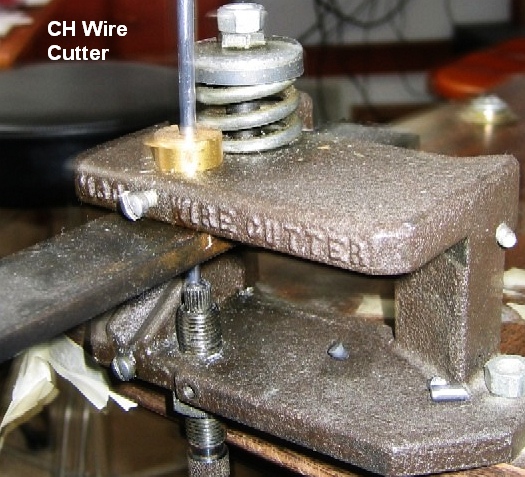
Answer by Randy: Jim, Since I cut all of the sticks using diagonal-cutting pliers, the ends are, indeed, waste. However, only about 1/8th inch on the beginning end — the final core may be too short. I have attached a pic of my old reliable CH cutter. I still use this cutter for .22-cal and 6mm cores and, occasionally, an odd lot of thirties. The CH cuts very square ends which are free of bulges and/or flaring.
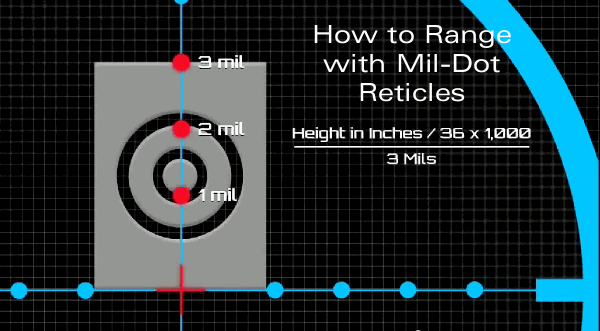
MIL-system scopes are popular with tactical shooters. One advantage of MIL scopes is that the mil-dot divisions in the reticle can be used to estimate range to a target. If you know the actual size of a target, you can calculate the distance to the target relatively easily with a mil-based ranging reticle. Watch this helpful NRA video to see how this is done:
Leupold has released three new VX-3i scopes for precision shooters. The new VX-3i LRP (“Long Range Precision”) series of scopes offer impressive features at affordable price points. There are three new LRP models: 4.5-14x50mm, 6.5-20x50mm, and 8.5-25x50mm. The “3i” in the model names indicates a three-times zoom ratio.
Both front focal plane (FFP) and rear focal plane VX-3i LRP models will be offered. All VX-3i LRP scopes come with a removable throw lever on the zoom ring. The big, knurled turrets are easy to manipulate and feature an elevation zero stop. You can choose either quarter-MOA or 1/10th MIL clicks, and the reticles are matched to the click values — MOA/MOA or mil/mil.
Several popular reticle options are available, including MOA-based Impact-29 MOA, Impact-32 MOA and T-MOA®; or the mil-based TMR® and the new Leupold CCH (Combat Competition Hunter) reticle. The Leupold CCH is a grid-based reticle providing holdovers and wind holds in mils. That should prove popular with tactical marksmen and PRS competitors.
For target work at 400+ yards we like the 8.5-25x50mm LRP:
Competing with Vortex and Bushnell for the Tactical Market
We see these VX-3i scopes as direct competition for the Vortex and Bushnell scopes now favored by many tactical and PRS shooters. Leupold’s goal was to build a scope with the features customers want at affordable prices. Tim Lesser, Leupold’s VP of product development, explains: “The VX-3i LRP [optics line] is a high-end, long-range riflescope that’s within most people’s budget, be it for PRS, long-range target shooting or even hunting.”
Shotgun vs. Handgun — which is better for home defense? That’s a question that inspires strong opinions on both sides. We think the best answer may be “both”. There are some situations where a pistol is most handy, while there are other situations where the power (and lethality) of the shotgun clearly wins out. Some would argue that the shotgun offers an “intimidation” factor that may better resolve a threat without a shot being fired.
The NSSF, in cooperation with Thunder Ranch Training Center, has created an interesting video that examines the Shotgun vs. Handgun debate. As the Cheaper Than Dirt Blog notes: “The primary argument against the shotgun is a longer length leading to less maneuverability. On the other hand, the pistol offers better maneuverability, but lacks the stopping power of a shotgun”. Moreover, the pistol may be less accurate, according to some critics. This NSSF video looks at the question from a logical standpoint — making some surprising points.
As you can see in this still frame from the video, the shooting stance of the pistol shooter (Clint) is NOT much more compact than that of the two shotgunners (compare actual muzzle positions). So a shotgun may actually be more handy inside a home than some people realize. Clint concludes that the gun selection debate “is all very easily solved by only one question: ‘If someone was going to run across a bedroom at you and they had a big knife, would you rather shoot him one time with a pistol or one time with a shotgun?’ When you answer the question you figure out why this [shotgun length] doesn’t really bother us. We simply take these [shotguns] and use them in a slightly different manner…”
In this video, Thunder Ranch Director Clint Smith explains why the overall length of a shotgun, as held in firing position against the shoulder, is not really that much greater than the “shooting stance length” of a handgun held in a proper firing position (with arms extended). Accordingly gun length/size should not be the deciding factor when choosing a firearm for home defense.
Whatever Weapon You Choose — Train with It
Fundamentally, you should use the firearm that is 100% reliable, and with which you have trained regularly. Mastery of a defensive firearm — whether shotgun or handgun — needs to be second-nature. You should be able to operate all the controls (safety, pump, decocker, slide, bolt handle etc.) by “instinct” based on hours of training. Likewise you should know how to operate the light/laser if your defensive firearm is so equipped. Importantly, you should be able to reload in darkness, and clear malfunctions without panicking.







 Cerrosafe is a metal alloy that has some unique properties which make it ideal for chamber casting. First, it has a relatively low melting point of 158 to 190° Fahrenheit. This makes it easy for the handloader to melt the Cerrosafe in his home shop. Second, it shrinks slightly during cooling which allows it to be extracted from the chamber easily. It then re-expands to the chamber’s original size after about one hour at room temperature. After cooling for about 200 hours, the chamber cast will expand to about .0025″ larger than the actual chamber size.