In Brownells’ GunTech™ Archive of instructional articles and videos, Eric Kiesler has written an informative Guide to Metal Prep for bluing or bake-on resin coatings. Eric’s “how-to” advice will be useful for prepping something as small as a scope ring or as large as a complete barrelled action. Here is a selection from Eric’s article:
Gunsmith’s Guide to Metal Prep for Baking & Bluing
By Eric Kiesler
Prior to bluing or the application of a bake-on coating, a steel surface must be properly prepared. In either case, at a minimum the work piece must be thoroughly and completely degreased. There are many acceptable ways to degrease steel parts, so long as no residue remains the method used is not critical. We typically recommend TCE (#083-060-024) for degreasing prior to the application of Brownells Baking Lacquer (#083-046-801) or Oxpho Blue (#082-024-004). The TCE in the spray can is preferable as it allows you vigorously spray the surface, start at the top of the part and hose it down to the bottom chasing the grease off.
Prior to hot caustic Bluing (#082-005-007) the parts are immersed in a heated detergent bath using Dicro-Clean (#082-005-008) because (like TCE) we know it will have no adverse after effects or residue that could cause problems later on. Once the degreasing is complete, the part could be blued or coated, however, with bake on coatings, adhesion is greatly enhanced if the surface of the parts are roughed up. This can be accomplished by sanding them with a fine abrasive cloths, sand paper, Emory Cloth (#657-110-120) or by abrasive blasting. Abrasive blasting is preferable because it will typically reach areas that sand paper might not.
For the Gun Kote (#083-051-001) brand of bake-on finish, aluminum oxide (#084-206-060) must be used as the abrasive blasting media in your abrasive blaster. For our other bake on coatings (and even Aluma-Hyde) sand or glass beads may be used in the blaster. If you do abrasive blast the part (highly recommended), it should be degreased afterwards because the blasting media may have contaminants in it. You don’t want to coat a highly polished part since shiny metal resists the coating, but a highly polished part could certainly be blued.
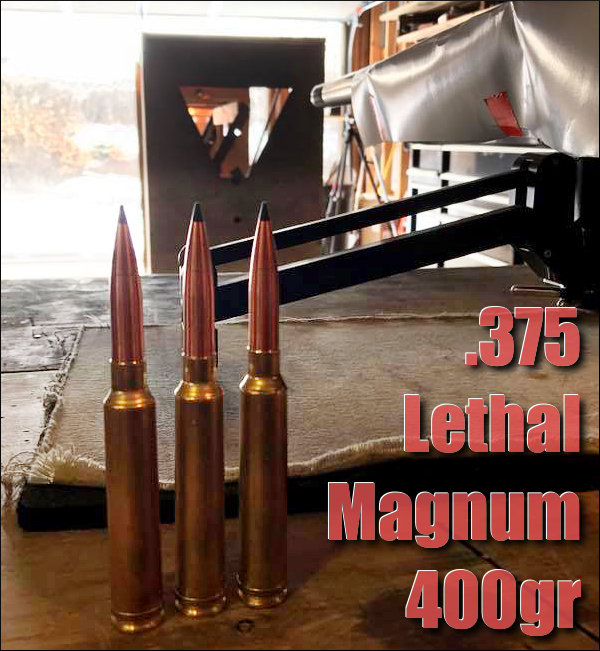
Serious ammo — .375 Lethal Magnum rounds loaded with 400gr Cutting Edge Lazer bullets. One wag posted “They look like SCUD missiles.”
In the Extreme Long Range (ELR) game, great ballistics are paramount, but you also need excellent accuracy. The top ELR shooters campaign large-caliber rifles that boast truly remarkable accuracy, considering the massive cartridges they’re shooting (with 160+ grains of powder). These big boomers, such as the .375 Lethal Magnum shown above, can really hammer.
The winner of the 2016 King of 2 Miles (KO2M) event was Mitchell Fitzpatrick, shooting a .375 Lethal Mag cartridge, as part of Team Applied Ballistics. Another member of that squad, Paul Phillips, is also campaigning a new rifle chambered for the .375 Lethal Magnum. Paul was recently doing load development for his new beast, which features a McMillan stock, Nightforce scope, and Phoenix Bipod. Among his barrels for this rig is a massive, 38″-long Bartlein.
“I had a great time today doing load development at Applied Ballistics LLC laboratory with Bryan Litz, Bill Litz, and Mitchell Fitzpatrick. I was testing loads for my .375 Lethal Mag built by Lethal Precision Arms LLC. The last several test groups were sub half-min at 300 yards. Next testing is at 1800 yards.” — Paul Phillips
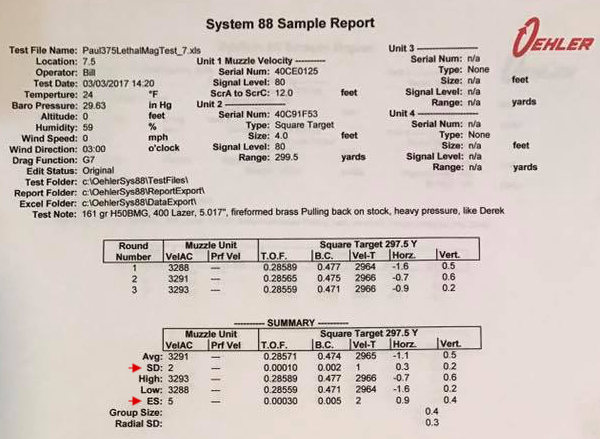
For this test, Paul’s load featured 400gr Cutting Edge Lazer bullets launched at a blistering 3290 FPS with Hodgdon H50BMG powder. Looks like Paul got his load dialed in “good and proper”. He fired a 0.9″ group at 300 yards, and the Oehler System 88 chronograph showed a very low Extreme Spread (ES) of just 5 FPS. That’s impressive even for just three shots.
A little snow on the ground can’t stop the Applied Ballistics testing team…
Look carefully and you’ll find the powder charge weight — a bit more than you’d load in a 6PPC…
Bryan Litz inspects the .375-caliber barrel with bore-scope.
Serious reloaders know that PMA Tool makes some of the best specialty reloading tools you can buy. To help folks get the most out of their PMA products, the company offers “how-to” videos. One such video features PMA’s great Micro-Adjust Case Trimmer. PMA owner Pat Reagin tells us: “We’ve had quite of bit of interest in the case trimmer, but a lot of guys want to see it in action. So we’ve created an intro video that shows how to adjust and use the trimmer in various modes.”
Watch Micro-Adjust Case Trimmer Video
The PMA Micro-Adjust Case trimmer indexes off the shoulder but it also provides precise control over neck length. You aren’t limited to a built-in, neck-length setting like some other shoulder-indexed trimmers. The PMA Micro-Adjust Trimming tool currently sells for $129.95 including one cartridge insert. The inserts, which can be purchased for $13.95 separately, can often work for a multiple cartridge types within the same family. For example, you can use the same insert for both .243 Win and .260 Rem. There is another insert that works with both 7mm-08 and .308 Win.
PMA Micro-Adjust Case Trimmer Features:
Indexes off shoulder for easy, consistent trim length.
Cases captured in no-scratch, Delrin™ inserts.
Fully rotating head with bearing for smooth operation and clean, square cuts.
Sharp carbide cutter for quick, smooth cuts with minimal burr.
Spring loaded head allows complete control of rate of feed.
How to use the PMA Micro-Adjust Case Trimmer
The trimmer indexes case off the case shoulder through the use of interchangeable Delrin™ inserts which capture the shoulder and neck of the case. This insert is contained in a spring-loaded tool head that rides on a linear bearing. The Micro-Adjust Trimmer can be used in three ways.
First, you can secure the case in a PMA caseholder chucked in a power drill, drill press, or lathe. You hold the trimming tool with your hand and feed in the spinning case. (This method is handy because if you leave the case in the holder, after you have trimmed to length, you can switch tools and chamfer the case-mouth using the same power source).
In the second method, the trimmer’s adjustment knob is removed (after locking the setting) and the cutting shaft is chucked in a drill, drill press. or lathe. Using this method, the case itself is held by hand and fed into the cutter. Lastly, the trimmer can be used manually, holding the case in one hand and the trimmer in the other. That’s the slowest method, but it works if you do not have power tools handy.
Camp Perry photo. Starting this year, the High Power Championships will be held at Camp Atterbury, IN.
There are some big changes this year for the NRA National Rifle and Pistols Championships. The NRA High Power Rifle Championships will be held in Indiana (at Camp Atterbury), not at Camp Perry, Ohio. That’s new for 2017. The smallbore championships was moved a few years back to Camp Wa-Ke’-De Range in Bristol, Indiana. The Pistol Championships will remain at Camp Perry. So, when once all three Championships were held in the same historic place, Camp Perry, now they are in three locations. Some folks lament that change…
REGISTRATION OPEN for Championships
If you want to compete in any of the NRA National Championships, you can now register online. We provide links below for Highpower Rifle, Smallbore, and Pistol Event. When you register, you’ll need an identifier — NRA Member ID, NRA ID (15 digit number) or an NRA National Rifle and Pistol Championships Online Entry ID from a previous year’s entry. See the individual championship entry links listed below.
by Gavin Gear, UltimateReloader.com
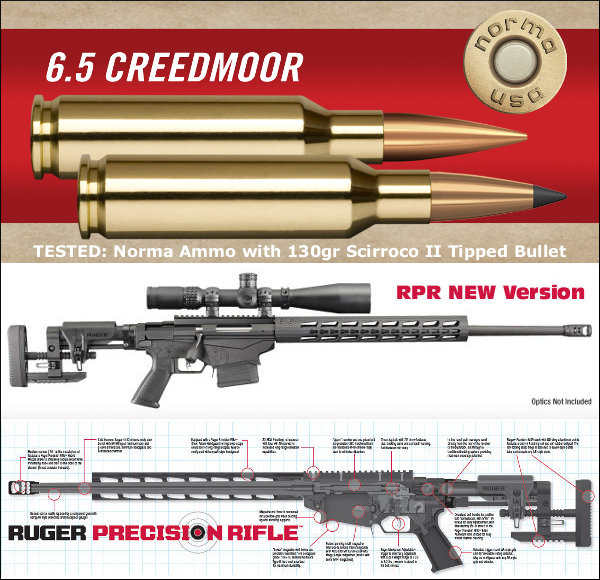
Norma is known for its high-quality brass and ammunition. I’ve used Norma brass for precision reloading in calibers like .30-06 with great results. Recently, I saw that Norma had announced a new addition to their Professional Hunter lineup of ammunition: in 6.5 Creedmoor! I thought I should try some out with the Ruger Precision Rifle, and that’s what I’ll cover in this post.
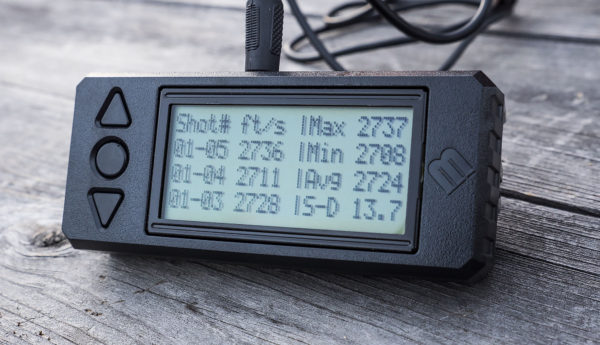
As you saw in the video, this ammunition behaves more like match ammunition than it does hunting ammunition — I really wish it was deer season! Here are the chronograph results:
This article comes from the Midsouth Shooters Blog. You’ll find other helpful gear reviews, reloading tips, and technical articles at www.MSSBlog.com.
With an SD of 13.7 FPS, this ammunition is very consistent in terms of velocity. It’s not surprising that the first four shots went into a .5″ group. This new ammunition is built around the Swift Scirocco II 6.5mm Bullet, and here’s more info about this precision-oriented hunting projectile:
Technical Information
Caliber: 264, 6.5mm
Bullet Diameter: 0.264
Bullet Weight: 130 Grains
Bullet Length: 1.350″
Bullet Style: Polymer Tip Spitzer Boat Tail
Bullet Coating: Non-Coated
Ballistics Information:
Sectional Density: .266
Ballistic Coefficient:.571
This is certainly a great choice of ammunition if you are hunting medium game with a rifle chambered in 6.5 Creedmoor. Can’t wait to sit down again with this ammunition to see if I can get that 3/8″ 5-shot group I know this ammo is capable of! If you want to try this Norma 6.5 Creedmoor Professional Hunter ammo yourself, you can purchase this excellent ammunition at Midsouth Shooters Supply.
The IWA Outdoor Classics trade show, aka “Euro SHOT Show”, opened today, March 3rd, in Nuremberg, Germany. For the next four days (March 3-6), 1455 exhibitors will show their products at the Nuremberg Exhibition Centre. This is a hugely popular event — last year’s IWA Outdoor Classics trade show attracted 45,530 trade visitors from 115 countries, and attendance should be even higher this year. IWA is Europe’s biggest combined trade show for the hunting, shooting, and civilian/military security industries. And this year, IWA Outdoor Classics was coordinated with EnforceTac, a two-day Law Enforcment/Security trade show held in Nuremberg March 1-2, 2017.
IWA even features an indoor Archery Range. For many years, the Archery Range has been a popular gathering place where exhibitors and visitors can practice their skills and learn about the latest archery products up close and personal.
About the IWA Outdoor Classics Trade Show
What is now the IWA Outdoor Classics trade show began 44 years ago as Germany’s national product show for gunsmiths and gun retailers. That product show started modestly in 1973 with less than 100 exhibitors. Over the past four decades IWA Outdoor Classics has grown into a massive event, drawing the major players in the hunting, security, and shooting sports industries. In the firearm universe, the IWA event is second only to America’s SHOT Show in importance.
Ever wondered what caused a particular bulge or marking on a case? And more importantly, does the issue make the case unsafe for further use? Sierra Bullets Ballistic Technician Duane Siercks offers some insight into various issues and their causes in this article from the Sierra Blog.
Incipient Case-Head Separation
This is a Winchester .308 Win case that has a real issue. This case has a very obvious incipient case head separation in the process of becoming a complete failure.
This is most commonly caused by over-sizing the case causing there to be excess headspace on the case. After a few firings and subsequent re-sizing, this case is just about ready to come completely apart. Proper die adjustment is certainly a requirement here. Of course this case is not safe to reuse.
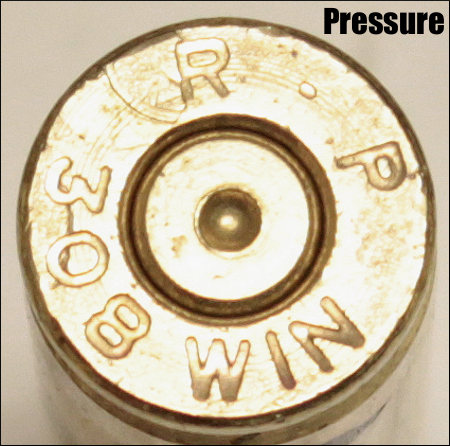
Excessive Pressure (Load Too Hot)
If you will notice in the picture of the case rim, there are two pressure signs to notice. First, look at the primer. It is basically flattened to about the max of what could be considered safe. If this was the only pressure sign noted, I would probably be fine with this load, but would constantly keep an eye on it especially if I was going to use this load in warmer temperatures. This load could easily cross into the “excess pressure” realm very quickly.
There is another sign of pressure that we cannot ignore. If you’ll notice, there is an ejector mark apparent that is located over the “R” of the R-P headstamp. This absolutely tells us that this load would not have been in the safe pressure range. If there were any of these rounds loaded, they should not be fired and should be dis-assembled. This case should not be reloaded.
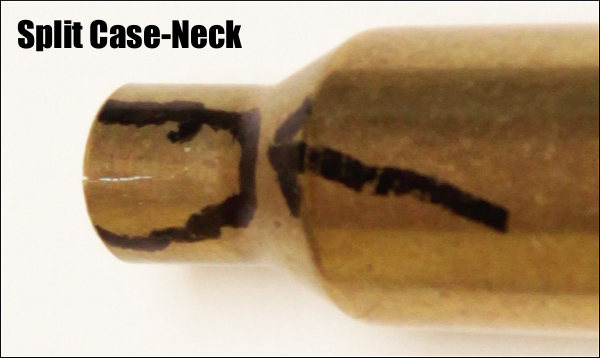
Split Case-Neck
Here we have an R-P .22-250 case that has died the death. Everything looks fine with this case except the neck is split. This case must be tossed.
A split neck is a normal occurrence that you must watch for. It is caused by work-hardening of the brass. Brass cases get harder with age and use. Brand new cases that are stored for a period of time can become hard enough that they will split like this case within one to two firings. I have had new factory loads do the same thing. Then as we resize and fire these cases repeatedly, they tend to get harder and harder. Eventually they will split. The life of the case can be extended by careful annealing practices. This is an issue that would need to be addressed in an article by itself. Of course this case is no longer usable.
In the classes that I teach, I try to use examples like this to let the students see what they should be looking for. As always, if we can assist you, whether you are new to reloading or very experienced, contact us here at Sierra Bullets by phone at 1-800-223-8799 or by email at sierra@sierrabullets.com.
Dented Case Body
Here we have a Lake City 7.62×51 (.308 Win.) case with two heavy marks/dents in the case body.
This one may be a bit of a mystery. It appears as if this case may have been caught in the action of a semi-auto rifle when the firearm jammed or the case failed to clear during the cycling process. I probably would not reload this case just to prevent any feeding problems. This also appeared to be a factory loaded round and I don’t really see any pressure issues or damage to the case.
It is very important to observe and inspect your cases before each reloading. After awhile it becomes second nature to notice the little things. Never get complacent as you become more familiar with the reloading process. If ever in doubt, call Sierra’s Techs at 1-800-223-8799.
Lyman Products now has a full-featured website that is modern, easy-to-navigate, and mobile-friendly. The newly-updated Lyman website features bigger photos, simpler navigation, and a shopping cart system that allows visitors to buy products directly through the site. It is also much easier to find key information, such as user manuals and product demo videos. Here are some “shortcuts” to key resources now available on LymanProducts.com.
The intuitive website allows visitors to create accounts, wish lists and find dealers near them. It’s been organized to allow visitors to easily locate their favorite brands or find products within a specific category such as gun care or shooting and practice gear. An extensive FAQ has been built from the most common customer questions and the video gallery offers instruction on gun cleaning and a sneak peek at what’s new for 2017.
“With the huge array of Lyman products and brands, we knew we had to offer our loyal customers a better platform on which to learn about our many products and brands,” Elizabeth Friedmann, Lyman’s Marketing Services Manager.
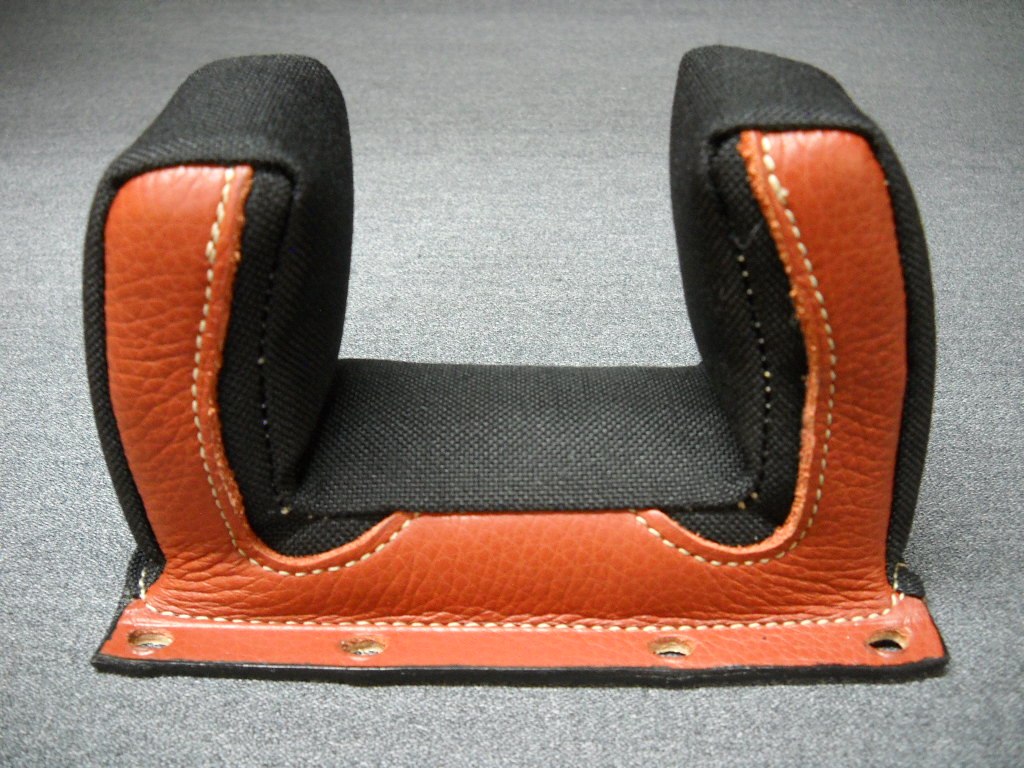
The NBRSA has liberalized its rules regarding front sandbags. Until this year, NBRSA rules required that benchrest competitors be able to lift their rifle fore-ends freely from the front bag. Accordingly, front bags could not “capture” the forearm or hold the gun down (i.e. keep it from rising). In order to meet this requirement, “legal” bags had straight sides that didn’t stand too far up.
Now the NBRSA rules have changed. You no longer have to be able to lift the gun up freely from the bag without interference. It’s now permissible to have a bag that offers some up/down retention. Check out this new bag from Edgewood Shooting Bags. Call “The EDGE”, it offers taller side sections that can hold the fore-arm in place and counter torque.
Edgewood’s designers state: “There are a couple of [NBRSA] rule changes for 2017. The change we found most intriguing was that the requirement of being able to lift your fore end freely from the front rest has been removed. So, we came up with a new design with super tall ears which will allow the innovators to push the envelope. Let’s see what you can do with these…”
We expect this new type of front bag will help stabilize short-range benchrest rifles, particularly in the 10.5-lb Sporter and Light Varmint classes. But we expect the biggest gains will be had with the big-caliber rifles used in Mid-Range and Long Range benchrest competition. In the 1000-yard game, heavy-recoiling 7mm and .30 caliber cartridges are popular with many shooters. These big guns generate considerable torque despite their ample weight. We predict these “super-sized” front bags will reduce both hop and rolling motion (torque) in the big guns.
We also expect that some varmint hunters will experiment with high-sided front bags that wrap around the fore-end. Such front bags may prove a real boon for guns with narrower, sporter-style fore-ends. And it would be interesting to see if this kind of tall-sided bag design will be incorporated into portable sandbags for the PRS game. We shall see…
Rule Change and Product Tip from EdLongrange. Product Tip from Boyd Allen. We welcome reader submissions.
When we first ran this story a while back, it spurred a hot debate, with strong opinions on both sides of the issue. Some guys argued vehemently that volumetric powder dispensing was best — citing the experience of short-range benchresters, most of whom still throw their charges. Others say weighing your charges is best, so long as you have a very precise, and very repeatable scale. We know some of the top 1000-yard shooters weigh their charges to the kernel.
Most competitive long-range shooters weigh powder charges for their handloads. Some even use ultra-precise magnetic force restoration scales to load to single-kernel tolerances. But is weight-based measuring always the best way to fill a case with powder? Another option is volumetric charging. This method fills a precisely-sized cavity with powder and then dumps the charge into the case. A Harrell’s rotary powder measure works this way, as does the sliding powder filler on a Dillon progressive press.
For long-range applications, most people believe that precise weighing of powder charges is the best way to achieve optimal accuracy and low ES/SD. However, those short-range Benchrest guys do pretty darn well with their thrown charges, at least at 100 and 200 yards.
Our friend Dennis Santiago recently observed something that made him scratch his head and wonder about weighing charges. His AR-15 match rifle shot better with volumetric (cavity-measured) charges than with weighed charges dispensed by an RCBS ChargeMaster. Here’s what he reports:
Cavity vs. Dribble (Dennis Santiago Report) I had the chance to compare nominally identical ammunition loaded two ways. These were all .223 Remington match loads using 77gr Sierra Match Kings over 23.4 grains of Hodgdon Varget. Same gun. However I loaded some ammo with charges dispensed with a Lee cavity-style powder measure while other rounds were loaded with powder weighed/dispensed by an RCBS Chargemaster. The cavity-drop ammo (with powder dropped from the Lee unit) was consistently better than the weighed-charge ammo. I have no idea why…
So, ladies and gentlemen — what do you think? Why did Mr. Santiago’s volumetrically-charged ammo shoot better than ammo filled with weighed charges? What’s your theory? Gary Eliseo suspects that Dennis’s Chargemaster might have been drifting. What do you think? Post your theories in the comments area below.


 In Brownells’ GunTech™ Archive of instructional articles and videos, Eric Kiesler has written an informative Guide to Metal Prep for bluing or bake-on resin coatings. Eric’s “how-to” advice will be useful for prepping something as small as a scope ring or as large as a complete barrelled action. Here is a selection from Eric’s article:
Prior to hot caustic Bluing (#082-005-007) the parts are immersed in a heated detergent bath using Dicro-Clean (#082-005-008) because (like TCE) we know it will have no adverse after effects or residue that could cause problems later on. Once the degreasing is complete, the part could be blued or coated, however, with bake on coatings, adhesion is greatly enhanced if the surface of the parts are roughed up. This can be accomplished by sanding them with a fine abrasive cloths, sand paper, Emory Cloth (#657-110-120) or by abrasive blasting. Abrasive blasting is preferable because it will typically reach areas that sand paper might not.
For the Gun Kote (#083-051-001) brand of bake-on finish, aluminum oxide (#084-206-060) must be used as the abrasive blasting media in your abrasive blaster. For our other bake on coatings (and even Aluma-Hyde) sand or glass beads may be used in the blaster. If you do abrasive blast the part (highly recommended), it should be degreased afterwards because the blasting media may have contaminants in it. You don’t want to coat a highly polished part since shiny metal resists the coating, but a highly polished part could certainly be blued.









 Most competitive long-range shooters weigh powder charges for their handloads. Some even use ultra-precise magnetic force restoration scales to load to single-kernel tolerances. But is weight-based measuring always the best way to fill a case with powder? Another option is volumetric charging. This method fills a precisely-sized cavity with powder and then dumps the charge into the case. A Harrell’s rotary powder measure works this way, as does the sliding powder filler on a Dillon progressive press.


