by James Mock
After owning three different rifles with BAT actions, I have become a loyal fan of BAT Machine quality and customer service. Back in 2009, I traded my BAT/Scoville for the BAT/Leonard that I currently shoot. This rifle has a long history and Terry Leonard told me that “Old 87″ (as I have named it) was one of the earlier BATs that he stocked. He wrapped the stock in fiberglass and used 2-part epoxy back then. I must say that this rifle has held up remarkably well since it dates back to the 1990s. The action is a RB/LP/RE octagon Model B with .308 bolt-face.
With this gun, I have shot several barrels of different calibers (.22 PPC, .22 PPC-short .095, 6mm PPC, 6XC, 6mm Dasher, .30BR, and will soon have a 6 BR-AI). It has been an exceptionally accurate rifle in several disciplines. In the hands of previous owners, it earned several Hall-of-Fame (HOF) points, and a “middle-of-the-pack” shooter (me) even received a HOF point with this rifle.
For most of its life, Old 87 served as a short range benchrest rifle, but I have used it for the last few years as a 600-yard rifle with the 6mm Dasher barrel. I was lucky enough to earn the Shooter of the Year award at the Prince Memorial Range in Louisiana for 2016.
After shooting my two Dasher barrels for last eight years, I have noticed a drop-off in accuracy at 600 yards. A decision had to be made — get a new barrel or sell the rifle and retire from competition. I will be 74 years old in six months and my competition days are limited due mainly to a chronic neck problem. After mulling over the decision to retire or not, I decided to give Old 87 one more year. Here is the story of how we upgraded the old war-horse.
Old 87 REBORN — Upgrading with New Components
I prefer cut-rifled barrels with four lands and grooves and have had success with .236 bore diameters and 1:8″ twist in long range rifles. I searched for barrels meeting those parameters and found a suitable BRUX at Bugholes.com (Southern Precision Rifles).
The 6BR-AI Option — Easy Fire Forming
I thought about having Billy Stevens chamber it for the Dasher, but decided to try something new. There seems to be a lot of interest in the 6BR-AI and I said, “Why not?” Well, I bought a shortened Dasher die from Harrell’s and will use my Wilson Dasher seating die. Bart Sauter was kind enough to let me use his reamer for chambering.
Fitting a New Roller-Type Cocking Piece on Older BAT Action
Since I was into the project this deep, I called Mike Ezell and ordered one of his Tungsten powder-dampened tuners. Since Old 87 had thousands of rounds since the firing pin spring has been replaced, I decided that it was probably needed. Well, I got to thinking (very dangerous) and asked Daryle Thom if it would be feasible to put a roller-type cocking piece and a new firing pin spring on such an old action.
The folks at BAT are very accommodating and they said that it would be no problem with such a conversion. While my bolt was in Idaho, the barrel with Ezell tuner arrived and I could not shoot it. However, my friend Jeff Turner loaned me his BAT bolt to see if it would work. Although the rifles differ in age by 15 or more years, the borrowed bolt worked perfectly in my rifle. This is a testimony to the great machine work performed at BAT Machine.
New Bolt Roller Tail-Piece Makes a Big Difference in Cocking Effort
With the borrowed bolt I managed to fire-form 50 rounds and get them ready for our 600-yard match on September 16. The folks at BAT quickly fixed my bolt by replacing the mainspring and ejector spring, polishing the ejector, and replacing the tail-piece with their roller type. Pictured below is this tail piece that makes a remarkable difference in the force needed to cock the action. It is amazing what this little wheel can do… even when placed in a 20+ year old action.
Working with the Ezell Barrel Tuner — Small Increments Work Best
Also, I would like to congratulate Mike Ezell on his new tuner which contains powdered Tungsten. It is easy to set up and Mike will help a buyer get maximum effectiveness from the unit. Just give him a call. Below is a picture of the tuner. I was lucky enough to have some time to “play” with it before the match.
Talking about the tuner, Mike writes: “Our new barrel tuners…
PDT stands for particle dampening technology. The science is there, we just applied it to a barrel tuner. The advantages are a wider tune window and more efficient control of barrel harmonics…in a tuner design that actually looks good.”
Mike advised me to set the tuner by turning it all the way into the shoulder and then come out to zero or the second time zero comes up if there is not at least half of a turn between the shoulder and the first zero. It is best to start with a proven load and adjust the tuner from that load. As unlikely as it seems, a rifle can go from a good tune to a very poor tune with only 5 marks (.005”) and vice versa.
Mike cautions those who use his tuner to NOT make adjustments which are too large. As a matter of fact, he recommends adjustments of .001 inch at a time. Ezell’s tuners are screwed onto the barrel with .900” by 32 threads per inch and has 32 marks on the circumference of the tuner. Therefore, each mark moves the tuner in or out by .001 inch. There are three set screws with Teflon tips which provide friction for the tuner on the threads. Do not tighten the screws so tight as they damage the fine threads.
If you want the smoothest bolt possible for your BAT, call or e-mail Daryle or Bruce Thom at BAT Machine and discuss your needs with them. I am sure glad that I did. If you want a state-of-the-Art tuner for your barrel, give Mike Ezell a call or visit his Ezell Custom Rifles Facebook Page.
— Good shooting, James Mock
Do you find that the crosshairs in your scope get blurry after a while, or that you experience eye strain during a match? This is normal, particularly as you get older. Focusing intensely on your target (through the scope or over iron sights) for an extended period of time can cause eye strain. Thankfully, there are things you can do to reduce eye fatigue. For one — breathe deeper to take in more oxygen. Secondly, give your eyes a break between shots, looking away from the scope or sights.
In our Forum there is an interesting thread about vision and eye fatigue. One Forum member observed: “I have noticed recently that if I linger on the target for too long the crosshairs begin to blur and the whole image gradually darkens as if a cloud passed over the sun. I do wear contacts and wonder if that’s the problem. Anyone else experienced this? — Tommy”
Forum members advised Tommy to relax and breath deep. Increase oxygen intake and also move the eyes off the target for a bit. Closing the eyes briefly between shots can also relieve eye strain. Tommy found this improved the situation.
Keith G. noted: “Make sure you are still breathing… [your condition] sounds similar to the symptoms of holding one’s breath.”
Phil H. explained: “Tom — Our eyes are tremendous oxygen hogs. What you are witnessing is caused by lack of oxygen. When this happens, get off the sights, stare at the grass (most people’s eyes find the color green relaxing), breath, then get back on the rifle. Working on your cardio can help immensely. Worked for me when I shot Palma. Those aperture sights were a bear! The better my cardio got the better and longer I could see. Same thing with scopes. Try it!”
Watercam concurred: “+1 on breathing. Take a long slow deep breath, exhale and break shot. Also make sure you take a moment to look at the horizon without looking through rifle or spotting scope once in a while to fight fatigue. Same thing happens when using iron sights.”
Arizona shooter Scott Harris offered this advice: “To some extent, [blurring vision] happens to anyone staring at something for a long time. I try to keep vision crisp by getting the shot off in a timely fashion or close the eyes briefly to refresh them. Also keep moisturized and protect against wind with wrap-around glasses”.
Breathing Better and Relaxing the Eyes Really Worked…
Tommy, the shooter with the eye problem, said his vision improved after he worked on his breathing and gave his eyes a rest between shots: “Thanks guys. These techniques shrunk my group just a bit and every little bit helps.”
Read more tips on reducing eye fatigue in our Forum Thread: That Vision Thing.
To avoid eye fatigue, take your eyes away from the scope between shots, and look at something nearby (or even close your eyes briefly). Also work on your breathing and don’t hold your breath too long — that robs your system of oxygen.
An outfit in Washigton State, Box to Bench Precision, has developed an oversize (23.5″ x 30″) precisely-scaled target designed for load development and scope testing. This target is very innovative. On the target you’ll find various clusters of aim points for various tasks. Upper left are orange aiming spots for testing various powder charges. In the upper right quadrant are more red aim points to be used when testing bullet seating depth. Running down the center of the target is a vertical line with horizontal marks showing precise MOA and Mil heights at 100 yards — use this feature to verify your click values.
And there’s more. In the lower right quadrant (far right) are three black targets to be used for chrono work. With these you can record cold velocity, hot barrel velocity and a “Final Velocity”. Over in the lower left quadrant, in the left-most column, are three dot targets for zeroing and recording group size with load data. Finally, four more black/white targets can be used for a scope box test (aka “shooting the square”). With a box test, you move from target to target, clicking in sequence to each corner of the square in sequence, evenutally returning to your original aim point. If your scope tracks correctly, the last box test shot should end up right on top of the first shot.
Record the Entire Load Development Process on One Target
For those used to shooting at conventional bulleyes or benchrest targets, this target may seem confusing, but it can really help organize and simplify the process of load development. We like the idea of having a single, durable target that performs double-duty — serving for load development as well as scope checking. And we like the fact that the target is pretty strong — the maker says: “The target is Tear-Resistant and Water-Proof”. We’d expect a maker based in the Pacific NW to design a target that can handle wet weather.
How to Order
So how much does all this target technology cost? A single, 23.5″ x 30″ target costs $6.99. A pack of three targets costs $19.47, while a five-target pack runs $29.95 (which works out to $5.99 per target). Targets ship in a durable cardboard tube. If you like what you see and want to order these targets, visit the Box To Box Precision Online Store.
OK, we admit that this is kind of a crazy gimmick, but we also know many of our readers would love to have one of these very unique shot glasses which have a real .308-Cal bullet molded into the side. The “Point of Impact Shot Glass” is available, for a limited time, from the NRA Store for $14.95.
Ultimate Conversation Starter
Looking for a conversation starter at your next gathering? Or a unique gift? The NRA Point-Of-Impact Shot Glass is a great gift item for a firearm enthusiast.
Featuring a genuine .308 caliber bullet molded directly into the glass, these glasses are a perfect blend of firearms and fun. Each 2 oz. shot glass is handcrafted in the USA and displays an NRA imprint.
Technical Specifications:
• Size: 2 oz. Shot Glass
• .308 bullet molded into glass
• Hand wash only
• Made in USA
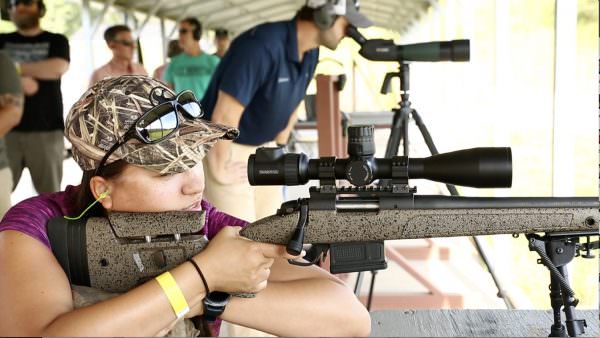
Wouldn’t it be great if rifle-makers offered demonstration days, where shooters could try out various rifles — with ammo provided? Yep, that would be nice. Well that’s exactly what Bergara Rifles USA has been doing with its Bergara Experience. We commend the company for offering these free “test drive” sessions, giving shooters a chance to test some impressive factory rifles.
This video covers the First Bergara Experience, held in North Carolina
Bergara hosted three shooting demo sessions last month (August) in the Southeast USA. The first event took place at Woody’s Hunting and Rifle Club in New Hill, North Carolina on August 5th. Next Bergara’s team hosted an event on August 19th at the White Feather Precision Shooting Range in Ardmore, Tennessee. The final Bergara Experience in August was held on the 26th at the Barbour Creek Shooting Academy in Eufaula, Alabama.
The video above was filmed at the inaugural Bergara Experience, in North Carolina. Shooters fired a variety of rifles both prone and from the bench. A crowd favorite was the precision B-14 HMR (see below) chambered in 6.5 Creedmoor — both with and without suppressors.
Here’s video from the Barbour Creek Academy. This is an excellent facility with a covered shooting house and a range that runs out to 1,580 yards. At Barbour Creek, shooters got to test the long range capabilities of Bergara rifles.
“It’s one thing to say your rifles are serious long-range precision rifles and to claim accuracy out hundreds of yards in your advertising, but we wanted to prove it,” noted Ben Fleming, Bergara’s VP of Sales and Marketing. “The concept behind the Bergara Experience was to give the public the opportunity to experience long distance shooting… these shoots show that the performance of these rifles is not just ad-talk, it’s built-in.”
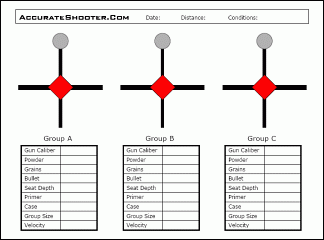
Bergara rifles all come with a test target (above). We thought it was interesting that Bergara uses a target we originally designed right here at AccurateShooter.com.
This target features a central red diamond, with lines for your cross-hairs, thicker on the horizontal. Our version includes boxes to enter load data, MV, and group size below each aiming graphic. CLICK HERE to Download Target.
The Lee Classic Cast “O”-style press has always been an excellent value — it works as well as some other presses costing twice as much. And now Lee has improved on its Classic Cast Press design by adding a breech-lock fitting in the top. This allows you to swap dies in and out in seconds, once your dies are equipped with breech-lock quick-change bushings. The Lee Classic Cast Breech Lock press is available for under $120.00. That makes it a bargain compared to other heavy-duty single-stage presses. MidwayUSA offers this press (item #824144) for $105.29, while Natchez Shooters Supplies sells the press (item #LEE90999) for $110.49.
Breech-Lock System Allows Fast Die Exchanges
With the Lee Breech-Lock Press system, the die drops straight in from the top. Then, with a quick 1/6th (60°) turn, the die locks firmly in place (like the breech on an artillery canon). The interrupted three-start thread assures dies return and lock into the exact same position each time. Bushings cost $7.43 each at Midsouth. If you prefer, you can leave a bushing in the press, and screw your dies in normally. But consider that it normally takes a dozen or more turns to screw in a normally threaded die. The Breech-lock system is way faster.
The Lee Classic Cast press features a strong, cast-iron frame and all-steel linkage. The large 1 1/8″-diameter ram is guided by over twelve square inches of ram bearing surface. We like the fact that you can mount the handle on either side, and adjust handle angle and length. As Lee explains: “The start and stop position is adjustable with a 48-tooth, ratchet-type handle clamp. In addition, the handle length is completely adjustable. Shorten [it] when you’re loading handgun and short rifle cases.”
Lock-Ring Eliminator Quick-Change Bushings
With Lee’s basic quick-lock bushings, you control vertical die position with the normal locking ring that seats against the top of the bushing. That works fine, but Lee also offers a handy Lock-Ring Eliminator Bushing (Lee SKU 90063). This clever design combines bushing and lock-ring into a single part. The Eliminator is turned from a solid piece of steel and the lock ring is integrated into the design of the part. With the Eliminator you’ll get the most repeatable and precise die positioning because lock ring and bushing are all one piece. Moreover, some guys say the Eliminator Bushings are easier to grab and remove than the standard Lee Breech-Lock Bushings.
Press owners have praised their Lee Classic Cast Breech-Lock units. Here are reports from two MidwayUSA customers:
Five Stars: Perfect single stage press. Loads accurately 6mm BR and 308 Win for competition. Large clearance is also great for my 460 Wby and 30-378 Wby. Pistol rounds in 44 mag and 45 ACP also load easy. The press has a lot of leverage for full-length rifle case sizing. Nice primer disposal system. Lowest price for its class. This unit beats my Lyman press by several miles…. ” — J. Davidson, California
Five Stars: This thing is outstanding and better than my old RCBS partner press. Once you get the sweet setting of the die, lock it in place and next time you load, you need not fumble to find the best setting. Breech lock is the key. I load a lot of .308 Win and .223 Rem for my ARs and this requires full-length sizing. Lee meets the challenge with no flex and excellent ram/die fit and alignment. Another nice feature is that the breech-lock inserts have a lock preventing [them] from unlocking. [T]he spent primer disposal is perfect vs. RCBS where primers can miss the primer catcher. The handle can also be placed left or right as needed and shortened for small cases or pistol to reduce the handle travel.” — E. Stanley, Rockford, IL
As precision hand-loaders, we normally assemble just one round at a time. That won’t cut it for an ammunition factory which needs to produce millions of rounds a month. To see how a modern factory achieves these kind of production levels, watch this video. It provides an inside look at the how ammunition is made with this step-by-step production guide from Hornady. The video begins by showing the stages in production of a lead-core jacketed bullet with exposed tip, such as the Hornady Interlock. Next, at the 1:38″ time-mark, the video shows how cartridge cases are made, starting with small brass cups (photo right). The brass is lengthened in a series of stages involving annealing, drawing, polishing, and the formation of the case head with primer pocket. Finally, at the 2:40″ time mark, the video shows how bullets and powder are seated into cartridge cases on the Hornady assembly line. In the final production stages, the completed ammunition is tested and packaged.
When considering .17-caliber Varminting, most guys think rimfire — shooting the 17 HMR or the newer 17 WSM. But there is a good, affordable centerfire option — the 17 Hornet — with quality factory ammunition available. Hornady produces factory 17 Hornet Ammo with three bullet options: 15.5gr NTX, 20gr V-Max, and the new 25gr HP Varmint. Our friends at Varminter.com recently conducted a test of Hornady’s new 25gr HP “Custom” ammunition, reasonably affordable at around $29/box of 50 rounds. Varminter.com tested the ammo in a CZ 527 rifle chambered for the 17 Hornet on a ground squirrel hunt in Northern Nevada.
Hornady 17 Hornet 25 Grain HP CUSTOM™ Ammo (#83006) Specifications:
25 grain HP Varmint bullet
3375 fps rated (Varminter.com averaged 3383 fps in CZ Model 527 with 24″ barrel)
632 FPE (Foot Pounds of Energy)
0.187 G1 Ballistic Coefficient
Ammo Testing and Hunt Report
By Varminter.com’s Editor
With the new 25gr Hornady 17 Hornet ammo, our accuracy results ranged from 0.528″ to 0.85″, with an average of 0.678″ over ten, 5-shot groups at 100 yards. After shooting the groups, we settled on a 200-yard zero, which put the rifle at 1.1″ high @ 100 yards and 5.3″ low @300 yards.
“I went 14 shots in a row without a miss, and that was from 80 yards out to 220 yards. On these small varmints here, the 25-grain HP does a good job [and] the ammunition is accurate.”
Ground Squirrel Gauntlet in Northern Nevada
It was a few months after the initial range work when I was able to really put this ammo to work on some varmints. The grass here in Southern Idaho had grown quite tall, so we decided to head over to a spot on a private ranch down in Northern Nevada. We were promised some good shooting, but until we actually sit down at the bench and start pulling the trigger, we try not to get our hopes up. Needless to say, we were not disappointed in the amount of varmints and shooting we experienced!
The set-up was simple. I set-up with my bench pointed down a private dirt road on the edge of a large alfalfa field. I was going to be shooting something I call “The Gauntlet”. What this means, is that the majority of the ground squirrels were making their home outside of the alfalfa fields. This is a perfect spot for ground squirrels, because they are forced to cross an open area (the dirt road), in order to get to the lush, green, alfalfa. Within this gauntlet, the ground squirrels would consistently stop on the edge to make sure it was safe to run across to the alfalfa side. This gives you a few seconds [time window] to find the squirrel in your scope and make the shot. The range of shoots were from 80 yards out to 220 yards down the road. CLICK HERE to read full 17 Hornet Hunt Report.
Speed Kills — 3650 FPS with a 20-Grainer
Based on the 22 Hornet cartridge case, the 17 Hornet can drive a 20-grain V-MAX bullet at 3,650 fps. At this velocity, the 17 Hornet can match the trajectory of a 55-grain .223 Remington load, but with much less noise and recoil. Look at the chart below. You can see that the 17 Hornet’s trajectory (blue-gray line) is almost an identical match for the larger .223 Rem (red line) all the way out to 400 yards or so.
NOAA photo of flooding after Hurricane Floyd in 1999. The Colt Python Revolver once belonged to Elvis Presley (Rock Island Auction).
Firearms owners who have seen their guns and stored ammunition submerged by flood waters in storm-wracked areas are probably wondering if their firearms and ammunition can be salvaged and safely used. To answer these questions, the NSSF and the Sporting Arms and Ammunition Manufacturers’ Institute (SAAMI®) created two documents outlining the proper response to submersion of guns and ammo. If you’ve got wet guns and/or ammo, download these two PDF files and read them carefully.
The SAAMI document “Guidance on Firearms That Have Been Submerged or Exposed to Extensive Amounts of Water” points out two major concerns about firearms that have been exposed to water: parts susceptible to moisture and rust damage such as metal parts, wood stocks and grips, and optics; and, secondly, infiltration of the action, barrel and safety systems by grit, silt and other foreign debris.
#1 Always unload firearms before beginning any treatment process.
It’s important to limit moisture and corrosion damage to the component parts of the firearm. This can be accomplished by disassembling the component parts and using up to two coats of a moisture-displacing lubricant such as Hoppes #9 MDL or WD-40 to clean and stabilize the parts while, importantly, following the product’s directions so as not to damage, for instance, plastic or synthetic parts. Another tip is to allow wood stocks and grips to air-dry and not be force dried by exposure to heat.
The document emphasizes that once the firearm has been thoroughly dried, consideration must be given to having the firearm inspected and serviced by the manufacturer, an authorized service center, or a qualified gunsmith before putting the firearm back in service.
Dealing with Ammunition That Was Submerged
Bottom Line, if your ammo has been submerged — DON’T USE IT. SAAMI explains why…
To help firearms owners determine what to do with ammunition that has been affected by water and moisture, SAAMI offers another helpful document, “Guidance on Ammunition That Has Been Submerged in Water.” This document covers differences in moisture resistance between centerfire, rimfire and shotshell ammunition, and potential hazards associated with “drying out” cartridges, including possible deterioration and damage to cartridges due to drying methods.
Another serious hazard that could result from using compromised ammunition is the potential for a bore obstruction due to partial ignition of either the priming compound or the propellant powder charge, or both. Firing a subsequent round through an obstructed barrel can result in bodily injury, death and property damage.
SAAMI provides the following cautionary conclusion: “It would be impossible to ascertain for certain the extent of the deteriorating affect, if any, the water may have had on each individual cartridge. Therefore, the safe answer is that no attempt be made to salvage or use submerged ammunition. The ammunition should be disposed of in a safe and responsible manner. Contact your local law enforcement agency for disposal instructions in your area.”
Today’s the day — you’ll want to tune in to Kelly McMillan’s Taking Stock Radio Show today, Friday, September 8, 2017. The broadcast will feature highly-respected gunsmith and Hall of Fame Benchrest Shooter Thomas ‘Speedy’ Gonzalez. The Radio Show, which streams on the internet, runs 9/31/2017 at 11:00 AM Pacific Time on VoiceAmerica Sports Channel.
Speedy and Kelly will discuss a variety of topics, including gunsmithing, stock design/manufacture, the past/present/future of Benchrest and F-Class competition, and how Benchrest reloading/tuning methods have influenced other disciplines. Speedy will also discuss how the standards for precision shooting have evolved in recent years. The quest for accuracy is never-ending. CLICK HERE to LISTEN.
Here’s an F-Open rifle Speedy built for a competitor at the recent F-Class World Championships in Canada.
Along with Speedy, this week Kelly McMillan interviews Phillip Naman, host of the Firing Line Radio Show, a California-based radio show covering a wide range of firearms topics, including hunting, gun rights, gun gear, shooting events, legislation, and gun safety.
You can also access last week’s episode, which features USA F-TR Team Captain Ray Gross, and Derek Rodgers, the newly-crowned F-TR World Champion.
About McMillan Fiberglass Stocks
Kelly McMillan is the president of McMillan Fiberglass Stocks (MFS). This company began in 1973 when Gale McMillan starting crafting benchrest stocks at home in his carport/garage. In 1975 MFS hired its first employee, Kelly McMillan. By 1979 Kelly was made a partner, and by 1984 Kelly was in charge of running the stock shop. Since that time MFS has continued to grow with innovation and design. Today McMillan Fiberglass Stocks has a 15,000 sq/ft facility and 65 employees.





 Ultimate Conversation Starter




 Breech-Lock System Allows Fast Die Exchanges
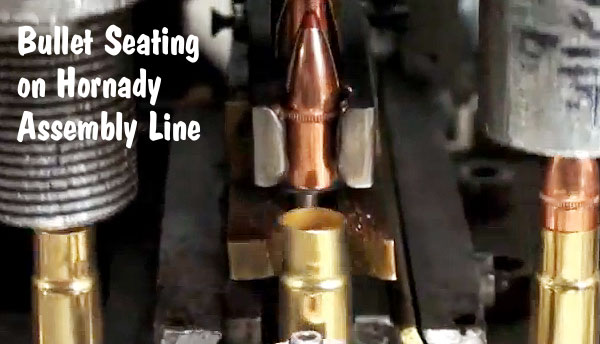
 As precision hand-loaders, we normally assemble just one round at a time. That won’t cut it for an ammunition factory which needs to produce millions of rounds a month. To see how a modern factory achieves these kind of production levels, watch this video. It provides an inside look at the how ammunition is made with this step-by-step production guide from Hornady. The video begins by showing the stages in production of a lead-core jacketed bullet with exposed tip, such as the Hornady Interlock. Next, at the 1:38″ time-mark, the video shows how cartridge cases are made, starting with small brass cups (photo right). The brass is lengthened in a series of stages involving annealing, drawing, polishing, and the formation of the case head with primer pocket. Finally, at the 2:40″ time mark, the video shows how bullets and powder are seated into cartridge cases on the Hornady assembly line. In the final production stages, the completed ammunition is tested and packaged.


 Today’s the day — you’ll want to tune in to Kelly McMillan’s


