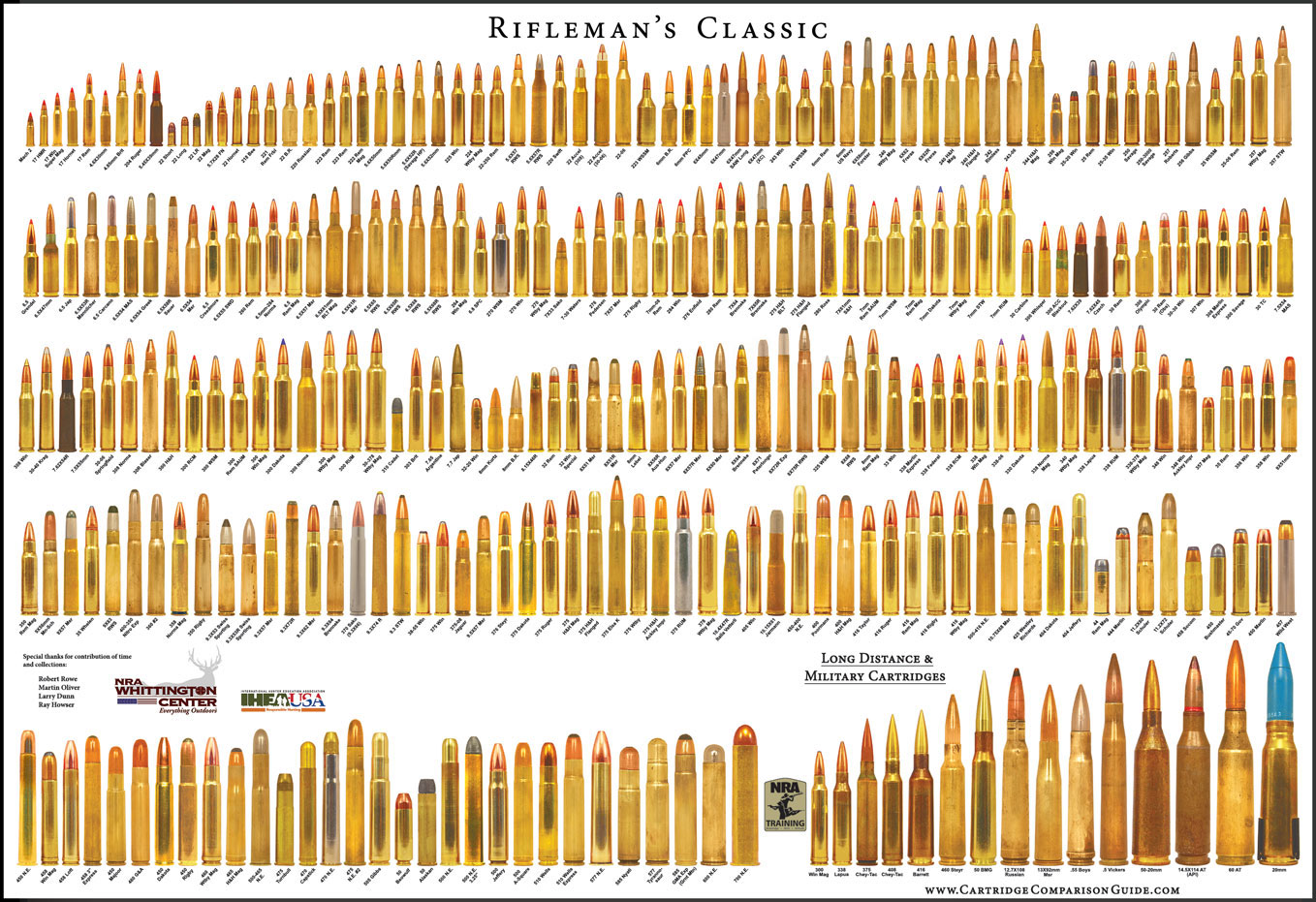
Need something for the walls of your “man cave” or reloading room? Looking for a great birthday gift for one of your shooting buddies? The creators of the Cartridge Comparison Guide offer a collection of wall posters showing ammunition types from 17 caliber rimfire cartridges all the way up to giant 35mm military rounds. ChamberIt.com currently offers 12 different large wall posters that display a huge variety of cartridge types. For example, the American Standard Poster (shown above) contains every standardized cartridge mass produced in the USA as of 2021. The cartridges are 100% to scale (life size). These posters feature full color images on high gloss / high quality 100-lb poster paper.
For example, the Rifleman’s Classic Poster (below), a full 38 inches wide and 27 inches tall, is the most comprehensive. This $17.76 poster displays over 300 rifle cartridge types at true size (within 4/1000 of an inch). Cartridges shown range from .17 caliber all the way up to the big boomers (including some cannon shells). The Rifleman’s Classic Poster includes nearly all American Standardized Rifle Cartridges and many European rifle cartridges.
Rifleman’s Classic Poster Click to view large size poster.
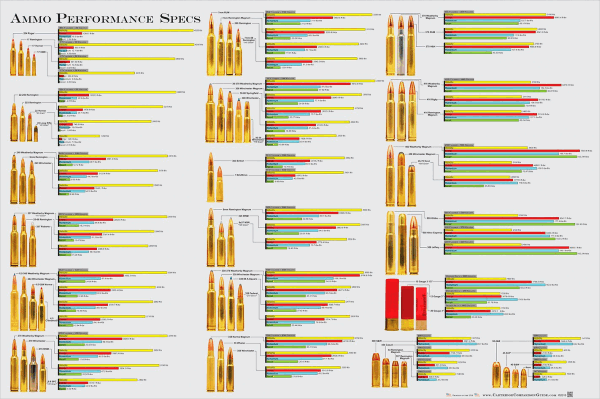
Ammunition Performance Specifications Poster
There is also an interesting Ammo Performance Specs poster. This shows dozens of popular hunting cartridges with the velocity, energy, momentum and recoil for each cartridge displayed in a bar graph.
This shows the actual size of the Ammo Performance Poster as displayed on a wall.
The handsome Colt Blued Python revolver has earned the 2025 NRA Golden Bullseye Award for Handgun of the Year, as chosen by the editors of NRA publication American Rifleman. This prestigious award will be presented at the NRA Annual Meetings & Exhibits being held this week in Atlanta, Georgia.
The double-action Colt Blued Python is offered with 3″, 4.24″, 5″, 6″ and 8″ barrels in .357 Magnum chambering. It has a superb trigger and features a target adjustable rear sight and user-replaceable front sight.
» CLICK HERE for Photo Gallery of New Blued Python
Colt has posted: “Built on a legacy of performance, the Blued Python is a .357 Magnum available in 3″, 4.24″, 5″, 6″ and 8″ barrel configurations, appealing to both collectors and avid shooters. The classic carbon steel Blued Python serves as a passport to a bygone era, where firearms were not just tools but also exquisite works of art. Modern upgrades ensure finely tuned double-action operation that delivers an impressively smooth trigger pull and consistent shot-to-shot reliability.”
Colt’s new Blued Python has a target-adjustable rear sight and replaceable front sight. The modernized ergonomic Walnut grip features a Colt Gold-tone Medallion.
“We’re honored the Blued Python is being recognized for what it is – an iconic American revolver,” said Joshua Dorsey, President of Colt’s Manufacturing Company LLC. “This NRA award is a testament to the craftsmanship and dedication of our design and engineering teams, and a nod to shooters who demand reliability, accuracy, and confidence in every trigger pull.”
AR owners know that their black rifles require regular cleaning and maintenance. And this modular platform allows many options for stocks, fore-arms, and optics mounting. That ability to customize is one of the AR’s major attractions, but customization requires solid understanding of the AR’s design and components.
To help AR owners optimize and maintain their rifles, Gun Digest Media has a 320-page illustrated book: AR-15 Setup, Maintenance and Repair. Authored by Patrick Sweeney, this paperback book is a “one-stop guide to repairing, maintaining and modifying America’s favorite rifle.” The current price for the book is $29.99 from Gun Digest, or $24.62 on Amazon (sale price). Gun Digest also offers a $27.99 Digital Download version.
GET FREE 40-Page AR-15 Book Sample
Note, if you are interested in the book, there is a substantial 40+ page FREE sample available on the Amazon site. You can see the entirety of the first two chapters from the Kindle digital version. CLICK HERE to visit Amazon.com and then click on the button labeled “Read Sample” below the cover image.
AR Set-Up and Maintenance
If you need to disassemble and maintain your AR rifle, swap barrels or handguards, add optics, or customize the stock, Gun Digest’s AR-15 Setup, Maintenance and Repair book tells you what you need to know. From field-stripping to barrel mounting and trigger installations, the book covers a wide range of topics. The book provides step-by-step instructions for set-up and maintenance, with hundreds of detailed photos. The book also includes AR gunsmithing chapters with reviews of recommended tools.
Author Patrick Sweeney is a certified master gunsmith and armorer instructor for police departments. Sweeney has also authored the notable 4-volume Gunsmithing the AR-15 series (Vol. 1, Vol. 2, Vol. 3, and Vol. 4) and 20+ other titles for Gun Digest Books.
Whether you want to learn about disassembling your AR for regular maintenance, field-stripping, swapping out parts, adding optics or customizing a stock, AR-15 Setup, Maintenance and Repair guides you through everything you need to know to keep your AR-platform rifle running well. There are also tips on how to improve accuracy, and maintain your bolt carrier group properly.
Authored by Patrick Sweeney
Published by Gun Digest Books
ISBN-13: 978-1951115470
320 pages, softcover, 8 ¼ x 10 7/8 inches
Editor’s NOTE: The key to keeping an AR running reliably is proper lubrication (in the RIGHT places), and regular cleaning of the bolt carrier and bolt, including ejector recess and extractor recess. The majority of non-functioning ARs we’ve seen had gunk, lube, carbon, and brass shavings in those recesses.
Other AR Books by Patrick Sweeney
Bonus Video — AR15 Maintenance with Jerry Miculek
In this helpful video, legendary shooting Jerry Miculek explains how he cleans and maintains his AR-platform rifles. Miculek shoots ARs in three-gun competitions.
Lapua, respected producer of outstanding cartridge cases, bullets, and ammunition, will be attending the 154th NRA Annual Meetings & Exhibits, scheduled for April 24-27, 2025, in Atlanta, Georgia. “Lapua uses the highest quality materials to provide shooters with components they can rely on” commented Director of Communications Morgan Joy-Twenter. “We encourage shooters and hunters to stop by booth #1916 to check out the wide range of Lapua products, including our new 7mm PRC, 6mm Dasher, and MaxRange Target bullets.”
New Lapua MaxRange Target Bullets
Lapua will offer new high-BC MaxRange Target bullets. These are designed for long-range precision rifle sports such as F-Class, Fullbore, PRS and other disciplines with distant targets, or where a very high-BC can help enhance long-range hits and accuracy. The first MaxRange Target offerings are a 6.5mm 144 grain and a .30 Caliber 175 grain.
New Lapua 6mm Dasher Cartridge Cases
New for 2025, Lapua will offer 6mm Dasher brass. The 6mm Dasher has long been a popular and versatile cartridge for many precision shooting disciplines such as 600-1,000 yard benchrest, varminting, and PRS/NRL competition. It is an extremely accurate cartridge that can drive 103-110gr match bullets at very accurate velocity nodes, and drive lighter 6mm varmint bullets at high speeds. With the new Dasher brass, you no longer need to spend time fire-forming 6mmBR brass into the higher-capacity Dasher. The Lapua 6mm Dasher brass is expected to arrive in Fall 2025.
New Lapua 7mm PRC Cartridge Cases
The 7mm PRC effortlessly delivers heaviest-in-class .284 caliber projectiles, which are coveted in today’s precision shooting and long-range hunting disciplines. F-Class and long-range match shooters have suffered from the lack of quality 7mm PRC cases and ammunition. Now that will change. Lapua will begin offering high-quality 7mm PRC cartridge cases for its loyal followers this fall.
New Bullets and Ammo Types from Berger
Berger, manufacturer of quality bullets and ammunition for competitive shooters and avid hunters, will attend the 154th NRA Annual Meetings & Exhibits in Atlanta Georgia. At booth #1916, Berger will showcase its entire product line, including new ammunition and bullet offerings.
For target shooters Berger now offers new .300 Norma Magnum ammunition with the 245 grain Long Range Hybrid Target bullet. This ammo has shown excellent accuracy in testing (see above). In addition, Berger has new .338 Norma Magnum ammo featured the 300 grain Hybrid OTM Tactical bullet. CLICK HERE for product specifications.
Berger has expanded its hunting ammo line to include .30-06 168 grain and 185 grain Classic Hunter, and .300 WSM 185 grain Classic Hunter. In addition, Berger will offer new hunting bullets in 2025. There’s a new 6.8mm/270 caliber 150 grain Hybrid Target bullet that should work great in .270 Winchester, .277 Fury, and 6.8 Western rifles. Berger will also offer a new 217 grain, .30 caliber Elite Hunter bullet.
NRA Event Schedule and Special Events
The 2025 NRA Annual Meetings & Exhibits runs April 24-27 at the Georgia World Congress Center in Atlanta, Georgia (see MAP below). The large Exhibit Hall will be open 9 AM to 6 PM on Friday and Saturday, and 10 AM to 5 PM on Sunday, providing attendees with the opportunity to explore a host of shooting and hunting products. CLICK HERE for EVENT Schedule.
This week we mark a major milestone — our 500th BargainFinder Deals of the Week! That works out to 9.6 YEARS of bargains, promos, and discounts. To mark our 500th Week of Hot Deals, we’re going big time — showcasing a total of TWENTY-FIVE deals — all under $500.00. PLUS here are great Discount Codes that can save you big bucks:
SPECIAL DISCOUNT CODES:
Brownells (APRIL25 — Save $25 on $250; APRIL50 — Save $50 on $500) Midsouth (FS417 — FREE Shipping $99+; FHM417 — FREE Hazmat $99+) Cabela’s and Bass Pro — FREE Shipping orders over $50 (no code) EuroOptic (VTX12 — 12% Off most Vortex Optics) Natchez Shooting (DG5 — 5% Off Any Order)
At the request of our readers, we provide select “Deals of the Week”. Every Sunday afternoon or Monday morning we offer our Best Bargain selections. Here are some of the best deals on firearms, hardware, reloading components, optics, and shooting accessories. Be aware that sale prices are subject to change, and once clearance inventory is sold, it’s gone for good. You snooze you lose.
NOTE: Products are for sale to persons 18 years of age or older. No products are for use by minors.
Gun Rack with Pistol Rack – Holds 9 Long Guns and 8 Handguns. Amazon $79.99 + FREE Shipping over $35.
ATN X-Sight 5 3-15x50mm UHD Day/Night Scope w/ Gen 5 Sensor, $449.99 at Optics Planet with Free Shipping.
Taurus .22 LR rimfire pistol with Green Dot optic and 5 mags, $329.99 at Kygunco.com. Good owner reviews.
This SAR9 pistol has good ergonomics and great owner reviews. It’s now just $199.99 at Palmetto SA ($350 off).
Compact straight or angled Vortex spotting scope good for hunting or PRS/NRL, $399.99 at Amazon.
Great price on Blazer handgun ammo with reloadable brass and clean-burning propellants. Just $219.99 at LockedLoaded.com.
Tikka T3x rifles are now on sale at EuroOptic.com with savings up to $500. Many calibers are offered starting at $499.00.
Save $29 this week on this very popular 5-station case prep center, now just $159.99 at Midsouth.
SIG Sauer MRAD FFP Tango MSR 3-18x50mm optic is $402.47 at MidwayUSA including Alpha-MSR mount and lens covers.
RCBS press, powder measure, scale, primer tool, and more. Rebel Master Reloading Kit is $399.99 at Midsouth ($100 off).
Amazing deal on RTAC backpack with pistol holder. Tan, Black, or Camo colors for just $12.99, $47 off. 88% Five-star ratings.
Editor’s NOTE: Shelley Davidson passed away in 2008 after a courageous battle with cancer. He was one of the great innovators in benchrest rifle design. This article, written before Shelley died, showcases Shelley’s creative talents at their best. His “Tinker Toy” design will always be a tribute to Shelley’s fabricating skills and imagination.
Shelley Davidson — a brilliant innovator. R.I.P. Shelley — you will not be forgotten.
Shelley Davidson’s peers called his radical rifle the “Tinker Toy” gun. We call it revolutionary. Even now, 14 years after its creation, there’s nothing quite like it. This innovative, skeleton design threw conventional wisdom to the winds. Shelley readily concedes he “broke the rules” of benchrest rifle building. But this was inspired rule-breaking, because Davidson’s rifle shot like a house on fire. The Tinker Toy gun won its first matches, both for Score AND for Group. And this rifle also delivered many “zero groups” in Gene Begg’s Texas Tunnel. Hats off to Shelley for conceiving and building a truly radical rifle that was also wicked accurate and successful in competition.
Tinker Toy 30 BR — Radical As It Gets
Report by Shelley Davidson
Although I’m not big on naming rifles, my shooting buddies have christened the gun “Tinker Toy.” I can live with that as it does kind of look as if it was made with a Tinker Toy set.
Origins of the Project
This project began with some wild ideas I had in the fall of 2006 about using magnets to tune a barrel. My idea was to use one magnet on the barrel and another on the stock so they pushed against each other to counter gravity-induced barrel sag (and possibly) tame barrel vibration in a beneficial manner. The only way to test these ideas was to build the device and mount it on a gun. That meant I had to build a new rifle because there was no place to mount a magnet on the stock of a conventional benchrest rig. I had a Kelbly-stocked heavy varmint stock with a Michael Kavanaugh paint job on it. I didn’t think Kav would ever forgive me if I started drilling holes in one of his works of art. My light varmint was in a carbon fiber Scoville stock that costs about a grand. Drilling into the Scoville for an experiment just smacked of bad judgment. So, the magnet thing was my first motivation for designing a new stock. As long as I was building from scratch I decided to offset the barrel and action 0.75″ to the right to counteract the spin/torque from the bullet.
Although there’s nothing new here, my second motivation was to build a 30BR that could shoot in the 10.5 lb light varmint class in NBRSA. The magnetic tuner will automatically make this gun illegal in the IBS. The IBS has declared all barrel attachments un-safe and have outlawed them. I personally feel that the IBS really outlawed all barrel attachments to prevent experimentation and innovation. But at least we have NBRSA matches.
Designing the New Gun — Thinking “Outside the Box”
Once I’d decided to build a lightweight stock that could support experimental devices out near the muzzle, I started drawing up some rough plans. I also took a trip to Jerry Stiller’s shop in Wylie, Texas for a brainstorming session with Jerry, the maker of Viper and other Benchrest actions. Jerry is a school-trained mechanical engineer and thinks differently than I do. I came away from Stiller’s shop with my design roughed out and sketched on paper. The design violated several covenants of conventional wisdom for building competition BR rifles. For instance, two-piece stocks stress the action. Stress reduction is why most BR rifles are glued into the stock. Another myth is that metal stocks vibrate too much so wood or foam-filled fiberglass or carbon fiber are used.
Tinker Toy Rifle DESIGN FEATURES
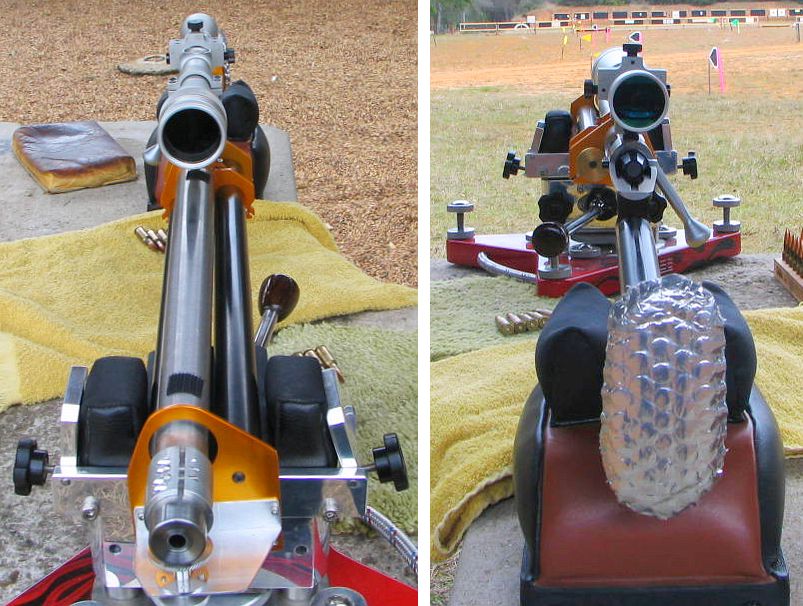
Shelly Davidson’s Rifle was so innovative, that almost every feature, except the bare action, is very different than you’ll find on most Benchrest rigs. Accordingly we felt it would be useful to isolate and describe the key design features, from stem to stern. Click thumbnails to view FULL-SIZE PHOTOS.
Front Bracket with Magnetic Tuner
The tuner consists of one rare earth magnet attached to the stock and another attached to a barrel sleeve with the magnets oriented so as to make the magnetic force repel each other. The purpose is to counter “barrel droop” and, hopefully, dampen barrel vibration. The lower magnet is carried on a threaded shaft (with lock ring), allowing the magnet to be raised up and down to adjust the “up push” on the barrel.
Tubular Fore-Arm Supported by Brackets
Three brackets support two tubes, one on either side of the barrel. The rear-most bracket is sandwiched between the barrel and the action. Four inches forward (max distance allowed for barrel blocks) a second bracket grips the barrel. Near the muzzle a third bracket secures the ends of the tubes and holds the magnetic tuner. To allow barrel offset, the left tube is 1″ diameter tube while the right tube is 5/8″ diameter.
Offset Barrel The rifle rests on a 3″ wide plate attached to the underside of the two fore-end tubes. With the plate centered in the front sandbag, the barreled action is actually offset 0.75″ to the right (looking forward from the breech). The purpose of this offset is to keep more weight on the right side to counter the tendency of the rifle to torque counter-clockwise. Two different diameter tubes allow for the built-in offset.
Floating Action without Sub-Support or Bedding
On the Tinker Toy gun, the action serves as a load-bearing assembly, holding the barrel in the front, and the skeleton buttstock (or “keel”) in the rear. Shelley was told that accuracy would suffer if you stressed a benchrest action in this manner but that proved untrue. It is a very simple solution to building a rifle, and it eliminates the need to bed the action. The forearm attaches to the action via a bracket installed like a recoil lug.
Skeleton Rear “Keel” Affixed Directly to Action
Davidson’s Tinker Toy does not have a conventional rear buttstock. Instead there is low-profile, v-shaped metal “keel”, as Davidson calls it, that rides the rear bag. The keel is supported by a tubular backbone that attaches at the rear of the Diamondback action. At the butt end is an aluminum plate covered with bubble wrap that serves as a butt pad. The skeletonized rear section helps the rifle maintain a very low center of gravity.
Locked Scope with External Windage and Elevation Adjustment
Shelley ran an older Leupold 36X Benchrest Scope with front-adjusting objective. To eliminate slop or loose tolerances in the erector mechanism that could cause changes in point of impact, the internals have been locked up by Jackie Schmidt. To move the cross-hairs relative to the bore axis, Shelley has a special Jewell/Foster rear ring that allows a limited amount of lateral and vertical movement of the entire scope body.
TINKER TOY SPECIFICATIONS
Action: Stiller SS Diamondback Drop-Port (1/2″ short), with .308 Bolt Face.
Barrel: Shilen .308 caliber, 17-twist, HV.
Chambering: 30BR, .330″ neck, Pacific Tool & Gauge Robinett Reamer.
Stock: Davidson Custom Tubular Stock with 0.75″ Offset Barreled Action.
Tube Construction: 6061 Aluminum, 1″ diameter (left), 5/8″ diameter (right).
Load: H4198 powder and 118gr Ronnie Cheek bullets. Loaded to 2980 fps.
Trigger: Jewell, 2 ounce BR.
Tuner: Custom, Adjustable with Opposing Magnets.
Optics: Leupold 36X (locked by J. Schmidt).
Rings: Jewell Foster External Adjusting Rings.
Stiller Diamondback Action and Shilen 17-Twist Barrel
I had wanted to use an aluminum Stiller Cobra drop port with a 6mmBR bolt face but Jerry had none in stock and he estimated it would be a year before one was available. Although I’ve waited for up to a year for an action in the past, I wanted to build this rifle during the fall of 2006 while the weather was pleasant enough to work in my unheated and un-air-conditioned garage shop. Jerry did have a 1/2″ short stainless steel Diamondback in stock so I purchased it even though it would add 3 ounces to the gun compared to the aluminum Cobra. Three ounces is a lot of weight when you’re working with a 10.5-lb limit. I had a heavy varmint contour Shilen 17-twist barrel that would work nicely and I had a Jewell trigger on a rifle that I wasn’t using at the time. I also decided to use my Leupold 36X (locked-up by Jackie Schmidt) with the Jewell/Foster adjustable rings.
Building the Tube Fore-Arm and Brackets
I took a wild guess as to tubing thickness and settled on .035″ for the 1″ left fore-arm tube and .058″ for the 5/8″ right fore-arm tube. All of the flat stock and tubes are 6061 Aluminum. I did the lathe work and the mill work and every evening I’d put the parts together and think about the proper way to proceed.
When the parts were mostly made, I started thinking that this was a truly ugly rifle. I thought about painting it but that wasn’t a good option as many of the parts are designed to slide over others and glue together. Anodizing was the best answer so while looking on the Internet for local anodizing shops I Googled “Home Anodizing”. Sure enough there were a few sites that told about how to anodize at home. I picked up some battery acid from NAPA Auto Supply, some Rit Clothes Dye from Wal-Mart, and a bunch of distilled water from the grocery store. Using an old battery charger as my dc power supply I started anodizing and dying the eighteen parts that went into the stock. Although I had to strip and re-anodize some of the parts, the work turned out acceptable.
Putting it All Together–Lug-Mounting the Fore-Arm and Lots of Epoxy
The barrel contour had to be modified to work with the stock which attaches by way of a rear plate which mounts like a recoil lug and a plate that ties the barrel and the stock tubes together 4″ forward of the bolt face. The four-inch maximum distance is a NBRSA rule concerning barrel blocks.
The recoil lug-style stock mount is probably the only truly innovative thing I did other than the opposing-magnet tuner. Basically, the rear bracket is sandwiched between the receiver face and the barrel shoulder–positioned where a conventional recoil lug would go. I also added a brass ring (visible in photo) between the anodized bracket and the barrel. This was done to distribute loads over a wider surface area. (I was concerned that the bracket material was fairly soft and I didn’t want to crush it as I torqued the barrel in place.) After fitting the barrel and plates I glued the entire gun together using epoxy and various LocTite adhesives. The rest of the parts were assembled but I did not Loctite the scope bases since I thought I’d be disassembling the rifle for re-work after the first trials. That came back to bite me during later testing when the gun started shooting erratically and I went down a couple of blind alleys before finding the loose bases.
Range Testing–Results Are Very Positive
The first range session was a real shocker. Even though the wind was up to 10mph and twitchy, the rifle showed promise from the very first shot. I really didn’t expect that kind of performance without, at least, some rework. After sighting in, I shot five, 5-shot groups that, when averaged together, measured .223″. That’s good enough to win some benchrest group matches. But I wasn’t finished with the gun yet–I still wanted to try out my magnetic tuner concept.
The Magnetic Tuner
Next, I built the magnetic tuner. The tuner consists of one rare earth magnet attached to the stock and another attached to a barrel sleeve with the magnets oriented so the magnetic forces repel each other. In order to test the magnets and to determine if the rifle really shot as well as it seemed to, I took it to Gene Beggs’s shooting tunnel in Odessa, Texas. I spent two days at the tunnel testing loads and then installed the magnetic tuner. The gun shoots well with the magnets and shoots well without them. I suppose I can’t make any claims as to how much, if any, improvement the magnets make. Gene said that my gun was the most accurate rifle to be tested at his one-year-old shooting facility: “Shelley Davidson brought one of the most unusual rifles I had ever seen; he called it his ‘Tube Gun.’ And boy, did it ever shoot! It still holds the record in the tunnel as the rifle that shot more zeros than any other to date.” I definitely recommend Gene’s facility for testing and refining shooting techniques and loads.
Competition — Tinker Toy Won Both Score and Group Matches
Finally the big day arrived when I’d shoot the first match with my new gun. The North Texas Shooters Association was holding its first club match of the 2007 season. At the Denton, Texas matches we shoot a Score Match in the morning and a Group Match in the afternoon. The March event was at 100 yards and the April match will be at 200 yards and so on alternating throughout the benchrest season.
Match One–Tinker Toy Wins Score with a 250 – 17X
Since the gun is chambered in 30BR and that chambering is almost immune to tuning woes, I preloaded 130 rounds with H4198 powder and 118gr Cheek bullets. I used my SEB front rest and rear bag which are made by Sebastian Lambang in Indonesia. Everything came together, and Tinker Toy demonstrated that the accuracy it showed in the tunnel was no fluke. The gun shot great and I won the morning match with a 250, 17X. The day was quite windy and the next best shooter scored a 250, 15X. So I’d chalked up my first win.
Match Two–Tinker Toy Wins Group with a .2282″ Agg Tinker Toy won the afternoon group match I entered with a five-group Aggregate of .2282″. (The second place score was .2568″.) My groups were .149″, .197″, .243″, .302″ (oops), and .250″. You know how some folks say a 30BR can’t be competitive with a PPC? Well that .2282″ Agg won’t break any records, but it is good enough to win some regional registered BR matches. So this rifle has demonstrated an ability to win in both Score and Group matches. Obviously I have a very good Shilen barrel, great Cheek bullets and the rest of the components are doing their jobs as well. But, the stock is also working well.
Score Shooting vs. Group Shooting–The Rules
In a score match, the shooter shoots one bullet at each of five record targets, which are clustered on one target sheet. The Aggregate score of five of these targets determines the winner. If the shooter touches the 10 ring on all of his 25 targets he can score a “clean” 250 score. Usually there will be more than one shooter who scores a 250 so the winner is determined by the X-count. The 1/2″ 10-point ring has a 1/16″ dot in its center. Touching the X dot adds to the shooters X count. In short-range group matches, the shooter must try to put five bullets through the same hole. At each distance (100 or 200), five, 5-shot matches are scored, the group sizes are added together (MOA equivalent at 200) and the total is divided by five to arrive at an Aggregate score.
With spring soon changing to summer, we are in peak varmint season in many parts of the country. In an area with a high number of critters, a semi-auto varmint rifle is a good choice. You get quick follow-up shots, with reliable 20-rd and 30-rd magazines.
For this Saturday at the Movies Showcase we feature a variety of semi-auto, AR-platform rifles chambered for efficient, high-velocity varmint ammo. Cartridges include: .17 WSM, .17 Remington, .20 Practical, .204 Ruger, .22 Grendel, .223 Rem, and 6mm ARC. We conclude with a video that reviews a variety of lead-free .223 Rem ammo types.
Rock Chuck Hunting in Eastern Oregon
This video has some great backcountry footage. The host nails a number of rockchucks with his .223 Rem-chambered AR-15. The shooter says that the default AR-15 cartridge works great for varmints: “The .223 Remington becomes a rockchuck hunter’s friend with the right load: Nosler 40gr Ballistic Tip loaded over a stuffed case of H335 powder. This achieves 3800 FPS with excellent accuracy.”
.17 Remington AR-15 — Small Bullet, Ultra-High Velocity
The .17 Remington wildcat is based on the .223 Remington case necked down to .172″, with the shoulder moved back. High muzzle velocity (4000+ FPS), flat trajectory, and very low recoil are the .17 Remington’s primary attributes. It has a maximum effective range of about 440 yards on prairie dog-sized animals, but the low BCs of the small .17-cal bullets makes them quite susceptible to crosswinds at such distances.
This Varminter.com video was created in spring 2022, just in time for Rockchuck and Thermal Coyote hunts. The host noted: “This was my first experience with the .17 Remington, but I was not unaware of its history and steady popularity among varmint and predator hunters. Although finding an available and affordable .17 Remington bolt-action rifle is nearly impossible nowadays, building one in an AR-15 was simple and straight-forward.” The video has full description of all the components for the build. The .17 Rem is fast — the 25gr bullet runs 3777 FPS from an 18″ barrel (see 01:42 time-mark). READ Full Story.
.17 WSM Rimfire in Franklin Armory F17-L
What’s the ultimate rimfire varmint rifle? An AR chambered for the .17 WSM could be the answer. Eric Mayer of Varminter.com states: “The Franklin Armory F17-L in .17 Winchester Super Magnum (WSM) has a lot of firsts. It is the first semi-automatic rifle in .17 WSM now available to the general public. It is the first gas-piston system, AR-15 rimfire rifle built in partnership between Franklin Armory and Osprey Defense.”
Eric has used the .17 WSM AR shooting ground squirrels, rock squirrels, prairie dogs, and rabbits. Eric notes: “The report of the .17 WSM is nowhere near as loud as most of the centerfire [varmint] cartridges. I found that when I shot the FA-17, it did not cause the other ground squirrels… to run for cover. The lack of recoil … allowed me to see right where I hit [and] if I happened to miss, [low recoil] made for quick corrections for wind, or distance.” READ Full Report
The .17 WSM is a much larger, more powerful round than the .17 HMR. See the size difference above.
Eric Mayer created his own custom .17 WSM AR-15 varmint rifle, built with a Franklin Armory F17-V4 Upper, Aero Precision Lower, and Magpul stock. This was used in California and Arizona. READ Full Story.
.20 Practical — Fast, Accurate, Easy to Form
The .20 Practical cartridge is simply a .223 Rem necked down to .20 caliber. This is a great choice for prairie dogs — and probably our favorite wildcat for the AR-15. Just neck down your .223 Rem brass, fit a .20-Cal barrel and you’re good to go. Robert Whitley notes the the .20 Practical “is a perfect cartridge for varmint hunting and general shooting — very accurate and fast! It functions 100% out of an AR-15.”
The .20 Practical offers some notable advantages for high-volume varmint shooters. The .20 Practical delivers very high velocity with very low recoil while still providing outstanding accuracy. The .20 Practical is great option for folks who favor “fast and light” — smaller, lower-mass bullets traveling at very high velocities. This little cartridge can launch 40-grainers at over 3900 FPS, and 32-grainers even faster. This makes the .20 Practical a great choice for an AR-based varmint rifle.
.20 Practical Ultimate AR Varminter
A decade ago AccurateShooter.com created a .20 Practical AR15 Ultimate Varminter with a custom 20-caliber upper from Robert Whitley of AR-X Enterprises, LLC. That project rifle was ultra-accurate — every 5-shot group out of the gun was less than the size of a dime. That gun was auctioned off, but Robert Whitley continues to produce custom 20 Practical AR-15 uppers.
You make .20 Practical cases by simply necking down .223 Rem brass to .20 caliber. You can start with standard .223 Rem brass and even load with standard .223 Rem dies. Just swap in a smaller expander and use smaller neck bushings.
Prairie Dog Hunt with .204 Ruger AR — Watch The P-Dogs Fly
The video was created during a 2018 prairie dog safari. It has stunning footage of hits on P-Dogs at multiple distances. You can see over FIFTY hits with some amazing P-Dog aerials. Watch the first flyin’ dog at 00:20 time-mark and there’s a truly spectacular gut-busting hit at 3:13. That shows the potency of a high-speed .20-cal projectile. The shooter was using a custom-built AR-15 chambered in a .204 Ruger. That cartridge was driving 35gr Berger hollow point bullets at a stunning 4050 FPS! The rifle was fitted with a Dakota silencer suppressor and many other custom components. If you’ve never tried prairie dog hunting, watch this video start to finish and you may be hooked.
6mm ARC AR-15 Varmint Rig
This Varminter.com video examines the 6mm ARC cartridge from a varmint hunter’s perspective. Created by Hornady, the 6mm ARC was designed for target shooting and medium-sized game both in bolt guns and Modern Sporting Rifles. Hornady states: “The 6mm ARC … fits in an AR-15-pattern action, functions reliably out of standard-capacity 24- or 17-round magazines. It delivers substantially better ballistics than the .223 Rem[.]” This video examines how the 6mm ARC performs in an AR-15 for varmint and predator hunting. The host reviews available factory varmint loads. The video also examines reloading components for the 6mm ARC — brass and bullets. CLICK HERE for full article.
Cottontail Rabbit Hunting with Suppressed .204 Ruger AR-15
As a varmint hunting tool, the .204 Ruger in an AR-15 is a versatile, worthy cartridge/rifle combo for the job. This video covers a cottontail rabbit hunt. The host states that “We were contacted by a farmer who was being slammed with cottontail rabbits eating out huge portions of his alfalfa fields.” This suppressed .204 Ruger AR-15 proved seriously effective on the rabbits, driving high-velocity rounds with impressive accuracy. See more details on the Varminter.com website.
The .22 Grendel is an extremely accurate and efficient cartridge based on the 6.5 Grendel necked down to .22 caliber. The case can drive 55gr varmint bullets at high velocities — over 3500 FPS. With a faster-twist barrel you can load up to 90gr bullets at 2500 FPS. The tester achieved velocities close to a 22-250. The short, fat case fits in AR-15 magazines, but may not feed as reliably during rapid fire. The tester did experience one double-feed.
Lead-Free Ammo Offerings Tested in .223 Rem AR-15
Some states — such as California — prohibit hunting with bullets that contain lead. If you plan to hunt in an area with such restrictions, you’ll need to find a lead-free substitute. Thankfully a number of manufacturers produce ammo with solid brass projectiles or other lead-free bullet designs. This Varminter.com video reviews .223 Remington no-lead ammunition from Cor-Bon, Hornady, Nosler and Winchester. These ammo types were tested in a AR-15 varmint rifle, used in a coyote hunt featured at the end of the video. SEE Full Story on Varminter.com.
Real Avid sells a unique multi-tool for rifles and shotguns. The Real Avid Gun Tool combines 18 of the most commonly used long gun tools in a compact package, which is now just $22.22 on Amazon. The Gun Tool boasts three Torx wrenches (T20; T15; T10), two Allen hex drives (3/32″; 5/32″), and four screwdriver blades (1/8″ flat; 3/16″ flat; Phillips 1 & 2). In addition, there is a magnetic 3/16″ driver, a pin punch, and a stainless claw blade useful for opening shipping boxes or trimming target backers.
The most unique feature of the Gun Tool ($22.22 on sale on Amazon) is a stepped, multi-size choke-tube wrench that fits six shotgun bores from .410 all the way up to 10 gauge (see photo below right). For active shotgunners, that provides great versatility in a small package.
Praise from Respected Reviewers
In 2012, the NRA’s American Hunter magazine awarded The Gun Tool their Golden Bullseye award in the “Gear of the Year” category. The Gun Tool has also been awarded an outstanding 100% approval rating and a full endorsement by the North American Hunting Club.
Noted gun journalist Jim Shepard wrote: “I’ve been playing with ‘The Gun Tool’… and I’ve found it to be a pretty promising device that really should find a place in lots of range bags. If you’re a long gun shooter, it has something you’ll eventually need in the way of a tightening/loosening/adjusting tool.” Jim cautions that the claw blade does not lock into place.
In years past the U.S. Army Marksmanship Unit Facebook page regularly released reloading “how-to” articles each week. One “Handloading Hump Day” post covered bore-cleaning, specifically the use of pull-through style bore-snakes. Visit the USAMU Facebook page for other helpful tips.
Barrel Cleaning with Bore-Snakes
Today, we’ll shift from handloading to rifle bore cleaning and maintenance, with information courtesy of the USAMU’s Custom Firearms Shop. We recently had some inquiries about bore cleaning, and this seems a good opportunity to share. After all, even the best handloads won’t yield their full potential in a poorly-cleaned and maintained rifle.
NOTE: Hoppes claims a trademark on the term “BoreSnake” (one word, no hyphen). For this article, the USAMU has used the term in hyphenated form, two words. We believe the USAMU is referring to a Hoppes Brand Boresnake, not a different bore cleaning rope.
BORE-SNAKES: MIRACLE REPLACEMENT FOR THE CLEANING ROD?
The experiences of our both firearms test specialist and this writer have given no evidence that proper use of a clean bore-snake will damage a match barrel. Of course, one does not pull the bore-snake at an angle to the crown when removing it — pull it straight out, parallel to the bore’s direction, to prevent crown wear over time.
Bore-snakes are very useful for some applications (primarily a hasty, interim wipe-down). In [my] experience they cannot replace a thorough cleaning with a proper rod and brushes. While the experiment cited here involves rimfire, it may help illustrate. Several years ago, the writer used his new, personal Anschutz to investigate the bore-snake issue. It had been fired ~350 rds with match ammo and had had 3 typical rod/brush cleanings.
Next, starting with a clean bore, the writer fired 300 more rounds without cleaning in order to build up a “worst-case” fouling condition. Afterwards, the writer examined the bore with a Hawkeye bore scope. There was a uniform, grey film down the entire barrel, with some small, intermittent lead build-up at and just forward of the throat.
Some bore-cleaning rope products feature separate, detachable bronze brush and bore mop segments. This allows more usage options (e.g. mop only), and makes it easier to clean the brush elements:
A new bore-snake was then wet with solvent and pulled through the bore. The Hawkeye revealed that the grey fouling was gone, and much of the visible fouling at the throat was reduced. However, nine more passes with the bore-snake, checking after each with the Hawkeye, revealed no further improvement in cleaning. The writer then cleaned with two wet patches, observed, then one stroke of a new, wet bronze brush, and one wet patch to clean out residue.
The Hawkeye showed a significant reduction in fouling at the throat; it was virtually gone. A second pass with a wet bronze brush and a wet patch removed the remaining fouling. Scrubbing the bore further, checking to see how much fouling was removed, revealed no significant improvement. The reason for this test was to learn what’s needed to get (and keep) this Anschutz clean with minimal cleaning rod use — and thus, minimal risk of bore damage/wear. Leaving fouling in the bore promotes corrosion over time.
Obviously, this applies to a nice, smooth rimfire match barrel, using good, well lubed ammo. It doesn’t apply directly to the use of copper-jacketed bullets, which leave a stubborn fouling all their own. However, it does suggest that while the bore-snake can be helpful and a useful field-expedient, to truly clean a rifle barrel one will still need a good quality rod, bronze brush and solvents. [Editor: Add a good-fitting cleaning rod bore guide.]
SO, WHAT ABOUT BORE SNAKES FOR BARREL BREAK-IN?
The goal of barrel break-in is to fire each shot through a clean barrel, preventing copper buildup and allowing the bullets their best chance at burnishing sharp edges. Thus, it seems this purpose would be best served by one’s usual rods, brushes and rod guides.
It’s nearly Easter and the 2025 outdoor season is well underway. Do you have a good first-aid kit in your vehicle to deal with possible injuries to family members of all ages? For just $20.00 you can get an excellent kit from Be Smart/TRI, the #1 maker of First Aid Kits in the USA.
TRI’s Be Smart Get Prepared First Aid Kit has 201 items inside a sturdy case with shoulder strap and carry handle. There is also a handy, detachable mini pouch with key essentials for first aid on-the-go. You can easily bring the mini-pouch along on a bike ride or hike.
This multi-purpose First Aid Kit includes:
• 50 – Bandages 3/4 x 3
• 30 – Bandages 3/8 x 1 1/2
• 6 – Bandages Closure
• 3 – Knuckle Bandages
• 1 – Tapes – .5 x 2.5yd Waterproof
• 10 – Cotton Tips – 2.75″”/10 Pack
• 4 – Finger Splints
• 1 – First Aid Guide
• 4 – Gauze Pad – 2 x 2 / 4 ply
• 4 – Gauze Pad – 4 x 4 / 4 ply
• 1 – Gauze Pad – 5 x 9
• 2 – Nitrile Gloves
• 1 – Instant Cold Pack – 5 x 6
To help ensure that outdoor adventures remain safe and trouble-free, the CTD Shooters’ Log has a helpful Essential Summer Survival Guide. This is worth reading before you venture away from civilization.
Here are some highlights of the article with links for MORE INFO:
First Aid Kits for Campers
You should never venture outside without a first aid kit close at hand. While exploring the outdoors, all types of accidents can occur—from cuts, scrapes, and burns to broken limbs and severe allergic reactions.
Basic Survival Skills
Basic survival skills are a necessity if you plan to spend any amount of time outdoors. These five tips, plus a how-to on what to pack in a lightweight, basic survival kit will help if you are ever stuck, lost, stranded or injured in the field.
How to Treat Burns
Fireworks, barbeques and campfires — in the summer we are frequently around fire, which increases our chance of getting burned. A first-degree burn is most likely home treatable, while a third degree burn requires immediate medical attention. Learn how to spot the differences between minor and severe burns.




 The handsome Colt Blued Python revolver has earned the 2025 NRA Golden Bullseye Award for Handgun of the Year, as chosen by the editors of NRA publication









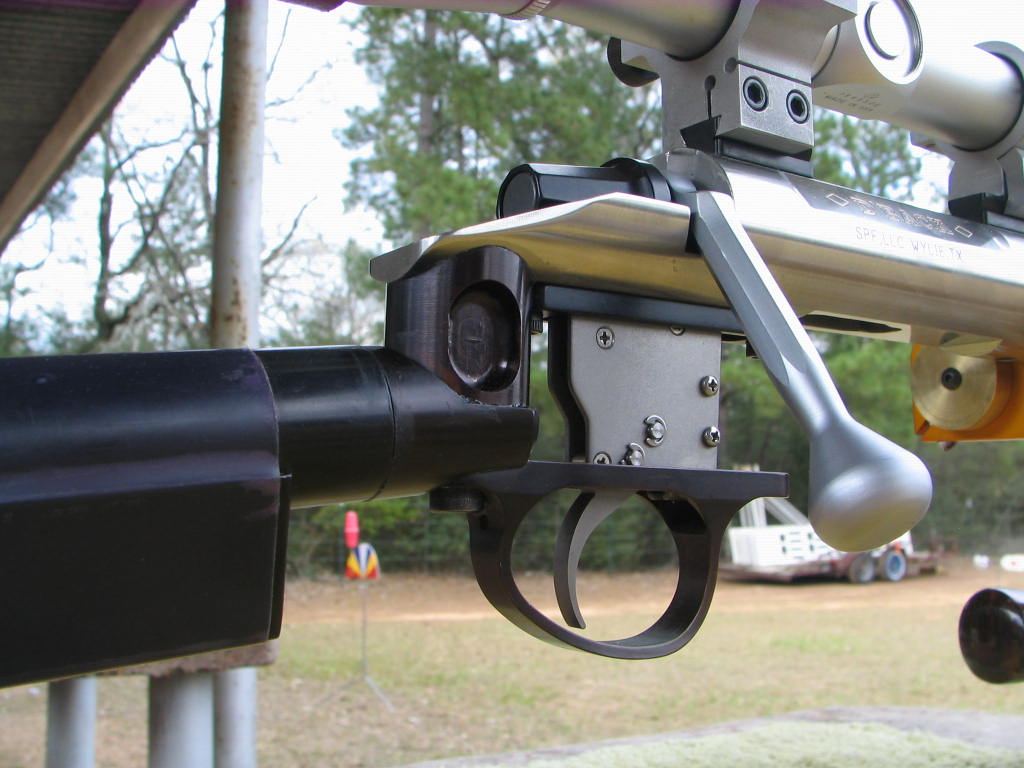


 The recoil lug-style stock mount is probably the only truly innovative thing I did other than the opposing-magnet tuner. Basically, the rear bracket is sandwiched between the receiver face and the barrel shoulder–positioned where a conventional recoil lug would go. I also added a brass ring (visible in photo) between the anodized bracket and the barrel. This was done to distribute loads over a wider surface area. (I was concerned that the bracket material was fairly soft and I didn’t want to crush it as I torqued the barrel in place.) After fitting the barrel and plates I glued the entire gun together using epoxy and various LocTite adhesives. The rest of the parts were assembled but I did not Loctite the scope bases since I thought I’d be disassembling the rifle for re-work after the first trials. That came back to bite me during later testing when the gun started shooting erratically and I went down a couple of blind alleys before finding the loose bases.

 Match One–Tinker Toy Wins Score with a 250 – 17X


 .20 Practical Ultimate AR Varminter



 Bore-snakes are very useful for some applications (primarily a hasty, interim wipe-down). In [my] experience they cannot replace a thorough cleaning with a proper rod and brushes. While the experiment cited here involves rimfire, it may help illustrate. Several years ago, the writer used his new, personal Anschutz to investigate the bore-snake issue. It had been fired ~350 rds with match ammo and had had 3 typical rod/brush cleanings.


