This story has all the ingredients: exotic location, exotic hardware, cool POV video (with John Lee Hooker blues soundtrack), plus something you’ve probably never seen before — a gravity-fed cartridge caddy that loads a PPC round into a benchrest rig with the push of a button. Watch this video to see Benchrest in Argentina with some very cool equipment:
Soundtrack includes John Lee Hooker’s blues classic “Boom, Boom” (starting at 0:28).
This video was filmed by our friend, Frenchman Pascal Fischbach, during his recent visit to Argentina. In Buenos Aires, Pascal met with action-maker extraordinaire Carlos (“Carlito”) Gonzales, creator of the CG Thunderbolt action. The video shows Carlito shooting groups with his CG-actioned benchrest rifle and MCF (“Manual Cartridge Feed”) ammo caddy. Look for the push-button control at the 1:15″ time-mark. The five-shot groups, shown at 1:20″, are pretty impressive. Even more impressive is how flawlessly this trick cartridge-fedding system works.
About Carlito’s Benchrest Rifle The rifle features Carlito’s CG thunderbolt action, in a low-profile carbon-fiber stock also made by Gonzales. Up front is a Bukys-style tuner. If you watch the video carefully, you may wonder “how do the cartridges get into the action?”, since you won’t see the shooter (Carlito) pulling rounds from a loading block. Well the secret is that metal contraption to the left of the gun. It is a gravity-fed caddy connected, via cable, to a hand control. After working the bolt to extract a fired case, the shooter can push a button and the next round drops down from the upper left into the left port/right eject action. Simply close the bolt and you’re ready to roll. For more information, visit Benchrest.com.ar or email casagonzalec [at] benchrest.com.ar .
External Horizontal Cartridge-Feeder
The Gonzales loading device is an open-ended, covered metal tray situated on the left side of the action (but it does not touch the gun — it is supported by an arm attached to the front rest). This feeds into the left-side loading port. The cases are gravity-fed, but the shooter has positive control over feeding. A cable with a push-button control runs from the magazine down to the rear foot of the pedestal rest. You just push the button to drop one cartridge from the magazine. We don’t know exactly how the cartridge is released in the magazine itself, but in the video below you can see how the push-button works. This device has been approved for competition by USA and International benchrest sanctioning bodies.
Photo by Rich Pollock of Benchrest.ca
Video Shows Cable-Operated Cartridge Feeder in Action
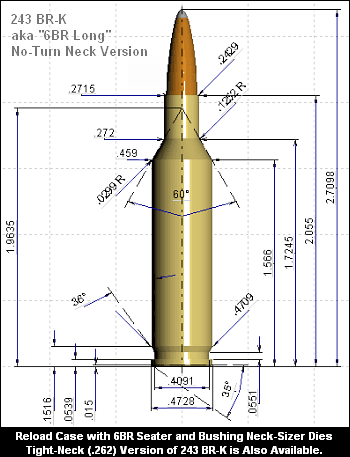
Gunsmith Mike Sosenko and long-time AccurateShooter Forum member John Adams have been using a modified .243 Winchester case with great success in Varmint Silhouette matches at the Pala Range in Southern California. Officially called the “.243 BR-K” (and informally dubbed the “6BR Long”), the wildcat is basically a .243 Winchester with less body taper and a 30-degree shoulder. The design essentially grafts a 6mmBR Norma “top end” to the .243 Winchester case. After fire-forming, Mike and John can reload this case using normal, unmodified 6BR neck-sizing and seater dies.
Compared to a .243 Winchester, the .243 BR-K’s body length is about .006″ longer, and the shoulder is about .0055″ wider. The main difference is the shoulder angle (30° vs. 20°), and the location of the neck-shoulder junction (“NSJ”). Based on reamer prints, the base to NSJ dimension is 1.718″ on the 6BR Long, compared to 1.804″ for the .243 Winchester. Neck length is a bit shorter because “the neck shrinks a little when the shoulder blows out” according to Sosenko. We’ve provided a mock-up diagram of the .243 BR-K, but you should check with Dave Kiff of Pacific Tool & Gauge for exact dimensions. Dave created the reamers for both the 6mm and 22-caliber versions of this wildcat. Ask for the “22 BR-K” or “.243 BR-K” reamer designs.
Wicked Velocity with Stable Brass
The main advantage of the .243 BR-K is serious velocity in a case that is very stable. Mike’s favorite load is the 95gr Berger VLD pushed by Reloader 22. With a stout load of RL22 and Federal 210m Primers, Sosenko is getting 3450 fps with the 95-grainer, with no bullet blow-ups. This is with a 1:8.5″ twist Broughton 5R barrel finished at 28.5″. The cases are holding up very well. Mike has a half-dozen loads on his brass and he hasn’t had to full-length size yet. Mike runs a .262″ tight neck, but there is also a no-turn version of the case (see illustration). Accuracy is excellent. Mike says the round delivers repeatable 1/4 MOA groups at 100 yards in testing. He has also experimented with N160, but, thus far, Reloader 22 has delivered smaller groups with better ES and SD.
John Adams shoots a no-turn (.274″) neck .243 BR-K with 105gr Berger VLDs. He’s getting about 3230 fps using Reloader 22. John says he can push the 105s faster, but 3220-3240 fps “seems to be the sweet spot.” John notes that “after about five reloadings on a case, it gets a little tight”. John then full-length sizes with a custom Hornady FL bushing die. “The Hornady custom shop dies work great” according to John. Adams also shoots a version of this wildcat necked down to 22-caliber. It has demonstrated outstanding velocity and good accuracy in initial testing with a 9-twist barrel. Using the 80gr Amax bullets, John is getting 3570+ fps speeds. John feels that his 22 BR-K needs some more development work. “The .243 BR-K is proven. We know what works. With the 22 I want to try different seating depths, experiment with a few different bullets, and fine-tune the velocity.”
Whitley’s 6mm Super X
Robert Whitley shoots a variant of the .243 Winchester he calls the 6mm Super X. This features a 30° shoulder, and slightly less body taper. He gains a little case capacity over the standard .243 Win, and he says the cartridge is extremely accurate with both 105-108 grain pills and the heavier 115s: “Here’s a picture of a .243 Win (left), a 6mm Super X (center), and a 6XC (right). All I can say is the 6mm Super X has been good to me and I have shot many a clean in 600-yard High Power matches with it with either DTAC 115s or Berger 115s.”
While Mike Sosenko and John Adams use their BR-Ks to push 95s and 105s at high velocities, Robert takes a different approach with his Super X. He shoots the high-BC 115s and keeps velocities under 3000 fps. A long-range High Power shooter, Robert demands consistency during long shot strings. That means backing off from max attainable speeds, at least with the 115s. Robert writes:
“You can get 3050 fps with H4831SC and the 115s with no problem, I did it in testing multiple times, but to me that also does not mean anything because I shoot loads where they are the most consistent and accurate over a 22+ shot string. I have never found that any of the 6mm cartridges I have used with 115s will stay consistent, tight and accurate the whole way at 3050 fps for 22+ shots straight. I have tried 115s in the .243 Win, the 6CM, the 6mm Super X, the 6XC, the 6-6.5 x 47 Lapua and none of them ever stayed consistent and tight for 22 shots straight with the 115s at that speed. Most of the time with all the 6mm cartridges, if you get the 115s much over 2975 fps, they won’t hold tight for 22+ shots straight. Now if you’re a bench rest shooter and you only need to do a few sighters then 5 or 10 shots for record, you can run 3050 fps or more and the groups will likely hold tight during your string, but not when you need to go 22+ shots straight with no break. I have shot many different 6mm cartridges and done a lot of testing with many different powders, moly and non-moly bullets. I don’t find the ‘consistent accuracy’ (for 22+ shots straight) at those higher velocities.”
Less weight plus better heat dissipation — Sound good? Here is an innovative barrel technology that promises worthwhile performance benefits for hunters or match shooters. Lothar Walther (LW) has developed a new bi-metal barrel system that cuts weight dramatically while promising significantly-enhanced heat dissipation.
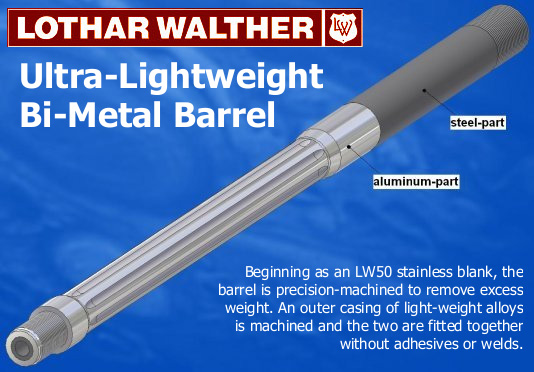
Walther’s Ultra-Lightweight Barrels combine steel with lightweight alloys. This results in a significant weight reduction without the use of carbon fiber, epoxy binders, or other heat-retaining materials. Beginning as an LW50 stainless blank, the barrel is precision-machined to remove excess weight. An outer casing of light-weight alloys is machined and the two are fitted together without adhesives. Basically you end up with the steel inner barrel inside a larger-diameter fluted aluminum outer barrel (see diagram). This gives you the ‘best of both worlds’ — light weight for ease of carry, and thick diameter for rigidity and enhanced heat dissipation. Near the action, the barrel remains all-steel.
The barrels come pre-chambered in your choice of caliber/cartridge, from .22LR up to .338 Lapua Magnum. Walther chambers the barrel — but a gunsmith is still required to finish the shoulder so that the headspace is set correctly for your action. These barrels are not inexpensive. A typical bi-metal Walther Barrel runs $850.00 – $875.00, for barrel lengths from 22″ to 30″. Threading for a muzzle brake or suppressor (if desired) is normally included in that price.
We haven’t tested one of these bi-metal composite barrels, but the potential for significant weight savings is obvious — aluminum is a lot lighter than steel. What’s more, a metals expert we contacted said that a bi-metal system employing fluted aluminum over steel, if assembled properly, could dissipate heat much better than steel alone (given the same diameter). Stainless steel has a thermal conductivity factor of 16. Aluminum has a thermal conductivity factor of 250.*
Our expert also pointed out that some other composite barrel systems on the market actually increase heat retention because they place insulating materials next to the inner steel barrel. (Carbon, Fiberglass, and Epoxy are all considered “insulating substances” as they have very low thermal conductivity*.) The LW system of aluminum over metal should avoid this mistake, our expert believes. Lothar Walther says: “Unlike solid steel barrels, this barrel sheds heat fast. VERY FAST!”
Half the Weight of Conventional Barrels
How much weight can you save? With a 1.200″ shank diameter and a muzzle diameter of 0.850″, the LW Ultra-Lightweight Barrel is less than half the weight of a standard varmint barrel of the same size. Walther claims its UltraLight Barrel can be “carried for long distances and stand up to heavy firing.” This, LW says, makes these barrels “perfect… for varmint and tactical uses”.
Pre-Chambered Ultra-Lightweight Barrels Available in .22 to .338 Calibers
Lothar Walther offers Ultra-Lightweight barrels in a full range of calibers from .22LR to .338. Each Ultra-Lightweight Barrel comes complete with chamber, crown, and breech threads. These barrels are fluted by the factory. If you order a LW Ultra-Lightweight barrel, Lothar Walter provides the services of a specialist trained in building guns with these barrels. To order one of Lothar Walther’s bi-metal barrels, CLICK HERE or contact Lothar Walthar at the address below:
*Thermal conductivity is the quantity of heat transmitted through a unit thickness in a direction normal to a surface of unit area, due to a unit temperature gradient under steady state conditions. The factor values are based on this formula: W/(m.K) = 0.85984 kcal/(hr.m. °C). Here are thermal conductivty values for common materials: Aluminum, 250; Brass, 109; Steel (Carbon 1%), 45; Stainless Steel, 16; Carbon, 1.7; Brick dense, 1.3; Concrete (medium) 0.7; Epoxy, 0.35; Fiberglass, .04.
Story tip from EdLongRange. We welcome reader submissions.
Over the years, many Civilian Marksmanship Program firearms purchasers have asked if the CMP would consider offering reliable, reasonably-priced and prompt maintenance, repair and upgrade of USGI-issue rifles. The CMP has responded and the answer is “YES”.
Starting October 1, 2013, the CMP Custom Shop (Anniston, AL) opens for business, providing a wide variety of repair, upgrade and custom services for a wide range of U.S. Military rifles, specifically those issued in early eras. As well as regular repairs (and troubleshooting), the CMP Custom Shop will be able to perform virtually any normal upgrading, accurizing, customizing, and refinishing for the types of rifles the CMP sells.
CMP will work on the M1 Garand, M1 Carbine, 1903 and 1903A3 Springfield, the 1917 Enfield and the Krag. Other rifles like the Remington 40X, Mossberg 44, and H&R Model 12 can also be serviced. CMP will NOT work on shotguns, pistols, revolvers, M14/M1A, AR15-style rifles or other commercially-produced modern rifles. For a list of services (with prices) visit the CMP Custom Shop webpage.
NOTE: Before you can send a rifle to the CMP Custom Shop you must be a customer on file in the CMP system. Customers must meet the same eligibility requirements as for CMP rifle purchases. Once qualified, you can purchase a rifle from the CMP and have the CMP Custom Shop make modifications to it prior to shipping.
CMP Custom Shop Can Work on USGI Rifles Purchased from Other Sources
The CMP Custom Shop can work on rifles that may have been purchased elsewhere as long as they were made by a USGI contractor. Some examples include: Springfield Armory (not Springfield Inc.), Harrington & Richardson, Winchester, International Harvester, Remington, Rock Island, Eddystone, Inland, Underwood, Rock-Ola, Quality Hardware, National Postal meter, Standard Products, IBM, Irwin-Pederson and Saginaw. NOTE: There are many NON-USGI copies of the M1 Garand, 1903 Springfield and especially the M1 Carbine that CMP will be unable to work on.
For more information, call (256) 835-8455, x1113, or send email to customshop [at] thecmp.org. Shipping and Correspondence address for the CMP Custom Shop is:
Stiller’s Precision Firearms (www.viperactions.com) has introduced a new line of billet stainless Octagon actions, dubbed the Spectre series. Designed primarily for tactical use, Stiller’s new Spectre Actions can also be used for long range hunting. Offered in .308 short action, .308 long action, and Magnum sizes, the black oxide-coated, octagonal Spectres feature a +20 MOA angled Picatinny rail milled into the receiver body.
MSRP for all Stiller Spectre actions is $1295.00 (price does not include separate, pinned recoil lug). Short-action Spectres are available right now, while the long-action and magnum versions should be in stock by December, 2013. To order, visit ViperActions.com or call 972-429-5000.
Spectres Designed to Fit Rem 700 Inlets with Minor Mods
The Spectres should fit most stocks designed for Rem 700-type actions (with minor modifications). Stiller’s Precision explains: “Spectres are octagonal stainless steel replacements for the Remington 700 series actions. The Spectre will fit most chassis including the Accuracy International series as a drop in replacement for the Remington 700 series actions. In standard stocks some minor inletting will be needed to clear the corners of the octagon.”
The short actions have .223 and .308 bolt-faces, while Spectre long actions have .308 or magnum bolt-faces. The .223 bolt uses the Sako-style extractor, while the others use a modified M16-type extractor. Spectre actions are only available with a straight handle. All tactical actions feature a one-piece-from-billet bolt and a screw-on knob. The standard bolt finish is black Iron Nitride QPQ (very durable).
Spectres Will Work with AI and AICS Magazines
Short-action Spectres have a magazine cutout for Accuracy International double stack magazines. They also work well with centerfeed-style detachable magazines such as the AICS. Stiller’s Precision offers detachable bottom metal systems that utilize both magazines. The short action Spectre will NOT function with the BDL [hinged floor plate] style magazine. The long Spectres have the standard Remington 700 style magazine cutout for either AICS style centerfeed detachable magazines or the BDL-style (hinged floor plate) magazine.
While attending the 2013 F-Class World Championships at Raton, we had a chance to talk with Derek Rodgers, who had just been named the 2013 U.S. F-TR National Champion. Derek’s F-TR Win at Raton makes him the only shooter to have won U.S. F-Class National titles in both F-Open and F-TR divisions. Derek was excited about his performance at Raton: “F-TR was my first love in competitive shooting and [winning the F-TR title] has always been a personal goal to achieve”. In this Q&A session, Derek tells us about his rifles and his Nationals-winning .308 Winchester load. Derek also provides some advice for new shooters in the F-TR game.
Q: Readers want to know about your rifle. How did your select your stock, action, and bipod? And tell us about working with your gunsmith Doan Trevor and the quality of his work.
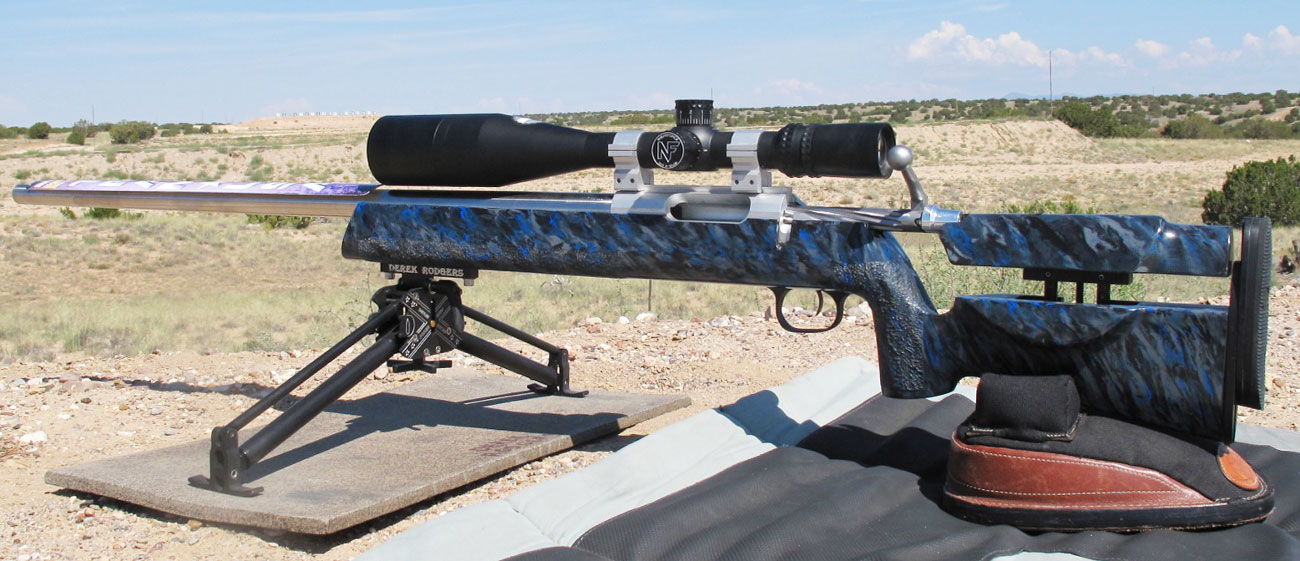
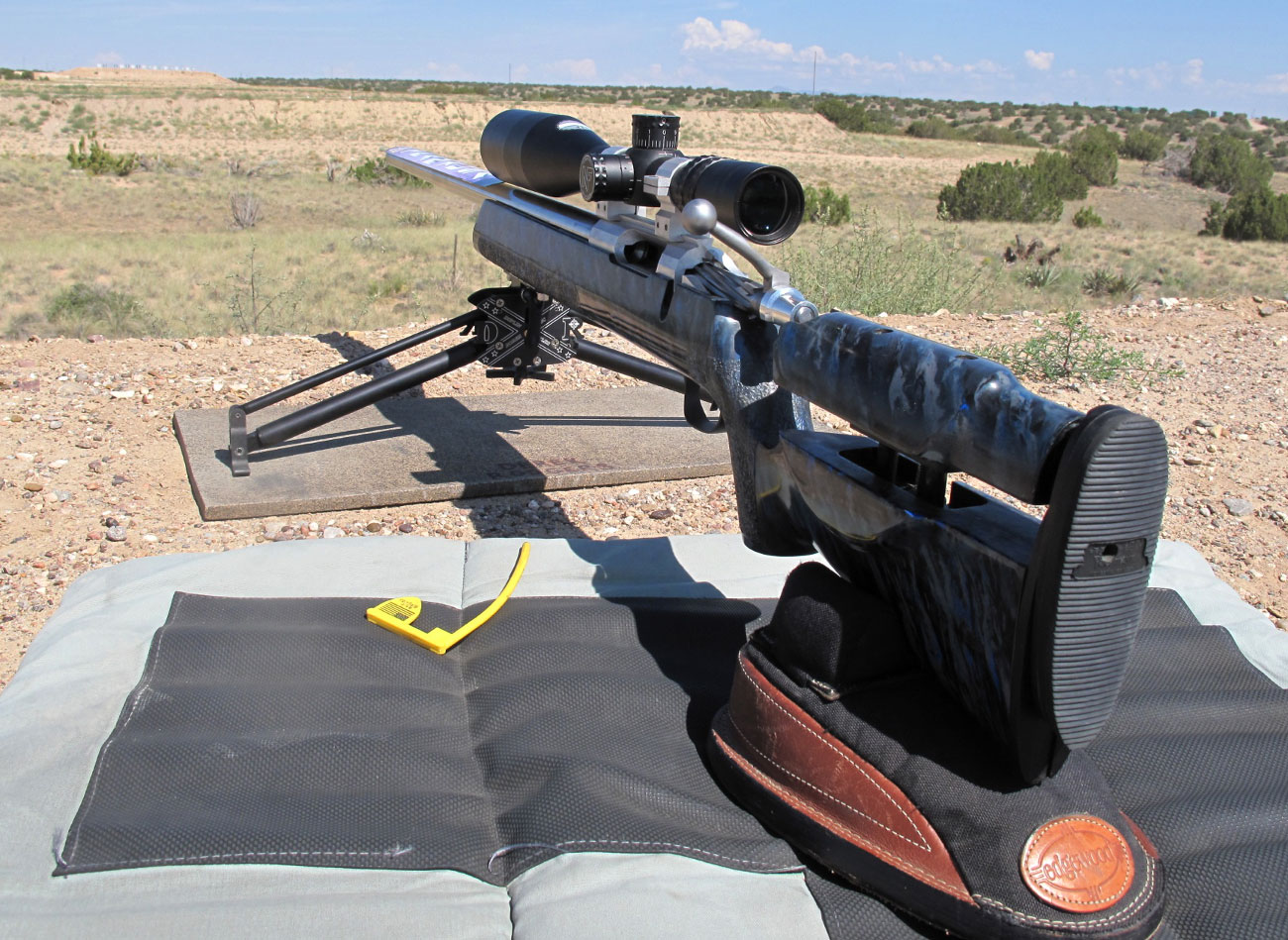
Derek: For my F-TR project, I carefully chose as many lightweight components as possible, without compromising performance. I wanted to put the weight savings (from light components) into a heaver, stiffer barrel. The rifle features a left port, left bolt Kelbly F-Class Panda action fitted with a Kelbly trigger. The stock was acquired as an uncut blank. It’s a McMillan Prone stock and is very comfortable in design. It also has a nice vertical pistol grip and gentle palm swell. This makes getting behind the gun feel very natural. [Editor’s Note: Though Derek is a right-hander, he shoots with a Left bolt-Left port action. This allows him to stay in the shooting position, right hand on grip, while manipulating the bolt (and feeding rounds) with his non-trigger-pulling hand.]
CLICK on Rifle Photos for Full-Screen Versions
Rifle photos by Dennis Welker.
Doan Trevor built the entire rifle. Doan even made all of the hardware on the gun. Doan was able to drop pounds vs. ounces as a result. Doan’s 3-way butt-plate hardware alone weighs just half a pound! Doan was highly attentive in helping me build the gun the way I wanted. His bedding and fitment is clean and he has creative ideas for the competitive shooter. While my stock is fiberglass, Doan really shines when it comes to building stocks from wood blanks. In fact, Doan built the stock used by second-place finisher Lige Harris, and also fourth-place Trudie Fay. I feel fortunate to have Doan so close. He’s truly a master craftsman who can quickly turn a project into reality.
I chose a Bartlein barrel on this rifle. It is an 1:11″ twist, 32″ long, heavy-contour barrel to stabilize heavy bullets. This barrel was a real hummer from the start. I shot six shells over the chronograph to determine initial chamber behavior and all six loads shot into 1 hole at 100 yards. Each cartridge had 0.5 grains increase in powder. That’s never happened to me before.
Up front, I used a Duplin Bipod. It weighs just 17.2 ounces and is made in North Carolina by Clint Cooper and supplied through Brownells/Sinclair. It is a new product for them and it has already proved to be an extremely lightweight, solid platform. Kelbly rings and an NXS 8-32X scope top the rifle off.
Q: Could you talk about your experience shooting at Raton — dealing with the challenging winds. Did you have any strategy going into the Nationals? Did that change?
Derek: The Raton winds can be intimidating to a person that has never shot there before. In fact, one of the first comments I heard was that it was ugly and nasty out there as the flags ripped straight out to the NW. I glanced downrange and thought it looked like another beautiful New Mexico day (being from NM does have its perks). There is usually no shortage of big wind out here. I’m fortunate to shoot 1K matches locally at a Del Norte Gun Range located outside of Albuquerque. It prepared me to shoot when I can see the mirage and proceed with caution when I can’t. It is the same elevation as the Whittington Center and gives me true testing with actual come-ups that will work dead on at both ranges. My strategy going in to the match was to shoot heavy 200 grain Berger hybrid bullets. I felt like it was the best compromise between BC and velocity. My load held an incredibly flat water-line and that gave me the confidence to either shoot through the entire string in tough wind or stop and wait until the switching winds returned to what I like to see. I was fortunate to pick the correct wind-sets and jump in when I needed to — or wait when the mirage didn’t look right. It paid off as I saw competitors’ targets raised with wide ring spotters. A few times I watched my clock and let a couple relays tick down to the last several minutes before finishing. The winds are quite challenging here and wind pickups and let-offs are huge! The wind calls are definitely magnified in Raton.
Q: You are the only shooter to have won both the F-Open and F-TR U.S. National Championships. How would you compare and contrast F-Open vs. F-TR?
Derek: Now that I’ve won both F-TR and F-Open National titles, I have finally captured the elusive F-TR national victory. F-TR was my first love in competitive shooting and [winning the F-TR title] has always been a personal goal to achieve. I could not be happier to win in my home state with a spectacular level of expertise in attendance. You really need to remain 100% focused in F-TR and try not to miss any condition change. If you do, you will pay dearly as the .308 Win just doesn’t have the extra horsepower to plow through the minor wind changes like Open guns can. Needless to say, F-Open shooters have their hands full in Raton as well; high BCs and fast, booming magnums aren’t the only way to get good scores. Open shooters need to be just as in-tune with the wind. Most of the Open Class shooters use sophisticated rests and cartridges superior to the .308 Win. However, I saw rough conditions disrupt many top shooters as they handed over their score cards to line officers. Although not in a front rest, I have learned to manage my F-TR gun to keep it tracking straight back under recoil. I had two main concerns in Raton this year with my F-TR rifle: 1) Keep all my shots on paper even if the winds blow 25+ mph; and 2) do NOT shoot another target! It’s very easy to do if your bipod slides over during recoil. That was less of a concern for me when I shot Open. Open Class rifles have a more stable foundation that stays in place better. However, just one crossfire at this level will take you out of contention to win anything in Open or F-TR. Both classes are very tough these days on the upper level and you can’t afford to give away points.
Q. What was your load for Raton and did you have to make any adjustments for the altitude or temperature?
Derek: My load for the upcoming Nationals was something I used earlier in the year to win the 2013 East Coast Sinclair Nationals: Berger 200gr Hybrids, Lapua brass, Varget powder, Wolf LR primers. I felt it was very consistent against some of the best F-TR shooters around. However, my biggest concern was my load being over-pressured in late summer. It was a hot year in New Mexico. In June, I made a couple trips to Raton and discovered my loads that I felt were safe were actually on the hot side. I tested locally in the heat of the day vs. calm cool mornings. I also spent quite a bit of time studying past load data / temperatures and came up with a game plan to work with what I had. I kept my fingers crossed that the ambient temperature would stay in the low 80s. I knew my load shot well from 50-80 degrees, but above that and I thought I may have problems with the groups coming apart late in a string. I saw this happen to me in the past with temp-stable powders in a .308 Win. In fact, .308 Win loads become much more critical when pushing the cartridge to its full capacity. Had the temps been in the mid to upper 90s, I’m sure the rifle would have shot differently.
Q: What advice would you offer to someone getting started in F-TR competition?
Derek: I think shooting F-TR has allowed me to really get an idea of what the wind is doing. If a new shooter is interested in trying it, the best tips I can offer is to partner up with a few experienced shooters that know how to hand-load carefully and compare shooting notes. This helps someone get traction with proven methods. Another tip would be to get matches under your belt–at different ranges. It may seem trivial, but each range is different. The shooter may benefit by seeing something that he hasn’t encountered before. The other thing I’d suggest to new shooters is not to worry about your score when starting. Keep shooting. More trigger time is key. I’d recommend working on eliminating your lowest ring value first. For example, if you’re lowest score was a 6, next match try to only shoot better than 7s. Once that is eliminated work on your 8s. When you consistently shoot 9s and 10s then you can be assured that your technique is solid and manageable. Higher scores and Xs will come….
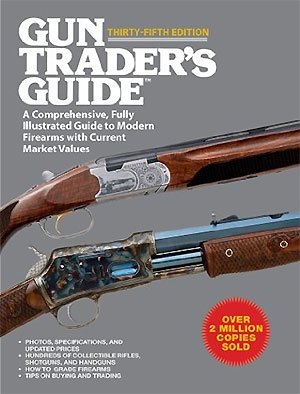
The new, 35th Edition of the Gun Trader’s Guide has just been released. This fully-illustrated resource features current market values for thousands of rifles, pistols, and shotguns. This 35th Edition, now with over 1000 photographs, boasts one hundred new entries since last year’s edition. Along with the Blue Blue of Gun Values, the Gun Trader’s Guide is one of the two definitive resources on gun prices. If you buy or sell firearms, the Gun Traders’ Guide is a must-have item that will pay for itself. Over two million copies of the Gun Trader’s Guide have been sold to date. Order soon to be one of the first to own the new 35th Edition. Amazon’s price is $22.97.
New this year is a Kindle Edition of the Gun Trader’s Guide to Rifles. Packed with 608 pages of material, this eBook edition of the Guide can be viewed on a Kindle, iPad, laptop, or your home computer. Introductory price is just $16.47, with release slated for September 13, 2013. You can pre-order now via Amazon.com.
Get Books Fast from Amazon.com
You can order the Gun Trader’s Guide, the Blue Book of Gun Values and other popular firearms and shooting books through the AccurateShooter Bookstore. To save you time, we’ve collected the best books on shooting, reloading, hunting, and gunsmithing all in one location. Ordering, secure billing, and shipping are all handled efficiently by Amazon.com.
American Kenny Adams is the new F-Open World Champion, winning the individual title last week at Raton, New Mexico. ‘King Kenny’ rose to the top through with skill, countless days of practice, and great determination. He put in the trigger time, including many long days at Raton. But when we cornered Kenny after his win at the Worlds he was quick to give credit to his gunsmith, Stick Starks of S&S Precision Rifles in Texas.
Kenny told us: “I want to thank my gunsmith, Stick Starks from S&S — he got me going in this thing in the right direction four and a half years ago. Working with Stick has probably shaved a couple of YEARS off my learning curve.” Kenny’s world-beating rifle features a Panda F-Class action placed in a Robertson F-Class stock. The Krieger barrel is chambered for the 7mm RSAUM.
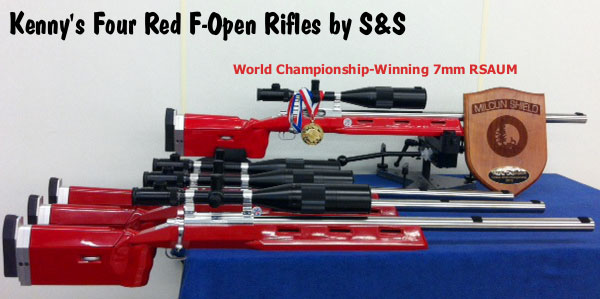
Kenny Has Four Red F-Class Rifles All By S&S
What’s interesting is that Stick Starks made Kenny three other F-Class rigs, all with red Robertson stocks and Panda F-Class actions. So, counting the championship 7mm RSAUM, Kenny owns a fleet of four fire-engine-red F-Class rigs, all built by Stick at S&S. These three other red rifles were originally chambered in 6.5-284, 6mmBR, and 6.5×47, but Kenny switches barrels (and chamberings) to suit the venue and course of fire. In Raton, Kenny had two (2) of the red rifles chambered in 7mm RSAUM and two (2) chambered for the .284 Winchester. However, in the Individual World Championship he shot just one rifle, a 7mm RSAUM (shown below). He used the second 7mm RSAUM-chambered rifle in the F-Open Team Championship. This second RSAUM (used for team shooting) is the one pictured above, but his other RSAUM is identical in all respects. He did not shoot either .284 Win during the Worlds.
Kenny’s World-Beating 7mm RSAUM Load
For his 7mm RSAUMs Kenny loads Hodgdon H4350 powder and Federal 215m primers into Nosler or Norma RSAUM brass. In the RSAUM he runs Berger 180gr Hybrid bullets seated “just touching” the lands. For his .284 Winchester-chambered rifles he loads necked-up Lapua 6.5-284 brass with 180gr Hybrids pushed by H4831sc powder and Federal 210m primers. Interestingly, he is very precise with his charge weights. Using a Sartorius Magnetic Force Restoration scale, Kenny tries to hold his powder charges to within 1-2 kernels charge-weight consistency.
While Kenny praised S&S for building great rifles, Stick is quick to say that Kenny deserves the credit: “He’s the man that pulled the trigger. He’s the man that beat the world. You can’t believe how dedicated Kenny is to his sport. He spends so much time shooting and practicing — true dedication. Kenny hung in there, never gave up, did the best a man can hope to do. Yeah you have to have good equipment, but you do have to have dedication in this sport. Buy the best equipment you can and the rest is up to you — learning how to read conditions. That’s all there is to it.”
S&S Can Build You a ‘Kenny Clone’ for $3800.00
By the way, if you want a gun just like Kenny’s, Stick told us: “I’ve got barrels, Panda F-Class actions, and I have one last Robertson F-Class stock left. Just one — these aren’t made any more you know. A complete build, with barrel of your choosing and Jewell trigger, will be about $3800.00.”
S&S Precision Rifles is a leading gunsmithing operation based in Argyle, Texas. Stick Starks and the crew at S&S build very accurate rifles, that also exhibit superb craftsmanship. While S&S built a championship-winning F-Open gun for Kenny, they can also built short-range benchrest rigs, as well as varmint and hunting rifles — all with hallmark S&S quality. S&S can handle every aspect of gunsmithing — chambering, bedding, even stock-painting.
In the video above, the folks at S&S put together some tack-drivers for their customers. There are some nice glimpses of bedding work, and barrel finishing. Watch carefully — at the 40-second mark you’ll see a sub-1/4″, 10-shot group that S&S co-owner “Stick” Starks shot at 200 yards with his 6.5×47 Lapua rifle. That’s serious accuracy. Half-way through the video, Stick offers advice for shooters looking for a super-accurate fun gun for club shoots: “If you want to shoot [at] 100 and 200 yards, I’d get me a 6BR or a 30 BR. It would be the most fun gun you ever had… and the barrel will probably last three or four thousand rounds.” If you want a gun to shoot at primarily 500-600 yards, Stick recommends the 6.5×47 Lapua chambering: “Run it with the Berger 130s and Hodgdon H4350 powder. That H4350 works great with the 130 Bergers.”
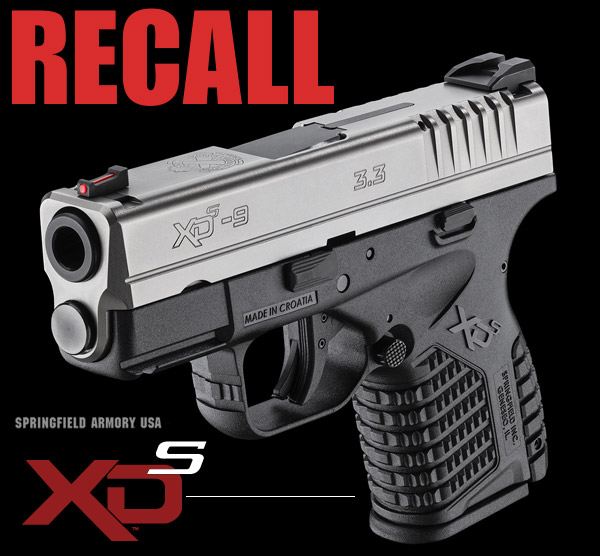
Springfield Armory (Springfield) is recalling certain 3.3 XD-S™ 9mm and 3.3 XD-S™ .45ACP pistols (serial numbers below). The reason for the safety recall is that “under exceptionally rare circumstances, some 3.3 XD-S™ 9mm and .45ACP caliber pistols could experience an unintended discharge during the loading process when the slide is released, or could experience a double-fire when the trigger is pulled once.” This could cause serious injury or death. If you own an XD-S 9mm or .45 ACP pistol subject to recall, stop using the pistol, carefully unload it, and return it to Springfield. Springfield will install new components that should eliminate the potentially dangerous condition.
This Safety Recall Applies to:
Springfield 3.3 XD-S™ 9mm pistols – serial numbers between XS900000 and XS938700.
Springfield 3.3 XD-S™ .45ACP pistols – serial numbers between XS500000 and XS686300.
Note: This Safety Recall does not apply to any XD® or XD(M)® pistols.
If you have one of the affected XD-S 3.3 pistols, go to the Springfield Recall Notice Page (or call 800-680-6866). Click on the Get Started link at the top of the Recall Notice Page. Enter your serial number and click Next. The serial number is located on the frame beneath the dust cover (accessory rail). If your pistol is subject to recall, you will need to provide your contact info. If you no longer own the 3.3 XD-S™ 9mm or .45ACP pistol, please advise Springfield of the current owner.
Springfield will provide a return authorization and mailing label, so owners can return affected XD-S pistols at no cost. Springfield will then install upgraded components, and return the pistol. Visit www.springfieldrecall.com for further information or call 800-680-6866.
Compared to bolt-action rifles, direct gas impingement AR-platform rifles tend to be filthy, maintenance-intensive beasts, requiring regular disassembly and cleaning of the innards. Op-rod style AR variants run cleaner and cooler, but they still require regular maintenance. Now there is a versatile, compact multi-tool that performs a variety of critical servicing/maintenance tasks for AR-platform rifles.
Weighing just 6 ounces, the new D-CAT from Space Age Weaponry fits in the storage compartment of a standard AR-15 fixed butt stock. Brownells says the D-CAT (“Deployable Compact Armorer’s Tool”) is the “only tool necessary to assemble the AR-15/M16 from component parts, or perform a complete disassembly”. The video below explains the feature and functions of the $149.99D-CAT.
The D-CAT is made from quality materials: 6061-T6 Aircraft Aluminum, 303 Stainless steel, and H13 Tool Steel. Bits, punches, and other small parts are located in the tool magazine, within the torque handle. Simply rotate the magazine gate to expose the individual compartments. Within the magazine you will find a 1/8″ punch, a flat blade driver, front sight adjustment tool, and a 3/16″ and 9/64″ hex driver. There is also a spare punch pocket and a Hammer/Trigger pin pocket. This is also the mode in which the D-CAT is used as a screwdriver. The driver makes use of a standard ¼” hex well so the tool can be augmented to serve as a general purpose driver for any bit you choose to carry.
Tool Tip from EdLongrange. We welcome reader submissions.


 The rifle features Carlito’s CG thunderbolt action, in a low-profile carbon-fiber stock also made by Gonzales. Up front is a Bukys-style tuner. If you watch the video carefully, you may wonder “how do the cartridges get into the action?”, since you won’t see the shooter (Carlito) pulling rounds from a loading block. Well the secret is that metal contraption to the left of the gun. It is a gravity-fed caddy connected, via cable, to a hand control. After working the bolt to extract a fired case, the shooter can push a button and the next round drops down from the upper left into the left port/right eject action. Simply close the bolt and you’re ready to roll. For more information, visit Benchrest.com.ar or email casagonzalec [at] benchrest.com.ar .




 We haven’t tested one of these bi-metal composite barrels, but the potential for significant weight savings is obvious — aluminum is a lot lighter than steel. What’s more, a metals expert we contacted said that a bi-metal system employing fluted aluminum over steel, if assembled properly, could dissipate heat much better than steel alone (given the same diameter). Stainless steel has a
  Over the years, many Civilian Marksmanship Program firearms purchasers have asked if the CMP would consider offering reliable, reasonably-priced and prompt maintenance, repair and upgrade of USGI-issue rifles. The CMP has responded and the answer is “YES”.

 For more information, call (256) 835-8455, x1113, or send email to customshop [at] thecmp.org. Shipping and Correspondence address for the CMP Custom Shop is:






 American Kenny Adams is the new F-Open World Champion, winning the individual title last week at Raton, New Mexico. ‘King Kenny’ rose to the top through with skill, countless days of practice, and great determination. He put in the trigger time, including many long days at Raton. But when we cornered Kenny after his win at the Worlds he was quick to give credit to his gunsmith, Stick Starks of