Jewell triggers are still the most-used triggers on competition benchrest and F-Class rifles and they are also popular for hunting, varmint, and tactical rifles (with or without safeties). While a Jewell trigger can work for years with minimal maintenance, if the trigger becomes gunked up, it may be necessary to disassemble the trigger for a thorough cleaning. Our friends Ed and Steve, aka the 6.5 Guys, have produced a helpful video that shows how to disassemble and then reassemble a Jewell trigger.
Why You May Need to Disassemble Your Jewell Trigger — the 6.5 Guys
Jewell triggers are a popular choice in the sport of long range precision shooting, and like everything else require regular cleaning and maintenance. In most cases they can be cleaned with charcoal lighter fluid or dropped into an ultrasonic cleaner. Should the situation require, they can be completely disassembled according to the Jewell Trigger Manual.
We ran into a situation where we had to dissemble a trigger due to the entrapment of some sticky dirt that couldn’t be removed with an ultrasonic cleaner. Our first step was to find some step-by-step instructions but we couldn’t find anything.
Recognizing that other shooters might be in the same situation we produced a step-by-step guide and video, published in full on 65Guys.com. These instructions will work with a left- or right-handed trigger. In our case we worked with a left-handed BR model trigger with safety and bolt release.
Step-by-Step Instructions are provided on 65Guys.com website. We recommend you read all the instructions carefully before you even think about disassembling your trigger. This video explains the process so you can get a sense of what is involved.
Emil Kovan is one of the top F-Class shooters in the world. He won the 2014 United States F-Open Championship. Earlier this month Emil finished second in F-Open Division at the 2016 Canadian National F-Class Championship in Ontario. Emil actually tied Open-class winner Shiraz Balolia for overall score AND “V”-count, but Emil was awarded second on the tie-breaker.
“What are the best components for an F-Open class rifle, and why?” That’s a question that I get asked all the time and will try to answer in this article. Two months ago, I was contacted by Duane, a gentleman I met at the 2015 F-Class Nationals. He was interested in building a rifle with the new Master Class Low Profile F-Open Stock, created by Carl Bernosky and Alex Sitman of Master Class Stocks.
I have known Alex Sitman for many years, and use his stocks exclusively, but was not very familiar with his new Low Profile F-Open stock. After a brief conversation with Alex, I placed an order, and had the stock inletted and bedded at my shop in a month. My first impression was “Wow that’s a long stock” — the forearm is significantly longer than on the original Master Class F-Class prone stock. I bolted the barreled action in, and squeezed the end of the forearm and barrel together, the stock flexed a little bit, but not as much as other designs that I have tested. I think that’s due to having “more meat” in the receiver area. The full stock depth continues farther forward that on some other “low profile” designs. That makes the stock stiffer in the vertical plane, reducing the hinging effect forward of the action. The stock was finished in gloss black per the customer’s request. Interestingly, I found that the multiple layers of paint and clearcoat stiffened the stock up quite a bit.
CLICK IMAGE below for full-screen version
Low Center of Gravity Tames Torque
Compared to the original Master Class F-Open stock, the barrel sits about an inch lower. Lower center of gravity equals less torque, and that is very important when shooting heavy bullets in fast twist barrels. Another significant improvement is that the toe of the stock is flat and parallel to the forearm. I added a 3/4″ track rail in the rear, and milled the underside of the fore-end to create two parallel “rails” in the front to help the stock track better.
One of the biggest reasons why I like Master Class stocks, is the pistol grip. I don’t shoot “free recoil” and a comfortable pistol grip is super important to me when selecting a stock. The new Master Class Low Profile stock shares the same grip as the old model. This allows the stock to accommodate either a “hard hold” style or a more free-recoil style of shooting — whatever the rifle’s owner prefers. This design versatility is one reason I recommend Master Class stocks. Shooters may experiment with either shooting style to find what suits them best.
Cartridge Choice — A 40° .284 Win Improved
Duane decided to have the barrel chambered for my 284 KMR IMP (Improved) wildcat. What is .284 KMR IMP and why choose it over the straight .284 Winchester? Improved by definition means “made better”, I took a great cartridge, and modified it to increase capacity, reduce pressure, and increase brass life.
There are many “improved” variants of the original .284 Winchester: 7mm Walker, .284 Shehane, .284 Ackley and so on. My version, the 284 KMR IMP, shares the .010″ blown-out sidewalls of the .284 Shehane, but I have further increased the case capacity by changing the shoulder angle from 35 to 40 degrees. The 284 KMR IMP allows you to almost match magnum cartridge velocity in a standard-bolt-face action. If you want to run 180gr-class 7mm bullets over 2900 FPS, it is cheaper and more convenient to have a barrel chambered in 284 KMR IMP than to spend $650 for a magnum bolt.
Tuning Loads for the .284 Win Improved Cartridges
The 284 KMR IMP seems to have two nodes, one around 2820 fps and other at 2940 fps. My match load clocks at 2935 fps with single-digit ES. Note –I selected that load based on accuracy, NOT raw speed. A lot of novice (or hard-headed) shooters make the mistake to push their cartridges to the max, and disregard more accurate loads at lower velocity.
The sport of F-Class is rapidly growing, and the equipment used is improving constantly. I remember that only few years ago, an F-Open rifle that could shoot sub-one-inch of vertical at 300 yards was considered competitive. Now, we are pursuing sub-one-inch vertical at 600 yards! It takes a great rifle to approach that goal, but it is also up to the shooter to learn and experiment as much as possible in order to achieve success.
Dies for an Improved .284 Win Cartridge
One of the biggest challenges in campaigning a wildcat cartridge has been obtaining great dies. When searching for custom dies, it almost seems like that the odds are stacked against us. The most common problem is wait-time — custom die orders can take months to be completed. Also, most custom die makers want you to send them two or three cases, each fire-formed three times. I find that funny because if could somehow properly size the cases for three fire-forming cycles, I would not need a sizing die.
Custom-made dies should size the case just right, but sometimes the die’s internal dimensions are slightly off, and this leads to problem number two: dies sizing too much (or even worse) too little. I had a one “custom” die that would not size the bottom of the case enough. This made the extraction of fired cases very difficult. I feel that the best option (if available) for shooters interested in wildcat chambers is to have their gunsmiths make the dies. I offer that die-making service in addition to barrel chambering.
BAT Machine “M” Action
Duane decided to use a BAT M action for this rifle, and I think that he could not have made a better choice. We are blessed with many good match-quality receivers: Barnard, BAT, Borden, Kelbly, Nesika, and Stiller just to mention a few. These are all very well-made and suitable for F-Class. Among BAT Machine Co.actions, I like BAT models M, MB, and 3LL best. I prefer these because because of their size (large bedding footprint) smoothness, timing, options available, and last but not least visual appearance.
Trigger: I recommend and use Jewell triggers. Other good options are: Kelbly, CG Jackson (good 2-Stage) Anschutz (best 2-Stage for Bat and Kelbly actions), Bix’N Andy, and David Tubb.
Barrel: Duane made another good choice here. He decided to go with a Brux 1:8.5″-twist, 4-groove cut-rifled barrel. If you look at the F-Class and Long Range benchrest equipment lists, you will see that cut-rifled barrels are currently dominating. Many records have been shot with both button-rifled, and cut-rifled barrels. I have shot both, and prefer cut-rifled barrels. I am not saying that button-rifled barrels are not capable of shooting as well as cut-rifled barrels, but on average, in my experience, four out of five cut-rifled barrels (from top makers) will shoot well, vs. three out of five buttoned barrels. YMMV, but this is what I’ve observed.
Scope: Duane’s rifle was fitted with a Nightforce 15-55x52mm Competition scope with DDR-2 reticle. This optic is ultra clear, reasonably lightweight (28 oz.), super reliable, and has 1/8 MOA clicks — what you want for long range F-Class competition. In this 15-55X NF model, I like the DDR-2 reticle best, because fine cross hairs (FCH) are hard to see in heavy mirage. The DDR-2 has a heavier horizontal line, with a center dot. March scopes are also very popular and very well-made.
Thanks for reading, and keep ‘em in the middle…
Emil Kovan Competition History:
– 2014 F-Class Open National Champion
– 2016 F-Class Open Canadian Championship, Silver Medal (tied for first on score)
– 2015 F-Class Open National Championship, Silver Medal
– F-Class Open National Championship Teams, 2015, 2014, 2013, Shooting Team Member
– Over 15 wins in Regional and State Championships in Palma, F-TR, F-Open
The Remington 700 is the most popular bolt-action rifle in America, at least according to Gunbroker.com sales figures for new and “previously-owned” rifles. So, chances are that you (or a close family member) may have a Rem 700 of some vintage sitting in the gunsafe. But do you have a copy of the official Remington 700 product manual in digital PDF format? Probably not.
To get you squared away, CLICK HERE for a PDF version of the latest Remington 700 Owner’s Manual (also covers models Seven, and 673).
Here are links for other Remington Manuals (Right lick and “Save As” to Download):
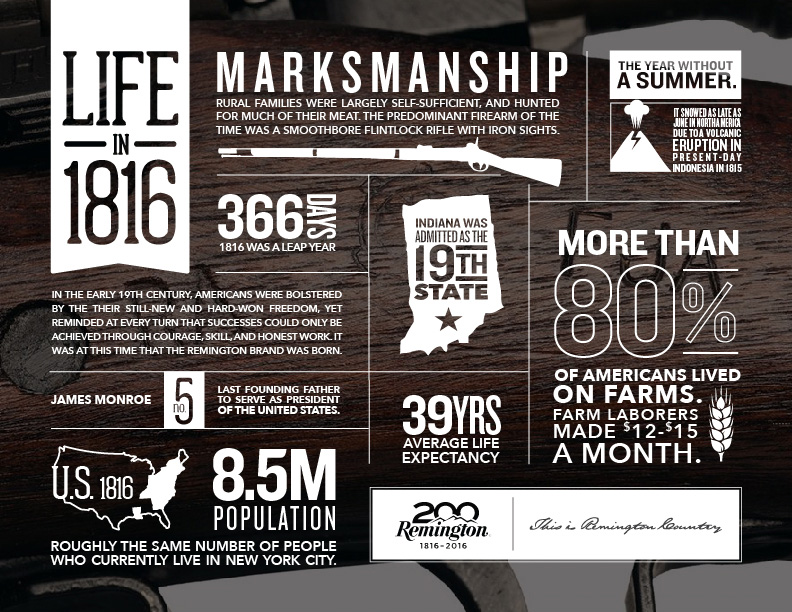
This week, American Rifleman TV looks at the history and heritage of Remington, which celebrates its 200th Anniversary this year. Founded in 1816, Remington is the oldest continuously-operating gun manufacturer in the United States, and it still sells more sporting rifles and shotguns than any other American company. Remington has also developed more cartridges than any other U.S. company. If you want to learn more about this important arms-maker, watch tonight’s episode, which you can preview below.
Two Hundred Years of Gun-Making Remington Arms Company celebrates its 200th year in business in 2016. The Remington enterprise was founded in 1816 by Eliphalet Remington in Ilion, New York, as E. Remington and Sons. Remington is America’s oldest gun maker and is still the largest U.S. producer of shotguns and rifles. And it is the only American Company that sells firearms and ammunition under its own name. CLICK HERE for 200 facts about the 200-year-old company.
American Life in 1816
What was life like in America in 1816, two hundred years ago? This infographic offers some interesting facts. For example, average life expectancy was only 39 years, and a farm laborer earned just $12-$15 per month. Still want to go back to the “good old days”?
If you own a FN SCAR 17S rifle — check the serial number before you shoot it. FN America recently recalled hundreds of FN SCAR rifles. In an official Recall Notice, the gun maker stated that 471 SCAR 17S rifles are being recalled due to the possibility of catastrophic failure caused by defective bolts. Here are key terms of the 8/10/2016 FN SCAR Recall Notice:
FN America, LLC is recalling 471 of its FN SCAR® 17S rifles due to the possibility that certain products may have been assembled with a bolt that does not meet our hardness specifications. Firing may cause catastrophic failure of the rifle over a period of time. FN America shipped these SCARs July 28 and 29, 2016, and is hoping to contain the issue at the distributor level. In the event any of the affected SCARs have been sold to customers, FN America will reach out to those customers and warn them not to use their FN SCAR® 17S if it is one of the serial numbers being recalled. Failure to follow these instructions could cause injury or death.
Although no injuries have been reported as a result of this potential issue, FN America is advising customers to discontinue use of these rifles immediately and return affected products to FN America directly for inspection and possible retrofit with compatible bolts at no cost. FN America also advises all FN distributors to immediately return all recalled products currently in inventory to FN America[.]
For more information, contact FN’s customer service at 1-855-536-4872, ext 145 or send email to fnscar17srecall@fnamerica.com .
Forum member Mike T. (aka “Watercam”), has cleverly adapted a tubegun cheek piece to conventional fiberglass and wood stocks. The cheek piece hardware comes from Competition Machine and is the same as used on Gary Eliseo’s tubegun stocks. Here is Watercam’s Project Report:
Installing Tubegun Cheek Piece on Conventional Gun Stock
All of my match rifles are equipped with thumb-wheel adjustable cheek pieces for the best of reasons — adjustments can be made while in position, on target. I’ve learned that variations in position, terrain, and vertical angle all demand adjustability to achieve optimal cheek weld.
I wanted a cheek piece for my hunting and tactical type stocks that gave the same adjustability without having to cut a chunk off of my butt stocks. It needed to be affordable and easy to install. I also wanted a unit that would not push my head laterally away from the centerline of the scope or iron sights. Turns out I already had what I needed on my Gary Eliseo B-1 tubegun. I ran the idea past Gary, who said: “If you’ll be the guinea pig I’ll send the hardware”.
Using Gary’s hardware, I mounted Eliseo alloy thumb-wheel adjustable cheek pieces on a Bell & Carlson Medalist hunting stock and a Boyd’s laminate tactical stock. Read Forum Discussion.
Building Version One on Bell & Calson Stock
I had a Bell & Carlson Medalist stock for a Mauser 98 chambered in 9.3×62. This test rifle was enough of a thumper to reveal if the metal cheek piece could handle strong recoil.
I started by drilling three 1/2″ holes into the top of the comb to match the two pillars and one threaded shaft on the cheek piece. I used aluminum tubing to make guides for each and epoxied them in place. Inletting the oval hole for the thumb wheel was reasonably straight forward and the fiber reinforced foam in the buttstock offered enough support. A large flat washer epoxied underneath where the thumbwheel lay gave a smooth bearing surface. Total adjustment (with 2.25″ pillars and shafts) is just about an inch. I chose to trim the bottom of the skirt of Gary’s cheek plate so as to allow better position behind the scope for me and allow maximum adjustment even with the cheek piece of the stock. Set screws could be used instead of the thumb-wheel or in conjunction with it. In the end it was exactly what I envisioned and works great! The only thing left to do is paint the metal to match the stock.
Version Two — Installed on Boyds Laminated Tactical Stock
Watercam’s second metal cheek piece installation was on a laminated tactical stock. This Boyds stock did have a movable comb, but the original adjustable cheek section was too awkward to adjust from position. So I adapted the Eliseo cheek piece to to the Boyds stock, as you can see:
Cheek piece installation for both stocks was straight-forward, and the new cheek pieces work every bit as well the systems on my match rifles. Aluminum tubes epoxied in place guide the rods and threaded shank. A matching-diameter flat washer epoxied under the wheel provides smooth bearing surface. The glass-filled filler of the butt stock is plenty strong enough to support the unit. A set screw and knob can be added to lock in changes if so desired.
Many of you may not have seen how Jerry Stiller’s innovative Drop-Port works with a 6BR, PPC, or Dasher case. Stiller Precision has created one slick system. Just retract the bolt and your case exits, nose-first, through a small port, coming to rest right under the gun. It works by gravity alone so you don’t need a conventional ejector, with the case alignment issues an ejector can create. (An ejector pushes on one side of the rim — this can push the case out of “perfect” alignment.) While Drop-port technology could, potentially, work with nearly any size cartridge, at this time, Drop-ports are only offered for PPC, 6BR, and Dasher-sized cases. Your Editor has a Drop-Port Viper action used with the 6mm BRDX cartridge, which is similar to a Dasher but with a slightly longer neck. It works flawlessly. Our Belgian friend David Bergen was kind enough to video his Viper Drop-Port in action:
Currently, the Drop-port system is available with the Viper action (both aluminum and stainless), and the round-profile Diamondback actions (but expect to wait a LONG time if you want the flat-bottomed Viper action). Because of the nature of Drop-port geometry, this system is optimized for short-length benchrest cartridges such as the 220 Russian, 22 and 6mm PPC, 6mmBR, and the 6mmBR Improved (Dasher, BRX, BRDX). If you plan to use a Drop-port with a Dasher or other improved case, you should tell Stiller Precision when you order. Also, if your gunsmith has not built a Drop-port rifle before, he should first consult with Stiller Precision, (972) 429-5000, to ensure the exit port is placed and inletted correctly in the stock. Getting the geometry exactly right is critical with this system.
Muzzle brakes are controversial. Some people swear by them, while others swear at them. Still, there’s no question that a good brake can reduce felt recoil up to 45%. And likewise, the best brakes, when installed properly, seem to have no negative effect on accuracy.
Roy Bertalotto has done considerable experimentation with muzzle brakes, testing dozens of brake designs on his own rifles over the past few years. Roy’s article, Adventures with Muzzle Brakes, discusses various aspects of muzzle brake design and performance. Roy doesn’t claim that his testing is definitive, but his article is definitely worth a read. Here are some of Roy’s interesting findings:
Exit Hole Diameter
“Best accuracy and effectiveness of the brake was obtained with a hole .020″ over bullet diameter. If the exit hole is too small, such as +.005″ over bullet diameter, accuracy suffers. If the depth of the exit hole is too shallow, the metal around the hole will erode very quickly.”
Hole Placement
“The most effective braking was with a brake 1″ in diameter with a 3/4″ exit hole on each side, just in front of the muzzle. The bullet passes through a cone of 35 degrees before it exits the brake. (Like the tank example), Incredible reduction of recoil. But loud and ugly. Very easy to make since you don’t need a spin fixture or a dividing head.”
Bottom Gas Venting Helps Accuracy
“In my tests, not having holes all around the brake effects accuracy a bit. I believe it does something to the bullet by the air pushed ahead of the bullet creating unequal turbulence in the bullet path. I’ve tried a few brakes where I drilled only holes on the top, test fired, and then completed holes on the bottom and in every case, accuracy improved.” Below are spiral-ported brakes crafted by Clay Spencer.
Brakes Work Best with High-Pressure Cartridges
“The higher the pressure of the particular round, the more effective the brake. I have over 20 rifles with brakes. The 220 Swift is the king of reduction. Followed very closely by the 25-06, 6mm Remington, any Weatherby small bore. With a proper brake and a hot handload under a 40 gr bullet, the Swift will move 1/2″ to the rear and 0 muzzle rise! Big boomers with low pressure like 45-70s and shot guns benefit the least.” [Editor’s Note: Roy is judging effectiveness by the percentage of recoil reduction rather than absolute levels of recoil. Obviously if you start with a heavier-recoiling round, the absolute amount of recoil energy reduction is greater. Roy is really talking about efficiency–brakes are most efficient when used with high-pressure cartridges.]
Installation is Key to Accuracy
Roy’s findings are fascinating and suggest that further study of muzzle brakes is warranted. But we can all agree that precision installation of the brake is essential for accuracy. A poorly-installed, mis-aligned brake will degrade accuracy, that is well-known.
Harrell’s Precision has made thousands of muzzle brakes, in many styles and port arrangements. The Harrell brothers offer some good advice for gunsmiths installing brakes: “Muzzle brakes aren’t magic, they reduce recoil by redirecting exiting gas. What’s important is that they are straight and the threads are perpendicular with the base. The only way to get the base and threads perpendicular is to thread, not tap, them on a lathe.”
Looking for a good job in the firearms industry? The NSSF has you covered. The NSSF Jobs Site site offers up-to-date job listings, powerful search features, and a mobile-friendly interface. It’s easy to upload your Resumé, and the Job Alert feature can send you new listings via email as soon as they post. Visit jobs.nssf.org for current employment opportunities in the shooting, hunting and outdoor industry.
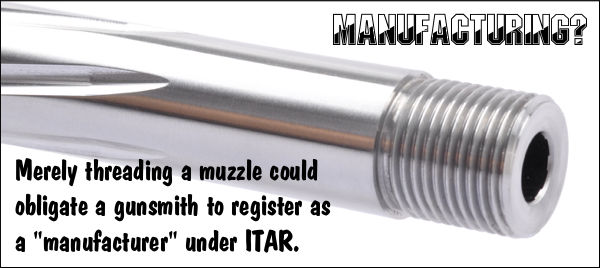
On July 22, 2016 the U.S. Department of State’s Directorate of Defense Trade Controls (DDTC) issued a 4-page “Guidance” concerning gunsmithing activities. This “Guidance” described the types of tasks and services which would obligate gunsmiths to register as “manufacturers” under the Arms Export Control Act (AECA) and International Traffic in Arms Regulations (ITAR). Any “manufacturers” of “defense articles” (which includes firearms and ammunition) must fill out burdensome paperwork every year and pay an exorbitant $2,250 annual registration fee. The “Guidance” stated that completing even one simple smithing task, such as threading a muzzle, will obligate a smith to register as an ITAR “manufacturer”. And this holds true even if the “manufacturer” does not export a single product, or only makes component parts, such as a wood gunstock. READ 7/22/2016 DDTC Guidance.
Clearly this “Guidance” threatens the traditional activities and livelihoods of normal, non-exporting gunsmiths around the country. The potential penalties for failure to register are draconian — huge fines and up to 20 years in prison.
Recognizing that the latest DDTC “Guidance” represents a severe threat to the firearms industry, the National Shooting Sports Foundation (NSSF) is leading an effort to get the DDTC to change its policies. The NSSF also urges concerned citizens to contact their elected representatives in Washington.
NSSF Statement Regarding DDTC’s Firearms “Guidance” on ITAR Registration
DDTC asserts that the guidance merely restates existing DDTC policy and interpretation of the AECA and ITAR manufacturer registration requirement.
Unfortunately, DDTC’s “guidance” has created considerable and understandable confusion and concern among gunsmiths and gun owners. The National Shooting Sports Foundation (NSSF) is reviewing the guidance and will send a letter of protest to DDTC expressing our strong opposition to the new “guidance,” the scope of which clearly exceeds their statutory authority. The term “manufacture” as used in the AECA and ITAR is its ordinary dictionary definition. Clearly, many of the activities DDTC claims require registration constitutes gun smithing and is not manufacturing under any reasonable dictionary definition of the term. DDTC’s position is similar to claiming an auto mechanic who fixes your car is a car manufacturer.
NSSF has been working diligently for many years to eliminate, or at least significantly lower, the excessive and burdensome registration fee especially for non-exporting manufacturers and non-essential component parts manufacturers. Simply put, forcing small manufacturer to pay $2,250 annually to register when they are not utilizing the DDTC export licensing system to export products is an unfair and onerous regulatory burden. This is even more outrageous when one considers that DDTC is sitting on at least $140 million dollars of previously paid registration fees collected over many years from exporters from many industries including ours.
Additionally, we have been working with allies in Congress to pressure the Obama administration to complete the Export Control Reform (ECR) initiative, which would (with limited exceptions) do away with the AECA and ITAR manufacturer registration requirement and onerous fee for commercial and sporting firearms.
To date, the Obama Administration has refused to publish and implement the regulatory changes necessary to transfer [the] export licensing of commercial and sporting firearms and ammunition products to the Department of Commerce from the Department of State. Read more on Export Control Reform. Yet, the proposed rules have been drafted and ready for publication since December 2012. Inaction persists despite congressional testimony and letters to members of the U.S. House and the Senate that [the Administration] would publish the rules.
Why has the Obama administration refused to move ECR forward for our industry? It is really very simple. The Obama Administration is singling out our industry for different treatment under the ECR because of its gun control politics. It is time to force Congress to step in and stop the Obama Administration’s gun control agenda from stopping this needed reform.
Here is the key language in the DDTC’s “ITAR Registration Requirements – Consolidated Guidance” Ruling of 7/22/2016:
2. Registration Required – Manufacturing: In response to questions from persons engaged in the business of gunsmithing, DDTC has found in specific cases that ITAR registration is required because the following activities meet the ordinary, contemporary, common meaning of “manufacturing” and, therefore, constitute “manufacturing” for ITAR purposes:
a) Use of any special tooling or equipment upgrading in order to improve the capability of assembled or repaired firearms;
b) Modifications to a firearm that change round capacity;
c) The production of firearm parts (including, but not limited to, barrels, stocks, cylinders, breech mechanisms, triggers, silencers, or suppressors);
d) The systemized production of ammunition, including the automated loading or reloading of ammunition;
e) The machining or cutting of firearms, e.g., threading of muzzles or muzzle brake installation requiring machining, that results in an enhanced capability;
f) Rechambering firearms through machining, cutting, or drilling;
g) Chambering, cutting, or threading barrel blanks; and
h) Blueprinting firearms by machining the barrel.
How Can Gun Owners and Gunsmiths Help?
Call your U.S. Representative at 202-225-3121 and U.S. Senators at 202-224-3121 urge him or her to support Rep. Collin Peterson’s (D-Minn.) Resolution, (H. Res. 829) that demands the Obama administration complete the ECR and publish the proposed rules to transfer the licensing of commercial and sporting firearms and ammunition products to the Department of Commerce (which does not require registration or payment of a fee).
Tell your U.S. Representative and Senators to force DDTC to stop imposing excessive and onerous registration fees on small businesses that do not export products. Tell them to support language in the Fiscal Year 2017 State and Foreign Operations Appropriations bill that will reduce the registration fee to a nominal amount for all non-exporting manufacturers and component part manufacturers.
Tell your U.S. Representative and Senators to stop the Department of State and DDTC from exceeding their statutory authority. The DDTC should have no power to control non-export activities. Threading a barrel or fitting a stock should not oblige a gunsmith to register with the Department of State and pay a fee of $2,250 per year.


 Emil Kovan Competition History: