Even with high-quality brass from Lapua, Peterson, Norma, Alpha and RWS, occasionally you may find one or two cases per box which have a small flake or obstruction in the flash-hole. This will appear like a thin crescent on one side of the flash hole (see photo). You should inspect ALL new brass before loading to identify any pieces with a partially-obstructed flash hole. It’s a good idea to remove any flake or thin crescent left as an artifact of the flash-hole forming process. Because the flash-hole itself is normally centered and of the correct diameter, it is not necessary to ream the flash-hole to a larger diameter. All you really need to do is remove the small obstruction(s). This can be done quickly with inexpensive tools.
Use a Small Pin Vise to Remove Flash-Hole Obstructions
Folks have asked if there is a tool that can remove obstructions from a Lapua small, BR-sized flash hole without opening the hole size. The Lapua PPC/BR flash hole is spec’d at 1.5mm, which works out to 0.059055″. Most of the PPC/BR flash-hole uniforming tools on the market use a 1/16″ bit which is nominally 0.0625″, but these often run oversize — up to 0.066″.
If you want to just clear out any obstructions in the flash hole, without increasing the flash hole diameter, you can use an inexpensive “pin vise” with an appropriate drill bit. For $5.19, Amazon sells a 10-piece set of cobalt steel 1.5mm drill bits, that matches the Lapua flash hole exactly. Other vendors offer a #53 pin vise drill bit that measures .0595″ or .060″ (depending or source). An 0.0595″ bit is close enough. You can find pin vises and these small-diameter drill bits at hobby stores.
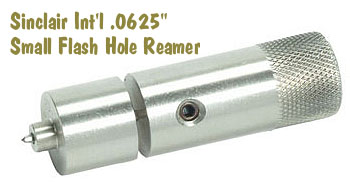
For quite some time, Sinclair Int’l has sold a similar device for small (PPC and BR-size) flash holes. Like the 07-3081 unit for large flash holes, the 073000 Reamer for small flash holes works from the outside, so it can index off the primer pocket. It reams to .0625″, and also costs $29.99. The standard dimension for Lapua 220 Russian and 6mmBR flash holes is 1.5mm or .0590″. This tool will permit standard-size decapping rods with .0625″ tips to work without binding. However, note that both Forster and Redding normally supply .057″ decapping pins with their PPC and BR dies. So, it is NOT necessary to ream your Lapua BR/PPC flashholes, unless you prefer to do so for uniformity. It IS, however, a good idea to check BR/PPC flash holes for burrs before loading the first time.
NOTE: If you purchase either the 073081 or 073000 Sinclair Flash Hole Reamer tools, we recommend you mic the cutter tip before you process a bunch of cases. Sometimes a tip comes through that is oversize. This will ream the flash holes larger than you may intend.
To celebrate its 45th year in business, Creedmoor Sports is running a big SALE — 45 Days of Deals. For the past month, Creedmoor Sports has marked its 45th Anniversary by discounting a wide variety of products including scopes, reloading presses, dies, shooting accessories, competition sights, shooting coats, hats, plus bullets and brass.
CLICK HERE to see all the current sale items. If you are looking for brass, many types of quality Peterson, ADG and Starline brass are on sale now. The 45 Days of Deals will conclude soon — so don’t hesitate if you see an item you want. NOTE: The Sale landing page only displays 12 items by default. You can speed your search by clicking the control to display 36 items per page. In total, 78 items are on sale.
Among our picks for the best deals are: 1) $119.95 Shooting Coat; 2) American Bullet Co. .308 Win Ammo; 3) Black Hills .223 Rem Ammo; and 4) Vertex Electronic Earplugs.
Featured Products from Creedmoor Sports 45 Days of Deals:
A few years back, Our friend Grant Guess had a “close encounter” with a bad primer. An apparently defective primer caused part of the casehead on one of his rounds to blow out. This, in turn, allowed high pressure gas to vent through the damaged primer pocket. Take a good look, boys and girls. This is yet another very good reason to wear safety glasses … EVERY time you shoot. The cartridge was a 6.5-06, handloaded in necked-down Winchester-headstamp .270 Win brass. Grant reports:
“I had a blow-through between the primer and the primer pocket today. The action was really smoking and I got a face full of gas. This was a reasonably light charge. Thank God for safety glasses.
I should also mention that it appears there is a 3/64 hole that is halfway between the primer and the primer pocket. Like it burned a small jet hole through both of them.”
Could this happen to you? It just might. On seeing this damaged case, one of Grant’s Facebook friends, Chris D., observed: “Search the internet, you will see a lot of these pin hole ‘in the corner’ failures. Obviously Winchester has some issues with the LR primers.”
Careful Examination Reveals Apparent Primer Defect
After this incident, Grant examined the damaged case: “I [measured] the flash hole and it is not over-sized or under-sized. The primer clearly has an area where it had a defect. At [50,000 CUP], it doesn’t take much of a defect to cause issues. There was a slight bit of pucker-factor on the next shot….”
There was huge news in the reloading world this week. Hodgdon Powder Company (Hodgdon) has acquired RCBS from Revelyst, a division of of Vista Outdoor (VSTO). Most operations of RCBS will remain in Oroville, California for now, and the full product line will stay in production — presses, dies, powder measures, case prep tools, priming tools, scales and more. But this is still big news, with a leading reloading gear maker being acquired by a leading powder maker/distributor.
Today’s Saturday Showcase feature some of the most popular and noteworthy RCBS products including single-stage, turret, and progressive presses, plus powder dispensers and other tools.
RCBS ChargeMaster Link Scale/Dispenser with Bluetooth
Having a modern, electronic powder scale/dispenser makes the hand-loading process vastly more efficient. The latest generation of powder dispensers are very accurate, and they can store charge settings for multiple cartridge types. The latest RCBS ChargeMaster Link dispenser has a modern interface, plus Bluetooth technology that “talks” to a handy App on your mobile device. This is available now for $299.99 at Cabelas.com.
RCBS Combo Kit — Good Choice for Getting Started in Reloading
You can definitely save money by buying multiple reloading gear items in one combo package. RCBS offers a variety of Reloading Combo Kits which feature reloading press, powder measure, scale, priming tool, and other items. These range in price from $265-$620 on Amazon. This video reviews an RCBS Rebel Master Kit. This is a very complete starter set-up, sold for $499.99 at Midsouth.
Along with the press, we like many of the components in the Rebel Master combo kit. The powder measure works well as does the trickler, and the hand primer tool is reliable, with good feeding and plenty of leverage.
RCBS Partner Press
We think all serious reloaders should have a small, secondary single-stage press for repetitive tasks such as decapping primers. In addition, a small, compact press can be transported easily to the range. Load development can be done more efficiently when loading at the range, as you can easily modify seating depth and other variables. The RCBS Partner Press (#ad) is a great choice for a secondary press. This UltimateReloader video shows the key features of the Partner Press.
RCBS 6-Station Turret Press — Operation Tips
This editor has owned and used an RCBS Turret Press for over two decades. While certainly not as versatile/sophisticated as the Area 419 XERO turret press, this six-station RCBS press does its job handily. It is a good choice if you load multiple pistol cartridges. With six stations, you can install both a sizing and a seating die for three different cartridge types, such as 9mm Luger, .357 Magnum, and .45 ACP.
RCBS Brass Boss Case Prep Center
The RCBS Boss is a powered case prep center that performs multiple tasks efficiently. Priced at $198.99 on Amazon (#ad), the RCBS Boss boasts six variable, high-speed rotating stations (four at <350 RPM; two at <550 RPM). This unit is great for initial case prep (chamfering/deburring) and regular brass maintenance.
RCBS Summit — Set-UP and Field installation on Vehicle
The RCBS Summit Press (#ad) is a very unique, small footprint press that operates differently than most reloading presses. The cast-iron Summit has a large-diameter center column and die moves up and down to meet the cartridge. With this small footprint, the Summit can be used in the field. As you can see in the second video, one of our testers actually mounted a Summit Press on his vehicle (with a special pedestal) so he could load anywhere.
RCBS Bench-mount Priming Tool (Two Short Videos)
If you need to prime large numbers of cases, the RCBS bench-mount Auto Priming Tool can do so efficiently at a modest cost (currently $155.09 on Amazon #ad). It attaches to your bench so it is secure and stable. A vertical tube holds dozens of primers that feed into the pusher as you can see in these videos. Older guys who experience pain when gripping hand primer tools have praised this bench-mounted RCBS unit.
Choosing a Case Cleaning System
Here Kent Sakamoto of RCBS looks at the three main types of brass cleaning systems: Vibratory Tumbler, Wet Tumbler (with media), and Ultrasonic Cleaning Machine. Kent reviews the pros and cons of each system. Most gun owners can benefit by having an ultrasonic machine for parts cleaning as well as a tumbler for cleaning fired brass.
As an Amazon affiliate, this site can earn revenues through sales commissions.
Here is big news for reloaders. RCBS, one of the leading producers of dies, reloading gear, case prep tools, powder dispensers, and reloading presses, has been acquired by Hodgdon Powder Company. RCBS has been operated by Revelyst, a division of of Vista Outdoor (VSTO). (SEE Revelyst Report on Yahoo Finance.) Here is the text from the official press release announcing the acquisition:
Hodgdon Powder Company Acquires RCBS Reloading
May 02, 2024
Hodgdon Powder Company is pleased to announce the acquisition of RCBS Reloading from Revelyst, a segment of Vista Outdoor (NYSE: VSTO). This acquisition is effective May 2, 2024, with Hodgdon prepared to immediately continue shipping RCBS products to wholesale and retail customers.
“This acquisition of RCBS, the leading brand in metallic reloading tools, is a perfect complement to our portfolio of smokeless powder brands for our handloading customers,” said Steve Kehrwald, president and CEO of Hodgdon Powder Company. With our world-class ballistics labs, we look forward to providing even more load data to our new RCBS customers.”
Hodgdon is thrilled to add the RCBS facility in Oroville, CA to our company-owned facilities in Shawnee, KS, Herington, KS and Miles City, MT. The addition of the RCBS team will more than double the headcount at the Hodgdon Powder Company and greatly expands the company’s manufacturing capabilities.
“For years, our friends have referred to the Hodgdon family and company as ‘The Gunpowder People’ and this acquisition further demonstrates our dedication to the handloader,” said J.B. Hodgdon, co-owner with his late brother Bob, of the Hodgdon Powder Company. “Our dad Bruce partnered with Fred Huntington from RCBS to conduct Reloading Roadshow events in the 1950s and 1960s. I believe they both are looking down today, proud to have our two great brands together in 2024.”
Comment from Vista Outdoor/Revelyst
“For more than 80 years, RCBS has demonstrated their manufacturing, innovation and operational excellence,” Said Eric Nyman, Co-CEO of Vista Outdoor and CEO of Revelyst. “We are thrilled for RCBS and their new ownership with Hodgdon Powder. This transaction joins two iconic brands, and it ensures that RCBS is positioned for success in the next chapter of its history.”
Hodgdon sent a letter today to its customers. In the letter, Hodgdon Sales V.P. Shawn Kelley states: “Hodgon Powder Company announced earlier this morning that we acquired RCBS from Vista Outdoor, effective immediately.” Shown above is the letter sent to customers.
Every handloader can benefit from a turret press. This type of press features an upper rotating disk that has multiple threaded placements for dies or other tools (such as powder dispensers). There are a variety of turret presses on the market today with the remarkable Area 419 9-Station Zero Press at the top end, and the inexpensive Lee turret presses at the other end of the spectrum. In between are Lyman’s 8-station All-American turret, the Redding 7-station T-7 press, and the RCBS 6-station turret.
Today’s Saturday video showcase features notable turret presses from Area 419, Lyman, Redding, and RCBS. We lead off with a feature on the advanced Area 419 ZERO 9-station turret.
Area 419 ZERO 9-Station Turret Reloading Press — Without Peer
Area 419’s impressive ZERO reloading press is a 9-station turret press with some very unique features. This press was designed to be the most precise turret ever created. As tested by Gavin Gear of UltimateReloader.com, the ZERO turret press delivered very impressive shoulder-bump consistency and ultra-low seated bullet run-out (about +/- 0.0005″). The numbers were as good as you can get from a quality single-stage press, so Area 419 did some impressive engineering. We would expect that, as this represents a big investment — MSRP is $1275.00. SEE FULL REVIEW on UltimateReloader.com.
The ZERO turret press lets you install up to nine (9) different reloading dies in the large top turret, which revolves around a central axis. But unlike most turret presses, the ZERO doesn’t have flex or wobble when you’re loading. This is because Area 419 includes a clever system for locking the turret in position after you’ve selected the die from your array.
Lyman Brass Smith All-American 8-Station Turret Press
The 8-station Lyman Brass-Smith All-American Turret Press is an impressive product. Since its introduction in 2018, Lyman’s All-American 8 has become popular with handloaders. With a $227.50 street price at MidwayUSA, the 8-station Lyman is $148 cheaper than the $375.49 7-station Redding T-7 (current Amazon price). No question, that’s a significant price advantage, which has helped Lyman grab turret press sales from Redding.
More Stations Provide More Reloading Options
Gavin liked having 8 stations, because this offers more flexibility. With eight stations, you can have four two-die sets, or three two-die sets plus a dedicated decapping die and a powder measure. Gavin notes: “I’ve owned many reloading presses, including 3-station, 4-station, 5-station, and 7-station variants, but I’ve never owned an 8-station press until the Brass-Smith All-American 8 came to the shop. I’ll have to say… you can’t get too many stations, especially on a manually-indexed turret. I love the idea that you can leave dies on the press, and load multiple calibers/chamberings using the same turret setup.”
Redding T-7 Turret Press Overview
The Redding T-7 has long been a leading turret press for precision handloaders. It offers one more station than the other “green” turret press offered by RCBS. It has a reliable optional priming system and plenty of leverage. We like the build quality of the Redding T-7, but it is now significantly more expensive than the Lyman turret, which has one more station. See a comparison of the Redding T-7 and Lyman 8-station turret press in the next video.
8 vs. 7 Stations — Lyman Turret and Redding T-7 Comparison
If you’re considering acquiring a turret press, it helps to compare products side by side. Here is an interesting comparison video showcasing the Redding T-7 and the Lyman 8-station turret press. This video offers a side-by-side comparison of the Redding turret and the Lyman turret, showing how each performs key functions.
RCBS Six-Station Turret Press
This Editor has used an RCBS Turret Press for over 15 years. It does not have the most stations or the most sophisticated features, but it has proven very reliable over the years. I use it primarily to use with pistol sizing and seating dies. Having six stations allows me to load multiple cartridge types: 9x19mm, .357 Magnum, and .45 ACP. READ FULL REVIEW on UltimateReloader.com.
Creedmoor Enhanced Turret Heads for Redding, Lyman, RCBS
Creedmoor Sports offers enhanced precision press heads for the RCBS Turret Press, Lyman 8 Turret Press, and RCBS 6-Station Turret Press. The Creedmoor Enhanced Press Head is a direct drop-in upgrade to the factory OEM press head and can be installed in a matter of minutes. This press head is precision-crafted from stainless steel bar stock. Priced at $199.95, these enhanced heads are featured in the video below.
The $199.95 Creedmoor Sports turret top allows greater precision in case sizing and bullet seating. A recent UltimateReloader video covers the advantages of the new precision turret head for the Redding T-7. READ Full Report on UltimateReloader.com.
The Hornady Handbook of Cartridge Reloading is now available in App form. Like the print and eBook versions of the Reloading Handbook, the new Hornady Reloading Guide App provides comprehensive reloading information. It covers rifle cartridges from the 17 Hornet to the 50 BMG and handgun cartridges from the 22 Hornet to the 500 S&W. This is a convenient mobile App, that works with both iOS (Apple) and Android devices. There are versions for both smartphones and tablets (iPads and Android). With this App you can access load data at the range, making it easier to do efficient load development at the range.
Hornady Reloading App Features:
Velocity and powder charts
An impressive lineup of powders
Find reliable loads by cartridge and bullet weight
Information on bullet design and shooting application
Very comprehensive load data from .17 Cal up to .50 Cal
Download FREE APP — Apple and Android compatible
The Hornady Reloading App is FREE to download. The App includes more than 200 calibers with a variety of loads featuring Hornady bullets, such as the A-Tip Match, ELD-X, and ELD® Match line.
Subscription Options
The iOS and Android download pages explain that fees may be required for detailed information: “Derived from extensive testing by Hornady Manufacturing Company, this App includes reloading data for over 200 cartridges and 300 bullets. [Hornady reports] only data that proved safe in our research. Users have the ability to purchase data for individual cartridges, purchase the whole current edition of the handbook, or subscribe and receive the entire handbook plus more. Subscription provides access to all handbook data on your mobile device and real updates for all new data without waiting for the new handbook publication to be produced.”
Vihtavuori Powders, a leading choice of competitive target shooters and long-range hunters, returns as the title sponsor of the F-Class Points Series V2 Finale. The 2024 V2 Finale will be held May 23-26, 2024 and at the Bayou Rifles Juliff Range in Rosharan, Texas.
“We’re thrilled to extend our partnership with Vihtavuori for the 2024 V2 Finale event! As one of our original sponsors, their direct support has been instrumental in bringing this event to life and supporting its growth, commented Tod Hendricks, F-Class Point Series member. “Now serving as the lead sponsor, Vihtavuori’ s continued generosity ensures that events like ours can flourish, offering fresh and exhilarating experiences in the competitive shooting sports arena.”
The F-Class Points Series is a yearlong F-Class points system and leaderboard, that culminates in the V2 Finale, which pits F-Class competitors against each other in a bracket-style double elimination match. Sixty-four competitors, 32 for each class (F-Open and FT/R), are invited to the Finale based on their series ranking. Since the V2’s inaugural series in 2021, partnerships have begun in Canada, South Africa, Italy, and Australia. The 2024 Finale will be held May 23-26 at Bayou Rifles in Rosharon, TX.
CLICK HERE for V2 Finale and F-Class Points Series rules. For more information on the F-Class Points Series and V2 Finale, visit FClassPointSeries.com.
This new-format match pits F-Class competitors against each other in a bracket-style double elimination match. The elite field (32 per class) is selected via a preceding Points series. In the past targets were placed at 1000 yards. In something unusual for an American F-Class match, in the V2 Finale all shooting will be done via PAIR FIRING, with shooters going head-to-head with alternating shots. The listed course of fire for 2024 is:
3.1. 2 CONVERTIBLE SIGHTERS AND 15 SHOTS FOR RECORD AT 1000 YARDS, PAIR FIRE
3.2. 2 CONVERTIBLE SIGHTERS AND 10 SHOTS FOR RECORD AT 1000 YARDS, PAIR FIRE
3.3. 5 SHOTS FOR RECORD AT 1000 YARDS, PAIR FIRE
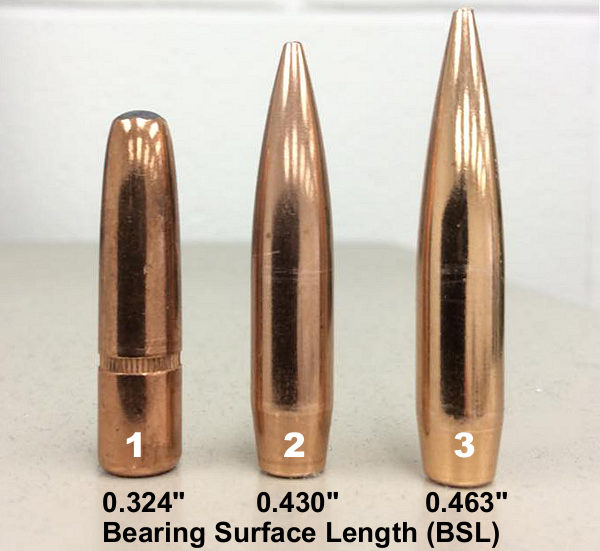
Photo 1: Three Near-Equal-Weight 7mm Bullets with Different Shapes
TECH TIP: Bullets of the same weight (and caliber) can generate very different pressure levels due to variances in Bearing Surface Length (BSL).
This article, from the USAMU Facebook Page, concerns reloading safety. In the relentless quest for more speed and flatter ballistics, some hand-loaders load way too hot, running charges that exceed safe pressure levels. Hint: If you need a mallet to open your bolt, chances are your load is too hot. Stay within safe margins — your equipment will last longer, and you won’t risk an injury caused by over-pressure. In this article, the USAMU explains that you need to account for bullet shape, diameter, and bearing surface when working up a load. Don’t assume that a load which is safe for one bullet will be safe for another even if both bullets are exactly the same weight.
How Bullet Profile and Bearing Surface Affect Pressure Levels
Today, we continue our handloading safety theme, focusing on not inadvertently exceeding the boundaries of known, safe data. Bullet manufacturers’ loading manuals often display three, four, or more similar-weight bullets grouped together with one set of load recipes. The manufacturer has tested these bullets and developed safe data for that group. However, seeing data in this format can tempt loaders — especially new ones — to think that ALL bullets of a given weight and caliber can interchangeably use the same load data. Actually, not so much.
However, bullet designs include many variables such as different bearing surface lengths, hardness, and even slight variations in diameter. In fact, diameters can occasionally range up to 0.001″ by design. Thus, choosing untested bullets of the same weight and caliber, and using them with data not developed for them can yield excess pressures.
This is only one of the countless reasons not to begin at or very near the highest pressure loads during load development. Always begin at the starting load and look for pressure signs as one increases powder charges.
Bullet Bearing Surface and Pressure
Bullet bearing surface length (BSL) is often overlooked when considering maximum safe powder charges and pressures. In Photo 1, note the differences in the bullets’ appearance. All three are 7 mm, and their maximum weight difference is just five grains. Yet, the traditional round nose, flat base design on the left appears to have much more BSL than the sleeker match bullets. All things being equal, based on appearance, the RN/FB bullet seems likely to reach maximum pressure with significantly less powder than the other two designs.
TECH TIP: Bullets of the same weight (and caliber) can generate very different pressure levels due to variances in Bearing Surface Length (BSL).
Bullet 1 (L-R), the RN/FB, has a very slight taper and only reaches its full diameter (0.284 inch) very near the cannelure. This taper is often seen on similar bullets; it helps reduce pressures with good accuracy. The calculated BSL of Bullet 1 was ~0.324″. The BSL of Bullet 2, in the center, was ~0.430″, and Bullet 3’s was ~ 0.463″. Obviously, bullets can be visually deceiving as to BSL!
Some might be tempted to use a bullet ogive comparator (or two) to measure bullets’ true BSL for comparison’s sake. Unfortunately, comparators don’t typically measure maximum bullet diameter and this approach can be deluding.
Note: Due to time constraints, the writer used an approximate, direct measurement approach to assess the bullets’ different BSLs. While fairly repeatable, the results were far from ballistics engineer-grade. Still, they are adequate for this example.
Photo 2: The Perils of Measuring Bearing Surface Length with Comparators
In Photo 2, two 7mm comparators have been installed on a dial caliper in an attempt to measure BSL. Using this approach, the BSLs differed sharply from the original [measurements]. The comparator-measured Bullet 1 BSL was 0.694” vs. 0.324” (original), Bullet 2 was 0.601” (comparator) vs. 0.430” (original), and Bullet 3 (shown in Photo 2) was 0.602” (comparator) vs. 0.463” (original). [Editor’s comment — Note the very large difference for Bullet 1, masking the fact that the true full diameter on this bullet starts very far back. You can use comparators on calipers, but be aware that this method may give you deceptive reading — we’ve seen variances just by reversing the comparators on the calipers, because the comparators, typically, are not perfectly round, nor are they machined to precision tolerances.]
Thanks to the U.S. Army Marksmanship Unit for allowing the reprint of this article.
Product innovation is all about “building a better mousetrap”, or in this case, building a better bore-cleaning patch. A real smart guy, Shane Smith, has invented a triangular patch that earned a patent. The U.S. Patent Office has awarded a utility patent for BoreSmith’s triangular Pyramid Patch™. This unique cleaning patch was designed by Shane Smith, a mathematician/physicist who employed his scientific and firearms knowledge to create innovative bore-cleaning products.
BoreSmith’s clever Triangle Patch™ (aka Pyramid Patch) presents more cleaning surface area to the bore wall than does a conventional square or round patch (of equivalent size). At the same time, the unique geometry makes Triangle Patches much less likely to jam in the barrel. This is because the notches in the sides of the triangle allow the patch to sit more uniformly on the jag (without bunching up). In addition, the Pyramid patch is must less likely to jam due to pleating. One reason conventional patches get stuck is unwanted 5-layer pleating. The special notches in the Pyramid patch remove all or most 5-layer pleating. As a result the patch does not bunch up and this also reduces rod bowing.
Triangle Patch Function and Geometry Explained (See 1:18 time-mark):
NOTE: Despite what you may see in this video, you should ALWAYS insert brushes and patches from the chamber end first, using a fitted cleaning rod bore guide. With bolt-action rifles, NEVER insert a cleaning rod (with brush or jag) in through the muzzle. This may damage the delicate crown of your barrel.




 Velocity and powder charts



 Bullet 1 (L-R), the RN/FB, has a very slight taper and only reaches its full diameter (0.284 inch) very near the cannelure. This taper is often seen on similar bullets; it helps reduce pressures with good accuracy. The calculated BSL of Bullet 1 was ~0.324″. The BSL of Bullet 2, in the center, was ~0.430″, and Bullet 3’s was ~ 0.463″. Obviously, bullets can be visually deceiving as to BSL!


