In 2024 the MidwayUSA Foundation paid over $6.8 million to youth shooting sports teams and organizations. This record-breaking 2024 grant cycle provided over $5 million to 952 youth shooting teams and over $1.7 million to nearly 40 organizations that work with youth shooting programs. Established in 2008, the MidwayUSA Foundation has paid nearly $73 million in cash grants to support youth shooting sports over the years. Foundation grants assist with costs for ammunition, targets, entry fees, and travel. Grants also help cover certification costs for coaches.
This grant cycle’s average payout per team totaled $5,302. Community members can donate directly to the youth shooting team of their choice, which MidwayUSA Foundation will match, to grow the team’s annual cash grant. In addition to youth shooting teams, MidwayUSA Foundation provides funds to key state, regional, and national organizations that support youth shooting sports. Each shooting program’s grant is 5% of its MidwayUSA Foundation endowment balance and thanks to the endowment model this funding is available in perpetuity.
Rachel Augustine of Missouri 4-H Foundation stated: “The grants we receive from the MidwayUSA Foundation play a crucial role in the success of Missouri 4-H shooting sports. They help us provide essential funding for equipment, volunteer training, and state and national contests, as well as events. Through 4-H shooting sports, youth gain confidence, leadership, and responsibility, while developing a lifelong appreciation for shooting, hunting, and the outdoors.”
Donations Are Tax-Deductible
Donations made to MidwayUSA Foundation are tax-deductible and 100% of the donation goes to the endowment of the donor’s choice — nothing is removed for operations.
The MidwayUSA Foundation is a 501(c)(3) public charity working to sustain and grow youth shooting sports by providing long-term funding to youth shooting teams. For more information please visit MidwayUSAFoundation.org or call 1-877-375-4570.
Brownells hosts the 4th Annual 2A Day (Second Amendment Day) on February 22, 2025, a nationwide event dedicated to celebrating Second Amendment rights, advocating for their preservation, and strengthening the firearms community. On 2A Day, you can visit a participating range and take advantage of free firearm rental or limited free ammo. There are participating ranges in Scottsdale, Arizona; Johnston, Iowa; Ballwin, Missouri; Omaha, Nebraska; and Auburn, Virginia. And some other local ranges may offer free firearm rentals or limited free ammo. Or head to the range of your choice and shoot for fun.
With support from sponsors including CCI, Federal, Fiocchi, Henry, Hornady, Leupold, Magpul, Remington, Smith & Wesson, and Volquartsen, 2A Day provides multiple ways for firearm enthusiasts to participate:
CELEBRATE — Brownells is partnering with shooting ranges across the country to offer free range time and limited complimentary ammunition for participants.
ADVOCATE — Brownells encourages gun owners to actively support the Second Amendment by engaging with lawmakers at both the state and federal levels. The Brownells 2A Day webpage provides links to help individuals contact their elected representatives.
JOIN — Gun owners are encouraged to join national and state organizations committed to protecting gun rights, such as the 2nd Amendment Foundation (SAF) and the Gun Owners of America (GOA). Brownells will donate 4% of all sales from February 18-23 to 2A advocacy groups.
Second Amendment Day Official Target (Download for FREE)
“February 22nd is a day we, as a nation, can recognize, celebrate and do our part to secure one of the most important rights guaranteed by our Constitution – the right to keep and bear arms,” said Pete Brownell, Chairman of the Board at Brownells. “I hope Americans from all walks of life visit the range on this one day – 2/22 … and safely exercise their Second Amendment right, which is the underpinning of safety and security in America.”
Story based on report by Ashley Dugan, CMP Staff Writer
For the first time, the Civilian Marksmanship Program (CMP) will utilize outdoor electronic targets for the 2025 National Rimfire Sporter Rifle Match, set for July 20 at the Camp Perry National Guard Training Facility in Port Clinton, Ohio. Unlike previous years, the 2025 National Rimfire Sporter event will be held on Camp Perry’s Petrarca Range, which is equipped with CMP’s eTargets year-round. The range features more conveniences, such as a covered firing line and adjacent parking.
For the first time, the CMP National Rimfire Sporter Match will utilize electronic targets on the Petraca Range. Monitors placed alongside each competitor will instantly show shot placements during the match, while suspended displays above the firing line will allow spectators to follow action in real time.
“The change to eTargets should improve the experience for the competitors”, said Brian Williams, CMP’s Highpower Manager. “The matches should run faster, without the need to hang targets and do the scoring.”
The National Rimfire Sporter Match is open to both adults and juniors of all experience levels. Using .22 LR rifles at 25 and 50, match participants traditionally shoot in three classes: Open Sight (O), Telescope Sight (T) and Tactical Unlimited (TU). Due to high demand, for 2025 the CMP has added a new M-class so competitors can use U.S. military rimfire training rifles.
Registration for the 2025 National Matches opens March 1, 2025. The 2025 National Rifle Matches will run July 22 through August 3, 2025. The CMP will employ eTargets for all Highpower rifle matches, National Trophy rifle competitions and rifle Games events. The target system will also be used for National Mid-Range and Long Range Matches, August 4-9, 2025. CLICK HERE to learn more about the National Rimfire Sporter Rifle Match and other National Matches events.
About CMP Kongsberg Electronic Targets
The CMP’s outdoor electronic targets employ Kongsberg Target System (KTS) technology. The system includes monitors at each firing point that instantly display accurate shot scores. The mobile version of the KTS system, which has been featured at CMP Travel Games events and the National Matches highpower series for the last several years, will be the applied targets for the 2025 National Matches.
As another advantage, the eTarget system at the National Matches will include the KTS Shooter’s Journal, which keeps a log of each individual’s shots/scores on the firing line.
The 2025 Southwest Nationals (SWN) concluded yesterday at the Ben Avery Range outside Phoenix. The individual long-range matches were held for F-Open, F-TR, and Sling shooters. There was a good turn-out, particularly in the F-Open class. The match was very challenging at the end, with strong winds (see Brandon Green short video below). Along with the individual competitions there were team matches for F-Open, F-TR, and Sling (Palma/Optic) Teams. The weekend featured individual and team matches at 1000 yards on Saturday and Sunday. This was preceded by multi-distance (800, 900, 1000 yard) events on Thursday (Team) and Friday (Individual). EDITOR’s NOTE: We are still awaiting the final published results for some events. We will update/correct the information when available.
Shown above are Tim Vaught (left) and Keith Trapp, winners in F-Open and F-TR classes respectively. Congratulations to Tim (F-Open) and Keith (F-TR) for their first-place finishes among very tough competition. Well done!
2025 SWN Long-Range Match, Individual Results
2025 Southwest Nationals F-Open, F-TR, Sling 600-Yard Top 10
F-Open LR Top Ten
TIM VAUGHT 1245-66X *MW*
ROBERT MASSINGILL 1241-59X
DOUG SKOGMAN 1240-62X
ALAN KULCAK 1239-65X
WILLIAM KOLODZIEJ 1236-82X
JOSEPH FAIRLEY 1236-62X HiGS
SCOTT MCNEELY 1235-75X
PETER JOHNS 1235-69X
SHANE HOWETH 1235-68X
JOSHUA MASSINGILL 1235-62X HiJr
F-TR LR Top Ten
KEITH TRAPP 1237-72X *MW*
OLEG SAVELYEV 1234-48X
NIKLAS MONTIN 1227-49X
ALLEN TAMPKE 1223-54X
BRAD SAUVE 1223-47X HiSr
JEREMY NEWELL 1223-40X
ERIC BISSON 1222-53X
ALAN BARNHART 1221-50X
BENOIT VAUTOUR 1221-50X
TRACY HOGG 1220-39X
SLING LR Top Ten
BOBBY GILL A 791-33X *MW*
DAVID LUCKMAN P 790-35X
JUSTIN SKARET A 790-33X
MICHAEL STORER P 788-36X
MIKE KELLEY P 788-34X
JESS MELLEN F 788-28X
LARRY SOLLARS P 787-35X
PHIL HAYES A 787-32X
PARAG PATEL P 787-30X
RYAN HAYES P 786-30X
Forum member Johnnyi praised the folks who worked hard to run this major match: “Thank you so much to all of the volunteers organizers and staff who run one of the best matches in the country. So many friendly and welcoming faces! Much much appreciated in donating your time away from your families to put on this event!”
The Southwest Nationals is one of the few American events where sling shooters compete on the same firing line as F-Class competitors (though in separate groups).
2025 SWN Long-Range Match, TEAM Results
2025 Southwest Nationals F-Open, F-TR, Sling TEAM Results
USA F-TR BERGER 2556-125X
USA F-TR VORTEX 2556-106X
GUN RUNNERS 2551-117X
TEAM USA VIHTAVUORI 2543-114X
SPIN DRIFTERS 2526-102X
SLING LR Top Five
USNRT FRIGUGLIETTI 2570-115X
USNRT-VFB THEURER 2560-119X
USNRT MRNAK 2557-127X
THREE MEN & A BABY 2556-125X
USNRT GROSS 2546-107X
Congrats to the Winning Teams in F-Open, F-TR, and Sling disciplines: F-Open, Bayou Boyz
Captain: Neil Woody, Coach: Peter Johns
Johnny Ingram, Joseph Fairley, Pat Wood, Alan Kulcak, Michael Kurtz
F-TR, Team USA F-TR Berger
Captain: Charles Rowe, Coach: Jim Crofts
Robert Garibay, Todd Strasavich, Kimberly Rowe, Oleg Savelyev, Adam Husted
SLING (Palma), USNRT Friguglietti
Captain: Justin Utley, Coach: John Friguglietti
Michael Storer, Curtis Gordon, Trudie Fay, Benjamin Lucchesi, John Friguglietti
Interview with 2025 F-Open Winner Tim Vaught and Range View Video at Ben Avery:
Here are two members of winning Team USA F-TR Berger with Brandon Green (at left). Brandon posted: “Helping good friends celebrate their F-TR team win yesterday. Great job guys!”
The SWN was made possible this year through the participation of three dozen sponsors including Berger, Lapua, Vihtavuori, Applied Ballistics, BAT Machine, Brux Barrels, SEB Rests, Lilja Barrels, F-Class Products, Borden Accuracy, McMillen Stocks, Whidden Gunworks, 21st Century, Sightron, PMA Tool, Kelbly’s, Creedmoor Sports, Doan Trevor, Nightforce, SW Action Works and many other companies.
Photo by Nancy Tompkins near Ben Avery Shooting Facility in 2022. Nancy posted: “Thank you to all of the sponsors, volunteers, and shooters who have traveled from all over… to make this match so special.”
Do you have trouble seeing your bullet holes (on paper) when shooting past 400 yards? That’s a common issue even with premium ($2000+) high-magnification scopes. Here’s a target that solves that problem. A hit creates a larger black circle that’s much more visible than a plain bullet hole, making this target ideal for use at longer range (500 yards and beyond).
The 12″ square Birchwood Casey white background Sight-In Target displays a black “halo” around each hit (like the yellow circle on a conventional Shoot-N-C). Larger than bullet diameter, the “halos” can be easily seen with a high-magnification scope at long range (see video below). The self-adhesive target features four diamonds with contrasting red box centers. For precise aiming, you can position your cross-hairs to align with the corners of the boxes. Or, you can put a target dot sticker in the middle.
This video shows Black Shot Halos on white background:
While we envision using this target with optics at long range, Birchwood Casey says that open sights show up well against the white background, making these targets well-suited for indoor ranges or use in low light conditions.
This white background grid target has five aiming points and a 1-inch grid overlay for quick and easy sight adjustments. It comes with target pasters that allow shooters to cover up bullet holes and continue using the target for added value. The White/Black Shoot-N-C 12″ Sight-In Targets come in 5-packs with target pasters for $11.89 from MidwayUSA or $9.99 at Ramsey Outdoor. If you prefer circle targets, there is a larger 17.5″ Shoot-N-C target with one large bull with red diamond center (photo right).
High-Viz Option — Yellow on Black Grid with Yellow Halos
If you prefer seeing ultra-high-contrast yellow/green “halos” for your hits, Birchwood Casey also makes adhesive grid targets with five yellow-edged diamonds. Red circles provide precise aiming points in the middle of each box. You can quickly estimate group size or dial-in your zero using the hi-viz yellow 1″ grid lines. These yellow-on-black targets are available in three sizes: 8″ square, 12″ square, and 17.25″ square. These yellow-on-black grid targets start at $7.60 for an 8″ six-pack.
As an Amazon affiliate, this site can earn revenues through sales commissions.
The 2025 Southwest Nationals kicked off yesterday at the Ben Avery Range outside Phoenix. The individual 600-yard match was held for F-Open, F-TR, and Sling shooters. There was a good turn-out, particularly in the F-Open class. Shooting was impressive, with 11 F-Open competitors recording 600 points over the course of three 20-rd sessions — not dropping a single point all day. F-Open Ace Peter Johns was the top finisher, with 600-47X.
Modern F-TR rifle looking down-range at Ben Avery Shooting Facility.
Tracy Hogg took the F-TR division with 598-36X. In the sling division, which had both “A” (Any Sight/Any Rifle*) and “P” (Palma) classes, David Luckman topped the field with a stellar 600-48X score. Robert Gustin (in “A” class) had the next highest score, 600-46X. That’s mighty impressive for a older marksman who competes as a Grand Senior.
Today, February 13th, there will be mid-range Team Competition at 600 yards. Expect this match to go down to the wire, and probably be decided on X-Count. CLICK HERE for a Squadding List of teams with target assignments.
Multi-time National High Power Champion Brandon Green is competing this week at Ben Avery. On his Facebook page, Brandon posted: “If anyone wants to follow along with the 2025 Southwest Nationals here’s the link: DesertSharpshooter.com/2025-southwest-nationals. An incredible amount of talent on the range this week! The individual Long Range Championship event will start this Friday.”
2025 Southwest Nationals F-Open, F-TR, Sling 600-Yard Top 10
F-Open 600 Top Ten
PETER JOHNS 600-47X *MW*
ALAN KULCAK 600-47X
TED WEDELL 600-45X
SHILOH PLUE 600-44X HiJr
PAT WOOD 600-42X HiSr
DAVID ROLLAFSON 600-42X
DAN BRAMLEY 600-40X
NORMAN HARROLD 600-37X
TIM VAUGHT 600-35X
AMOS WISHERD 600-34X
F-TR 600 Top Ten
TRACY HOGG 598-38X *MW*
ERIC BISSON 596-37X
BRAD SAUVE 596-35X HiSr
KEITH TRAPP 595-36X
RANDY LITTLETON 595-34X HiGS
ALAN BARNHART 595-33X
JEREMY NEWELL 595-31X
JOSH SIEPERT 594-30X
CARLTON BRAY 594-27X
SCOTT KYLE T 594-25X
SLING 600 Top Ten
DAVID LUCKMAN P 600-48X *MW*
ROBERT GUSTIN A 600-46X HiGS
CURTIS GORDON P 600-34X HiSr
TRUDIE FAY P 599-44X HiWo
BRANDON GREEN P 599-41X
OLIVER MILANOVIC P 599-37X
MICHAEL STORER P 599-36X
MATTHEW BUTTON P 599-32X
PARAG PATAL P 598-42X
KIMBERLY ROWE A 597-45X
The shooting by the top F-Open shooters was mighty impressive. The top 11 finishers all had 600 scores, not dropping a point. And the next dozen shooters finished with 599 scores, just one point back. Among the 599ers, Brandon Zwahr had a 599-47X, matching the X-count of F-Open 600-yard winner Peter Johns.
Stunning F-Open rifle with SEB Mini front rest with Blake Machine accessories.
Top competitors show focus and concentration in SWN mid-range match 2022.
Bird’s Eye Ben Avery — A Look at the Range
If you’ve never visited the Ben Avery Facility north of Phoenix, Arizona, here’s a video that shows the 1000-yard range (including drone footage). The desert range at Ben Avery is something special — check out this “birds-eye view”. This 2016 video also includes an interview with Derek Rodgers, F-TR World Champion, King of 2 Miles, and the only man who who has earned both F-Open AND F-TR USA National titles.
Sling Shooters in Palma Division
For the Palma division, the cartridge of choice is the .308 Winchester (7.62.x51). This versatile cartridge is still capable of extreme accuracy. Never underestimate a skilled sling shooter with a good Palma rifle. Below is multi-time NRA National Long-Range Champion John Whidden in action at Ben Avery a few seasons back. John’s rifle featured a centerfire action in an aluminum Anschutz small-bore stock.
* Brandon Green explains: “The ‘A’ is for Any rifle/Any sight (so basically unlimited up to .338 with either iron sights or optics). And ‘P’ is Palma division”, which is limited to iron sights rifles with .223 Rem (5.56) or .308 Winchester (7.62×51) chamberings.
This was one of our 25 Most Popular Articles in 2017. We’re repeating it for those of you who may have missed it the first time around. These diagrams were created by the South Texas Shooting Marksmanship Training Center (STMTC).
There was an excellent article about Mirage created for the South Texas Marksmanship Training Center (STMTC). This article explains what causes mirage and how mirage can move the perceived aiming point on your target. Most importantly, the article explains, in considerable detail, how you can “read” mirage to discern wind speeds and wind directions.
Mirage Is Your Friend
While hot days with lots of mirage can be frustrating, mirage can reveal how the wind is flowing (and changing). If you learn how to recognize and read mirage patterns, you can use that information to shoot higher scores. That’s why many leading long-range shooters tell us: “Mirage is your friend.” As the STMTC article explained: “A mirage condition is not a handicap, since it offers a very accurate method of perceiving small wind changes[.]”
Mirage Illustrated with Diagrams
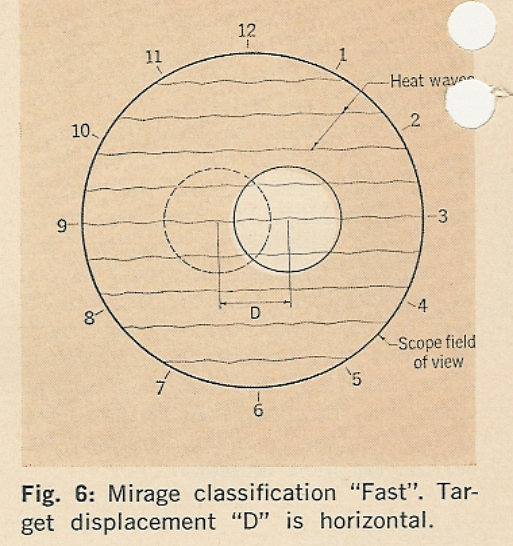
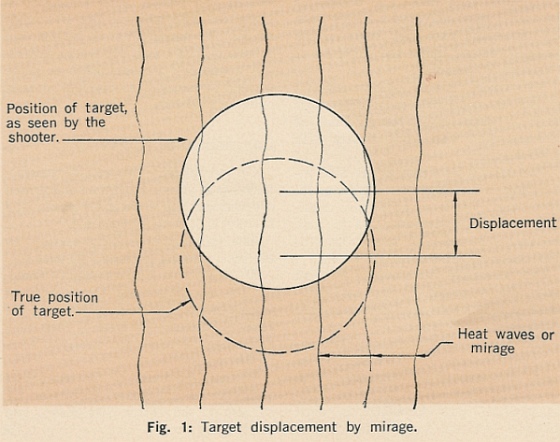
With simple but effective graphic illustrations, this is one of the best explanations of mirage (and mirage reading) we have found on the internet. This is a “must-read” for any serious competitive shooter. Here is a brief sample from the article, along with an illustration. NOTE: the full article is six times longer and has 8 diagrams.
The term “mirage” as used by the shooter does not refer to a true mirage, but to heat waves and the refraction of light as it is bent passing through air layers of different density. Light which passes obliquely from one wind medium to another it undergoes an abrupt change in direction, whenever its velocity in the second medium is different from the velocity in the first wind medium; the shooter will see a “mirage”.
The density of air, and therefore its refraction, varies with its temperature. A condition of cool air overlaying warm air next to the ground is the cause of heat waves or “mirage”. The warm air, having a lower index of refraction, is mixed with the cooler air above by convection, irregularly bending the light transmitting the target image to the shooter’s eye. Figure 1 shows (greatly exaggerated) the vertical displacement of the target image by heat waves.
Heat waves are easily seen with the unaided eye on a hot, bright day and can be seen with spotting scope on all but the coldest days. To observe heat waves, the scope should be focused on a point about midway to the target. This will cause the target to appear slightly out of focus, but since the high power rifle shooter generally does not try to spot bullet holes, the lack in target clarity is more than compensated by clarity of the heat waves.
Story tip from Boyd Allen. We welcome reader submissions.
The 2025 Southwest Nationals (SWN) start 2/12/2025 at the Ben Avery Range outside Phoenix, AZ. The big event starts with a 600-yard Mid-Range Match. Many of the nation’s most talented F-Class and sling shooters will be there. But no matter what your skill level, it is still possible to make major mistakes that can spoil the day and/or put you out of the running for the entire match. This article aims to help competitors avoid the big errors/oversights/failures, aka “train wrecks”, that can ruin a match.
Photo by Sherri Jo Gallagher.
In any shooting competition, you must try to avoid major screw-ups that can ruin your day (or your match). In this article, past F-TR National Mid-Range and Long Range Champion Bryan Litz talks about “Train Wrecks”, i.e. those big disasters (such as equipment failures) that can ruin a whole match. Bryan illustrates the types of “train wrecks” that commonly befall competitors, and he explains how to avoid these “unmitigated disasters”.
Urban Dictionary “Train Wreck” Definition: “A total @#$&! disaster … the kind that makes you want to shake your head.”
Success in long range competition depends on many things. Those who aspire to be competitive are usually detail-oriented, and focused on all the small things that might give them an edge. Unfortunately it’s common for shooters lose sight of the big picture — missing the forest for the trees, so to speak.
Consistency is one of the universal principles of successful shooting. The tournament champion is the shooter with the highest average performance over several days, often times not winning a single match. While you can win tournaments without an isolated stellar performance, you cannot win tournaments if you have a single train wreck performance. And this is why it’s important for the detail-oriented shooter to keep an eye out for potential “big picture” problems that can derail the train of success!
Train wrecks can be defined differently by shooters of various skill levels and categories. Anything from problems causing a miss, to problems causing a 3/4-MOA shift in wind zero can manifest as a train wreck, depending on the kind of shooting you’re doing.
Below is a list of common Shooting Match Train Wrecks, and suggestions for avoiding them.
1. Cross-Firing. The fastest and most common way to destroy your score (and any hopes of winning a tournament) is to cross-fire. The cure is obviously basic awareness of your target number on each shot, but you can stack the odds in your favor if you’re smart. For sling shooters, establish your Natural Point of Aim (NPA) and monitor that it doesn’t shift during your course of fire. If you’re doing this right, you’ll always come back on your target naturally, without deliberately checking each time. You should be doing this anyway, but avoiding cross-fires is another incentive for monitoring this important fundamental. In F-Class shooting, pay attention to how the rifle recoils, and where the crosshairs settle. If the crosshairs always settle to the right, either make an adjustment to your bipod, hold, or simply make sure to move back each shot. Also consider your scope. Running super high magnification can leave the number board out of the scope’s field view. That can really increase the risk of cross-firing.
2. Equipment Failure. There are a wide variety of equipment failures you may encounter at a match, from loose sight fasteners, to broken bipods, to high-round-count barrels that that suddenly “go south” (just to mention a few possibilities). Mechanical components can and do fail. The best policy is to put some thought into what the critical failure points are, monitor wear of these parts, and have spares ready. This is where an ounce of prevention can prevent a ton of train wreck. On this note, if you like running hot loads, consider whether that extra 20 fps is worth blowing up a bullet (10 points), sticking a bolt (DNF), or worse yet, causing injury to yourself or someone nearby.
3. Scoring/Pit Malfunction. Although not related to your shooting technique, doing things to insure you get at least fair treatment from your scorer and pit puller is a good idea. Try to meet the others on your target so they can associate a face with the shooter for whom they’re pulling. If you learn your scorer is a Democrat, it’s probably best not to tell Obama jokes before you go for record. If your pit puller is elderly, it may be unwise to shoot very rapidly and risk a shot being missed (by the pit worker), or having to call for a mark. Slowing down a second or two between shots might prevent a 5-minute delay and possibly an undeserved miss.
Photo by Sherri Jo Gallagher.
4. Wind Issues. Tricky winds derail many trains. A lot can be written about wind strategies, but here’s a simple tip about how to take the edge off a worse case scenario. You don’t have to start blazing away on the command of “Commence fire”. If the wind is blowing like a bastard when your time starts, just wait! You’re allotted 30 minutes to fire your string in long range slow fire. With average pit service, it might take you 10 minutes if you hustle, less in F-Class. Point being, you have about three times longer than you need. So let everyone else shoot through the storm and look for a window (or windows) of time which are not so adverse. Of course this is a risk, conditions might get worse if you wait. This is where judgment comes in. Just know you have options for managing time and keep an eye on the clock. Saving rounds in a slow fire match is a costly and embarrassing train wreck.
5. Mind Your Physical Health. While traveling for shooting matches, most shooters break their normal patterns of diet, sleep, alcohol consumption, etc. These disruptions to the norm can have detrimental effects on your body and your ability to shoot and even think clearly. If you’re used to an indoor job and eating salads in air-conditioned break rooms and you travel to a week-long rifle match which keeps you on your feet all day in 90-degree heat and high humidity, while eating greasy restaurant food, drinking beer and getting little sleep, then you might as well plan on daily train wrecks. If the match is four hours away, rather than leaving at 3:00 am and drinking five cups of coffee on the morning drive, arrive the night before and get a good night’s sleep.”
Keep focused on the important stuff. You never want to lose sight of the big picture. Keep the important, common sense things in mind as well as the minutia of meplat trimming, weighing powder to the kernel, and cleaning your barrel ’til it’s squeaky clean. Remember, all the little enhancements can’t make up for one big train wreck!
The 2025 Southwest Nationals (SWN), one of the major long-range rifle matches of the year, kicks off next week in Arizona. Running from February 12th through 16th, the match commences with the Mid-Range event on Wednesday, February 12th, and concludes with the 2-day 1000-yard match on Saturday the 15th and Sunday the 16th. On Thursday and Friday there are team and individual Palma Matches at 800, 900, and 1000 yards. CLICK HERE for the official 2025 SW Nationals Program PDF.
For this Saturday Showcase, we provide videos from past SWN events, plus informative videos that explain how to prepare for the event and pack your gear for air travel and/or lengthy overland trips.
Tips for New Competitors at the Southwest Nationals
Headed to the SW Nationals for the first time? Never shot at the Ben Avery range before? Then definitely watch this F-Class John video. It provides a series of smart tips for SWN first-timers.
Highlights from 2024 SW Nationals with Past Champ Erik Cortina
This video follows long-range competitors at the 2024 Southwest Nationals. The video shows match preparation and competition. There are interviews with participants and highlights of the challenging conditions. The video concludes with the announcement of class winners. 2024 F-Open winner Jay Christopherson is interviewed starting at 12:18 time-mark.
Analyzing Conditions at 2022 SW Nationals
In this video past SWN Champion Erik Cortina and F-Class John analyze relays from the 2022 match, discussing shot holds for specific wind conditions. You can learn quite a bit from this dialog with two top F-Open shooters. Erik won the F-Open LR SWN event in 2023.
Packing Gear for Air Travel — Tips from F-Class John
It can be very challenging to travel via airline to a major shooting event because of all the gear you’ll need to bring, along with your rifle(s). F-Open shooters must bring a heavy, bulky front rest and rear bag, while F-TR shooters will need a large front tripod and rear bag. Then you’ll need to transport a spotting scope with its adjustable mount, plus a LOT of loaded ammunition. Some shooters will also bring a press and dies to do final seating of their ammo. That’s a lot of gear. In this video, F-Class John shows how to pack rifles, gear, and ammo efficiently so air travel can go safely and smoothly.
Southwest Nationals Video SHORTS
Bird’s Eye Ben Avery — A Look at the Range
If you’ve never visited the Ben Avery Facility north of Phoenix, Arizona, here’s a video that shows the 1000-yard range (including drone footage). The desert range at Ben Avery is something special — check out this “birds-eye view”. This 2016 video also includes an interview with Derek Rodgers, F-TR World Champion, King of 2 Miles, and the only man who who has earned both F-Open AND F-TR USA National titles.
Sling Shooters in Palma Division
For the Palma division, the cartridge of choice is the .308 Winchester (7.62.x51). This versatile cartridge is still capable of extreme accuracy. Never underestimate a skilled sling shooter with a good Palma rifle. Below is multi-time NRA National Long-Range Champion John Whidden in action. John’s rifle features a centerfire action in an aluminum Anschutz small-bore stock.
Ballistics wizard Bryan Litz shoots at the 2015 SW Nationals. Notice how steady he holds his rifle.
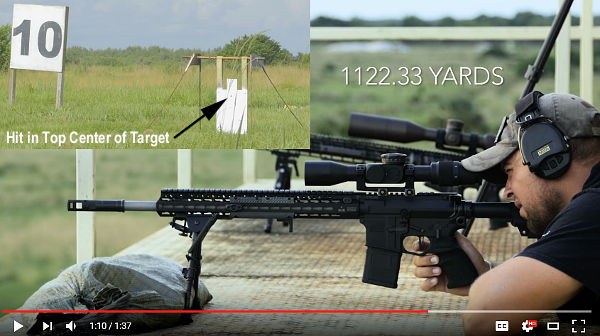
Many of our readers have never had a chance to shoot much past 600 yards. How far away does a 1000-yard+ target really seem to the naked eye? Well this short video answers that question. Gorilla Ammo, the video’s producers, used a camera-carrying aerial drone to fly downrange from the firing line all the way out to 1122 yards (and back again). Watch the drone footage at 0:00-0:07 and especially 0:48-1:03. The “bird’s-eye view” really gives you a sense of the distance. The “fly-back” at 0:48-1:03 time-mark is what makes this video worth watching.
The video features prone shooting at steel targets placed at 750 and 1122 yards. We do apologize for the lame, “oh so serious” voice-over which attempts to make this rather ordinary range session seem like some kind of life-changing experience. (Frankly, you may just want to turn the sound off — it’s that annoying.) It’s really not that big a deal to hit steel at 750 yards with a quality AR-15, chambered in .223 Rem, shooting Sierra 77 grain MatchKings.
Hitting Steel at 1122 Yards with 2540 FPS Ammo Can Be Challenging
The 1122-yard hits are a bit more impressive. Gorilla Ammo lists a relatively sedate 2540 fps Muzzle Velocity for its .223 Rem 77gr SMK ammunition. According to JBM Ballistics, at 1125 yards, that 2540 fps load has 68.3 MOA of drop from a 100-yard zero (firing at sea level and 80° F ambient). Moreover the bullet goes trans-sonic around 750 yards (losing stability) and is traveling just 933 fps at impact. And the wind’s the killer — at 1125 yards, with this bullet/load, a mere 2 mph, full-value wind change can move the Point of Impact over three feet!


 In 2024 the MidwayUSA Foundation paid over $6.8 million to youth shooting sports teams and organizations. This record-breaking 2024 grant cycle provided over $5 million to 952 youth shooting teams and over $1.7 million to nearly 40 organizations that work with youth shooting programs. Established in 2008, the MidwayUSA Foundation has paid nearly $73 million in cash grants to support youth shooting sports over the years. Foundation grants assist with costs for ammunition, targets, entry fees, and travel. Grants also help cover certification costs for coaches.




 Train Wrecks (and How to Avoid Them)


 4. Wind Issues. Tricky winds derail many trains. A lot can be written about wind strategies, but here’s a simple tip about how to take the edge off a worse case scenario. You don’t have to start blazing away on the command of “Commence fire”. If the wind is blowing like a bastard when your time starts, just wait! You’re allotted 30 minutes to fire your string in long range slow fire. With average pit service, it might take you 10 minutes if you hustle, less in F-Class. Point being, you have about three times longer than you need. So let everyone else shoot through the storm and look for a window (or windows) of time which are not so adverse. Of course this is a risk, conditions might get worse if you wait. This is where judgment comes in. Just know you have options for managing time and keep an eye on the clock. Saving rounds in a slow fire match is a costly and embarrassing train wreck.