Most of our readers are rifle guys, but it’s definitely fun to shoot a pistol match a few times a year. You don’t need a lot of equipment, and if you shoot IDPA (Int’l Defensive Pistol Assn.) matches, you can really win with a $400 pistol and $20.00 worth of bulk 9mm ammo. That’s a bargain compared to what you’ll spend on a competitive Benchrest or F-Class rig and custom rifle hand-loads.
If you want to get into the IDPA game, Shooting Sports USA has a good article that explains the basic rules and classifications. IDPA is not your grandad’s bullseye pistol match. There is movement and action. Stages are timed, and competitors engage targets from cover if available. Singled-handed shooting is sometimes required, as is shooting while moving. You can compete with pretty much any handgun suitable for self-defense — but no $4000 Raceguns with fancy optics. The fact that you can be 100% competitive without spending a ton of money is what makes IDPA so popular.
Shooting Sports USA polled IDPA shooters at the 2016 IDPA Nationals to determine their favorite gun brands and models. The #1 choice was the 9mm Glock 34 for the SSP (Standard Service Pistol) and ESP (Enhanced Service Pistol) Classes. Next most popular was the Smith & Wesson M&P Pro.
Along with SSP and ESP, there are three other main IDPA classes: Custom Defensive Pistol (CDP) for .45 ACPs (mostly 1911 types), Concealed Carry Pistol (CCP), and Revolver (REV). All classes have a minimum power factor. Scores are based on time and shot placement on the IDPA target.
IDPA Scoring System
The official IDPA Target (right) has multiple scoring zones. If you don’t hit the target’s center mass zone or head zone (both appear green in illustration), you drop one or three points. Here’s the formula: Score (in seconds) = Time + Points Down + Penalties. In IDPA, “points down” (and penalties) are added to your time. If you hit the outer edge of the target, you get 3 points down. Nearer center can be 1 point down. Center hit or head shot is 0 points down. See IDPA Scoring for Dummies.
Five Tips for New IDPA Shooters
This Editor got his start in competitive shooting with local IDPA matches. I shot a 9mm Glock 34, and a 9mm SIG Sauer P226, and even did one match with a .38 Spl S&W Snubbie. I eventually settled on the SIG P226, as it fit my hand better than the Glock, was more accurate, and was every bit as reliable. The P226 also pointed better than the Glock for me — something that helps with target acquisition. Here are FIVE TIPS for new IDPA competitors:
1. Dry-Fire Practice at Home
You can improve your grip and sight acquisition dramatically with 30 minutes of dry-firing every week. Get some quality snap caps and go to it. One tip — don’t do this in your back-yard if the nosy neighbors can see. We had one friend who was dry-firing in his yard and got an unexpected visit from the local police (with guns drawn). That can turn out badly to say the least…
2. Practice One-Handed Shooting (Both Strong-Hand and Weak-Hand)
Most of the worst misses I saw during IDPA matches were during stages requiring one-handed shooting. A lot of pistol shooters have spent all their time shooting two-handed. That’s the best technique, but in an IDPA match, you may be required to shoot one-handed. If you’re a righty, shooting with the left hand only will feel really weird, and your accuracy will be poor unless you practice. We suggest starting your one-handed training with a rimfire pistol, then transition to your centerfire pistol.
3. For 9mm, Don’t Bother to Hand-load Your Ammo
This may seem like sacrilege, but if you’re only shooting one match a month, it’s probably not worth the time and money to reload 9x19mm. I did reload my 9mm ammo on a progressive for a couple years. After looking at money and time, I just started buying bulk commercial 9mm which worked fine. I was only saving a few cents per round by reloading, and that wasn’t worth the time invested.
4. Get a Good Holster That Fits Right
In IDPA matches you normally draw from holster during the match. I saw a lot of people struggle because they had Kydex holsters that would not release easily, or leather holsters that fit too tight or rocked during draw. Try a few different brands at the local store.
5. Be Smooth, Be Calm, and AIM Your Shots
Many folks come into IDPA thinking it’s all about speed. But there are score zones on the official IDPA target, so you need to focus and AIM. Don’t just “run and gun”. If you stay calm, align your sights in the center of the target for EVERY shot, you will end up with a higher score with fewer “points down”. Speed will come with time. It is better to make sure each one of your shots is a hit.
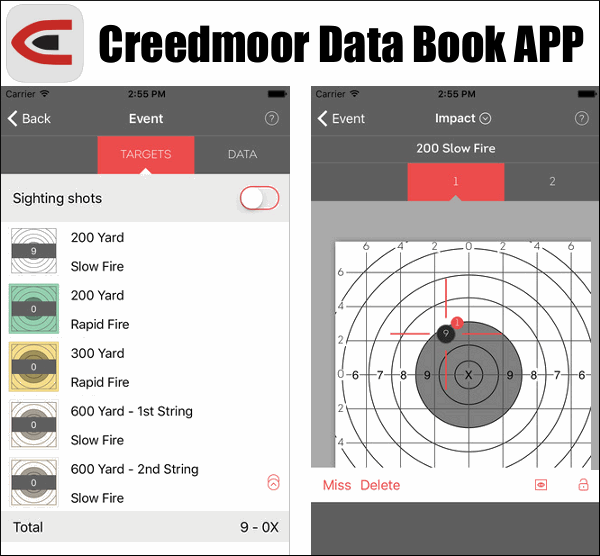
Tired of carrying old-fashioned paper Score Books? Well now you can go digital — Creedmoor Sports offers a full-featured Scoring Book App that lets you plot your shot locations/scores using an Android device or Apple iPhone or iPad. The price is right — FREE! Just visit the Apple App Store or Google Play Store to download the App for FREE.
Record Match and Practice Data
This new App, available for free in the Apple App Store, and the Google Play Store provides all the same functions and capabilities of the traditional, spiral-bound print-format Creedmoor Rifle Data/Score Book, but with the convenience and ease of recording your match and practice information with your mobile device. With this App you can break your 20 shot slow-fire segments into either 10- or 20-shot targets, and also opt for sighting shots. All the specific event data can also be recorded, such as location, wind, light etc., along with wind and elevation adjustments.
COMMUNICATIONS Restrictions: In some matches you are not allowed to have electronic communication ability, so you may have to set your iPhone to “Airplane Mode”, or use this only with an iPod (which does not have two-way communication capability).
This week, as part of the annual Sturgis Motorcycle Rally, there will be shooting range demo days — the inaugural GUNFEST 2022 presented by GunBroker.com. This 3-day event at the Buffalo Chip Shooting Complex gives visitors the opportunity to test out the latest firearm products, ammunition, accessories and more in a supervised, controlled environment.
Participating companies include: AMMO Inc., Bellmark, Boss Bullets, GunBroker, IWI, KelTec, Kimber, SIG Sauer, Silencer Central, Springfield Armory, Umarex, and Walther.
GUNFEST 2022 offers visitors the chance to try out live ammunition, thermal optics, air guns, shotguns, rifles, and handguns in private shooting lanes. The event is free and open to the public — but shooters must purchase the ammunition they use.
GUNFEST is a three-day shooting event held August 5th, 6th, and 7th at the Sturgis Buffalo Chip Shooting Complex. General admission is free but shooters must pay for ammo. Attendees will have the opportunity to try out new firearms and suppressors. The event runs from 8:30 am to 3:00 pm on Friday, Saturday, and Sunday, August 5-7, 2022.
Location: Buffalo Chip Shooting Complex – 20622 Fort Meade Way, Sturgis, South Dakota
Guidelines for Participation at GUNFEST
Participants must first register with valid ID. Those who want to test firearms must then purchase an “ammunition punchcard” offering 25, 50, 75, or 100-round ammunition “round experiences”.
The event website explains: “When you decide what firearm you’d like to experience you will let the Sponsor booth’s representative know what you’d like to shoot. The Sponsor booth’s representative will then have their assigned GUNFEST RANGE OFFICER escort you and the firearm you’ve selected to experience into 1 of the Sponsor’s private shooting lanes.
It is here, AND ONLY HERE, ammunition will be provided to the participant to shoot at the various steel targets down range within the assigned range lane. NO ammunition will leave the range firing line and NO REFUNDS on ammunition purchases.”
This Video was filmed in 2017 at the Sturgis Shooting Complex during Rally Week:
Any long range shooter knows that wind is our ultimate nemesis. The best ways of overcoming wind are to measure what we can and use computers to calculate deflection. The Applied Ballistics Kestrel is a great tool for this. As good as our tools may be, we don’t always have them at our fingertips, or they break, batteries go dead, and so on. In these cases, it’s nice to have a simple way of estimating wind based on known variables. There are numerous wind formulas of various complexity.
The Applied Ballistics (AB) Wind Hack is about the simplest way to get a rough wind solution. Here it is: You simply add 2 to the first digit of your G7 BC, and divide your drop by this number to get the 10 mph crosswind deflection. For example, suppose you’re shooting a .308 caliber 175-grain bullet with a G7 BC of 0.260 at 1000 yards, and your drop is 37 MOA. For a G7 BC of 0.260, your “wind number” is 2+2=4. So your 10 mph wind deflection is your drop (37 MOA) divided by your “wind number” (4) = 9.25 MOA. This is really close to the actual 9.37 MOA calculated by the ballistic software.
WIND HACK Formula
10 mph Cross Wind Deflection = Drop (in MOA) divided by (G7 BC 1st Digit + 2)
Give the AB wind hack a try to see how it works with your ballistics!
Some Caveats: Your drop number has to be from a 100-yard zero. This wind hack is most accurate for supersonic flight. Within supersonic range, accuracy is typically better than +/-6″. You can easily scale the 10 mph crosswind deflection by the actual wind speed. Wind direction has to be scaled by the cosine of the angle.
Summer 2022 is speeding along. Today is the first day of August, and that means it’s National Shooting Sports Month (NSSM). To help grow the ranks of shooters, the National Shooting Sports Foundation (NSSF) asks you to bring a new shooter to the range in August. That’s a good mission — adding to the ranks of shooters is the best way to preserve our Second Amendment rights.
This coast-to-coast celebration spotlights the fun and enjoyment of target shooting. Newcomers can take their first shots, and experienced shooters can invite someone new to the range or help an erstwhile shooter rediscover the fun of target shooting. This month-long event involves all the shooting sports — rifle, pistol, and shotgun.
Find Shooting Sports Events Near You
The NSSF’s ShootingSportsMonth.org website offers a comprehensive, searchable database. This lets you search by state, to find ranges, events, and sales promotions near you. Visit the NSSF online database of NSSM shooting events to find matches, clinics, training sessions, special sales — and much more.
Great FREE Targets for Fun at the Range
To promote National Shooting Sports Month, the NSSF offers 17 FREE Downloadable Targets. There are regular bullseyes, as well as Darts, Golf, and more. We really like the Billiards target and kids love the Water Balloons target. You can download all 17 targets for free, and then print them out, ideally with a color printer. Below are six of our favorite targets. Click HERE to download these six targets (3.5 mb ZIP).
What Shooters Can Do to Promote National Shooting Sports Month:
The NSSF says: “As shooters, you serve a critical role in the continued growth of gun ownership and shooting sports participation. We urge you to join us this August for National Shooting Sports Month.” There are a variety of ways you can help this August:
— Introduce a family member, friend, or group of friends to the shooting sports by taking them to a local range that’s hosting an event.
— Spread the word to family/friends and encourage them to get out to the range in August.
— Encourage the ranges and retailers near you to host an event this August and add them to the official events calendar at www.ShootingSportsMonth.org.
Story by Paula Crenshaw
SFC Brandon Green of the U.S. Army Marksmanship Unit completely dominated the recent NRA Long Range Rifle Championships at Camp Atterbury, Indiana. Green finished as the 2022 Overall LR Champion, AND he won every other major individual Long Range Trophy — something that has NEVER been done before. With this truly dominant Long Range performance, along with his three previous National High Power Championships, Green has established himself, without a doubt, as one of the greatest American marksmen who has ever lived.
With this article, you can learn from SFC Green — sharing in his knowledge and amazing skill set. Today we feature a set of USAMU videos hosted by Brandon, with input from other top USAMU shooters. Watch, learn, and improve your game!
Marksmanship Video Training with SFC Brandon Green
The U.S. Army Marksmanship Unit (USAMU) has produced an excellent series of videos covering the Basic Rifleman’s Course. If you are getting started in High Power shooting, or want to improve your position shooting skills, this series is well worth watching. And these videos are not just for service rifle shooters — even bench shooters can benefit from these videos, particularly Part 5, which explains how to estimate wind speed and direction. The lead instructor for these videos is SFC Brandon Green, three-time National High Power Champion, and 2017 Service Rifle Champion. When SFC Green talks, you should listen.
SFC Brandon Green is a shooting superstar. Green won the National Long Range Championship this summer at Camp Atterbury, Indiana, winning every major trophy. Back in 2018, Green won his third NRA National High Power Rifle Championship in 2018, also at Camp Atterbury Brandon dominated the HP Championship cycle, finishing eight points and ten Xs ahead of his nearest competitor. Brandon also won High Power National Championships in 2015 and 2013. One of the greatest marksmen in the nation’s history, SFC Green excels at all positions, both rapid-fire and slow-fire.
Part 5 — Wind and Weather Estimation (Very Useful for All Shooters)
Note: This video includes a hit location “target analysis” in the first 6 minutes.
Part 4 — Minute of Angle Explained
Part 3 — Ballistics and Zeroing
Part 2 — Positions, Sight Alignment, and Natural Point of Aim (Very Useful)
Part 1 — Aiming and Sight Picture
SFC Brandon Green (left above) has set multiple National Records at Camp Perry.
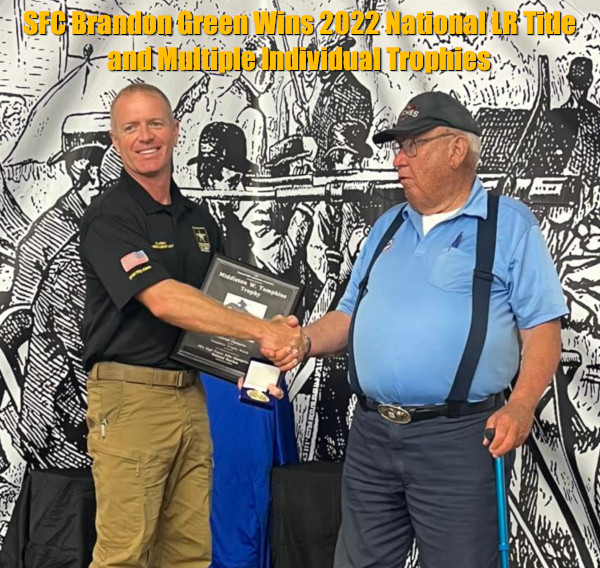
SFC Brandon Green, 2022 National Long Range Champion, is congratulated by Mid Tompkins.
SFC Brandon Green of the U.S. Army Marksmanship Unit has added another remarkable achievement to his storied shooting career. In winning ALL the major Long Range events this summer, Green proved that he is one of the greatest American marksmen of all time. The USAMU’s Green, a three-time National High Power Champion, added multiple Long Range wins to his resume this summer. At the NRA National Matches in Camp Atterbury, Indiana, SFC Green won all four major “any rifle” trophies in the Long Range Championships. He was also the overall National Long-range Champion, winning the Tompkins trophy. No human had ever done that before. We congratulate Brandon on his amazing set of wins.
At Camp Atterbury this week, Brandon Green won all four NRA Long Range Individual National Trophies for Any Rifle: Wimbledon Cup, Mustin Trophy, Leech Cup, and Remington Band of Brothers Trophy. Green also won the Canadian Cup (National Any Rifle Champion) and Tompkins Trophy (overall National Long-Range Champion). No one has ever accomplished this feat in the history of the National Trophies. This is a truly historic individual performance by SFC Green, a fitting complement to his multiple High Power National Championships.
The Tompkins Trophy is a bronze statuette of a cowboy riding a horse while defending himself from an unseen pursuer. The work is entitled “Prayer and a Winchester” by L.E. “Gus” Shafer. The trophy was donated to NRA by Middleton W. Tompkins for Long Range High Power Rifle competition.
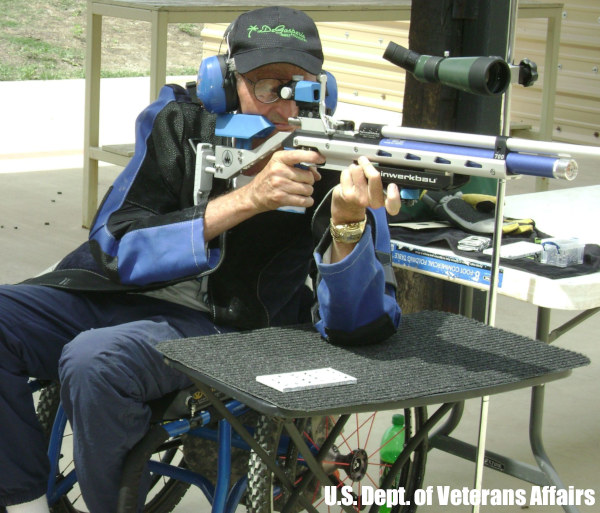
One of the great thing about shooting is that marksmanship is one of the few sports where physically-challenged persons can compete at the highest level — with some provisions for wheelchair access and mobility. For example, in the world of F-Class competition, Matt Schwartzkopf is one of the best in the nation. Matt, a rangemaster at Ben Avery in Arizona, is a double amputee (below the knee). He hasn’t let that challenge stop him. He has been a Top-10 finisher at major F-Class matches, and was chosen to shoot with F-TR Team USA.
F-TR Team USA member Matt Schwartzkopf is a double amputee below the knee, having had his lower legs removed due to a birth defect. That hasn’t held him back. Matt is an inspiration to us all. He told us: “This condition has not held me back from anything.” Jokingly, he added, “I may not have ‘a leg to stand on’, but that doesn’t mean I can’t still shoot 10s and Xs at 1000.” Matt is living proof that competitive shooting is a sport for all individuals — young and old, able-bodied and physically challenged.
Matt isn’t just a talented shooter — he runs range operations at Ben Avery in Arizona. During a major match, Matt can be seen supervising the firing line, organizing pit crews, and posting match results.
New USA Nationwide Adventure Database for Adaptive Shooters
Here’s a great new opportunity for shooters and sportsmen with physical limitations. The NRA has created a nationwide database of hunting and fishing adventures for individuals with disabilities. There are programs throughout the country with 45+ organizations such as Buckmasters, Freedom Hunters, Hope Outdoors, Hunting with Heroes, and Safari Club International.
“Venturing into the outdoors has long been acknowledged as healing for the body and soul”, said NRA National Adaptive Shooting Programs Manager Dr. Joe Logar, PT, DPT. “These benefits can be even more profound for someone experiencing an illness, injury, or disability.”
NRA’s Hunter Services and Adaptive Shooting Programs have maintained a list of organizations offering people with disabilities outdoor opportunities. Now available in a searchable database, any adaptive shooter can easily choose from adventures such as guided whitetail hunts, chartered fishing trips, and accessible hiking trails anywhere across the country. To find a program, visit the NRA Adaptive Shooting Program’s Hunting/Fishing Trip Database.
NRA Resources for Adaptive Shooting Events
The NRA Adaptive Shooting Program also provides information for organizations planning an event to include person with disabilities. Events may be organized by veterans’ groups, rehabilitation facilities, and gun clubs. For more information visit AdaptiveShooting.NRA.org.
Adaptive Shooting Programs in the United Kingdom
Across the pond, the National Rifle Association of the United Kingdom (NRAUK) also has adaptive shooting programs. The NRA.ORG.UK website has a wealth of information for disabled shooters.
The NRAUK states: “There are many different types of target shooting available for people to try in Great Britain. Some of them are readily accessible to disabled people, others less so. Also, shooting clubs and facilities do not all cater for every discipline; some only offer one, whilst larger complexes can cater for many of them. The only place in the country where almost all disciplines can be tried is Bisley Camp in Surrey. Access to the outdoor ranges is being improved all the time, although most are already accessible.
If the disciplines that you particularly fancy are not suitable for your type of disability at the moment, or are not currently available in your area, do not give up hope! The key skills for target shooting are very similar for all disciplines, so you could start with a different but similar option, learn those key skills, and take up your first choice when it is available to you.”
Making Ranges Suitable for Disabled Shooters
The Summer 2019 issue of NRA Club Connections magazine has a feature on Adaptive Shooting. This article explains how range owners can make their lines of fire more accessible with the addition of a simple mat.
Photo from Gunwerks Sheep Mountain L3 Mountain Shooting Course in July 2021. Register Here.
Carpe Diem — “Seize the Day”. Make every day count…
This story is not directly about firearms, or reloading gear, or any of the little details of our sport. It, instead, is about life… and, sadly, about death. The recent passing of a friend (and fellow shooter) got me to thinking, “I’m nearly sixty-six — what if I only had ten more years to live — how would I want to live my life? What really counts the most? What things would I do differently? What dreams would I pursue?”
AccurateShooter.com has many thousands of readers in their 50s, 60s, and 70s. Hopefully we will all live long, happy, and fruitful lives. But it’s wise to remember that we are all mortal, and the clock is ticking. Consider this — in the United States, the average male life expectancy is 76.3 years.*
Using that number as a rough benchmark, I may have just 10 and a half more years to enjoy life and to do the things I love — shooting, traveling, sailing, camping, listening to music, being with friends and family. Only 10.5 years left — that’s a real number my brain can comprehend all too well, particularly after the last 14 months have been so restricted due to COVID.
There is some good news — the actuarial tables predict that, since I’ve almost made it to 66 years already, I should live well past age 76. The predicted life-span of a 66-year-old American male is 17.2 years, which works out to 206 more months, and 896 more weekends. That’s less scary, but the message still rings true — time is running out. Live your dreams while you can.
Living a Life with More Good Times, and Fewer Regrets
Recently, a group of men, very near the end of their lives, were surveyed. They were asked if they would do things differently if they could live their lives over again. The vast majority of these men gave surprisingly similar responses, which fit into five “Life Lessons”. These “Top 5 Regrets of the Dying” were reported in a story by Bronnie Ware, writing for the AARP online magazine. Ware writes: “When questioned about any regrets they had or anything they would do differently, common themes surfaced.” Here are the five regrets most often mentioned by older men:
1. I wish I’d had the courage to live a life true to myself, not the life others expected of me.
“This was the most common regret of all. When people realize that their life is almost over and look back clearly on it, it is easy to see how many dreams have gone unfulfilled. ”
Lesson: Don’t wait to follow your dreams. Be true to yourself.
2. I wish I didn’t work so hard.
“This came from every male patient [surveyed]. All of the men… deeply regretted spending so much of their lives on the treadmill of a work existence.”
Lesson: Don’t let your work crowd out other important aspects of life.
3. I wish I’d had the courage to express my feelings.
“Many people suppressed their feelings in order to keep peace with others. As a result, they settled for a mediocre existence and never became who they were truly capable of becoming.”
Lesson: Express yourself truthfully. Don’t suppress your feelings for decades.
4. I wish I had stayed in touch with my friends.
“There were many deep regrets about not giving friendships the time and effort they deserved. Many [were] so caught up in their own lives that they had let golden friendships slip by over the years.”
Lesson: Take an interest your friends’ lives; keep bonds of friendship strong.
5. I wish that I had let myself be happier.
“This is a surprisingly common [regret]. Many did not realize until the end that happiness is a choice.”
Lesson: Affirmatively pursue the things that bring you happiness. Don’t just stick to old habits.
Turn Off the Computer, and Do Something Memorable with Your Friends Today
How does this all apply to our shooting hobby? Well, if (like me) you are middle-aged (or older), go have some fun this weekend! Load up your rifle and get to the range. Don’t put off doing the things that make you happy. Call those old buddies you may not have seen in a long time. Renew friendships. Get out into nature. And start figuring out how you can live your dreams. As the saying goes, “Time waits for no man”.
*This is based on 2020 World Health Organization Data for all males. One of our readers pointed out that the numbers actually work out better than this, because once a man survives to later life, men of his surviving age cohort enjoy a projected lifespan longer than the average projected lifespan from birth. For example, using Social Security Administration (SSA) data, an American man born exactly 60 years ago, has a calculated average life expectancy of 23 years… meaning he would live to age 83, on average. CLICK HERE to see SSA-predicted longevity based on your birthdate.
When shooting groups at long range on paper it can be difficult to distinguish which bullet holes belong to a particular sequence of shots. If, for example, you shot three 5-shot groups at 600+ yards on a paper target, you would have 15 bullet holes on the target (assuming no misses). But at that distance it would be difficult to see the holes on target (even with a spotting scope). Accordingly, when you inspected the target up close, it would be hard to tell which shots belonged to which group. You might have a vague idea, but couldn’t be sure, without a target camera recording the shot sequence.
Here is a method to separate multiple shots into specific groups so you can better evaluate your load and shooting skills. The trick is pretty simple — mark your bullets with a color from a Sharpie or other felt marking pen. If you are shooting three 5-shot groups, mark five with red, five with green, and five with blue (or purple). Then, when you inspect the target, you can identify the group placements by the colors that appear on the paper.
Round Robin: Using colors you can shoot “Round-Robin” to evaluate seating depths, neck tension, or other variables without having the shot order (and barrel heating) affect group sizes unequally. For example you might have three different neck tensions, each marked with a different color on the bullets. Then shoot Red, Blue, Green in that sequence for five total shots per color.
Smart Tip to Show Colors More Vividly
If the bullet inks are not showing up on your target paper clearly, here is a simple trick that can make the colors “bleed” to be more visible. In your range kit, bring some alcohol solution along with some Q-tips. Then dab the shots on the paper target lightly with wet Q-Tips. Here is the front of a target before and after application of alcohol:
Forum Member NewbieShooter explains: “Dabbing a bit of alcohol on the bullet holes with Q-Tips makes the color pop a bit… especially on the back side.” See below:
In short order you will see the colors spread into the paper, clearly marking the shot holes by distinguishing colors. If you were shooting a dark bullseye, view the the BACK side of the target to see the colors on a light background.
Credits: Bullet Tips photo by Forum Member Dave Way; Target photos by Forum Member NewbieShooter; Story tip from Boyd Allen.


 Along with SSP and ESP, there are three other main IDPA classes: Custom Defensive Pistol (CDP) for .45 ACPs (mostly 1911 types), Concealed Carry Pistol (CCP), and Revolver (REV). All classes have a minimum power factor. Scores are based on time and shot placement on the IDPA target.
 Tired of carrying old-fashioned paper Score Books? Well now you can go digital —



 SFC Brandon Green, 2022 National Long Range Champion, is congratulated by Mid Tompkins.
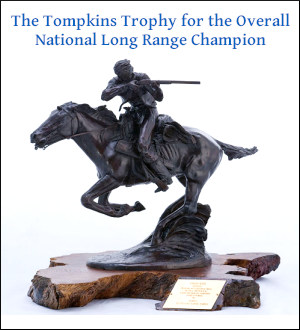 At Camp Atterbury this week, Brandon Green won all four NRA Long Range Individual National Trophies for Any Rifle: Wimbledon Cup, Mustin Trophy, Leech Cup, and Remington Band of Brothers Trophy. Green also won the Canadian Cup (National Any Rifle Champion) and Tompkins Trophy (overall National Long-Range Champion). No one has ever accomplished this feat in the history of the National Trophies. This is a truly historic individual performance by SFC Green, a fitting complement to his multiple High Power National Championships.


 F-TR Team USA member Matt Schwartzkopf is a double amputee below the knee, having had his lower legs removed due to a birth defect. That hasn’t held him back. Matt is an inspiration to us all. He told us: “This condition has not held me back from anything.” Jokingly, he added, “I may not have ‘a leg to stand on’, but that doesn’t mean I can’t still shoot 10s and Xs at 1000.” Matt is living proof that competitive shooting is a sport for all individuals — young and old, able-bodied and physically challenged.