|
|
May 4th, 2008
Smart shooters know they need a quality pair of ANSI-certified, impact-resistant shooting glasses, the kind we list in our comprehensive Guide to Shooting Eyewear.
But active shooters need MORE than a pair of shooting glasses. Think about a typical out-of-town two-day shooting match–you drive for hours, then spend most of the day standing around in the sun. The actual amount of time you’re shooting the rifle or on the firing line is probably only one or two hours a day, max.
So consider the numbers–you need shooting glasses for maybe 4-5 hours total over the weekend. But you need regular sunglasses for another 20+ hours.
Accordingly, we recommend shooters have a clear or lightly-tinted pair of ANSI safety glasses for shooting, PLUS a second, darker pair of sunglasses for general outdoor use and driving–these should be quality sunglasses, not $7.00/pair junk from a convenience store.
Consider this–If you have a QUALITY pair of driving glasses you will arrive at your shooting match with less eye fatigue. That means you will be able to see better, with less strain, through that $1000+ scope.
There are many quality brands of sunglasses, but we prefer Serengetis with the “Drivers Lens”. Most Serengetis have extremely high-grade, optically-correct lenses. The rose-brown Drivers Lens filters 95% of blue wavelengths. That reduces eye fatigue and increases sharpness — and that’s no BS. Because blue light focuses at a different point than other wavelengths, by filtering it out, far-away objects will appear more sharply focused.

Serengetis typically sell for $100 or more. We’ve found a source, Sunglasses Giant, that sells Serengetis (with Drivers Lens) for just $68.94. We like the Serengeti Summits because they have strong frames, photochromatic (light-adjusting) lenses, and decent side coverage. The Bromos are similar, but with a tortoise-style frame. Optics Planet also has the Summits with Drivers Lens for $71.95. Summits retail for $120.00 elsewhere. NOTE: Summits and Bromos are also available with a rose “Sedona” lens. Avoid that. Intended for snow skiing and mountaineering, the Sedona lens is too dark and too pink.

This editor has tried many of the other name brand sunglasses such as Bolle, Hobie, Maui Jim, Oakley, Smith Optics, and Vaurnet. I’ve owned them all. Serengetis offer a better, sharper lens than any of them. And nothing beats the Serengeti for driving. For fishing, snow-skiing, or boating, polarized SR-91 Kaenons are great–but that’s not what you want for general driving use. Polarization blocks 50-80% of visible light.

If you order the Serengeti Summits or Bromos, remember that these are NOT safety glasses. You need separate ANSI-certified safety eyewear for the relatively short amount of time you’re actually shooting or situated near the firing line.
FYI, Serengeti is a division of Bushnell Outdoor Products, a company that supports the shooting sports.
May 3rd, 2008
 Janet Tomsyn Raab, a Distinguished prone and position shooter and ISSF Class ‘A’ coach, has been named National Manager of the NRA’s High Power Rifle Programs.
AccurateShooter.com thinks Raab is a great choice. Not only is Raab an accomplished shooter with victories in both national and international competition, but she shoots a 6BR in 300m matches for the USA women’s team. We think Raab will bring a fresh new perspective to her position and do a great job promoting competitive shooting among women and juniors. Rabb founded Center Shot Sports in Centreville, VA and coaches junior athletes in the area.
Raab achieved her Distinguished Badge in High Power Service Rifle in 1986 and her International Distinguished Shooter Badge in 2006. One of only three Class “A” International Shooting Sport Federation (ISSF) coaches in the United States, Raab is the only woman High Power Rifle competitor to win the coveted Nathan Hale Trophy as High Civilian in the National Trophy Individual match at Camp Perry. Janet was also on the USA 300m Women’ Prone Team that won the ISSF World Championship in Croatia.

Raab’s responsibilities include managing the Competitive Shooting Department’s High Power Rifle competitions and programs. She works with State Associations and local clubs to enhance current programs while developing new ones. Raab can be reached at NRA Headquarters at (703) 267-1479.
May 2nd, 2008
The Williamsport Club kicks off its long-range benchrest season this weekend. Light Guns will shoot on Saturday, May 3, while Heavy Guns compete on Sunday, May 4. Cold, windy conditions are predicted–but serious shooters won’t miss this chance to dust off their bench guns after the long winter. Assistant Editor Jason Baney will be shooting his 6BR, and his gunsmith, Mark King, may try out a radically long-throated, short-barreled 6BR burning H4895. This season, it should be interesting to see how the small “sixes” fare against the big 30s at 1000 yards.

Williamsport, aka “The Original Pennsylvannia 1000 Yard Benchrest Club”, will also host 600-yard matches this year, starting with a “Fun Shoot” on May 17th following the scheduled 1K Light Gun Match.
CLICK HERE for the full 2008 Williamsport Match Schedule (600 yard BR, 1000 yard BR, Prone League, and Keystone High Power).
May 1st, 2008
On April 30th, the gun industry scored a huge win in Federal Court. The U.S. Court of Appeals for the Second Circuit tossed out New York City’s long-standing lawsuit against firearms manufacturers. That suit sought to hold gun makers responsible for the criminal misuse of firearms.
CLICK HERE to READ FULL COURT OPINION

Judge Robert J. Miner, writing for the U.S. Court of Appeals, held the Protection of Lawful Commerce in Arms Act, enacted in 2005, is constitutional and that Brooklyn, NY, federal court judge Jack B. Weinstein misinterpreted the law by not dismissing the case.
“We think Congress clearly intended to protect from vicarious liability members of the firearms industry who engage in the ‘lawful design, manufacture, marketing, distribution, importation, or sale’ of firearms,” said Judge Miner. In dismissing the city’s claim that its suit fit within an exception to the Arms Act, the court wrote that the statute was “intended to shield the firearms industry from the vicarious liability for harm caused by firearms that were lawfully distributed[.]”
The Appellate Court ruling is seen by many as a major setback for gun-control groups, principally the Brady Center to Prevent Gun Violence, which funded many of the municipal lawsuits, including this New York City case, against the firearms industry.
The city’s lawsuit against the nation’s firearms manufacturers was originally filed by Mayor Rudolph Giuliani in June 2000 and was continued by Mayor Michael Bloomberg. Mayor Bloomberg is also suing out-of-state firearms retailers. That case will go to trial later this month before Judge Weinstein.
This report is provided by the National Shooting Sports Foundation (NSSF).
May 1st, 2008
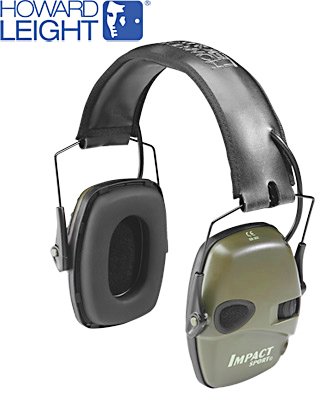
Now through May 31, 2008, MidwayUSA has the Howard Leight Impact Sport Earmuffs on sale for $49.99, $10.00 off the regular price. That’s a heck of a deal. These electronic muffs (item 671923) perform as well as some other noise-cancelling muffs that cost two or three times the price.
Because the Howard Leight Impact Sport muffs only carry a Noise Reduction Rating (NRR) of 22 db, we recommend you use these OVER foam ear plugs. When you do that, the electronic noise circuit still allows you to hear range commands. Forum member Danny Reever has a pair of the Leight Impacts. He reports: “Off the firing line, while others are shooting, you can easily carry on a conversation while the electronics cancel out the gunfire. Amplification is crisp and clear even at the highest setting. On the firing line, the slim profile of the muffs does not interfere with cheek weld and are comfortable.
The 22-decibel noise reduction rating (NRR) is a bit low for my liking, but I have found using 29-db plugs coupled with a slight gain in the electronics allows me to get maximum protection and still hear range commands. In fact, by increasing the volume further I could still hear conversations up and down the firing line.”
Assistant Editor Jason Baney also has a pair of the Howard Leight electronic muffs. He says: “They are comfortable and work great if you wear plugs underneath. You can even plug an iPod into them.”
Both Cabela’s buyers and MidwayUSA customers have praised these units:
“I am a firearms instructor/SWAT instructor, active on two SWAT teams. [I] have burned through too many pairs of Peltors due to their poor battery set up. These are cheaper price-wise, but [have] better controls and battery storage. Amazing sound quality. In reality to beat the performance you need to spend four to five times the money. If I could give ten stars I would…” ZM, Cabelas customer.
“I have a set of Peltors that I paid triple the price for and they aren’t half as good. These [Leights] have nice smooth attenuation unlike the Peltor that snap on and off in a very annoying fashion. These fit tight, have good noise reduction and good sound quality. The low profile works well with rifles and shotguns. Don’t bother spending more, these are great!” Paul D., MidwayUSA Customer.
April 30th, 2008
The 6mm Dasher is based on the 6mm BR cartridge with the shoulder blown forward about 0.100″ and “improved” to 40°. Case capacity is raised to about 41.0 grains. This allows the Dasher to drive 105-108gr bullets comfortably at 2970-3000 fps without over-stressing the brass.

Robert Hoppe is one of the top 600-yard shooters in the country. Last fall, shooting a 6 Dasher, Robert nailed a 0.5823″, 5-shot group. At the time it was the smallest group ever shot in 600-yard registered benchrest competition. Just last weekend, John Lewis shot even smaller with an IBS Heavy Gun, but Robert’s 0.5823″ still remains the NBRSA 600-yard record, and the smallest group ever shot at 600 by a 17-lb class rifle. Robert has been very successful in the 600-yard game, and he finished 5th recently at the NBRSA 600-yard competition. He knows how to wring the best accuracy out of the 6mm Dasher cartridge. Here Robert offers some tips on load development and tuning for the 6mm Dasher.

CLICK HERE to watch HOPPE VIDEO
April 30th, 2008
 The 30th Annual NRA National Action Pistol Championship, also known as the NRA Bianchi Cup, will be held in Columbia, Missouri, May 21 to 24. Over 200 of the world’s top pistoleros will compete at the Green Valley RPC’s Chapman Academy Range. Tens of thousands of dollars in cash and prizes will be awarded, making the Bianchi Cup one of the richest shooting sports events.
CLICK HERE for On-line Bianchi Cup Entry Form

The event originated in 1979 as a Law Enforcement Training match. The “founding father” was holster maker (and former police officer) John Bianchi. Since its inception, the NRA Bianchi Cup has retained its original, 4-event course of fire:
The Practical Event: From the appropriate shooting line, the shooter fires at distances from 10 yards to 50 yards under varying time limits.
The Barricade Event: From within shooting boxes and behind barricades, a shooter fires at targets on either side of the barricade at different distances and under varying time limits.
The Falling Plate Event: From the appropriate shooting line, the shooter fires at 8 inch round steel plates arranged in banks of six at distances from 10 to 25 yards under varying time limits.
The Moving Target Event: From within shooting boxes at distances ranging from 10 to 25 yards, the shooter fires at a target moving from left to right with the target being exposed for only 6 seconds.
Scoring
Speed and accuracy is the key to winning the Championship. Each event is timed and is worth 480 points, equaling a total of 1920 possible points.
For more info about the Bianchi Cup and Action Pistol events, contact Tom Hughes at bianchicup@nrahq.org or (800) 672-3888, extension 1478. Bianchi Cup revolver photo courtesy J.C. Blauvelt Gunsmith.
April 29th, 2008
Forum member Ron Tilley finished fourth overall at the recent NBRSA 600-Yard Nationals. This was an impressive performance for a relative newcomer to the 600-yard game without “local knowledge” of the Sacramento range. The top 3 finishers, Jerry Tierney, Peter White, and Craig St. Claire, all have extensive experience shooting at Sacramento.

While many of the top shooters were using a 6mm in Light Gun (such as a 6 Dasher or 6-6.5×47), Ron campaigned a 260 Ackley Improved. This is based on a 260 Rem case, with the shoulder blown forward to 40 degrees. Improving the 260 Rem case adds just enough extra capacity to get the 140gr-class bullets into the 2900+ fps velocity window where they seem to perform best.
Ron starts with Lapua 243 cases, necked up to 6.5 mm. He was shooting 140gr Berger VLD bullets, pushed by Hodgdon H4831sc powder and Russian primers. Ron says this combination has been “very accurate right out of the gate.” Ron’s 2920 fps load delivers 5-shot groups in the high teens and low twos, with very low ES and SD. In the video interview below, Ron explains the merits of the 260 AI cartridge, and offers tips on case prep and loading for accuracy.

CLICK HERE to WATCH TILLEY VIDEO
Ron was shooting an eye-catching rifle. It featured a carbon fiber and wood Terry Leonard stock, BAT Action, and Nightforce scope. With all-premium components, Terry’s 260AI is a beautiful rig that shoots as good as it looks.


April 29th, 2008
From May 12th through 22nd, over 170 top rifle and pistol shooters will compete for spots on the 2008 U.S. Olympic Team at the Smallbore Shooting Trials. The event will be held at Ft. Benning’s International Shooting Complex in Columbus, GA, home of the U.S. Army Marksmanship Unit (USAMU). The U.S. Olympic Team Trials are conducted jointly by the U.S. Olympic Committee and USA Shooting.

In smallbore rifle, there is one U.S. Olympic team spot available for Men’s Prone and Men’s 3-Position (Matt Emmons has already secured a spot in both Prone and 3P) and there are two spots available in Women’s 3-Position. Among the athletes competing for a spot on the U.S. Olympic Team in Men’s Rifle will be two-time Olympian Jason Parker, a member of the USAMU and 2007 Pan American Games gold medalist. (Parker already qualified for a Team spot in Men’s Air Rifle.) Parker’s USAMU teammate and three-time Olympian Mike Anti will try to secure a spot on his fourth U.S. Olympic Team.
Michael McPhail will be vying for a spot on his first U.S. Olympic Team in both 3-Position and Prone Rifle. McPhail recently captured the bronze medal in Prone at the “Good Luck Beijing” 2008 ISSF World Cup. Two-time Olympian Tom Tamas is looking to earn a spot on his third U.S. Olympic Team in Men’s Prone.
For more information on the U.S.A. Smallbore Olympic Trials, visit USAShooting.org.
April 28th, 2008
From April 25-27, three dozen of the nation’s top 600-yard shooters vied for honors at the NBRSA 600-yard Nationals in Sacramento. The tightly-contested match came down to the last relay on the last day. Jerry Tierney earned top honors for the match, under a scoring system that totals a shooters’ rankings for Light Gun Score, Light Gun Group, Heavy Gun Score, and Heavy Gun Group. Tierney, shooting an Eliseo Tube Gun chambered in 6 Dasher, captured the 2008 Championship with a total of 10 rank points. Peter White of Modesto, CA, shot a great match with his 6 BRX to finish second with 17 points. Craig St. Claire was not far behind, finishing third with 21 points.

Amid a field of exotic benchrest rifles, Tierney’s Tubegun (basically a modified High Power rifle) looked out of place. Jerry shot the same Eliseo R5 Tubegun in both light and heavy classes. The tubegun kit for this rifle was actually donated to 6mmBR.com by Gary Eliseo for a fund-raiser and Tierney was the high bidder on our auction.
Just before the match Jerry did some bullet comparison testing, settling on the Berger 108s. “I’m glad I tried the 108s”, Jerry told us, “they shot awesome, with very little vertical.” Tierney used a load of 33.0 grains of Hodgdon Varget, CCI BR4 primers, with the Berger 108s jumped about 0.015″ from the lands. Fitted with a Delrin front sled and a bag-riding arm in the rear, the Eliseo R5 handled extremely well. Jerry says “with a couple modifications, this Cross the Course gun worked great as a bench rifle. It tracked as well as any bench gun I’ve ever used.” Jerry’s light Palma contour Krieger barrel had about 500 rounds through it before the Nationals. Jerry says “there’s never been a brush in this barrel. At the Nationals, I cleaned at the end of each day, but I simply ran a couple wet patches through the bore. That’s it. I just wanted to get the loose carbon out.”

Challenging Winds–Big Angle and Velocity Changes
On all three days the wind started light but variable, then got stronger and more switchy as the day progressed. On Sunday, during the third and last relay the wind was clocking 45-60 degrees, and varying in velocity from 1-10 mph. You needed to watch the big flags to the left of the firing line to see the major switches according to Overall Winner Tierney. Jerry told us: “I used some local knowledge in that last relay. Conditions were tough, but I know when the wind is clocking like that you have to pay attention. I was seeing a full 2 MOA shift on the target.”

CLICK HERE to WATCH TIERNEY VIDEO
In the above video you can see Jerry shooting on Sunday’s third relay. Note how Jerry was looking over to the left at the flags after every shot and how he keeps his ammo covered, out of the sun. In the middle of the video Jerry has a fail to extract and has to clear an empty. Jerry explained: “I was trying to have the cases land on the towel just below the rifle by moving the bolt very slowly. Sometimes the fired case did not eject and stayed on top of the follower. With normal bolt operation the case would eject fine, but land off the bench.” Remarkably, Jerry stayed cool in the process. His performance in the third relay on Sunday, in very challenging winds, put him in the lead for the match. Jerry says “that third relay won me the match.”

Match Results
Overall Standings
1. Jerry Tierney 10 pts (6 Dasher Light & Heavy)
2. Peter White 17 pts (6 BRX Light & Heavy)
3. Craig St. Claire 21 pts (n/a)
4. Ron Tilley 23 pts (260AI Light & Heavy)
5. Robert Hoppe 31 pts (6 Dasher Light & Heavy)

Light Gun
Group Agg: Bob Dorton 3.155″, Don Nielson 3.349″
Score Agg: Craig St. Claire 271-3X, Jerry Tierney 263-2x
1-Target Small Group: Don Nielson 1.482″, Ray Meketa 1.682″, Jerry Tierney 1.799″
1-Target High Score: Robert Hoppe 49-3x, Ray Meketa 49-3x
Heavy Gun
Group Agg: Peter White 4.506″, Robert Hoppe 4.789″
Score Agg: Jerry Tierney 546-3X, Peter White 543-3X
1-Target Small Group: Rick Duncan 2.505″, Henry Pickney 2.641″
1-Target High Score: Robert Hoppe 98-2X, Rick Duncan 96-1X
We will be working on an in-depth report on the match this week. Watch the home page for a feature story soon. There was some fantastic hardware on the line, such as Warren Stallings’ barrel-block Heavy Gun shown below.

As usual, Ed Eckhoff ran a great match, and the scoring was fast and flawless. Craig St. Claire and his girlfriend catered a couple lunches for the shooters and Don Nielson supplied a huge Perpetual trophy for this match.
|


