|
|
February 2nd, 2008
Here’s an early product story from SHOT Show. Glen Seekins of Seekins Precision announced that he is producing a new detachable magazine system for Remingtons. This combines new bottom metal with a fitted magazine. Five sizes are offered: short action .223 (2.5″), short action .308 (2.9″), WSM (3.05″), long/magnum action (3.65″), and .338 Lapua (3.9″). Glen cautions the system may require small alteration of factory BDL inlets. Pillars will be included in the kit.

Seekins hopes to start shipping the first run of magazine systems by mid-February. Retail price is $289.99 with one 5-round magazine. Extra mags will be $59-69 depending on caliber. For now, only 5-round mags are available. 10-round mags will be produced at a later date for most calibers.

February 1st, 2008
The new Bushnell 6500 series of riflescopes has been much anticipated. Today, Bushnell announced that its new 6500s, with 6.5x zoom range, will start shipping to vendors in March 2008. Bushnell claims the 6500 series delivers the highest resolution and widest field of view in its lineup of rifle scopes.

Three models are offered: 2.5-16x42mm, 2.5-16x50mm and 4.5-30x50mm. All three models feature side parallax adjustment, 30mm main tubes, and multi-coated optics with RainGuard®. The 2.5x models can be adjusted from 10 yards to infinity while the 4.5x model adjusts from 25 yards to infinity. Suggested retail prices are: 2.5-16x42mm – $699; 2.5-16x50mm – $779; and 4.5-30x50mm – $899. Expect “street prices” to be about $75 – $100 less for each model, once sufficent supplies reach the marketplace.
Our readers will probably be most interested in the 4.5-30X version. It has a 30mm main tube, 50mm objective, and weighs 21 ounces. The 4.5-30x offers 80-MOA of elevation and windage with 1/4-MOA clicks. Only two reticles are currently offered, a “Multi-X” fine-plex and a mil-dot.
The new 6500 Elite 4.5-30x50mm competes head to head with Sightron’s new 6-30x56mm SIII scope. At SHOT Show we’ll get a look at both new optics and then post our impressions. For target shooters, the Sightron appears to have the edge–as it offers a larger front objective, and target turrets standard.
CLICK HERE for more info on Bushnell 6500 Scopes.
February 1st, 2008
 Fifty-two competitors, many clad in historic military uniforms, shot period-correct rifles and pistols in the So. Michigan Gun Club’s 8th Annual CMP “Snow Shoot” Vintage Rifle Match. Cold, snowy weather on January 26th didn’t stop the diehard shooters from enjoying friendly competition and supporting the M1 for Vets Program, which provides M1 Garand Rifles to disabled American veterans of the Iraq and Afghanistan conflicts. Over $1000 dollars was raised for the M1 for Vets Program.
The overall match winner was Caleb Hughes. Hughes shot a 289-3X with a K-31 Swiss 7.5×55 and received the First Place Trophy, a plaque and a gold Military CMP pin. The second place winner was Phil Randall who shot a 283-6X and received the Second Place Trophy, a plaque and a gold M1903 CMP pin. Alexandra Verburg was the top female shooter of the match. Competing in her very first Snow Shoot, Verburg shot an impressive 214-1X with an M1 Carbine to win the First Place Women’s Trophy. CLICK HERE to learn more about the Michigan Snow Shoot.

January 31st, 2008
There is one subject on which we should all be in agreement — the need to wear quality, protective eyewear whenever one uses a firearm. Sadly, it’s not uncommon, at the range, to see shooters wearing no eye protection, or wearing cheap, “dime-store” glasses that can shatter on impact.
 We’ve created a comprehensive Guide to Protective Eyewear. Forum member ChuckW2 told us: “That was the most important article that has ever been posted on this site. I am amazed how many people do not wear glasses while shooting or hunting. Great read….” If you haven’t done so already, read the story. We guarantee you’ll learn something new.
The Eyewear Guide explains the safety standards that apply to protective eyewear and reviews the best lens materials currently available including Polycarbonate, Trivex™, and SR-91. You may not have heard of Trivex, but it is probably the best material out there right now — it’s tough, lightweight, and has better optical properties than Polycarbonate. SR-91 is a good choice for those who need a polarized lens. Our Eyewear Guide also includes a section by Danny Reever on Prescription Shooting Glasses. Danny discusses the available options in lens materials and has many helpful recommendations.

Along with our reviews of lens materials, tint properties, and frame design, we highlight a study done by the NRA’s American Hunter magazine. 10 popular brands of eyewear were tested, with some very interesting results. The testers observed that price does not necessarily assure quality. The $12 Bollé VX and the $5.95 Pyramex Rendezvous both worked better than some much more expensive brands.
On the other hand, don’t select eyewear simply because it’s cheap or easy to find. American Hunter editor Jeff Johnston observed:
“It’s a mistake to assume that any plastic-lens sunglasses off the rack at the local 7-11 are made of polycarbonate and therefore are effective as shooting glasses—cheap plastics are not polycarbonates; in fact, wearing them could be worse than wearing nothing, as they can introduce sharp shards of plastic to your eyes in addition to the projectile(s) that caused them to break.”
January 31st, 2008
If you can’t make it to Las Vegas this weekend for the SHOT Show, tune in your radios for live audio programming from the show floor. Radio Talk Show host Tom Gresham will air his three-hour Gun Talk Radio program from the main hall of the show, featuring a lineup of major manufacturers.

“This year looks to be huge,” said Gresham. “Every company has new guns and products, and we’ll have them on the air, live, to talk about them. For millions of listeners, this is an on-the-spot report on what turns them on — new guns!”
Gun Talk Radio will broadcast from the Beretta booth on the show floor, and Gresham says he has commitments from a number of companies, including Springfield Armory, Smith & Wesson, Beretta, Brownells, Taurus, Ruger, and Trijicon.” Tom Gresham’s Gun Talk is carried on radio stations across the country and is featured on XM Satellite radio.
Starting Saturday, your editor will also be a SHOT show. On this Daily Bulletin, I’ll be posting reports, complete with photos and video. There are new products from Lapua, Nikon, Schmidt & Bender, and Sightron we plan to feature — along with some surprises. Stay tuned.
January 30th, 2008
Beretta, which now owns both SAKO and Tikka, has just introduced the new SAKO A7, based on the SAKO 75, but designed to sell at a lower price point. It retains many of the better features of the SAKO 75, including adjustable trigger (2.2 lb. minimum pull), three-lug bolt with 70° throw, and ergonomic stock. The A7 offers a new 3-round detachable magazine, with an improved latching mechanism drawn from the SAKO 85.
To learn more about the A7, visit www.SakoA7.net, a whiz-bang Flash-enabled website with photos and specs. Caution–the site has obnoxious sound effects and navigation like a video game, but we guess Beretta’s marketing gurus decided “bells and whistles” would sell more rifles.

Unlike most SAKOs, the A7 lacks a dovetail on the top of the receiver that would allow you to mount rings directly to the action without the need for a separate scope rail. In deference to American shooters, who seem to prefer separate mounting rails, The A7 ships with Weaver-style scope mounting blocks front and rear. In our view, the dovetail is actually a cleaner, lower-profile, and more rigid set-up for a hunting rifle, but this is one more example of building a product the consumer thinks he wants, whether it makes sense or not.
Notably, Beretta is marketing the new SAKO A7 with an accuracy guarantee — One MOA for five shots. While that’s not spectacular, few other major gun companies (Cooper being the notable exception) provide accuracy guarantees for their hunting rifles. SAKO claims that “Each rifle must place five shots within one inch at 100 yards or it doesn’t ship.” Sako A7 gun weight (without scope) averages 6.5 pounds, while length of pull is 14 inches. Calibers and twist rates are shown below. Unfortunately, no fast-twist 6mm barrels are offered with the .243 Win chambering.

January 30th, 2008
 In the wintertime, it’s common to encounter problems with static electricity when throwing your powder charges. The static can cause powder kernels to cling to the surface of reloading components, and can cause powder clumping. Clumped or sticky powder may make your measure bind or grab in the middle of the cycle, which can throw off your charge weight. Here are a couple simple ways you can minimize the effects of static electricity and improve the consistency of your powder measuring.
 Ground Your Powder Measure — If you’re throwing powder charges in the fall or winter and have problems with bridging or sticking powder, use a ground wire. Bullet-smith Victor Johnson (Johnson Precision Bullets) tells us: “I have a 25-foot piece of real small wire with alligator clips on each end. It’s that long so I can run it down the hall to a water pipe. Use the wire tie from a bread bag to hold it in a small roll to put in the range box. When using it at the range use a 6″ nail from the co-op or Lowe’s / Home Depot and just push it into the ground.”
Use Bounce Dryer Sheets — A quick pass with the thin cloths used in dryers will eliminate “static cling” on your plastic reloading parts like powder throwers, powder funnels, and reloading press guides. Thanks to Doc76251 for this tip.
January 29th, 2008
 Turning necks is widely, if not universally, done by short-range benchresters shooting 6 PPC and 22 PPC cartridges. On the other hand, many long-range shooters, using bigger cases with longer bullets, have had great success with sorted, but non-neck-turned Lapua brass. For example, Richard Schatz has set multiple world records, and won many major matches shooting his no-turn Dashers.
Turned necks still completely dominate the short-range benchrest game. But, do we have any hard evidence of how much of an advantage turned necks offer? And, is it fair to say that turning necks is less advantageous with longer, heavier bullets typically used for 600- and 1000-yard benchrest?
Lou Murdica is a very skilled benchrest shooter in California. This editor has personally seen Lou finish first in a short-range BR match competing against some of the best shooters on the West Coast. Lou does a lot of serious comparison testing of components, and he has access to an indoor tunnel. The tunnel allows Lou to eliminate (or at least minimize) wind effects when testing ammo. Over the past few months Lou has been testing turned vs. unturned necks, and he recently posted some interesting conclusions.

Lou writes: “I don’t want to say that what some people have done is wrong for them, but I have been testing for nine months, shooting three to four times a week. I have found that there IS a difference between turned brass and unturned brass. Turned brass has shot better every single time in my tests. However, I have also come to the conclusion that if you shoot with very, very light neck tension it is hard to tell the difference between turned brass or unturned brass. If you shoot with any neck tension, though, turning does make a difference and you can get flyers with unturned brass.
The benefits of neck-turning showed up more in the 22 calibers than the 6mm. Moreover, I shot thick necks in the 6mm better than the 22. I found that the 22 wanted more release that the 6mm. I could get the 6mm to shoot tight necks easier than the 22.
For what it’s worth, I think that everyone should at least clean up their brass with a turner. All these years people have tried to find short cuts in shooting benchrest and every time we always come back to the same steps and care in making brass as before. I think it’s a given that if you want to compete at the top you cannot take short cuts. You may get by once or twice, but in the long run it will hurt you.
Since 1991 when I was on the winning team at the 1st World Shoot in France, I started to experiment and shoot every weird thing I could find or build. I tried more crap, bought and built more guns and while doing this I tried to shoot every shoot I could across the country. I took Tony Boyer’s class three years back, and the first thing he told me was pick a couple of guns out of all of them and shoot 6 PPC and nothing else for the next couple years. He told me to spend my money on barrels for those guns. Well, I did as he suggested and boy, it made a difference in my shooting.
What I’m trying to say to all the guys that have been shooting benchrest for a while and are starting to travel to the bigger matches is, stick with proven goods that have dominated for years, like the 6 PPC, with turned necks. You can try the weird stuff in practice.”
Neck-Turning, Neck Tension, and Longer Bullets
–Does a Different Rule Apply?
Keep in mind that Lou is primarily talking about short-range PPC loads with short, flat-base bullets. Those who are shooting beyond 400 yards typically use longer boat-tail, high-BC bullets. These have a smaller, less pronounced pressure ring, a much longer bearing surface, and weigh two to three times as much as a 6mm PPC match bullet. The longer bullets are also propelled by slower powders, operating in a somewhat lower pressure range than is common for a competitive 6 PPC load. Notably, top 600-yard shooters like Terry Brady and Richard Schatz have found that these long bullets prefer relatively light neck tension, meaning the neck is sized to just .001-.002 under a loaded round.
 This takes us back to one of Lou Murdica’s observations. Lou said: “I have also come to the conclusion that if you shoot with very, very light neck tension it is hard to tell the difference between turned brass or unturned brass.” Though Lou was mostly working with the lighter bullets, perhaps his observations explain why unturned brass has worked surprisingly well with the heavier bullets with long bearing surfaces. Since those long bullets typically work best with relatively light tension, maybe the benefits of turning necks are not so great, and that’s why someone like Richard Schatz can win with no-turn Dasher brass. Richard was the 2007 IBS 600-yard Shooter of the Year.
This is not to say that turned necks can’t benefit the 600-yard shooter. Murdica also shoots 600 yards, and he believes neck-turning helps long-range accuracy. Don Nielson absolutely dominated the NBRSA 600-yard Nationals using brass that was carefully neck-turned with his Pumpkin neck turning tool. Don strongly believes that his turned necks helped with accuracy and shot-to-shot consistency. So the jury is still out on the merits of neck-turning with longer bullets in bigger cases, but we applaud Lou Murdica for doing some serious research and putting in the “tunnel time” to confirm the benefits of turned necks for the short-range PPC shooters.
January 29th, 2008
The USA Shooting Safety Coalition has completed a “Basics of Firearm Safety” video that showcases the safety practices of elite Olympic shooters. The video includes USA Shooting athletes and leading industry professionals and “is intended to be part of a comprehensive program for use by instructors while raising the awareness of shooting sports as a competitive, fun, family-oriented, life-long activity,” notes Buddy DuVall, USA Shooting Marketing Director.
CLICK HERE for SAFETY VIDEO

The professionally-produced video features a variety of disciplines from Olympic free pistol to skeet shooting, and includes some nice action footage. Even if you’re a seasoned shooter, the video can teach you a few things. USA Shooting is the national governing body for Olympic shooting sports. Other Safety Coalition members are the National Shooting Sports Foundation, National 4-H Shooting Sports and the International Hunter Education Association. To learn more about USA Olympic Shooting, visit www.USAShooting.org.
January 28th, 2008
In recent years, spray-on finishes have become a popular alternative to traditional blueing for chrome-moly barrels and receivers, plus other gun parts. Spray-on finishes provide excellent rust-proofing, some degree of abrasion resistance, and many of the finishes also provide increased lubricity for moving parts. (Be aware, however, that these finishes go on thin, and the finish can wear through on high-abrasion areas, such as slide rails on pistols.)
Matte spray-on products work well for hunters looking for a dull, non-glossy finish that blends into the background. A bake-on polymer-type finish is a very good choice for a shotgun or rifle used in the winter or in damp environments (such as duck blinds).

Brownells has created a Six-part series of videos that explain, step by step, how to apply a spray-on finish to gun parts. In Parts I & II, Brownells gunsmith Dave Bennetts explains the basics of spray-on finishes, then shows how to properly prep metal parts for finishing.
In the next four videos, Bennetts provides specific application instructions for four different spray-on gun finish products. Bennetts explains the strengths and weaknesses of each product for particular firearm types. Click the links below to watch the specific product videos:
Spray-on Finish – Chapter 3 – Baking Lacquer
Spray-on Finish – Chapter 4 – Gun-Kote
Spray-on Finish – Chapter 5 – Teflon-Moly
Spray-on Finish – Chapter 6 – Aluma-Hyde II
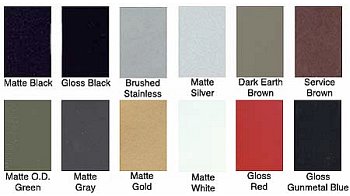
Of the four featured products, Gun-Kote, sold by Brownells under license from KG Industries, offers superior corrosion resistance, and is probably the most popular of the four products for use on rifles. Gun-Kote was originally developed for the military and was first used by Navy SEALS. Gun-Kote is an “oven-cure” finish applied to pre-heated metal. Though it goes on thin, Gun Kote cures to a hard coating that resists abrasion and won’t wear through as easily as bluing or chemically blackened surface treatments. Brownells Gun-Kote is offered in a wide variety of colors, shown below.
|


