In 2020, Lyman released the updated Second Edition of its AR Reloading Handbook. The original AR Reloading Handbook was the first reloading manual dedicated exclusively to the most popular semi-auto rifle in the USA. The Second Edition of this comprehensive Lyman AR Reloading Handbook has been updated to include more cartridge types and significantly more load data. This provides AR shooters with reloading info for the vast majority of popular chamberings used in AR-platform firearms. CLICK HERE to order the book for just $12.49 on Amazon, a 31% savings off the $17.98 list price.
Reloaders will appreciate the extensive pressure-tested data covering a very wide selection of bullet types and powder types. The Second Edition provided data for newer cartridges such as the .224 Valkyrie, .22 Nosler, .24 Nosler, 350 Legend, as well as sub-sonic data. In addition, articles by well-known authorities are included, covering topics such as “Building An AR” and “AR15 Gas System Lengths”. This book is available direct from Lyman and from Amazon (at a discount).
Features of Lyman AR Reloading Handbook (Second Edition)
— Reloading data for popular AR-platform cartridge types, including the .223 Rem, .224 Valkyrie, 6.8 Rem, .300 AAC, 7.62×39, 350 Legend, 450 Bushmaster, .50 Beowulf and more.
— Many informative articles on specialty topics such as Reloading for Suppressors and Building ARs.
— Load Data covers all major brands of bullets and powders.
— Load Data for cast bullet data and sub-sonic loads.
AR-Platform Insights — Operation and Maintenance Tips
Here are two helpful videos for AR owners. The first uses 3D computer animation to show how AR-platform rifles work — from the inside. The Cutaway views show the operation of the gas system and bolt while cycling. The second video, by legendary competitive shooter Jerry Miculek, provide helpful guidance on AR disassembly and maintenance.
Book publishing tip from EdLongRange. We welcome reader submissions.
Hodgdon Reloading Data Center
Looking for a good load for a new rifle? Or perhaps you want to try a new powder and bullet combo for an existing rig. One of the best places to start for load data is Hodgdon’s online Reloading Data Center for pistol, rifle, and shotgun reloaders. Check out the Reloading Data Center at www.HodgdonReloading.com.
In the Data Center, you’ll find thousands of load recipes for pistol, rifle, and shotgun. Rifle shooters will find dozens of loads for their favorite Hodgdon, IMR, Accurate, Ramshot, and Winchester powders.
Benchrest, F-Class, Silhouette, ELR, and PRS/NRL competitors will find ultra-accurate loads for H4198, H4895, Varget, H4350, H4831sc, IMR 8208 XBR and other popular propellants. Hodgdon’s Reloading Center is “mobile-friendly” so it works well with smartphones and tables. Navigation is easy, and you can set the search criteria easily choosing your favorite powder or bullets. After choosing a cartridge, you can pre-select specific bullet weights and powder types. That quickly delivers just the information you want and need. You won’t have to scroll through scores of entries for bullets or powders you don’t use.
NOTE: This shows results for two bullet weights and two powder choices. With more powders and bullets selected you will get more results. The “BUY NOW” buttons link to the Hodgdon webstore.
Reloading Center is Smartphone-Friendly
Mobile users will notice that the current Hodgdon Reloading Center is “user-friendly” for smart-phone and tablet users. Controls have been optimized for touch-screens, and buttons are large and easy to use.
How to Get Started with Handloading
Getting started in Reloading? Ultimate Reloader offers a helpful introductory video that covers the basics. In addition, a recent Ultimate Reloader article reviews the types of reloading presses, plus the other gear you’ll need, from dies to powder dispensers.
If you need high-quality .224, 6mm, 6.5mm, 7mm, and/or .308 match or hunting bullets, head over to Creedmoor Sports. This leading vendor recently received a very large supply of Berger Bullets in a wide variety of bullet weights and calibers. And Creedmoor has promotional pricing on many of these Berger Bullets. Don’t delay, as the most popular bullet types could sell out soon. For example, the 6mm 105gr Hybrids just sold out this morning, as we were writing this story. Also the promotional pricing can change.
Shown below are examples of the popular Berger Bullets now in stock. Click on any photo to go to the Creedmoor Sports sale page for those particular bullets.
Ace tactical shooter and gunsmith Jim See of Elite Accuracy LLC has tested a Frankford Arsenal rotary brass tumbler. Like the older Thumbler’s Tumblers, this can tumble your cases in a liquid solution. The wet-tumbling process worked very well Jim reports. Posting on Facebook, Jim noted: “I was super impressed with the Frankford Arsenal rotary tumbler and cleaning packs they sent me. I ran 350 pieces of brass for one hour. They now look great.” Jim appreciated not having to deal with dry tumbling media, such as crushed walnut shells. Dry media produces dust and can leave residues or clog flash-holes.
Interestingly, Jim recommends you try wet-tumbling WITHOUT using stainless media. At least give it a try. Tumbling without media simplifies the process and you don’t have to worry about pins stuck in flash-holes or case-necks*. Jim reports: “Stainless steel pins come with the Frankford kit, but mine hit the trash right out of the box. There is no need to clean the inside of your cases 100% and that’s all the pins add to the equation. The brass bumping brass with hot water and Frankford’s liquid cleaner works great all by itself.” One wag stated: “That’s great to hear. Stainless steel pins are a PITA.”
Other Facebook posters concurred with Jim’s evaluation of the Frankford Arsenal Rotary Tumbler:
“I’ve had one for a couple years, and it works well. I usually run about 250-300 Dasher cases at once in it. But I use the pins because I’m OCD about clean brass.” — David W.
“I’ve had one for a year and a half and it definitely works with or without pins.” — Luke C.
“I got one about six months ago and have yet to use any stainless steel media [pins]. I just use some dawn, distilled water, and Lemi Shine®. Turns nasty 5.56 range brass bright and shiny.” — Brian D.
“I don’t use the pins either and use a combination of Dawn soap and Lemi Shine.” — Jon N.G.
This video shows how to assemble and operate the Frankford rotary tumbler. But note, Jim See does NOT feel that it is necessary to use stainless media.
How to Dry Your Brass — Hair Dryer Vs. Machine
The downside of wet tumbling is that you end up with a pile of wet brass at the end of the cleaning cycle. There are many ways to dry brass, from drying in the sun to using a kitchen oven (be careful not to “overcook” your brass). One Facebook poster asked Jim: “What is your drying method for wet brass, and how long does it take?”
Jim See replied: “To start I just drain off the dirty water, and rinse the brass with clean hot water. Then I roll the brass on a towel for 30 seconds and put the brass in a one-gallon bucket. Next I insert a hair dryer in the bucket (with the brass) and let it run for about 5 minutes. With this procedure, the drying process for me is done in less than 10 minutes.”
Jack Lanhart has another method: “I use a food dehydrator. It takes 30 to 45 minutes.”
For those who don’t want to mess with towels and hair dryers, Frankford Arsenal offers a matching Platinum Series Case Dryer that simplifies the process of drying brass. Lyman also makes an excellent Cyclone Case Dryer. These drying machines each cost about $65.00 and both have multiple levels so you can separate different types of cartridge brass. Lyman states that “The forced heated air circulation of the Cyclone will dry your brass inside and out within an hour or two, with no unsightly water spots.” The Lyman dryer can also be used for ultrasonically-cleaned gun parts.
*The Frankford Rotary tumbler does include media separators if you choose to use the provided pins or other media. CLICK HERE for diagram showing how to use media separators.
Lyman makes a very handy product for reloaders that can save space on your reloading bench and give you more efficient powder flow into your cases. With common plastic “one size fits all” type powder funnels, the powder sometimes sticks to the sides of the funnel. Or, the fit to the case mouth is less than ideal so some of the kernels end up on the bench.
Precision powder funnels solve those problems. But what if you shoot a wide range of calibers with big and small case mouths? Lyman has the answer: the Brass-Smith Precision Funnel set, now $28.79 at Midsouth. This handy product combines a static-free cast aluminum funnel with a set of SIX (6) CNC-machined inserts that fit cartridges from .22 caliber all the way up to .338 caliber. It is easy to swap the inserts to match the particular cartridge you are loading. In this Ultimate Reloader video, our friend Gavin Gear shows how to use the Lyman Precision Pro Powder Funnel Set with multiple neck-diameter inserts:
Product Description: “The Brass-Smith Precision Funnel set is made to be completely static-free, no more powder clinging to surfaces which can happen with lightweight plastic Funnel. This is no ‘one size fits all’ funnel — the Brass Smith Precision Funnel set uses precision-machined, caliber-specific inserts to properly fit the case neck. CNC-turned aluminum inserts to fit specific cartridge families for calibers 22 to 338. Inserts are laser-marked for caliber identification. The inserts can be quickly and easily installed by simply pushing them into place and then pulling them out when changing calibers. The Funnel comes with inserts for .22, .243/6mm, .25/6.5mm, .270/7mm, .30 and .338 caliber rifle cartridges. A padded storage case neatly stores the funnel and inserts when not in use.”
Forum Member Likes the Lyman Precision Powder Funnel Set
One of our Accurate Shooter Forum members, Garandman, purchased the Lyman Precision Funnel System. He has used it now for multiple cartridge types and is very pleased with the results. Here is his report:
“I wanted to share my good experience with the Lyman powder funnel. First off, with the funnels being aluminum / pot metal, no static charge forms and the powder kernels go right down the funnel into the case with no hang-up.
Also the funnel comes with interchangeable case neck dimension inserts so you get no powder loss outside the case neck. And the funnel is also is less likely to stick to the case neck and pull it out of your loading block. That could spill powder all over the place.”
Overall, the Lyman Precison Funnel Set with case neck inserts has done a great job for Garandman and he suggests you may want to add this tool to your reloading tool collection. Below is a Lyman Precision Funnel Set review from Johnny’s Reloading Bench. This video review has nice close-ups of the six precision inserts from .22 to .338 calibers.
Wilson Combat has introduced a New Ultralight Arms (NULA™) line of bolt-action rifles. These hunting rigs are accurate and very light weight, ranging from 4 lb. 15 oz. to 5 lb. 4 oz., depending on caliber and barrel length. Currently, five chamberings/calibers are offered: .243 Winchester, 6.5 Creedmoor, 7mm-08 Remington, .308 Winchester, and .358 Winchester. Other chamberings will be offered in the future.
With a $3295.00 MSRP, the NULA rifles are expensive. But this modern ultra-light bolt-action rifle seems like a good choice for an avid hunter. NULA rifles have a sub-1″ MOA accuracy guarantee. Weighing about 5 pounds without scope, the NULA is also one of the lightest hunting rifles on the market. On extended hunts, light weight is a huge advantage. No one wants to carry a 10-lb rifle for many miles in the field.
The NULA rifle is a good choice for hunters, given its lightweight design. And the guaranteed sub-MOA accuracy should give hunters confidence. The NULA’s lightweight construction makes it easy to carry and maneuver in the field. Wilson Combat states: “Whether you’re hunting big game or small varmints, this bolt action rifle provides the accuracy and dependability needed to get your trophy quickly and cleanly.”
This top-of-the-line rifle boasts many premium components: Timney Elite Hunter trigger (with 2.75- to 3.25-lb trigger pull), Wilson Combat 416R stainless honed stress-relieved button-rifled barrel, and EDM Cut and machined action made from 4140 bar stock. The barrele action is fitted to an ultra-lightweight carbon fiber stock with reinforced receiver walls for added strength without adding weight.
For its NULA rifle series, Wilson Combat started with a proven Melvin Forbes rifle design and then made several major improvements. The NULA rifles are now produced with advanced manufacturing methods and modern materials including carbon fiber.
Bill Wilson stated: “I feel so fortunate to know Melvin and to have been entrusted with the opportunity to continue his legacy of building the finest and lightest bolt rifles on the market. I’m also deeply humbled and honored that Melvin has put his trust in me and my team at Wilson Combat to continue his life’s work. He is basically turning his ‘baby’ over to us and I assure him and all the past and future customers we won’t let any of you down.”
For hunters in a tree stand, SFC McPhail recommends a position with your weakside leg pulled up and firmly braced on the front rail of the treestand. You can then rest your support arm on your leg. This provides a rock-solid position when shooting from a stand.
Team USA Olympian and ISSF World Cup Winner SFC Michael McPhail is one of the world’s best smallbore rifle shooters. He is also an avid hunter, who enjoys harvesting game with centerfire rifles. In a USAMU video, McPhail shows how competition shooting positions can be adapted for hunters. McPhail shows how well-established positions can provide a more stable platform for hunters in the field. That can help ensure a successful hunt. McPhail demonstrates three positions: kneeling, supported prone, and sitting in a tree-stand.
Watch SFC McPhail Demonstrate Positions for Hunters (Good Video):
McPhail first demonstrates the kneeling position. Michael notes: “I like kneeling. It’s a little bit of an under-utilized position, but it’s almost as stable as prone. It allows you get up off the ground a little bit higher to [compensate for] vegetation. For kneeling start by taking your non-dominant foot and put that towards the target, while at the same time dropping down to a knee on the dominant leg. At the same time … wrap the sling around wrist and fore-arm, lean slightly into the target and take the shot.”
McPhail shows a nice “field expedient” use of your backpack. He shows how the basic prone position can be adapted, using the pack as a front rifle support. McPhail recommends pulling your dominant (strongside) leg forward, bent at the knee. According to Michael, this takes pressure off the abdomen, helps minimizes heart beat effects, and helps with breathing.
Hunting season is coming up, so it’s time to get your rifle squared away. You’ll want to zero that rifle before the hunt, and you need to know how your shots will impact with a cold barrel.
Commonly, hunters won’t have the ability to fire one or two fouling shots before heading out on a hunt. Therefore it’s important that a hunter understands how his rifle shoots with a “cold bore shot”. Both the point of impact (and possibly velocity), may be different with a cold bore than with a barrel that has been warmed and fouled with a series of shots. In this video from the U.S. Army Marksmanship Unit (USAMU), you’ll learn how to determine your cold bore point of impact (POI) for a rifle that just been cleaned, as well as the cold bore POI with a barrel that has already been “fouled in”.
SGT Joe Hein of the USAMU shows how to plot cold bore POI with both a clean bore and a fouled bore. Note that the “cold bore” shot from a fouled barrel was closer to the follow-up shots than the cold bore shot from a clean barrel. This is typical of many factory barrels. SGT Hein provides a simple way to understand your rifle’s cold bore performance. Hein’s advice can keep you from missing that long range shot at that big buck on opening day. A little time spent on the range before that critical first shot will help ensure you have meat in the freezer this season.
This is the biggest sale day of the year for hunters. MidwayUSA’s Camo Tuesday is a once-a-year event with some of the best deals you’ll find on hunting clothing, rifles, optics, trail cams, boots, backpacks, ammo, rangefinders, binoculars, GPS units, knives, and everything else a hunter could need. There are 270 items on sale plus up to 65% OFF on hunting clothing. Along with great Camo Tuesday bargains, you can get FREE Shipping for orders over $75 with Code CAMOTUES23.
CAMO TUESDAY Hunting Gear Sale at MidwayUSA
Camo Tuesday only happens once a year. It is more than just another hunting sale — it’s the ultimate shopping day for the fall hunting season. You can get huge savings on select hunting gear, plus free shipping. MidwayUSA offers big discounts on camouflage clothing as well as hunting boots, rifles, shotguns, crossbows, ammunition, optics, rangefinders, trails cams and more. Here are just a few of the deals:
Camo Tuesday Sweepstakes — Many Prizes
Along with the sale discounts, MidwayUSA is running a Camo Tuesday Hunting Gear Sweepstakes with prizes totaling $4,623.02 in value. No purchase is necessary, but MidwayUSA requires entrants’ email address and telephone number.
Camo Tuesday Sweepstakes Prizes
$1,000 dollars of MidwayUSA hunting clothing
4 Cuddeback Cuddelink L-Series Trail Cameras
Scent Crusher Halo Series Transport Bag
Crispi Nevada GTX Hunting Boots
YETI Roadie 60 Coolerand more!
Enter online for a chance to win the full Prize Package with a $4,623.02 Total Value. CLICK HERE for contest entry page.
Do primer types make a significant difference in accuracy or vertical dispersion at long range? The answer is “maybe”. Here’s one anecdotal study that tracked vertical variance among six different primer types. The tester is a good shooter with a very accurate rifle — four of the six 4-shot groups were under 2″ at 500 yards. This test doesn’t settle the question, but does suggest that it may be worth trying a few different primer types with your match ammo.
Here is a very interesting test for the 6 BRA (6mmBR Ackley) cartridge. Forum member James Phillips, a talented long-range benchrest shooter, tested SIX different primer types from three different manufacturers. To help determine vertical dispersion, James set his target out at 500 yards. He then proceeded to shoot 4-shot groups, in order, with each primer type. Velocities were recorded with a chrono. The photo above shows the results. James says: “I’ll retest the best two for accuracy and consistency with 10 shots each”. CLICK HERE for full-screen target photo.
As you can see, ALL the groups are pretty impressive. The smallest groups, 1.253″, was shot with CCI 400 primers. Next best (and very close) was CCI BR4, at 1.275″ for four shots. The “flat line” winner was the Remington 7.5, at upper left. There was almost no vertical. If you are intrigued by this interesting primer test, you can join the discussion in this Primer Test FORUM THREAD.
Primer Brand
Group Size
Velocity
Extreme Spread
Std Deviation
Remington 7.5
1.985″ 4 shot
2955 FPS
8 FPS
4.0 FPS
Federal 205M
2.200″ 4 shot
2951 FPS
11 FPS
4.8 FPS
Sellier Bellot SR
1.673″ 4 shot
2950 FPS
14 FPS
5.9 FPS
CCI 450M
2.341″ 4 shot
2947 FPS
14 FPS
6.6 FPS
CCI 400
1.253″ 4 shot
2950 FPS
3 FPS
1.3 FPS
CCI BR4
1.275″ 4 shot
2949 FPS
15 FPS
6.9 FPS
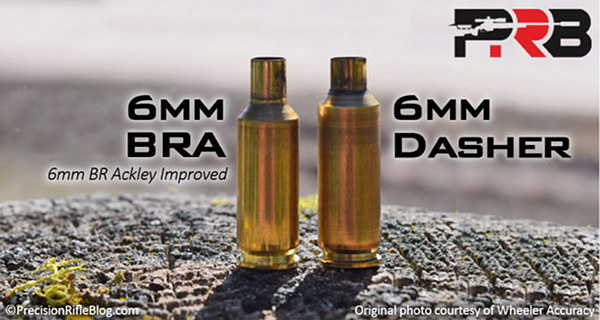
CARTRIDGE: 6mmBR Ackley, aka 6 BRA. Parent case is 6mmBR Norma. The 6 BRA is fire-formed to create a 40-degree shoulder and less body taper. Capacity is increased, but the neck is longer than a 6mm Dasher. The capacity is enough to get to the 2950+ FPS accuracy node. Some shooters say the 6 BRA is more forgiving than the 6mm Dasher. The 6 BRA is certainly easier to fire-form.
TEST REPORT — Conditions, Shooting Method, Loading Method
Tester James Phillips posted this report in ourShooters’ Forum:
Conditions: The testing was done in the morning over flags. The flags never moved or even twitched. I had as perfect conditions as I could have asked for. It was overcast so no mirage and no wind. There were no other shooters, just me.
Test Procedure: Each shot was precisely shot at my pace and centered the best possible using my Nightforce 15-55X scope. I did not use the round-robin method. Each four-shot group with the same was shot at one time. Then I moved onto the next primer. Everything felt right for each and every shot fired today. Of course I could repeat the test tomorrow and it could be exact opposite of today’s test. We can chase this forever. But [soon] I’m going to test the BR4 and 400 primer… for best accuracy and consistency for 10 shots each.
How Rounds Were Loaded: Each load was weighed to one (1) kernel of powder. So I know that’s as good as I can weigh them. Each bullet seating force was within 1# on my 21st Century hydraulic arbor press.
Previous Initial Load Testing: All groups were shot with 31.1 grains of H4895. During initial load testing I settled in on the Sellier & Bellot primer to finalize everything as it showed more promise over the CCI 450 Magnum I also tried. I was actually surprised to have seen the higher ES and SD from that primer today along with the vertical shown. [Editor: Look carefully — one shot from the CCI 450 is right in the center black diamond, stretching the vertical. By contrast the Rem 7.5 had almost no vertical.]
Velocity and NODE Considerations: I was about 5-6 FPS above what appeared to been my optimum velocity of 2943-2945 FPS, so I’ll test 5 shots of 31.0 and 5 of 31.1 and see what happens from there. I can only assume my velocities where higher due to the higher humidity and of course temps were 5 degrees warmer this morning as well. It wasn’t far off but I noticed it.


 Team USA Olympian and