Here’s a cool tool for your hand-loaders, particularly if you load large quantities of bulk ammo for a variety of firearms. Lyman’s handy Ammo Checkers check the diameters of reloaded rounds and factory ammo, so you can quickly confirm that your ammo fits a standard chamber. Just drop your loaded rounds in the Ammo Checker, and if the round fits into the gauge, it will fit in the gun’s chamber.
Lyman Ammo Checkers are multi-caliber — each orange block checks six or eight different cartridge types, with each caliber/cartridge name engraved on the gauge. Ammo Checkers are machined to SAAMI minimum chamber dimensions from solid blocks of 6061 T6 aluminum. Ammo Checkers are available in three versions covering most common handgun and rifle calibers:
Handgun Ammo Checker (#7833000) $37.99 on Amazon
Fits: .380 Auto, 9mm Luger, .38 Super, .40 S&W, .45 ACP, .38/357, .44 Spl/Mag, and .45 Colt
Cheaper Multi-Cartridge Pistol Ammo Checker Blocks
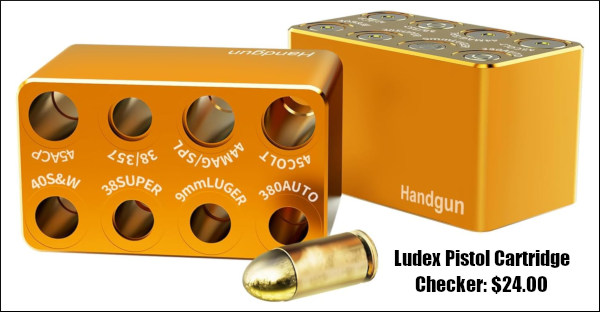
There are also some cheaper multi-caliber pistol ammo checker blocks from foreign makers.
Pistol Ammo Checker — Ludex Block, $24.00 on Amazon (Orange)
Fits: .380 Auto, 9mm Luger, .38 Super, .40 S&W, .45 ACP, .38/.357, .44 Mag/Spl, and 45 Colt.
Pistol Ammo Checker — LYHgogo Block, $19.81 on Amazon (Black)
Fits: .380 Auto, 9mm Luger, .38 Super, .40 S&W, .45 ACP, .38/.357, .44 Mag/Spl, and 45 Colt.
Why Use a Case Gauge?
We find that case gauges like the Lyman Ammo Checker are particularly useful for handgun reloaders using progressive presses. The chambers of many popular semi-auto pistols are partly unsupported. This allows the case to swell in the bottom quarter. The case may not be sized adequately by your sizing die, which can lead to misfeeds or malfunctions.
Additionally, if you have loaded a large quantity of ammo for a semi-auto rifle such as an AR15, it’s not a bad idea to check your cartridges before you load them into your magazines. All you need is one mis-sized round to cause a stoppage. That will ruin your day if you are competing in a Service Rifle match or 3-Gun event.
Jason Cohen’s “We the People” patriotic .284 Shehane F-Class rifle. It has already demonstrated great promise, scoring second place in its very first match, a 3×20 at 1000 yards in Wyoming.
With the United States of America’s 250th birthday coming on July 4, 2026, just six days from now, we are featuring a handsome F-Class rifle with a patriotic theme. This rifle has the historic “We the People” phrase painted on its handsome Cerus stock. The phrase “We the People” is the famous opening to the Preamble of the U.S. Constitution. Adopted on September 17, 1787, this preamble indicates the government derives its political power directly from its citizens rather than from a monarch or government officials. This cool rig also features the U.S. Stars and Stripes flag on the buttstock.
Rifle Report by Jason Cohen
The rifle began its life as a Will McClosky Cerus stock. I approached Will at the Berger SW Nationals about a rifle I wanted to build. I wanted to do something different — PAINT it. He said he had just the stock that I could use, and sent that to Bryan Blake at Blake Machine. I chose Bryan for two reasons — first, I have shot with him a few times at National matches and he is approachable and very helpful. Second I visited his shop during the SWN in February and liked what I observed and how he approached things. Bryan never seems to be happy with the status quo. He is always trying new ideas.
I noticed that Bryan had been adding aluminum rails to the front of Cerus stocks to lower the center of gravity and improve tracking. I asked him to modify my stock and fit it with the new forearm rails, shown in the photo below. I sent him a Panda F-Class action with a +20 MOA Picatinny rail. Bryan did all the stock work and fitted the action, rails, and RAD recoil pad. Everything turned out flawless.
The barrel is a Blake Machine 1:8″-twist finished at 32 inches. It was fitted to my action by Dale Woolum of Woolum Accuracy. Dale chambers all my barrels on all my rifles. Dale also threaded the barrel for a Woolum Accuracy tuner. This has proven to be a valuable tool in my load development. On this build, I am trying a Bix’N Andy trigger for the first time.
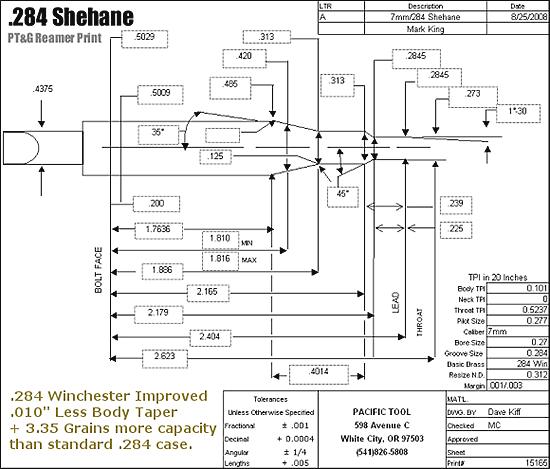
The 284 Shehane has a proven record of accomplishments and that is why I have chosen it. I use Lapua brass (6.5-284 necked-up), CCI BR-2 primers, Hodgdon H4350 powder, and Berger 184gr bullets. All these components have been a successful combination that has worked flawlessly in my other rifle.
.284 Shehane Load Development
Load development for me starts with each new barrel. I screw on the new barrel, fire 25 rounds of whatever I have left over and then clean it. I push out to 600 yds and do a ladder test in round-robin format. I start 0.6 grains lower than my last charge that worked. I work up from that reduced charge weight in increments of 0.3 grains. The paper tells the rest of the story. Once I get something that works well at 600 yards I go back in work around that by 0.1 grains. After that I play a little with seating depth and look for a change. I will occasionally mess with the tuner and tighten things up if possible.
About the Patriotic Paint Job
So I had the idea of painting the stock because there are so many wood stocks with clear coat these days. Unless you really get some exotic woods they all seem to blend together. I have nothing against clear-coated wood, but I wanted something different, as this was my first all-wood rifle. (For short-range benchrest, I was shooting a Bob Scoville carbon stock and Terry Leonard laminate).
We started with all white on the stock and came up with the idea of an American Flag on the buttstock. I was thinking of ribbons on the front in red and blue but we could not get the layout right. Then the idea of “We the People” popped into the head. My painter said “awesome!” and he was able to airbrush the stock with a little yellow and brown to give it that vintage paper look.
The front rest is a SEB Max (see above). I chose the Max because I was shooting Group Benchrest first then made the transition to F-Class. This rest proves to be versatile in all my shooting — Short- and Long-Range Benchrest AND F-Class. The rear bag is a Edgewood EDGEbag Gator. The gun gets transported in a Pelican Hard case when I travel. Locally, I use a Champions Choice soft bag.
Jason Jumped to Open Class after Starting with F-TR
This “We the People” rifle will be one of my primary rifles for F-Open competition. I will run it through its paces shortly and see how well it does. I have high hopes of it being an great gun. I shoot primarily local and regional matches — Colorado, Wyoming, and possibly Nebraska this summer. I will travel to the F-Class Nationals in Raton as well. I used to shoot F-TR before this and made the transition to Open last season. This is my second season shooting F-Open. 2018 was my first National event and was a learning experience for me. But I was hooked after that match.
Tips for F-Class Competitors
Get some good equipment and eliminate having issues that can be caused by budget builds. It’s OK to be frugal, but sometimes cutting corners will cause you more problems and have you chasing your tail. If you’re looking for the “recipe for success”, get a good action plus a top-tier barrel and great glass.
The .284 Shehane — Accurate and Forgiving Wildcat
The 284 Shehane is amazing, very forgiving and not temperamental. I choose this because I really did not know otherwise and was steered to the Shehane by a friend. Its proven track record helped as well. Straight .284 or Shehane — you cannot go wrong. I run a 184gr Berger at about 2850 FPS and get great brass life in my other rifles. I usually start to consider tossing the brass around 15 firings. Primer pockets start to get a little looser and the brass seems to need more sizing than the newer brass with less firings.
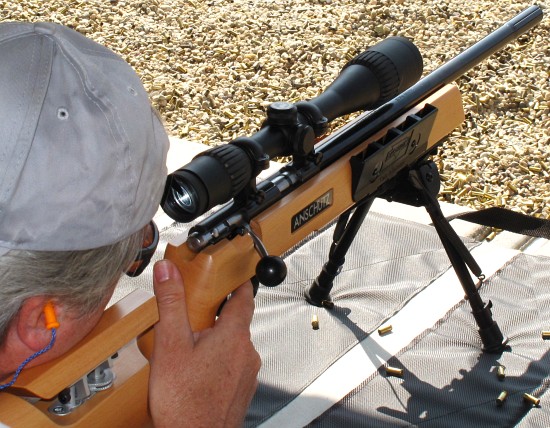
AccurateShooter’s Editor trains with .22 LR Anschutz model 64R back in 2008.
Rimfire Tactical Matches Aren’t Really New
NRL22 and PRS 22 rimfire shooting disciplines are fun, affordable forms of competition. We’re pleased to see the rapid growth of NRL22 and PRS rimfire. However, the concept of a rimfire tactical/practical match is not new — at least on the West Coast. Way before anyone every heard of PRS, California shooting clubs conducted “Rimfire Tactical” matches. These matches were first fired nearly two decades ago. CLICK HERE to read our comprehensive Rimfire Tactical report from way back in 2008. That article includes free targets, ballistics charts, and a complete run-down on suitable rimfire rifles.
The Concept Behind the Rimfire Tactical Match by Bill Erwin
Many guys who shoot long-range tactical matches practice with .22 LR rifles of similar configuration. Rimfire ammo is way more affordable than centerfire, you do not need a big range facility, and shooting rimfire saves wear and tear on your centerfire rifle. Further, for learning how to read the wind, there really is no better training tool than a 22 LR, even as close as 50 yards. Check out this table showing how a .22 LR ballistics compare to .308 Win:
.22 LR vs. .308, Distances for Equal 10 MPH Wind Drift
This table shows the corresponding distances at which a 10 mph full-value crosswind pushes a .22 LR bullet and .308 projectile the same amount. Values are based on 0.130 BC for a 40gr .22 LR bullet, and 0.496 BC for 175gr .308 bullet.
22 LR 40gr 1050 fps
50 yd Wind 1.0″
75 yd Wind 2.2″
100 yd Wind 3.8″
125 yd Wind 5.8″
150 yd Wind 8.2″
175 yd Wind 11.0″
200 yd Wind 14.3″
.308 Win 175gr 2650 fps
130 yd Wind 1.07″
180 yd Wind 2.15″
230 yd Wind 3.68″
280 yd Wind 5.63″
330 yd Wind 7.98″
380 yd Wind 10.71″
440 yd Wind 14.56″
This table shows how the .22 LR can be an effective substitute for a .308 Win during training. Because the smaller bullet drifts more in the wind, a .22 LR rimfire shooter will experience roughly the same crosswind effects as if he was shooting a 175gr .308 Win twice as far out. So, rimfire work can teach you to dope the wind like a .308 Win, but at less than half the distance. Shooting a .22 LR at 100 yards is like shooting a .308 Win (with 175gr SMK) at 230 yards.
SPECIAL BONUS–Rimfire Tactical Precision Targets
These FREE targets by DesertFrog are offered in Adobe Acrobat format for easy printing. CLICK HERE to download all six targets as a .ZIP archive.
Rimfire Training Target for Fun Matches
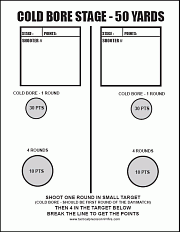
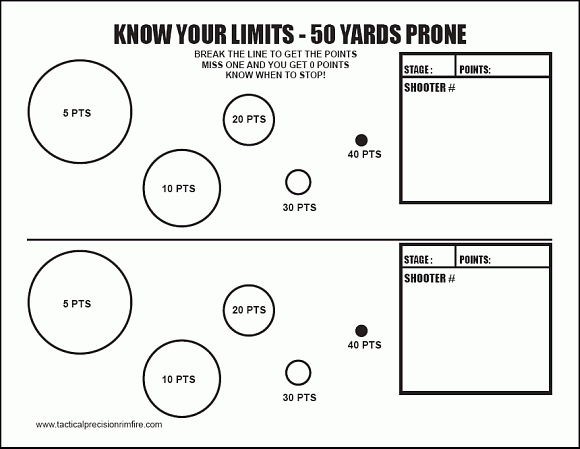
Here’s a rimfire training target with “big to small” target circles. Start with the largest circles, then move to the smaller ones in sequence. This systematic drill provides increasing challenge shot-by-shot. Novices often are quite surprised to see their accuracy improve as they move from bigger to smaller aiming points. That provides positive feedback — always a good thing.
Right Click and “Save as” to download printable PDF versions of target.
Yes, folks, it’s officially summer now. This year’s Summer Solstice, considered the official start of summer (and the longest day of the year), happened Sunday, June 21, at 1:24 AM Pacific Daylight Time (PDT).
We hope you have fun this summer with friends and family. To help ensure those summer adventures remain safe and trouble-free, the CTD Shooters’ Log has prepared a helpful Essential Summer Survival Guide. This is worth reading before you venture away from civilization.
Here are some highlights of the article with links for MORE INFO:
First Aid Kits for Campers
You should never venture outside without a first aid kit close at hand. While exploring the outdoors, all types of accidents can occur—from cuts, scrapes, and burns to broken limbs and severe allergic reactions.
Basic Survival Skills
Basic survival skills are a necessity if you plan to spend any amount of time outdoors. These five tips, plus a how-to on what to pack in a lightweight, basic survival kit will help if you are ever stuck, lost, stranded or injured in the field.
How to Treat Burns
Fireworks, barbeques and campfires — in the summer we are frequently around fire, which increases our chance of getting burned. A first-degree burn is most likely home treatable, while a third degree burn requires immediate medical attention. Learn how to spot the differences between minor and severe burns.
Millions of Americans now exercise their Constitutional right to “keep and bear arms”, specifically to carry a pistol for personal protection and home defense. In response to the rapid growth of the CCW (Concealed Carry Weapon) market, numerous gun-makers have introduced compact handguns specifically designed for concealed carry. These “Carry Guns” tend to be smaller, lighter, with smoother, rounded edges on slide and frame. Today, many modern carry guns are also “Optics Ready”, meaning they have slides that can accept smaller red dot sights. And some companies are now selling handguns with the optics pre-installed.
For today’s Saturday video showcase, we feature six videos covering a wide range of popular semi-automatic carry guns. You’ll see offerings from Beretta, Glock, HK, Kahr, Kimber, Ruger, Smith & Wesson, Taurus, Walther and more. In addition, we’ve included a video that covers the pros and cons of installing optics on carry pistols. Finally, as a bonus, we’ve included a video that highlights five handguns that you may want to avoid, as they have not lived up to expectations.
Seven Best Carry Pistols for the Money
Here the Honest Outlaw Channel reviews seven semi-auto pistols. The host states these are the “7 best pistols for the money,” adding that “these handguns are reliable, accurate, durable, light weight, and cost less than most alternatives.” This video was released in late 2025. It covers these current-generation pistols: Ruger RXM (1:42 time); S&W Bodyguard 2.0 (3:45 time); CZ P-07 (5:55 time); Sig P365 X Macro (7:40 time); Canik Mete MC9 Prime (9:12 time); CZ P-10 Series (10:57 time); S&W Shield Plus Performance Center (13:13 time).
Five Favorite Carry Pistols — Colion Noir’s Top Handguns
Colion Noir is a very popular gun reviewer and Second Amendment advocate. In this video, which has over 1.1 million views, Colion covers the five guns he personally carries. Why five? Colion states: “When it comes to my concealed carry guns, I practice tactical polyamory. Essentially, I don’t just carry one gun. I have a rotation of guns I carry based on what I’m wearing that day, where I’m going, and what I’m doing. I put a lot of thought into my carry rotation, which changes based on my needs. Sometimes a gun that’s better at handling the job comes out, and I’ll carry it once I’m comfortable with its reliability. That said, there are five guns I consistently carry[.]”
Five Top Choices among CCW & EDC (Everyday Carry) Handguns
The host notes: “We are going over the five best CCW firearms that I reviewed this year and ranking them from 1 to 5. We are going to save the best for the last. Some of the criteria for ranking these firearms isn’t only based on performance. We are ranking based on performance, price, reliability, and comfort.”
Five Modern Micro-Compact Pistols for Concealed Carry
In this video, testers for the respected Pew-Pew Tactical site field test and review five popular 9mm ultra-compact “micro-pistols”. If you’re looking for the best micro pistols, this video should be helpful, discussing micro-compact pistol features, performance, and value. The testers ranked these five pistols as follows:
Editor’s Pick: Sig Sauer P365 Optics-Ready
Best Value: Smith & Wesson M&P9 Shield Plus
Best Features: Springfield Armory Hellcat OSP
Best For Large Hands: Mossberg MC2c
Best Budget (Bang for Buck): Taurus GX4
Four years ago, Kimber’s R7 Mako pistol won the 2022 Golden Bullseye Award from NRA’s Shooting Illustrated magazine, winning the magazine’s “Handgun of the Year” category. The R7 Mako is very compact, with good ergonomics, yet it offers 12-rd (11+1) capacity (and 13+1 with extended magazine). The R7 Mako showed outstanding accuracy when tested indoors (see video at 15:25 time-mark).
The R7 Mako is offered Optics Ready for $599.00 MSRP or with Crimson Trace Red Dot Optic installed for $799.00 MSRP. SEE Shooting Illustrated Review.
Heckler & Koch CC9 Double-Stack Micro-Compact
Heckler & Koch (HK) has released its new CC9 micro-compact, striker-fired 9x19mm pistol. With great accuracy, ergonomics, and reliability, the HK CC9 should be a top choice among micro-compact pistols. Designed and produced in the USA, this is the smallest double-stack carry pistol HK has ever built. The CC9 features a modular grip with swappable backstraps. With a “Safe Take Down Feature” for disassembly, there is no need to pull the trigger during field-striping, making the CC9 safer than a Glock. The slide is optics-ready and there is a short Picatinny rail on the front of the polymer frame for mounting accessories. The micro-compact CC9 is 6.03″ long and 0.99″ wid and the CC9 weighs 18.4 ounces without magazine.
Tiny But Impressive — Best Pocket-Carry Pistol
Repected gun reviewer (and attorney) Colon Noir has tested dozens of pistols in multiple calibers. While he recommends using a holster and carrying a 9mm pistol with good ergonomics, he recognizes that some folks want an option of a very thin, ultra-compact handgun that can be carried in a man’s pocket. This video review Colon’s favorite “pocket pistol”, the Ruger LCP Max, a slim .380 ACP handgun that weighs just 10.6 oz. and has a 0.75″-wide slide.
Optics on Carry Pistols — Factors to Consider
Red Dot sights are becoming more popular than ever. Many pistols today are “Optics Ready”, and some handguns can now be purchased with optics already installed. There are both strengths and weaknesses having optics on CCW handguns. This video reviews the features and function of six affordable compact red dots suitable for CCW pistols. Along with covering the factors to consider, the video provides advice on red dot mounting, zeroing, and more.
BONUS: Five Handguns to Avoid
When shopping for a handgun, it’s helpful to know which models to avoid, because of poor reliability or other shortcomings. This Honest Outlaw video reveals five handguns that are not the best choices for concealed carry: Smith & Wesson CSX, SCCY CPX-2, Remington RP-9, Kahr CW 380, and Taurus PT 22.
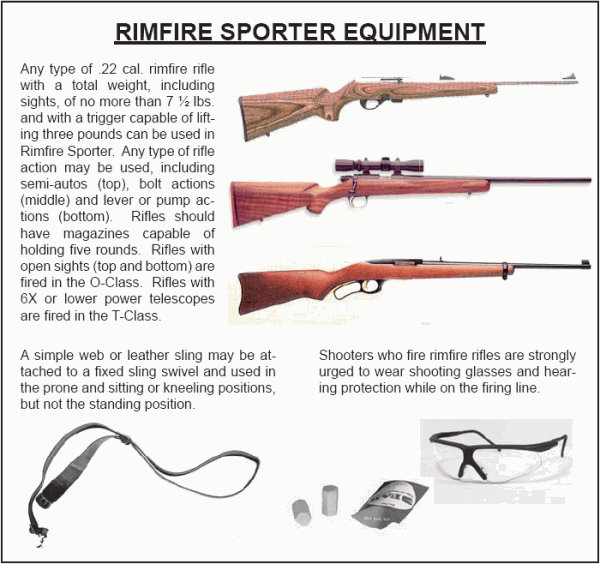
The CMP Rimfire Sporter discipline is for smallbore rifles that weigh 7 1/2 pounds or less with sights. Firing is done at 25 and 50 yards in prone, sitting, and standing positions, in slow and rapid-fire modes. The CMP has a special smart-phone App that helps speed up scoring. Rimfire Sporter matches are held throughout the country in connection with the CMP’s Travel Games.
And each summer, the major National Rimfire Sporter Match attracts hundreds of shooters to the shore of Lake Erie at Camp Perry. This year’s Rimfire Sporter Match at Camp Perry will be held on Saturday, August 1st, 2026, with check-in/clinic on Friday, July 31, 2026. The CMP National Rimfire Sporter Rifle Match offers shooters a recreation-oriented competition where they use affordable, smallbore sporter rifles with either scopes or iron sights. All you need are a .22 LR rifle, sling, and ammo.
Rifles may be manually operated or semi-automatic, in three classes: the standard “O Class” for open-sighted rifles, “T-Class” for telescope-sighted rifles, and the “Tactical Rimfire” Class. Firing is done at 50 and 25 yards on a target with a 1.78″ ten-ring. The target is simple enough for a beginner to hit, yet challenging enough that only one competitor in the history of the match has ever fired a perfect 600 score.
Rimfire Sporter Course of Fire
At the Rimfire Sporter Match, competitors complete slow fire prone, rapid fire prone, slow fire sitting or kneeling, rapid fire sitting or kneeling, slow fire standing, and rapid fire standing shot sequences.
What is Required for the Camp Perry Rimfire Sporter Match
Competitors need to bring their own .22 cal. Rimfire rifle(s) and ammunition. Special target shooting equipment, shooting jackets, or shooting gloves are not permitted, but you can bring a spotting scope and ground cloth or shooting mat. The firing points have grass (sometimes a bit wet with rain). Competitors are strongly urged to wear hearing and eye protection. Assistance for disabled competitors is provided.
A free Shooters’ Clinic is usually held in connection with the Rimfire Sport match at Camp Perry. The Clinic covers Rimfire Sporter rules, safety instructions, course of fire, and competition procedures. Shooters who have not previously attended a CMP Rimfire Sporter Match are strongly encouraged to attend.
This week the U.S. Supreme Court issued an important decision on a gun rights case challenging restrictive laws in Hawaii. In Wolford v. Lopez, the Supreme Court held that a Hawaiian law prohibiting concealed carry on private property (and business locations) violated the Second Amendment of the U.S. Constitution.
Fox News explained: “The U.S. Supreme Court ruled against Hawaii on Thursday (6/25/26), handing concealed-carry permit holders a major victory in a 6-3 decision. The Supreme Court sided with the plaintiff in Wolford v. Lopez, who contested Hawaii’s state law requiring a property owner’s explicit permission to allow lawful gun owners to bring firearms into public businesses.” This affected the ability of residents to carry licensed handguns into stores, hotels, and other venues.
“Hawaii’s law at issue here violates the constitutional right to keep and bear arms,” Justice Samuel Alito wrote. “This regime hobbles what the Second Amendment protects: the right of Americans to carry arms for self-defense as they go about their daily lives.”
The ruling reverses a decision by the U.S. Court of Appeals for the Ninth Circuit, which had upheld Hawaii’s restrictions after the state enacted them in response to the Supreme Court’s 2022 Bruen decision.
Here is an analysis of the case from the Second Amendment Foundation (SAF):
For the second week in a row, the U.S. Supreme Court has handed a victory to gun owners after striking down Hawaii’s so-called “Vampire Rule” in Wolford v Lopez.
Last year, the Second Amendment Foundation (SAF) filed an amicus brief urging the Supreme Court to strike the law down. The Hawaii law, similar to statutes found in California, New York and other states, bans carry of firearms on property open to the public — grocery stores, restaurants, gas stations and more — unless the owner posts a sign stating that carry is allowed on the premises. Prior laws permitted lawful carry in businesses open to the public unless the owner affirmatively requested that guns not be carried. The flipping of the default situation – from allowing guns unless denied, to banning all guns unless invited – created a de facto public carry ban that … the Supreme Court has held to violate the Second Amendment.
“Our stance is that one of the most fundamental underlying principles of the Second Amendment is the right to carry in public for self-defense,” said SAF Exec. Director Adam Kraut. “If a business does not want you to carry a firearm on the premises, the burden should be on the proprietor, not the private citizen, which would be in line with the ‘no soliciting’ or ‘no shoes, no shirt, no service’ signs we’re all familiar with. Today the Supreme Court told Hawaii that such transparent attempts at banning constitutionally protected conduct will not be tolerated.”
“The Supreme Court rightfully overturned the Ninth Circuit’s ruling in Wolford and now the Second Amendment rights of Hawaii’s residents are one step closer to being fully restored,” said SAF Exec. V.P. Alan M. Gottlieb. “This law was nothing more than a thinly veiled attempt to disarm peaceable citizens, and we’re grateful the Supreme Court saw through the ruse. With this precedent-setting ruling in hand, other states that have similar laws in place should be on notice – SAF is coming after you[.]”
Montana-based PROOF Research has released a revealing video showcasing carbon fiber firearms technology and the company’s barrel-making process. Viewers will find the 8-minute film an intriguing introduction to composite barrel-making, which employs aerospace carbon fiber wrapped around a steel barrel core. The video showcases the high-tech machines used at PROOF’s production facilities.
This video shows how PROOF Research employs aerospace-grade, high-temperature composite materials to build match-grade carbon fiber-wrapped barrels.
Dr. David Curliss, General Manager of PROOF Research’s Advanced Composite Division, and former head of the U.S. Air Force High Temperature Composites Laboratory, explains how aerospace expertise helps in the development of PROOF’s firearms-related products: “We are able to provide premier materials for PROOF Research for firearms barrels applications as well as the aerospace market. We’re probably the only firearms technology company that has composite materials in orbit around the earth.”
Here’s a very useful product that should please shooters who wet-tumble their brass with stainless media, or use ultrasonic cleaning machines to clean cartridge brass (and gun parts). Employing forced hot air circulation, the Lyman Cyclone Case Dryer will dry a large quantity of brass in under two hours. Internal racks provide five drying levels.
Currently priced at $81.99 at both MidwayUSA and Amazon.com, the Lyman Cyclone Case Dryer is an affordable and effective product for folks who use an ultrasonic or rotary-tumbler brass cleaning system.
The Lyman Cyclone Case Dryer works fast. No need to wait overnight (or longer) to air-dry your brass. Lyman states that “The forced heated air circulation of the Cyclone will dry your brass inside and out within an hour or two, with no unsightly water spots.” The handy individual trays keep different types of brass separate. The dryer can also be used for gun parts that have been ultrasonically cleaned.
Lyman Cyclone Case Dryer Features:
• Holds up to 1000 .223 Rem cases or 2000 9x19mm Luger cases
• Works with cartridge brass cases or gun parts
• Fast drying time — Typically 1 to 2 hours
• Timer control can be set up to 3 hours
• Durable ABS trays with recessed handles
Watch How Cyclone Case Dryer Functions with both Cartridge Brass and Gun Parts
Cyclone Case Dryer 115V (Part #7631560) MSRP: $99.95
Cyclone Case Dryer 220V (Part #7631561) MSRP: $112.00
Try a club match this summer! Every summer weekend hundreds of local club “fun matches” are conducted around the country. And the first official day of summer — the Summer Solstice — is June 20, 2025, just 9 days away. That means local summer weekend fun matches will be held at ranges across the country. So load some ammo, get your rifle, and have some fun.
One of the good things about club shoots is that you don’t have to spend a fortune on equipment to have fun. But we’ve seen that many club shooters handicap themselves with a few common equipment oversights or lack of attention to detail while reloading. Here are SIX TIPS that can help you avoid these common mistakes, and build more accurate ammo for your club matches.
1. Align Front Rest and Rear Bag
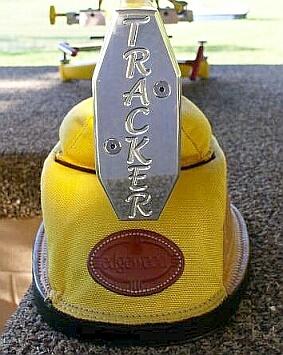
We see many shooters whose rear bag is angled left or right relative to the bore axis. This can happen when you rush your set-up. But even if you set the gun up carefully, the rear bag can twist due to recoil or the way your arm contacts the bag. After every shot, make sure your rear bag is aligned properly (this is especially important for bag squeezers who may actually pull the bag out of alignment as they squeeze).
Forum member ArtB adds: “To align my front rest and rear bag with the target, I use an old golf club shaft. I run it from my front rest stop through a line that crosses over my speed screw and into the slot between the two ears. I stand behind that set-up and make sure I see a straight line pointing at the target. I also have a piece of tape that I’ve placed on the golf shaft that indicates how far the back end of the rear bag should be placed from the front rest stop.”
2. Avoid Contact Interference
We see three common kinds of contact or mechanical interference that can really hurt accuracy. First, if your stock has front and/or rear sling swivels make sure these do NOT contact the front or rear bags at any point of the gun’s travel. When a sling swivel digs into the front bag that can cause a shot to pop high or low. To avoid this, reposition the rifle so the swivels don’t contact the bags or simply remove the swivels before your match. Second, watch out for the rear of the stock grip area. Make sure this is not resting on the bag as you fire and that it can’t come back to contact the bag during recoil. That lip or edge at the bottom of the grip can cause problems when it contacts the rear bag. Third, watch out for the stud or arm on the front rest that limits forward stock travel. With some rests this is high enough that it can actually contact the barrel. We encountered one shooter recently who was complaining about “vertical flyers” during his match. It turns out his barrel was actually hitting the front stop! With most front rests you can either lower the stop or twist the arm to the left or right so it won’t contact the barrel.
3. Weigh Your Charges — Every One
This may sound obvious, but many folks still rely on a powder measure. Yes we know that most short-range BR shooters throw their charges without weighing, but if you’re going to pre-load for a club match there is no reason NOT to weigh your charges. You may be surprised at how inconsistent your powder measure actually is. One of our testers was recently throwing H4198 charges from a mechanical measure for his 30BR. Each charge was then weighed twice with a Denver Instrument lab scale. Our tester found that thrown charges varied by up to 0.7 grains! And that’s with a premium measure.
4. Measure Your Loaded Ammo — After Bullet Seating
Even if you’ve checked your brass and bullets prior to assembling your ammo, we recommend that you weigh your loaded rounds and measure them from base of case to bullet ogive using a comparator. If you find a round that is “way off” in weight or more than .005″ off your intended base to ogive length, set it aside and use that round for a fouler. (Note: if the weight is off by more than 6 or 7 grains you may want to disassemble the round and check your powder charge.) With premium, pre-sorted bullets, we’ve found that we can keep 95% of loaded rounds within a range of .002″, measuring from base (of case) to ogive. Now, with some lots of bullets, you just can’t keep things within .002″, but you should still measure each loaded match round to ensure you don’t have some cases that are way too short or way too long.
5. Check Your Fasteners
Before a match you need to double-check your scope rings or iron sight mounts to ensure everything is tight. Likewise, you should check the tension on the screws/bolts that hold the action in place. Even with a low-recoiling rimfire rifle, action screws or scope rings can come loose during normal shooting.
6. Make a Checklist and Pack the Night Before
Ever drive 50 miles to a match then discover you have the wrong ammo or that you forgot your bolt? Well, mistakes like that happen to the best of us. You can avoid these oversights (and reduce stress at matches) by making a checklist of all the stuff you need. Organize your firearms, range kit, ammo box, and shooting accessories the night before the match. And, like a good Boy Scout, “be prepared”. Bring a jacket and hat if it might be cold. If you have windflags, bring them (even if you’re not sure the rules allow them). Bring spare batteries, and it’s wise to bring a spare rifle and ammo for it. If you have just one gun, a simple mechanical breakdown (such as a broken firing pin) can ruin your whole weekend.



 With the United States of America’s 250th birthday coming on July 4, 2026, just six days from now, we are featuring a handsome F-Class rifle with a patriotic theme. This rifle has the historic “We the People” phrase painted on its handsome Cerus stock. The phrase “We the People” is the famous opening to the Preamble of the U.S. Constitution. Adopted on September 17, 1787, this preamble indicates the government derives its political power directly from its citizens rather than from a monarch or government officials. This cool rig also features the U.S. Stars and Stripes flag on the buttstock.







 Yes, folks, it’s officially summer now. This year’s Summer Solstice, considered the official start of summer (and the longest day of the year), happened Sunday, June 21, at 1:24 AM Pacific Daylight Time (PDT).






 1. Align Front Rest and Rear Bag
 5. Check Your Fasteners


