Jason Cohen’s “We the People” patriotic .284 Shehane F-Class rifle. It has already demonstrated great promise, scoring second place in its very first match, a 3×20 at 1000 yards in Wyoming.
Rifle Report by Jason Cohen
The rifle began its life as a Will McClosky Cerus stock. I approached Will at the Berger SW Nationals about a rifle I wanted to build. I wanted to do something different — PAINT it. He said he had just the stock that I could use, and sent that to Bryan Blake at Blake Machine. I chose Bryan for two reasons — first, I have shot with him a few times at National matches and he is approachable and very helpful. Second I visited his shop during the SWN in February and liked what I observed and how he approached things. Bryan never seems to be happy with the status quo. He is always trying new ideas.
I noticed that Bryan had been adding aluminum rails to the front of Cerus stocks to lower the center of gravity and improve tracking. I asked him to modify my stock and fit it with the new forearm rails, shown in the photo below. I sent him a Panda F-Class action with a +20 MOA Picatinny rail. Bryan did all the stock work and fitted the action, rails, and RAD recoil pad. Everything turned out flawless.
The barrel is a Blake Machine 1:8″-twist finished at 32 inches. It was fitted to my action by Dale Woolum of Woolum Accuracy. Dale chambers all my barrels on all my rifles. Dale also threaded the barrel for a Woolum Accuracy tuner. This has proven to be a valuable tool in my load development. On this build, I am trying a Bix’N Andy trigger for the first time.
The 284 Shehane has a proven record of accomplishments and that is why I have chosen it. I use Lapua brass (6.5-284 necked-up), CCI BR-2 primers, Hodgdon H4350 powder, and Berger 184gr bullets. All these components have been a successful combination that has worked flawlessly in my other rifle.
.284 Shehane Load Development
Load development for me starts with each new barrel. I screw on the new barrel, fire 25 rounds of whatever I have left over and then clean it. I push out to 600 yds and do a ladder test in round-robin format. I start 0.6 grains lower than my last charge that worked. I work up from that reduced charge weight in increments of 0.3 grains. The paper tells the rest of the story. Once I get something that works well at 600 yards I go back in work around that by 0.1 grains. After that I play a little with seating depth and look for a change. I will occasionally mess with the tuner and tighten things up if possible.
About the Patriotic Paint Job
So I had the idea of painting the stock because there are so many wood stocks with clear coat these days. Unless you really get some exotic woods they all seem to blend together. I have nothing against clear-coated wood, but I wanted something different, as this was my first all-wood rifle. (For short-range benchrest, I was shooting a Bob Scoville carbon stock and Terry Leonard laminate).
We started with all white on the stock and came up with the idea of an American Flag on the buttstock. I was thinking of ribbons on the front in red and blue but we could not get the layout right. Then the idea of “We the People” popped into the head. My painter said “awesome!” and he was able to airbrush the stock with a little yellow and brown to give it that vintage paper look.
The front rest is a SEB Max (see above). I chose the Max because I was shooting Group Benchrest first then made the transition to F-Class. This rest proves to be versatile in all my shooting — Short- and Long-Range Benchrest AND F-Class. The rear bag is a Edgewood EDGEbag Gator. The gun gets transported in a Pelican Hard case when I travel. Locally, I use a Champions Choice soft bag.
Jason Jumped to Open Class after Starting with F-TR
This “We the People” rifle will be one of my primary rifles for F-Open competition. I will run it through its paces shortly and see how well it does. I have high hopes of it being an great gun. I shoot primarily local and regional matches — Colorado, Wyoming, and possibly Nebraska this summer. I will travel to the F-Class Nationals in Raton as well. I used to shoot F-TR before this and made the transition to Open last season. This is my second season shooting F-Open. 2018 was my first National event and was a learning experience for me. But I was hooked after that match.
Tips for F-Class Competitors
Get some good equipment and eliminate having issues that can be caused by budget builds. It’s OK to be frugal, but sometimes cutting corners will cause you more problems and have you chasing your tail. If you’re looking for the “recipe for success”, get a good action plus a top-tier barrel and great glass.
The .284 Shehane — Accurate and Forgiving Wildcat
The 284 Shehane is amazing, very forgiving and not temperamental. I choose this because I really did not know otherwise and was steered to the Shehane by a friend. Its proven track record helped as well. Straight .284 or Shehane — you cannot go wrong. I run a 184gr Berger at about 2850 FPS and get great brass life in my other rifles. I usually start to consider tossing the brass around 15 firings. Primer pockets start to get a little looser and the brass seems to need more sizing than the newer brass with less firings.
ZEISS has introduced new, intuitive thin-line reticles that allow faster aiming with “smart” hold-overs and hold-offs. The new thin-line ZMOA-T20 and ZMOA-T30 second focal plane (SFP) reticles provide an unobstructed view of the target, while providing MOA-based hold-over lines and wind-hold markers. This allows for fast follow-up shots with corrected windage holds.
On both horizontal and vertical lines there are marks with one MOA spacing, plus MOA reference numbers placed every two MOA. The center cross “floats” to aid ultra-precise shot placement. The small dots located left and right of the main vertical centerline allow the shooter to make windage holds and gauge bullet impacts with confidence. The MOA reference marks and indicators subtend accurately at the riflescope’s highest magnification setting.
The “T20″ and “T30″ codes indicate the MOA “value” of hash marks available below the reticle’s horizontal centerline, i.e. 20 MOA and 30 MOA. The Conquest V4 4-16x44mm boasts the ZMOA-T30 reticle, while the Conquest V4 6-24x50mm model incorporates the ZMOAi-T20 illuminated reticle. On the illuminated ZMOAi-T20 Zeiss scope, the small center cross-hair (shown in red) illuminates for low-light applications.
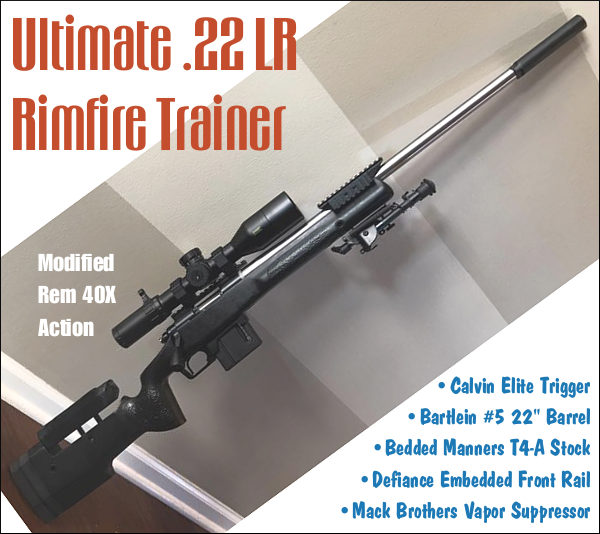
Brian, a gunsmith at GA Precision, built this rimfire rig with GAP colleague Anthony Soukup.
On his Facebook page, Tactical competitor Bryan Sikes posted a photo of a rimfire rig we really liked. Brian works at GA Precision. He and fellow GAP gunsmith Anthony Soukup built this rifle. With a modified Rem 40X action, Manners stock, Bartlein barrel, and Mack Brothers suppressor, this rig has top-quality components stem to stern. And Bryan tells us this rifle performs as good as it looks: “This is the baddest little .22 LR trainer ever. I’m stoked about it. With the barrel length and can, it’s the exact length of my regular comp rigs.” With length, balance, and ergonomics near identical to Bryan’s centerfire competition rifles, this 40X is a superb training tool.
Many readers wanted to know about the bottom metal and the detachable box magazine. Bryan Sike reveals: “The magazine setup is designed specifically to replicate my actual competition rifles. The bottom metal is for use with AI magazines and uses a standard M5 type inlet just like any centerfire completion rifle. In this case with the .22LR, Mike Bush designed a high reliability rimfire magazine using the same outside dimensions as an AI magazine. This rifle was built no different from any other. The action was modified and trued, barreled, fully bedded, etc. using ALL components common to centerfire match rifles.” The Rem 40X action was modified by Modacam Custom Rifles to work as a repeater with box mags.
Bryan adds that a new rimfire action is in the works: “My preference is modified Remington 40X actions and the soon-to-be available, V-22 action from Mike Bush. Both of which are TRUE repeaters and don’t feed from a Savage magazine. This rifle feels nothing like a .22 LR and that was the whole point.”
Why You Need a .22 LR Tactical Cross-Trainer
Many guys who shoot long-range tactical matches practice with .22 LR rifles of similar configuration. Rimfire ammo is way more affordable than centerfire, you do not need a big range facility, and shooting rimfire saves wear and tear on your centerfire rifle. Further, for learning how to read the wind, there really is no better training tool than a .22 LR, even as close as 50 yards.
Our Friend “DesertFrog”, who shoots tactical matches in Southern California, explains: “I used to shoot an average of 200 rounds of .308 Match ammo a month for training (50 per weekend). These days I shoot maybe an average of 50 rounds of .308 Win per month and probably around 600 rounds of .22 LR. Using mainly the .22 LR for practice did NOT hurt my standings in actual competitions. I shot my .308 just as well in matches, but saved the cost of hundreds of rounds of .308. If I didn’t reload and was still buying boxes of Federal Gold Medal Match .308 Win [at $1.00/round], this would be a savings of [$150 per month on the centerfire ammo.]” Money saved is money earned.
Targets for Rimfire Cross-Training
SPECIAL BONUS–Rimfire Tactical Precision Targets
These FREE targets by DesertFrog are offered in Adobe Acrobat format for easy printing. CLICK HERE to download all six targets as a .ZIP archive.
Shooting Sports USA has a fascinating article about the Perpetual Trophies awarded in national-level NRA matches. The story recounts the history behind the elaborate trophies, some from the 1870s. SSUSA’s Jennifer Pearsall writes: “The pieces of wood, stone and precious metal … are more than just instant recognition of achievement. They are the link of the American shooter’s present to his or her patriotic past. As you read this legacy of the NRA ranges, their founders, and the long list of cups, bowls, and plaques, realize that the history of competitive shooting is undeniably a significant part of the foundation of this country”. Read Full Trophy Story HERE.
Stunners in silver. Above are the NRA Leech Cup (left) and Wimbledon Cup (right).
The NRA was co-founded by Col. William Church and Gen. George Wood Wingate (ranked Captain at the time). Both Church and Wingate hoped to improved the marksmanship skills of American soldiers. One of the newly-formed NRA’s first actions was to issue: “An Act to Establish a Rifle Range and Promote Skill in Marksmanship”. That led to the opening of the famed Creedmoor Range, with a special inaugural match in June of 1873.
Many of the awards presented in the first NRA matches were cash or firearms. Some of these firearms were heavily embellished works of art. In the very first match, a member of the 22nd New York Regiment took home a gold-mounted Winchester Model 1866 valued at $100 — big money for the time.
In the 1870s shooting competitions were social as well as sporting events. Ladies and gentlemen came to watch and cheer the winners. This illustration, originally from Harpers Weekly, portrays the shooters and the viewing gallery at the 1876 Grand Centennial Championship—the “Palma” Match.
The Leech Cup — A Gift from Ireland
The Leech Cup was created for the first meeting of the American and Irish shooting teams. The elaborate cup was presented by Major Arthur Leech, captain of the the Irish team, to the Amateur Rifle Club of New York. This masterpiece of Irish silver-smithing was later given to the NRA in 1901 by the New York Club. Today, the Leech Cup is the oldest trophy offered in overall NRA competitive target shooting, awarded through the National High Power Long Range Championships.
The Wimbledon Cup
The Wimbledon Trophy was a gift from the NRA of Great Britain. It was given, as a gesture of sportsmanship, after the the U.S. Team was denied the ability to compete in England’s Elcho Shield match, then limited to Britain, Scotland, and Ireland. To maintain friendly competitive relations, the British presented the Americans with a large, engraved, lion-footed tankard trophy to be awarded each year to the Champion U.S. long-distance rifleman.
The Palma Team Trophy
Originally named the Centennial Trophy, in honor of the Centennial celebration of the independence of the United States of America, the Palma Trophy was commissioned from Tiffany’s at a cost of $1,500. The trophy was a full-sized replica of a Roman Legion standard, executed in bronze with silver and gold inlay. On the banner of the standard was the legend, “In the name of the United States of America to the Riflemen of the world”. Above the banner was an eagle, bearing in its talons a wreath of palm leaves and a plaque on which was the single word, “PALMA”, the Latin word for palm tree, which was used by the Romans to signify victory, or the ultimate in excellence.
Because the word Palma was so easily seen, the trophy soon became known as the “Palma Trophy”, and by 1878 was referred to officially by that name. The original seven and one-half foot trophy is now lost, having not been seen since at least 1954. Serving in its place is a copy which was commissioned by Dr. Herbert M. Aitken of Eau Claire, WI. The copy was made from the original Tiffany blue-prints at a cost of $32,500. Dr. Aitken has given this copy of the Palma Trophy to the NRA for use in the Palma Match. The trophy is retained by the winning team until the next Palma Match.
In 2008, the Palma Trophy was returned to the NRA, and it was decided that the trophy, once refurbished, will travel to the host nation for the match every four years, then returned to the NRA for safekeeping.
The first competition for the Palma Team was a challenge match for which the British Commonwealth nations were invited. The match was fired in 1876 at the old Creedmoor Range on Long Island as part of the Centennial celebration of the United States. Teams representing Scotland, Ireland, Canada, Australia, and the United States took part. The match is currently fired on a four-year interval.
Emil Praslick III is widely recognized as one of the greatest wind wizards on the planet — a master at identifying wind value and direction, and predicting wind cycles. As coach of the USAMU and top civilian teams, Emil has helped win many high-level championships. In the three videos we feature today, Emil, who works with Capstone Precision Group (Berger, Lapua, SK, Vihtavuori) and Team Applied Ballistics, explains how to determine wind direction and velocity using a variety of indicators. Praslick, now retired from the U.S. Army, was an 18-time National and 2-time World Champion coach with the USAMU.
Video ONE: Wind Theory Basics — Understanding “Wind Values”
In this video from UltimateReloader.com, Emil explains the basics of modern wind theory. To properly understand the effect of the wind you need to know both the velocity of the wind and its angle. The combination of those variables translates to the wind value. Emil also explains that the wind value may not be constant — it can cycle both in speed and velocity. Emil also explains some of the environmental conditions such as mirage that can reveal wind conditions.
Video TWO: Determining the Direction of the Wind
Key Point in Video — Find the Boil
Emil explains how to determine wind direction using optic. The method is to use spotting scope, riflescope, or binoculars to look for the “Boil” — the condition in mirage when the light waves rising straight up. The wind will generate that straight-up, vertical boil in your optics when it is blowing directly at you, or directly from your rear. To identify this, traverse your scope or optics until you see the boil running straight up. When you see that vertical boil, the direction your optic is pointing is aligned with the wind flow (either blowing towards you or from directly behind you).
Video THREE: The No Wind Zero Setting
In this second video, Emil defines the “No-Wind Zero”, and explains why competitive shooters must understand the no-wind zero and have their sights or optics set for a no-wind zero starting point before heading to a match. In order to hit your target, after determining wind speed and direction, says Emil, “you have to have your scope setting dialed to ‘no wind zero’ first.”
Coach of Champions — Emil Praslick III
SFC Emil Praslick III, (U.S. Army, retired) works with Berger Bullets and Applied Ballistics. Emil served as the Head Coach of the U.S. National Long Range Rifle Team and Head Coach of the USAMU for several years. Teams coached by Emil have won 33 Inter-Service Rifle Championships. On top of that, teams he coached set 18 National records and 2 World Records. Overall, in the role of coach, Praslick can be credited with the most team wins of any coach in U.S. Military history.
Good news for rimfire shooters! Lapua will open a new rimfire test center in Ohio in the fall of 2019. At this new facility, which will replicate Lapua’s current rimfire test center in Arizona, shooters can test various lots of Lapua rimfire ammunition to determine what shoots best in their firearms. The new location will have a full 100 meter testing tunnel, with electronic target readouts for both 50 meters and 100 meters. Customers have the option to send their rifles in for testing or schedule an onsite appointment to participate and view the test process.
“We’re taking our established practices and testing capabilities from our Mesa, AZ location to our new, second location in Ohio, offering customers state-of-the-art rimfire ammunition testing,” said Adam Braverman, Director of Sales and Marketing.
Patterned after the world-renowned Lapua Service Center in Schönebeck, Germany, the new Ohio facility will give shooters the chance to test various types and lots of rimfire ammunition, in their own firearms, under ideal conditions. Customers interested in performing ammo tests at either USA Lapua Rimfire Test locations (Arizona or Ohio), may call (480) 898-2731 or email rimfiretest@capstonepg.com .
Lapua announced: “Lapua … is proud to announce our second USA Lapua Rimfire Test Center at the Cardinal Shooting Center in Marengo, Ohio. The new Lapua Rimfire Test Center will offer competitive shooters and consumers alike the opportunity to match individual lots of Lapua ammunition to their match rifles and pistols. The new East Location will officially open in late Fall of 2019. All of the capabilities of the new test center will replicate our current Lapua Rimfire Test Center in Mesa, AZ.”
“We’re excited to partner with Lapua and bring this facility and test capabilities to our current and potential customers,” stated Jim Henderson, Director of Competitions at the Cardinal Shooting Center, “We feel this will help many consumers, as well as junior and collegiate teams…”
About Lapua
Lapua produces bullets, brass, and loaded rimfire and centerfire ammunition for civilian and professional use. Lapua is a part of the Capstone Precision Group, exclusive U.S. distributor for Berger, Lapua, Vihtavuori and SK-Rimfire products. For more information, visit Lapua.com.
Better jump on this money-saving promo boys and girls, because the deals expire tonight, at 11:59 pm CDT on July 12, 2019. And write down those Brownells Coupon Codes, because this special deal can save you some serious bucks: $10 off $100, $20 off $175, and a whopping $30 off $250. Plus, with each of these discount deals you get FREE Shipping as well. That could easily save you $10-$15 on a typical order (HazMat fees extra).
These Coupon Codes apply to both regularly-priced and SALE merchandise — pretty much everything currently in inventory (but no back-orders). Here are some of the current items ON SALE at Brownells.
Now this is smart — ZEISS has just introduced a series of precision scope rings with integral bubble levels. These new ZEISS Ultralight 1913 Mil-Spec Rings for Picatinny Rails are beautifully made, making them a smart choice for mounting all brands of quality riflescopes. The rings are currently offered in 30mm diameter (low, med, high) and 36mm diameter (med, high), with 34mm versions coming out in the very near future.
We like the craftsmanship on these Precision Rings — they are “micro-radiused” on the machined leading edges to ensure a non-marring design. That special design feature helps prevent annoying marks on your expensive scope. Along with the built-in anti-cant levels, these rings feature an integral bottom recoil lug. That helps ensure the rings align perfectly and hold securely even with the high recoil forces generated by big caliber, magnum rifles.
Though these Precision Rings are very strong, they are also relatively light-weight. Crafted from Mil-Spec 7075-T6 aluminum (Type III) these rings weigh just 4.4 ounces with screws for a 30mm low set. For durability, ZEISS UltraLight Rings feature a 30-micron hard, matte black, anodized finish. The ring sets ship with a nice hard case, which includes both T15 and T25 Torx driver bits. The Zeiss Ultralight 30mm Rings cost $179.99 while the larger-diameter 36mm rings cost $199.99
NOTE: These rings are designed for correct, Mil-Spec Picatinny rails (aka MIL-STD-1913 rail or STANAG 2324 rail). Some lower-cost “Weaver-type” rails may not be ideal. ZEISS states: “For optimum performance and flawless mounting, we strongly advise that you mount [these rings] on a high-quality 1913 Mil-Std specification rail[.]”
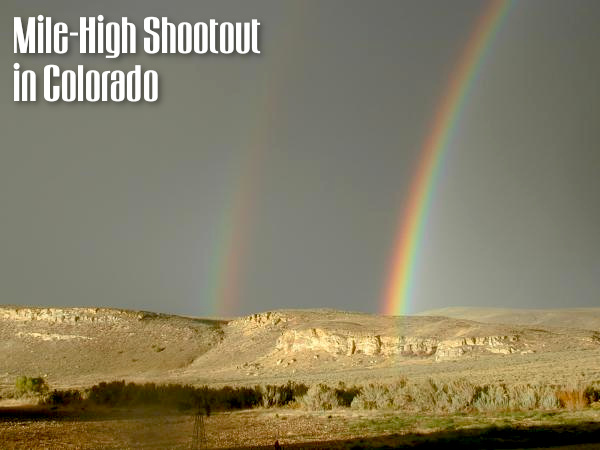
Look carefully at this Colorado double rainbow. Note that the color spectra are reversed — sort of a mirror image. This is true of ALL double rainbows.
A great practical/tactical shooting match is happening this weekend in scenic Colorado. The High Country Precison Mile-High Shootout will be held July 12-14 at the Rio Ro Mo Ranch outside of Craig, Colorado. The match will include a mix of long-range and positional shooting on natural terrain. A 200- to 250-round course of fire can be expected for the competition.
The Mile-High Shootout starts on Friday, July 12 with check-in and open targets out to 1,300 yards. Saturday will be an all-day match. Sunday, the competition shooting will conclude mid-day, followed by an awards ceremony after lunch.
McMillan Fiberglass Stocks will co-sponsor the Mile-High Shootout, the 12th match of the 2019 National Rifle League series. McMillan supports the National Rifle League in the goal of expanding practical rifle competition. McMillan notes: “Events such as these are important to help bring new shooters into the long-range shooting sports and are activities that are enjoyed by the entire family.”
This 2018 Mile-High Shootout Teaser Is Really Worth Watching — Plenty of Action!
South Dakota Steel Classic, August 16-18
Another great NRL Match is set for mid-August in South Dakota. The 2-day South Dakota Steel Classic will take place August 16-18, 2019 in St. Orient, South Dakota. This is a very popular match, and all 110 competitor slots have sold out. But check with Match Director Michael Kane for last-minute openings.
The South Dakota Steel Classic features multi-position precision shooting with targets from 25-1300 yards. Nearly all of the shots are practical in nature having a hunting or military-type application. CLICK HERE to learn more about this major NRL match in August.
Big news for the shooting community! Just six years after it acquired Savage Arms, outdoor industry mega-corp Vista Outdoor is selling off Savage Arms. The firearms-maker will be acquired by a private investment group led by Savage’s current management. When the sale is complete, Vista Outdoor, parent company of dozens of outdoor brands such as Bushnell, Bell Helmets, CCI, Camelback, Federal, RCBS, and Weaver, will no longer produce firearms of any kind. The sell-back to the Savage management group will include Stevens Arms*, which primarily produces shotguns.
There were multiple reasons given for the sale, which include:
1. Cutting costs, reducing corporate debt, and consolidating operations at Vista Outdoor.
2. Focusing more on the ammunition brands Alliant, CCI, Speer, and Federal.
3. Giving Vista Outdoor’s “ammunition brands flexibility to work with any industry partner”.
In addition, we suspect that, given the current political climate and media antagonism towards gun-makers, Vista Outdoor’s leadership deemed that owning Savage was bad for the company’s overall image. The potential profits from Savage were simply not worth the negative press as well as the potential liabilities from gun-related lawsuits.
By the Numbers: Vista Outdoor acquired Savage Arms (and Stevens) in July 2013 for $315 million. The July 2019 sell-off of Savage Arms (and Stevens) for $170 million represents a $145 million loss for Vista Outdoor. That’s not a good business model.
Founded in 1894, Massachusetts-based Savage Arms is one of America’s oldest gun-makers. While it has produced a wide variety of firearms over the past 125 years, Savage is now best known for its affordable bolt-action hunting rifles that feature barrels attached by a barrel-nut. In recent years, Savage has also moved aggressively into the “black rifle” market producing its MSR series of AR-platform rifles in a variety of chamberings. Savage also produces a popular semi-auto Rimfire rifle, the Savage A17/A22 series.
Here is the official Press Release covering Vista Outdoor’s sale of Savage Arms to a group of investors headed by Al Kasper, Savage’s President and CEO (emphasis added):
Vista Outdoor Announces Sale of Savage Brand
Vista Outdoor Inc. (“Vista Outdoor”) (NYSE: VSTO) announced today that it has completed the sale of the legal entity operating its Savage Arms and Stevens firearms brands to a financial buyer for a total purchase price of $170 million, comprised of $158 million paid at closing and $12 million to be paid upon maturity of a five-year seller note issued by the buyer to Vista Outdoor in connection with the transaction.
The sale is part of Vista Outdoor’s previously announced transformation plan, which outlined the intent to reshape the company’s portfolio by cutting costs, consolidating leadership, paying down debt, and divesting certain brands, including both its eyewear brands and firearms brands, in order to pursue growth in product categories where the company believes it can be market leaders. As the company now looks forward, the focus is on ammunition, hunting and shooting accessories, hydration bottles and packs, outdoor cooking products, and cycling/ski helmets and accessories.
“Divesting our Savage brand was a key aspect of our transformation plan,” said Chris Metz, CEO of Vista Outdoor. “While it was a difficult decision to sell such an iconic brand, I remain confident that this was the correct choice to help Vista Outdoor grow in those categories where we can have leadership positions. Savage is a fantastic business, and it deserves to continue to evolve into other firearms categories. At this time, however, we simply do not have the resources to transform Savage into the full-service firearms company that it deserves to be and, therefore, we determined the brand would be better off with a different owner. We’re excited to see Savage reach its full potential under new ownership.”
Savage was acquired by Vista Outdoor’s predecessor, ATK, in 2013. ATK’s sporting business – which included Savage, Bushnell, Federal and CCI Ammunition, and dozens of other hunt/shoot accessories brands, spun off in 2015 to become Vista Outdoor.
“The Savage acquisition helped create Vista Outdoor, and we’re grateful for all the success the brand brought to our company over the past six years,” said Metz. “However, this divestiture now gives our ammunition brands flexibility to work with any industry partner to create the best products and meet our consumers’ needs.”
At closing, Vista Outdoor received gross proceeds from the divestiture of $158 million. Vista Outdoor will use the net after-tax proceeds of the sale to repay outstanding indebtedness.
“Reducing our debt is a key part of turning around our business,” said Metz. “Selling Savage and further reducing our overall leverage will improve our financial flexibility and better position the company for long-term growth. We’ve now rebuilt the company’s foundation to provide a more stable base upon which to grow. We have a portfolio of brands that all have the potential to be strong, market leaders in their respective categories and I’m proud of my team’s efforts in reshaping the portfolio over the course of the past year.”
*American firearms manufacturer J. Stevens Arms & Tool Company, now part of Savage Arms, introduced the .22 Long Rifle cartridge in 1887. Savage Arms was founded in 1894 by Arthur Savage in Utica, New York. Within 20 years Savage was producing rifles, handguns, and ammunition. Savage introduced the first hammerless lever-action rifle, the Model 1895, derived from Arthur Savage’s Model 1892 rifle that he had designed for Colt.
Story tip from EdLongrange. We welcome reader submissions.



 On both horizontal and vertical lines there are marks with one MOA spacing, plus MOA reference numbers placed every two MOA. The center cross “floats” to aid ultra-precise shot placement. The small dots located left and right of the main vertical centerline allow the shooter to make windage holds and gauge bullet impacts with confidence. The MOA reference marks and indicators subtend accurately at the riflescope’s highest magnification setting.




 The Palma Team Trophy