Seven United States rifle competitors, including Olympic gold medalist Ginny Thrasher, will compete for Team USA at the 2019 Pan American Games in Lima, Peru. The XVIII Pan American Games will be contested July 26 – August 11 and will feature over 6,500 athletes from 41 nations.
Athletes were determined based on results of the 2019 Spring Selection Match held March 25-30 in Fort Benning, Georgia. In search of three Olympic quotas, Team USA will include the reigning Olympic champion Thrasher, now competing in Three-Position (3P) smallbore (not Air Rifle where she won Gold). She’ll be joined by her 2016 Olympic teammates Michael McPhail, and Lucas Kozeniesky. The full list of all Pan-American Games USA Rifle competitors is at the end of this story.
In men’s Three-Position Smallbore, two-time Olympian McPhail is slotted to compete alongside his U.S. Army Marksmanship Unit (USAMU) teammate Tim Sherry. Sherry will also compete in Air Rifle and in the Mixed Team Air Rifle competition with Weisz.
This will be the first Pan American Games for Thrasher, who recently graduated from West Virginia University. While at WVU, Thrasher won the 2016 NCAA smallbore and air rifle titles and helped lead the Mountaineers to two NCAA National Championships, while earning 12 All-America awards.
SFC Michael McPhail has switched from prone smallbore rifle to three-position smallbore.
Gunning for a third Olympic opportunity, McPhail had to re-invent himself after his discipline (Prone Rifle) was eliminated from the Olympic program after 2016. The USAMU soldier now shoots Three-Position Smallbore Rifle very well indeed — McPhail won the Spring Selection Match and earned a bronze medal at the 2018 World Championships.
Alpha Unknown, which had two shooters in the match, reported “This was the coolest place we’ve ever shot from… we’ll see you next year.”
Joe Burdick, owner of Rock Solid Shooting Solutions, provides this report from Wyoming: “I’m having a blast at the Nightforce ELR Steel Challenge at the Q Creek Ranch south of Casper, WY. Made my longest hits ever in competition at 1800 and some change. This 300 Winchester Magnum is absolutely PUNISHING the steel. The short targets here are at a thousand yards. I had multiple hits and clean runs on stages with targets from 1200-1800 yards. I missed the longest target of the match (2100 yards) by about 0.2 Mils.”
All photos by Joe Burdick other than as indicated by Alpha Unknown and Mitchell Fitzpatrick.
Target locations are indicated with red dots.
Burdick had high praise for the match and the venue: “This is a super cool match in an incredible location. It is remote but the size and beauty of the venue make it well worth the trip. The range is covered with life-size elk, wolf, ram, antelope, and even kangaroo targets with plenty of circles and squares as well.” The vast Q Creek Ranch encompasses 560,000 acres of scenic Wyoming landscape.
Burdick, whose company Rock Solid Shooting Solutions runs matches and sells custom gun covers, wanted to acknowledge his sponsors and equipment suppliers: Bushnell, Kelbly’s, WildEar, Precision Rifle & Tool, Huber Concepts, The Heritage Flag Company, Armageddon Gear, MasterPiece Arms, Kahntrol Solutions, BEST Targets, and Patriot Cases.
“Incredible location. It is remote but the size and beauty of the venue make it well worth the trip.”
Confirming Elevation Dope Is Essential for ELR Competition
Prior to the match, Joe verified his long-range “dope” at the Q-Creek Ranch shooting at distant targets. Joe reports: “Shooting my 300 Winchester Magnum, I made my longest hit ever with any rifle at 2086 yards.”
The 2086-yard target is marked with the red dot on the photo. The yellow dots represent the location of the 1000, 1409, 1725, and 1816 yard targets for reference.
And the Winners Are…
Chris Gittings and Brent Wood tied for Overall and Hunter Class honors at 115 points with Brent taking the tie-breaker. Notably, Brent’s son Tyler won the Junior Division. With 114 points, Mitchell Fitzpatrick took First Place in Open Division at the Nightforce ELR Steel Challenge. Congrats to all four marksmen on their great shooting! Fitzpatrick works with Applied Ballistics in the AB Weapons Division. He was shooting an AB Weapons Division M30TS rifle chambered for AB’s new .338 EnABELR cartridge, running 300gr Berger Hybrid OTM bullets at 3160 FPS. The scope was a 5-25x56mm NF ATACR with T3 reticle.
At the request of our readers, we provide select “Deals of the Week”. Every Monday morning we offer our Best Bargain selections. Here are some of the best deals on firearms, hardware, reloading components, optics, and shooting accessories. Be aware that sale prices are subject to change, and once clearance inventory is sold, it’s gone for good. You snooze you lose.
1. Midway USA — Norma 6.5 Creedmoor Brass, 250 for $99.99
The 6.5 Creedmoor is more popular than ever but like any super-trendy cartridge, supplies seem to be either out of stock or too expensive. If you have a 6.5 Creedmoor, check out this killer deal. You can get 250 Norma 6.5 Creedmoor cases for only $99.99. That works out to just forty cents per case — less than half what you’d pay for some other 6.5 Creedmoor brass. We can’t remember the last time we’ve seen such a great deal on quality brass for such a popular cartridge. But you better act soon — we expect this MidwayUSA deal to sell out quickly.
2. Grafs.com — FREE Litz Book with $100 Lapua Bullet Buy
This is just one example. This deal works with ANY Lapua bullets purchased from Grafs.com.
Lapua makes great bullets. Bryan Litz writes great books. And now you can get both with this special promotion from Graf & Sons. Here’s the deal — if you buy at least $100.00 worth of Lapua bullets at Grafs.com, you’ll get a free Applied Ballistics book authored by Bryan Litz. You can mix and match any types of Lapua bullets — as long as the bullet order totals $100.00 or more. The book may be one of various Litz titles, such as Modern Advancements in Long Range Shooting or Ballistic Performance of Rifle Bullets. NOTE: You do NOT get to pick the book title — you get what’s available. You want to move quickly on this deal — books are limited to supply on hand.
3. EuroOptic — FREE Kestrel 3500 with Leupold Mark 5HD Scope
Leupold’s new Mark 5HD scopes are impressive. Make no mistake — Mark 5HDs are fine tactical optics fully capable of winning PRS/NRL matches. Available in 3.6-18x44mm, 5-25x56mm, and 7-35x56mm with a multitude of reticle choices, there’s something for every tactical shooter out there. And right now when you buy any Laupold Mark 5HD scope from EuroOptic.com you get a FREE Kestrel 3500NV, a $269.00 value. That’s a fantastic bonus! The FREE Kestrel will be added to your cart automatically at no extra cost.
4. Natchez — Weaver T-Series XR 36x40mm, $389.99
With so many zoom scopes on the market it’s easy to forget some of the best fixed power scopes out there. Weaver T-Series scopes have served benchrest shooters for decades and the new side-parallax Weaver XRs take the T-Series to a new level. You can pick up the Weaver T-Series 36x40mm XR Scope for the crazy low price of $389.99.(This has FCH with 1/16 MOA dot reticle.) You can also grab the 46X version for $569.99 or the Classic T-Series 36X with front objective parallax for just $329.99. All choices are great bargains.
5. Midsouth — Hornady 123gr 6.5mm bullets, 250 for $59.99
We featured 6.5 brass this week and here’s the matching bullet deal. You can grab 250 Hornady 123gr 6.5mm bullets for just $59.99. That’s a mere twenty-four cents per bullet! The 120-130gr class of 6.5mm bullets is an excellent choice for both paper-punching and PRS. These Hornady 123-grainers offer good accuracy with less recoil (and much lower cost) than the 140-145gr class of 6.5mm match bullets.
6. Federal 20% REBATE for Bullets, Brass, and Primers
Reloading component costs add up quickly which is why we include this great rebate offer from Federal. Just purchase at least $100 worth of Federal reloading components (bullets, brass, and primers) and then fill out this form and you’ll get 20% back up to $100. The bottom line is that if you need any components, this is the time to stock up. NOTE: This Federal Rebate also applies to components purchased from other vendors such as Bruno’s, Midsouth, and Powder Valley.
7. Midsouth — Rock Chucker Supreme Reloading Kit, $269.49
Everything you see above can be yours for just $269.49. Amazing Deal. Right now, Midsouth is selling the Rock Chucker Supreme Master Reloading Kit for $269.49, a fine price considering all the hardware you get: Press, Primer Tool, Scale, Powder Measure, Loading Tray, Reloading Manual and more. Heck, the Rock Chucker press alone is worth $165.00+. This is good starter kit for any reloader with sturdy items,such as the Rock Chucker, that will last a lifetime. NOTE: This is listed at $299.99 on the Midsouth Home Page, but the product page now shows $269.49 and that’s what shows when you add the Kit to your shopping cart.
8. Area 419 — Master Funnel Kit, $90.00
Precision loading often requires dropping powder one case at a time and without the right gear this can cause issues. Bad powder funnels can cause bridging or stuck kernels leading to light loads in one case and heavy in another. These issues can be solved using the Master Funnel Kit from Area 419. This kit contains 6 caliber specific color coded heads (22 cal, 6mm/243, 6.5mm/264, 7mm/284, 30 cal, 338 cal) plus the funnel and stand. The funnel is specially designed to ensure powder doesn’t bounce out and the heads are securely threaded and designed to fit snugly on the shoulder of the brass. If you’re looking to upgrade your gear to the top of the line this is the one to get.
9. Amazon — Tipton Gun Butler, $23.49
Here’s a handy, portable gun caddy that works well for rifle maintenance chores at home or at the range. Right now the Tipton Gun Butler is marked down to $23.49. The Gun Butler offers a convenient platform for cleaning your gun or doing tasks such as scope mounting. Two removable forks/cradles hold a gun securely in place, while compartments and slots hold solvents, jags, brushes, mops, and tools. The Gun Butler features a convenient carrying handle, and slip-resistant rubber feet. NOTE: The front cradle may not work well with wide benchrest fore-ends.
Soon after Lapua released the 6.5×47 cartridge, wildcatters recognized the potential of a necked-down 6mm version of the case. The 6-6.5×47 has emerged as a great, do-it-all cartridge that performs well in High Power competition, 600- and 1000-yard benchrest, and PRS tactical matches. But the 6-6.5×47 is not just for paper-punching. An efficient cartridge with great inherent accuracy, the 6-6.5×47 can be an excellent, flat-shooting, long-range varmint round. Here we feature Stan Stewart’s BAT-actioned 6-6.5×47 varminter. Fitted with a Krieger 1:10″ barrel, Stan’s rifle excels with a wide variety of varmint bullets. Whether driving 70-grainers at 3700 fps, or pushing the Berger 88gr High-BC FB bullet at 3400 fps, this 6-6.5×47 delivers half-MOA (or better) accuracy, in a well-balanced, easy-handling rifle.
The 6-6.5×47 for Precision Long-Range Varminting
The rifle carries a 12-42x56mm Nightforce NSX in Nightforce rings “hand-lapped for optimal fit/alignment”.
‘Seller’s Remorse’ Spurs 6mm Project Report by Stan Stewart
After selling my 6mm Remington Ackley Improved a couple of years ago and wishing I hadn’t, I begun to think about a new custom rifle for work on Prairie Dog towns and New York wood chucks at 600+ yards. I have a .223 AR and 22-250 for medium ranges but I missed my 6mm AI for long-range work so I started asking questions.
The 22-250 is a fine chambering, but it is hard on barrels, and I think the 6mms may have an accuracy edge out past 400 yards. Also, shooters today enjoy a vast collection of really great 6mm bullets. Barrel life and bullet options were two main reasons I decided to build a 6mm rather than another .224-caliber gun. But the question remained… what 6mm chambering to choose?
I started doing serious research on the 6-6.5×47. I received a lot of good advice from AccurateShooter.com and other websites on the pros and cons. I also talked to gunsmiths — quite a few recommended the new cartridge as well. Some of the cartridge attributes I liked was the small rifle primer, enough case capacity to efficiently reach 3700 fps with a 70gr bullet and 3400 fps with an 85-grainer without being terribly over-bore. Most important was the 6-6.5×47’s reputation for inherent accuracy without being finicky like my 6mm AI. So, having chosen my cartridge, I started asking for gunsmith recommendations. Again the folks on the AccurateShooter.com Forum were very helpful. After many conversations I settled on Dave Bruno in Dayton, Pennsylvania. He was a good choice.
Putting Together the New Rig with Premium Components
From the get-go, I knew I wanted a BAT action and Krieger barrel. BAT Machine and Krieger Barrels enjoy a great reputation in the shooting industry. BATs are beautifully-machined, smooth, and strong. Krieger cut-rifled barrels are known for dependable accuracy and long barrel life. While many 6-6.5×47 shooters choose an 8-twist barrel to shoot the 100-108gr bullets, I would be using smaller, varmint-weight bullets, so I selected a 1:10″ twist Krieger. This would allow me to shoot bullets from 60 grains up to 90 grains. Dave chambered the barrel with a .269″ neck and fluted the barrel to save weight. I also had Dave install a Vais muzzle brake. Dave fitted the BAT with a 2 oz. Jewell trigger, mounted a +20 MOA scope rail, then pillar-bedded the BAT into a McMillan Hunter-Class-style fiberglass stock.
Load Development for Varminting
I had selected a few powders and bullets recommended by other 6-6.5×47 shooters and started by seating all the bullets .005″ off the lands. The powders I selected were Varget, Vihtavuori N-550, and Reloder 15.
I was very pleased with the 88gr Bergers. In initial testing, they grouped well and I was able to drive them to 3400 fps easily. As I wanted a gun for long-range varmint work, I was hoping the 1:10″-twist barrel would provide enough stability for the heavier weight bullets. It did — the 10-twist worked great! I was able to shoot the lighter weight bullets and the 88s were superb. With a BC of 0.391, leaving the barrel at 3400, these bullets were still traveling at 2600 fps at 600 yards!
I did a lot of testing, recording group sizes for a variety of different bullets (see below) and powders. With group size/velocity data in a spreadsheet I was able to “crunch the numbers” and choose my preferred loads. The data drew a clear picture of what the rifle shot best. Here is a chart showing comparative group sizes, arranged by bullet type. On the last three lines, powders are listed by average for all bullets.
Final Thoughts on the 6-6.5×47 Lapua
I have owned three rifles chambered in 22-250 and will always own a rifle in this caliber because it is inherently accurate and drives a 50gr bullet at 3800 fps. No question the 22-250 can be deadly out to 500 yards. However, I’ve found that shooting past 400 yards with the light bullets is difficult if there is any wind at all. That’s why I liked my 6mm AI for those longer shots and why I decided on the 6-6.5×47 Lapua. I couldn’t be happier with my choice. The only thing that could make it better is if Lapua would produce the 6-6.5×47 as an “official” factory 6mm cartridge with 6mm necks right out of the box. But overall, I am very happy with the cartridge, and I thank Dave Bruno for producing a superbly accurate varmint rifle.
On Father’s Day, time spent together is more important than any gift that comes in a box…
Today is Father’s Day, a special Sunday when we acknowledge our patriarchs and show our gratitude for all their hard work and sacrifice on our behalf, and the love they have shown us over the years. If you’re lucky, you’re reading this after having spent a day at the shooting range (or the local fishing hole, or golf course) with your Dad. The important thing is to be together with “Pops” and do something you both enjoy together. If you haven’t finalized your Father’s Day planning, here are some suggestions:
1. Hand-wash and wax your father’s truck or car.
2. Clean your dad’s rifles, or help him put together some handloads.
3. Take your dad out to a live music concert, go to a ball game, or maybe head down to the local fishin’ hole.
4. Go for a hike together or just a drive in the country.
5. Head down to Sears or the local hardware store and let you Dad pick out some new tools.
6. Sit down with your dad, bring a note pad, and ask him to tell you some stories about his youth, or his military experience. This Editor learned some amazing things about his own father this way.
Whatever you choose to do with your father, use your time wisely. Turn off your computer, and go be with your father today. Do something with him that makes him smile. The time spent together is more important than any gift that comes in a box. And, if he lives far from you, give him a call and let him know how important he is to your life. Remind him of the old adage: “Good fathers make good sons”.
When my father, a disabled WW2 Army vet, passed away I received the flag that was draped on his coffin. On most days I fly one of those nylon flags that you can pick up at hardware or department stores. But on holidays, like today, and his birthday, Dad’s flag is out there snapping in the breeze on top of the pole. I find myself talking to him as it gets put up in the morning and comes down at sunset. Hope when the time comes one of my boys will fly my flag. — Bill Slattery Jr.
My father used to play with my brother and me in the yard. Mother would come out and say, “You’re tearing up the grass”! “We’re not raising grass,” Dad would reply, “We’re raising boys”. — Harmon Killebrew.
Think you can shoot fast with a bolt gun? Bet you can’t beat these Norwegian speed-demons. Inge Hvitås recently set a new Mad Minute World Record, putting 39 rounds inside a 16″ circle at 200 meters, all in a single minute. Another Norwegian ace fired 48 rounds in a minute, with 38 in the bullseye. Now that’s spectacular speed and accuracy.
Watch Inge Hvitås Set New Mad Minute World Record:
New Mad Minute World Record — 39 Hits in One Minute (60 seconds)
At the Haga shooting range in Norway, spectators witnessed spectacular speed shooting earlier this month. On June 4th, Norwegian shooter Inge Hvitås set a new Mad Minute Challenge World Record with 39 hits in ONE MINUTE at 200m. The target was a 40cm (15.75″) bullseye placed at 200m (218 yards). Fellow Norwegian Jesper Nilsstua also shot brilliantly, sending 48 rounds down-range in one minute. Jesper had 38 hits, missing the record by just one. Both shooters were using iron-sighted Sauer 200 STR target rifles, which are normally chambered for the 6.5×55 cartridge. For this event, magazines are limited to 5 rounds and shooters may use slings but no bipods or other support.
Amazing Bolt-Gun Cycling Speed — 48 Rounds in One Minute
Another Norwegian ace, Jesper Nilsstua, missed the Mad Minute Challenge record (by one hit), but boy was he fast. Dennis Santiago (who has done his own Mad Minute drill), was dazzled: “This dude didn’t get the new world’s record of 39 hits in 60 seconds. He ‘only’ got 38 hits after getting off an amazing 48 shots in 60 seconds. Watch the smoothness of his shooting. It’s amazing.”
For the Mad Minute Challenge in Norway, a standard 200m DFS target was used, with 1 point per hit within the black area which is 40cm (15.75″, or 6.9 MOA) in diameter.
Norwegian Mad Minute Challenge — Event Rules
The organizers of the event posted: “The Mad Minute Challenge [is] a modern edition of a old military drill. This is a place for sport shooters to … share experiences on the subject of speed shooting with bolt-action rifles. The Mad Minute Challenge is all about the sport! To make a attempt for the record everyone must follow these five simple rules:”
About the Original MAD MINUTE
“Mad Minute” was a pre-World War I term used by British Army riflemen during training at the Hythe School of Musketry to describe scoring a minimum of 15 hits on a target at 300 yards within one minute using a bolt-action rifle (usually a Lee-Enfield or Lee-Metford rifle). It was not uncommon during the First World War for riflemen to greatly exceed this score. The record, set in 1914 by Sergeant Instructor Alfred Snoxall, was 38 hits.
Listed as “Practice number 22, Rapid Fire” of The Musketry Regulations, Part I, 1909, this drill required at least 15 shots on the Second Class target at 300 yards. The exercise was just one of several annual tests to classify a soldier as a sharpshooter, first or second class shooter depending on the points achieved.
Research indicates the Second Class target was a 48″ x 48″ square with 24″ inner circle and 36″ outer circle. The sight mark was a central 12″ x 12″ shape representing a soldier. ALL hits scored points (3 for center circle, 2 for outer circle, 1 for outer square). NOTE: Though some sources say the Mad Minute drill used a 12″-diameter round target, this appears to be a mistake from Ian Hogg’s book “The Encyclopedia of Weaponry”. No other source mentions a 12″ circle, which would be a mere 3.82 MOA. In reality the true drill target was a 48″ x 48″ square, roughly 15 times larger. (From No.WikiPedia.)
34th Annual Fifty Caliber Championship Coming Soon
The 34th Annual Fifty Caliber Shooters Association (FCSA) 1000/600 Yard World Championship will be held July 4, 5 and 6, 2019 at the Whittington Center in Raton, New Mexico, a beautiful facility. The FCSA Championship takes place right after the 2019 King of 2 Miles event, running June 29 – July 1, 2019.
Looking downrange at the 1000-yard line. Note the fan and air hose for cooling the barrel.
Competitor’s POV perspective from a FCSA Match. Note the mirage.
By James Patterson This article first appeared in Sinclair International’s Reloading Press Blog
For a number of years I drooled over every .50 BMG caliber rifle that I came across, I read every article I could find and determined that ‘Someday’ I was going to have one. Well I finally took the plunge and in 2002 I purchased my first ‘Big 50’. Almost immediately I joined the Fifty Caliber Shooters Association (FCSA) and I have since come to immensely enjoy shooting this challenging cartridge and associating with some of the best people on earth.
FCSA Founded in 1985 The FCSA, started in 1985, is an international organization with members in 22 countries. Headquartered in Monroe, Utah, the FCSA has a membership of approximately 4000. While the FCSA provides a service to military and law enforcement with research and instruction as well as an active liaison in both communities, the primary charter of the FCSA is the promotion of the sporting use of the 50 BMG cartridge and its wildcat derivatives. It has been the FCSA and its members who have lead the way in refining .50-caliber cartridges, rifles, and 1000-yard plus shooting know-how. Members enjoy a quarterly magazine, a suppliers directory, an active website with great photo galleries, and access to literally the best repository of 50 BMG information on the planet. If you are interested in Mr. John Browning’s big 50, you should seriously consider joining the FCSA.
This interesting .50 Cal rig features a liquid-cooled barrel and unusual scope mounting arrangement.
While all aspects of the 50 BMG are promoted by the FCSA, the primary sport is 1000-yard competition. In 2010, there were 16 separate official matches scheduled across the USA, and many more ‘fun-shoots’. This sport is an incredible mix of the science, skill, and art of extreme long range accuracy. I had been actively shooting rifles and hunting for well over 40 years and had always considered myself a “rifle man”. But I had no idea of the learning curve that [faced me] when I first joined the FCSA.
Historically, 1000-yard shooting has been primarily a benchrest activity but in the past several years we have seen a tremendous interest in ‘Hunter Class’ competition; this is shot prone using a bipod. This form of long range match shooting is excellent preparation for long range hunting. The required skill set [for ultra-long-range hunting] is guaranteed to humble even the most experienced rifleman.
Cost of Big-Bore Shooting
Is owning and shooting a 50 BMG caliber rifle expensive? Relatively speaking yes, but one must put it into perspective. Rifles may run from $2500 to $8000, maybe even more for a top of the line custom rifle. A premium long-range scope will set you back $1800 to $3500. And while excellent .50 BMG commercial ammo is available, it runs $5 to $6 per round! Most serious shooters start reloading for the rifle as soon as practical, not only for the economics of reloading but also for the ability to fine tune custom ammo for their specific rifle. It’s a very rare match that is won shooting commercial ammo.
This is just one example. This deal works with ANY Lapua bullets purchased from Grafs.com. You can mix and match, as long as you buy at least $100 worth of Lapua bullets.
Lapua makes great bullets. Bryan Litz writes great books. And now you can get both with this special promotion from Graf & Sons. Here’s the deal — if you buy at least $100.00 worth of Lapua bullets at Grafs.com, you’ll get a free Applied Ballistics book authored by Bryan Litz.
You can mix and match any types of Lapua bullets — as long as the bullet order totals $100.00 or more. The book may be one of various Litz titles, such as Modern Advancements in Long Range Shooting or Ballistic Performance of Rifle Bullets. NOTE: You do NOT get to pick the book title — you get what’s available. You want to move quickly on this deal — books are limited to supply on hand.
If you order now, you can get the bullets to shoot, and give the book to Dad for a late Father’s Day gift.
Lapua Bullets — Accuracy & Consistency If you haven’t tried Lapua bullets yet you should. The Scenar-L bullets we have tested have proven extremely consistent in weight and base-to-ogive measurement.
And they shoot. We have a couple rifles that prefer Scenars over all other match bullets we have tried. We have won club matches with the 6mm Scenar-L 105s in a 6mmBR, while the 6.5mm 123gr Scenar and 136gr Scenar-L work superbly in our 6.5 Creedmoors.
Another legislative attack on the firearms industry is being pushed in Congress by Democratic party politicians. Rep. Adam Schiff (D-CA) and Sen. Richard Blumenthal (D-CT) reintroduced legislation this week that targets the gun industry, allowing persons to sue the makers of firearms that were used by criminals to cause injury. Currently, such lawsuits are blocked by the Protection of Lawful Commerce in Arms Act (PLCAA) enacted in 2005.
The new Democratic legislation, the “Access to Justice for Victims of Gun Violence Act”, would repeal the PLCAA. If the PLCAA is repealed, then gun-makers could potentially be sued for the actions of criminals using firearms — even if the guns were stolen. If bad guys cause harm with guns, the Democrats want the gun-makers to pay, and keep paying. The goal is to eventually bankrupt the gun industry and put companies such as Colt, Ruger, and Smith & Wesson out of business.
The Democrats have gone after the PLCAA before. NPR reports: “The effort to repeal PLCAA by Democrats on Capitol Hill is not new. Schiff first introduced the measure in 2013, and it has been reintroduced at least two other times without gaining traction.”
The real goal of this legislation is to cripple the gun industry. GunAmerica Digest explains: “One of the primary goals of anti-gunners is to bankrupt the gun industry by repealing the Protection of Lawful Commerce in Arms Act (PLCAA).”
The sponsors of the new legislation claim their legislation is needed to protect citizens. Congressman Schiff (D-CA) declared: “This bill would pierce the gun industry’s liability shield by putting an end to the special protections the gun industry receives when they shirk their fundamental responsibility to act with reasonable care for the public safety.”
GunsAmerica Digest says don’t believe this: “Schiff and Blumenthal are grossly mis-characterizing the purpose of PLCAA. It does NOT protect members of the gun industry from product liability suits for manufacturing or design defects or certain types of negligent conduct. It merely prohibits lawsuits against gun makers for damages resulting from the third-party criminal misuse of their firearms.”
It’s clear what the sponsors of this legislation really want. They seek to destroy the U.S. gun industry through waves of lawsuits — “death by 1000 cuts”. The anti-gunners may not be able to remove the Second Amendment from the Bill of Rights, but if they succeed in bankrupting all the major gun-makers, then the “Right to Keep and Bear Arms” won’t be worth much.
Practical/Tactical fans, mark your calendars. The Precision Rifle EXPO is back for its second year, running September 28-29, 2019 at the Arena Training Facility in Blakely, Georgia. Last year, over 800 attendees came to the two-day event. This year, manufacturers will be showing off actions, optics, ammo, reloading equipment, stocks, chassis, electronics, supporting equipment (bags and tripods), rifles, triggers, suppressors, and much more. There will be training sessions on precision handloading, wind reading, marksmanship, ballistic devices, and introduction to competition.
The event lets precision rifle enthusiasts connect with top manufacturers, rifle instructors, and leading tactical competitors. You can Pre-Register for $35, or pay $50 at the door in September. Registration includes access to the exhibition tent and the range locations, plus the educational classes for both days.
Video Showcases Last Year’s Precision Rifle EXPO:
All Types of Products Will Be on Display
The Precision Rifle EXPO offers a unique opportunity to check out the latest products from dozens of top companies all in one place. We expect over 40 companies will be at the EXPO, displaying complete rifles, actions, triggers, stocks, optics, reloading gear, ammo, electronics, rangefinders, chronographs, ear protection, support bags, bipods, tripods, and all manner of accessories.
Nick Gadarzi in Utah NRL match with Leupold Mark 5HD™ 5-25×56mm, TMR reticle
Precision Rifle EXPO 2018 Exhibitor List
NOTE: There may be some changes for 2019, but there should still be 40+ Exhibitors.
Accurate Ordnance
Alpha Munitions
Atlas (B&T Industries)
Area 419
Armageddon Gear
Barrett
Berger
Bushnell
Cole-TAC
Curtis Custom
Defiance
Federal
GA Precision
Hunts Long Range
Kahles
Kelbly’s
Kestrel
Knights Armament
Lapua
Magnetospeed
Manners Stocks
MasterPiece Arms
McMillan Stocks
McWhorter Rifles
MDT Chassis
Nightforce
Proof Research Barrels
RCBS
Really Right Stuff
Rugged Suppressors
Schmidt & Bender
Sierra
SK Ammo
Stillers Precision
Swarovski
Timney
Trigger Tech
Vortex
Vudoo Rifles
Warnes Scope Mounts
West Texas Ordnance
Whidden Gun Works
Arena Training Facility — 2300 Acres
The 2300-acre Arena Training Facility is a premier shooting facility with multiple shooting ranges from 50m to 2100m. Arena’s 1000-yard covered Known Distance range offers multiple benches, steel and paper targets out to 1000 yards. On Arena’s UKD (unknown distance) range shooters can engage steel out to 2300 yards. This 2100m UKD range boasts a 3-Story Shooting Tower, Air-Conditioned Shoot House, and multiple Positional Challenges.space.
The Arena Training Facility is located approximately two hours from the Hartsfield Airport in Atlanta, Georgia and is centrally located in the Southeastern USA.


 Joe Burdick, owner of


 Burdick, whose company


 ‘Seller’s Remorse’ Spurs 6mm Project


 Final Thoughts on the 6-6.5×47 Lapua
 Today is Father’s Day, a special Sunday when we acknowledge our patriarchs and show our gratitude for all their hard work and sacrifice on our behalf, and the love they have shown us over the years. If you’re lucky, you’re reading this after having spent a day at the shooting range (or the local fishing hole, or golf course) with your Dad. The important thing is to be together with “Pops” and do something you both enjoy together. If you haven’t finalized your Father’s Day planning, here are some suggestions:


 Research indicates the Second Class target was a 48″ x 48″ square with 24″ inner circle and 36″ outer circle. The sight mark was a central 12″ x 12″ shape representing a soldier. ALL hits scored points (3 for center circle, 2 for outer circle, 1 for outer square). NOTE: Though some sources say the Mad Minute drill used a 12″-diameter round target, this appears to be a mistake from Ian Hogg’s book “The Encyclopedia of Weaponry”. No other source mentions a 12″ circle, which would be a mere 3.82 MOA. In reality the true drill target was a 48″ x 48″ square, roughly 15 times larger. (From


 The FCSA, started in 1985, is an international organization with members in 22 countries. Headquartered in Monroe, Utah, the FCSA has a membership of approximately 4000. While the FCSA provides a service to military and law enforcement with research and instruction as well as an active liaison in both communities, the primary charter of the FCSA is the promotion of the sporting use of the 50 BMG cartridge and its wildcat derivatives. It has been the FCSA and its members who have lead the way in refining .50-caliber cartridges, rifles, and 1000-yard plus shooting know-how. Members enjoy a quarterly magazine, a suppliers directory, an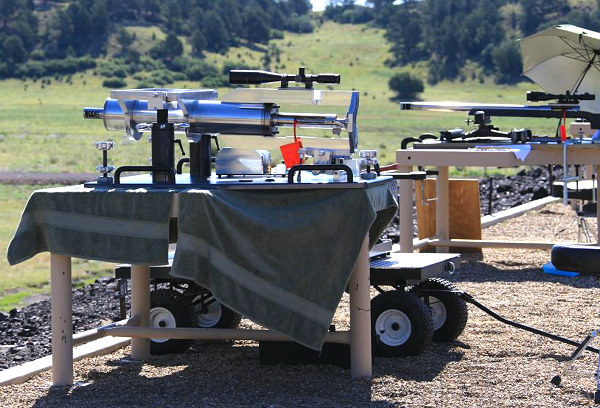


 If you haven’t tried Lapua bullets yet you should. The Scenar-L bullets we have tested have proven extremely consistent in weight and base-to-ogive measurement.


