For folks in the gun industry, the third Monday in January is the best day of the year. Held in conjunction with SHOT Show, Industry Day at the Range lets us try out dozens of new rifles and pistols, as well as meet top gun designers and friends in the shooting sports. We saw some very great new products this year. Here are some of the most interesting “take-aways” from Industry Day at the Range, held in Bolder City, Nevada on January 22, 2018.
New Guns + Old Friends
Meeting old friends, and shooting new guns. That’s what Monday was all about at the annual Industry Day at the Range, a “hands-on” preview the day before SHOT Show opens in Las Vegas. Your Editor met with old buddy Jason Baney at the crack of dawn and headed out to the Boulder City (NV) range.
We were not disappointed — there was plenty to see this year. On display were a bunch of new precision rifles, a slew of new handguns, and some very exotic optics.
Most Interesting New Rifles
Tikka T1x — Tikka’s New Rimfire Rifle is a Winner
The new Tikka T1x doesn’t disappoint. The bolt operates smoothly. The action feels solid and refined — like a good centerfire action. The trigger is excellent — it breaks cleanly with no creep or grittiness, and we’re told it can be easily adjusted below 2 pounds pull weight. The stock has a good feel in the hand and doesn’t flex — unlike some cheap Tupperware stocks you’ll find on some domestic rimfires. In addition, the action has the same footprint as the Tikka T3, so you can swap this .22 LR action into any stock that fits a T3. Overall this was the single rifle this Editor shot on Industry Day that I would really want to own.
Ruger Precision Rimfire — Baby Brother to the Ruger Precision Rifle
We test-fired the new Ruger Precision Rimfire. Unfortunately, with the wobbly setup and no paper targets, we could not really evaluate accuracy. Function is good, but we couldn’t call the bolt movement smooth. The trigger is not bad. Most of the chassis from the handguard rearward is reinforced polymer so the gun is pretty light. The + 30 MOA Picatinny rail is nice.
Above you can see the Ruger Precision Rimfire with its big centerfire brother, the Ruger Precision Rifle. Initial reports say that Ruger’s new rimfire rifle shoots well with affordable .22 LR ammo. Here’s a report from Forum Member RICHK: “Took mine to the range today, and ran eight (8) brands of ammo through it. Three worked really well. The best, Federal Match 22, shot .145 inch groups at 50 yards. Fine rifle.”
SAKO TRG 42 A-1 in .338 Lapua Magnum
Here is a handsome, beautifully-machined big-bore tactical rifle with all the bells and whistles. Firing from a high-tech tripod with Crux Ordnance rifle mount, our buddy Jason drilled steel at 500+ yards with the big .338 Lapua Magnum Sako. It’s awfully nice when you don’t have to pay for the ammo and they don’t mind if you take home the superb Lapua brass. This is a high end rig for serious engagements.
Savage Model 110 Line with AccuFit Comb and Buttpad Inserts
Savage showed off its new-for-2018 Model 110 Line-Up with the new Accufit system of cheekpiece/buttpad extensions that allow shooters to customize comb height and LOP. But, we were more interested in what you can’t see — the new internal aluminum chassis.
As part of Savage’s new Accustock system, a long aluminum sub-chassis serves as a bedding block for the action and provides general stiffening for the stock. That’s smart engineering. This video shows how the Savage internal chassis works. We highly recommend you watch this video:
Ritter & Stark SX-1 Modular Tactical Rifle
We liked the new Ritter and Stark Rifle SX-1 Modular Tactical Rifle from Germany. Fit and finish is very good. This is an honest competitor to the Accuracy International rifles. This rig is designed to allow rapid barrel changes for three chamberings: .308 Winchester, .300 Winchester Magnum, and .338 Lapua Magnum. Ergonomics were good — the grip was comfortable and we like the fact that the butt adjusts for vertical position. Notably, the scope rail is mounted on the barrel itself, and the bolt locks directly into the barrel. This patented system allows scope, rail, and barrel to be swapped out as one integrated assembly, which should definitely help maintain zero when barrels are exchanged.
Kriss Vector SBR — Full-Auto Fun and Firepower
We got a chance to shoot the 9x19mm version of the Kriss Vector Gen II SBR (Short Barrel Rifle) in FDE (Flat Dark Earth). This is a full-auto, pistol cartridge short-barrel rifle that uses Glock mags. It has a handy fire control selector so you can shoot it in single-shot, two-shot, or full-auto modes. This was a hoot to shoot. We’ve shot full-auto 9mm Uzi subguns in the past and this Kriss was easier to hold on target (and more accurate). Recoil was negligible. This is offered in four calibers: .357 Sig, 9x19mm, 10mm, and .45 ACP. MSRP is $1569.00, but civilians can’t buy this.
Best New Handguns
We viewed hundreds of pistols, shot a dozen or so, and came away with three we really liked. Here is a stunningly expensive 1911-type STI race gun, a handsome new 9mm Kimber, and a very innovative new polymer pistol from Europe, the Archon Type B.
STI 2011 DVC Open Race Gun — Four Grand Worth of Zing and Bling
At $3999.00, this is probably the most expensive comp pistol we’ve ever seen. This STI 2011 DVC Open features a host of “go-fast” features including relieved slide, gold-tone TiN barrel with extended compensator, over-size Dawson Precision Magwell, mounted C-More 8-MOA optic, and a special lever for fast slide racking. If you want to win, this might be a good investment, but this Editor kept thinking “this pistol costs more than my car is worth…”
Kimber Aegis Pro 9mm with 4″ Barrel
This is a 1911-style pistol with some interesting features. It combines a full-size bobtail frame with a shorter 4″ barrel. This makes the gun balance very nicely and it’s a bit more compact for carry. The trigger pull was outstanding, and recoil was mild with the 9mm Luger chambering, so this gun was a pleasure to shoot. This Editor would like to have one of these. The slide is machined to fit a Red Dot sight. For gun games and action pistol comps, the Red Dot really speeds up the aiming process.
Archon Firearms Type B with Ultra-Low Bore Axis
Developed in Italy, Made in Germany, and backed by the big RUAG company, the new Archon Type B 9mm pistol is one of the most innovative semi-auto handguns we’ve seen in years. The Type B boasts a patented barrel system. It is not the classic Browning tilting barrel. The Type B’s barrel is not fixed; however, it moves only a few millimeters up and back as the slide retracts. That barrel geometry allows the slide to be exceptionally low. And the frame design puts the web of your hand up high. Those design features really do help tame perceived muzzle lift. This gun was easy to shoot, and the sights came back on target very quickly.
Trends in Ammunition
On Industry Day at the Range, all ammo is free. So you can shoot to your heart’s content without worrying about cost (or picking up your brass). This year we noted that many gun-makers supplied Federal Syntec ammo with distinctive red, polymer-encapsulated bullets. The polymer coating cuts barrel fouling, and also reduces ricochets and “splashback” on steel targets:
Winchester also unveiled an interesting line of Hybrid-X ammunition. This has a dual-element bullet. The rear section of the bullet is jacketed with a heavy element core. The front half of the bullet has a shaped, polymer matrix cone. This hybrid design offers improved penetration PLUS greater energy delivery inside the target as the bullet separates into multiple elements. You can see how this works in the Ballistic Gelatin photo below.
Suppressed Weapon Systems (SWS) had a rack of rifles with very fat barrels — barrels that served double duty. These barrels are, effectively, extremely long suppressors. The conventional barrel unit is combined with a full-length sound moderator, offering exceptional noise reduction. In the photo above, every rifle in the front side of the rack has an SWS integral suppressor/barrel system. This is interesting technology.
With two dozen shooting bays, plus an elevated shooting station with targets out to 400 yards, there is plenty of action. Here’s the layout:
Next best thing to being there — this 5-minute video, filmed in 2015-16, shows all the activities on Media Day at the Boulder Rifle and Pistol Club. It’s a great overview of the event where over 1700 media members and buyers gather to test and evaluate the latest (and greatest) guns and shooting accessories introductions from over 200 manufacturers.
Hey guys, you’ll probably want to download this new Powder Burn Rate Chart issued by Hodgdon/IMR. This recently-released table includes the latest IMR powders including the Enduron series (IMR 4166, 4451, 4955, 7977), shown in green below. Please note, the chart is not limited to Hodgdon and IMR propellants. It also includes popular powders from Accurate, Alliant, Norma, Ramshot (Western), Vihtavuori, and Winchester.
This chart provides useful information for all hand-loaders. When doing load development, and testing one powder versus another, it’s generally wise to choose propellants that share the same relative burn rate, as least for starters.
NOTE: Hodgdon powders are shown in blue, IMR standard powders are shown in yellow, IMR Enduron powders are shown in green, and Winchester powder are shown in red. DOWNLOAD Chart HERE.
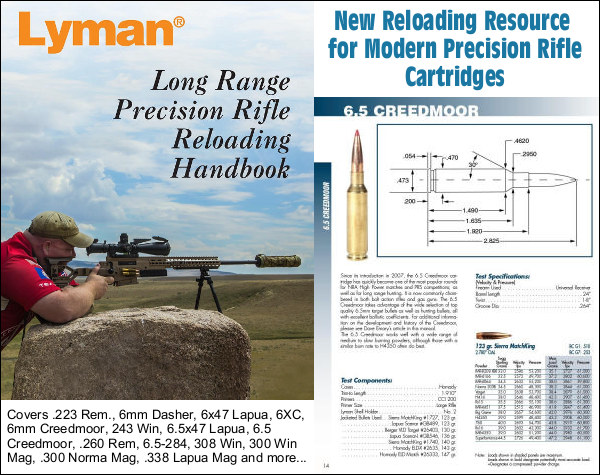
Lyman Products is offering a new reloading resource, the Lyman “Long Range Precision Rifle Reloading Handbook”. With the growing interest in Precision Rifle Series (PRS) events and Extended Long Range matches, Lyman saw the need for an up-to-date, reliable print resource for precision long range competitors. Lyman says this is “The first-ever reloading manual specifically written for the growing sport of precision long range shooting.”
Lyman’s new book covers the most popular cartridge types, and the premium components used by top shooters. The book covers the vast majority of popular cartridge types used in long range precision shooting. You’ll find .223 Rem, 6mm Dasher, 6×47 Lapua, 6XC, 6mm Creedmoor, .243 Win, 6.5×47 Lapua, 6.5 Creedmoor, .260 Rem., 6.5-284 Norma, .308 Win, .300 Win Mag, .300 Norma Mag, .338 Lapua Mag and more. The data section includes Berger and Lapua target bullets, as well as Sierra MatchKings and Hornady ELDs. A wide range of propellants from Accurate, Alliant, Hodgdon, IMR, Norma, VihtaVuori, Ramshot, and Winchester are reviewed.
Lyman Handbook Includes Articles by Leading Experts and Top PRS Shooters
The new handbook also includes articles by top PRS shooters and industry experts. Articles such as “PRS How-To” and “Rifle Systems for PRS” by Matt Gervais provide expert info and tips and techniques to start competing. An authoritative article by Hornady’s Dave Emary, “The History and Design of the 6.5 and 6mm Creedmoor” explains why these cartridges have become so popular for PRS and other applications. Emary’s “Reloading Considerations for Long Range Ammunition” is also highly recommended for both novice and experienced hand-loaders.
“As the leader in reloading data, we saw a need for an accurate and reliable source of reloading data for these precision, long-range loads,” said Trevor Mullen, Lyman’s Global Marketing VP. “Our process of compiling a new reloading handbook … is to work with the best in their field — reloaders, the manufacturers of ammunition and rifles, participants in the PRS sport, and our own staff of highly-skilled, highly knowledgeable test shooters. This new handbook [will help] those looking for that edge in PRS competitions.”
The “Long Range Precision Rifle Reloading Handbook”, priced at $16.98, will be available soon from online retailers. Within a short time you can also purchase the book from the Lyman web store. (It is not yet in stock).
On 1/21/18, new World Records were set under ELR Central rules for verified, consecutive three-shot string without sighters. Competitors started from cold bore, no sighters or ranging shots allowed. That’s a tough standard. In fact the first 12 shooters failed to put three shots on target at 1500 yards before Paul Phillips took his turn. Paul, Lucky number 13, placed all three of his shots on the 36″ x 36″ plate, claiming a first-ever record. Later that afternoon, John Armstrong duplicated that feat, also putting three shots on target at 1500 with no sighters.
But the best performances of all came later. Nate Stallter, shooting a .375 CheyTac, nailed his three shots at over one mile — 1768 yards. But it gets better — Nate broke his own record later in the afternoon, going 3 for 3 at 2011 yards.
David Tubb posted: “Congratulations to my son-in-law, Nate. Today he won the ELR Central World Record competition. This competition allows two separate attempts (spaced four hours apart) and consists of three cold bore shots each time. He took 3 shots and had 3 hits at 1768 yards in the morning and then beat his own record in the afternoon with 3 shots and 3 hits at 2011 yards after the wind had become trickier.”
Stallter used the new Tubb Adaptive Target Rifle (Tubb Gun) with a Dynamic Targeting Reticle and Tubb T7T two-stage trigger. He was shooting the .375 Cheytac with a 364gr Warner flatline bullet that has a patent pending Nose Ring modification in a Schneider 1:7″ twist barrel. Three of the Tubb Rifles are shown below. Note the long barrels.
As we explained, this was a tough challenge. Competitors started with a cold bore, with no sighters alowed — that makes it especially tough.
Watch this video to hear the record-setting shooters describe their equipment — chambering, action, stock, barrel, bipod, and optics. No the video is not sideways! Nearly all this video is correct, horizontal orientation. Click triangle to start correct format.
None of the competitors had shot these kind of distances at this facility, the Front Sight Firearms Training Center in Pahrump, Nevada. And the “no sighters” rule really added to the difficulty — witness the fact that the first 12 shooters failed to put three consecutive hits on a square yard of steel at 1500. Here are the three record-setting shooters:
1. Paul Phillips, 1500 yards (first record) | 2. John Armstrong, 1500 yards (tied record)
Those who understand the challenge were impressed …
Andy McNeill observed: “I’ve shot targets further too, but I didn’t go 3 for 3 with no sighters. These hit cold bore and then two consecutive follow-up shots at specific target sizes. This is what a record should be. Not I hit a target at X distance once after slinging lead at it all day.”
Jacob Scobell liked the match format: “Love that this is intentional, consecutive impacts with a fixed size target and not just a statistical probability of hitting the broad side of a barn with unlimited shots. Excellent to see a standard being set.
Now will all of these other supposed ‘world record holders’ step up and enter this competition? Sure some guy who can impact upon demand beyond 4000 yards would cake walk this right? A registered event with multiple shooters means put up or shut up.”
SHOT SHOW Edition: For this week, we are doing something a bit different. Rather than showcasing discounted Deals of the Week, for this Monday, we’re featuring new-for-2018 products that will be on display at SHOT Show in Las Vegas. We have selected new products that, we believe, offer excellent inherent value even without special discounts. You may not be able to purchase all these items right away, but expect them at major vendors by early spring.
1. Lapua .300 Norma Magnum and .338 Norma Magnum Brass
A recent development based on the .338 Norma Magnum necked down to .30 caliber, the .300 Norma Magnum was adopted as the U.S. Military’s Advanced Sniper Cartridge “for extra long ranges beyond 1500 meters”. In addition to its military duties, the 300 Norma is sure to find favor with Long Range competitive shooters and hunters. We are excited to see this impressive new offering added to Lapua’s line of outstanding cartridge brass. Along with the .300 Norma, Lapua will also produce the .338 Norma Magnum parent cartridge. That .338 NM was developed by J. Sloan and D. Kiff as a long-range sporting cartridge, based on the .416 Rigby case. Norma adopted and standardized the .338 Norma Magnum through CIP certification in 2010.
2. New T1x Rimfire Rifle from Tikka
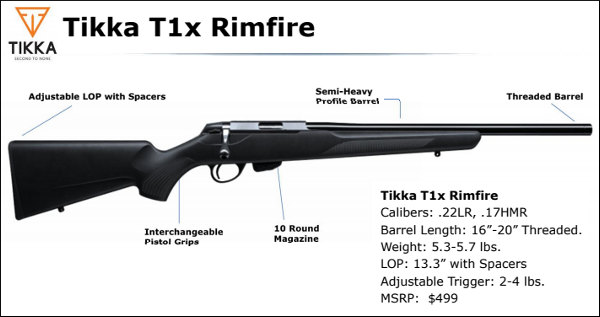
Tikka is introducing a new Rimfire rifle, the Tikka T1x. It features a medium-contour 20″ barrel with threaded muzzle, 10-round detachable magazine, and a smooth bolt throw. This will be offered in Both .22 LR and .17 HMR. The rifle boasts the feel and balance of Tikka’s centerfire line, so this can serve as a nice small-bore option for fans of Tikka hunting rifles. MSRP for the T1X is $499.00. There has been considerable shooter interest in this new Tikka which should provide competition to the CZ line of European rimfire rifles. The pricing is more than a Ruger or Savage, but much less than an Anschutz.
3. New Savage 110 Models with Adjustable Stocks
For 2018, Savage’s model 110 line-up boasts higher-quality, user-adjustable stocks. The all-new AccuFit system allows shooters to customize length of pull and comb height. The new AccuStock features a rigid chassis embedded in the stock. Savage has a full line of revamped 110s with these enhanced stocks. For example, the Savage 110 Long Range Hunter shown here features a 26″ barrel with brake, and is offered in six calibers: 6.5 Creedmoor, .260 Rem, .308 Win, 300 WSM, and .338 Federal.
4. Starline 6mm and 6.5mm Creedmoor Rifle Brass, $50/100
Starline Brass has recently added the 6.5/6mm family of cartridges to the company’s growing line of rifle cases. Starline is now producing 6.5 Creedmoor in both Large Primer pocket and Small Primer pocket versions. It also offers 6mm Creedmoor, and 6.5 Grendel. This brass will be pretty affordable, starting out at $125 for 250 cases (that works out to just $50 per hundred). Starline already sells other popular rifle brass, including .223 Rem, .243 Win, .260 Rem, and .308 Win. While this Starline brass won’t rival Lapua Brass, it may be suitable for tactical competitors who must run stages where it is impractical to recover your brass.
Lyman is releasing a beefy All-American Turret Press with eight (8) stations. That’s one more than the Redding T-7 Turret Press, and two more stations than the six-station RCBS Turret Press. With the Lyman’s EIGHT stations you can hold sizing AND seating dies for four different rifle cartridges. With eight stations available — there are countless options. Rigidity is very important with a turret press — if you have too much “give” of flex with the turret head you may get inconsistent results when bumping shoulders using full-length dies. With a heavy cast-iron frame and turret head, Lyman says its new Turret Press is “the most rugged” on the market. We like the front-mount priming system which can easily be operated with your free hand, whether you mount the press arm on the left or the right. You can purchase this press for $199.99 from MidwayUSA.
6. Ruger — Ruger Precision Rimfire, $399.99
The Ruger Precision Rimfire .22 LR rifle is so new that few vendors have them yet. But you CAN pre-order one now for $399.99 from Sportsmans Outdoor Superstore (MSRP: $529.00). For PRS shooters and Ruger Precision Rifle owners, this may be an ideal rimfire cross-trainer, with ergonomics and balance like their centerfire rig. This PRS-style .22 LR rig has some very interesting features, including adjustable bolt throw that lets shooters change from a rimfire 1.5″ bolt throw to a short-action centerfire 3″ bolt throw, reducing the chance of short-stroking your bolt in competition. The Ruger Marksman trigger adjusts from 2.25 to 5.0 pounds.
7. Vortex — New Affordable Viper HD Spotting Scopes
High-end performance at a mid-range price — the new-for-2018 Vortex Viper® HD Spotting Scopes offer impressive clarity, resolution, and color fidelity at an affordable price. The new 20-60x85mm model has a $1099.99 MSRP. That’s half the price of some other top-quality spotting scopes. The 15-45x65mm models have an $849.99 MSRP. These spotters feature HD lenses and helical-style focus. For conventience, the attachment collar allows the entire spotter to rotate. Designed for durability, the Viper HD spotter is has rubber armor, and exterior lenses are protected by ArmorTek — an ultra-hard, scratch-resistant compound that repels oil, dirt, and fingerprints. Both sizes are offered in straight and angled versions. And like all Vortex products, the Viper HD Spotting Scopes are covered by a lifetime, unconditional, no-fault, transferable, VIP Warranty.
8. MTM Cleaning Rod Case, $25.00 Street Price
Here’s a cool new product that will make it easier to stow and/or transport your precious cleaning rods. Sure you can tuck a single rod in a gun case, but what if you want to carry a variety of rods to the range? This case holds up to four (4) rods securely, and keeps solvent residues off your fine firearms. MTM’s new Gun Cleaning Rod Case is capable of storing four rifle or shotgun cleaning rods up to 47″ long. Each rod is held in an individual slot and there are foam inserts on either end, making transportation secure and rattle-free. You don’t have to worry about the rods banging into each other. We like the fact that MTM has cleverly included multi-sized “corrals” to hold patches from large to small. Plus there is plenty of room to hold jags and brushes.
9. Mossberg MVP Precision in 6.5 Creedmoor and .308 Win
The Mossberg MVP Precision looks good. It has all-new chassis with a longer fore-end up front and a fully-adjustable LUTH-AR MBA-3 stock in the back. Every rifle comes with an LBA trigger, and 20″ or 24″ threaded and free-floated medium bull barrels are standard. The action features an oversize bolt handle with a Picatinny rail on top. Available chamberings include the 6.5 Creedmoor (no surprise) and 7.62×51 (.308 Win). Mossberg will also offer combo packages fitted with Vortex Viper HS-T riflescope. Mossberg has not announced an MSRP for the new MVP Precision. However, we expect this new rifle to have a street price around $1300.00, competitive with the Ruger Precision Rifle.
ScopeSlicker NX is a weather-resistant scope cover that includes two built-in lens cloths. This smartly-designed socpe protector features two retaining bands that keep it on the scope, while providing quick access by flipping each end up to view through the scope. ScopeSlicker NX is made from premium neoprene for abrasion and impact protection. The slim-fitting neoprene cover is available in a variety of hi-resolution patterns, and fits a wide range of common scope sizes.
Over the past year, this was one of the TOP TEN most-read Daily Bulletin articles. We are reprising it today for readers who may have missed it the first time around…
When shooting pistols do your shots normally land smack dab in the middle of the target? If not, you may have some technique problems that are causing your shots to move off center. Top Shot Champion Chris Cheng has produced a good video for the National Shooting Sports Foundation (NSSF) that helps handgunners diagnose accuracy issues. By shooting 3-shot groups and looking at the pattern and location of the shots, you can see what you’re doing wrong (or right). Here are some examples. Note, this process works best for shooters whose shots fall typically in one target zone. If your shots are all over the target, your form is inconsistent and problems will be harder to diagnose.
1. Low Left — Jerking Trigger: Here we see three (3) shots at the 7 O’clock position. This shows that the shooter is jerking the trigger, meaning that the shooter is pulling the trigger too quickly and therefore forcing the barrel to drop when breaking the shot. This is a very common problem, particularly with novices who are reacting to the noise/recoil of the pistol.
2. 9 O’Clock — Too Little Trigger Finger: If we see three (3) shots at the 9 O’clock position, what this can be indicative of too little trigger finger on the trigger. And therefore with every shot, the shots are getting pushed to the left. Try moving your trigger finger on to the pad of your index finger. Also try dry firing drills.
3. High Left — Anticipating Recoil: In this next example, we see three shots around the 11 O’clock position. What could be happening here is that the shooter is anticipating the recoil, and is actually lifting the gun up when he shoots. We recommend slowing down, working on your breathing, and, again, do dry-firing drills.
4. 3 O’Clock — Too Much Trigger Finger: Finally, if you see three (3) shots at the 3 O’clock position, this can indicate that there is too much trigger finger on the trigger. Therefore when the shot breaks the shooter is pulling each shot to the right. Note: Each of these descriptions is for a RIGHT-handed shooter. If you are a left-handed shooter you’ll want to reverse those descriptions.
Let’s face it, AR-platform rifles run dirty, at least compared to typical bolt-action rifles. The AR15 works by piping gas from the barrel back into the bolt carrier, causing the bolt to unlock and the carrier to move the bolt backward. The “exhaust gas” from the barrel contains soot and carbon. The carbon will form hard deposits on the bolt. In addition, the carbon can combine with lube on the bolt carrier to make a nasty, paste-like sludge. This can be particularly problematic when the black paste pollutes the ejector and extractor recess.
This Editor has inspected dozens of ARs over the years. Other than mag-related malfunctions, the most common cause of AR cycling problems I found was oily gunk in the extractor and ejector areas. Many AR owners overlook these critical areas. Look at an AR that hasn’t been cleaned properly and you’ll probably find black gunk (and small brass shavings) in the ejector and extractor recesses.
If you want to keep your black rifle running smoothly and reliably, you must clean it regularly and follow the correct maintenance procedures. Here are three videos that explain how to properly disassemble and clean AR-platform rifles.
Take-Down and Full Cleaning of AR15 by Jerry Miculek
Here ace shooter Jerry Miculek takes down and cleans an AR-platform rifle belonging to his daughter Lena. This is a good video because Lena’s rifle was “run hard and packed up dirty” so you can see where carbon and grease build up. This 35-minute video is very thorough. Jerry is one of the nation’s top action carbine shooters, so listen carefully to his advice on cleaning and lubrication.
How to Clean Your AR-Platform Rifle
This is a good basic video that shows the take-down and cleaning procedure for a typical AR15. It uses some fast-motion sequences to speed up the story. Check out this video if you don’t have the time to sit through the Miculek video above.
Cleaning and Lubricating AR15 Bolt Carrier Group
This video offers very specific advice on the bolt carrier group, which receives the dirty gas directly from the barrel. Be sure to check the extractor and ejector recesses. That’s where old lube, brass shavings, and carbon accumulate. Follow the directions in this video for lubrication, and don’t over-lubricate the bolt carrier — that will only capture more carbon.
When you make a reloading mistake, you may need to “pull down” assembled ammo. The embedded UltimateReloader.com video demonstrates how to use the Hornady Cam-Lock bullet pulling system.
When Reloading Goes Bad — The Danger of Over-Charging
Our friend Gavin Gear of UltimateReloader.com was recently reloading some 9mm pistol ammo with his Hornady progressive press. As part of his reloading procedure, he visually checks the cases — and he noticed that the charges seemed high. Sure enough, his most recently-produced rounds were about two grains over spec. He diagnosed the issue: “I was using a powder measure without a baffle. What happened was, over the course of the loading session, things settled in, and the charge level increased.”
Not knowing just when his powder measure started delivering too much powder, Gavin decided, for safety’s sake, to pull down all the ammo he had just reloaded. Yes that’s time-consuming, but it’s better than the alternative — having a dangerous Kaboom while shooting. With fast-burning pistol powders, a two-grain over-charge could cause a blown case, damaged firearm, and/or serious injury.
Watch Cam-Lock Bullet Puller Used to Remove Bullets from Loaded Ammo:
Use of Bullet Puller starts 4:00 minutes into video.
Gavin says it is vitally important to perform safety checks during the reloading process: “You’ve got to do it — check every single round to make sure there IS powder, and that there’s not too MUCH powder. Double, Triple, Quadruple check your components… and your powder charges. You can’t be too careful.”
To pull down a loaded round, first place the cartridge in the shellholder on your press ram. Then raise the round up into the bullet puller device installed where a die would go. The Hornady Cam-lock bullet puller works by clamping the bullet in a collet when you flip down the red-coated lever. Then, with the case held by the rim in the shell-holder, the bullet exits the cartridge as the press ram is lowered. It takes time, but it’s pretty fool-proof once you get the hang of it. This entire process is illustrated in Gavin’s video, starting near the four-minute mark.
The Hornady Cam Lock Bullet Puller has four (4) key components: 1. Cam-Lock die body; 2. Cam-Lock lever; 3. Stem; and 4. Collet (Caliber-specific).
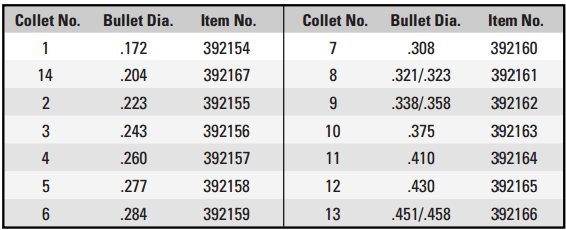
NOTE: In order to use this tool, you’ll need the appropriate collet for each diameter range of bullets you intend to pull. For example use collet #3 for 6mm, collect #6 for 7mm, and collet #7 for .308 Caliber.
The 2018 CMP competition rules are now approved and posted on the CMP website. The 2018 CMP Highpower Rifle and Pistol Competition Rules and the 2018 CMP Games Rifle and Pistol Competition Rules can be downloaded on the CMP Competition Rules Page.
Evolution of CMP Competition Rules
There are a number of important CMP Rule changes for 2018 that are spelled out below. CMP Competition Rules have undergone major changes in the last few years that were aimed at modernizing the CMP competition program and promoting greater participation in rifle and pistol target shooting. In 2015, rule changes expanded the types of pistols that can be used in EIC and National Match Service Pistol events and introduced the immediately popular CMP 22 Rimfire Pistol Distinguished program. The most significant 2016 change was the authorization for Service Rifle shooters to use optical sights with 4.5X max magnification. 2017 saw the introduction of a new classification system, rules for electronic targets and the addition of rules for “Alternative Rifles” and “Match Rifles”.
Important Rules Changes for 2018
The biggest change in the 2018 Rules is the introduction of a two-track system for conducting CMP-sanctioned Highpower Rifle Matches. Highpower Rifle events can now be conducted as either traditional “National Trophy Rifle Events” where there are no sighting shots and competitors start rapid-fire series from standing or as “CMP Cup Match Events” where sighting shots are allowed before each stage and competitors start rapid-fire series in position. All EIC Rifle Matches and Camp Perry National Trophy Matches will continue to be conducted according to National Trophy rules, with no sighters and rapid-fire starting from standing. The CMP Cup Matches, which are scheduled at the beginning of the 2018 CMP Highpower Rifle Matches at Camp Perry on 23-25 July, and the CMP Cup Matches, which are included in the 2018 CMP Travel Games programs, will be conducted under Cup Match rules with sighters and rapid-fire stages starting in position.
The rules for CMP As-Issued Military Rifle and Pistol events and Rimfire Sporter Matches remain unchanged in this regard. These events typically allow sighters at the beginning of each course of fire. Competitors start rapid-fire series from standing, but any competitors who are 70 or over or who have physical limitations that prevent them from readily standing and getting back into position are allowed to start rapid-fire series in position.
Otherwise the 2018 CMP Games Rifle and Pistol Rules, which include Rimfire Sporter Rifle Rules, have only minor changes from the 2017 edition.
National Records — Rules providing for the official recognition of National Records in open and junior categories in CMP-recognized events were added for 2018. The CMP is compiling its first list of official records and will post it on the CMP website as soon as it is ready. To be recognized as National Records, scores must be fired in the National Matches or in competitions conducted by the CMP staff such as CMP Travel Games or National Range Matches.
CMP Smallbore Matches Coming to Camp Perry
Traditional smallbore rifle championships are returning to Camp Perry in 2018 and rules for those events are being drafted now. The 2018 National Matches Calendar features six days of CMP Smallbore Rifle shooting on 17-22 July. There will be two days of smallbore position and four days of smallbore prone shooting, along with one full day of Rimfire Sporter Rifle competition on 22 July. Provisional CMP Smallbore Rifle Rules will be released in the next few weeks.
Electronic Targets — A new section has been added to the CMP Rulebooks to help explain and clarify the CMP’s Electronic Scoring Target Rules. See Rule 7.0 in the CMP Competition Highpower Rifle and Pistol Competition Rules or Rule 9.0 in the CMP Games Rifle and Pistol Competition Rules.
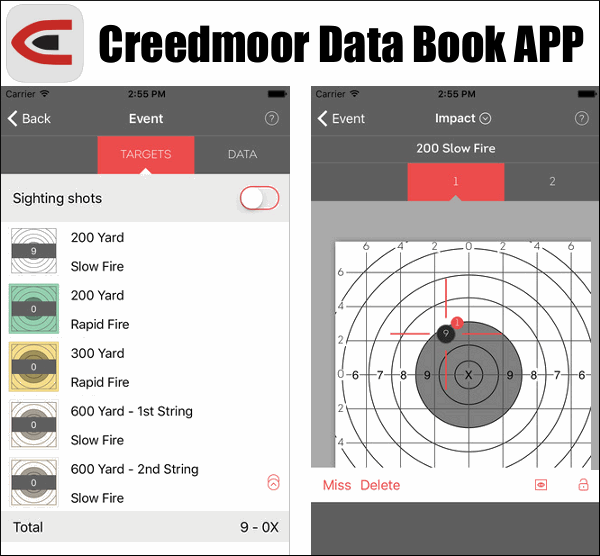
Tired of hauling around an old-fashioned Score Book and making entries with pencil and paper? Well now you can go digital — Creedmoor Sports has released a full-featured Scoring Book App that lets you plot your shot locations using an iPhone, iPod, or iPad (Apple tablet). The price is right — just visit the iTunes store to download the App for FREE.
Record Match and Practice Data
This new App, available for free in the Apple App Store, and the Google Play Store provides all the same functions and capabilities of the traditional Creedmoor print Data Book, but with the convenience and ease of recording your match and practice information with your iPhone or tablet. With this App you can break your 20 shot slow-fire segments into either 10- or 20-shot targets, and also opt for sighting shots. All the specific event data can also be recorded, such as location, wind, light etc., along with wind and elevation adjustments.
COMMUNICATIONS Restrictions: In some matches you are not allowed to have electronic communication ability, so you may have to set your iPhone to “Airplane Mode”, or use this only with an iPod (which does not have two-way communication capability).


 Savage showed off its new-for-2018 Model 110 Line-Up with the new Accufit system of cheekpiece/buttpad extensions that allow shooters to customize comb height and LOP. But, we were more interested in what you can’t see — the new internal aluminum chassis.










 Tired of hauling around an old-fashioned Score Book and making entries with pencil and paper? Well now you can go digital —


