The Hickory Groundhog and Egg Shoot, the richest varmint shoot East of the Mississippi, is just two days away. Now in its 38th year, the popular Hickory Shoot will be held this Saturday, April 7, 2018 starting at 8:00 am. The event is hosted the first Saturday of April each year by Larry Willis of Bull’s Eye Sporting Goods, (704) 462-1948. The basic entry fee is just $25.00 per gun. That’s cheap for a chance to win a bundle of cash, plus valuable prizes such as Shehane stocks and Nightforce optics.
The Hickory Groundhog and Egg Shoot is the best event of its kind in the Southeast. Yes, conditions can be challenging (with mirage and switchy winds), but you can win big. In years past over $7,000 worth of prizes and cash has been awarded. Shooters can also compete in an Egg Shoot for cash and other prizes. The event is held near Hickory, North Carolina.
Hickory Shoot Course of Fire
The normal course of fire consists of three sets of paper groundhog targets at 100, 300, and 500 yards, and NO Sighters. They do have a bench for handicapped shooters that can not get down in the prone position. Most competitors will shoot at the head at 100 yards because the points are higher. At the longer distances, 300 yards and 500 yards, most shooters go for body shots on the paper groundhog target. The Hickory employs “worst-edge” scoring, meaning if you cut a scoring line you get the next lower score.
Anatomy of a Hickory-Winning Rig — Brady’s Record-Setting 6BR
If you wonder what kind of rifle can win the big money at the Hickory Shoot, have a look at Terry Brady’s 42-lb 6BR. In 2010, Terry won the Custom Class in the Hickory Shoot, setting an all-time record with a 99 score. Terry was shooting a straight 6mmBR rifle, purpose-built for Groundhog shoots, which have no weight limit in Custom Class. The fiberglass Shehane Tracker stock was stuffed with lead shot from stem to stern, so that the gun weighs nearly 42 pounds with optics.
Relays Run Like Clock-Work
The shoot is run very smoothly, with one relay shooting while the next relay waits outside the shooting area, ready to go. Once a relay is done, shooters grab their items and exit on one end of the shooting platform while the next relay comes in from the other end. The relays move through in rapid succession.
You must quickly set up and get ready because as soon as the target pullers get back they are ready to shoot. When the fire command is given you have two minutes to get your three shots off at that distance. When the cease fire is called you quickly grab your gear and get off the shooting platform because the next relay is coming in.
The Sureshot Armament Group (SAG) has developed a modular aluminum chassis for the vintage, straight-pull Swiss K31 rifle. This chassis transforms an old classic into a modern, fast-cycling tactical rig. The SAG Lightweight K31 Rifle Chassis is CNC-Machined from aluminum. Hard anodized, it weighs just 2 lbs. 13 ounces. It offers adjustable cheek piece and butt-pad, with a three-inch LOP adjustment range. Believe it or not, installing a vintage K31 into this SAG stock is an easy bolt-on process. No modification of the K31 action is required.
The chassis-builder SAG states: “The main idea behind the SAG Lightweight K31 Rifle Chassis was to give the shooter …ergonomics of a Tube-gun but with lines of the classic rifle. The chassis ‘wraps’ the shooter around the rifle, moving bolt operation under the shooters cheek to allow the marksman to maintain cheek weld during the whole shooting series.” The chassis design also allows a more forward optics placement for better eye relief.
SAG Lightweight K31 Rifle Chassis Features:
CNC-Machined Aluminum with hard-anodized matte finish
Easy bolt-on installation to Swiss K31
Adjustable Cheek Piece (0-30mm)
Adjustable Buttpad to set LOP (11.5” – 14.5”)
KEYMOD Interface on fore-end and buttstock
Accepts any AR-type pistol grip
Overall chassis weight: 2 lbs. 13 oz. (1280 grams)
Chassis MSRP: €950 ($1163.00 USD)
About Switzerland’s Original Karabiner Model 1931 (K31)
The Karabiner Model 1931 (K31) is a magazine-fed, straight-pull bolt action rifle. It was the standard issue rifle of the Swiss armed forces from 1933 until 1958, though examples remained in service into the 1970s. It has a 6-round removable magazine, and is chambered for the 7.5×55mm Swiss Gewehrpatrone 1911 cartridge (aka GP 11).
Wiki Photo by Bouterolle, CC BY-SA 3.0
Although the K31 is a straight-pull carbine broadly based on previous Swiss “Schmidt–Rubin” service rifles and carbines, the K31 was not designed by Colonel Rudolf Schmidt (1832–1898) as he was not alive in 1931 to do so. Mechanical engineer Eduard Rubin (1846–1920) was the designer of the 7.5×55mm Swiss ammunition for which previous Swiss service rifles and the K31 are chambered. The Karabiner Model 1931 was a new design by the Eidgenössische Waffenfabrik in Bern, Switzerland under Colonel Adolf Furrer (1873–1958). The Karabiner Model 1931 replaced both the Model 1911 rifle and carbine and was gradually replaced by the Stgw 57 from 1958 onwards.
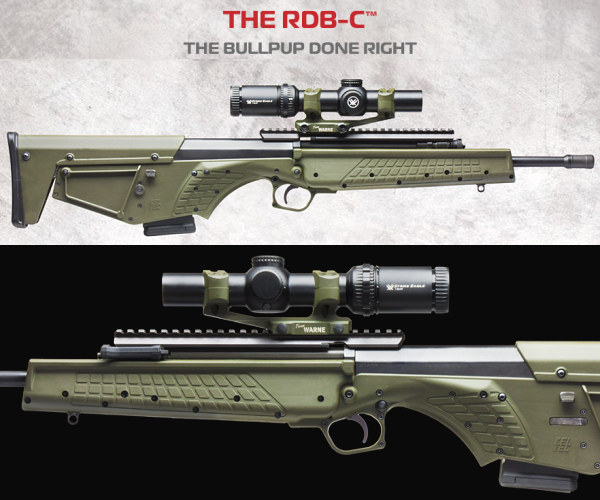
KelTec offers a semi-auto bullpup rifle which it claims is “Left Coast Compliant”. Presumably, this “featureless” rifle can be sold in California because it does not have a pistol grip, or other “evil” features disfavored by gun-phobic California politicians. This rig, the KelTec RDB-C “Hunter”, has been offered in .223 Remington and 6.5 Grendel*.
We actually like the looks of the new KelTec RDB-C, which was first introduced in 2016. The ergonomics seem sensible, and this rifle should be easy to stow and transport. KelTec also says that the cartridge ejection system is user-friendly: “[The] downward shell ejection system eliminates the side ejection disadvantage of ordinary bullpups. The result is brass and gas that eject out of your line of sight making it a truly ambidextrous, high performance rifle for everyone.”
KelTec also includes a gas pressure control with the RDB-C. This lets you control the cycling rate to suit different types of ammo. That’s smart. KelTec explains: “The RDB is also adjustable for a wide variety of ammunition and makes for an excellent suppressor host.”
6.5 Grendel Version Tested in 2016
*When the RDB-C rifle was introduced in 2016, KelTec listed 6.5 Grendel as a chambering, along with .223 Rem. One YouTube video shows a 6.5 Grendel RDB-C reviewed and then test-fired. Watch video at 14:00 time-mark. However, this 6.5 Grendel chambering is NOT currently listed on KelTec’s website.
The new 39th Edition of the Blue Book of Gun Values is releasing this month. You can purchase this popular price guide through Blue Book Publications for $49.95. Or save ten bucks by ordering from MidwayUSA for $39.99. The Blue Book of Gun Values by S.P. Fjestad is the leading gun valuation resource. There are now 1.8 million copies in circulation worldwide. This book continues to be the “Bible” for buyers, sellers, collectors, and connoisseurs in the firearms industry.
Blue Book of Gun Values, 39th Edition, April 2018
2512 Pages with 1700 gun makers and nearly 23,000 gun descriptions
This new 39th Edition contains new-for-2018 firearms makes and models, with important pricing updates on many current and discontinued models.
Features of the new Blue Book of Gun Values:
· 2018 makes and models have been included, with many new handguns and rifles.
· 2,512 Pages covering nearly 1,700 manufacturers and trademarks, with almost 23,000 gun model descriptions.
· 500,000+ up-to-date values are provided. No other book has more.
· Important pricing updates on major trademark current, antique, and discontinued models, including Colt, Winchester, Smith & Wesson, and Ruger.
· The 80-page color Photo Percentage Grading System (PPGS) has been revised, making firearms grading even easier and more accurate.
· More information, more values, and more history than any other guide on the market.
Sample Page from Blue Book of Gun Values:
Review by Tom Gresham, Gun Talk Radio Host
“At some point, every gun owner asks the question, ‘What’s it worth?’ The leading reference for decades has been the Blue Book of Gun Values. Whether you are a seller, a buyer, a shopper, or just curious, this constantly-updated gold mine of research is your friend.”
Here’s a record-setting rimfire benchrest rifle owned by our friend Joe Friedrich.
The experts at ELEY Limited, top rimfire ammo-maker, have posted a helpful guide to cleaning rimfire barrels. We reprint highlights of the article below, but we suggest you read the full article on the Eley website: How to Clean Your Rifle the ELEY Way.
Editor’s Comment: This is not the only way to clean a rimfire barrel. There are other procedures. This is the method recommended by ELEY based on decades of experience with the top smallbore shooters in the world, including many Olympic Gold Medalists. Some shooters have been very successful cleaning less frequently, or using different types of solvents. The ELEY method is a good starting point.
Rimfire Barrel Cleaning
1. Clean the extension tube with a 12 gauge brush and felt or tissue moistened with solvent.
2. Smoothly insert a cleaning rod guide into the receiver.
3. Apply a dry felt to the cleaning rod adapter and push it through the barrel to the muzzle in one slow steady movement. As the felt is dry it may feel stiff.
4. Remove the soiled felt and pull back the cleaning rod.
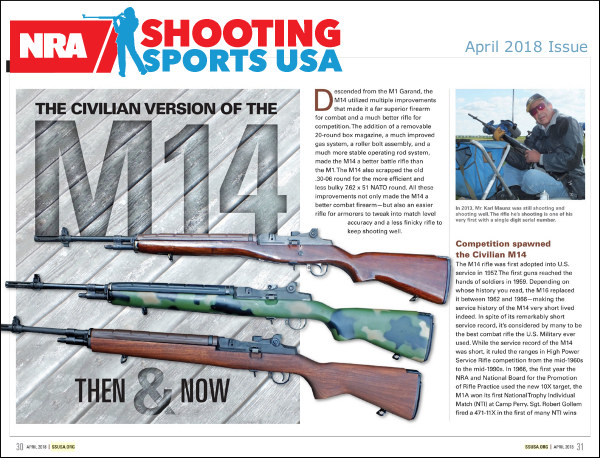
“Descended from the M1 Garand, the M14 utilized multiple improvements that made it a far superior firearm for combat and a much better rifle for competition.” — Dick Jones, Shooting Sports USA.
In the April 2018 issue of Shooting Sports USA, you’ll find a good article on the civilian version of the M14, now sold commercially as the Springfield M1A. An evolution of the battle-proven M1 Garand, the M14 was designed to shoot the 7.62×51 (.308 Win) round instead of the larger .30-06 Springfield cartridge used in WWI, WWII and Korea. While the vast majority of today’s M1As are chambered for .308 Win/7.62×51, Springfield Armory also produces a 6.5 Creedmoor version.
Dick Jones reports that accurized M14/M1As could post remarkable scores: “The accuracy potential of the M14/M1A is unquestionable. During their reign as service rifles, they produced multiple perfect 200 scores at 600 and 1000 yards in the hands of top shooters. This is a difficult feat with a modern, scoped, magnum-caliber rifle and remarkable with an iron-sighted battle rifle. Good competition rifles can group 10 shots under one MOA, and the meticulously-massaged rifles used by the top shooters during my career would consistently put up 10 shots under an inch at 200 yards off a test cradle.”
For many years, the semi-auto version of the M14 was “top dog” in iron sights Service Rifle competition. Now that discipline is dominated by .223 Rem (5.56×45) AR-type rifles, but the bigger .308-caliber rifle, now sold as the M1A, remains popular. The CMP hosts a major M1A Match every year at Camp Perry, sponsored by Springfield Armory. Significant prizes are awarded. M1A Match competitors took home over $25,000 worth of cash and merchandise in 2016.
In this video, YouTube Reviewer Hickok 45 compares the M1 Garand and the M14/M1A:
See how the modern M1A is built in this Springfield Armory Video:
As racing improves automobiles, competition improves firearms, and the current crop of Springfield M1As, from the Basic to the top-of-the-line Super Match and Loaded models, reflects the years of development. The M14 and its variants are still in service today and it’s still considered by many to be the best battle rifle in the history of the U.S. Military. — Dick Jones, Shooting Sports USA
For blastin’ small varmints (such as ground squirrels) out to 200 yards or so, it is hard to beat the little 17 HMR rimfire cartridge. Yes there are much more powerful centerfire varmint rounds, and the newer 17 WSM rimfire offers more velocity, but the 17 HMR offers a winning combination of accuracy and affordability, plus there are many excellent 17 HMR factory rifles with a variety of stock options. We like the Savage A17 with thumbhole stock. Volquartsen also makes fine 17 HMR rigs, including this rifle belonging to Top Shot Champion Dustin Ellermann. Dustin says this rig has shot half-MOA groups at 100 yards with CCI A17 ammunition.
For Those Serious Varmint Safaris — 2000 Rounds of 17 HMR
Fans of the 17 HMR who shoot a lot of rounds during varmint season should rejoice at this latest offer from Midsouth Shooters Supply — 2000 rounds of Hornady 17 HMR V-Max for $339.00. That’s a very good deal that works out to $8.47 per 50-round box. This Hornady ammo typically sells for about $11-$12 per box ($11.69 at MidwayUSA), so you can see this is a very attractive offer. 2000 rounds may seem like a lot, but we’ve shot up to 400 rounds in a single afternoon on a West Coast Squirrel Safari.
At the request of our readers, we provide select “Deals of the Week”. Every Monday morning we offer our Best Bargain selections. Here are some of the best deals on firearms, hardware, reloading components, optics, and shooting accessories. Be aware that sale prices are subject to change, and once clearance inventory is sold, it’s gone for good. You snooze you lose.
1. Amazon — Sig Kilo 1250 Rangefinder, $179.99
Hunting season is coming soon. That means going through your gear check-list before you head to deer country. If you don’t have a quality, compact Laser Rangefinder, here’s a great deal. The 6x20mm SIG Kilo 1250 Camo Rangefinder is now on sale for under $180.00. This is a very accurate LRF, that ranges deer-sized targets at long distances quickly. The scan mode is very fast (4X per second) and this offers both line of sight (LOS) or angle modified range (AMR). The unit is compact and light — a bonus for hunters. There are more expensive Laser Rangefinder that can range farther, but this $179.99 Kilo 1250 will definitely do the job on a hunting trip for one-third the price. NOTE: Check multiple Amazon vendors for current free shipping offers.
2. MidwayUSA — Norma Match-22 Ammo, 1500 Rounds, $99.99
This Norma Match-22 ammunition is good stuff. In many rifles it shoots as well as $8/box products from other makers. But now you can get Match-22 for the equivalent of $3.33 per 50-round box when you buy 30 boxes. MidwayUSA is selling 1500 rounds of Match-22 (three 500-round cases) plus an ammo can for just $99.99. That works out to just 6.7 cents per round. If you don’t need that much .22 LR ammo, you can also buy 500 rounds for $39.99. We think you’ll be happy with this Norma Match-22 ammo. It is a good choice for tactical cross-training, rimfire silhouette, and fun shooting. This Editor just ordered a 1500-round can.
3. Bruno Shooters Supply Sale — Save on Optics, Bullets, Brass Etc.
Bruno Shooters Supply is running a major Spring Sale. Lapua brass, powder, Berger bullets, Sierra bullets, rimfire ammo, optics, chronographs — all this and more is on sale at Bruno’s right now. But you have to act quickly. This storewide sale ends April 2, 2018 at 11:59 pm. You snooze, you loose. NOTE: You don’t need a special discount code — the sale prices are already shown online. No Back-orders with special sale pricing. As part of the Spring Sale, Bruno’s is also offering free shipping on Krieger barrels, Jewell triggers, and LabRadar chronographs.
4. Brownells — Howa 1500 Barreled Actions, Starting at $259.99
Howa makes excellent, smooth-running actions, and the Howa HACT 2-stage trigger is WAY better than most domestic factory triggers. Right now you can save big bucks on Howa 1500 barreled actions, complete with HACT trigger and trigger-guard, starting at $259.99. Both regular actions and Mini Actions are offered. Available chamberings include 6.5 Grendel, 6.5 Creedmoor (back-ordered), 7.62×39, .308 Winchester, and .300 Win Mag. Some of these barreled actions come with a rugged Cerakote finish, while others have a blued finish. You can also get FREE Shipping with Code MDV during checkout. But note, this item requires delivery to an FFL-holder.
5. CDNN Sports– Walther Creed 9mm Pistol, $269.99
The Walther Creed offers excellent ergonomics, good accuracy, and well-designed controls at a killer price — $269.99 at CDNN Sports. This gun, designed to be a value-leader, emulates Walther’s more expensive PPQ model (MSRP $649.00) at a much lower price. The Creed’s frame size and shape is the same as the PPQ, but the Creed lacks interchangeable backstraps. Slide and trigger are very similar. The Creed features a snag-free bobbed hammer. Testers have praised the new Creed, saying that, despite the bargain price, it “sacrifices little to nothing in… ergonomics, accuracy, and reliability.”
6. FosPower 10200 mAh Waterproof Charger, $25.99
When you’re at the range or on a hunt, it’s smart to have a USB-output battery pack for smart phone, target-cam monitor, even a LabRadar. There are many battery packs available, but most are fairly fragile, with exposed ports. This “ruggedized” FosPower 10200 mAh charger is different. It is waterproof, dust-proof, and shock-proof. (IP67 certified: dust and water resistance for up to 3ft/1m for 30 minutes under water.) It can handle all that a PRS competitor or hunter can dish out. It even has a handy LED light. Right now it’s priced at $25.99 with FREE Shipping (on orders over $25.00).
7. Grafs.com — Lyman Pro-Touch Digital Scale, $44.99 (42% Off)
We like this little Lyman Pro-Touch scale for the price — $44.99. No this compact digital scale won’t compete with a $700 Force Restoration balance that can measure a half-kernel. But this little Lyman is good enough for range loading, and for other tasks, such as sorting bullets and brass by weight. Graf’s $44.99 price is a genuine bargain. Lyman says the scale has “accuracy to 1/10th grain with anti-drift technology”. It can run with supplied AC adapter or three AAA batteries. This very same scale sells for $79.59 right now on Amazon. You can save over 40% by buying from Grafs.com this week.
8. Amazon — Jialitte Scope Bubble Level, $12.49
All serious rifle shooters need a scope level. This nicely designed Jialitte Scope Bubble Level features a 30mm milled inside diameter, plus an inner insert ring so it will also fit 1″-diameter main tubes — that dual-diameter versatility is a nice feature. We also like the way the unit is nicely radiused, and has a low profile in the middle. Price is just $12.59 with free shipping. User reviews have been very positive. You could easily pay $35.00 or more for a 30mm scope level. Purchasers have praised this product — nearly all verified buyers rated this five stars.
These Six-inch “splatter” targets display a bright yellow ring around each bullet hole. We like these adhesive Glow Shot targets for practice at 300-600 yards. The neon yellow on black provides high contrast so you can easily see 6mm bullet impacts at 600 yards. The 6″-diameter is one-MOA at 600 yards — a good aiming center size. Priced at just $14.99 for a sixty-count package, these are a good value compared to the larger Birchwood Casey Splatter Targets. Note: This Glow Shot target is also available in a Red Circle version, and Tri-Color version (red, yellow, and green).
Vihtavuori markets a full line of quality, European-made powders for rifles and pistols. Finland-based Vihtavuori is operated by the same parent company, Nammo, that owns Lapua and Berger Bullets. If you haven’t tried Vihtavuori powders yet, you may be pleasantly surprised. For loading .45 ACP, our favorite powder is VV N320 — it burns clean and is very accurate. Likewise, VV makes excellent powders for rifle applications — from small varmint cartridges to large magnums.
New Reloading Data Released Vihtavuori offers free reloading data on its website, and through a free Mobile App. And now those resources are even more complete…
Last week, Vihtavuori added new reloading data for ten different cartridge types, including some of the most popular pistol and rifle cartridges. You’ll find new pistol data for 9mm Luger and .45 ACP, and extensive new load data for .223 Rem, .260 Rem, .308 Win, and .30-06 Springfield (among others). Overall the 2018 data update features over 20 new bullets, with more than 140 new lines! All new data is also available in FREE Vihtavuori Reload App for iOS and Android. The updated online information supplements Vihtavuori’s Reloading Databases, which have dedicated sections for Rifle Cartridges, Pistol Cartridges, and Cowboy Action.
New Reloading Data is available for these TEN cartridge types:
The much-loved Shilen SWAP MEET will take place in Ennis, Texas on Saturday, April 14, 2018 from 8:00 am through 2:00 pm. This will be the first year at Shilen’s new location which boasts a much bigger production building. If you are looking for some great bargains on gun gear, and are near the Dallas-Fort Worth area, definitely mark this date on your calendar. The Shilen Swap Meet is one of the best events of its kind, and Team Shilen will even be providing a delicious lunch to attendees.
VISIT SHILEN’S NEW LOCATION!
Team Shilen says: “After a busy year and lots of changes Shilen is excited to host this year’s Swap Meet in our new location and show off the new building. We hope that you will come and see the new building and bring lots of stuff to sell or trade with others.” ANYONE can come and ANYONE can be a vendor. There are NO entry or vendor fees and we will persevere rain or shine. There will be gun stuff everywhere –buy and sell as much as you like. There will be complementary lunch, as always.
SWAP MEET Scheduled HIGHLIGHTS
Watch Barrel-Making. A Shilen crew will run barrel-making machines from 8:00 am to 11:00 am. Watch precision barrels being made. The techs will answer all your questions about the process.
Sign up for Door Prizes — Shilen Merchandise. There will be multiple drawings for free or discounted Shilen apparel or merchandise. Go to the sign-up table to be entered in the drawings, which will be held at 9 am, 10 am, 10:30 am, 11 am, and 1 pm.
Get Shilen Barrels at Huge Discounts. “Swap Meet Barrels” will be put out at 8:00 am! These barrels were originally ordered by Shilen customers throughout the year, but orders were canceled or customers changed their mind on contour, chamber, etc. These barrels were placed back in stock for resale. When Swap Meet Time arrives any such barrels still remaining in stock are sold at huge discounts to Swap Meet Customers Only. NOTE: These barrels are in NO WAY factory “seconds” or any lower quality. The warranty on these barrels is the same as any other Shilen barrels.
Sell Your Own Gear. At the Shilen Swap Meet, you can Bring Your Own Table (BYOT). Register to sell anything gun-related: presses, reloading gear, stocks, triggers, scope rings — you name it. Vendor Space is available on a first come-first served basis, starting Saturday morning at 7:00 am. Email or call Shilen for more information. NOTE: Sellers will be entered in a separate Vendor Drawing at 1:00 pm Email: comments@shilen.com. Call: 972-875-5318
TIPS for Visitors: The SWAP MEET wraps up at 2:00 pm. The best stuff sells fast, so if you are looking for something particular get here early! Keep an eye on the Shilen’s Swap Meet page for a preview of Vendors and the products they’ll be selling.


 Relays Run Like Clock-Work




 The experts at