Is long range shooting going to become a big-money sport like golf? Well the North American Long Range Shooting Association (NALRSA) thinks so. This relatively new organization is running a series of matches with huge money pay-outs for the top shooters.
The next NALRSA Match is happening next weekend (August 18-20) in Saguache, Colorado. Remarkably, the organizers will be offering $35,000 in total prize money, making this one of the richest rifle matches of the year:
“$35,000 dollar guaranteed payout in Colorado! Yes you read that right! As promised we are adding money into the Format 2 competition. We are going to guarantee $5,000 in each category #5 and #7. So get signed up! We have a vision at NALRSA to turn Long Range Shooting into a ‘real’ sporting event with BIG payouts just like so many other sporting events. Help us grow the sport and become a part of our exciting events!”
This guy knows a thing or two about long range shooting.
Yep, that’s our buddy Erik Cortina (left) with the $6,250 First Prize check he received for finishing first in NALRSA’s Bandera (TX) match held in May.
What you see above is what happens when you shoot the wrong powder in a muzzle-loader. Specifically, a charge of smokeless powder was used instead of black powder or black powder substitute. The difference in energy (by weight and volume) between black powder and modern smokeless powder is huge. You should never, ever run smokeless powder in a black powder recipe. The result can be catastrophic. In this case the hapless shooter lost a couple fingers. So he got a free twin-digit amputation, thanks to his reloading mistake. The lesson to learn here is to always double-check your propellant before loading. And never “re-bottle” smokeless powder into a different container with a different label (or worse yet, no label at all).
This incident happened in Indiana a couple years back. As reported by the Indiana Dept. of Natural Resources (DNR), this was a classic case of “user error”: “Corporal Eric Doane worked a firearm accident last night in Martin County that resulted in the shooter losing a couple fingers. This is what can happen when you shoot smokeless powder out of a muzzle-loader designed for black powder.”
Top Shot former Champion Dustin Ellerman likes his Volquartsens, and we can see why. With his latest 17 HMR rimfire varminter, he’s seen some outstanding accuracy with CCI ammo. On his Facebook page, Dustin reports: “Prepping for prairie dogs and I’m floored by this cold, sub-half-inch group shot with the Volquartsen Custom 17 HMR at 100 yards.” This thumbhole-stock rifle features a Bowers Group USS suppressor, and 3-12x56mm Meopta Scope. Dustin tried different types of CCI 17 HMR ammo. This small group was shot with CCI A17 ammo.
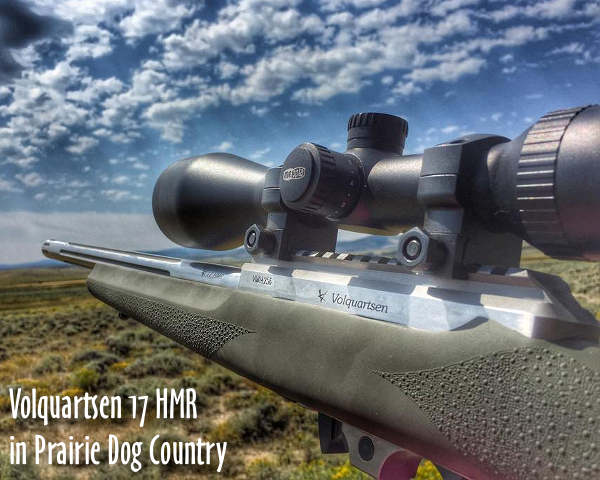
A couple years back Dustin took another Volquartsen 17 HMR on a Prairie Dog hunt in Wyoming. He was impressed with the rifle (shown below) and the little rimfire cartridge. Dustin says the effective range of the 17 HMR is farther than one might expect: “I made hits out to 300 yards. 200 yards was easy as long as the wind wasn’t too bad.”
Here’s the Volquartsen 17 HMR Dustin used in Wyoming in 2015:
After that 2015 P-Dog expedition, Dustin became a fan of the 17 HMR cartridge: “Never paid it much attention before now because the ammo is five times more expensive than .22 LR and I mostly target shoot. However, for prairie dogs, the 17 HMR is amazing!” Consider this — Hornady’s 17 HMR ammo pushes a 17gr V-Max bullet at 2550 fps, twice as fast as typical .22 LR rounds.
The F-Class World Championships (FCWC) commence today at the Connaught Ranges outside Ottawa, Ontario, Canada. We wish good luck to all the competitors. Based on the conditions at the recent Canadian F-Class National Championships, conditions could be challenging.
F-Class World Championships EVENT SCHEDULE: Friday, August 11 (REST DAY – RANGE CLOSED)
Competitor Check-In for FCWC; Rifle Inspection; International Teams Reception
Saturday, August 12: Opening Ceremonies; ICFRA FCWC (Individual)
Sunday, August 13: ICFRA FCWC (Individual)
Monday, August 14: ICFRA FCWC (Individual); Awards Prize Giving
Tuesday, August 15: TEAM PRACTICE DAY
Wednesday, August 16: ICFRA FCWC (Teams)
Thursday, August 17: ICFRA FCWC (Teams): Awards Prize Giving & Closing Ceremonies
Tips for Success at the F-Class Worlds — #1, Avoid Train Wrecks
As an assist to all the competitors, we’re repeating an article by Bryan Litz, which many have found very helpful — how to avoid “Train Wrecks” at major championships.
When you have a major, critical problem at a shooting match, i.e. a “train wreck”, this can be the end of your weekend. In this article, Ballistics Guru Bryan Litz talks about “train wrecks” — the big disasters (such as equipment failures) that can ruin a whole match. A recent USA F-TR Champion, Bryan illustrates the types of “train wrecks” that commonly befall competitors, and he explains how to avoid these “unmitigated disasters”.
Success in long range competition depends on many things. Those who aspire to be competitive are usually detail-oriented, and focused on all the small things that might give them an edge. Unfortunately it’s common for shooters lose sight of the big picture — missing the forest for the trees, so to speak.
Consistency is one of the universal principles of successful shooting. The tournament champion is the shooter with the highest average performance over several days, often times not winning a single match. While you can win tournaments without an isolated stellar performance, you cannot win tournaments if you have a single train wreck performance. And this is why it’s important for the detail-oriented shooter to keep an eye out for potential “big picture” problems that can derail the train of success!
Train wrecks can be defined differently by shooters of various skill levels and categories. Anything from problems causing a miss, to problems causing a 3/4-MOA shift in wind zero can manifest as a train wreck, depending on the kind of shooting you’re doing.
Below is a list of common Shooting Match Train Wrecks, and suggestions for avoiding them.
1. Cross-Firing. The fastest and most common way to destroy your score (and any hopes of winning a tournament) is to cross-fire. The cure is obviously basic awareness of your target number on each shot, but you can stack the odds in your favor if you’re smart. For sling shooters, establish your Natural Point of Aim (NPA) and monitor that it doesn’t shift during your course of fire. If you’re doing this right, you’ll always come back on your target naturally, without deliberately checking each time. You should be doing this anyway, but avoiding cross-fires is another incentive for monitoring this important fundamental. In F-Class shooting, pay attention to how the rifle recoils, and where the crosshairs settle. If the crosshairs always settle to the right, either make an adjustment to your bipod, hold, or simply make sure to move back each shot. Also consider your scope. Running super high magnification can leave the number board out of the scope’s field view. That can really increase the risk of cross-firing.
2. Equipment Failure. There are a wide variety of equipment failures you may encounter at a match, from loose sight fasteners, to broken bipods, to high-round-count barrels that that suddenly “go south” (just to mention a few possibilities). Mechanical components can and do fail. The best policy is to put some thought into what the critical failure points are, monitor wear of these parts, and have spares ready. This is where an ounce of prevention can prevent a ton of train wreck. On this note, if you like running hot loads, consider whether that extra 20 fps is worth blowing up a bullet (10 points), sticking a bolt (DNF), or worse yet, causing injury to yourself or someone nearby.
3. Scoring/Pit Malfunction. Although not related to your shooting technique, doing things to insure you get at least fair treatment from your scorer and pit puller is a good idea. Try to meet the others on your target so they can associate a face with the shooter for whom they’re pulling. If you learn your scorer is a Democrat, it’s probably best not to tell Obama jokes before you go for record. If your pit puller is elderly, it may be unwise to shoot very rapidly and risk a shot being missed (by the pit worker), or having to call for a mark. Slowing down a second or two between shots might prevent a 5-minute delay and possibly an undeserved miss.
4. Wind Issues. Tricky winds derail many trains. A lot can be written about wind strategies, but here’s a simple tip about how to take the edge off a worse case scenario. You don’t have to start blazing away on the command of “Commence fire”. If the wind is blowing like a bastard when your time starts, just wait! You’re allotted 30 minutes to fire your string in long range slow fire. With average pit service, it might take you 10 minutes if you hustle, less in F-Class. Point being, you have about three times longer than you need. So let everyone else shoot through the storm and look for a window (or windows) of time which are not so adverse. Of course this is a risk, conditions might get worse if you wait. This is where judgment comes in. Just know you have options for managing time and keep an eye on the clock. Saving rounds in a slow fire match is a costly and embarrassing train wreck.
5. Mind Your Physical Health. While traveling for shooting matches, most shooters break their normal patterns of diet, sleep, alcohol consumption, etc. These disruptions to the norm can have detrimental effects on your body and your ability to shoot and even think clearly. If you’re used to an indoor job and eating salads in air-conditioned break rooms and you travel to a week-long rifle match which keeps you on your feet all day in 90-degree heat and high humidity, while eating greasy restaurant food, drinking beer and getting little sleep, then you might as well plan on daily train wrecks. If the match is four hours away, rather than leaving at 3:00 am and drinking five cups of coffee on the morning drive, arrive the night before and get a good night’s sleep.”
Keep focused on the important stuff. You never want to lose sight of the big picture. Keep the important, common sense things in mind as well as the minutia of meplat trimming, weighing powder to the kernel, and cleaning your barrel ’til it’s squeaky clean. Remember, all the little enhancements can’t make up for one big train wreck!
We’ve used a variety of target cam systems — When you get a good one, they are a great tool for training and load development, and just fun shooting.
Over the past five years we’ve tested many target cam systems. To be frank, some have been disappointing, but we think the Caldwell Target Cam System works well. A number of our Forum members have purchased this system and the reviews have been generally quite positive — image quality is good, reception is good, software is good, and storage cases work well. The only complaint is that the flexible camera arm can droop with time. READ Target Cam Forum Reviews.
Caldwell Target Cam Review by Nando-AS
“I have been using the Caldwell camera for over a year and it works great for me in every respect. I use it mainly at 600 yards, but I have also used it at 1000 yards successfully. In my case, as opposed to the experience posted by Snakepit (see below), the flexible arm that supports the camera is as tight as when it was brand new. The only thing that has broken so far is the plastic top on one of the two stakes supplied to steady the tripods to the ground. Instead of the stakes, I now use a couple of heavy shooting bags. I just place one bag over one of the legs of the tripod, and that is good enough.”
Target Cam Output with camera placed 600 yards from shooter:
Target Cam view at 600 yards: Blue ring is three inches, outer circle is six inches. I use a Samsung Tablet to display the image. I zoom in when actually shooting — so each target fills the screen.
Caldwell Target Cam Review by Shoot4Fun
“Caldwell Target Camera owner here. It comes neatly packed in a soft case and even has two stands for the camera/transmitter and the receiver units. I have only used it to 500 yards though they do call it a one-mile system. The resolution is very good and it has some neat features for capturing and labeling your targets. I did buy two Tallantcell USB packs to power it but it has internal batteries as well. The App works with my iPad or my iPhone and I’m sure there is an Android version too. I see them on sale from time to time at under $375 complete.”
Caldwell Target Cam Review by SnakePit
“I have the Caldwell Target Camera system and it works great. I mainly use it at 600 yards and the transmitter has enough power that I do not have to use the receiver at the bench for my tablet or cell phone. But Caldwell needs to do something with the flexible arm that holds the camera to the tripod. It becomes loose after a while and the camera wants to droop down. Caldwell sent me a replacement flexible arm but it is starting to have the same problem. You can get it to work when this happens but it can be a hassle. Other than that it is a great system for the price and I would buy another one.”
Important Features of a Target Cam System
Key qualities you’ll want in a target cam system are: ease of set-up, good video resolution, effective range (good signal quality/strength), good battery run-time, and the ability to use WiFi-enabled devices for viewing. Caldwell’s new Long-Range Target Camera offers all these things, making it an impressive new product for the price — $359.95 at Midsouth Shooters Supply. Some other target cam systems on the market cost twice as much, yet lack key features of the Caldwell system.
Watch Video, Record Video, Capture Stills, Measure Group Size and more…
The Caldwell LR Target Camera is very versatile, allowing you to both watch and record video and/or stills on any WiFi-enabled device. A free iOS/Android Mobile App allows you to record video, save still pictures, add notes, calculate group size, and save session info. This video shows the complete set-up process and how to use the free App. It shows actual Target Cam output on a WiFi-enabled tablet:
Caldwell LR Target Camera Features:
— High Definition (720p) camera delivers sharp image with good detail.
— WiFi output is compatible with Android, iPhone and most tablets.
— System can stream live HD video, record video, and save still images.
— Camera, transmitter, and receiver are contained in sturdy, waterproof housings.
— Breaks down into custom-fitted storage case for easy transport.
— Rechargeable Lithium-Ion batteries run system for up to 6 hours continuously.
— External power jack for more permanent installation.
— Target Camera Mobile App for iOS and Android devices.
— Includes two collapsible, tripod-base Antenna/router stands.
— Positionable, spring-loaded camera clamp.
The 2017 Canadian F-Class Championships have concluded. As the event preceded the 2017 F-Class World Championship (in the same venue) by a few days, many of the world’s best F-Class shooters were on hand at the Connaught Ranges outside Ottawa, Ontario. Competition was fierce — as were the winds at times. The challenging conditions gave shooters a good test in preparation for the FCWC which gets underway in earnest on Saturday, August 12, 2017.
Kevin Chou Wins Second Straight F-TR Canadian Title
Canada’s Kevin Chou (Aurora, ON) shot great to win the F-TR match with a strong 426v30 score. This made was two wins in a row for Kevin, who also took the F-TR Title in 2016. Two Yanks completed the podium, with Jeff Rorer (420v25) taking second place, and Robby Burton (418v25) placing third.
Rhys Ireland Wins F-Open Canadian Championship
The F-Open Championship was a tightly-fought match that went down to the wire. Rhys Ireland won the Individual F-Open Championship with a 434v30. Just one point behind at 433v39 was Australia’s Rod Davies. Third, again just one point back, was Canadian Barry Price (433v30).
Team USA (Litz) Wins F-TR Team Championship
American F-TR Teams managed a clean sweep of the top three places in the 4-shooter LUM Team Match. Team USA Litz secured the team victory with a 875v71 score. Finishing second in F-TR was USA Team Swartzkopf (871v74), followed by Team USA Hardin (870v72).
Who can explain the lines and dots on this shot tracking chart used by Bryan Litz?
F-TR Team USA (Litz) members (alphabetically) Douglas Boyer, Robby Burton, Dan Lentz, Monte Milanuk; Bryan Litz (head coach), Stan Pate (asst.)
Team USA (Nancy) Wins F-Open Team Title
The F-Open 4-shooter Team Competition was also dominated by American squads which finished first and second. Winning F-Open Gold, with a score of 888v98, was Team USA (Nancy), coached by Nancy Tompkins, America’s “First Lady of Shooting”. Finishing second was Team USA (Walker) with 887v100, followed by the Canadian F-Open Team at 887v90.
F-Open Team USA (Nancy) was packed with talent. Shooters were: Shiraz Balolia, Ken Dickerman, James Laney, and Pat Scully. Another American deserves mention, John Myers of the Texas F-Open Team. We believe John’s 225v27 was the high score for the team match, and he was the only competitor to shoot “clean”, not dropping a point.
Sebastian Lambang, inventor/builder of SEB Rests, competed in the Canadian Championships. Over half the competitors used SEB rests — Joy-Pods for F-TR and NEOs and MINIs for F-Open.
Conditions were windy and challenging at the 2017 Canadian F-Class Championships. Will the strong winds continue for the F-Class World Championships (FCWC) starting tomorrow, August 12, 2017. Only the wind gods know for sure. Good luck to all the FCWC competitors from all nations!
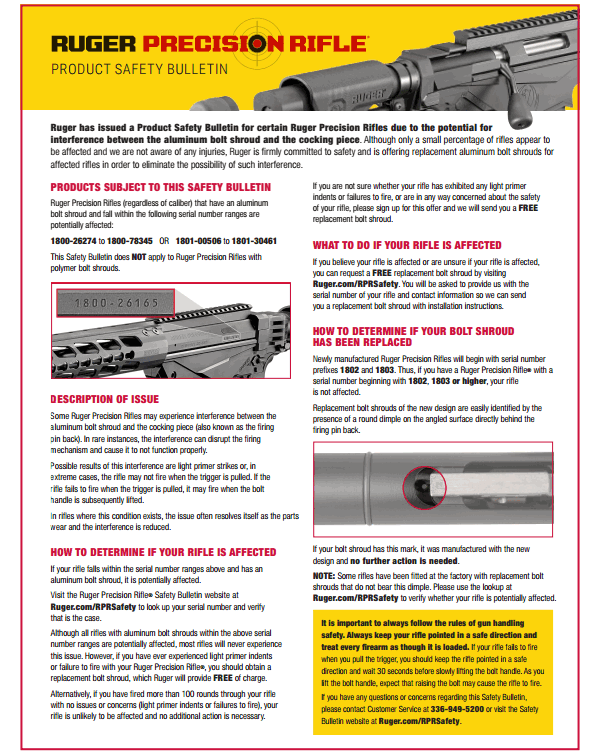
Ruger has issued a Product Safety Bulletin for certain Ruger Precision Rifles due to the potential for interference between the aluminum bolt shroud and the cocking piece (also known as the firing pin back). This can lead to light primer strikes. The real problem is that: “If the rifle fails to fire when the trigger is pulled, it may fire when the bolt handle is subsequently lifted”. NOTE: Ruger Precision Rifles with polymer bolt shrouds are NOT affected.
Although only a small percentage of rifles appear to be affected and there are no reported injuries, Ruger is offering replacement aluminum bolt shrouds for affected rifles in order to eliminate the possibility of bolt/shroud interference. View Safety Bulletin PDF
AFFECTED RIFLES: Ruger Precision Rifles (regardless of caliber) that have an aluminum bolt shroud and fall within the following serial number ranges are potentially affected:
SN 1800-26274 to 1800-78345 OR SN 1801-00506 to 1801-30461
If you believe your rifle is affected or are unsure if your rifle is affected, you can request a FREE replacement bolt shroud by visiting Ruger.com/RPRSafety.
DESCRIPTION OF ISSUE
Some Ruger Precision Rifles may experience interference between the aluminum bolt shroud and the cocking piece (aka the firing pin back). In rare instances, the interference can disrupt the firing mechanism and cause it to not function properly. Possible results of this interference are light primer strikes or, in extreme cases, the rifle may not fire when the trigger is pulled. If the rifle fails to fire when the trigger is pulled, it may fire when the bolt handle is subsequently lifted. In rifles where this condition exists, the issue often resolves itself as parts wear and interference is reduced.
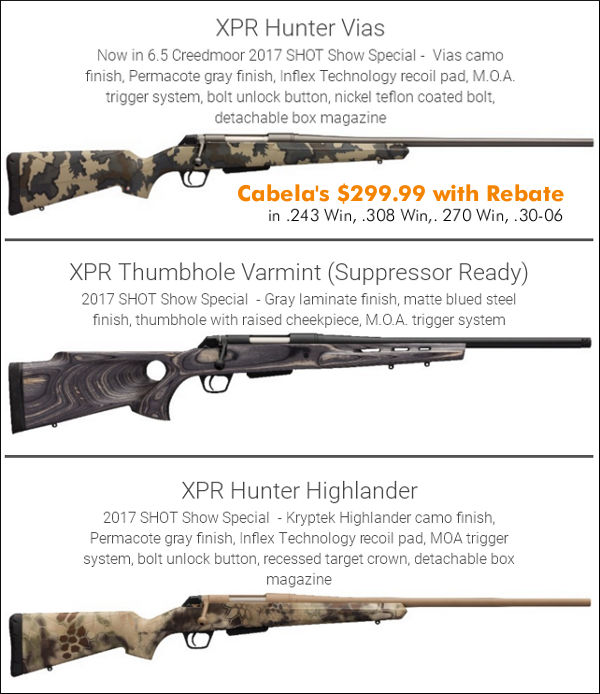
Are you or a friend/family member looking for a good hunting rifle at a great price? Check out this promotion for the Winchester XPR. This is a fine-handling rig with a smooth bolt and some of the best camo finishes you can get. Right now at Cabelas.com the Winchester XPR in Vias Camo is on sale for $399.99. But here’s the kicker, Winchester is offering a $100.00 Mail-In Rebate. That drops your net cost to just $299.99. That’s an insanely good deal.
You’ll also find other versions of the Winchester XPR on sale at other vendors. Here are some of our favorite XPR variants (and there are a dozen others):
The Winchester Rebate is good through September 30, 2017. It also applies to Winchester SX3, SX4, and SXP Shotguns. CLICK HERE for Rebate Form.
Written by Sierra Bullets Ballistic Technician Paul Box
Judging by the calls I’ve had through the years, I think some shooters might be placing too much importance on Ballistic Coefficient (B.C.). The best example of this comes from a call I had one day. This shooter called wanting the ballistic coefficient of one of our Sierra bullets. After I told him he seemed a little disappointed, so I ask him what his application was. Long range target, deer hunting in the woods? Talk to me.
As it turned out, he hunted deer in open timber. He very rarely shot beyond 100 yards. I pointed out to him that, under 200 yards, B.C. has little impact. Let’s compare a couple of bullets.
Let’s look at the trajectory of a couple of bullets and see how they compare. The .30 caliber 180 grain Round Nose #2170 RN and the 180 grain Spitzer Boat Tail #2160 SBT. The round nose has a B.C. of .240, while the SBT is .501. Starting both bullets out of the muzzle at 2700 FPS [with a 100-yard ZERO], at 200 yards the #2170 RN impacts 4.46″ low while the #2160 SBT impacts 3.88″ low. That’s a difference of only 0.58″ in spite of a huge difference in Ballistic Coefficient. If we compare out at 500 yards, then we have a [significant drop variance] of 14.27″ between these two bullets. [Editor: That difference could mean a miss at 500 yards.]
Distance to Your Prey is the Key Consideration
In a hunting situation, under 200 yards, having a difference of only .58” isn’t going to make or break us. But when elk hunting in wide open spaces it could mean everything.
The next time you’re choosing a bullet, give some thought about the distances you will be shooting. Sometimes B.C. isn’t everything. If you have any questions, please give the Sierra Bullets technicians a call at 800-233-8799.
American Silhouette shooter Eric Mietenkorte delivered a superb performance at the recent Canadian National Silhouette Championships in Fort Steel, British Columbia. Eric recorded a 1-2-3 Trifecta with 1st Place in Master Standard Rifle, 2nd Place in Master Hunter Rifle, and 3rd place in Master Smallbore Hunter. Eric is coming home with quite the trophy harvest. Other top shooters included Team Lapua members Mark Pharr and Cathy Winstead-Severin.
Erich called this a “target rich environment”…
Eric tells us: “The Canadian National Championships are all wrapped up. Thanks to the Bull River Shooters Association (B.R.S.A.) for hosting an incredible event! What a great [week] of shooting! Such a beautiful range with the nicest people! It was great seeing old friends and making new ones. [There were] definitely some challenging wind and mirage conditions, but lots of great shooting, and I even took home some hardware.” Erich has posted these photos from the event.
Erich was quick on the trigger shooting pigs at 300 meters. He says “I love hearing that clang from hitting the steel.” Click speaker icon to hear audio.
6.5mm Chamberings Favored for Centerfire (High Power) Silhouette
The 6.5mm caliber seems to be the “sweet spot” for High Power Silhouette shooters. Erich says: “I use the .260 Bobcat (6.5×250) wildcat. Most still use the .260 Remington and 6.5×47 Lapua.” Other popular chamberings for High Power Silhouette include the 6.5 Creedmoor, 6mmBR, 6mm Dasher, 6×47 Lapua, and 7mm-08.
One wicked cool paint job — the Fighter Plane graphics on Erich’s smallbore rifle drew admiring glances.
Here Erich spots for fellow American shooters Mark Pharr and Cathy Winstead-Severin of Team Lapua.
The Cranbrook Daily Townsman News did a nice story on the Championships, complete with this informative video.
Fort Steele in British Columbia is a beautiful venue. Stunning scenery all around…


 Is long range shooting going to become a big-money sport like golf? Well the North American Long Range Shooting Association (NALRSA) thinks so. This relatively new organization is running a series of matches with huge money pay-outs for the top shooters.




 Train Wrecks (and How to Avoid Them)
 4. Wind Issues. Tricky winds derail many trains. A lot can be written about wind strategies, but here’s a simple tip about how to take the edge off a worse case scenario. You don’t have to start blazing away on the command of “Commence fire”. If the wind is blowing like a bastard when your time starts, just wait! You’re allotted 30 minutes to fire your string in long range slow fire. With average pit service, it might take you 10 minutes if you hustle, less in F-Class. Point being, you have about three times longer than you need. So let everyone else shoot through the storm and look for a window (or windows) of time which are not so adverse. Of course this is a risk, conditions might get worse if you wait. This is where judgment comes in. Just know you have options for managing time and keep an eye on the clock. Saving rounds in a slow fire match is a costly and embarrassing train wreck.