Think Vegas in January, baby — yes, we’re talkin’ about SHOT Show (Jan. 23-26, 2018). Registration for the National Shooting Sports Foundation’s 2018 SHOT Show is now open for all Attendees, Exhibitors, and Media. Register online now at Shotshow.org. The SHOT Show hotel booking system is also active. It’s a good idea to reserve rooms early to get the best rates. SHOT Show organizers have negotiated deeply discounted rates at dozens of Las Vegas hotels, with prices as low as $56 per night. However, some of the most popular affiliated hotels are already sold out. And sometimes you can get better deals through websites such as Priceline and Trivago.com.
Scheduled for January 23-26 in Las Vegas, the big gun industry convention is just two months away. While registering, attendees can enroll in SHOT Show University, and/or sign up for other educational offerings. Sorry, the Industry Dinner is already sold out.
SHOT Show is NOT open to the general public. To attend you need to have an affiliation with a gun industry company, retailer, or media outlet. That said, thousands of non-professionals attend each year, receiving credentials from gun shops, parts distributors, retailers and the like.
SHOT Show tip from EdLongrange. We welcome user submissions.
Do you enjoy shooting pistols for sport, or perhaps you carry a handgun for self-defense? If you’re like most of us, you might benefit from a “refresher course” on the fundamentals of handgun shooting. The NRA has created a useful Infographic that covers important basics of handgun marksmanship — key things such as Sight Alignment and Trigger Control. Here are the first two (2) lessons. Click the link below to see all SIX (6) training topics: Sight Alignment, Sight Focus, Trigger Control, Breath Control, Hold Control, and Follow-Through.
Video Shows Sight Alignment, Grip, Stance, Trigger Control and More
In this USAMU video, SGT Shane Coley talks about the basics of sight alignment and trigger control. But then SGT Coley talks about other important control factors such as grip, arm position, and body stance. For rapid-fire shooting, you need to have a good arm and body positioning to control recoil and get back on target quickly. This video is a valuable complement to the NRA Infographic because it demonstrates all the important pistol fundamentals during live fire, at the range.
With good factory rifle ammo costing $1.00 per round — a Laser BoreSighter could pay for itself in just a couple range sessions.
Laser BoreSighters — fitted to your chamber — help you get on target more quickly, particularly with factory firearms. Just activate the unit, slip it into the chamber and look for the red dot on the target. The laser dot is about 2″ in diameter at 100 yards, and is visible even in full sunlight. Right now you can get HQ Issue BoreSighters for just $14.99 at Sportsman’s Guide (member price is $13.49). These units have a durable brass metal body and the battery will run an hour. Boresighters are offered for numerous popular rifle cartridge types including: .223 Rem, .22-250, 6.5 Creedmoor, .308 Win family, and .30-06 (full list below). Sportsman’s Guide also offers Pistol Laser BoreSighters for $17.99 (pistol chamberings: .38 SPL/.357 Mag, .40 SW, .44 Magnum, .45 ACP).
In-chamber BoreSighters are much safer than the kind that you insert in the end of the barrel (or attach to muzzle). If you forget your laser bore-sight placed in the end of the barrel, and then fire a round, you can blow up your barrel and/or suffer serious injury — it HAS happened,.
Sierra Bullets has recently released load data for the 6mm Creedmoor cartridge, a necked-down version of the 6.5 Creedmoor, a popular PRS, tactical, and hunting cartridge. Sierra has released very comprehensive 6mm Creedmoor load data, covering fifteen (15) different bullets from 55 to 110 grains. NOTE: Hornady-brand brass was used for Sierra’s 6mm Creedmoor load tests, not the newer, stronger Lapua 6.5 CM brass with small primer pockets. Hand-loaders using Lapua 6.5 Creedmoor brass necked to 6mm may have to adjust their loads.
Sierra writes: “As soon as the 6.5 Creedmoor was released in 2007, a 6mm version was being envisioned. After the 6mm Creedmoor demonstrated its worth at 1000 yards it began to catch the attention of Precision Rifle Series (PRS) competitors. The 6mm/6.5 Creedmoor is a great fit for those looking for an AR platform-friendly cartridge. It delivers velocities very similar to the .243 Win and yet fits the AR10 magazine length[.] The 30-degree shoulder makes this a very efficient case and helps prolong case life as well. The 6mm/6.5 Creedmoor works well with powders such as H4350, RE-17, and Ramshot Hunter for heavier long-range bullet weights. Slightly faster powders such as RE-15, Win 760, and Vihtavuori N540 work well with lighter weight bullets.”
Sierra Bullets Tested for 6mm Creedmoor Load Data
55gr BlitzKing (#1502)
60gr HP (#1500)
70gr HPBT (#1505)
70gr BlitzKing (#1507)
75gr HP (#1510)
In developing its 6mm Creedmoor load data, Sierra tested a very wide selection of propellants, two dozen overall. For the smaller bullets, fast-burning powders such as Benchmark, H4895, and CFE223 were tested. For the heavier 100+ grain bullets, Sierra tested a selection of medium-burn-rate powders including H4350, Reloder 16, Reloder 17, Varget, and Superformance. Sierra did a very thorough job. We know this information will be welcomed by 6mm Creedmoor shooters.
Don’t know what powder to try first? For the 107-110 grain bullets, if you want best accuracy and low ES/SD, our Forum members recommend Alliant Reloder 16 and Hodgdon H4350. If you are seeking max velocity with the 110-grainer, look at Hodgdon Superformance and Reloder 19.
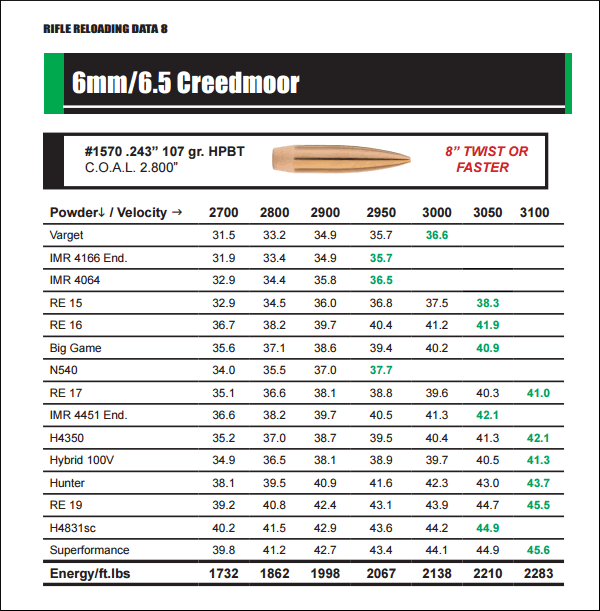
Here are Sierra’s 6mm Creedmoor Load Data Charts for the 107gr MK and 110gr MK. There are a half-dozen other tables for lighter-weight bullets.
Wintertime, the season of cold and damp, is right around the corner. There’s already snow on the ground in some parts of the country. If you want your fine firearms to remain pristine and rust-free through the winter months, it’s wise to protect then while they are stored in a safe. You should protect blued surfaces with a rust-blocker. In addition, we recommend storing guns in protective sleeves. Our take on Bore-Store Gun sleeves is simple: They work great, so buy them and use them — for ALL your valuable firearms.
These thick, synthetic-fleece sacks cushion your guns, preventing nicks and scratches. The breathable fabric wicks away moisture, and the fibers are coating with corrosion inhibitors. I personally use Bore-Stores for in-safe storage with all my guns, and I have never had one of my guns rust inside a Bore-Store, even when I lived a stone’s throw from the ocean.
Bore-Stores are offered in a wide range of sizes, so you can find something to fit everything from a Snub-nosed revolver to a 32″-barrelled 50 BMG. Rifle-size Bore Stores can be purchased for $12.00 – $21.00 from Brownells. For long F-Class or tactical rifles, we recommend the 10″x52″ Scoped Shotgun Bag, Brownells item 132-000-003. You can also order direct from the Bore-Store manufacturer, Big Spring Enterprises, www.BoreStores.com. Big Spring will also craft custom sizes on request.
Consider Military-Style, Triple-Layer Bags for Long-Term Storage
While we prefer Bore-Stores for regularly-used guns, if you have heirloom firearms that will be kept in storage for very long periods without seeing any use, you may want to grease them up and place them in the thin, but rugged three-layer storage bags sold by Brownells. The bags are made from a three-layer laminate of polyester, aluminum, and polyethylene film, with a shiny silver exterior. Though the laminate is thin, the Brownells storage bags are puncture-resistant, and have a 0% moisture transmission rating so moisture can’t get inside. These bags are also resistant to petroleum-based chemicals and they won’t break down even in contact with soil or moisture.
Here’s one VITAL bit of advice for using these bags. Be absolutely sure, before you seal up the bags, that your guns are DRY and that all metal surfaces have been coated with an effective anti-corrosive, such as BoeShield T9 or Eezox. Brownells’ storage bags are inexpensive. A three-pak of 12″x 60″ rifle sacks (item 083-055-003WB) costs just $22.99 — under eight bucks a gun. That’s cheap insurance for rifles and shotguns that may cost thousands of dollars.
Get Your Guns Out of Foam-lined Cases — They Are Rust Magnets
Just about the worst thing you can do in the winter (short of leaving your rifle outside in the rain) is to store firearms in tight, foam-padded cases. The foam in these cases actually collects and retains moisture from the air, acting as the perfect breeding ground for rust.
Remember, those plastic-shelled cases with foam interiors are for transport, not for long-term storage. Don’t repeat the mistake of a wealthy gun collector I know. He stored four valuable Colt Single Action Army (SAA) revolvers in individual foam-padded cases, and locked these away in his gun safe. A year later, every one of his precious SAAs had rusted, some badly.
Report by Boyd Allen, IBS Executive VP
The 2017 IBS 600-Yard Nationals were held October 20-21 at the Memphis Sport Shooting Association (MSSA) Range. There was a good turn-out for the event, with 80 shooters. Conditions were challenging Saturday afternoon — strong winds that put some shooters right off the target. But those who mastered the conditions earned glory. The “Top Gun” at this year’s Nationals, earning the title of IBS 600-yard National Champion, was Andy Ferguson. In winning the Two-Gun Overall, Andy turned in a truly dominant performance, recording First Place Score in both Light Gun and Heavy Gun classes, along with second in HG group and fourth in LG Group. Finishing second Overall was Gaylan Breyans, while Jim Bauer was third.
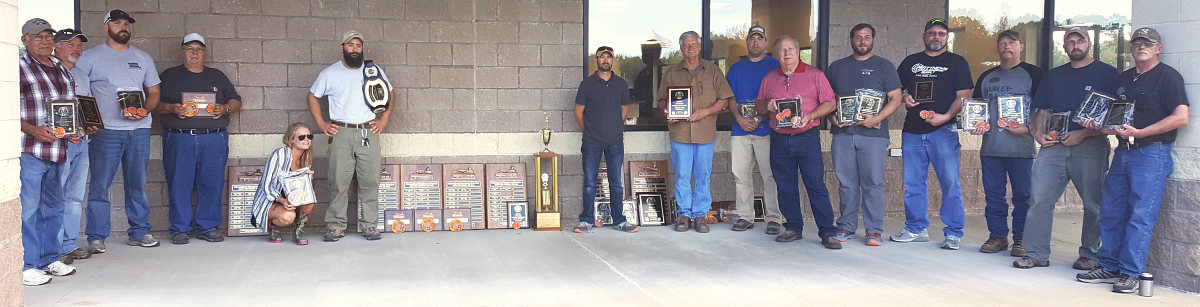
Top Shooters (L to R): Steve Wilson, Scotty Powell, Seth Wooten, Gene Ford, Lindsey Talley, Andy ”Who” Ferguson, Gaylon Breans, Jim Bauer, Justin Dale, Darrell Jones, James Lederer, Robby Miles, Jeff Godfrey, Jason Wolfe, Mike Hanes. NOTE: CLICK PHOTO for large image of top shooters.
Today’s 600-yard benchrest rigs are capable of remarkable accuracy. Even with tough conditions in the afternoons, there was some pretty impressive shooting. Out of 640 targets that were shot by 80 competitors there were 27 scores of 50, 56 groups of 2” or less, 14 of 1.50” or less, 3 groups of 1.25″ or less, and one of 1” or less. See the FULL Results for more details.
Demonstration of Winning Form — Smooth and Fast
How do you win a 600-Yard National Benchrest Championship? Here’s a video answer to that question. To see how a top shooter handles his rifle on the bench, watch the short clip below of Two-Gun Winner Andy Ferguson shooting one of his targets with his 6BR Light Gun. Andy demonstrates smooth “table manners”. He keeps his head down, running off five shots in under 15 seconds. Note how well the gun tracks, returning to Point of Aim.
Match Winner Andy Ferguson Drills Five Shots in Under 15 seconds with his Light Gun
Notably, Andy won the match shooting the “plain vanilla” 6mmBR Norma — not a Dasher, not a 6 BRX, not a 6 BR Ackley. The parent 6mmBR cartridge can still do the job, particularly in the hands of a smooth shooter like Andy Ferguson. At the Memphis range, the usual strategy is to shoot on the sighter gong just before the switch to the record and then fire all shots on the record target as rapidly as possible to stay in the same wind condition.
600-Yard Benchrest Competition — The Basics
Two Classes — Light Gun and Heavy Gun
For those that are not familiar with this 600-yard Benchrest competition, the equipment rules are the same as for 1,000-yard Benchrest. There are two classes of rifles. The Light Gun (LG) rifles are limited to 17 pounds with no stock width or buttstock angle restrictions. The front and rear of these rifles must rest on sand bags. The rear bag may not have any provision for aiming the rifle.
Heavy Gun (HG) rifles have no weight limit. Like the LGs their stocks are not limited as to width or butt stock shape. HG rear sand bags may be supported by “mechanical” rests. Return to battery rests are not allowed for either class. Both HG and LG classes may use muzzle brakes.
Match Procedures at Memphis
In 600-yard IBS Benchrest competition, targets are measured for group size and there is also a score value based on shot placement in the target rings. Prizes are awarded for group, score, and combined. Before the first record target of an Aggregate, the sighter period is six minutes. For subsequent targets in that Agg, it is reduced to two minutes. At the end of sighter period, upon command, shooters have 10 minutes to complete their record target. Aggregates consist of eight targets. Shots that do not print on the target result in that target being disqualified (DQ), as well as the applicable Aggregate.
At this year’s Nationals, shooters rotated four benches to the right after every pair of targets was shot, continuing that rotation through both days. LG was shot on Friday, HG on Saturday. Thanks to an efficient target crew and recorded match commands, shooting was over by 2:25 pm both days.
Equipment List for Top Ten Shooters
The Top Ten Shooters all ran 6mm cartridges (6BRs and Dashers) loaded with similar components. All of the Top Ten who listed their components ran Varget powder and CCI 450 primers in Lapua brass. BAT Actions were predominant, and both Nightforce and Sightron scopes were popular. The top projectiles were Vapor Trail 103s and Berger 105s.
Top Ten Equipment List CLICK HERE for longer Equipment List.
A Well-Run Match
According to all reports the entire event ran like a well-oiled machine. The target crew was quick and skilled and all of the other details were handled efficiently. Prizes and trophies were in abundance. There was even some originality. Much to everyone’s amusement, instead of the usual (boring) plaque or trophy for the Two-Gun winner, a professional wrestling-style Prize Belt was awarded. Great idea! Showing off the Champ’s Belt is Two-Gun winner Andy Ferguson (Right) with past Shooter-of-the-Year Richard Schatz.
Wicked Winds Challenge Shooters on Saturday
The conditions were variously described as “horrible”, the “worst for any match on this range this year”, and so on. Conditions were worse on Saturday than Friday, blowing like stink by the end of the day. Friday morning it was cool, humid and breezy, with a wind speed of a little over 3 mph. By mid-afternoon, when the match finished, it was 20 degrees warmer and the wind had increased significantly to about 9 mph. Saturday morning was warmer, less humid, and the wind speed was about the same as Friday afternoon. But by mid-afternoon, at the end of the match, the wind was blowing 15 mph having peaked an hour earlier at 17 mph!
Doing a little research on the Berger Bullets website, with a 105gr VLD running 2950 fps, and a 15 mph wind coming from 5 O’Clock, the bullet deflection at 600 yards would be over 17.5 inches. There were a fair number of shooters with good records that missed targets.
Good Deed by Match Director Mike Moses
Match Director Mike Moses “paid it forward” this year in Memphis. Mike learned that his friend, bullet-maker Bart Sauter, had invited a young barrel-maker, James Lederer, to the Nationals. As this would be Lederer’s first 600-yard experience, Bart was going to lend Lederer one of Bart’s rifles. But it had another maker’s barrel installed. Mike decided Lederer should, fittingly, use a barrel Lederer made himself. So Mike then chambered up one of two Lederer barrels Mike had recently purchased, and fitted it to one of his own rifles. Mike then fire-formed cases, worked up a load, and assembled ammo for the match.
Mike prepared three complete rifles (and ammo) for the match — one for himself, one for his daughter (Lindsey Talley, ace photographer), and one for James Lederer. It’s hard enough to prepare a Nationals rig for one shooter. Mike did it for three people, PLUS he ran the match.
How did it work out? James Lederer finished mid-pack on Friday, and put what he had learned to good use on Saturday, taking a solid fourth place in Heavy Gun.
Both Bart and Mike have been impressed with the quality of Lederer barrels. James has several years’ experience working for a well-known barrel-maker before designing his own computer-controlled cut-rifling machine, and opening his own one-man shop.
Bauer Power — Jim and Sally Bauer at IBS 600-Yard Nationals
Jim Bauer sends 5 record rounds down range with his “Eagle” HG in Maxi-Tracker stock.
Sally Bauer shoots sighter rounds with her Stars & Stripes HG Maxi-Tracker.
The Bauers have a great transport set-up, with custom, slide-out rifle carriers fitted to their van. You can see the two Heavy Guns featured in the videos in the lower drawer.
The Memphis Sport Shooting Association Facility
The Memphis Sport Shooting Association operates an impressive facility with ranges for rifle, pistol, and shotgun. The 600-yard benchrest range, with covered firing line, is nicely sited, with thick stands of trees left and right. There are 24 very solid concrete-top benches. Plentiful rain and sunshine provide ideal conditions for trees and grass. For those of us in the arid West, the Memphis range seems green and lush. The trees on either side offer some (but obviously not complete) protection from wind.
The range was built on land that had been an across-the-course High Power range, and the raised berms for intermediate firing lines are still present. That makes the wind bit more “interesting” when head- or tail-wind angles prevail. There are no pits. For each bench, at 600 yards, two record targets are posted one above the other with a 20” square steel sighter gong directly below. The sighter plates are repainted throughout the day during target changes. CLICK HERE for a 360-degree video view of the range from the covered firing line.
To the IBS Membership — Thanks for Helping with Match Reports
Putting together these match reports for the IBS page on Accurateshooter.com is challenging and enjoyable work. The hard part is coming up with pictures and videos. This time I have been lucky and I am thankful for that. The best part is that I get to talk to some very fine people. Thank you all for taking the time to make my work possible. I appreciate it. — Boyd Allen
Credit Randy Dawson (Birdog) for most of the images and videos used here.
At the request of our readers, we provide select “Deals of the Week”. Every Monday morning we offer our Best Bargain selections. Here are some of the best deals on firearms, hardware, reloading components, optics, and shooting accessories. Be aware that sale prices are subject to change, and once clearance inventory is sold, it’s gone for good. You snooze you lose.
1. Dick’s Sporting Goods — Black Friday Gun Safe Sale
Need a Gun Safe? Head down to Dick’s Sporting Goods on Black Friday (11/25/2017). The giant, 64-gun Stack-On Sentinel vault will be marked down from $1499.99 to $699.98, a $800 savings, and a killer deal on a BIG vault! A medium-sized 24-gun safe will sell for just $399.98 — $300 off the regular price. NOTE, if you cannot wait until Black Friday, you can still save with pre-Black Friday sale pricing right now. You’ll pay more than on Black Friday, but there are still some significant savings. For example, right now you can get the Field & Stream Pro 36-gun safe for $699.98, marked down from $899.99.
NOTE: The Biggest Discounts (in the Red Advert above) are for Black Friday, 11/25/2017 ONLY! Lesser discounts apply now.
2. Natchez — Rock Chucker Supreme Reloading Kit, $224.99
Everything you see above can be yours for just $224.99, after RCBS $25.00 Rebate. Hell of a Deal. Right now, Natchez is selling the Rock Chucker Supreme Master Reloading Kit for $249.99. Heck, the Rock Chucker press alone is worth $150.00+. The Natchez price is $70-$90 cheaper than many other vendors. Plus this Master Reloading Kit now qualifies for a $25.00 RCBS Rebate. That lowers your net cost to just $224.99. That an amazing deal considering all the hardware you get: Press, Primer Tool, Scale, Powder Measure, Loading Tray, Reloading Manual and more…
3. Midsouth — Radians Moldable Earplugs, $10.88
If you’re a shooter, you need hearing protection — serious hearing protection. Along with muffs and disposable foam plugs, custom molded hearing protection is an option. You can spend up to $100.00 per set for molded plugs at a gunshow or you can buy the Radian’s moldable plugs for $10.88 at Midsouth. If you follow the simple instructions, you can custom-mold these to our own ears in just 10 minutes. Many people feel this is the most secure and comfortable form of ear protection if you need hearing protection for many hours at a time. Five different colors are available. After molding, the units are washable, so they can be re-used many times. We recommend replacing the sets every few months.
If you read our recent report on fixed-power F-Class optics, you’ll know that a fixed-power scopes are not just for 100/200-yard centerfire Benchrest competition. These can be used for F-Class competition, varmint matches, rimfire BR, and air rifle matches. You give up some flexibility without the variable power, but the scope will be lighter, less expensive, and potentially more reliable. We do a lot of load development work with a Weaver 36X scope because it is “dead nuts” reliable. Right now the Weaver T-Series XR 36x40mm scope (Fine Cross-Hair + Dot) is just $369.99 at Natchez Shooter’s Supply. But it gets better — this side-parallax optic qualifies for a $30.00 Weaver Rebate PLUS you can get $20.00 off with Natchez Code DOT171110. So your total NET Cost is just $319.99. NOTE: You can get this XR scope with silver finish and FCH reticle for the same $369.99 price, with the same promotions.
5. CDNN — Savage 11/111 Rifle with Bushnell Scope, $349.99
Need a reliable sub-MOA hunting rifle? Here’s heck of a deal on rifle AND optic. Right now you can purchase a Savage model 11/111 for $349.99 after $100 mail-in rebate from Savage. And get this — that price includes a 3-9x40mm Bushnell Trophy scope. That’s right, you get a brand new Savage rifle plus a new Bushnell scope, all for $349.99 after rebate. Great Deal. Chose the Long Action model 111 or the Short Action model 11. Fifteen popular chamberings are offered, so you’re sure to find a caliber/cartridge that suits your hunting requirements. Choices are: .243 Win, .25-06, 6.5 Creedmoor, .260 Rem, 6.5×284 NORMA, .270 Win, .270 WSM, 7mm-08, 7mm Rem Mag, .308 Win, .30-06 Spr, .300 WSM, .300 Win Mag, .338 Federal, and .338 Win Mag.
Hornady has released a new FREE Ballistic Calculator App for iOS (Apple) and Android OS. This new Mobile Ballistic App includes Hornady’s advanced 4DOF™ calculator as well as a standard BC (ballistic coefficient) calculator. The Hornady Ballistic Calculator App is Bluetooth-enabled so it can communicate with select wind meters.
The Hornady Ballistic App is FREE but you do need to supply an email address. We found the App downloaded quickly and installed easily. While the Mobile Ballistic App is new, Hornady has offered a web-based online 4DOF Ballistic App since August 2016.
7. Amazon — Neiko Digital Calipers, $16.85
Even if you have a good set of calipers, you may want to get one of these Neiko 01407A Digital Calipers. The #1 best-selling digital caliper on Amazon.com, this Neiko tool features a large LCD Screen and measures up to 6.0 inches. With over 3000 customer reviews, this product has earned an overall rating of 4.4 out of 5 stars. It’s hard to go wrong for $16.85, even if you just use these as a spare set for measuring group sizes and case trim lengths.
8. CDNN — Ruger 9E 9mm Pistol, $279.99
There have been some great deals on polymer-framed 9x19mm pistols lately, and this is one of the best. The Ruger 9E has won many converts from Glock ranks with its comfortable ergonomics, low bore axis, and unique reversible backstrap (flat or arched) that lets you quickly customize the grip size and feel. Another nice feature is the raked front sight for easier holstering. Right now you can get the Ruger 9E for just $279.99. That’s over $200 less than a Glock 19. And though the Glock costs way more, we actually prefer the Ruger’s grip angle, sights, and controls.
9. Amazon — Mystery Deal of the Week, $649.00
Not too long ago, this big name, European-engineered item sold for $799.00 and offered best-in-class performance at that price. Now this same high-end product can be had for just $649.00 at Amazon. A key tool for hunters and tactical shooters, this compact, 6.4 oz. product offers great performance with the backing of a world-class manufacturer. If you like European electro-optics, this big-name product will help you get on target all the way out to 2000 yards. CLICK HERE to see the Mystery Deal.
Report based on story By Ashley Brugnone, CMP Writer
The CMP Travel Games will see some big changes in 2018. The Civilian Marksmanship Program (CMP) has revamped its 2018 Travel Games schedule by adding matches and establishing its own Classification System. Starting in 2018, ALL additional Travel Games matches will be held on Electronic Targets, the CMP will take over the Creedmoor Cup Matches, and all matches will now follow CMP High Power Rifle Competition Rules. Moreover, all the Individual Service Rifle Matches will now count towards the new CMP Classification System.
Electronic Targets to Be Used for Additional Travel Games Matches
In 2018, the CMP will take over the Creedmoor Cup Matches and add new events to the CMP Oklahoma and New England Games. All additional matches will use the CMP’s Electronic Target System. This shows shot location instantly on monitors next to each shooter. The Electronic Targets also eliminate the need for pit duty, so matches run more quickly and there is less work for competitors.
New Events Added to the CMP Travel Games
Additional matches added to the Travel Games include Excellence In Competition (EIC) events that will count towards the Distinguished Rifleman Badge. All regular CMP events, such as the Small Arms Firing School, various vintage rifle competitions, Vintage Sniper Match, Rimfire Match, Carbine Match, and pistol matches (except Western), will still be included on the Travel Games schedule.
File photo from 2015 Oklahoma CMP Games. Check schedule for 2018 dates.
Match Changes for CMP 2018 Travel Games:
Oklahoma CMP Cup & CMP Games Matches — two 80-Shot (800 Aggregate) Matches and a 4-Man Team Match.
Eastern CMP Cup & CMP Games Matches — The three Creedmoor 80 Shot Matches will now be changed to three 80-Shot CMP Cup Matches (800 Aggregate). A 4-Man Team Match and EIC Rifle Match will still be fired.
New England CMP Cup & CMP Games Matches — two 80-Shot (800 Aggregate) Matches and a 4-Man Team Match.
Western CMP Cup & CMP Games Matches — The three Creedmoor 80-Shot Matches will now be changed to two 100-Shot (1000 Aggregate) Matches. A 4-Man Team Match and EIC Rifle Match will still be fired.
IMR, a Hodgdon Powder Company brand, will soon release a new, slow-burn-rate magnum powder, IMR Enduron® 8133. This new powder is designed for large, magnum cartridges, such as .300 Win Magnum, .300 Remington Ultra Magnum, and 28 Nosler, among others. With the slowest burn rate among Enduron powders, 8133 has burn properties similar to Hodgdon Retumbo. The new Enduron 8133 powder will be available in 1-lb and 8-lb canisters starting in February 2018. Load Data for this new powder is already listed on the Hodgdon Reloading Data Center.
IMR® Legendary Powders now offers five (5) Enduron powders: IMR 4166, IMR 4451, IMR 4955, IMR 7977, and IMR 8133. “It was always our intent to fill out the Enduron line with a magnum powder and we could not be happier with how 8133 performed in development and testing,” says Ron Reiber, Hodgdon ballistician. “This powder delivers the [slow burn rate] magnum-caliber reloaders require and adds all of the performance characteristics of the Enduron line of powders”. These qualities include temp stability, significantly reduced copper fouling, and optimal load density.
Modern Powder Technology for Enhanced Performance
Copper fouling reduction – these powders contain an additive that drastically reduces copper fouling in the gun barrel. Copper fouling should be minimal, allowing shooters to spend more time shooting and less time cleaning a rifle to retain accuracy.
Temperature change stability – the Enduron line is insensitive to temperature changes. Whether a rifle is sighted in during the heat of summer, hunted in a November snowstorm or hunting multiple locations with drastic temperature swings, point of impact with ammunition loaded with Enduron technology will be very consistent.
Optimal load density - Enduron powders provide optimal load density, assisting in maintaining low standard deviations in velocity and pressure, a key feature for top accuracy.
Environmentally friendly - Enduron technology is environmentally friendly, crafted using raw materials that are not harmful to the environment.
The Enduron Line-Up of Five Powders
IMR now offers FIVE Enduron powders that cover a broad range of burn rates. They are suitable for a wide variety of cartridges, from small varmint cartridges all the way up to the .338 Lapua Magnum.
IMR 4166 possesses the fastest burn rate in the Enduron lineup. It is the perfect burn speed for cartridges such as .308 Win, 7.62mm NATO, 22-250 Rem and 257 Roberts. A versatile, match-grade propellant, IMR 4166 is comparable to Hodgdon® Varget.
IMR 4451 is a mid-range burn speed powder, ideally suited for cartridges such as .270 Winchester, .30-06 and 300 Winchester Short Magnum. This powder is comparable to Hodgdon H4350.
IMR 4955 is a medium burn speed powder, falling in between IMR 4451 and IMR 7977 in burn speed. It provides top performance in big game cartridges such as 25-06, 280 Remington and 300 Winchester Magnum. This powder is comparable to Hodgdon H4831.
IMR 7977 has the second slowest burn rate among the Enduron Technology powders. It yields great performance in .300 Winchester Magnum, 7MM Remington Magnum, and .338 Lapua Magnum. IMR 7977 is comparable to Hodgdon H1000.
IMR 8133 is designed specifically for magnum calibers, such as .300 Remington Ultra Magnum, 28 Nosler, or the .264 Winchester Magnum, among many others. This new powder has the slowest burn rate among the Enduron powders and compares in burn rate to Hodgdon Retumbo.
You may not be aware, but the Civilian Marksmanship Program runs a reliable, reasonably-priced maintenance/repair facility for USGI-issue rifles. Since October 2013, the CMP Custom Shop (Anniston, AL) has provided gunsmithing services for a wide range of U.S. Military rifles, specifically those issued in early eras. As well as repairs and troubleshooting, the CMP Custom Shop can upgrade, accurize, customize, and refinish the types of rifles the CMP sells.
CMP will work on the M1 Garand, M1 Carbine, 1903 and 1903A3 Springfield, the 1917 Enfield and the Krag. Other rifles like the Remington 40X, Mossberg 44, and H&R Model 12 can also be serviced. CMP will NOT work on shotguns, pistols, revolvers, M14/M1A, AR15-style rifles or other commercially-produced modern rifles. For a list of services (with prices) visit the CMP Custom Shop webpage.
NOTE: Before you can send a rifle to the CMP Custom Shop you must be a customer on file in the CMP system. Customers must meet the same eligibility requirements as for CMP rifle purchases. Once qualified, you can purchase a rifle from the CMP and have the CMP Custom Shop make modifications to it prior to shipping.
CMP Custom Shop Can Work on USGI Rifles Purchased from Other Sources
The CMP Custom Shop can work on rifles that may have been purchased elsewhere as long as they were made by a USGI contractor. Some examples include: Springfield Armory (not Springfield Inc.), Harrington & Richardson, Winchester, International Harvester, Remington, Rock Island, Eddystone, Inland, Underwood, Rock-Ola, Quality Hardware, National Postal meter, Standard Products, IBM, Irwin-Pederson and Saginaw. NOTE: There are many NON-USGI copies of the M1 Garand, 1903 Springfield and especially the M1 Carbine that CMP will be unable to work on.
For more information, call (256) 835-8455, x1113, or send email to customshop [at] thecmp.org. Shipping and Correspondence address for the CMP Custom Shop is:






 Here’s one VITAL bit of advice for using these bags. Be absolutely sure, before you seal up the bags, that your guns are DRY and that all metal surfaces have been coated with an effective anti-corrosive, such as BoeShield T9 or Eezox. Brownells’ storage bags are inexpensive. A three-pak of 12″x 60″ rifle sacks (item 083-055-003WB) costs just $22.99 — under eight bucks a gun. That’s cheap insurance for rifles and shotguns that may cost thousands of dollars.
 Remember, those plastic-shelled cases with foam interiors are for transport, not for long-term storage. Don’t repeat the mistake of a wealthy gun collector I know. He stored four valuable Colt Single Action Army (SAA) revolvers in individual foam-padded cases, and locked these away in his gun safe. A year later, every one of his precious SAAs had rusted, some badly.




 For more information, call (256) 835-8455, x1113, or send email to customshop [at] thecmp.org. Shipping and Correspondence address for the CMP Custom Shop is:


