Shooting USA TV will broadcast a great show today, 5/6/2026. Shooting USA’s Wednesday Night episode features the NRA World Shooting Championship (WSC) held last year (2025) at Camp Atterbury. This unique competition featured multiple disciplines shot with firearms supplied by sponsors. All of the guns were provided and when the match finished the stage firearms become prizes. There were also cash prize awards for the top Pro Class competitors. SEE NRA World Championship Program. NOTE: There will be no 2026 WSC “due to unforeseen circumstances”.
Shooting USA SHOW TIMES: This Shooting USA Episode airs Wednesday, May 6, 2026 at 9:00 PM Eastern and Pacific; 8:00 PM Central on the Outdoor Channel. If you miss the regular broadcast, you can stream the show online on Vimeo for $0.99 per episode.
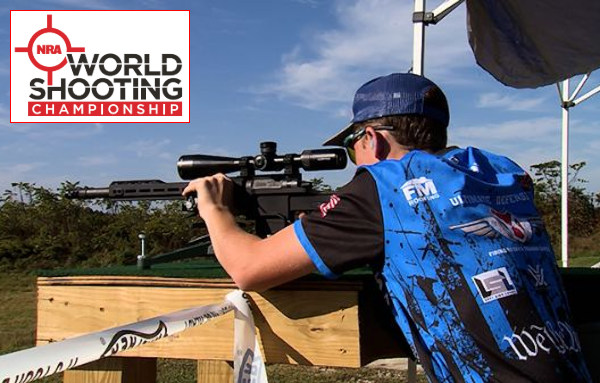
The 2025 NRA World Shooting Championship was held Sept. 30 – Oct. 4, 2025 at Camp Atterbury, Edinburgh, Indiana. Presented by Walther, this challenging event involved rifle, pistol, and shotgun shooting with a dozen disciplines — from short-range action pistol to long-range rifle.
The NRA World Shooting Championship
This championship is designed to test individuals through multiple different disciplines over a period of three days of shooting. Competitors compete in Professional and Amateur categories for cash and prizes of over $250,000. Walther and other sponsors supplied ALL firearms equipment and ammunition required for the 12 stages of competition.
To do well, competitors must be highly proficient in all shooting skills — rifle, pistol, shotgun, both rapid fire and precision, at multiple distances.
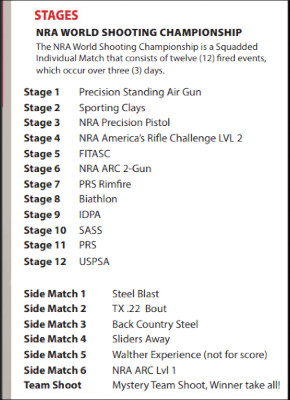
In 2025, the 12 stages were: Precision Standing Air Gun, Sporting Clays, NRA Precision Pistol, NRA Americas Rifle Challenge, FITASC, NRA ARC 2-Gun, PRS Rimfire, Biathlon, IDPA, SASS, PRS, and USPSA.
There were also six side matches with different disciplines: Steel Blast, TX .22 Bout, Back Country Steel, Sliders Away, Walther Experience, and NRA ARC Lvl 1. Lastly was the Mystery Team Shoot.
There is a good article on gun safes in SHOT Business, a publication for the NSSF SHOT Show audience. Written by Christopher Cogley, this Safe Spaces Article offers some very important things to consider when purchasing a gun safe. Here are key points from that article:
Safe Security — The security of a gun safe comes down to two main factors: the thickness of the steel and the construction of the safe. When it comes to construction, look for a safe that has continuous welded construction instead of bolts or spot-welding, which are easier for trained gun thieves to cut through with torches or high-power saws.
Lock Options — Traditional combination locks are arguably the simplest choice. The downside, though, is they don’t provide quick access to firearms in an emergency. Electronic and biometric keypads provide quicker access — but be sure to replace the batteries every year.
Fireproof Rating — Aside from theft, the biggest threat to your firearms is fire. Unfortunately, the fireproof rating on gun safes can be confusing because there is no single, “standard” fireproof rating. As a general rule, the fireproof rating states how long a safe can be exposed to a fire of a particular temperature and maintain a temperature inside the safe of no more than 350 degrees F. To put this in context, the average house fire creates temperatures between 800 and 1,200 degrees F.
Where to Place a Gun Safe in Your Home
The Safe Spaces article includes advice from Stephen Hall, CEO of Lock It Up Safes. Hall addressed the question: “Where should I put my safe?”
Hall states: “Ease of installation should NOT be the foremost consideration when making this decision. Putting a safe in the garage has both pros and cons. We see some retailers recommend the garage solely because they don’t have the right team on board to install safes in other locations, and wheeling one into the garage is the easy way out.
Putting a safe in the garage is fine if that is the only place you an put it, but most want the safe in the home, where they can get to it quickly. Temperature and humidity are important considerations as well, and both are more easily controlled in a house rather than in the garage.
One advantage to garage installation is the concrete floor provides a solid base for safe installation. Houses built on concrete slabs also offer a solid anchor on the first level. If the safe needs to go to an upper floor, the weight of the safe and its contents need to be factored in.”
Place Safe Against Outside Wall
Hall recommends placing your gun safe against an outside wall: “In case of fire, the safe will typically last longer as there is not a lot that can burn on one side of the safe, thus keeping it cooler.”
Don’t Make the Mistake of Buying an Undersized Safe
The most common mistake people make when buying a gun safe is getting a safe that’s too small. This video explains why you should probably invest in a bigger safe. First, the rated gun capacity is exaggerated — rifles with mounted optics, long barrels, wide forearms and/or pistol grips take up considerably more space than a small rimfire rifle or a lever gun with iron sights. Second, your gun collection will likely grow in years to come. Third, you may want to store other valuables in the safe — such as vital documents, jewelry, watches, and pricey electronics. In this video the host notes: “Get a much larger safe than you think you’ll need at first. This will guarantee that you will have enough room for future purchases and all the guns and equipment you currently have.”
Recommended Safe Features for Long-Gun Storage
Editor’s Recommendation:
Budget $1200-1500 for a safe from a major maker, with external hinges, and an interior at least 58″ high. That gives you room for 30″-barreled rifles with a top shelf for handguns and other valuables. A rotary rack and slide-out drawers are great additions.
Keypad or Dial? We favor rotary dial locks. With minimal maintenance they will function flawlessly for decades. But the digital locks offer quick-access and convenience. If you go digital, get a commercial-grade unit.
Fire-lining is worth getting, but a thin layer of sheet-rock doesn’t make a safe truly “fire-proof”.
Interior at least 58″ High and 30″ wide Overall Weight 750+ Pounds 8 Gauge or Heavier Wall Thickness Double-Wall, Composite Door with Relockers Minimum UL RSC Rated. TL-15 or TL-30 Rating is Desirable External Hinges
Mechanical UL Group II (or better) Lock with Standard Dial Or UL Type 1 Commercial-Grade Electronic Lock
Custom Interior Suitable for Scoped Guns with Long Barrels On-Door Storage System for Non-scoped Long Guns OR Rotary Gun Rack for Scoped Rifles and ARs
Internal (sandwiched) Insulator, Reinforced if Sheet-rock Palusol? Heat-Activated Expanding Door Seals
Slide-out Drawers for Handguns Fire-lined Inner Safe for Paper and Media
Low Gloss, Rust-resistant External Finish Pre-Drilled holes for Lag Bolts and in Rear for Electric Cord Overhead Fluorescent Lamp and/or LED Mini-lights on Strings