The NBRSA has liberalized its rules regarding front sandbags. Until this year, NBRSA rules required that benchrest competitors be able to lift their rifle fore-ends freely from the front bag. Accordingly, front bags could not “capture” the forearm or hold the gun down (i.e. keep it from rising). In order to meet this requirement, “legal” bags had straight sides that didn’t stand too far up.
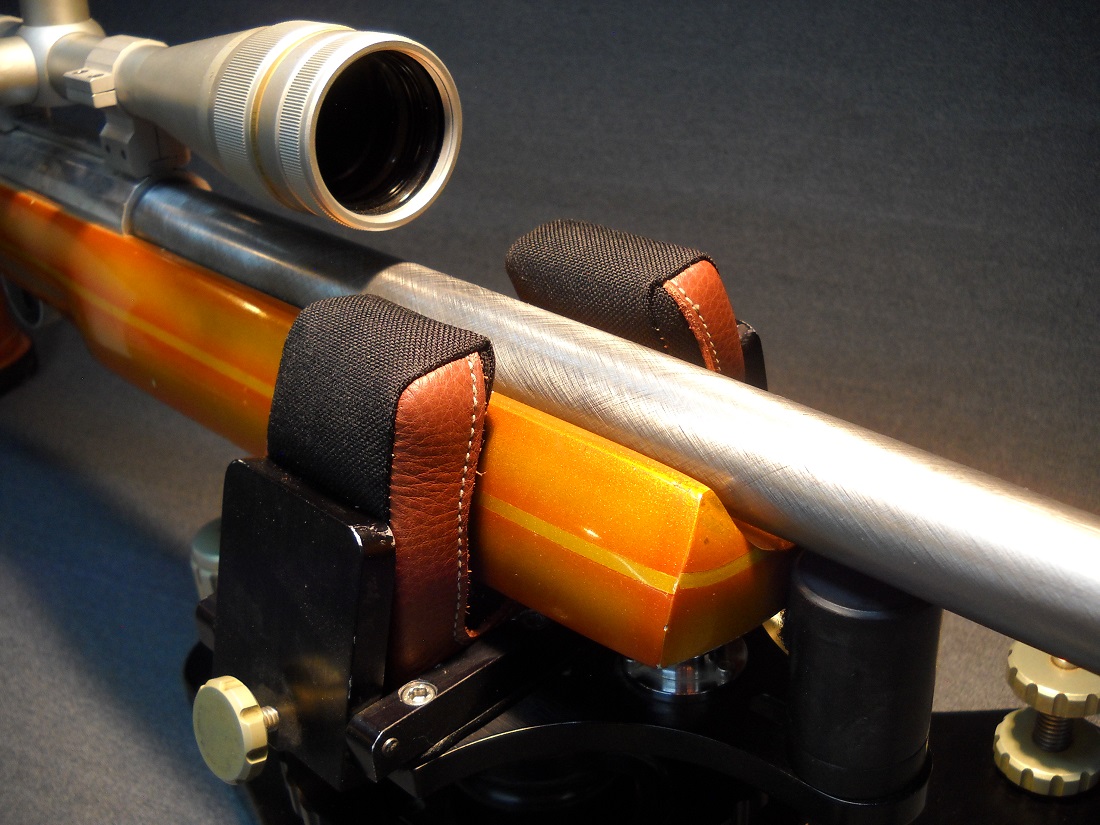
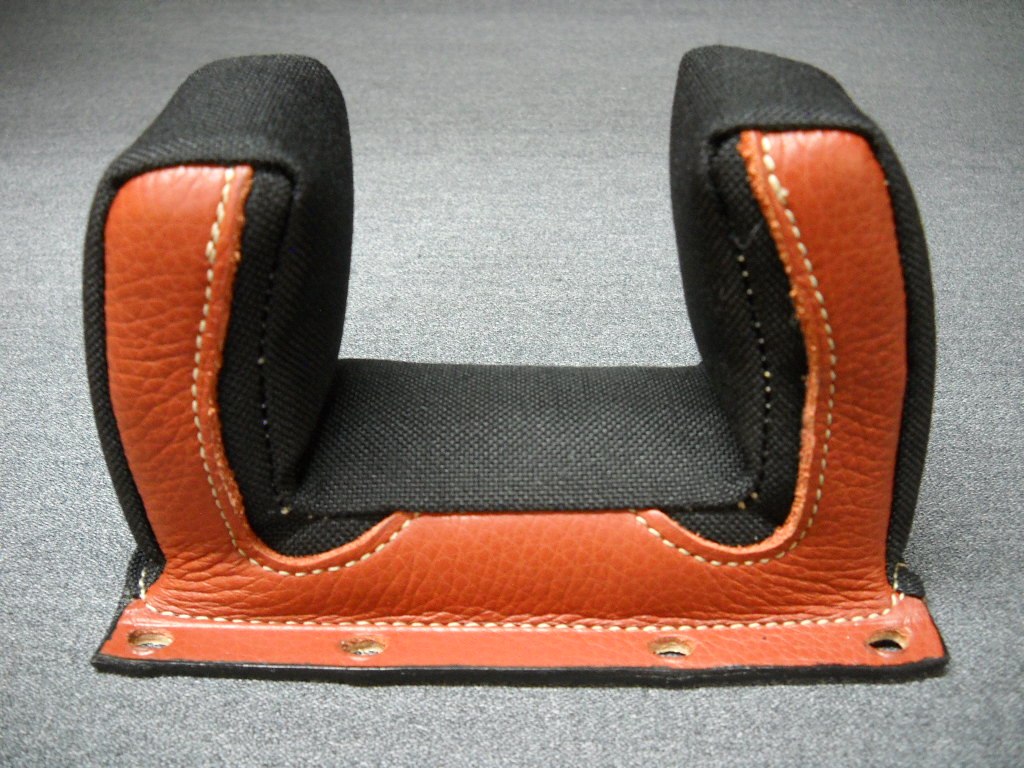
Now the NBRSA rules have changed. You no longer have to be able to lift the gun up freely from the bag without interference. It’s now permissible to have a bag that offers some up/down retention. Check out this new bag from Edgewood Shooting Bags. Call “The EDGE”, it offers taller side sections that can hold the fore-arm in place and counter torque.
Edgewood’s designers state: “There are a couple of [NBRSA] rule changes for 2017. The change we found most intriguing was that the requirement of being able to lift your fore end freely from the front rest has been removed. So, we came up with a new design with super tall ears which will allow the innovators to push the envelope. Let’s see what you can do with these…”
We expect this new type of front bag will help stabilize short-range benchrest rifles, particularly in the 10.5-lb Sporter and Light Varmint classes. But we expect the biggest gains will be had with the big-caliber rifles used in Mid-Range and Long Range benchrest competition. In the 1000-yard game, heavy-recoiling 7mm and .30 caliber cartridges are popular with many shooters. These big guns generate considerable torque despite their ample weight. We predict these “super-sized” front bags will reduce both hop and rolling motion (torque) in the big guns.
We also expect that some varmint hunters will experiment with high-sided front bags that wrap around the fore-end. Such front bags may prove a real boon for guns with narrower, sporter-style fore-ends. And it would be interesting to see if this kind of tall-sided bag design will be incorporated into portable sandbags for the PRS game. We shall see…
Rule Change and Product Tip from EdLongrange. Product Tip from Boyd Allen. We welcome reader submissions.
When we first ran this story a while back, it spurred a hot debate, with strong opinions on both sides of the issue. Some guys argued vehemently that volumetric powder dispensing was best — citing the experience of short-range benchresters, most of whom still throw their charges. Others say weighing your charges is best, so long as you have a very precise, and very repeatable scale. We know some of the top 1000-yard shooters weigh their charges to the kernel.
Most competitive long-range shooters weigh powder charges for their handloads. Some even use ultra-precise magnetic force restoration scales to load to single-kernel tolerances. But is weight-based measuring always the best way to fill a case with powder? Another option is volumetric charging. This method fills a precisely-sized cavity with powder and then dumps the charge into the case. A Harrell’s rotary powder measure works this way, as does the sliding powder filler on a Dillon progressive press.
For long-range applications, most people believe that precise weighing of powder charges is the best way to achieve optimal accuracy and low ES/SD. However, those short-range Benchrest guys do pretty darn well with their thrown charges, at least at 100 and 200 yards.
Our friend Dennis Santiago recently observed something that made him scratch his head and wonder about weighing charges. His AR-15 match rifle shot better with volumetric (cavity-measured) charges than with weighed charges dispensed by an RCBS ChargeMaster. Here’s what he reports:
Cavity vs. Dribble (Dennis Santiago Report) I had the chance to compare nominally identical ammunition loaded two ways. These were all .223 Remington match loads using 77gr Sierra Match Kings over 23.4 grains of Hodgdon Varget. Same gun. However I loaded some ammo with charges dispensed with a Lee cavity-style powder measure while other rounds were loaded with powder weighed/dispensed by an RCBS Chargemaster. The cavity-drop ammo (with powder dropped from the Lee unit) was consistently better than the weighed-charge ammo. I have no idea why…
So, ladies and gentlemen — what do you think? Why did Mr. Santiago’s volumetrically-charged ammo shoot better than ammo filled with weighed charges? What’s your theory? Gary Eliseo suspects that Dennis’s Chargemaster might have been drifting. What do you think? Post your theories in the comments area below.
Applied Ballistics has produced a series of YouTube videos about precision long range shooting. Featuring ace long-range shooter and professional ballistician Bryan Litz, these videos address various topics of interest to long-range marksmen. This featured video looks at Long Range mistakes — Bryan Litz reveals the most common ballistics-related shooting errors at Long Range. And then Bryan explains how to improve your shooting (and wind reading) to eliminate those common errors.
Watch Applied Ballistics Video about Common Mistakes in Long Range Shooting:
Bryan Litz of Applied Ballistics often hears the question: “What are the main reasons people miss their target at long range?” To answer that question, in this video, Bryan explains the most important variables in Long Range shooting. Bryan says: “Probably the number one thing is range — you have to have a [precise] range to your target because your bullet is dropping, and to hit the target you need to correct for bullet drop.” Distance may be indicated on the target bay (or berm), but for open ranges you should ascertain distance-to-target with a quality laser rangefinder. Even when the distance to target is shown with a sign or marker, you may want to confirm the distance with your rangefinder. (You may be surprised — we’ve seen marked target distances at commercial ranges off by 25+ yards!) Bryan says: “Get a good laser range to the target and you’ll be within a couple yards”.
After distance to target, the most important variable is the wind. This is the most challenging factor because the wind is constantly changing. Bryan explains: “After 300 or 400 yards, the wind [will] move your shots off the target if you don’t correct for it. The best way to account for the wind is to measure it at your location with a Kestrel. The Kestrel can give you the speed and direction of the wind at your location, which can baseline your wind call for your long-range shot.” Bryan acknowledges that there will still be variables: “The wind isn’t always blowing the same downrange as at your location… and the wind is always changing”. Bryan notes that you need to account for variances in wind between the time you gauge the wind angle and velocity and the time you actually you take your shot.
If you watch just one episode of Shooting USA TV this year, it should probably be this week’s hour-long SHOT Show Special. Tonight, March 1, 2017, enjoy a full hour of SHOT Show coverage. Jim Scoutten’s team of gun journalists work hard every January, bringing you highlights from the gun industry’s largest trade show. Jim, son John Scoutten, and other staffers prowled the 12 miles of aisles in the Sands Convention Center in Las Vegas, visiting many of the 1,600+ exhibitors. This episode provides a “first look” at the new guns, optics, and gear introduced for 2017. Click HERE to learn more about this week’s SHOT Show episode.
2017 SHOT Show Highlights: Savage MSR Rifles, GA Precision Tempest Action, Smith & Wesson M&P 10 in 6.5 Creedmoor, Colt double-action Cobra, STI Match pistols and a whole lot more.
Shooting USA Hour AIR TIMES
Shooting USA’s SHOT Show Special will air for a full hour on Wednesday, March 1, 2016 on the Outdoor Channel. Here are the air times, but you should check your local schedule. Look for Shooting USA TV on the Outdoor Channel.
Wednesday Night Schedule:
Eastern Time – 9:30 PM; 1:00 AM (TH)
Central Time – 8:30 PM; Midnight (TH)
Mountain Time – 7:30 PM; 11:00 PM
Pacific Time – 6:30 PM; 10:00 PM
<
Here are some of the 50+ new products featured on the SHOT Show Special:
If you don’t own a good gun vise yet, buy this now! Cabela’s current $24.99 price is a total steal! We paid about $45.00 12 years ago for the very similar Tipton gun vise which is still going strong. This Cabela’s unit has all the nice features of the Tipton at a fraction of the price. With tough, chemical-resistant polymer construction, this Lifetime Guaranteed Cabela’s gun vise will provide years of service — all for under $25.00. Can’t argue with that.
Every rifle owner should have a handy, portable workstation like this. It is great for barrel cleaning, bore-scoping, trigger-tuning, and general maintenance tasks. This affordable gun vise features rubberized jaws and cradles to protect your rifle’s finish. The large forward compartment holds bolts, large parts, brushes, and tools. Solvent bottles and patches fit in the flat-bottom holes, while two round-bottom “dished” compartments conveniently hold small parts. A quick-release cam in the rear allows fast mounting/unmounting of long guns.
Editor’s Comment: Our similar Tipton gun vise has proven invaluable for many tasks: cleaning barrels, stock refinishing/bedding, scope mounting, trigger adjusting, bore-scoping barrels, and checking throat length. To be honest, I can’t understand how any serious shooter can get along without a product such as this. That said, these types of gun vises are not perfect. The front cradle will NOT fit rifles with forearms wider than 3 inches. And if your butt-stock is very shallow (vertically) from comb down to toe, it may not fit the rear clamping system very well. But, for 95% of the rifles out there, this type of Gun Vise works great. Just don’t ever use it as a shooting rest — it is NOT designed for that!
FREE SHIPPING: If you order at least $99.00 worth of products from Cabelas.com you can get free shipping with Coupon Code 37SHIP.
Let it not be said that Gun Guys aren’t creative. Some of them have considerable artistic talent — witness this unique wall map of Ohio created from used ammunition boxes. This one-of-a-kind wall decor was created by Forum member “MrBottleneck”.
Here’s the story behind the Ohio Ammo Box Map:
“My son and I have been just goofing around creating wall art (if you consider it that). We shoot every weekend and when we see pristine discarded ammo boxes in the trash we have been saving them.
The range officers thought we were funny (or possibly nuts). We originally just had enough to make a square. However, after a few months of scrounging, we finally had enough boxes to expand our square into the state of Ohio as planned. The Ohio Map now proudly hangs in the man cave downstairs, and goes well with our rifle/ammo hobby. I think it’s pretty cool and it cost zero to make.” — MrBottleneck
Another Ohio-based forum member, Adam, found his location on the map: “Hey, I live at the top right corner of the Remington box on the right side.”
MrBottleneck’s Ohio map inspired Forum member JohnB to create something similar. John, who lives in New York State, says: “That is very cool indeed, now maybe I can make one in the shape of New York minus New York City.” Yes, John, that would be a vision of New York we Gun Guys could appreciate.
At the request of our readers, we provide select “Deals of the Week”. Every Monday morning we offer our Best Bargain selections. Here are some of the best deals on firearms, hardware, reloading components, and shooting accessories. Be aware that sale prices are subject to change, and once clearance inventory is sold, it’s gone for good. You snooze you lose.
1. Cabela’s — Winchester XBR Hunter, $349.99 after Rebate
Here’s a very sweet deal on a handsome Winchester hunting rig with detachable box mag. Right now Cabelas.com is offering $170.00 off a Winchester XPR. Plus there’s a $50.00 Mail-in Rebate. That reduces your net cost for the rifle to $349.99. That’s a great deal for a rifle with a smooth bolt action (with 60° lift), nice trigger, and detachable box magazine. This XPR is offered is a wide variety of chamberings: .243 Win, 7mm-08, .270 Win, .308 Win, .30-06 Springfield, .300 WSM. GO TO DEAL PAGE.
Here’s a great deal on Pacific Tool & Gauge-crafted Rem actions with PT&G bolts. These are new Remington-made actions, blueprinted, with PT&G bolts fitted. Sold by PT&G’s retail outlet Cabin Fever Sports, these are pretty much the same as PT&G’s $640 actions with special promo pricing. The prices for the Right Hand actions are $380.00 to $420.00 depending on bolt face. Cabin Fever Sports also has roughly 20 Left Hand (LH) Rem actions at $399.99. You can choose trigger type and add options, such as bolt fluting, for a few dollars more. Order online, or call in and ask for special pricing.
3. CDNN — Smith & Wesson Model 617 10-Shot Revolver, $699.99
This Editor’s first really accurate handgun was a Smith & Wesson model 617 that could easily stack ten shots in a dime at 10 yards. It remains my favorite and most-used handgun, and I will never part with it. What can we say about the model 617? Every serious gun guy should own one. The single-action trigger pull is superb, and the accuracy surpasses most any semi-auto rimfire pistol, except for a few, very, very expensive target pistols. We like the 6″ version for the longer site radius, but the 4″-barrel 617 is also very accurate, and it balances better. CDNN’s $699.99 sale price may seem like a lot of money, but MSRP is $829.00 and most dealers are charging $750.00 or more for a new 6″-barrel 617. Get one — you won’t regret it.
4. Amazon — Plano Field Locker Double Long Gun Case, $111.50
A full 54″ long inside, this Plano Field Locker Double Long Gun Case will hold big rifles with 30-31″ barrels. The case has tough latches, watertight seals, and wheels for easy transport. Right now this case is just $111.50 with Free Prime Shipping. That’s less than half what you’d pay for a Pelican this big. Buyers confirms this Plano case is capacious and tough: “It holds two 17-lb bench rifles with 30″ barrels… even the airline baggage handlers couldn’t damage this case” (Smitty). “I bought this case for a Savage 110BA .338 Lapua Magnum, and it’s so nice that I just bought a second one for a 50 BMG. There are very few rifle cases that will fit the larger rifles.” (Bruce L.) “I’ve used one case in extensive
field abuse, and it has held up remarkably well. IMO there is not a finer case available on the market for any big-bore center-fire rifle. You can spend more; but I don’t think you can get any better.” (Gene).
5. Monmouth Reloading — 500 Lake City 5.56 Cases, $35.00
500 pieces of Lake City brass for just thirty-five bucks? Yep, that’s a great deal for anyone who needs .223/5.56 brass for varmint safaris and tactical comps. Monmouth Reloading is selling genuine, once-fired Lake City 5.56x45mm brass, thick-walled and sourced direct from the U.S. Military. Monmouth reports: “Our current stock of Lake City 5.56 looks to be all newer year Lake City head stamp but may contain a small percentage of other NATO headstamps. Lake City is a popular, reliable brass, normally capable of many reloads.” Monmouth includes 1% overage to account for any damaged brass. NOTE: Brass has crimped primers, so the pockets will need to be reamed or swaged prior to reloading.
Here’s an awesome deal from EuroOptic.com. Save $200 on a very popular Vortex Precision Shooting Tactical (PST) optic. On sale for just $499.99, this 4-16x50mm EBR-1 Scope offers tactical turrets with Milradian adjustments, an illuminated second focal plane EBR-1 reticle, 30mm main tube, side-focus parallax, plus a large, bright objective. What’s more, this scope weighs just 22 ounces — making it an ideal optic for a tactical or precision rifle, varmint blaster, or hunting rifle.
We use 1″-diameter Target Spots for sight-in and practice at 100-300 yards. These bright red/orange self-adhesive dots are easy to see. At 100 yards the high-contrast black diamond centers provide precise aiming points. We found this 10-pack of target spots on Amazon at a rock-bottom price. You get 630 total stick-on dots for just $9.65 with FREE Shipping. You can also get 360 Birchwood Casey 1″ dots from Midsouth for just $3.15, but shipping is extra. If you’re already ordering something from Midsouth, you may want to add the dots to your order.
8. Harbor Freight — 8-Drawer Rolling Tool Cabinet, $169.99
This 27″-wide Roller Tool Cabinet makes a nice addition to any loading room or workspace. The eight (8) drawers will hold tools, reamers, dies, and spare parts. Larger items (such as tumbling media), can be placed on the lower shelf. Now through the end of February, this rolling cabinet is on SALE for just $169.99. This is a two-piece cabinet, with six (6) drawers in the top section, and two (2) large drawers in the bottom unit. The two units bolt together. CLICK HERE for more details.
6.5 Creedmoor (right) shown with .308 Win (left) and .243 Win (center) for comparison.
Though most popular for competition applications (PRS and XTC), the 6.5 Creedmoor is also a capable hunting cartridge. This month Norma spotlights the 6.5 Creedmoor cartridge and outlines the game-harvesting capabilities of Norma 6.5 Creedmoor factory ammunition.
Origins of the 6.5 Creedmoor
Dave Emary, senior engineer at Hornady, asked fellow competitive shooters about their “wish list” for a mid-sized round with long-range potential. It needed to offer efficiency, good ballistics, fine accuracy, and reliable feeding from a magazine. To achieve these goals, Emary necked the .30 T/C to .264 caliber (6.5 mm). The shoulder on this case is well to the rear, so long bullets with high ballistic coefficients can be used in short actions. The efficient Creedmoor case and its modest powder charge deliver hard hits on big game while keeping recoil modest. The case runs well in magazines sized for the .308 Winchester, and because it is efficient, the 6.5 Creedmoor delivers velocities very close to the .260 Remington (which is basically a 6.5-308 Win) with less powder. The 6.5 Creedmoor cartridge has shown excellent accuracy in PRS competition, though the 6mm Creedmoor has proven more competitive, given its reduced recoil.
Hunting with the 6.5 Creedmoor
by Wayne van Zwoll
I learned about the 6.5 Creedmoor by way of a rifle from Todd Seyfert at Magnum Research. The Remington 700 action wears a carbon-fiber barrel with a Krieger stainless core. GreyBull Precision added a stock and a modified 4.5-14X Leupold scope. Its 1/3-minute elevation dial is calibrated specifically for 130-grain boat-tail spitzers at Creedmoor velocities. “Spin the elevation dial to the distance in yards, and aim dead-on.” said GreyBull’s Don Ward. Prone with a sling, I was soon banging steel at 500 yards.
By the charts, the 6.5 Creedmoor is a superb cartridge for deer-size game. But I caught only a late elk season with this new rifle. The 6.5×55 and .260 had taken elk for me; surely the Creedmoor would as well. Alas, the close shot I’d wanted, to ensure precise bullet placement, didn’t come. When on the final evening Don and I spied a bull far off, there was no approach. “Your call,” he shrugged. “The air is dead-still.” I snugged the sling, prone, and dialed to the yardage. Ribs spot-lit by a sinking sun, the bull paused. Craaack! The animal spun, sprinted and fell. That shot was twice as long as any I’d ever attempted at elk.
Whitetail hunting with a Ruger 77, then a trip to sub-Saharan Africa with a T/C Icon, kept the 6.5 Creedmoor in my ammo pouch. The T/C dropped a Vaal Rhebok at 250 yards, in stiff wind (photo below). Shorter pokes on a variety of game produced consistently quick kills. I found the Creedmoor’s limit with an eland.
A high ballistic coefficient helped a Creedmoor bullet slice stiff wind 250 yards to this Vaal Rhebok.
Since then, I’ve seen several animals brought to bag by the 6.5 Creedmoor. And I’ve used it in a variety of rifles on paper and steel targets to 1,200 yards. It has become one of my favorite cartridges for deer-size game. Its mild report and recoil make it easy to shoot accurately. It seems an inherently accurate cartridge too. I’ve punched half-minute groups from production-class rifles. The proliferation of hunting loads for the 6.5 Creedmoor includes none better than Norma’s 130-grain Scirocco. This sleek, polymer-nose bullet, with its 15° boat-tail and a G1 ballistic coefficient over .550, flies very flat. In expansion and penetration tests, it opens reliably down to 1,750 fps, and drives straight and deep. A bonded bullet, it stays in one piece after high-speed impact, routinely retaining more than 80 percent of its original weight.
Here’s a little known fact that may startle most readers, even experienced gunsmiths: your barrel wears out in a matter of seconds. The useful life of a typical match barrel, in terms of actual bullet-in-barrel time, is only a few seconds. How can that be, you ask? Well you need to look at the actual time that bullets spend traveling through the bore during the barrel’s useful life. (Hint: it’s not very long).
Bullet-Time-in-Barrel Calculations
If a bullet flies at 3000 fps, it will pass through a 24″ (two-foot) barrel in 1/1500th of a second. If you have a useful barrel life of 3000 rounds, that would translate to just two seconds of actual bullet-in-barrel operating time.
Ah, but it’s not that simple. Your bullet starts at zero velocity and then accelerates as it passes through the bore, so the projectile’s average velocity is not the same as the 3000 fps muzzle velocity. So how long does a centerfire bullet (with 3000 fps MV) typically stay in the bore? The answer is about .002 seconds. This number was calculated by Varmint Al, who is a really smart engineer dude who worked at the Lawrence Livermore Laboratory, a government think tank that develops neutron bombs, fusion reactors and other simple stuff.
On his Barrel Tuner page, Varmint Al figured out that the amount of time a bullet spends in a barrel during firing is under .002 seconds. Al writes: “The approximate time that it takes a 3300 fps muzzle velocity bullet to exit the barrel, assuming a constant acceleration, is 0.0011 seconds. Actual exit times would be longer since the bullet is not under constant acceleration.”
We’ll use the .002 number for our calculations here, knowing that the exact number depends on barrel length and muzzle velocity. But .002 is a good average that errs, if anything, on the side of more barrel operating life rather than less.
So, if a bullet spends .002 seconds in the barrel during each shot, and you get 3000 rounds of accurate barrel life, how much actual firing time does the barrel deliver before it loses accuracy? That’s simple math: 3000 x .002 seconds = 6 seconds.
Gone in Six Seconds. Want to Cry Now?
Six seconds. That’s how long your barrel actually functions (in terms of bullet-in-barrel shot time) before it “goes south”. Yes, we know some barrels last longer than 3000 rounds. On the other hand, plenty of .243 Win and 6.5-284 barrels lose accuracy in 1500 rounds or less. If your barrel loses accuracy at the 1500-round mark, then it only worked for three seconds! Of course, if you are shooting a “long-lived” .308 Win that goes 5000 rounds before losing accuracy, then you get a whopping TEN seconds of barrel life. Anyway you look at it, a rifle barrel has very little longevity, when you consider actual firing time.
People already lament the high cost of replacing barrels. Now that you know how short-lived barrels really are, you can complain even louder. Of course our analysis does give you even more of an excuse to buy a nice new Bartlein, Krieger, Shilen etc. barrel for that fine rifle of yours.
We’ve been giving a lot of coverage to tactical rigs and gas guns lately, so we though it was time to showcase a purebred, state-of-the-art 1000-Yard Benchrest rig. This article features the impressive .284 Shehane Light Gun used by Henry Pasquet to capture the 2013 IBS 1000-yard Nationals.
With a 5″-wide “hammerhead” front and a special 3″-wide bag-rider plate in the rear, this 17-lb rig is ultra-stable in the bags, and tracks like a dream. In this story, Henry explains his set-up plus his processes for loading super-accurate ammo. Every long-range shooter can benefit from some of tips revealed here. And F-Class guys — if you’re shooting a .284 Win-based case in F-Open you should definitely read Henry’s precision reloading advice.
EDITOR: Guys, there is a ton of solid gold information in this article — take your time and read it carefully.
Yes old dogs can learn new tricks. Just five years ago Forum member Henry Pasquet (aka “HenryP”) got started in 1000-yard benchrest shooting. He was 66 at the time. Henry worked hard, learned fast, and pursued accuracy with a vengence. That all paid off when Henry won the 2013 IBS 1000-yard Nationals this summer, finishing as the Two-Gun Overall National Champion. Henry was kind enough to talk about his rifle, his reloading methods, and his strategy for success. In fact, Henry was eager to share “everything he knows, so that other guys can fast-track their learning process”. Henry told us: “I want to share every lesson I’ve learned, so that other guys can improve their game and enjoy the sport more.” Henry also wants to encourage other senior shooters: “If you pay attention to details (when reloading), and get a good rifle with a good barrel, age is not a handicap. With a good set-up, older guys can compete with anyone out there. This is one sport where you can be a champion in later life.”
Click on Rifle Photos to View Full-screen Versions
Q&A with Henry Pasquet, IBS 1000-Yard National Champion
Q: First, do you have any advice for older shooters getting started in their golden years?
Henry: You’re never too old. In this sport, you can excel even in your 60s, 70s and beyond. At this stage in life, we now have the time and money to get good equipment and rifles. Plus, our years of work experience help us to think, analyze, and thereby make progress. In this game, we older guys can definitely compete on a par with younger shooters.
HARDWARE
Q: Tell us about your Nationals-winning rifle and bench gear. Is there anything unique about your hardware that gave you an edge?
Henry: At the Nationals, I used my 17-lb Light Gun for both Light and Heavy Class. This rifle has a 1.55″, round BAT LP/RE action, fitted with a Bartlein barrel chambered for the .284 Shehane (an improved version of the .284 Winchester). The barrel was near-new; this was the first time I had used it this year. A great barrel and great batch of Berger 180gr VLDs all made a difference. Jay Cutright chambers my barrels. Jay’s metal-work is so precise that I can screw any barrel he’s chambered to any BAT action I own. The laminated stock was modified by Tommy Shurley from a standard 3″-wide fore-end to a 5″-wide True-Trac with an adjustable 3″-wide rear plate. It’s not pretty but it tracks like a Heavy Gun stock. Tommy made my other stocks as well.
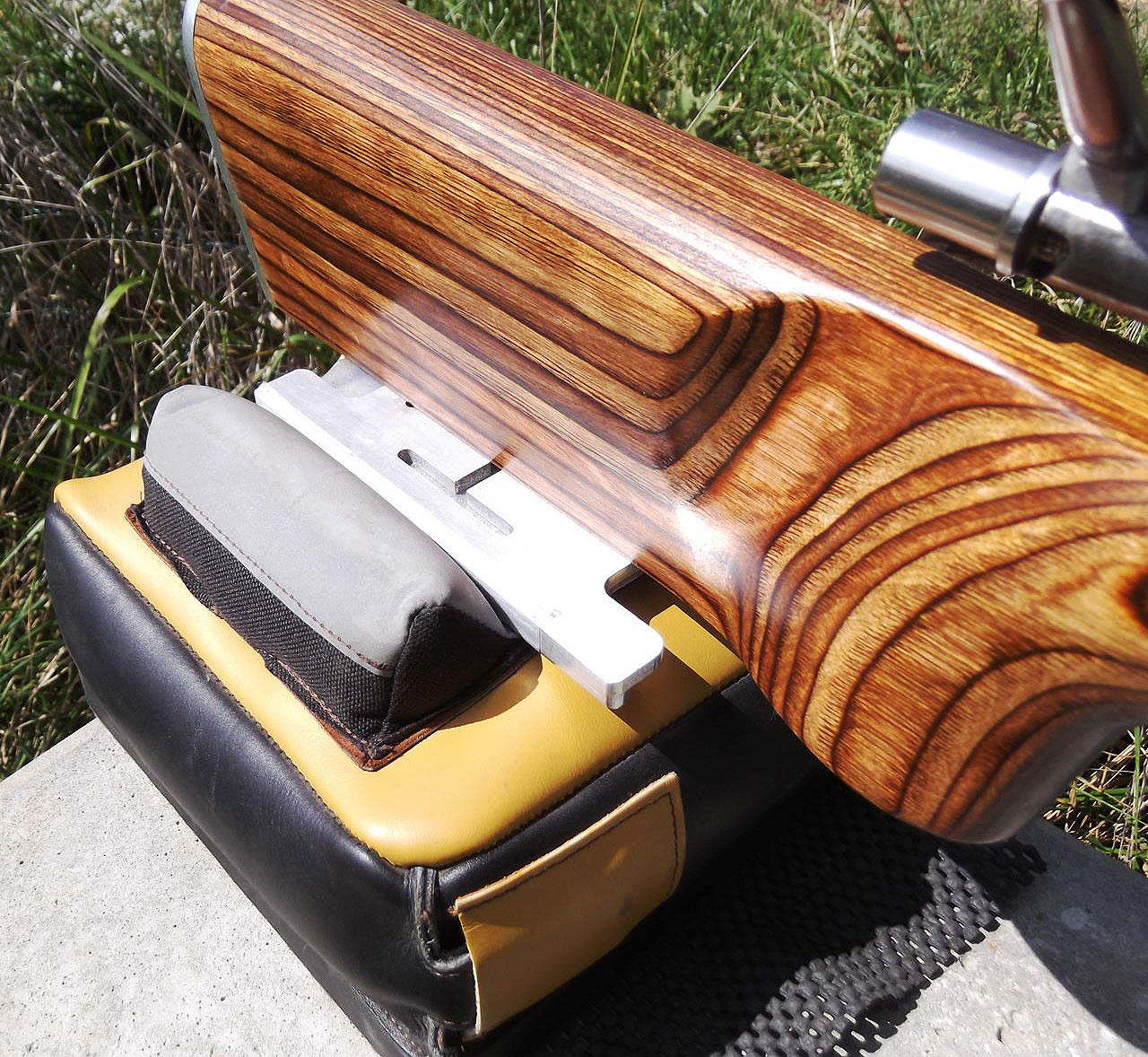
On top is a Nightforce 12-42x52mm Benchrest scope with CH-3 reticle. I used a Fulghum (Randolph Machine) front rest with an Edgewood bag made with the low-friction 3M material. In the rear I use a special-order Protekor rear “Doctor” bag with ears spaced 3 inches apart. The rear bag also has the new 3M material on contact surfaces (photo at right).
Q: During the Nationals, at the last minute you switched guns. Why did you go from a 6mm Dasher to a 7mm Shehane?
Henry: I had planned to use my Light and Heavy Dashers, but after placing the Dasher on the ready line, decided to switch to the .284 Shehane. It was still early in the morning and I felt that the heavier bullets would be easier to see against the berm. The Dasher had actually been giving tighter groups under perfect conditions, but seeing the impact is important.
Q: Tell us about the combined tuner/muzzle brake on some of your barrels. How does this improve rifle performance and how do you set the “tune”? Do you tune the barrel to the load?
Henry: I use a tuner or tuner/brake on every barrel. I started with Time Precision tuners. Art Cocchia advised getting a load with a good known accuracy node with minimum extreme spread, which controls vertical. Do not go for the hottest loads, which just reduces brass life. Then use the tuner and tune the barrel to the load. The .284 Light Gun needed a muzzle brake and tuner. I had a local gunsmith cut a thread on the muzzle brake for a tuner I got from Sid Goodling. (Eric Bostrom developed an almost identical unit at the same time. I use Eric’s tuner/brakes on all my new barrels.) Just before Nationals, I tried going up and down one marker. Down one mark cut the group in half! Think how much range time (and barrel life) that saved me. Using a tuner is easier than messing around changing loads and tweaking seating depths. Tuners definitely can work. Last year I shot a 3.348″ 10-shot group at 1000 with my .284 Win Heavy Gun fitted with a Time Precision Tuner.
Q: What are the advantages of your stock’s 5″-wide fore-end and 3″-wide rear plate? Is there a big difference in tracking and/or stability? Does the extra width make the rifle easier to shoot?
Henry: I had true Heavy Guns with 5-inch fronts and 3-inch rears. They tracked well. I felt the same result could be had with a Light Gun. I talked two stock makers into making them. I initially had the standard rear stock until Tommy Shurley and Mike Hearn came out with an adjustable rear plate. The stocks track perfectly. You can see your scope’s crosshairs stay on the target the whole time and push the rifle back for the next shot. There is no torquing (gun wobbling) when cycling the bolt. Us old guys need all the help we can get. I am getting rid of my 45-pound Heavy Guns and replacing them with Light Guns with heavy barrels.
Q: Some people say the .284 Shehane is not as accurate as the straight .284 Winchester. You’ve proved them wrong. Why do you like the .284 Shehane? More speed, less pressure?
Henry: The reason I rechambered my 7mm barrels to .284 Shehane was not velocity, pressure, or brass life. It was all about bolt lift. My straight .284 almost required me to stand up to eject brass. I damaged an extractor and had to send the bolt back to BAT. With the .284 Shehane, my bolt cycles like there is no case to eject.
Reloading Methods
Q: People want to know about your load and your loading methods. What can you reveal?
Henry: For my .284 Shehane at the Nationals, I loaded 52.5 grains of Hodgdon H4350 and Federal BR-2 primers behind Berger 180gr VLDs. I usually anneal the brass each winter. I have used the same brass for years. I use Redding bushing dies, apply Imperial sizing wax, resize, wipe off wax, clean and uniform the primers pockets using the RCBS Trim Mate Case prep center, then apply Imperial dry neck lube with a bore mop.
To dispense powder, I use a RCBS ChargeMaster set 0.1 grain below my desired load and then weigh them on a Sartorius GD-503 magnetic force restoration scale to get identical charges. I use a K&M Arbor Press with seating force gauge when seating the bullets with a Wilson inline die. My “target” seating force on the K&M dial is 20-23 units for Dashers and 35-40 units for the .284 Shehane. I put any variables aside for sighters. I do not weigh brass, bullets, or primers. My bullets were so consistent that I did not sort by bearing surface. I did trim the Berger VLDs to the shortest bullet length with a Hoover Trimmer, and then pointed the meplats just enough to close them with a Whidden pointer. I sort my bullets to 0.005″ overall length, rejecting about five percent.
Q: What kind of precision are you looking for in your reloads? Do you trickle to the kernel? Does this really help reduce extreme spread?
Henry: I try to keep my charge weights consistent to one kernel of powder. I use the Omega powder trickler with a Sartorius GD-503 lab-grade balance to achieve that. For accurate dispensing, put very little powder into the Omega so you can drop one kernel at a time. Single digit ES (Extreme Spread) is the goal. This does make a difference at 1000 yards. If you get the same push on the same bullet with the same neck tension, good things are going to happen.
Q: You believe consistent neck tension (i.e. grip on the bullet) is really important. What methods are you using to ensure consistent bullet release?
Henry: I apply Imperial dry neck lube to the inside of my case-necks with a bore mop. The K&M arbor with seating force gauge shows the need to do this. If you put a bullet into a clean case, it will be jerky when seating the bullet. You may see 40 units (on the K&M dial) dropping to 20, then slowly increasing pressure. I explained to a friend that not lubing the neck is like overhauling an engine without lubing the cylinders. Smooth entry gives the bullets a smooth release.
Barrel Cleaning
Q: You go 60-80 rounds between cleaning and the results speak for themselves. What is your barrel cleaning procedure? Do you think some guys clean too often or too aggressively?
Henry: I cringe when I see people wearing out their barrels with bronze brushes between relays. I clean my barrels at the end of each day when I get home. I shot my best-ever 1K Heavy Gun group (3.348″) at day’s end after 60 to 80 rounds. After trying other solvents, I have gone back to Wipe-out’s Carb-Out and Patch-Out products. I use about four patches of Carb-Out, let it sit a few minutes, then use one stroke of a nylon brush followed by Patch-Out until the barrel is clean. I use a bore mop to clean inside the chamber, then some Break Free LP on the bolt followed by bolt grease on the lugs and cocking part. I use a bore guide when anything goes down the barrel.
Shooting Skills and the Learning Process
Q: Henry, you can shoot long-distance on your own property in Missouri. How important is practice, and what do you do during a typical practice session?
Henry: I can shoot 1000 yards on my farm. I have a concrete bench using a slab from a yard furniture place on concrete blocks. Two 4 x 8 sheets of plywood hold four IBS targets. I never practice. I only test, keeping a notebook with all the info. I do most of my testing at 300 to 500 yards, shooting off my deck so I can see my shots immediately.
Q: How much of your success do you credit to really accurate rifles, versus superior shooting skills?
Henry: I do not consider myself another Carlos Hathcock or some master marksman. I am an average 1000-yard shooter, but I do work hard getting the most out of my rifles. Four other people have shot their first 1000-yard matches with my rifles, including my wife, and all of them won relays! I loaned my Dasher to another shooter two years ago and he got second at the 600-yard Nationals. Others will tell you that the rifle must be “on” to win. If your barrel or bullets are average, don’t expect to perform above average in competition.
Q: What you do enjoy most about long-range benchrest shooting? What are the attractions of this sport?
Henry: The sport offers good people and a real challenge. 1000-yard shooting keeps us all humble, but we still keep trying to see how good we can do. I am thankful for Robert Ross providing the only match location that I can shoot regularly.
Q: Henry, you have been a Forum member for many years. Have you learned important techniques from other Forum members and other shooters?
Henry: I have followed the AccurateShooter Forum since 2008. At my age I am not good at computers. I copied and analyzed many articles, especially on the .284 and the Dashers. Without AccurateShooter.com, I would probably still be shooting double-digit (10″+) groups at 1000 yards, and I sure wouldn’t have my name on a National Championship trophy.
Q: You are in your 70s now and have only been shooting competitively for a few years. How did you get so good so fast? How did you manage to beat shooters who are decades younger?
Henry: I had 20/10 vision when I was young, but am down to only 20/20. I have been interested in long range shooting for a long time including ground hog hunting. I went to some VHA jamborees also. In 2008, I went to the Williamsport Benchrest School with a friend from Pennsylvania, John Haas. We would compare notes frequently. I bought a BAT three lug from Tom Mousel in Montana. We also compared notes and made each other better. At IBS matches I studied other shooters’ equipment and techniques. I tried some, accepting some and rejecting some.
Here’s my advice:
Always be ready to learn something new. If it makes sense, try it. I would also encourage other older shooters not to quit. Stick to it. You can make enormous progress in a few seasons.



 Most competitive long-range shooters weigh powder charges for their handloads. Some even use ultra-precise magnetic force restoration scales to load to single-kernel tolerances. But is weight-based measuring always the best way to fill a case with powder? Another option is volumetric charging. This method fills a precisely-sized cavity with powder and then dumps the charge into the case. A Harrell’s rotary powder measure works this way, as does the sliding powder filler on a Dillon progressive press.





 Gone in Six Seconds. Want to Cry Now?
 Yes old dogs can learn new tricks. Just five years ago Forum member Henry Pasquet (aka “HenryP”) got started in 1000-yard benchrest shooting. He was 66 at the time. Henry worked hard, learned fast, and pursued accuracy with a vengence. That all paid off when Henry won the 2013 IBS 1000-yard Nationals this summer, finishing as the Two-Gun Overall National Champion. Henry was kind enough to talk about his rifle, his reloading methods, and his strategy for success. In fact, Henry was eager to share “everything he knows, so that other guys can fast-track their learning process”. Henry told us: “I want to share every lesson I’ve learned, so that other guys can improve their game and enjoy the sport more.” Henry also wants to encourage other senior shooters: “If you pay attention to details (when reloading), and get a good rifle with a good barrel, age is not a handicap. With a good set-up, older guys can compete with anyone out there. This is one sport where you can be a champion in later life.”

 On top is a Nightforce 12-42x52mm Benchrest scope with CH-3 reticle. I used a Fulghum (
 To dispense powder, I use a RCBS ChargeMaster set 0.1 grain below my desired load and then weigh them on a Sartorius GD-503 magnetic force restoration scale to get identical charges. I use a K&M Arbor Press with seating force gauge when seating the bullets with a Wilson inline die. My “target” seating force on the K&M dial is 20-23 units for Dashers and 35-40 units for the .284 Shehane. I put any variables aside for sighters. I do not weigh brass, bullets, or primers. My bullets were so consistent that I did not sort by bearing surface. I did trim the Berger VLDs to the shortest bullet length with a Hoover Trimmer, and then pointed the meplats just enough to close them with a Whidden pointer. I sort my bullets to 0.005″ overall length, rejecting about five percent.
 Q: You go 60-80 rounds between cleaning and the results speak for themselves. What is your barrel cleaning procedure? Do you think some guys clean too often or too aggressively?


