Shown is a new .338 Lapua Magnum rifle from Israel’s IWI. Impressively beefy rig.
For folks in the gun industry, the third Monday in January is the best day of the year. Held in conjunction with SHOT Show, Media Day at the Range lets us try out dozens of new rifles and pistols, as well as meet top gun designers and friends in the shooting sports. We saw some very interesting new products this year. Here are some of the most interesting “take-aways” from Media Day at the Range 2017 on January 16th.
Most Innovative — “The FIX” Rifle from Q
The star of Media Day, at least in the rifle category, was “The FIX”, a new modular rifle from the Q Team. This innovative rig features a totally unique bolt system with a 45° lift and a bolt housing that runs on rails (literally). This thing cycles fast and smoothly.
The trigger, set at 2.5 pounds, was one of the best we’ve ever tried on a centerfire factory rifle. One has to admire the engineering on “The FIX”. This new rifle has definitely “raised the bar” for tactical-style rifles. It’s different, it works, and it offers real advantages for both hunters and tactical style shooters.
Savage 10 with Ergonomic GRS Stock
Perhaps the most ergonomic rifle we shot all day was the new Savage GRS-10 in a stiff, composite GRS stock. European-crafted GRS stocks feature a very comfortable hand-grip, plus fully adjustable cheek-piece and adjustable length of pull. As shown this rifle is very affordable for PRS production-class competition.
To be frank, this Editor liked this rifle more than the Ruger Precision Rifle. A lot more. The GRS stock fit better, the Savage bolt cycled much more smoothly, the trigger was better, and the magazine seated more easily. If you don’t have to be “tacticool” with a metal stock, you should definitely consider this Savage. The new Savage GRS-10 will be offered in 6mm Creedmoor, 6.5 Creedmoor, and .308 Win chamberings. Here’s a video review by Guns America.
Blacktical Bolt-Action Rifles — The PRS Influence
We saw many new (or upgraded) PRS-style bolt action rifles in modular aluminum frames. There were offerings from Savage, Bergara, Tikka, and more. We’ll provide a more thorough run-down on these new guns next week. We really liked the new Tikka T3x TAC A1, while tactical shooters Ed and Steve (aka the 6.5 Guys) were impressed with the new Bergara: “Bergara has in-sourced chassis and triggers to produce very high quality offerings at a very competitive price. Handling, shooting and cycling the bolt on the $1150 MSRP Hunting and Match Rifle would lead one to believe the price tag was a mistake (maybe the first digit should have been a 2). We felt the same when we got behind the $1,699 Bergara Match Precision Rifle.”
Tikka T3x TAC A1
Bergara Match Precision
Pistols — The Sounds of Silence
The most interesting handgun on display was SilencerCo’s Maxim 9, which features an integral suppressor. It looks bulky but it felt relatively normal in the hand. The silencer did tame muzzle lift as well as reduce sound levels dramatically. This is an impressive piece of engineering.
There were many other pistols equipped with more conventional screw-on silencers. Here is a special edition Smith & Wesson M&P model.
Optics — High-End Models from Schmidt and Bender
There were many new optics on display at Media Day, none more impressive than the new 5-45x56mm PMII from Schidmt & Bender. Led by our good friend Kyle Brown, Schmidt & Bender USA had a strong presence at Range Day, with many optics models fitted to high-end tactical rifles. Jason Baney (shown below with Kyle), used one of these rifle/scope combos to make 5 of 5 hits on steel at 960 yards.
Jason Baney checks out the new 5-45x56mm PM II with help from Kyle Brown (left).
Meeting Old Friends
One of the great things about Media Day is the chance to re-connect with old friends. At the Winchester booth, it was great to see Kim Rhode, a six-time Olympic medalist (including three golds). She is the first Summer Olympian to win an individual medal at six consecutive summer games. Kim, a Californian, is leading efforts to challenge draconian new California laws that will severely restrict how ammo is distributed and sold in California. Kim said that, under the new ammo laws, she will not be able to obtain the special “International Loads” she shoots in competition. We wish Kim well in her efforts. We believe that California’s new laws restricting the purchase of ammunition are unconstitutional and, hopefully, will be challenged successfully in court.
Along with Kim we met with our friends Steve (L) and Ed (R), aka the 6.5 Guys, along with past Top Shot Champion Dustin Ellermann (in middle below).
World Record AR Speed-Shooting by Jerry Miculek
At the Smith & Wesson shooting bay, we watched the legendary Jerry Miculek set a world speed record for 10 rifle rounds total on three targets. Before a cheering gallery of fans, Jerry drilled multiple sub-two second runs using his S&W M&P 15T semi-auto rifle. The fastest split was a 1.59 (but we’re waiting for final confirmation on that). We’re told that’s definitely a new world record. Jerry may not be getting any younger, but he’s still blazing fast. Jerry calls this 10-shot drill “STL” or Share the Love.
Ammunition — Polymer Jacketed Pistol Bullets
One of the more notable, recent developments in pistol ammo has been synthetic jacketed bullets. With a total polymer shell over a lead core, these are safer when shooting steel targets because they do not fragment like conventional, jacketed bullets. With no exposed lead or copper, there’s minimal contact between these materials and the barrel, so there’s less copper and lead fouling. Moreover, according to Federal’s test engineers, the red Syntech coating produced 12% less friction in the barrel. Here is the American Eagle 9mm Luger 115gr Total Syntec Jacketed ammo provided by Beretta at Media Day.
Sierra Bullets has just released very complete load data for the popular 6.5 Creedmoor cartridge. This medium-sized cartridge has become one of the most popular chamberings for tactical and PRS shooters. The 6.5 Creedmoor combines excellent accuracy, good mag-feeding, good barrel life, moderate recoil, and reasonable component cost. That’s why this cartridge has caught on quickly.
Developed in 2007 by Dennis DeMille and Dave Emary, the 6.5 Creedmoor is a shortened and improved 30 TC cartridge case that was inspired by the .308 Winchester design. This short action design was created to maximize case capacity and a wide range of loading lengths, while still fitting in standard short action magazines. With the correct twist barrel, the versatile 6.5 Creedmoor can take advantage of the wide range of bullet weights available in 6.5 mm (i.e. .264 caliber). Reloaders should keep in mind that the 6.5 Creedmoor works best with medium to medium-slow powders such as H4350, Varget, Win 760, and RE-17. The light recoil and adaptability of the efficient 6.5 Creedmoor cartridge has already proven itself in high power, precision rifle series and benchrest competitions. Couple that with respectable barrel life and its intrinsic accuracy potential and you have a recipe for success which should insure its legacy for decades to come.
Here are three tables from the Sierra Bullets Reloading Manual (5th Edition). IMPORTANT — This is just a sample!! Sierra has load data for many other 6.5mm bullet types, including FB, Spitzer, SBT, HPBT, and Tipped MK from 85 grains to 142 grains. To view ALL 6.5 Creedmoor DATA, CLICK HERE.
INDICATES MAXIMUM LOAD – USE CAUTION
LOADS LESS THAN MINIMUM CHARGES SHOWN ARE NOT RECOMMENDED.
INDICATES MAXIMUM LOAD – USE CAUTION
LOADS LESS THAN MINIMUM CHARGES SHOWN ARE NOT RECOMMENDED.
INDICATES MAXIMUM LOAD – USE CAUTION
LOADS LESS THAN MINIMUM CHARGES SHOWN ARE NOT RECOMMENDED.
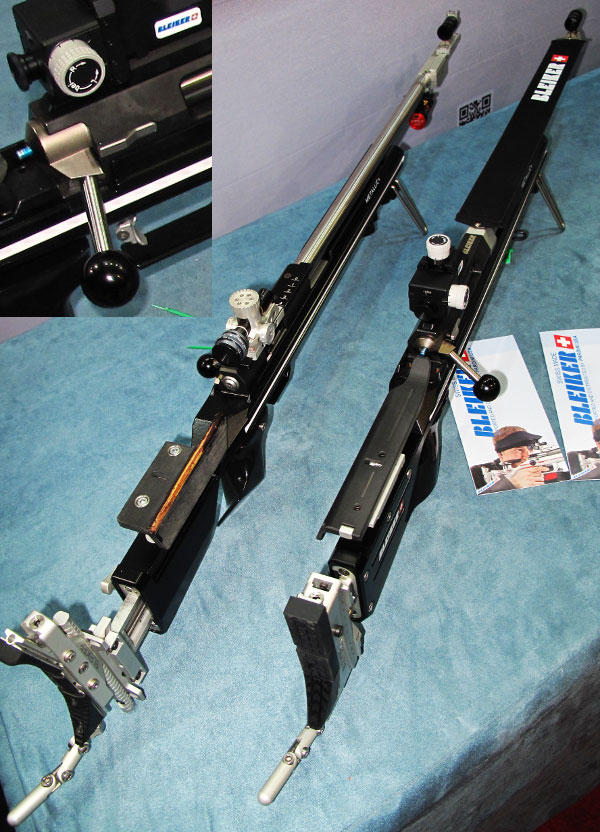
You are looking at $20,100 of Competition Rifles here. (Click Image for full-screen version.)
Don’t inquire about the price of a Bleiker competition rifle. As the expression goes, “If you have to ask, you can’t afford it”. At the Pardini USA booth at SHOT Show we saw a pair of bodacious black beauties — two “full-race” Bleikers, one a smallbore match rifle (.22 LR) and the other a 300m position rifle chambered in 6mmBR Norma. The combined price for the two rifles was a jaw-dropping $20,100.00. Yep, over $20K for the two. The 6mmBR rig was $10,200 while the smallbore rifle was $9,900.00.
Bleikers command such high prices because they win. At recent ISSF 300m and Smallbore Championships, Bleikers have been used by many of the medal winners. A gun is worth $10K if it can really put you on the podium or, better yet, deliver a world championship.
Take a look at this slick feature on the 300m gun. The adjustable cheek-pad automatically tilts up (for clearance) when you retract the bolt. That’s clever Swiss Engineering.
Get ready for a revolution in the F-Open, ELR, and Long-Range Benchrest games. Sierra just introduced a new 7mm bullet with a stunning 0.780 G1 BC. This new 197-grain HPBT MatchKing is one of the highest-BC, jacketed .284-caliber projectiles ever offered to the public. By comparison, Sierra’s own advanced 183-grain 7mm Matchking has a .707 G1 BC. That means the new 197-grainer has a 10% higher BC than the already slippery 183-grainer. That’s an impressive achievement by Sierra.
We expect top F-Open and long-range shooters will be trying the new 197-grainer as soon as they can get their hands on this new projectile. They may need new barrels however, as Sierra states: “This bullet requires a barrel twist rate of 1:7.5″ or faster”. Sierra expects to start shipping these slippery 7mm 197s very soon. You can order directly from Sierra’s website, stock code #1997, $54.20 for 100 bullets.
Factory Uniformed Bullet Tips
Sierra has officially announced that the 197gr SMK will come “pointed” from the factory. These impressive new 197s will have a “final meplat reducing operation” (pointing). This creates a higher BC (for less drag) and also makes the BC more uniform (reducing vertical spread at long range). Our tests of other factory-pointed Sierra MKs have demonstrated that Sierra does a very good job with this pointing operation. The “pointed” MatchKings we’ve shot recently had very nice tips, and did hold extremely “tight waterline” at 1000 yards, indicating that the pointing process does seem to enhance BC uniformity. Morever, radar-derived “real-world” BCs have been impressively uniform with the latest generation of pointed Sierra MKs (such as the new 110gr 6mm MatchKing).
Here is the statement from Sierra about the new bullets:
Shooters around the world will appreciate the accuracy and extreme long range performance of our new 7mm 197 grain HPBT (#1997). A sleek 27-caliber elongated ogive and a final meplat reducing operation (pointing) provide an increased ballistic coefficient for optimal wind resistance and velocity retention. To ensure precise bullet to bore alignment, a unique bearing surface to ogive junction uses the same 1.5 degree angle commonly found in many match rifle chamber throats.
While they are recognized around the world for record-setting accuracy, MatchKing® and Tipped MatchKing® bullets are not recommended for most hunting applications. Although MatchKing® and Tipped MatchKing® bullets are commonly used for varmint hunting, their design will not provide the same reliable explosive expansion at equivalent velocities in varmints compared to their lightly jacketed Hornet, Blitz BlitzKing, or Varminter counterparts.
New product tip from EdLongrange. We welcome reader submissions.
At the request of our readers, we provide select “Deals of the Week”. Every Monday morning we offer our Best Bargain selections. Here are some of the best deals on firearms, hardware, reloading components, and shooting accessories. Be aware that sale prices are subject to change, and once clearance inventory is sold, it’s gone for good. You snooze you lose.
1. Amazon — Lyman BoreCam $197.19
Here’s the best deal we’ve found on a very useful product. The Lyman BoreCam is an electro-optical borescope with a digital display. You can record “stills” on a SD card. This is one of the hottest products on the market right now — and users really like the BoreCam (although some wish the digital view-screen was larger). Amazon.com now has the Lyman BoreCam for $197.19. Grab it while you can at that price (with FREE shipping for Prime members). Other online vendors are charging a LOT more (e.g. MidwayUSA price is $259.99).
2. Natchez — RCBS ChargeMaster Dispenser, $259.99
Here’s a KILLER DEAL on the RCBS ChargeMaster combo scale/powder dispenser. This unit sells elsewhere for up to $389.00. You may want to act quickly as sale pricing changes frequently and many other vendors have recently raised their prices. Grafs.com sells this for $382.99 now while the current Amazon.com price is $349.99. You can save a lot through Natchez right now — ninety bucks compared to Amazon. Act quick before they sell out.
3. CDNN Sports — Ruger American Ranch Rifle (Tan), $349.99
Here’s a nice little varmint rifle from Ruger with good features and performance at a great price: $349.99. You could pay that much just for a barrel. This .223 Rem rifle features a 16.5″ hammer-forged barrel barrel threaded 1/2″-28 at the muzzle for brake or suppressor. The action, which features a 70° three-lug bolt, and Picatinny-style scope rail, sits in an aluminum bedding block. The crisp trigger adjusts down to 3 pounds. With a weight (before optics) of 6.1 pounds, this is a handy carry-around varminter. We like this rifle. For $349.99 it’s a steal.
Benchrest Matches have been won (and many records set) with 36X Weaver T-Series optics. Our friend Boyd Allen observed “You can pay three or four times as much for a scope but not necessarily be more competitive — a 36X front objective Weaver is enough to win with…” The Classic T-Series Weaver has proven to be one of the most reliable high-magnification scopes ever made. The “old-fashioned” adjustable objective works well and the Weaver Micro-Trac turret system delivers precise and repeatable elevation and windage control. Now just $369.99 at Natchez, this is a great deal.
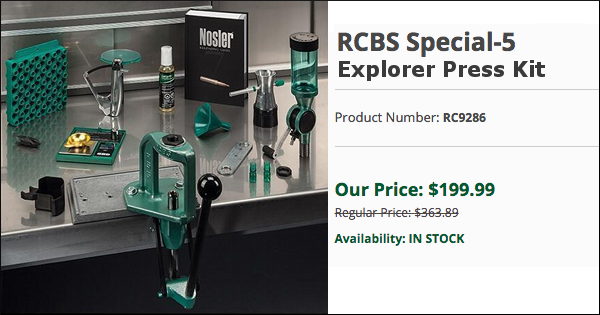
5. Natchez — Special 5 Reloading Press Kit, $199.99
Looking for a great holiday gift for a family member getting started in metallic cartridge reloading? This RCBS Kit has everything a new reloader needs: single-stage press, powder measure, scale, powder trickler, priming tool, cartridge tray, “rocket” chamfer tool, case lube and more. This is an excellent entry-level reloading kit, on sale for just $199.99 at Natchez Shooters Supplies. We like the relatively compact Special 5 press for most reloading duties. Eventually you may want to add an additional, large heavy press, but this will get the job done. For the combined package, with all the tools one needs to hand-load quality ammo — this is a stunningly good deal at $199.99.
6. Monmouth Reloading — 500 Lake City 5.56 Cases, $35.00
500 pieces of Lake City brass for just thirty-five bucks? Yep, that’s a great deal for anyone who needs .223/5.56 brass for varmint safaris and tactical comps. Monmouth Reloading is selling genuine, once-fired Lake City 5.56x45mm brass, thick-walled and sourced direct from the U.S. Military. Monmouth reports: “Our current stock of Lake City 5.56 looks to be all newer year Lake City head stamp but may contain a small percentage of other NATO headstamps. Lake City is a popular, reliable brass, normally capable of many reloads.” Monmouth includes 1% overage to account for any damaged brass. NOTE: Brass has crimped primers, so the pockets will need to be reamed or swaged prior to reloading.
Got patches? Here’s a great deal on 100% cotton flannel patches. There are many sizes available, starting at $9.99 for 800 one-inch “17 Cal” patches. For 6mm rifles, we actually like the 1.25″ round “22/223″ sized patches priced at $11.99 for 800. Choose either round patches or square patches in most sizes. We generally like round patches for use with spire-tip jags, but some shooters prefer to wrap their patches around a jag or brush and square patches work better for wrapping. The large, 2″-square .30 Cal patches cost $17.99 for 800. These prices include FREE Shipping for Prime Members.
8. Home Depot — 72″ Wood Workbench for $75.36
This patented Home Depot workbench assembles in a few minutes. Simply unfold the legs, pop in the shelf, and you are ready to start your project. Made from Premium 2×4 Hemlock fastened with glue and screws, this workbench is a great value. The bench (72″ wide x 35″ high x 22″ deep) can easily be stored when not in use. NOTE: The wood is unfinished (can be painted or stained).
Brownells is providing real-time coverage of SHOT Show on its SHOT Show Web Page. Starting Tuesday, January 17th, you can tune in to see videos filmed at the SHOT Show Convention Center. Brownells will spotlight new products and interview firearms industry experts.
All during SHOT Show week, Brownells will unveil new products. In addition, Brownells will interview industry notables such as Larry Vickers, Taran Butler, Bill Gieselle, and Frank Brownell. Along with video demos, dozens of new-for-2017 products will be spotlighted in a photo showcase.
Watch New Product Demos from the Brownells Booth at SHOT Show.
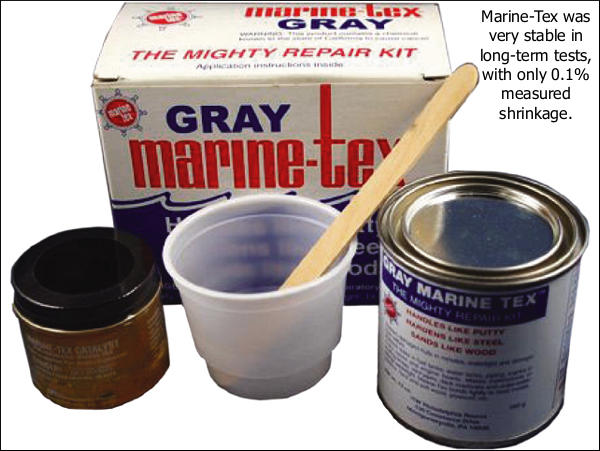
A customer of well-known gunsmith (and Hall-of-Fame shooter) Thomas “Speedy” Gonzalez recently asked Speedy about bedding compounds. Speedy offered some interesting advice based on long-term testing of various materials. Speedy favors Marine-Tex because it is very stable over time, while other materials can shrink up to 6% dimensionally. A good bedding job should be a perfect fit to your barreled action. If the bedding material shrinks over time, that is NOT a good thing….
Speedy’s customer asked: “I know you’re not a Devcon man in regards to bedding compounds but I respect your input in such matters and my question is this in regard to aluminum actions. If Devcon was considered, for an aluminum action, would you prefer aluminum compound formula or steel formula? I personally prefer Devcon steel and Marine-Tex for steel receivers but my experience with aluminum is limited. Also do you have a release agent preference that works better with aluminum?”
Speedy answered: “My only preference of one epoxy over another is their stability over time. My buddy who works for the Texas State Weights and Measures Department had me cast several of the most common types of epoxies used for bedding into 1.000″ machined blocks. After one year of being kept in a controlled climate and measured for shrinkage monthly, the Marine Tex shrunk only 1/10th of 1% (i.e. 0.1%) whereas almost all the others (including Devcon Steel formula, Devcon Aluminum formula…) shrunk 3% to 6%. The only other compounds that matched the Marine Tex were Araldite 1253 and Araldite 2014, with the latter being quite expensive for daily use.”
Speedy added: “The Marine Tex Grey has no atomized metal in its makeup even though it appears that it does. This can be proven by the use of a strong neodymium magnet. What is humorous to me is that people don’t like aluminum yet will bed their actions atop aluminum pillars that have twice the coefficient of expansion (COE) of steel. Like Devcon, it is what people have always done and used. Thus [they] perpetuate the same old stuff. That’s my two cents’ worth. But as I tell everyone, ‘I’ll tell you what I know or do, but it’s not my job to convince anyone to do it my way’.”
Release Agents — Try Shoe Polish
Regarding release agents, Speedy stated: “I use Kiwi Neutral or Tan shoe polish. This works great and you can find it anywhere. Do NOT use the black or brown as it will stick.”
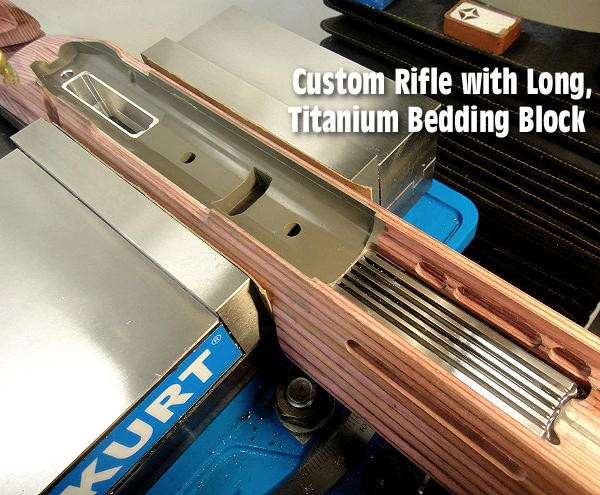
View More Photos of Speedy Inletting and Bedding Job CLICK HERE to see an interesting bedding job done by Speedy using a custom titanium bedding block. Speedy notes, “The stock was a raw blank requiring full inletting for the action to fit properly plus the titanium block. All the loading ports, bolt handle cut, bolt stop, and trigger guard cuts were done with diamond tooling to eliminate fraying and/or delamination of the wood.” You’ll find more projects by Speedy on his Facebook Page. Speedy is in San Antonio, Texas now, and accepting new projects with his company S.G. Rifles LLC.
We like binoculars with built-in Laser Rangefinding capability. With rangefinding binoculars, you can carry one less piece of gear, and a binocular optic is much more effective in the field than the monocular on a typical dedicated laser rangefinder (LRF). The stereo view gives better definition and depth perception, and the larger, binocular lenses give better low-light performance than the smaller-diameter monocular optic found in a conventional LRF.
Leica and Swarovski make excellent rangefinding binoculars, with great glass and impressive laser performance. But these European LRF Binoculars are very expensive — the latest Leica 10×42 Geovid is $2600.00 and the Swarovski 10×42 EL hits the three grand ($3000.00) mark. Frankly, that’s just too expensive for the vast majority of consumers.
New Vortex Rangefinding Binoculars at $1199.00 Street Price
Enter Vortex into the HD rangefinding binoculars marketplace with a quality, life-time “unconditional” guaranteed product at less than HALF the price of the Leica Geovid. MSRP of the Vortex’s new Fury HD Laser Rangefinder Binoculars is $1599.00, but “street price” will be hundreds less. Vortex says “expect to pay about $1199.00 at dealers for the Fury HD”. A lot more guys can afford $1200.00 than $2600.00, that’s for sure.
The Vortex Fury has some very cool features. It offers angle compensation as well as line-of-site modes. Scan mode gives readings as you pan or track a moving animal. You can set the distance output to yards or meters. All the controls are on the right side so you can operate the Fury HD easily with one hand. Check out the Fury’s features in the promo video below:
The Fury HD has good glass — fully multicoated HD lenses with good lowlight performance. The armored housing seems pretty tough. We like the fact that Vortex has provided a left eye diopter adjustment so users can fine-tune image focus for their vision.
Vortex says the Fury HD will range “reflective targets to 1600 yards with an ultra-fast readout”. That may be a bit generous. In the real world, we expect the hand-held Fury HD to range deer-sized objects out to 800 yards or so, and larger objects (such as vehicles) out to 1200. This is based on our testing of other similar rangefinding binoculars.
A beefy, new BAT action will debut at SHOT Show 2017. The new BAT TR Tactical action will be showcased by BulletCentral.com at Booth #2963. Notably, Bruce Thom, founder of BAT Machine, will be at the booth on Wednesday, January 18, 2017. Stop by to meet Bruce and learn more about this action.
Designed from the ground up for tactical and PRS shooters, the new TR action features a very stiff, robust body that still fits a Remington 700 inlet. The TR’s bolt is different than on BAT’s benchrest actions, so the TR runs better in dusty conditions and with extended strings of fire. This new action is fully compatible with Accuracy International double-stack magazines.
Story idea from EdLongrange. We welcome reader submissions.
There are many reasons you might want to make a chamber cast. You may have acquired an older rifle and need to verify the chamber dimensions. Or, if you have a new reamer, you may want to check the exact “cut” dimensions against the blueprint specs. A chamber casting is also valuable if you run across a firearm that you believe has a custom barrel on it and you want to find out the dimensions of the chamber. Lastly, you may want to prepare a chamber casting to be used in the making of custom dies. (Most reloading die makers know how to work from Cerrosafe chamber casts.)
Cerrosafe is a metal alloy that has some unique properties which make it ideal for chamber casting. First, it has a relatively low melting point of 158 to 190° Fahrenheit. This makes it easy for the handloader to melt the Cerrosafe in his home shop. Second, it shrinks slightly during cooling which allows it to be extracted from the chamber easily. It then re-expands to the chamber’s original size after about one hour at room temperature. After cooling for about 200 hours, the chamber cast will expand to about .0025″ larger than the actual chamber size.
One of our Forum members has done many Cerrosafe castings and he offers this smart advice:
1. Remove the barrel from the action to make the pour much easier. If you don’t remove the barrel, it can be hard to pour through the action (even with a funnel) and can make a mess if you’re not careful.
2. Pre-heat the barrel for 5-10 minutes in the oven on the very lowest setting (170° F in my oven). (DON’T overdo it!). Allow to cool for a couple minutes so you can pick it up and it is under 120° F. Pre-heating the barrel helps the Cerrosafe stay liquid as you pour the casting. This helps ensure a good, complete fit to the chamber.
How to Use Cerrosafe for Chamber Casting
The basic ingredient of Cerrosafe is bismuth. Bismuth is a heavy, coarse, crystalline metal which expands when it solidifies, up to 3.3% of its volume. When bismuth is alloyed with other metals, such as lead, tin, cadmium and indium, this expansion is modified according to the relative percentages of bismuth and other components present. As a general rule, bismuth alloys of approximately 50% bismuth exhibit little change of volume during solidification. Alloys containing more than this tend to expand during solidification and those containing less tend to shrink during solidification.
What all this means for the gunsmith is that you can make chamber castings using only Cerrosafe and a few, simple hand tools. To make a chamber casting, first clean and degrease the chamber. Use a tight-fitting, cotton patch that’s wrapped around a bore mop or brush to plug the bore just ahead of the throat. I usually leave the cleaning rod attached to the plug until it’s time to remove the plug. Melt the entire bar of Cerrosafe in a heatproof container that you can easily pour the hot Cerrosafe out of. You can use a propane torch or heat over a hot plate or the burner of a stove. Cerrosafe melts easily at 158°-195° F. While the casting metal is still liquid, stir very well, skim off the dross, and pour your chamber. The real trick with Cerrosafe is not to overheat it. If you heat the solid slowly, and keep it within the required temperature range, you shouldn’t get any dross.
Note the time the casting was poured. The casting will take only a very short time to solidify, usually within a minute. Wait 30 minutes and then remove the plug from the bore. Turn the muzzle upward and the casting will fall from the chamber. At 30 minutes after initial solidification, Cerrosafe shrinks slightly, so removal is very easy. Allow the new casting to cool thoroughly then measure the casting exactly one hour from the time it was cast. The casting will give you an exact measurement of the chamber. Cerrosafe casting metal can be used over and over. Remelt the entire amount back together and pour the Cerrosafe into a small mold of the appropriate size. Always melt the entire Cerrosafe ingot to make a chamber casting. For best results, never cut off, or use, just a part of the ingot.


 Developed in 2007 by Dennis DeMille and Dave Emary, the 6.5 Creedmoor is a shortened and improved 30 TC cartridge case that was inspired by the .308 Winchester design. This short action design was created to maximize case capacity and a wide range of loading lengths, while still fitting in standard short action magazines. With the correct twist barrel, the versatile 6.5 Creedmoor can take advantage of the wide range of bullet weights available in 6.5 mm (i.e. .264 caliber). Reloaders should keep in mind that the 6.5 Creedmoor works best with medium to medium-slow powders such as H4350, Varget, Win 760, and RE-17. The light recoil and adaptability of the efficient 6.5 Creedmoor cartridge has already proven itself in high power, precision rifle series and benchrest competitions. Couple that with respectable barrel life and its intrinsic accuracy potential and you have a recipe for success which should insure its legacy for decades to come.











 Cerrosafe is a metal alloy that has some unique properties which make it ideal for chamber casting. First, it has a relatively low melting point of 158 to 190° Fahrenheit. This makes it easy for the handloader to melt the Cerrosafe in his home shop. Second, it shrinks slightly during cooling which allows it to be extracted from the chamber easily. It then re-expands to the chamber’s original size after about one hour at room temperature. After cooling for about 200 hours, the chamber cast will expand to about .0025″ larger than the actual chamber size.


