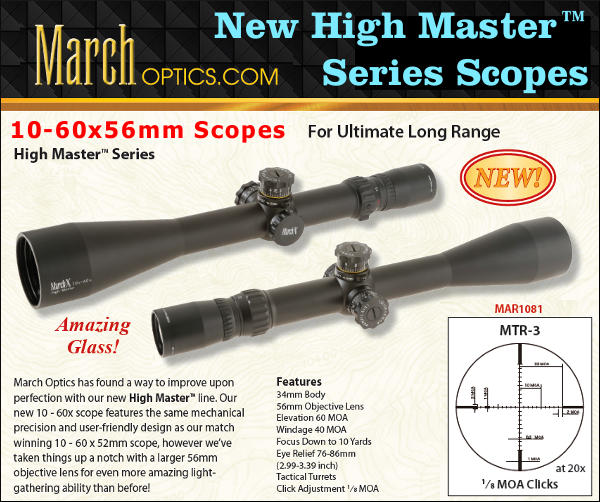
At SHOT Show in Las Vegas, March Optics will unveil its new “High Master” series scopes. These top-of-the line optics are designed for Benchrest and Long-Range Competition. We’ve always been impressed with the clarity and sharpness of March optics, and now they are even better. The High Master line of scopes boast class-leading, state-of-the-art ED glass that delivers outstanding sharpness with near-zero chromatic aberration.
The March engineers tell us: “We’ve found a way to improve upon perfection with our new High Master™ line. Meticulously designed and individually hand-assembled by the expert engineers at March, these scopes feature our new Super-ED, high-refractive glass for unparalleled quality and exceptional clarity. This high-tech glass greatly reduces chromatic aberration for a previously unheard-of level of sharpness and brilliance.”
New March High Master Scopes
March 10-60x56mm Zoom Scopes for Ultimate Long Range
(Five Versions: MAR1078 3⁄32 MOA DOT Reticle, MAR1079 1⁄8 MOA DOT Reticle, MAR1080 MTR-1 Reticle, MAR1081 MTR-3 Reticle, MAR1082 MTR-4 Reticle)
NOTE: The new 10-60x56mm scope features the same mechanical precision and user-friendly design as March’s match-winning 10-60x52mm zoom scope, but with a larger 56mm objective lens and enhanced glass.
March 40–60x52mm EP Zoom Scopes for Benchrest Competition
(Three Versions: MAR1083 CH Reticle, MAR1084 3⁄32 MOA DOT Reticle, MAR1085 1⁄8 MOA DOT Reticle)
NOTE: For shooters seeking “one-hole” accuracy in the Benchrest game, this is the scope. The new High Master 40-60x52mm EP Zoom scope gives serious Benchrest shooters an ultra-sharp, high-magnification variable scope with zero POI shift when changing magnification.
March 48 x 52mm Fixed Power Scopes for Benchrest Competition
(Three versions: MAR1075 Cross-Hair Reticle, MAR1076 3⁄32 MOA DOT Reticle, MAR1075 1⁄8 MOA DOT Reticle)
NOTE: These new March 48-power scopes look to set new quality standards among high-magnification, fixed power scopes for benchrest competition. Fixed-power scopes are lighter and simpler than variable scopes of equal magnification. In weight-limited Benchrest classes this fixed 48X will be a top choice.
Randy Robinett, founder of BIB Bullets, is a highly respected custom bullet-maker. In recent years, Randy’s 30-caliber projectiles have won countless benchrest-for-score matches, and captured many National titles. If you want to “run with the big dogs” in score competition, campaigning a 30BR with BIB bullets is a very smart way to go. In this article, Randy talks about the process of creating highly uniform cores for benchrest bullets.
This article originally started as an exchange of posts in Stan Ware’s Bench-Talk Forum. Stan, a gifted gunsmith, converted the Forum posts into an article, which first appeared on Stan’s Bench-Talk.com Website.
How to Make Benchrest-Quality Bullet Cores by Randy Robinett, BIB Bullets
OK, Stan “made me do it”! A while back, Stan Ware asked if I’d submit a ditty on bullet-making. Here is the “picture is worth a few words” version. Below is a photo of a spool of lead wire. This is the first step in making benchrest-quality bullets. This spool of .250″ diameter lead wire will be cut into approximately 130 pieces, each about thirty inches long.
The Core Cutter
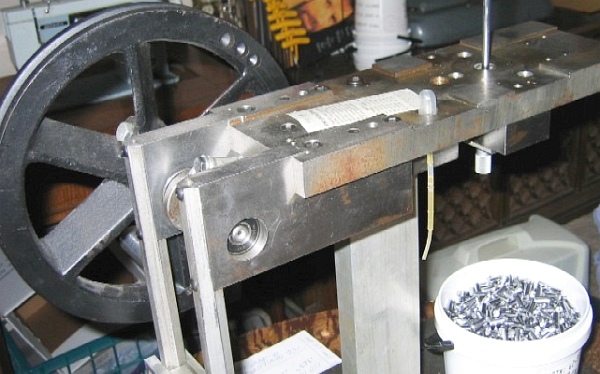
Here’s a really neat machine built by my Uncle and BIG MIKE. This is the core cutter. We made it using scrap steel and borrowed the crank shaft out of a 1966 Yamaha motorcycle to get the desired reciprocating-motion slide. When properly “juiced”, this machine can cut more than 3000 cores per hour.
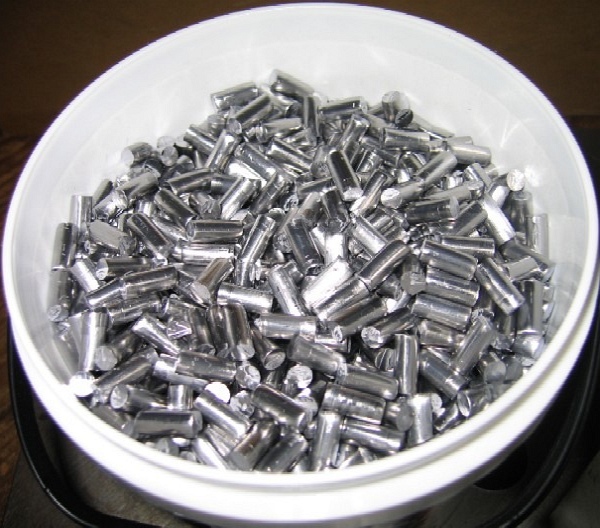
As you doubtless deduced, the “sticks” are inserted, then fed via gravity — straightness is a virtue here! The crank, for now, is powered by the human hand. The bucket contents are the result of loading the cutter and turning the crank wheel. This photo shows cores for 112 grain, .30-caliber bullets. There are about 2500 cores to the bucket.
Here’s a close-up of the business end of the core cutter. Using recorded micrometer settings, this clever design allows us to get very repeatable length when changing through the length/weight cycle.
The photo below provides a closer look at the just-cut cores. Note the relatively clean shanks and square, unflared ends. This bucket contains roughly 2500 cores. By contrast, a tour of the Hornady plant will reveal cores being cut and squirted via a single operation, and deposited into 50-100 gallon livestock watering tanks!
Upon my first tour of a commercial plant, I lost all feelings of guilt about the cost of custom, hand-made bullets. When one totals the amount of labor, “feel” and “culling” that goes into them, custom hand-made bullets represent one of the best bargains on the planet!
At Hornady, each press produces 50-55,000 finished bullets per 10-hour shift. By contrast, a maker of hand-crafted bullets, at best, may make 3% of that number during a 10-hour span! Yep, hand-made benchrest-quality bullets are a labor of love and should be purchased with these criteria in mind: 1) QUALITY; 2) availability; 3) price. There is no reason for a maker of hand-made benchrest-quality bullets to negotiate on price. His time is worth what one receives from the bargain!
Core-Making Q & A Randy’s original Bench-Talk Forum posts inspired some questions by Forum members. Here are Randy’s answers to spedific questions about core-making.
Question by Stan Ware: Randy, a post or two back you said the cores were cut into 30″ lengths first and straightened. Why do you cut to 30″ lengths? What is the reason for this?
Answer by Randy: Stan, the wire is cut into 30″ lengths (sticks) and then straightened, following which it is fed into the core cutter and cut into the individual individual “cores”. If you look at the core cutter photo above, you’ll see a stick of lead wire sticking up -it’s toward the right hand end of the contraption. The cut cores are also “ejected” by gravity — the white “tickler” brushes the cores as the slide moves forward and dislodges the core from the cutter bushing.
Q by GregP: Randy, How do you straighten the 30″ sticks? Roll them between metal plates?
Answer by Randy: Greg, BIG MIKE may kill me for letting out the secret. WE “roll” the wire between an aluminum plate, which is equipped with handles, and the “plate” which you can see in the pic of cutting the wire. The straightening is really a drag. Eventually, we will have the new cutter hooked up to a “feeder/straightener” and the wire will be cut into core slugs right off the roll! Well, that’s the Dream….
Question by Jim Saubier: How much of a nub do you use at the end of the 30″ section? I imagine that every section you will lose a little from the feed end. Your cutter looks real slick, we are using the manual deal and it isn’t quick by any means.
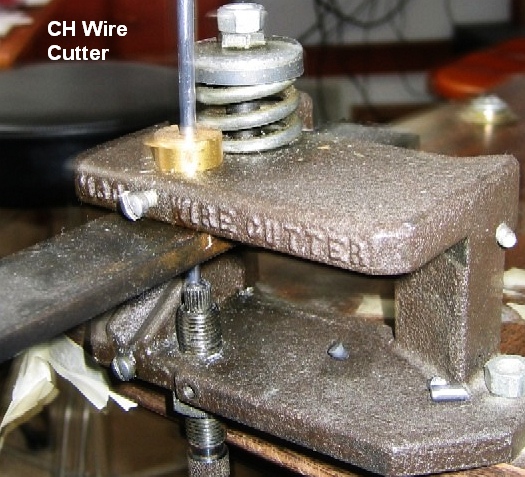
Answer by Randy: Jim, Since I cut all of the sticks using diagonal-cutting pliers, the ends are, indeed, waste. However, only about 1/8th inch on the beginning end — the final core may be too short. I have attached a pic of my old reliable CH cutter. I still use this cutter for .22-cal and 6mm cores and, occasionally, an odd lot of thirties. The CH cuts very square ends which are free of bulges and/or flaring.
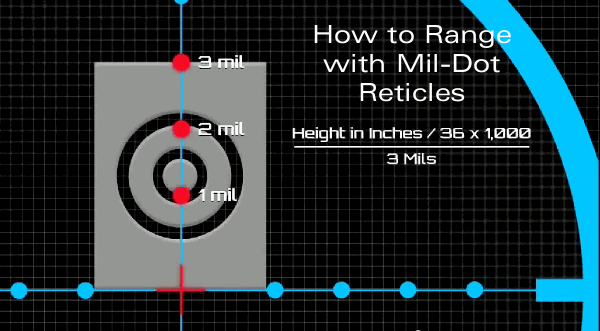
MIL-system scopes are popular with tactical shooters. One advantage of MIL scopes is that the mil-dot divisions in the reticle can be used to estimate range to a target. If you know the actual size of a target, you can calculate the distance to the target relatively easily with a mil-based ranging reticle. Watch this helpful NRA video to see how this is done:
Leupold has released three new VX-3i scopes for precision shooters. The new VX-3i LRP (“Long Range Precision”) series of scopes offer impressive features at affordable price points. There are three new LRP models: 4.5-14x50mm, 6.5-20x50mm, and 8.5-25x50mm. The “3i” in the model names indicates a three-times zoom ratio.
Both front focal plane (FFP) and rear focal plane VX-3i LRP models will be offered. All VX-3i LRP scopes come with a removable throw lever on the zoom ring. The big, knurled turrets are easy to manipulate and feature an elevation zero stop. You can choose either quarter-MOA or 1/10th MIL clicks, and the reticles are matched to the click values — MOA/MOA or mil/mil.
Several popular reticle options are available, including MOA-based Impact-29 MOA, Impact-32 MOA and T-MOA®; or the mil-based TMR® and the new Leupold CCH (Combat Competition Hunter) reticle. The Leupold CCH is a grid-based reticle providing holdovers and wind holds in mils. That should prove popular with tactical marksmen and PRS competitors.
For target work at 400+ yards we like the 8.5-25x50mm LRP:
Competing with Vortex and Bushnell for the Tactical Market
We see these VX-3i scopes as direct competition for the Vortex and Bushnell scopes now favored by many tactical and PRS shooters. Leupold’s goal was to build a scope with the features customers want at affordable prices. Tim Lesser, Leupold’s VP of product development, explains: “The VX-3i LRP [optics line] is a high-end, long-range riflescope that’s within most people’s budget, be it for PRS, long-range target shooting or even hunting.”
Shotgun vs. Handgun — which is better for home defense? That’s a question that inspires strong opinions on both sides. We think the best answer may be “both”. There are some situations where a pistol is most handy, while there are other situations where the power (and lethality) of the shotgun clearly wins out. Some would argue that the shotgun offers an “intimidation” factor that may better resolve a threat without a shot being fired.
The NSSF, in cooperation with Thunder Ranch Training Center, has created an interesting video that examines the Shotgun vs. Handgun debate. As the Cheaper Than Dirt Blog notes: “The primary argument against the shotgun is a longer length leading to less maneuverability. On the other hand, the pistol offers better maneuverability, but lacks the stopping power of a shotgun”. Moreover, the pistol may be less accurate, according to some critics. This NSSF video looks at the question from a logical standpoint — making some surprising points.
As you can see in this still frame from the video, the shooting stance of the pistol shooter (Clint) is NOT much more compact than that of the two shotgunners (compare actual muzzle positions). So a shotgun may actually be more handy inside a home than some people realize. Clint concludes that the gun selection debate “is all very easily solved by only one question: ‘If someone was going to run across a bedroom at you and they had a big knife, would you rather shoot him one time with a pistol or one time with a shotgun?’ When you answer the question you figure out why this [shotgun length] doesn’t really bother us. We simply take these [shotguns] and use them in a slightly different manner…”
In this video, Thunder Ranch Director Clint Smith explains why the overall length of a shotgun, as held in firing position against the shoulder, is not really that much greater than the “shooting stance length” of a handgun held in a proper firing position (with arms extended). Accordingly gun length/size should not be the deciding factor when choosing a firearm for home defense.
Whatever Weapon You Choose — Train with It
Fundamentally, you should use the firearm that is 100% reliable, and with which you have trained regularly. Mastery of a defensive firearm — whether shotgun or handgun — needs to be second-nature. You should be able to operate all the controls (safety, pump, decocker, slide, bolt handle etc.) by “instinct” based on hours of training. Likewise you should know how to operate the light/laser if your defensive firearm is so equipped. Importantly, you should be able to reload in darkness, and clear malfunctions without panicking.
SEB Rests, producers of the SEB NEO rest and innovative JoyPod bipod, have released an all-new, portable tripod-base Co-Axial rest, the SEB Mini. This is a very impressive bit of engineering by Sebastian Lambang. Weighing about 12 pounds, the SEB Mini is easy to transport yet stable and versatile in the field. A joystick lever-arm allows the shooter to move the front head (with sandbag) in any direction with a smooth continuous motion. The Mini delivers about 30 MOA vertical travel by 45 MOA horizontal travel with the same smooth, fluid feel as the NEO rest.
The Mini is now in full production and testers in the USA and UK have returned very positive test results. The Mini combines the smooth controls of a full-size Co-Axial front rest, yet is much easier to transport. Based on reports from testers Dan Bramley and Vince Bottomley, we predict the Mini will become extremely popular with F-Open competitors as well as all shooters currently using pedestal-style front rests for recreational shooting or load testing. Price for the complete unit (with front bag) is $675.00 shipped in the lower 48 states.
Inventor Seb Lambang told us his design goals in creating the Mini, which was named after “Mini” his pet Chihuahua: “The Mini rest is designed to be simple, compact, and light. It has has equal smoothness and MOA travel as the larger NEO rest.”
The new SEB Mini is a joystick (coaxial) rest with a height-adjustable single center column fitted on a base with three foldable legs. The top can be rotated 360 degrees and locked securely by the two adjustable locking levers. The lowest setting is about 6.25″, the highest is just over 10″. The SEB Mini can be used for F-Class shooting, bench rest shooting, varmint shooting, or load development. The joystick handle is compatible with the SEB NEOs and MAX co-axial rests. The Mini ships complete with a one-piece front sandbag in the buyer’s choice of width.
Key Features:
12-lb carry weight
Large Footprint, yet very portable
Legs adjust with individual thumbwheels
Mariner Wheel offers 40mm of Vertical Adjustment
Measures 5″ x 7″ x 16.25″ when folded
Lowest height approx 6.25″, highest 10″ or more
Head can be rotated independent of base assembly (to assist alignment)
Head unit can be purchased separately and fitted to different tripod base.
SEB Mini REVIEW by Dan Bramley:
Sebastian Lambang, the creator of the ever-popular SEB NEO and SEB MAX co-axial front rest, was kind enough to send me a SEB Mini for review. The point of this review is to give a shooter’s perspective. I will just say that the adjustments and movements are plenty sufficient to shoot in F-Class in High Power and rimfire.
Positives: The SEB Mini has all of the fine craftsmanship of the NEO. The fit and finish is excellent. This thing is SOLID! When the screws are all locked down it does not budge. The engineering is excellent and well thought-out. It comes in at 12.0 lbs with sand in bag and ready to shoot. To me this weight appears to be optimal, light enough to travel with but heavy enough to be stable.
Shootability: For me shooting off the SEB Mini was no different than shooting off the SEB NEO. The fluid motion of the coaxial top and stability were consistant with the NEO. Set-up was quick and the ability to set it down in reasonably close alignment and release the clamps on the Acme screw to allow perfect rest alignment was a nice feature. Course adjustment was quick with the large mariner wheel and the joystick has the same size collet as the NEO for those who may have made custom joysticks.
I shot my rimfire off of it at first, on concrete, and it didn’t move at all. No surprise there. So I figured I would shoot my biggest rifle off of it in an attempt to punish this little “Mini”.
Conclusion: This thing is just awesome! It folds up quite compact and would likely fit in a bag, instead of a pelican case, for travel. I have often thought of shooting my open rifle off of a JoyPod when traveling by air but that requires a rail etc. for mounting. I would not hesitate to shoot off this Mini in competition.
Vince Bottomley Tests the New Seb Mini
Our friend Vince Bottomley acquired a Seb Mini and had a chance to test it out in competition at the Diggle Range in the UK. Vince was very impressed with the Mini, which he says is very solid and smooth running, yet easy to set up. Vince used his new Mini to win a match, proving the unit is “competition-ready”: “When you do a range test like this, it’s always great if you can post a decent result and I’m pleased to be able to report that I won Open Class….”
Vince liked the smooth operation and broad windage/elevation adjustment range offered by the Mini:
“The joystick offers plenty of movement at 600 yards so staying on target throughout the shoot was no problem and, more importantly, I could swing onto my competitors’ targets as a final wind-check. Each of the three legs has its own ‘angle’ adjustment — enabling you to obtain a steady, level set-up on the most uneven of firing-points. The center pedestal can be raised and lowered using a mariner wheel and of course, there is the familiar joystick adjustment.”
Vince said it was easy to level the Mini and align the head with his rear bag: “Drop it on the point, then level the bubble using the leg-adjuster thumb-screws (photo right). Because the screws are at the pivot point they move the legs very quickly — as opposed to screwing the feet to level a NEO. Wind up the mariner wheel to get on target, nip up the locking levers and the rest is perfectly aligned, thanks to the swiveling head.”
Vince also liked the fact that the Mini is significantly lighter than a SEB NEO rest, but still stable because it has a wide footprint. See the comparison photo below.
Vince tells us that the Mini is truly easy to transport: “I’ve fixed a strap to my Mini so, by slinging it over my shoulder, I can carry rifle, mat and back-bag with ease — so that’s a big ‘plus’ right off.”
Conclusion: “The SEB Mini lived up to expectations and ticked all the boxes –lighter to carry, easy to set up, plenty of adjustment, very stable. Thank you Seb… You have a winner here!” — Vince Bottomley
Product Information from SEB Rests:
The complete SEB Mini includes Head unit, foldable legs, fore-end stop, aluminum bag bracket (with bubble level), joystick, leveling screws, and front bag. The base features three foldable legs, each of which can be adjusted/tilted for elevation via a thumb screw. We recommend setting the base/legs in the highest position initially, then lowering each leg via the thumb screws.
The Mini is offered in three (3) configurations. The complete Mini with base, foldable legs, and carry case is $800.00, including shipping to the lower 48 States. For considerable less there are two legless options. Option 1 is the Mini without the foldable legs. This could work for customers who may wish to fit the top to a solid base plate. Option 2 includes just the head unit with center post, mariner wheel and needle thrust bearing. Option 2 could suit customers who already have a Bald Eagle or Caldwell base with 1″ diameter center hole/post. However some machining may be required. Call Ernie Bishop at 307-257-7431 for current option prices and availability.
Net weight approx. 5.5 kilograms (12 lbs)
Top can be rotated 360° and locked securely in any position
Measures 5″ x 7″ x 16.25″ when folded
Joystick is compatible with SEB NEO, MAX and JoyPod
Lowest height approx 6.25″, highest 10″ or more
Foldable legs can be individually adjusted up/down with thumb screws
Extra wide footprint, leveling screws are about 17 inches apart
Ambidextrous, and can be used either “Up for Up” or “Up for Down”
Made from 6061 and 7075 aircraft grade aluminum
Head has removable fore-end stop
Standard fold-able base for traveling with tiltable legs
Comes with standard one-piece 3″-wide front bag 3″ wide (Optional bags*: 2-1/4″, wide sporter (for 1.5″-2″ stock), narrow sporter (for 1″-1.5″ stock)
For more information, visit SEBRests.com. The USA dealer is Ernie Bishop:
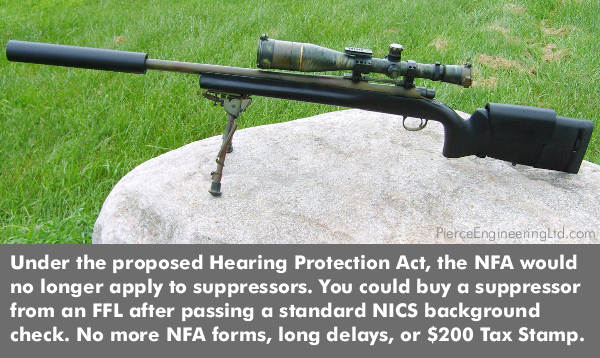
We may see a big change in how sound suppressors are regulated in the future, if new legislation from the Congressional Sportsmen’s Caucus (CSC) becomes law. On January 10, 2017, Rep. Jeff Duncan (SC) and Rep. John “Judge” Carter (TX) introduced H.R. 367, the Hearing Protection Act (HPA). This law would remove suppressors (aka “moderators”) from National Firearms Act (NFA) control, eliminating requirements of extensive paperwork, and purchase of a tax stamp. If the Hearing Protection Act becomes law, suppressors could be purchased through an FFL (after a NICS background check), just like a normal, non-NFA firearm. This would make suppressors more affordable in the 42 states where suppressors are legal to own. What’s more, the new legislation includes a provision to refund the $200 transfer tax to applicants who purchased a suppressor after Oct. 22, 2015.
Suppressors function by trapping the expanding gasses at the muzzle, allowing them to slowly cool in a baffled chamber. On average, suppressors reduce the noise of a gunshot by 20-35 decibels (dB), roughly the same sound reduction as earplugs or earmuffs. In addition to hearing protection, suppressors also mitigate noise complaints from those who live near shooting ranges.
“Many gun owners and sportsmen suffer severe hearing loss after years of shooting, and yet the tool necessary to reduce such loss is onerously regulated and taxed. It doesn’t make any sense,” said Chris W. Cox, executive director, NRA-ILA. “The Duncan-Carter Hearing Protection Act would allow people easier access to suppressors, which would help them to better protect their hearing.”
Guns.com explained how the Hearing Protection Act will change current law: “Since 1934, the federal government has treated devices designed to muffle or suppress the report of firearms as Title II devices that required registration under the National Firearms Registration and Transfer Record and mandated transfers that included a $200 tax stamp. The Duncan-Carter bill would repeal this requirement and treat suppressors as firearms — which would allow them to be transferred through any regular federal firearms license holders to anyone not prohibited from possessing them after the buyer passes an FBI instant background check.”
This video discusses an earlier version of the Hearing Protection Act, H.R. 3799:
“For the past five years, the Congressional Sportsmen’s Foundation (CSF) has worked alongside the state legislative sportsmen’s caucuses in the National Assembly of Sportsmen’s Caucuses, the American Suppressor Association, and many other partners at the state level to normalize the use of suppressors throughout the nation,” said CSF President Jeff Crane. A similar bill was introduced last year by Rep. Matt Salmon (AZ) but that legislation never made it out of committee.
If you have purchased a suppressor in the last year, the HPA could put money back in your pocket. As drafted, the HPA also includes a provision to refund the $200 transfer tax to applicants who purchased a suppressor after October 22, 2015.
Here’s the latest leveling technology for shooters. The innovative “SEND iT” device is an electronic level featuring five colored LEDs along with a conventional bubble level. When the rifle is level, a single green LED lights in the middle. If you are off-kilter, blue or red warning LEDs alert you. There are five sensitivity levels (from 0.2° to 1.0° between lights). The Send iT level can be mounted vertically as well as horizontally and the electronics will auto-sense the correct position.
The makers of the SEND iT claim it is the “most accurate and fastest shooting level made”. The system mounts to a Picatinny-style scope rail, extending out to the left side. There are multiple modes, including leveling, battery check, and sleep mode. The LEDs can be dimmed for night use.
This Video Shows the SEND iT Level Sensitivity Settings:
The SEND iT level, offered by Long Range Arms (LRA), will debut at SHOT Show 2017. Price and Pre-Order info will be available in late January on the Long Range Arms Facebook Page.
At the request of our readers, we provide select “Deals of the Week”. Every Monday morning we offer our Best Bargain selections. Here are some of the best deals on firearms, hardware, reloading components, and shooting accessories. Be aware that sale prices are subject to change, and once clearance inventory is sold, it’s gone for good. You snooze you lose.
1. Precision Reloading — Sierra Bullets Sale, Big Discounts
Right now Precision Reloading is running a BIG SALE on Sierra MatchKing (MK) and Tipped MatchKing (TMK) bullets. These projecticle are being offered at deep discounts, with very low prices (some close to wholesale). Here are a few examples of the dozens of types of Sierra Bullets on sale. In most cases you can choose either 100-ct or 500-ct packages.
Sierra 30 Cal, 195gr Tipped MK, 100 for $36.02 (marked down from $41.79)
Sierra 30 Cal, 155gr HPBT MK, 100 for $31.21 (marked down from $35.29)
Sierra 7mm, 183gr HPBT MK, 100 for $38.37 (marked down from $43.39) (Great new bullet)
Sierra 6.5mm, 142gr HPBT MK, 100 for $34.21 (marked down from $187.69)
Sierra 6.5mm, 130gr Tipped MK, 100 for $30.58 (marked down from $38.69)
Sierra 6mm, 107gr HPBT MK, 100 for $27.68 (marked down from $31.29)
Sierra 6mm, 95gr Tipped MK, 100 for $28.25 (marked down from $31.99)
Sierra 22 Cal, 80gr HPBT MK, 500 for $117.08 (marked down from $132.39)
Sierra 22 Cal 77gr TMK, 100 for $26.19 (marked down from $29.69)
NOTE: This Sierra Bullets Sale runs through January 11, 2017, so order soon!
Here’s an awesome deal from EuroOptic.com. Save $200 on a very popular Vortex Precision Shooting Tactical (PST) optic. On sale for just $499.99, this 4-16x50mm EBR-1 Scope offers tactical turrets with Milradian adjustments, an illuminated second focal plane EBR-1 reticle, 30mm main tube, side-focus parallax, plus a large, bright objective. What’s more, this scope weighs just 22 ounces — making it an ideal optic for a tactical or precision rifle, varmint blaster, or hunting rifle.
3. Amazon — Plano Double Rifle Case with Wheels, $106.37
This Plano Double Scoped Rifle Case is an Amazon Best Seller for good reason. It offers the functionality and durability of an SKB-type hard case for HALF the money. This is under $110.00, while the equivalent SKB is around $240.00, so you can buy two Planos for the price of one SKB. The 51.5″ interior will fit most scoped competition rifles up to about 29″ barrels (measure your own rifle to make sure). The handles are convenient and beefy and the wheels make this case easy to move through airports and parking lots. This is a very tough, roomy case for the money.
4. Grafs.com — Hornady Reloading Kit with Sonic Cleaner, $299.99
This Hornady Reloading Kit is a great deal at $299.99 (30% off Graf’s regular price). This kit comes with everything you need: Lock-N-Load single stage press, L-N-L Powder Measure, Digital Scale, Powder Trickler, Funnel, 9th Ed. Handbook of Cartridge Reloading, 3 L-N-L die bushings, handheld priming tool, universal reloading block, chamfering and deburring tool, primer turning plate and One Shot Case Lube. Plus this Kit includes a bonus FREE Lock-N-Load Sonic Case Cleaner, a $90.00 value. NOTE: This reloading Kit also qualifies for Hornady’s Get Loaded Free Bullets promotion.
5. Amazon — Leight MAX NRR33 Earplugs, $7.45 for 50 Pairs.
These Howard Leight NRR33 Max plugs are your Editor’s favorite foam earplugs. They seal out noise better than any others I’ve tried. Between shooting, motorcycling and mowing lawns, I probably have Max plugs in my ears 2-3 days a week. This is a very good price for a bulk pack of 50 pairs (100 plugs). And if you act soon, you can get free shipping to boot.
6. Amazon — MTM Shooting Range Box, $32.99 Shipped
The versatile MTM Shooting Range Box includes cradles so you can do gun maintenance while at the range. A lift-out tray holds small items such as patches and jags. This durable, Made-in-USA product can hold ammo, windmeter, LRF, cleaning supplies, and other gear. The $32.99 Sale Price includes free shipping for Prime members.
7. Amazon — Tipton 12-pc Ultra-Jag Set, $16.99
Brass jags work well — with one hitch. Strong copper solvents can leech metal from the jag itself, leaving a tell-tale blue tint on your patches. This “false positive” can lead shooters to over-clean their barrels. No such problem with these nickel-plated Ultra Jags. For just $16.99 you can get 12 jags in a handy, clear-top fitted caddy. All Tipton nickel-plated jags have 8-32 thread, except for the .17 caliber jag which has a 5-40 thread.
8. Midsouth — 17 HMR V-Max Ammo, $10.45 for 50 rounds
Need 17 HMR ammo for your planned 2017 varmint safaris? Then grab this Hornady V-Max ammo while you can at $10.45 for a 50-round box. This is a great price. Other vendors are selling the same Hornady ammo for as much as $15.00 per box. We’ve used this ammo and it was very accurate out of both semi-auto (Savage A17) and bolt-action (CZ 455) 17 HMR rifles.
Production wood rifle stocks, both laminates and hardwoods, are commonly made with stock duplicating machines. Stock duplicators allow a stock-maker to copy a master design faithfully and efficiently. The video below, from Colorado rifle-maker Michael Cuypers, shows a stock duplicator (in automatic mode) cutting a piece of Turkish Walnut, for a mauser 98. This machine rotates the blank while a spinning vertical cutting head shapes and trims the blank. This duplicator manually tracks the shape/profile of the master blank. To make another stock, this process needs to be repeated, with the master in place. For more information about this duplicating machine, visit www.riflebuilders.com.
Watch Stock Duplicator in Progress
Future Technology: We are starting to see stocks made with CNC milling machines that cut stock profiles based on three-dimensional scans of master stock designs. However, the traditional mechanical duplicator process in the video is still most commonly used by most of today’s stock-makers.
Turkish Walnut — Where to Get a Beautiful Blank
The Bijou Creek video above shows a Turkish Walnut stock being roughed out. Turkish Walnut is some of the most beautifully figured wood available — but it can be pricy. If you are looking for this kind of ultra-high-grade wood, it makes sense to shop carefully. You’ll find a wide selection of Turkish Walnut blanks at the HunterBid.com website. Hundreds of selections are available at auction. Prices start as low as $150.00. The finest blanks sell for $1,000 or more. New blank selections are added to the website every other day. HunterBid.com is run by Chiron Inc., which is 100% owned by the Ergin family who are of Turkish origin. Chiron maintains warehouses in Dover, NH and Istanbul, Turkey.
Video find by Boyd Allen. We welcome reader submissions.







 “The joystick offers plenty of movement at 600 yards so staying on target throughout the shoot was no problem and, more importantly, I could swing onto my competitors’ targets as a final wind-check. Each of the three legs has its own ‘angle’ adjustment — enabling you to obtain a steady, level set-up on the most uneven of firing-points. The center pedestal can be raised and lowered using a mariner wheel and of course, there is the familiar joystick adjustment.”