Can’t make it to SHOT Show in January? Well CLICK HERE for a sneak preview of new products that will be on display at the Sands Convention Center in Las Vegas. Shown below are some interesting new products we liked. You’ll find 100+ new products online in the SHOT Show New Product Center. Here are four that caught our attention:
Bighorn Arms Action with Interchangeable Bolt Head
This new action from Bighorn Arms has many interesting features. It boasts a floating, interchangeable bolt head, plus a patent-pending enclosed mechanical ejector. It also offers tool-less bolt disassembly, and a Savage small shank is available for a Remage-type setup. With this versatile system you can swap bolt head and barrel in minutes. That’s great for varminters who heat up barrels quickly. It also lets competitors swap calibers easily. An F-TR shooter could compete with a .308 Win but train with less-expensive .223 Rem. This new action is machined after heat-treating, then precision ground (not turned) for best strength and dimensional accuracy. The bolt handle and body are crafted from one piece of 4130 chromoly steel. NOTE: This action can be ordered as AICS and AW magazine compatible, or AICS-only for a stiffer action. Price: $1325.00.
Matrix Side-Charging AR Upper (Non-Reciprocating)
This patent-pending product from Matrix Arms eliminates the conventional rear charging-handle on ARs. It provides an easy-to-operate charging handle on the left side of the upper. Available in 5.56x45mm and 9mm Luger, the patent-pending Matrix Arms side-charging upper allows the use of a standard 5.56 bolt carrier group without modifications. Note this design does NOT reciprocate (move back and forth) like the charging handle on an AK47. Once you use the handle to chamber the first round, the handle doesn’t move. The Matrix upper also offers a protective sleeve to eliminate dust or debris in harsh conditions. Price: $299.00 (upper receiver only); $599.00 (complete upper with barrel + handguard).
Ritter & Stark Modular Tactical Rifle
There’s a new long-range precision tactical rifle from Ritter & Stark (R&S) of Austria. The new SX-1 Modular Tactical Rifle (MTR) is designed to allow rapid barrel changes for three chamberings: .308 Winchester, .300 Winchester Magnum, and .338 Lapua Magnum. Notably, the scope rail is mounted on the barrel itself, and the bolt locks directly into the barrel. This patented system allows scope, rail, and barrel to be swapped out as one integrated assembly, which should definitely help maintain zero when barrels are exchanged. Price: $5555.00.
TekMat Long Gun Cleaning Kit with Roll-Up Mat
Now this is smart! TekMat’s 28-Piece Universal Rifle/Shotgun Cleaning Kit rolls up in its own fitted cleaning mat. You get brushes, jags, and slotted tips to clean everything from .22 caliber to a .45 caliber, along with 12 and 20 gauge shotguns. Also included is an aluminum tool handle, four brass rods, two cotton brushes, cotton patches, solvent and gun oil. All parts have a labeled location on the mat and elastic bands hold everything in place. The kit easily rolls up and fits inside the included carry bag. TekMat cleaning mats feature a soft, durable, and stain resistant thermoplastic polyester cleaning surface. Price: $59.95.
Today’s the day — November 8, 2016, Election Day. We urge all our readers to get out and vote. Every vote DOES count. This is a very critical election for gun rights issues. It’s not just about the Presidential race. Control of Congress is at stake, as are important upcoming nominations for the Supreme Court. If you care about the future of the country (not to mention the future of the shooting sports), get out and vote today.
Likewise, remember that state elections are very important too. Just look at what has happened in California. Every year Californians have seen new challenges to citizens’ Constitutional rights to own firearms. Handguns are restricted, self-loading rifles are restricted, hunting areas are closed. And now California’s majority-party politicians want to require citizens to have a state permit in order to purchase ammunition. Make no mistake about it — the ultimate goal of many proponents of these measures is to end private ownership of firearms altogether. The only way to halt these kind of infringements is to elect State and Federal representatives who respect gun rights, who are friends of the shooting sports, and who believe in the Second Amendment.
Let’s say you’ve purchased a new scope, and the spec-sheet indicates it is calibrated for quarter-MOA clicks. One MOA is 1.047″ inches at 100 yards, so you figure that’s how far your point of impact (POI) will move with four clicks. Well, unfortunately, you may be wrong. You can’t necessarily rely on what the manufacturer says. Production tolerances being what they are, you should test your scope to determine how much movement it actually delivers with each click of the turret. It may move a quarter-MOA, or maybe a quarter-inch, or maybe something else entirely. (Likewise scopes advertised as having 1/8-MOA clicks may deliver more or less than 1 actual MOA for 8 clicks.)
Reader Lindy explains how to check your clicks: “First, make sure the rifle is not loaded. Take a 40″ or longer carpenter’s ruler, and put a very visible mark (such as the center of an orange Shoot’N’C dot), at 37.7 inches. (On mine, I placed two dots side by side every 5 inches, so I could quickly count the dots.) Mount the ruler vertically (zero at top) exactly 100 yards away, carefully measured.
At the request of our readers, we provide select “Deals of the Week”. Every Monday morning we offer our Bargain selections. Here are some of the best deals on firearms, hardware, reloading components, and shooting accessories. Be aware that sale prices are subject to change, and once clearance inventory is sold, it’s gone for good. You snooze you lose.
1. Amazon — Howard Leight Electronic Muffs, $26.99
Act quickly — this is a DEAL of the DAY on Amazon! We’ve never seen a lower price on these popular electronic muffs, which are Amazon’s #1 seller in the category. The price goes back up tomorrow! Every shooter should own a pair of electronic muffs, even if you prefer shooting with earplugs and/or standard muffs. Electronic muffs are great when you are doing spotting duties or are working near the firing line. They allow you to hear ordinary conversations while still providing vital hearing protection. Right now Amazon.com has the Howard Leight Impact Sport Electronic Muffs on sale for just $26.99 (Deal of the Day). See All Price Options. NOTE: For regular, sustained shooting we recommend muffs and/or earplugs with a higher NRR rating.
2. CDNN Sports — Ruger American Ranch Rifle (Tan), $349.99
Here’s a nice little varmint rifle from Ruger with good features and performance at a killer price: $349.99. You could pay that much just for a barrel. This .223 Rem rifle features a 16.5″ hammer-forged barrel barrel threaded 1/2″-28 at the muzzle for brake or suppressor. The action, which features a 70° three-lug bolt, and Picatinny-style scope rail, sits in an aluminum bedding block. The crisp trigger adjusts down to 3 pounds. With a weight (before optics) of 6.1 pounds, this is a handy carry-around varminter. We like this rifle. For $349.99 it’s a steal.
3. Amazon — Caldwell Long Range Target Cam System, $329.49
Forum members have purchased this Caldwell Target Cam System and they’ve found that it works reliably, providing a clear signal to any WiFi-enabled mobile device (smartphone, iPad, Laptop). One member specifically tested the unit at 1000 yards and it functioned fine. NOTE: This system does NOT have a zoom camera lens, so you need to position the camera within 10 yards or so of the target. But if you place it to the side a bit, this shouldn’t be a problem. This system comes with a nice, fitted carrying case that holds camera, transceivers, antennas, and stands. You get a very capable system for under $330.00 (Amazon price includes free shipping for Prime members). You can also get this system from Midsouth for $357.02 (shipping extra).
Got patches? Here’s a great deal on 100% cotton flannel patches. There are many sizes available, starting at $8.99 for 800 one-inch “17 Cal” patches. For 6mm rifles, we actually like the 1.25″ round “22/223″ sized patches priced at $11.99 for 800. Choose either round patches or square patches in most sizes. We generally like round patches for use with spire-tip jags, but some shooters prefer to wrap their patches around a jag or brush and square patches work better for wrapping. The large, 2″-square .30 Cal patches cost $17.99 for 800.
5. Amazon — Frankford Quick-N-EZ Case Tumbler, $34.99
Look no further for a great deal on a reliable tumbler. We’ve used this very same machine to tumble both pistol brass and rifle cases. We like the see-through, transparent top and the large capacity — this will hold up to 350 .223 Rem cases. With 1000+ customer reviews on Amazon.com, this Frankford Quick-N-Easy Case Tumbler has earned a 4.5-star rating. If you need a tumbler, you might want to order soon — this is the best price we’ve seen in a while.
6. CDNN Sports — 45 ACP Ruger American Pistol, $399.99
At $399.99, this modern .45 ACP Ruger American Pistol costs hundreds less than premium polymer handguns from Europe. Compared to a Glock 21, it has better sights, a better trigger, and better ergonomics. Compared to an HK USP it has a lower bore axis and is way less expensive. FYI the Ruger’s low bore axis really does reduce felt recoil. The Ruger American pistol has interchangable grip panels so you can adjust the grip to your hand size. Controls are ambidextrous. Bottom line, this is a very good gun that gives up little to Glock, HK, and Walther. Buy American and save hundreds.
The RCBS Rock Chucker remains a classic — a big, strong, versatile press that can handle most reloading chores with ease. And now you can get a genuine Rock Chucker Supreme for $126.99 — a very good deal. The Rock Chucker offers plenty of leverage for case-sizing and the “O” is tall enough for long cartridges. The Rock Chucker has a very strong base and should last a lifetime. We’re not fans of the Rock Chucker’s priming system but most serious reloaders use a separate priming tool.
8. RCBS — Buy Green, Get Green Rebate
RCBS is running a very attractive Rebate Program currently. If you spend $300.00 on qualifying products you get a $75.00 rebate. Spend $50 and get a $10.00 Rebate. This program is limited to one (1) rebate redemption per calendar year, with a maximum of $75.00. CLICK HERE for more information. NOTE: To qualify, you must supply completed RCBS rebate coupon, original UPC barcodes from package, and original cash register receipt and/or dated, itemized sales invoice.
Need quality .22 LR rimfire ammo at an affordable price? Consider Norma. Most folks think Norma only produces centerfire ammo and cartridge brass. As a result, people haven’t been looking for Norma rimfire ammo. Their loss is your gain. Accurate, reliable Norma .22 LR ammunition is in-stock right now at leading online vendors. This is good quality ammo, made in Europe. Bullets.com has Norma Tac-22 ammo in stock at $5.25 per 50-rd box (SKU: BL7819). In addition, Bullets.com offers Norma Match-22 ammunition at $7.50 per 50-rd box (SKU: BL11887).
The Coriolis Effect comes into play with extreme long-range shots like this (2100 yards at Raton, NM). The rotation of the earth actually moves the target a small distance (in space) during the long duration of the bullet’s flight.
When you’re out at the range, the Earth seems very stable. But it is actually a big sphere zooming through space while spinning around its axis, one complete turn every 24 hours. The rotation of the earth can create problems for extreme long-range shooters. During extended bullet flight times, the rotation of the planet causes an apparent deflection of the bullet path over very long distances. This is the ballistics manifestation of the Coriolis Effect.
Bryan Litz of Applied Ballistics has produced a short video that explains the Coriolis Effect. Bryan notes that Coriolis is “a very subtle effect. People like to make more of it than it is because it seems mysterious.” In most common shooting situations inside 1K, Coriolis is not important. At 1000 yards, the Effect represents less than one click (for most cartridge types). Even well past 1000 yards, in windy conditions, the Coriolis Effect may well be “lost in the noise”. But in very calm conditions, when shooting at extreme ranges, Bryan says you can benefit from adjusting your ballistics solution for Coriolis.
Bryan explains: “The Coriolis Effect… has to do with the spin of the earth. You are basically shooting from one point to another on a rotating sphere, in an inertial reference frame. The consequence of that is that, if the flight time of the bullet gets significantly long, the bullet can have an apparent drift from its intended target. The amount [of apparent drift] is very small — it depends on your latitude and azimuth of fire on the planet.”
Coriolis is a very subtle effect. With typical bullet BCs and velocities, you must get to at least 1000 yards before Coriolis amounts to even one click. Accordingly, Bryan advises: “Coriolis Effect is NOT something to think about on moving targets, it is NOT something to think about in high, uncertain wind environments because there are variables that are dominating your uncertainty picture, and the Coriolis will distract you more than the correction is worth.”
“Where you could think about Coriolis, and have it be a major impact on your hit percentage, is if you are shooting at extended range, at relatively small targets, in low-wind conditions. Where you know your muzzle velocity and BC very well, [and there are] pristine conditions, that’s where you’re going to see Coriolis creep in. You’ll receive more refinement and accuracy in your ballistics solutions if you account for Coriolis on those types of shots. But in most practical long-range shooting situations, Coriolis is NOT important. What IS important is to understand is when you should think about it and when you shouldn’t, i.e. when applying it will matter and when it won’t.”
The Coriolis Effect — General Physics
The Coriolis Effect is the apparent deflection of moving objects when the motion is described relative to a rotating reference frame. The Coriolis force acts in a direction perpendicular to the rotation axis and to the velocity of the body in the rotating frame and is proportional to the object’s speed in the rotating frame.
A commonly encountered rotating reference frame is the Earth. The Coriolis effect is caused by the rotation of the Earth and the inertia of the mass experiencing the effect. Because the Earth completes only one rotation per day, the Coriolis force is quite small, and its effects generally become noticeable only for motions occurring over large distances and long periods of time. This force causes moving objects on the surface of the Earth to be deflected to the right (with respect to the direction of travel) in the Northern Hemisphere and to the left in the Southern Hemisphere. The horizontal deflection effect is greater near the poles and smallest at the equator, since the rate of change in the diameter of the circles of latitude when travelling north or south, increases the closer the object is to the poles. (Source: Wikipedia)
Sierra has just announced a new, high-BC .30-caliber projectile. This provides a very interesting new option for F-TR competitors and long-range benchrest shooters. The new 195-grain Tipped MatchKing (TMK) boasts an impressive 0.610 G1 Ballistic Coefficient. That compares well with any conventional bullet in this caliber and weight range. The key to the high BC is the green acetal resin tip that lowers drag while making the BC more consistent for every bullet in the box. NOTE: This .30-caliber 195 grain TMK requires a twist rate of 1:10” or faster to stabilize.
The new 30 cal. 195 grain Tipped MatchKing® bullets will be available in 500-ct boxes (product #7795C) with a $243.84 MSRP as well as 100-ct boxes (product #7795) with MSRP of $51.19 per box. Note, this new 195gr TMK is designed for competition use — primarily as a paper-puncher. Sierra says: “Tipped MatchKing® bullets are not recommended for most hunting applications.”
New Product Tip from EdLongrange. We welcome reader submissions.
This important video shows what really happens when loaded ammunition burns. You will probably be surprised. Contrary to Hollywood notions, the ammo doesn’t ignite in a massive explosion. Far from it… basically the rounds “cook off” one by one, and the bullets release at relatively low velocity. We’ve featured this SAAMI research project before, but it is worth reprising for those who have not yet seen the burn tests.
A couple years back, SAAMI released an important video concerning ammo and fire. With professional fire-fighters standing by, over 400,000 rounds of ammo were incinerated in a series of eye-opening tests. If you haven’t had the chance to view this video yet, you should take the time to watch it now
The Sporting Arms and Ammunition Manufacturers’ Institute (SAAMI) has produced an amazing 25-minute video that shows what actually happens to sporting ammunition involved in a fire. This video shows the results of serious tests conducted with the assistance of professional fire crews. We strongly recommend you watch this video, all the way through. It dispels many myths, while demonstrating what really happens when ammunition is burned, dropped, or crushed.
Watch SAAMI Ammunition Testing Video
Video Timeline
2:10 Impact Test (ignited outside firearm)
3:40 65-foot Drop Test
5:08 Bullet Impact (.308 Win firing)
7:55 Blasting Cap Attacks
9:55 Bulldozer and Forklift Tests
12:20 Boxed Ammo Bonfire
15:37 Bonfire without Packaging
17:21 Retail Store Simulation Burn
20:55 Truck Trailer Burn
Over 400,000 rounds of ammunition were used in the tests. Some of the footage is quite remarkable. Testers built a bonfire with 28,000 rounds of boxed ammo soaked in diesel fuel. Then the testers loaded five pallets of ammo (250,000 rounds) in the back of a semi-truck, and torched it all using wood and paper fire-starting materials doused with diesel fuel.
The video shows that, when ammo boxes are set on fire, and ammunition does discharge, the bullet normally exits at low speed and low pressure. SAAMI states: “Smokeless powders must be confined to propel a projectile at high velocity. When not in a firearm, projectile velocities are extremely low.” At distances of 10 meters, bullets launched from “cooked-off” ammo would not penetrate the normal “turn-out gear” worn by fire-fighters.
We are not suggesting you disregard the risks of ammo “cooking off” in a fire, but you will learn the realities of the situation by watching the video. There are some amazing demonstrations — including a simulated retail store fire with 115,000 rounds of ammo in boxes. As cartridges cook off, it sounds like a battery of machine-guns, but projectiles did not penetrate the “store” walls, or even two layers of sheet-rock. The fire crew puts out the “store fire” easily in under 20 seconds, just using water.
Additional Testing: Drop Test, Projectile Test, Crush Test, Blasting Cap Test
Drop Test
The video also offers interesting ammo-handling tests. Boxes of ammo were dropped from a height of 65 feet. Only a tiny fraction of the cartridges discharged, and there was no chain-fire. SAAMI concludes: “When dropped from extreme heights (65 feet), sporting ammunition is unlikely to ignite. If a cartridge ignites, it does not propagate.”
Rifle Fire Test
SAAMI’s testers even tried to blow up boxes of ammunition with rifle fire. Boxes of loaded ammo were shot with .308 Win rounds from 65 yards. The video includes fascinating slow-motion footage showing rounds penetrating boxes of rifle cartridges, pistol ammo, and shotgun shells. Individual cartridges that were penetrated were destroyed, but adjacent cartridges suffered little damage, other than some powder leakage. SAAMI observed: “Most of the ammunition did not ignite. When a cartridge did ignite, there was no chain reaction.”
Bulldozer Crush Test
The test team also did an amazing “crush-test” using a Bulldozer. First boxes of loaded ammo, then loose piles of ammo, were crushed under the treads of a Bulldozer. A handful of rounds fired off, but again there was no chain-fire, and no large explosion. SAAMI observed: “Even in the most extreme conditions of compression and friction, sporting ammunition is unlikely to ignite. [If it does ignite when crushed] it does not propagate.”
Blasting Cap Test
Perhaps most amazingly, the testers were not able to get ammunition to chain-fire (detonate all at once), even when using blasting caps affixed directly to live primers. In the SAAMI test, a blasting cap was placed on the primer of a round housed in a large box of ammo. One cartridge ignited but the rest of the boxed ammo was relatively undamaged and there was no propagation.
What’s the next best thing to a stockpile of gleaming, freshly-loaded ammo? How about a movie showing gleaming, freshly-loaded ammo being made — from start to finish? The five-minute video below shows the ammunition production process at the Lake City Army Ammunition Plant, a division of ATK. Lake City is the largest producer of small arms ammunition for the U.S. military, producing roughly four MILLION small-caliber rounds every day.
This promotional video does go overboard at times (too many smiling employees gushing about quality control). Still, it is fascinating to watch the process of creating cartridges — from the drawing (or extrusion) of raw brass into casings to the placement of projectiles and primers.
Quick History of Lake City Ammunition Plant Lake City Army Ammunition Plant (LCAAP) is a 3,935-acre government-owned, contractor-operated facility in Independence, Missouri that was established by Remington Arms in 1941 to manufacture and test small caliber ammunition for the U.S. Army. The facility has remained in continuous operation except for one 5-year period following World War II. As of July 2007, the plant produced nearly 1.4 billion rounds of ammunition per year. Remington Arms operated the plant from its inception until 1985, when operations were taken over by Olin Corporation. Since April 2001, it has been operated by Alliant Techsystems (ATK).
Throughout the cinematic history of Hollywood, guns have been popular elements. You’ll find firearms featured in all sorts of movies — westerns, historical war dramas, spy flicks, and action thrillers. The National Firearms Museum has a Hollywood Guns exhibit dedicated to some of cinema’s most iconic firearms. Think you can name these famous guns found in the exhibit? Take the quiz and put your knowledge to the test. It will take a good knowledge of cinema AND guns to do well. FWIW, Your Editor just did this quiz on the NRA Blog Website and got 6 out of 7 answers correct. Can you beat that score?
NOTE: The quiz skips one question. You’ll see a reference to “Question Eight” but there are actually only seven (7) questions.
The folks at Sierra Bullets asked a few staff bulletsmiths a classic question about guns: “If you could own only one firearm which one would you choose?” There were many interesting answers including a “cheater” response — the drilling — which is really two guns in one. The most-often mentioned chambering was the venerable .30-06. Respondents cited its versatility, hunting prowess, and ready availability of ammo. The popular .308 Winchester, as expected, got mentions as did its cousins the .243 Win and 7mm-08. There were quite a few votes for classic lever guns, as well as 12-gauge shotguns. Two bulletsmiths cited the .22 LR, and we can certainly see the logic in that answer. The little rimfire cartridge is versatile, quiet, and inexpensive.
We ask our readers the same question — if you could only have one long gun, what type of firearm would it be? List the gun type and chambering in the comments section.
If You Could Have Just One Long-Gun — ANSWERS:
Media Relations Manager Carroll Pilant answered: “I would NEVER own only one gun. If I HAD to pick one, it would be a drilling in 12 gauge over .30-06.”
Ballistic Technician Rich Machholz answered: “The early tang safety Ruger M77s pretty much have all you could want in a bolt gun, but I do like the Winchester lever guns and the combination guns, particularly the drillings. Since I have the first two, I’m going for a Doug Turnbull 1886 or a side by side 20 gauge over .223 drilling.”
Ballistic Technician Philip Mahin answered: “More than likely it would have to be a bolt action .30-06. The reliability is legendary on a wide range of game animals and factory ammunition has still been available at my local stores even in these tough times.”
Ballistic Technician Duane Siercks answered: “If I had to boil it all down to one gun, it would probably be a .30-06. I have a Remington 700C (custom shop gun) that has worked very well for anything and everything I have ever wanted to do with it.”
Ballistic Technician Paul Box answered: “A .22 Rimfire.”
Chief Ballistician Tommy Todd answered: “Remington 700 in .308 Winchester.”
VP – Sales & Marketing Matt Reams answered: “A light weight Kimber in 25-06.”
Production Toolsetter Brad Vansell answered: “Savage weather warrior 7mm-08 is my rifle of choice.”
Production Toolsetter Dan Mahnken answered: “The .308 Winchester rifle — [based on the] wide range of bullets made and the wide range of things that one can hunt with it.”
Process Engineer David Palm answered: “Savage action 243 Winchester.”
Ballistic Technician Gary Prisendorf answered: “Probably a .22 LR. It may not be the best choice, but you could use it for about anything if you really had to.”
Production Manager Chris Hatfield answered: “Beretta A300 Outlander 12 gauge.”


 Likewise, remember that state elections are very important too. Just look at what has happened in California. Every year Californians have seen new challenges to citizens’ Constitutional rights to own firearms. Handguns are restricted, self-loading rifles are restricted, hunting areas are closed. And now California’s majority-party politicians want to require citizens to have a state permit in order to purchase ammunition. Make no mistake about it — the ultimate goal of many proponents of these measures is to end private ownership of firearms altogether. The only way to halt these kind of infringements is to elect State and Federal representatives who respect gun rights, who are friends of the shooting sports, and who believe in the Second Amendment.
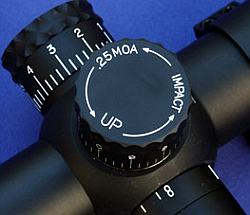 Let’s say you’ve purchased a new scope, and the spec-sheet indicates it is calibrated for quarter-MOA clicks. One MOA is 1.047″ inches at 100 yards, so you figure that’s how far your point of impact (POI) will move with four clicks. Well, unfortunately, you may be wrong. You can’t necessarily rely on what the manufacturer says. Production tolerances being what they are, you should test your scope to determine how much movement it actually delivers with each click of the turret. It may move a quarter-MOA, or maybe a quarter-inch, or maybe something else entirely. (Likewise scopes advertised as having 1/8-MOA clicks may deliver more or less than 1 actual MOA for 8 clicks.)


 When you’re out at the range, the Earth seems very stable. But it is actually a big sphere zooming through space while spinning around its axis, one complete turn every 24 hours. The rotation of the earth can create problems for extreme long-range shooters. During extended bullet flight times, the rotation of the planet causes an apparent deflection of the bullet path over very long distances. This is the ballistics manifestation of the


 The Sporting Arms and Ammunition Manufacturers’ Institute (
 We are not suggesting you disregard the risks of ammo “cooking off” in a fire, but you will learn the realities of the situation by watching the video. There are some amazing demonstrations — including a simulated retail store fire with 115,000 rounds of ammo in boxes. As cartridges cook off, it sounds like a battery of machine-guns, but projectiles did not penetrate the “store” walls, or even two layers of sheet-rock. The fire crew puts out the “store fire” easily in under 20 seconds, just using water.
 What’s the next best thing to a stockpile of gleaming, freshly-loaded ammo? How about a movie showing gleaming, freshly-loaded ammo being made — from start to finish? The five-minute video below shows the ammunition production process at the Lake City Army Ammunition Plant, a division of ATK. Lake City is the largest producer of small arms ammunition for the U.S. military, producing roughly four MILLION small-caliber rounds every day.


