The folks at Sierra Bullets asked a few staff bulletsmiths a classic question about guns: “If you could own only one firearm which one would you choose?” There were many interesting answers including a “cheater” response — the drilling — which is really two guns in one. The most-often mentioned chambering was the venerable .30-06. Respondents cited its versatility, hunting prowess, and ready availability of ammo. The popular .308 Winchester, as expected, got mentions as did its cousins the .243 Win and 7mm-08. There were quite a few votes for classic lever guns, as well as 12-gauge shotguns. Two bulletsmiths cited the .22 LR, and we can certainly see the logic in that answer. The little rimfire cartridge is versatile, quiet, and inexpensive.
We ask our readers the same question — if you could only have one long gun, what type of firearm would it be? List the gun type and chambering in the comments section.
If You Could Have Just One Long-Gun — ANSWERS:
Media Relations Manager Carroll Pilant answered: “I would NEVER own only one gun. If I HAD to pick one, it would be a drilling in 12 gauge over .30-06.”
Ballistic Technician Rich Machholz answered: “The early tang safety Ruger M77s pretty much have all you could want in a bolt gun, but I do like the Winchester lever guns and the combination guns, particularly the drillings. Since I have the first two, I’m going for a Doug Turnbull 1886 or a side by side 20 gauge over .223 drilling.”
Ballistic Technician Philip Mahin answered: “More than likely it would have to be a bolt action .30-06. The reliability is legendary on a wide range of game animals and factory ammunition has still been available at my local stores even in these tough times.”
Ballistic Technician Duane Siercks answered: “If I had to boil it all down to one gun, it would probably be a .30-06. I have a Remington 700C (custom shop gun) that has worked very well for anything and everything I have ever wanted to do with it.”
Ballistic Technician Paul Box answered: “A .22 Rimfire.”
Chief Ballistician Tommy Todd answered: “Remington 700 in .308 Winchester.”
VP – Sales & Marketing Matt Reams answered: “A light weight Kimber in 25-06.”
Production Toolsetter Brad Vansell answered: “Savage weather warrior 7mm-08 is my rifle of choice.”
Production Toolsetter Dan Mahnken answered: “The .308 Winchester rifle — [based on the] wide range of bullets made and the wide range of things that one can hunt with it.”
Process Engineer David Palm answered: “Savage action 243 Winchester.”
Ballistic Technician Gary Prisendorf answered: “Probably a .22 LR. It may not be the best choice, but you could use it for about anything if you really had to.”
Production Manager Chris Hatfield answered: “Beretta A300 Outlander 12 gauge.”
NOTE: Despite the “BLK” in the name, this is a NOT a black powder substitute. This is a modern smokeless powder suitable for a wide variety of popular cartridges.
Hodgdon has announced a new “faster” variant of its popular CFE 223 powder. That’s good news for shooters of small varmint cartridges. Hodgdon’s new CFE BLK (named after the .300 AAC Blackout cartridge) has a faster burn rate than the original CFE 223. That makes CFE BLK ideal for small cartridges such as the .17 Hornet and .221 Fireball. The original CFE 223 propellant was formulated for reduced copper fouling (“CFE” in the name refers to “Copper Fouling Eraser”). New CFE BLK shares this reduced fouling technology which was developed originally for the U.S. military. Many of our Forum members have tried CFE 223 and confirmed that is performs “as advertised” — with less copper fouling that most other propellants. That’s a big benefit for varmint shooters, who may put hundreds of rounds through a barrel in a single day on the varmint fields.
Optimized for the .300 AAC Blackout cartridge, CFE BLK works great for .300 Blackout loads in AR-type rifles throughout the range of bullet weights. Moreover, CFE BLK is perfect for subsonic, reduced loads. In addition, Hodgdon reports that CFE BLK performs superbly in many smaller-capacity cartridges, in particular varmint cartridges such as the .17 Hornet, .17 Ackley Hornet, .218 Bee, .221 Fireball. CFE BLK is also well-suited for the 6.8 Remington SPC and the 7.62X39 Russian cartridge.
CFE BLK Meters Well and Burns Clean
CFE BLK is a spherical (ball) powder. Hodgdon reports the CFE BLK meters well, allowing reloaders to throw very consistent charges every time: “This fine powder meters like a dream and leaves no copper residue, extending accuracy for longer shooting periods, and making clean-up quick and easy.”
CFE BLK Should Be on Dealers’ Shelves in January 2017
Starting in January, 2017, CFE BLK powder will be available in both one-pound (1-lb.) and eight-pound (8-lb.) containers. Check with leading vendors such as Bruno’s, Midsouth, and Powder Valley. By the end of 2016, you should find complete load data for CFE BLK on the Hodgdon Reloading Data Center at www.HodgdonReloading.com.
When we first ran this story a while back, it generated great interest among readers. By popular request, we’re reprinting this story, in case you missed it the first time around. — Editor
Precision shooters favor premium brass from Lapua, Norma, or RWS. (Lake City also makes quality brass in military calibers.) Premium brass delivers better accuracy, more consistent velocities, and longer life. Shooters understand the importance of good brass, but many of us have no idea how cartridge cases are actually made. Here’s how it’s done.
The process starts with a brass disk stamped from strips of metal. Then, through a series of stages, the brass is extruded or drawn into a cylindrical shape. In the extrusion process the brass is squeezed through a die under tremendous pressure. This is repeated two or three times typically. In the more traditional “draw” process, the case is progressively stretched longer, in 3 to 5 stages, using a series of high-pressure rams forcing the brass into a form die. While extrusion may be more common today, RWS, which makes some of the most uniform brass in the world, still uses the draw process: “It starts with cup drawing after the bands have been punched out. RWS cases are drawn in three ‘stages’ and after each draw they are annealed, pickled, rinsed and subjected to further quality improvement measures. This achieves specific hardening of the brass cases and increases their resistance to extraordinary stresses.” FYI, Lapua also uses a traditional draw process to manufacture most of its cartridge brass (although Lapua employs some proprietary steps that are different from RWS’s methods).
After the cases are extruded or drawn to max length, the cases are trimmed and the neck/shoulder are formed. Then the extractor groove (on rimless cases) is formed or machined, and the primer pocket is created in the base. One way to form the primer pocket is to use a hardened steel plug called a “bunter”. In the photos below you see the stages for forming a 20mm cannon case (courtesy OldAmmo.com), along with bunters used for Lake City rifle brass. This illustrates the draw process (as opposed to extrusion). The process of draw-forming rifle brass is that same as for this 20mm shell, just on a smaller scale.
River Valley Ordnance explains: “When a case is being made, it is drawn to its final draw length, with the diameter being slightly smaller than needed. At this point in its life, the head of the draw is slightly rounded, and there are no provisions for a primer. So the final drawn cases are trimmed to length, then run into the head bunter. A punch, ground to the intended contours for the inside of the case, pushes the draw into a cylindrical die and holds it in place while another punch rams into the case from the other end, mashing the bottom flat. That secondary ram holds the headstamp bunter punch.
The headstamp bunter punch has a protrusion on the end to make the primer pocket, and has raised lettering around the face to form the headstamp writing. This is, of course, all a mirror image of the finished case head. Small cases, such as 5.56×45, can be headed with a single strike. Larger cases, like 7.62×51 and 50 BMG, need to be struck once to form a dent for the primer pocket, then a second strike to finish the pocket, flatten the head, and imprint the writing. This second strike works the brass to harden it so it will support the pressure of firing.”
Thanks to Guy Hildebrand, of the Cartridge Collectors’ Exchange, OldAmmo.com, for providing this 20mm Draw Set photo. Bunter photo from River Valley Ordnance.
By all indications, Americans are buying more guns than ever before. Some pundits have joked that President Obama is the “greatest gun salesman in history”. Looking at NICS (FBI instant check) records, Dean Weingarten of the Gun Watch Blog concludes that 2016 will see new records set, likely surpassing 2015 as the year with the highest number of gun sales ever. CLICK Link to Gun Watch.
Weingarten writes:
The private firearm stock in the United States will have increased by nearly 100 million firearms, or 30%, during the two terms of the Barack Obama presidency.
Many indicators show a soaring and diverse level of gun ownership. Carry permits are burgeoning, approaching 15 million and more. Gun ownership among women and minorities is at an all-time high.
This October continued the record-breaking pace to establish 2016 as the year with the most gun sales ever. The 2016 NICS checks are far ahead of those for 2015, the previous record holder. In October 2016 there were 2,333,539 National Instant Checks done. In 2015, the NICS done in October were 1,976,759.
In 2015, the total NICS checks for the year were 23,141,970. In 2016, through October, they were 22,206,233. That is less than 1 million below the total for 2015, with the two biggest months in 2016 yet to happen. Last year there were 17,584,346 by the end of October.
A record number of NICS Checks may take place in 2016. Photo: Benton Co. Gunworks.
The numbers are 26.3% ahead of where 2015 was at this time. If this pace continues, 2016 will end up with 29.2 million background checks for the year.
Given the NICS numbers, there will probably be 17 to 18 million guns added to the private stock in 2016. That would increase the total number to over 400 million private firearms in the United States.
Who would have thought that President Obama would be the record-setting, all time champion, gun salesman? The total NICS checks will reach over 250 million by years end. That will be over 150 million firearms added to the private stock in the last 18 years (there are 0.6 sales per check on average). Over 37% of the private firearms stock will be less than 18 years old.
Story by Boyd Allen
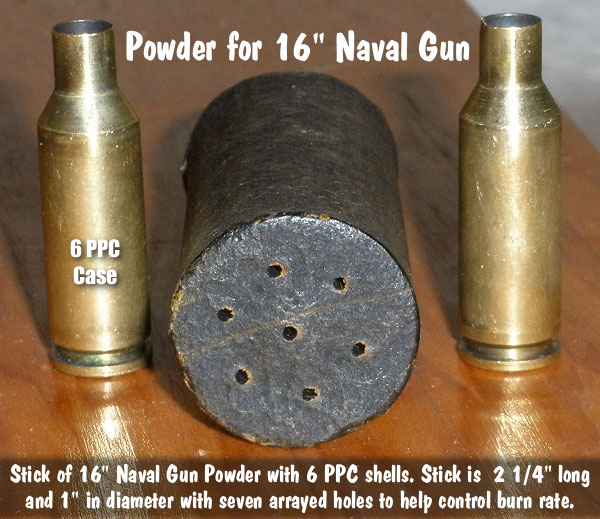
While many top competitive shooters trickle their stick powder charges to a kernel or two, that would be impractical when loading charges for giant naval guns. You may be surprised, but the shells fired by the U.S. Navy’s massive 14″ and 16″ naval guns were also propelled by stick-type extruded powders. You couldn’t trickle these ‘kernels’ though — a single stick or ‘grain’ can be over 2″ long. Take a look…
In connection with a Benchrest Central discussion that drifted to the subject of powders used in large naval guns, I heard from Joe McNeil, whose father was involved in manufacturing those very propellants as a DuPont employee. Joe writes:
“My Dad worked for the DuPont company for over 40 years. Every time the nation went to war he was assigned to the gun powder plants which DuPont ran for the government for $1.00 per year! His last assignment was at the Indiana Ordnance Plant in Jefferson, Indiana from 1952 through 1958. He had a display case made of all of the different powders made at the plant and left it to me. That’s why I have a grain of 16″ gun powder. He took me out to the Jefferson proving grounds once when they tested the powder in a 16″ gun. We watched from a half-mile away but it left a lasting impression when they fired that gun. They actually had a set of rings they fired through to test the performance of the powder and shell. This was a truly fond memory of my Dad and his work.”
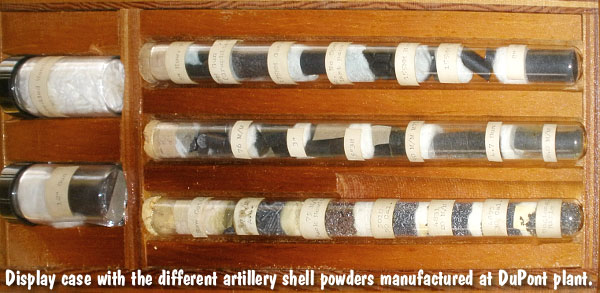
Here are some pictures of the gun powder “grains” made during the Korean War at the Indiana Ordnance Works where Joe McNeil’s father worked.
Above is the display case with the different powders manufactured at the DuPont plant. They include: 37 MM/AA, 75MM Pack Howitzer, 50 Cal. 5010, 20 MM 4831, 30 Cal. 4895, 76 MM, 3″, 5″, 90 MM, 4.7″, 240MM, 8″, 280 MM, 175 MM, 155 MM Howitzer, 155 MM Gun M.P., 8″ Gun M.P., 12″, 14, 16″. There are different-sized ‘grains’ for specific rounds.
Many visitors to the site ask us, “I’ve got a .223 and .308. What will a 6mmBR Norma (6BR) give me that I’m not getting already?” Well first you will probably average consistently smaller groups than your current .223 or .308 rifle (assuming the 6BR has a quality barrel and trigger). A good .308 Winchester can be superbly accurate, no question about that, but the lesser recoil of the 6BR works in the shooter’s favor over a long string of fire. Even with a Rem 700 or Savage action factory action, a 6BR with a benchrest stock, premium barrel, and a high-quality chambering job should deliver 5-shot groups in the high twos to mid-threes, provided you do your job. We have one 6BR rifle that shoots Lapua factory-loaded 6BR ammunition in the low twos and high ones. That’s exceptional, we admit, but it still shows how the 6BR is an inherently accurate cartridge, even with factory loads.
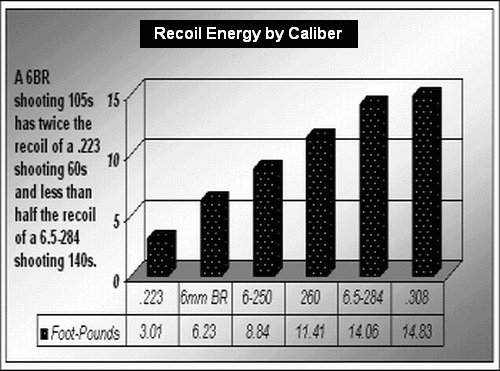
Compared to a .223, the 6BR offers a much better selection of high-BC projectiles, and will deliver considerably more power on the target. Compared to the .308 shooting 168gr MatchKings, a 6BR shooting 105-107gr bullets offers better ballistics all the way out to 1000 yards. Plus, for most people, the 6BR is just easier to shoot than a .308. Recoil is less than half of the .308 cartridge. Both the .308 and 6BR chamberings offer good barrel life, but the 6BR uses 15-18 grains less powder, saving you money. On the other hand the .308 is the designated cartridge for F-TR and Palma shooting, so it may be a more versatile chambering for Long-Range competition. So which would we choose between the 6BR and the .308? Actually we think you should have both. The 6BR is my favorite cartridge out to 500 yards, and I like the .308 Win for F-TR. And… if you want to shoot at the World Fullbore Championships this week at Camp Perry there’s only one choice — a .308 Win.
Sierra’s new 110gr 6mm MatchKing is so new you won’t even find it on Sierra’s website. But MidwayUSA has it listed as “coming soon”. This new bullet, optimized for a 1:7″-twist barrel, promises class-leading ballistics. The listed G1 Ballistic Coefficient (BC) is an impressive 0.617 (sorry, no G7 BC has been stated). That’s 12.8% higher than the 0.547 G1 BC Sierra claims for its older 107gr MatchKing. That’s a very significant improvement. We attribute the reduced drag of the new 110-grainer to an improved hybrid-ogive bullet shape along with much smaller meplats. Sierra has not yet confirmed that it is pointing the meplats of the new 6mm 110s at the factory, but we expect that may be the case. In this respect the 110-grainers could be like Sierra’s excellent 183gr 7mm MatchKings, which come with tight, pointed tips right out of the box.
G1 vs. G7 and Listed BCs vs. Tested BCs — What You Need to Know
Manufacturer-listed G1 Ballistic Coefficients of 6mm Match Bullets
If you look at the table above you’ll see that Sierra’s claimed 0.617 G1 BC for the new 110gr MK is higher than the 0.536 Berger lists for its 105gr 6mm Hybrid and higher than the 0.536 Hornady lists for the new 108gr 6mm ELD Bullet. We do think Sierra’s 110-grainer will prove to have the highest BC of the bunch, based on recent comparison tests by Sierra.
Let’s explain… Sierra lists a 0.547 G1 BC for its 107-grain MatchKing. Sierra tells us that the the .547 listed BC is for the current lots of 107-grainers which are pointed by Sierra. Sierra’s Matt Reams states that the new 110-grainers definitely have less drag than the current Sierra 107gr MKs or Berger 105gr Hybrids: “We have shot the pointed 107s side by side (raced) in our 300-meter range next to the [Berger] 105s and our pointed 107s had a higher BC between those two lots. In the comparison we did, our lot of new pointed 107s had a slightly higher BC than the [Berger] 105s. The 110s are significantly higher than both.”
In the real world, Sierra’s new 110gr 6mm MatchKing may not have as big an edge over the competition as it seems from Sierra’s claimed 0.617 G1 BC. (The G7 numbers may be closer.) Nonetheless, we do expect that Sierra’s new 110-grainer will be very competitive, and may actually have best-in-class BC. And if the new 110gr SMKs come “tipped” from the factory that will be a very good thing.
Anybody currently shooting a heavy 6mm bullet in competition should look at the new 110gr MatchKing when it becomes available. It could prove to be a winner. NOTE However — Sierra recommends a true 1:7″-twist barrel to stabilize the new 110-grainers.
New Product Tip from Boyd Allen. We welcome reader submissions.
Stan Pate is the first-ever F-TR competitor to earn International Distinguished Rifleman honors in his discipline. We congratulate Stan for that achievement. As a long-time competitor, Pate has earned numerous honors throughout his shooting career. The International Distinguished Rifleman award is a culmination of decades of hard work and dedication to the shooting sports.
“To earn the International Distinguished Badge, especially as the first F-T/R shooter to do so, is the pinnacle of my competitive shooting career,” Pate said. “I’m honored to share this award with all of those who have supported me, especially Leupold[.]”
The coveted International Distinguished Rifleman Badge is earned by accumulating points at authorized matches. In the USA, this program is overseen by the National Rifle Association. International Distinguished points can only be earned at authorized international competitions. Points can be earned for the International Distinguished award at World Championships, the America Match, and the Australia Match. A total of 30 points must be earned to be recognized as International Distinguished.
“Stan represents the pinnacle of his sport and we’re honored to call him a friend and a partner,” said Rob Morrison, vice president of global marketing for Leupold & Stevens. “His tenacity and perseverance in competition demand that his optics perform at a similar level, which is why he chooses Leupold.”
Watch Video for Tips from Past National F-TR Team Members Mike Miller and Stan Pate
If you’re shopping for a heavy-duty, single-stage reloading press, there’s a new option you should consider. MEC, noted for its shotshell reloading machines, has just introduced an all-new, cast-iron press, the MEC Marksman press. This new single-stage press has features we really like. First, the beefy, cast-iron frame is strong enough for the toughest reloading jobs. Second, the MEC Marksman features an OPEN front — that smart design makes it easier to insert and remove cartridge cases during the reloading process. It also makes it much easier to place your bullets during the seating stage. This open-front design makes good sense — note that Hornady’s new LNL single-stage press also has an open-front layout for important reasons. Lastly the MEC Marksman has an innovative, self-centering shell-holder. This patent-pending design should help hand-loaders reload more efficiently.
MEC MARKSMAN
Manufacturer’s Product Description
The MEC Marksman is made from ductile cast iron for superior quality and durability. Our patent-pending self-centering shell holder provides greater accuracy and consistency to every reload. The MEC Marksman is compatible with all 7/8-14 thread dies to change calibers quickly. Reload .22 Hornet to .416 Rigby all with one convenient machine. The MEC Marksman single-stage metallic reloader and accessory products are made in the USA in Mayville, Wisconsin.
In addition to the MEC Marksman, MEC’s new Metallic line of products will include reloading accessories. Powder measure, powder trickler, scale, and calipers will be offered. An additional base is available for easy installation and is compatible with the MEC Jig Fixture mounting system. Case prep tools and components are also available.
Nosler recently introduced a new series of high-BC bullets with factory-closed meplats. Bryan Litz’s team at Applied Ballistics is now testing these new Reduced Drag Factor (RDF) projectiles to determine their performance — and specifically to see if the BCs are as high as claimed. Nosler bullet testing is underway this week and Litz hopes to bring the results to the Applied Ballistics Seminar in North Carolina later this week (November 3-4, 2016).
Applied Ballistics Seminar Fall 2016: November 3 – 4, 2016 – Caraway Conference Center
4756 Caraway Mountain Road Sophia, NC 27350; Phone: (336) 629-2374. Seminar Sign-Up.
Bryan notes: “If you live in the Southeast region, this is the last seminar for you for at least a year, possibly longer. We will most likely do the next seminars in regions not yet visited.”
Applied Ballistics Library Update
Bryan Litz is hard at work testing new projectiles: “We are currently in the middle of testing all these new offerings that have recently come out. In fact, the lab is up and running today, with some of the new Nosler RDFs going down range. Bullet measurements have been taken with our state-of-the-art digital comparator which is accurate to within 0.0001″. For example, shown below are the measured dimensions for the new Nosler RDF .308 175 grain projectile. For these new bullets, we will not only have complete BC measurements accurate to ± 1%, but we will have Custom Drag Models (CDMs) coming as well.”
New Data Coming Soon
Bryan hopes to present the new Nosler data at the Seminar this week in North Carolina. In addition, Bryan is developing information for the Hornady ELD bullets, G9 Competition Series solid bullets, some new Sierras, and some other projectiles not currently in the library: “Once we complete testing on all these new offerings, we will then compile the library for the next library update (which will be done across all platforms). We want to make sure that none of these new offerings are left out. For those who want to see some of the early results, come join us at this final seminar of 2016!”
Custom Drag Models
Applied Ballistics has been providing custom drag models for use in trajectory prediction for the past several years. Custom Drag Models (CDMs) for bullets are a more refined way of modeling drag for bullets because you’re not referencing a standard like G1 or G7, rather you’re using the actual measured drag of a specific bullet in a ballistic solver. This results in more accurate trajectory predictions, especially through transonic.


 Precision shooters favor premium brass from


 Many visitors to the site ask us, “I’ve got a .223 and .308. What will a 6mmBR Norma (6BR) give me that I’m not getting already?” Well first you will probably average consistently smaller groups than your current .223 or .308 rifle (assuming the 6BR has a quality barrel and trigger). A good .308 Winchester can be superbly accurate, no question about that, but the lesser recoil of the 6BR works in the shooter’s favor over a long string of fire. Even with a Rem 700 or Savage action factory action, a 6BR with a benchrest stock, premium barrel, and a high-quality chambering job should deliver 5-shot groups in the high twos to mid-threes, provided you do your job. We have one 6BR rifle that shoots Lapua factory-loaded 6BR ammunition in the low twos and high ones. That’s exceptional, we admit, but it still shows how the 6BR is an inherently accurate cartridge, even with factory loads.


 MEC MARKSMAN


