When we first ran this story a couple years ago, it proved immensely popular with our readers. In case you missed it the first time around, check out what can be done with a factory Savage 110 BA at extreme long range — 1760 yards (one mile). Shooter Mark Dalzell did a great job with the video, which features multiple camera views so you can see the shooter and the target at the same time. Enjoy!
This video by Mark Dalzell demonstrates the long-range capabilities of the Savage 110 BA chambered in .338 Lapua Magnum. Mark took his “BadAss” rig out to the southwest Nevada desert just north of Jean Dry Lakes. He placed a 2’x3′ target way, way out there — a full mile (1760 yards) away. At that range, flight time to target was 3.75 seconds! Sighting with a Nightforce 5-22x50mm NXS scope, Mark needed a few shots to get on target, but eventually made multiple hits, using 67 MOA of elevation and 2.25 MOA left windage. You can view the hits starting at 1:56 time-mark on the video. (Mark had a second camera set up closer to the target — this displays frame in frame in the video, and if you watch carefully you can see the strikes.) The ammo was HSM 250gr HPBT match with a 3.600″ COAL. The shooting was done at 8:13 in the morning, with clear conditions, very light winds. Temp was 57°, humidity 24.5, Density Altitude 3666. Video soundtrack is La Grange by ZZ Top.
PLAY BUTTON
LISTEN TO MARK TALK about One Mile Shooting:
CLICK Play Button to hear Mark Dalzell TALK about his .338 LM Savage 110 BA and how he scored hits at 1760 yards.
Good Shooting Mark. That’s darn good for a factory rifle. You also had the elevation dialed in real close before the firing started! That shows a good knowledge of your ammo’s long-range ballistics. We also noticed how effective that muzzle brake was. Recoil looked about the same as an un-braked .308 Win.
If you thought Mark’s 1760-yard shooting was impressive, Mark has produced another video that shows a session at even greater distances — out to 2300 yards. Watch Mark Dalzell Shoot at 2300 Yards.
Jeffrey Block has created a great FREE software program, OnTarget, that measures shot groups quickly and precisely. All you need is a photo or scan of your target. The program allows you to set your target distance, and provides caliber-specific tools to precisely mark the center of each shot. Once you’ve marked each bullet hole, Jeff’s OnTarget program automatically calculates group center, maximum group spread (CTC), average distance to center, group width and height, and group offset from point of aim. The program will even measure multiple groups on the same target.
Video Tutorial Shows How OnTarget Software Works
Jeff created an excellent Animated Tutorial demonstrating OnTarget’s functions. It shows how to import a target image or scan, how to set target distance and scale, how to set bullet size, how to circle each bullet hole, and how to save the marked and measured target. VIEW OnTarget TUTORIAL.
After just a few minutes spent learning the program’s tool buttons, we were able to plot shot groups on a variety of targets with ease. Once you select the target distance and bullet diameter, figuring group size is a simple matter of centering a circle tool over each bullet hole. Then the program “connects the dots” and provides all the info you could want automatically.
The program worked with bullet holes as small as 17 caliber and as large as 50 caliber. It is very precise, but remember that if your target photo was taken at an angle, distorted perspective can cause slight errors in measurement. Therefore, for the ultimate precision, you want to start with a flat scan of the target.
OnTarget Compared to Measuring Manually
We found OnTarget to be especially useful for groups with widely dispersed bullet holes, or very small bullet holes, such as 17 caliber holes. We’ve found that it’s difficult to measure 17-cal group sizes with a standard caliper, because the tool itself obscures the tiny holes. With OnTarget, the program can zoom up your target view, making it much easier to plot the center of each shot. And with a widely dispersed group of shots, the program automatically finds the two most distant shots. You can’t mistakenly pick the wrong pair of shots to measure.
MEASURING REAL TARGETS — Actual Examples
Here are examples we created with OnTarget. The first photo shows a 17 Mach 2 target. These tiny 17-cal holes are notoriously hard to measure. With OnTarget, it’s a snap. You just load the target image into the program, zoom in with the controls, and then click on the center of the holes. The program automatically calculates group size, displaying measurements in both inches and minutes of angle (MOA)
Original Target (with ruler for scale)
Target Captured and Displayed in Program
Detail of Group, Enlarged by Program
10-shot Groups? — No Problem
Here’s another target, showing 6mm bullet holes at 600 yards. The first image shows the target image loaded into the program with the ten holes circled in red.
Target Displayed in Program
For this target we have used the Aiming Point option. The Aim Point was set at the center of the “X” and the program calculates average distance from the Aim Point. Very cool.
Detail of 10-Shot Group, Enlarged by Program
No Scanner Needed
The OnTarget program grabs target scans directly from a flatbed scanner using Microsoft’s Windows Image Acquisition system. But don’t worry if you don’t have a scanner. You can just take a digital photo of your target and OnTarget will import it quickly and easily. To set target scale, a simple tool allows you to mark a known length on the target (such as the diameter of the “X” Ring), and the program will then size the target accordingly. Is OnTarget precise and accurate? Here’s what Forum Member Steve W. says: “I used the extreme spread measurement of a group on one of my 600-yard match targets… as it was officially scored at the match. By clicking the +—+ icon, then clicked the cursor in the centers of the two extreme spread holes, I then entered that value in the reference window. After that it was simple because the bullet placement cursor’s circle was the same size as the black outline of the actual bullet holes on the picture of the target. OnTarget’s measurement came up within .006″ of the official 2.772 inch measurement of the group. That’s pretty darned close; well inside the human judgment of aligning the tips of a micrometer on the bullet holes.”
Bottom Line — Great Program — Download It Today
Jeffrey Block has done a great service for shooters by creating the FREE OnTarget program. It is easy to learn, it functions great, and it can save you time and effort measuring targets. It also lets you easily archive and compare multiple targets produced during load development or rifle testing. You can record ammo type, date, location, weather etc. in note fields accessed by “Group Info” and “Target Info” tabs.
Keep in mind that OnTarget was NOT created to replace existing methods for scoring competition targets. But for all other target measuring purposes it does a great job. Visit Jeff’s website, OnTargetShooting.com, view the tutorial, and check out OnTarget for yourselves.
To learn more about OnTarget, see more measuring samples, and read advanced Power-User Tips, visit our full OnTarget Product Review.
Here is a very interesting rifle, a true metal/wood hybrid that combines an aluminum front section with figured walnut in the rear half. As you can see, this unique rifle also features a barrel block that allows the Savage action to float. You may be wondering “how is the metal section connected to the wood?” The gun’s owner/builder epoxied a stainless steel tube in the wood and that tube is secured in the aluminum fore-end with set screws.
Forum member Justin V. reports: “Sometime last fall my buddy wanted to build barrel-blocked Bavage. He is a machinist by trade so he was able to build all of the custom components himself. I know he put a ton of time into this thing over the winter, taking his time to get it done right. If you shoot in Cadillac or Midland, Michigan you will probably see him around. He tried to shoot a match this past weekend but was rained out. Hopefully it will stop raining in Michigan so he can see what it can do at 600 yards. Here are the results….” Learn more about this gun in this FORUM Thread.
PrecisionRifleBlog.com recently reviewed several video-based rifle training DVD sets. While instructional DVDs will never replace live “hands-on” training, they can be cost-effective ways to sharpen your skills. Watched periodically, these training DVDs can help reinforce the fundamentals.
PRB’s Editor Cal Zant has purchased several rifle training DVDs over the years. His recent Precision Rifle Blog DVD review looks at four different options:
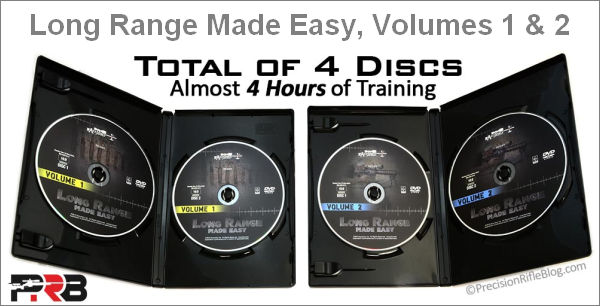
Long Range Made Easy, Two-Volume Set, from Accuracy 1st The Art Of The Precision Rifle, with Todd Hodnett (Magpul Dynamics) Putting Rounds On Target, with Bryan Litz (Applied Ballistics) Rifles Only — Precision Rifle Instructional DVDs, with Jacob Bynum
Cal reports that each of these four titles offers a slightly different approach, with each instructor displaying his own focus, based on his background and expertise.
Accuracy 1st’s Long Range Made Easy Two-Volume Set seemed to win PRB’s Editor’s Choice Award. The tagline on the DVD is: “Go from basic to advanced with the guy that has trained our best military snipers for the past 10 years.” That’s a pretty good description. Todd Hodnett is the primary instructor, and Bryan Litz joins him in several segments.
It’s the best of both worlds. Todd Hodnett’s pragmatic “the-bullet-cannot-lie” approach (field-proven by hundreds of the world’s best snipers), is combined with Bryan Litz’s engineering approach and vast knowledge of external ballistics verified with carefully recorded live-fire experiments. The two styles complement each other well, and provide an extremely well-rounded and comprehensive overview.
The DVD set is split into two volumes, each of which includes two discs. All together there are almost four hours of instruction from the most respected guys in the industry. And they cover a lot of ground — you’d never be able to cover this much in a one- or two-day live class. Plus with the DVD you can easily repeat an important point, and watch the whole program more than once.
Cal paid $76.95 out-of-pocket for the Long Range Made Easy, Vol. 1 & 2 Bundle, so his review wasn’t a paid advertisement. He thought this set provides a ton of value, and could help a lot of shooters. Here are key topics covered in Long Range Made Easy:
■ Advice for Gear Purchases
■ Optimal Gun Setup
■ Technique for Position
■ Simple & Quick Wind Formula
■ Using the Applied Ballistics Kestrel
■ Truing Ballistic Algorithms, Drag Scale Factoring, and Custom Drag Models
■ WEZ Analysis
■ Wind Course
If you’re new to the long range game, or you’ve been doing it for a few years and want to learn directly from some of the most sought-after instructors in the world, then check out Cal’s write-up over at PrecisionRifleBlog.com. CLICK HERE for PRB Review of Training DVDs.
Think Vegas in January, baby — yes, we’re talkin’ about SHOT Show (Jan. 17-20, 2017). Registration for the National Shooting Sports Foundation’s 2015 SHOT Show is now open for all Attendees and Media. Register online now at Shotshow.org. The SHOT Show hotel booking system is also active. It’s a good idea to reserve rooms early to get the best rates. SHOT Show organizers have negotiated deeply discounted rates at dozens of Las Vegas hotels, with prices as low as $56 per night.
Scheduled for January 17-20 in Las Vegas, the big gun industry convention is just three months away. While registering, attendees can add Industry Dinner tickets, enroll in SHOT Show University, and/or sign up for other educational offerings.
SHOT Show tip from EdLongrange. We welcome user submissions.
Werner Mehl of Kurzzeit.com produced a 10-minute video for the 2010 SHOT Show. This amazing video became a huge hit on YouTube, with over 53,300 “likes”. If you haven’t viewed this mesmerizing video yet, check it out — you’ve probably never seen anything like it. This super-slow-motion video has been watched over 12.1 million times, making it one of the most popular shooting-related videos in history. Employing cameras recording at up to 1,000,000 (one million) frames per second, Mehl’s bullet flight video has been called “astounding”, “entrancing”, and a “work of art.” If you haven’t seen it yet, sit back and enjoy!
LINK: Kurzzeit.com Video System and BMC-19/PVM-21 Chronograph
Click the link above to learn more about Werner Mehl and his super-sophisticated camera systems that can record at 1,000,000 frames per second. On the same linked page you can learn about the advanced BMC-19 chronograph (previously sold as the PVM-21) designed by Werner. Operating “all-infrared, all the time”, the BMC-19 is the best optical chronograph we have tested for very low light conditions, or very tricky light conditions.
Sometimes a dedicated shooter just has to help out. That was the case for our friend Dennis Santiago, who drove from Southern California all the way to Phoenix, Arizona this past weekend to help with the CMP Games being held at the Ben Avery Shooting Facility.
Here’s a Facebook post from Dennis Santiago, reporting from Ben Avery:
Western Games Pit Monkey 2016
Competitive high-powered rifle shooting is very much a team sport. Though shot individually, it is the product of many things and many people working together. Sometimes circumstances are such that it means it’s your turn to help. That was the case this weekend. It was so good to see everyone. — Dennis
Pay It Forward
Definition of phrase: 1. Respond to a person’s kindness to oneself by being kind to someone else. E.g.: “I will take the support I have had and try to pay it forward whenever I can.”
We commend Dennis for his willingness to help staff this important shooting event. Likewise we commend all those persons who volunteer to help at shooting matches around the country. Without their commitment and dedication, the shooting sports could not thrive.
“Here is a sneak peak of my new barreled action for ELR. Compliments of Lethal Precision Arms. This Bartlein barrel is chambered in .375 Lethal Magnum. This massive cartridge will be launching the 405 grain Berger solids with a BC of 1.09 @ 3200+ FPS. The 38″ barrel is screwed on to a two-inch round .50 Cal Action from BAT Machine. This barreled action weighs 35 pounds and is approximately 48 inches long as shown in the photo. Yes that’s 35 pounds NOT counting stock, scope, muzzle brake, and bipod.
This barreled action is now being sent to McMillan Group International for custom in-letting and a custom Big Mac Stock optimized for Extreme Long Range. Stay tuned for more progress on this new ELR Beast for the next King of 2 Miles competition.”
Our buddy Paul Phillips is an outstanding shooter who has competed with the U.S. National Team and is currently a member of the U.S. Rifle Team F-TR. Paul has been interested in extreme long-range (ELR) shooting for quite some time, but the King of 2 Miles (KO2M) event this fall at Raton, NM really brought things into focus for Paul. A member of the K02M-winning Applied Ballistics squad, Paul now knows exactly what kind of hardware (and cartridge) it takes to win at two miles (and beyond). Now he’s ready for more, and he’s building a very special (and very big) rifle.
After his experience at the King of 2 Miles event, Paul decided he needed his own world-class rifle for the ultra-long-range game. For this rifle, Paul acquired a massive BAT action and a ginormous Bartlein barrel, finished at 38 inches. The .375 Lethal Magnum chambering is wildcat that starts with the 585 Hubel Express (HE) case, adapted for a Cheytac boltface. This jumbo cartridge can propel 405gr Berger solids at 3200+ FPS. The G1 BC of these prototype solids is a stunning 1.09. Note: Berger has no current plans to market this .375-caliber solid bullet — it is still in the prototype stage.
You can never be too safe when hand-loading your own ammunition. This helpful Brownells video outlines the Seven Fundamental Reloading Safety Tips. This is important information for novice hand-loaders and a good refresher for those with reloading experience!
Summary of the Seven Safety Tips:
1. Store your reloading supplies in a safe and dry location, away from children and away from any possible source of ignition. This includes keeping your powder and primers separate.
2. Get and use respected reloading manuals, especially for new cartridges. Start low and work up slowly while watching for warning signs of pressure and/or case fatigue.
3. Locate your reloading activity where you will not be distracted. If you get interrupted, stop. (Distractions will eventually lead to mistakes.)
4. Do NOT mix powders. Keep your powders clearly marked and dated. You can use masking tape to write the date on the container.
5. If you load the same cartridge type for different firearms, make sure your ammo headspaces properly in each gun.
6. Check cases frequently. Look for split necks, case head separation or other signs of fatigue and excessive pressure.
7. If reloading military brass, be aware that case capacity is usually reduced, and initial loads should be at least 10-15% lower than published data.
Here are some other tips that will help your avoid making costly mistakes (such as using the wrong powder, or undercharging a case):
Powder Type — Always double-check the label on your powder containers. After placing powder in the powder measure, put a piece of tape on the measure with the powder type written on it. Some guys write the powder type on a card and place that right in the hopper.
Scale Drift — Electronic balances can drift. If you are using a digital powder scale, calibrate the scale with a test weight every 50 rounds or so.
Case Fill — If you throw more than one charge at a time, look INSIDE every case before seating a bullet. Squib charges can be dangerous if you don’t notice them before firing the next round.
Progressive Presses — When using a progressive press, consider using an RCBS Lock-Out Die. This will detect a low charge and stop the machine. These dies will work with RCBS, Hornady, and Dillon progressives.
The Nammo Group, parent of Lapua and Vihtavuori, has announced the acquisition of Berger Bullets, one of the USA’s leading bullet makers. With Berger Bullets joining the Nammo Group, this teams America’s ultra-premium bullet-maker with what is arguably the world’s most respected cartridge brass and ammunition-maker. This is huge news. For competition shooters this may be a “marriage made in heaven”. Many top shooters, including champions like Bryan Litz and John Whidden, are already shooting Berger bullets in Lapua brass. This merger will make it easier for the two companies (Berger and Lapua) to optimize the performance of factory ammo, as well as to optimize brass for use with Berger match projectiles.
A spokesman for Lapua said that Lapua will continue to make bullets in Europe while Berger will conduct its regular operations in the USA: “Lapua will still make bullets, and it will be ‘business as usual’ for Berger at this time. There are no plans to change production sites to consolidate product lines. Berger will continue to operate as an independent business, just under the Nammo umbrella.” NOTE: This acquisition will be subject to regulatory approvals by U.S. governmental authorities.
On firearm industry analyst believes this merger is a “win-win” for both Berger and Nammo: “This will help Berger export more product to the European market while it will give Nammo a stronger connection to the huge U.S. firearms market, expanding Nammo’s North American customer base”. Nammo president/CEO Morten Brandtzæg concurred, stating: “Having Berger Bullets on board is the perfect match for Nammo. Their products, which are complementary to our other premium brands, will strengthen our group’s strategic position in the U.S. commercial ammunition market.” This acquistion WILL include Berger’s ABM Ammunition and J-4 Jackets product lines.
Here is the press release issued by the Nammo Group, which is headquartered in Norway and has 2,100 employees in 12 countries:


 After just a few minutes spent learning the program’s tool buttons, we were able to plot shot groups on a variety of targets with ease. Once you select the target distance and bullet diameter, figuring group size is a simple matter of centering a circle tool over each bullet hole. Then the program “connects the dots” and provides all the info you could want automatically.