In this video, Bryan Litz of Applied Ballistics talks about Density Altitude and the effect of atmospheric conditions on bullet flight. Bryan explains why you must accurately account for Density Altitude when figuring long-range trajectories.
Bryan tells us: “One of the important elements in calculating a fire solution for long-range shooting is understanding the effect of atmospherics. Temperature, pressure, and humidity all affect the air density that the bullet’s flying through. You can combine all those effects into one number (value) called ‘Density Altitude’. That means that you just have one number to track instead of three. But, ultimately, what you are doing is that you are describing to your ballistics solver the characteristics of the atmosphere that your bullet’s flying through so that the software can make the necessary adjustments and account for it in its calculations for drop and wind drift.”
Bryan adds: “Once you get past 500 or 600 yards you really need to start paying careful attention to atmospherics and account for them in your ballistic solutions”. You can learn more about Density Altitude in Bryan’s book, Applied Ballistics for Long Range Shooting (Third Edition).
General Scientific Definition of Density Altitude
Density altitude is the altitude relative to the standard atmosphere conditions (ISA) at which the air density would be equal to the indicated air density at the place of observation. Density altitude can be calculated from atmospheric pressure and temperature (assuming dry air). Here is the formula:
Air is more dense at lower elevations primarily because of gravity: “As gravity pulls the air towards the ground, [lower] molecules are subject to the additional weight of all the molecules above. This additional weight means the air pressure is highest at sea level, and diminishes with increases in elevation”.*
Both an increase in temperature, decrease in atmospheric pressure, and, to a much lesser degree, increase in humidity will cause an increase in density altitude. In hot and humid conditions, the density altitude at a particular location may be significantly higher than the true altitude.
The 2016 Rio Olympic Games kick off today with the Opening Ceremony. Shooting sports will be a part of these Olympics with competitions for rifle, pistol, and shotgun. From August 6 though August 14, Olympic shooters will compete in Brazil’s ultra-modern Olympic Shooting Center, originally created for the 2007 Pan-American Games at a cost of $53.5 million.
SFC Michael McPhail, shown above, is currently ranked #1 in the world in the smallbore 50m prone rifle discipline. He’s one of the favorites to win Gold in 2016.
With Rio just one hour ahead of the Eastern Time zone, Americans will enjoy great “real-time” coverage of the 2016 Summer Games. NBCUniversal will present 2,084 hours of Olympic programming across 11 affiliated TV and Cable networks.
Olympic Shooting Event Schedule
Note: All times are listed in Eastern Standard Time, one hour AFTER Rio Local Time. These are events with USA competitors.
Friday, August 5
7:00 pm Opening Ceremony
Saturday, August 6
7:30 am – 10m Air Rifle Women
9:30 am – Finals 10m Air Rifle Women
12:00 pm – 10m Air Pistol Men
2:30 pm – Finals 10m Air Pistol Men
Sunday, August 7
8:00 am – 10m Air Pistol Women
8:00 am – Trap Women
10:00 am – Finals 10m Air Pistol Women
2:00 pm – Finals Trap Women
Monday, August 8
8:00 am – 10m Air Rifle Men
11:00 am – Finals 10m Air Rifle Men
Tuesday, August 9
8:00 am – 25m Pistol Women Precision Stage
11:00 am – 25m Pistol Women Rapid Stage
2:30 pm – Finals 25m Pistol Women
Wednesday, August 10
8:00 am – 50m Pistol Men
8:00 am – Double Trap Men
11:00 am – Finals 50m Pistol Men
2:00 pm – Finals Double Trap Men
Thursday, August 11
8:00 am – 50m Rifle 3-Position Women
11:00 am – Finals Rifle 3-Position Women
Friday, August 12
8:00 am – 50m Rifle Prone Men
8:00 am – Skeet Women
9:30 am – Skeet Men Day 1
10:00 am – Finals 50m Rifle Prone Men
11:15 am – 25m Rapid Fire Pistol Men Stage 1
2:00 pm – Finals Skeet Women
Saturday, August 13
8:00 am – 25m Rapid Fire Pistol Men Stage 2
8:30 am – Skeet Men Day 2
11:30 am – Finals 25m Rapid Fire Pistol Men
2:00 pm – Finals Skeet Men
Sunday, August 14
8:00 am – 50m Rifle 3-Position Men
12:00 pm – Finals 50m Rifle 3-Position Men
You’ll find more information on Team USA and Olympic Shooting Competition on these websites:
For anyone interested in accurate rifles, this is absolutely a “must-watch” video. Watch blanks being cryogenically treated, then drilled and lathe-turned. Next comes the big stuff — the massive rifling machines that single-point-cut the rifling in a precise, time-consuming process. Following that you can see barrels being contoured, polished, and inspected (with air gauge and bore-scope). There is even a sequence showing chambers being cut.
Click Arrow to Watch Krieger Barrels Video:
Here is a time-line of the important barrel-making processes shown in the video. You may want to use the “Pause” button, or repeat some segments to get a better look at particular operations. The numbers on the left represent playback minutes and seconds.
Krieger Barrel-Making Processes Shown in Video:
00:24 – Cryogenic treatment of steel blanks
00:38 – Pre-contour Barrels on CNC lathe
01:14 – Drilling Barrels
01:28 – Finish Turning on CNC lathe
01:40 – Reaming
01:50 – Cut Rifling
02:12 – Hand Lapping
02:25 – Cut Rifling
Based on the questions we get on a daily basis on our 800 (Customer Support) line, twist is one of the most misunderstood subjects in the gun field. So let’s look deeper into this mystery and get a better understanding of what twist really means.
When you see the term 1:14″ (1-14) or 1:9″ twist, just exactly what does this mean? A rifle having a 1:14″ twist means the bullet will rotate one complete revolution every fourteen inches of the barrel. Naturally a 1:9″ turns one time every nine inches that it travels down the barrel. Now, here’s something that some people have trouble with. I’ve had calls from shooters thinking that a 1:14″ twist was faster than a 1:9″ because the number was higher with the 1:14″. The easiest way to remember this is the higher the number, the slower the twist rate is.
Now, the biggest misconception is that if a shooter has a .223 with a 1:8″ twist, his rifle won’t stabilize a 55gr bullet or anything lighter. So let’s look at what is required. The longer a bullet is for its diameter, the faster the twist has to be to stabilize it. In the case of the .223 with a 1:8″ twist, this was designed to stabilize 80gr bullets in this diameter. In truth the opposite is true. A 1:8″ will spin a 55gr faster than what is required in order to stabilize that length of bullet. If you have a bullet with good concentricity in its jacket, over-spinning it will not [normally] hurt its accuracy potential. [Editor’s Note: In addition, the faster twist rate will not, normally, decrease velocity significantly. That’s been confirmed by testing done by Bryan Litz’s Applied Ballistics Labs. There may be some minor speed loss.]
Many barrel-makers mark the twist rate and bore dimensions on their barrel blanks.
Think of it like tires on your truck. If you have a new set of tires put on your truck, and they balance them proper at the tire shop, you can drive down a street in town at 35 MPH and they spin perfect. You can get out on the highway and drive 65 MPH and they still spin perfect. A bullet acts the same way.
Once I loaded some 35gr HP bullets in a 22-250 Ackley with a 1:8″ twist. After putting three shots down range, the average velocity was 4584 FPS with an RPM level of 412,560. The group measured .750″ at 100 yards. This is a clear example that it is hard to over-stabilize a good bullet.
Twist-rate illustration by Erik Dahlberg courtesy FireArmsID.com. Krieger barrel photo courtesy GS Arizona.
22Plinkster Tours CCI/Speer Idaho Factory
Trickshot artist and YouTube host 22Plinkster recently got a chance to tour the CCI/Speer production facility in Lewiston, Idaho. This large plant produces both rimfire and centerfire ammunition. While touring the plant, 22Plinkster was allowed to capture video showing the creation of .22 LR rounds from start to finish. This is a fascinating video, well worth watching.
This revealing video shows all phases of .22 LR ammo production including cupping, drawing, annealing, washing, drying, head-stamping, priming, powder charging, bullet seating, crimping, waxing, inspection, and final packaging. If you’ve got ten minutes to spare, we really recommend you watch the video from start to finish. You’ll definitely learn some new things about rimfire ammo.
.22 Plinkster was literally up to his neck in ammo while touring the CCI/Speer Idaho ammo plant. He says: “This was truly a dream come true for me. I can’t thank the people at CCI and Speer enough for allowing me to do this. I couldn’t possibly show everything that went on at the factory. However, hopefully I showed you enough for you to grasp the concept of how rimfire [ammo] is made.”
Speer Brothers Brought Ammo Production to Lewiston
Here is an interesting historical footnote. Today’s large CCI/Speer operation in Idaho can be traced back to the companies founded by the Speer brothers. After settling in Lewiston in 1944, Vernon Speer started Speer Bullets. A few years later, in 1951, Vernon’s brother Dick (with partner Arvid Nelson) started Cascade Cartridges Inc., a producer of small-arms ammunition and primers. Yes, as you may suspect, Cascade Cartridges Inc. is now CCI, a Vista Outdoor company, and one of the largest manufacturers of primers and loaded ammunition. Today, the CCI/Speer Lewiston plant produces both Speer bullets and CCI-branded ammunition and primers. Vista Outdoor’s predecessor, ATK, acquired the plant in 2001. Vernon Speer died in 1979, and Dick Speer died in 1994.
Chuck’s Pair of Pennsylvania Dashers
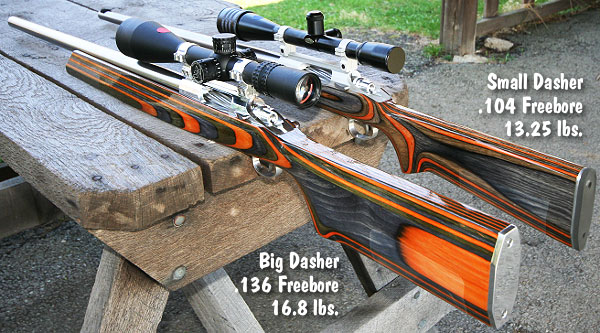
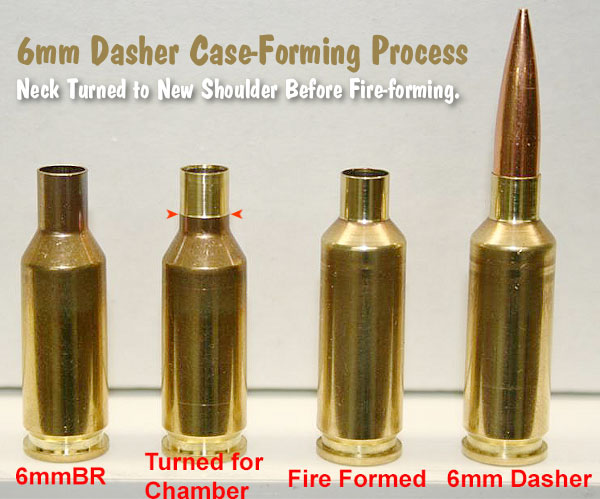
There’s been a lot of interest in the 6mm Dasher cartridge lately, so we thought we’d showcase a matched pair of Dasher rifles belonging to a Forum member. The 6mm Dasher began as a wildcat improved version of the 6mmBR Norma cartridge. The 6mm Dasher has been very successful in competition, and now factory Norma-made Dasher cartridge brass is available from Bullets.com.
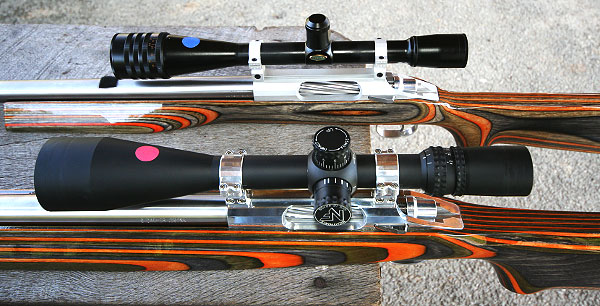
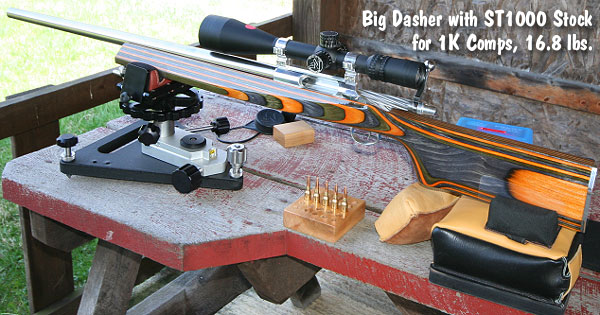
Forum Member Chuck L. (aka “Ridgeway”) has created a handsome duo of 6mm Dashers for competitive benchrest and varmint matches in Pennsylvania. Both guns are built on Kelbly Panda RBLP actions, with Bartlein 8-twist barrels, and Shehane Laminated Tracker Stocks. However, the two rifles are not exact twins, as you can see. One, which we’ll call the Big Dasher, is built on a Shehane ST1000 Tracker stock. The other gun, the Small Dasher, sports Shehane’s “Baby Tracker” stock — a design used with great success by Richard Schatz. The Big Dasher, optimized for 1000-yard competition, also has a slightly longer freebore — 0.136″ vs. 0.104″ for the Small Dasher.
Specifications for the Dasher Duo:
Small Dasher (13.5-pounder): Chambered for 6mm Dasher with approximately .104 freebore and a .264 NK. (No way of knowing exactly since it freebore was done in a separate operation by Kelbly.) Components are: Shehane Baby Tracker stock, Kelbly Panda RPLB action, Bartlein 1:8″ LV barrel at 26 ¾”, Kelbly Rings, Weaver T36, Jewell trigger. The barrel was chambered by Kelblys and the stock was bedded, glued and balanced by a shooting buddy (Forum Member johara1). I clear-coated the stock with auto urethane. Total weight is 13 lbs., 4 ounces.
Big Dasher (1K Light Gun, 17-pounder): Chambered for 6mm Dasher with a .136 freebore and .264 neck (PTG Reamer). Components are: Shehane ST-1000 stock, Kelbly Panda RPLB action, Bartlein 1:8″ HV 5R barrel at 28″, Shehane +20-MOA rings, Nightforce NXS 12-42x56mm, Jewell trigger. The barrel work, pillar installation, and bedding was done by Dave Bruno. The stock was clear-coated by Chuck with auto urethane. Chuck also made the rear butt plate and balanced the rifle. Total weight: 16 lbs., 13 ounces.
Chuck tells us: “I don’t get out shooting competition as much as I want due to time and family, but when I do compete, I shoot a Groundhog match at Southfork Rifle Club in Beaverdale, PA. Info on Southfork Club events can be found at Southforkrifleclub.com. The Southfork match is basically a 100-, 300- and 500-yard match with one sighter the entire match and 5 shots at each yardage for score. The Small Dasher, with the shorter ‘Baby Tracker’ stock, was set up for the Southfork Rifle Club’s ‘Light Unlimited’ class which has a 13.5-lb max weight.” (Editor: ‘unlimited’ is a misnomer for a weight-limited category.)
Chuck adds: “The Big Dasher with the heavy ST-1000 stock is set up for 1000-yard benchrest matches in Light Gun class. I hope to shoot a couple 1K matches with it at Reade Range in southwest Pennsylvania. I am still in load development for this rifle since it was just finished in January. One ironic thing is, it shoots the same load I’m shooting out of the lighter gun rather well. The only difference between the two chambers is the freebore is roughly thirty thousandths longer on the 1K gun (Large Dasher). I will also shoot this at Southfork in the ‘Heavy Unlimited’ class.”
Dasher Case-Forming: Neck-Turn then Fire-form with Bullets Hard in Lands
To fireform, I turn my cases down to fit the chamber and stop where the false shoulder makes snug contact with the chamber. Fire-forming rounds are loaded up with a 29-grain charge of H4895 or Varget and a 108gr Berger bullet seated hard into the lands about 0.020″ past initial contact with the rifling. It takes about three firings to make a nice clean Dasher case with a sharp shoulder. I anneal about every 3-4 firings. I have many cases that have about 10+ firings on them and they are still shooting well. The primer pockets are a little looser, but still hold a primer.
Both Dashers Group in the Ones at 100 Yards
My main bullet for both rifles is the 107gr Sierra MK, loaded with Reloder 15 powder, Lapua cases and CCI 450 primers. My main load for the Small Dasher is 33.0 grains of Reloder 15. This load shoots in the ones at 100 yards. For the Big Dasher, I’m still working on a load, although the same 33.0 grain load shoots in the ones in the heavier gun as well. I’m still looking for more velocity and my ‘max’ node. So far, I’ve gone well above 33.0 grains of RL 15 without pressure signs, but that load produces vertical at 100 yards, so I’m going to tinker with the load until I see pressure or it starts to shoot.
The Burris Eliminator III is an impressive piece of electro-optical technology. With a push of a button, a built-in laser rangefinder senses the distance to your target and the Eliminator’s microprocessor instantly calculates the required hold-over based on your load’s ballistics. The calculated aiming point is then displayed in the reticle with an illuminated red dot on the vertical cross-hair. Just put the bright red dot on the target and make the shot. We’ve used this scope out to 600 yards on small steel targets and it worked flawlessly.
If you ever wanted to get one of these advanced scopes for your next hunt or prarie dog safari, now is a great time to buy. Burris is now offering $100 off Burris Eliminators: “Our most popular rebate ever has returned for 2016, so if you missed out last year, this time you’ve got no excuses.” Eliminator III LaserScopes (Item # 200116 or 200120) purchased between August 1st and December 31st, are eligible for a $100 mail-in rebate. CLICK HERE for Rebate Form and Full Instructions.
To Receive Your Rebate:
Fill out the coupon with your name and shipping address and send proof of purchase the original UPC barcode from box and a copy of your sales receipt to:
Yes, there are ten (10) shots. In the lower left (7 o’clock) of the group, two shots overlap!
Stunning 1000-Yard 10-Shot Group You’re looking at a stunning feat of rifle accuracy. That’s a sub-3″, ten-shot group shot at 1000 yards, all 10s or Xs. Measured at 2.856 inches, this group by shooter Mike Gaizauskas works out to 0.2727 MOA. Nearly quarter-MOA for ten shots at 1K! And the vertical for 7 of 10 shots is under an inch. Now that’s impressive. This was done with an IBS Heavy Class Benchrest gun, chambered for the 6.5×47 Lapua, a mid-sized cartridge originally designed for 300m competition.
Gun Specs: 6.5×47 Lapua chambering, Krieger 30″, 1:8″-twist barrel, Lapua 139 grain Scenars, Hodgdon H4350, CCI BR4 primers, Nightforce NSX scope. Smithed by Mark King, stock by Mike Gaizaukaus.
This amazing group, which establishes new IBS world records, was shot at the Harry Jones Memorial 1000-Yard Gun Club range in Fairview, West Virginia. Set in wooded, rolling hills, this range is shielded on all sides by thick stands of trees. It’s a beautiful facility, and you can see why, when conditions are right, the Harry Jones range can be about as close to shooting in a “tunnel” as you’ll ever get at 1000 yards. The Harry Jones Club in WV hosted the 2014 IBS Long-Range Nationals.
Mike’s remarkable 10-shot performance may be a Score Record as well as a group record, because all ten shots were in the 10-Ring and, under IBS rules, group size is the tie-breaker, rather than X-Count. Mike’s target was scored 100-3X, with two of the three Xs just clipping the outside of the X-Ring. Match directors reported: “On 7/24/2016, two new pending IBS 1000-yard world records were shot by Mike Gaizauskas with a 6.5X47 Lapua: 1) Heavy Gun Group (2.856″) and 2) Heavy Gun Score (100-3X). Congratulations Mike!” Here are the listed IBS records that will be broken, when this target is certified:
► Current IBS 1000-Yard Heavy Gun 10-Shot Single Group Record: 3.044″, Joel Pendergraft, 4/18/2009.
► Current IBS 1000-Yard Heavy Gun 10-Shot Single Group Score Record: 100 points, with 3.353″ group size tie-breaker, Gary Nicholson, 7/27/13.
Best 1000-Yard 10-Shot Groups Ever
This jaw-dropping 2.856″ group by Mike Gaizauskas also handily breaks the current NBRSA 1000-Yard, ten-shot Heavy Gun Record, which was 3.9912″ set by Bill Johnston on November 17, 2015. FYI: IBS and NBRSA Light Guns only shoot five-shot groups, so there is no equivalent IBS or NBRSA Light Gun 1K ten-shot record.
Only one other 10-shot, 100-score 1000-yard group was better than this in the history of rifle competition on this planet. Back in 2010, at a Williamsport match, Matt Kline shot a 2.815″ 100-4X. Depending on how Mike’s 2016 2.856″ group is finally measured, it could end up smaller than Matt’s. The difference (before final IBS verification) is only 0.041″, a mere four hundredths of an inch.
In 2014, Jim Richards fired a 10-shot Light Gun group at 1000 yards initially measured at 2.6872″. Shot under Williamsport Rules at the Deep Creek Range in Montana, that 10-shot group may be the smallest ever at 1K. However, the whole group was out in the 8 Ring, for a score of 80, not 100.
About the 6.5×57 Lapua Cartridge
To learn more about the record-setting 6.5×47 Lapua cartridge, including bullet and powder options and reloading tips, visit our comprehensive 6.5×47 Lapua Cartridge Guide.
The 6.5x47mm Lapua was developed in 2005 as a precision cartridge for 300m CISM rifle matches. Lapua (of Finland) and Swiss rifle-maker Grünig & Elmiger created this new cartridge to match the “pure accuracy” of the 6mmBR, but with even better ballistics. Following its debut as a 300m match cartridge, the 6.5×47 has proven to be a popular “jack of all trades”. Shooters have adopted this efficient, mid-sized cartridge because it offers excellent accuracy, mild recoil, good ballistics, and ample barrel life (plus it feeds well from a magazine). The 6.5×47 Lapua has won two NBRSA 600-yard Nationals. Now that this modern, mid-sized cartridge has set an all-time record for grouping precision at 1000 yards, we expect more shooters to experiment with this cartridge in the mid- and long-range benchrest disciplines.
Story Tip by Boyd Allen. We welcome reader submissions
In this video, Bryan Litz of Applied Ballistics explains how to choose a bullet for long-range shooting and explains what you should be looking for when developing a long-range load. Bryan notes that, with a new rifle build, the bullet you select may actually dictate your gun components. When starting from a “clean slate”, once you select a bullet, you will then pick a barrel, twist rate, and cartridge that are appropriate for that bullet. In choosing a long-range projectile, Bryan recommends you choose a high-BC bullet “that is known for precision”. Then you need to find an ultra-consistent, reliable load.
This video is worth watching. Bryan Litz makes some very good points.
Load Development — Why Consistency is Key (and Half-MOA May Be Good Enough)
After choosing a bullet for your long-range project, then you need to develop a load through testing. Bryan explains: “Once you’ve selected a bullet … and you have selected the components around that bullet, the most important thing to remember in hand-loading is consistency. You’re going to do some testing to see what combination of powder charge, powder type, and seating depth give you the best groups and lowest standard deviations in muzzle velocity.”
Bryan says that if you develop a load that can shoot consistent, half-minute groups in all conditions, you should be satisfied. Bryan says that many long-range shooters “spin their wheels” trying to achieve a quarter-MOA load. Often they give up and start all over with a new bullet, new powder, and even a new cartridge type. That wastes time, money, and energy.
Bryan cautions: “My advice for hand-loaders who are long-range shooters, is this: If you can get a load that is reliable and can shoot consistent, half-minute groups with low MV variation and you can shoot that load in any condition and it will work well, then STICK with THAT LOAD. Then focus on practicing, focus on the fundamentals of marksmanship. The consistency you develop over time by using the same ammunition will mean more to your success in long range shooting than refining a half-minute load down to a quarter-minute load.”
Bryan notes that, at very long range, shooting skills and wind-calling abilities count most: “Your ability to hit a 10″ target at 1000 yards doesn’t improve very much if you can make your rifle group a quarter-minute vs. a half a minute. What’s going to determine your hit percentage on a target like that is how well you can calculate an accurate firing solution and center your group on that target. A lot of people would be more effective if they focused on the fire solution and accurately centering the group on the target [rather than attempting to achieve smaller groups through continuous load development].”
Editor’s Note: We agree 100% with the points Bryan makes in this video. However, for certain disciplines, such as 600-yard benchrest, you WILL need a sub-half-MOA rifle to be competitive at major matches. Well-tuned, modern 600-yard benchrest rigs can shoot 1/4-MOA or better at 100 yards. Thankfully, with the powder, bullets, and barrels available now, 1/4-MOA precision (in good, stable conditions) is achievable with a 17-lb benchgun built by a good smith with premium components.
Looking for a great price on an excellent hunting rifle? Here is the Tikka Deal of the Decade. EuroOptic.com has received nearly 3,500 Tikka T3 rifles, which will be sold at deep discounts as part of an inventory clearance program by Beretta, Tikka’s parent company. The Tikka T3 is a good, stout rifle with a smooth, 3-lug action, crisp trigger, and quality barrel. Accuracy is typically well under 1 MOA (for three shots). T3 barreled actions also are a good “core” for a tactical build. The strong T3 action handles detachable magazines, and fits a variety of third-party stocks such as McRees Precision G7 and G10 chassis systems.
Our friend Jason Baney of EuroOptic.com tells us: “We have two tractor-trailer loads of Tikka T3 rifles (about 3500 units) dropping here today…and the sale prices are amazingly low. I am sure it will take a day or so to get all the rifles in the system, then they will show in stock. Everything currently showing on our site should either be in stock or coming in stock this week. Feel free to order/backorder through the link below, or give us a shout.”





 You’re looking at a stunning feat of rifle accuracy. That’s a sub-3″, ten-shot group shot at 1000 yards, all 10s or Xs. Measured at 2.856 inches, this group by shooter Mike Gaizauskas works out to 0.2727 MOA. Nearly quarter-MOA for ten shots at 1K! And the vertical for 7 of 10 shots is under an inch. Now that’s impressive. This was done with an IBS Heavy Class Benchrest gun, chambered for the 6.5×47 Lapua, a mid-sized cartridge originally designed for 300m competition.


