Every serious shooter should have some kind of anti-cant device fitted to his or her rifle. When you tilt your rifle to one side or the other from shot to shot, even a little bit, this can alter your point of impact. Unless the direction and angle of tilt (or cant) is exactly the same for each shot, canting your rifle will open up your groups. And the effects of inconsistent cant* become more extreme the farther you shoot. READ MORE about rifle canting.
Jackson Hole Shooting Experience Instructional Video features scope-mounted Wheeler level.
In this video, Bryce Bergen of Long Range Shooters of Utah explains the key reasons you should fit a bubble level (anti-cant device, ACI) to your rifle. Bergen explains why inconsistent canting alters impact at long range. Bergen also offers tips on mounting your anti-cant device and working with bipods.
You don’t need to spend a lot of money on your bubble level. While there are fancy levels that cost more than $130.00, you can get a functional level for a tenth that cost. This Discovery scope level is CNC-machined to close tolerances for a good fit. It is available with three diameters to fit scopes with 1″, 30mm, or 34mm main tubes. The 1″ version is just $12.99 while the 30mm model is $13.95 and the large 34mm version is $15.95. This unit will do the job, and user reviews are very positive.
Scope-Mount Vs. Rail-Mounted Levels
Some “experts” recommend a scope-mounted bubble level rather than a rail-mounted level. The reason is that you can easily orient the position of a scope-mounted level. With the scope’s vertical cross-hair aligned with a plumb line, simply rotate the bubble level mount until the bubble is centered. It’s not so easy to adjust a rail-mounted level. If your rail is slightly off, or if the rail-mounted anti-cant device doesn’t sit perfectly horizontal when clamped on the rail, the bubble may not center in the view port.
Combo Anti-Cant + Angle Degree Indicator System Flatline Ops sells a smart, scope-mounted leveling device with an optional vertical Strong Arm™ accessory for mounting an Angle-Degree-Indicator (ADI), which allows the shooter to make quick “true range” corrections for up-angle and down-angle shots.
As a combined unit, the Accu/Level™ (fitted with Strong Arm and ADI) is a great set-up for the tactical shooter or long-range hunter. The bubble level rotates inward for protection, then kicks out to the left for easy visibility. The ADI is held in plain view on the left, under the bubble level. On LongRangeHunting.com, Jim See explains how the Accu/Level works in the field and how he employed the ACI during a hunt. CLICK HERE for Accu/Level™ Field Test.
We like the combined Level + ADI system that Flatline Ops has developed. But it is very expensive: The 30mm Accu/Level™ costs $139.99 and the Strong Arm (for ADI mounting) is $58.99. So you’ve got two hundred bucks invested before adding the $110.00 ADI. That’s a significant chunk of change that could be invested in your scope instead.
* By itself, canting the rifle does not hurt accuracy as long as the angle is exactly the same for every shot. Many sling/irons shooters, including David Tubb, cant their rifles. With scoped rifles, if you do prefer a cant, you should mount the scope so that the cross-hairs are plumb with your rifle at your preferred cant angle. You want that vertical cross-hair straight up and down always. The key is to never change the cant of your rifle from shot to shot.
The new SEB Mini joystick (coaxial) pedestal rest has been a huge success. Sebastian (“Seb”) Lambang’s SEBRests.com team is shipping these out worldwide to meet demand. The great thing about the Mini is that it folds up into a small package, making it much easier to transport than a conventional coaxial front rest such as the Seb NEO or Farley. Shown above is an army of Minis getting ready to conquer the world (well at least the world of shooting).
Even though the Mini is compact and relatively light weight, it is very stable and gives up very little in performance to a full-sized joystick front rest such as the SEB NEO. At the Berger SW Nationals last month, our Systems Admin Jay Christopherson used a SEB Mini. Jay finished Second in F-Open Class just one point behind winner David Gosnell, thereby proving the SEB Mini is “competition ready”.
Jay reports: “I’m glad I had the SEB Mini — it worked great and was much easier to transport and carry from position to position.” Here’s a short video of Jay using the SEB Mini to drill a string of Xs with his .284 Winchester F-Open rifle.
New Carry Bag for SEB Mini
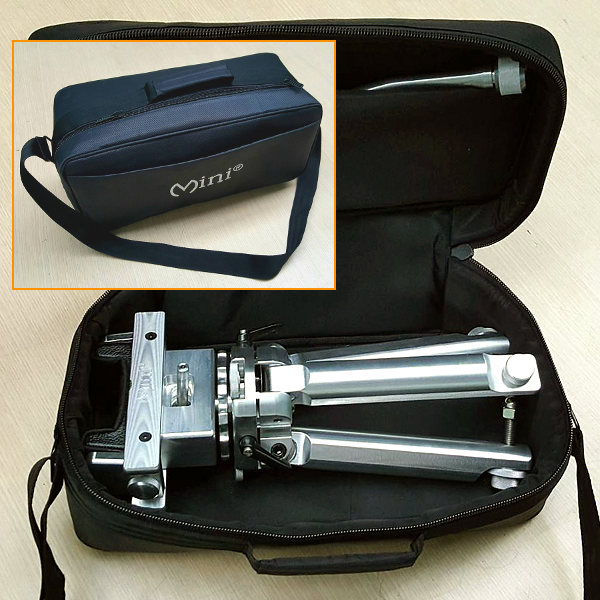
With the success of the SEB Mini, Seb Lambang has already started designing some new accessories. Here is a prototype carry package, the Mini Transporter. You can see this compact bag will hold a Mini even with big F-Class feet attached. Seb says: “I’m experimenting with soft case for Mini rest… Your thoughts?” We think Seb should certainly offer this case for sale. Post your thoughts in the comment section below.
SEB Mini with large disc feet attached still fits in bag.
It’s not easy to place a first shot on target at 1500 yards. You must measure the wind speed with precision, know your exact muzzle velocity, and have a sophisticated ballistics solver. In this short video from Ryansrangereport.com, the shooter manages a first-round hit on a steel silhouette at 1500 yards. He used a Kestrel 4500 NV Weather Meter with Applied Ballistics software to figure out the trajectory for his 6.5 Creedmoor rounds.
The Kestrel recorded a wind velocity, and the internal software calculated a solution of 17 Mils elevation (that’s 928 inches of drop) with 2.5 Mils windage. “Bang” — the shooter sends it, and 2.6 seconds later “Clang” he had a hit (flight time was 2.6 seconds). Bryan Litz observes: “This is the science of accuracy (in the form of an Applied Ballistics Kestrel) being put to good use at 1500 yards”.
Later in the video (1:05-1:15) the shooter places three rounds on steel at 1000 yards in just 10 seconds. The three shots all fall within 10″ or so — pretty impressive for rapid fire. The shooter reports: “[In my 6.5 Creedmoor] I’m using a 136gr Lapua Scenar L. This bullet has impressed me. It screams out of my barrel at 2940 fps and holds on all the way out to 1,500 yards.”
The rifle was built by Aaron Roberts of Roberts Precision Rifles (RPRifles.com). Chambered for the 6.5 Creedmoor, it features a Leupold Mark VI 3-18x44mm scope.
Roberts Precision Rifles
19515 Wied Rd. Suite D
Spring, Texas 77388
Phone: 281-651-5593
Email: rprifles @ gmail.com
We recommend you tune in to Shooting USA on the Outdoor Channel tonight. Tonight’s episode features both a Vintage Sniper Rifle competition and the GAP Grind, one of the most popular tactical matches. The show airs at 9:30 PM ET, 8:30 PM Central, 7:30 PM MTN, and 6:30 PM Pacific.
Vintage Sniper Rifle Match at Talladega
This week, Shooting USA features the Vintage Sniper Match at the CMP’s Talladega Marksmanship Park. This is a two-man team event, for shooter and spotter, using military rifles in service up to 1953. One added challenge is the time limit. The team has only 20 seconds to complete each shot — That’s 20 seconds for the spotter to read the conditions, and for the shooter to pull the trigger.
Guns of Grandfathers…
In this episode two USAMU marksmen, SGTs Daniel Crody and Robert Shoup, compete with an Springfield M 1903 A4 reproduction topped with a vintage optic. “For me it holds a little bit of sentimental value,” says SGT Crody. “I did have two grandfathers in World War II. It is definitely a pleasure holding a piece of history… and to be able to see and feel what these guys had as far as tools to operate with.”
Who can identify this rifle, with its unusual scope mount?
“It’s a match that brings a different type of competitor out. It brings a nostalgic competitor out. You’ll see World War II time-period rifles, sniper-type rifles that were used during World War II, Korean War era,” says the CMP’s Chief Executive Officer, Mark Johnson. “The optics are either original optics or current reproduction of old optics.”
GAP Grind on Shooting USA
Tonight’s Shooting USA episode also features the Bushnell GAP Grind, a tough tactical/practical match in Tennessee with 300 competitors. The Grind runs a Pro-Am format — new shooters partner with an experienced shooters for the two-day, 25-stage event. This year John Scoutten teamed up with new shooter Jen Hodson. Even with the challenges, Jen had a great time at the GAP Grind. “I will definitely be back!” says Jen, shown here:
Ramia Whitecotton Facebook photo.
On the first day of the Bushnell GAP Grind, teams are scored together. On the second day team members still work together but scores are logged individually. This is a difficult event with awkward positions, barriers, and other challenges. Targets vary in size, shape, and distance. One of the toughest targets is the 500-Yard Mover.
Californians Buy Bulk Ammo Online While They Still Can
Californians are buying more ammunition, and in bigger, bulk quantities, according to data from online ammo retailer Wideners.com. In the two months since 2016’s General Election, Wideners.com’s online traffic from California is up a full fifty percent (50%). Nationwide traffic to the site has remained relatively static for the same period. And Widener’s sales are up dramatically for the most popular ammo types: 9mm Luger, .223 Rem (5.56×45), and .308 Win (7.62×51).
IMPENDING BAN on Mail-Order Ammo — Starting January 1, 2018, California gun owners will no longer be able to buy ammunition online. Only face-to-face ammo purchases will be allowed inside the state. Per Proposition 63, California will also require a background check for ammunition purchases, and ammo buyers must obtain a four-year purchaser’s license from the CA Department of Justice.
“There’s been a massive influx of California hunters and sport shooters who are stocking up in the wake of California’s new laws”, reports Anne Taylor of Widener’s. “There’s not just increased interest, it’s clear the gun owners who are buying are buying in bulk. We’ve seen our average order weight go up in the past couple months. We expect this sort of rush will continue through the rest of the year.”
“We heard from a lot of customers in late December and early January who were confused about Prop 63,” Taylor said. “Many people seemed to think the background checks would start immediately.”
Percent Increase in Sales by Municipality:
Los Angeles Metro Area – 395%
San Francisco Metro Area – 417%
San Diego Metro Area – 161%
Sacramento Metro Area – 449%
Anaheim Metro Area – 264%
San Jose Metro Area – 233%
Note: Data based on IP Address of computer used to make purchase comparing the two-month period before and after 2016’s General Election. Municipalities such as San Francisco and Los Angeles already restrict online ammo purchases.
The biggest sales increase has been observed with .223 Rem/5.56×45 rifle ammunition, the most common cartridge type used in AR-platform rifles. In fact, .223/5.56 ammo sales in the eight weeks following the 2016 election were TWICE as great as in the preceding eight weeks.
Biggest jump in ammo sales has been for .223/5.56 ammo suitable for ARs.
9mm ammo and .308 rifle ammo are also experiencing large gains from California buyers with increases of 60-80%. That’s notable becauses sales remain static in those calibers in the rest of the country. Overall, Widener’s sales data shows the average quantity purchased by Californians is up 20% in the two months following the 2016 election compared to the same time period before.
Flat-bottomed stocks are great for benchrest shooting, but their geometry is not ideal for mounting conventional Harris bipods, which were originally designed for stocks with a curved underbelly. Long-time Forum member Mark S. wanted to know if there is a way to make a stud-mounted bipod more secure on a flat-bottomed stock: “I have started shooting some steel matches that require shooting from bipods. My best gun for the job is a 6BRX in a MBR benchrest stock. I have installed a stud, but the bipod is still wanting to turn sometimes. What do you use?”
Here’s a solution for Mark and others using Harris bipods on flat-bottomed stocks with studs. Get the Harris-made #9 (HB9) adapter. Costing just $22.12 (at Midsouth), the HB9 adapter provides an extended contact surface with pads, so the bipod will fit securely on your flat fore-end.The HB9 adapter also has a center cut-out for the swivel stud so the bipod adapter aligns properly on the underside of your stock:
Our friends at Targetshooter Magazine just returned from the IWA Outdoor Classics trade show in Germany. With 1455 exhibitors and over 45,530 attendees from around the globe, the IWA exhibition is a major event that rivals the USA’s SHOT Show in Las Vegas.
Here are some highlights from TargetShooter’s IWA Trade Show Report:
Target Optics
Perhaps this is a good place to start, with the latest long-range March offering, the High Master. This is a superb 10-60x56mm scope with a 34mm tube and ED glass. I predict that this scope will once again set the bar for the serious F-Class shooter. Obviously you can’t assess a scope like this at an exhibition, but I hope Target Shooter will have one soon for a proper test.
Tactical Rifle
This year, Tikka decided it was time they got in on the act and staged a press seminar to launch their version – the T3x TAC A1. This one doesn’t go the full AR butt route but has a very nice folding stock and, in spite of this and a 24-inch barrel, keeps the weight down to a respectable 5.1 kg (11.24 lb). Tikka has a very large following and I suspect this one will be a great seller, especially in the 6.5 Creedmoor chambering with 10-shot magazine.
Actions
Another action which caught my eye was from a Canadian company called Ultimatum Precision. They had incorporated some really useful features into their ‘Rem footprint’ action and, being Canadian, it might be more accessible without all the American ITAR nonsense. It incorporates a three-lug, floating bolt-head design which means that caliber changes are a cinch, especially with the option of a barrel-nut fixing. It comes with a hard, black finish and will be offered in the usual bolt/port configurations.
Here’s a very funny video that should put a smile on your face — especially if you’ve ever competed in action shooting events. This tongue-in-cheek video from the SuperSetCA team identifies seven (7) annoying/insufferable types of shooters you’ll find at shooting matches. You can’t help but chuckle watching this video. The satire is “dead on” — we’ve all met these kind of clowns at one time or another.
Among the personality types lampooned by the video are the “way too serious” type, the completely unprepared type, the “Hollywood” show-off, the “always an excuse” type, and of course the “I’m too old for this” competitor. As a shooter past age sixty, this Editor might even fall into that category — at least when it comes to “run and gun” games. When I’m asked to gallop around a range carrying heavy gear, yes I’ve been known to mutter: “I’m too [insert swear word] old for this….”
Here’s an extra challenge for you. According to the video’s producers, there are several TV and/or Movie references sprinkled throughout. Can you name them all (with run-times)? (Hint, look for Lethal Weapon and Matrix spoofs).
Want to go into retail? Here’s your chance! Gander Mountain Company (GMC) is going on the auction blocks. To facilitate a “going-concern sale” of the business, GMC has filed bankruptcy petitions in the U.S. Bankruptcy Court for the District of Minnesota. Gander Mountain plans to put the business up for sale, and will solicit bids prior to an auction in late April 2017. The company expects to submit the winning bid to the Bankruptcy Court for approval in early May and anticipates a closing of the sale by May 15, 2017.
Here are highlights from Gander Mountain’s official statement about the Bankruptcy:
Gander Mountain [states that], to maximize the opportunity to achieve a “going-concern” sale of its business, it and certain of its subsidiaries have filed voluntary petitions for relief under Chapter 11 of the United States Bankruptcy Code.
This action is the result of an in-depth review of the company’s strategic options undertaken in recent months to preserve the value of the company and position it for long-term success. Like many retailers, Gander Mountain experienced challenging traffic patterns and shifts in consumer demand resulting from increased direct-to-customer sales by key vendors and accelerated growth of e-commerce.
The company’s strategic review yielded the following conclusions:
A narrowly focused and lower cost operating model is necessary to position the company for profitable growth;
The company does not have the financial capacity or time to reset its operations to fully implement the new model and, as a result;
The best available path forward is to sell the company on a going-concern basis.
The court’s protections will enable us to manage the sale process on an expedited basis while protecting the interests of our customers, employees and other stakeholders. Gander Mountain is in active discussions with a number of parties interested in a going-concern sale and expects to solicit bids prior to an auction … in late April 2017. The company expects to submit the winning bid to the Court for approval in early May and anticipates a closing of the sale by May 15.
The company generally expects to conduct normal business operations during the pendency of its restructuring. Employee pay will continue to arrive on time and in full, employee benefits will remain in place, retirement accounts are intact and protected. As a product of the company’s strategic review, 32 underperforming retail locations will begin a shutdown process in the next several weeks.
At the request of our readers, we provide select “Deals of the Week”. Every Monday morning we offer our Best Bargain selections. Here are some of the best deals on firearms, hardware, reloading components, and shooting accessories. Be aware that sale prices are subject to change, and once clearance inventory is sold, it’s gone for good. You snooze you lose.
1. Whidden Gunworks — Barnard Actions on Sale (up to $445 Off)
Barnard makes great actions, many of which come complete with superb two-stage triggers. For a long-range competition rifle, a Barnard action is a very good choice. And now you can save up to $445.00 on Barnard Precision actions, most including triggers. Prices have been slashed on a wide selection of Barnard actions. For example the model PL is on sale for $970.00, marked down from $1395.00. This is a great opportunity to save. We’re all familiar with the Model P, but check out other models. Potential customers may want to review detailed descriptions and action specs on the Barnard Precision website, www.Barnard.co.nz. NOTE: This sale is limited to inventory on hand, the actions listed below:
Barnard Sale Tip by EdLongrange.
2. Cabela’s — SIG .45 ACP P220 40th Anniversary, $799.99
Every serious gun guy should own a .45 ACP and at least one SIG Sauer pistol. Now you can combine both those “must haves” with an accurate, ultra-reliable SIG P220. This week, the deluxe P220 40th Anniversary model with threaded muzzle as is featured as Cabela’s “Gun of the Week” special. We’ve checked around the web, and this special P220 sells elsewhere for $1060-$1099, so this $799.99 Cabela’s special truly is an exceptional deal, saving you hundreds. This Editor owns two SIG pistols; I can attest that SIG handguns offer class-leading accuracy and reliability.
You don’t need to spend big bucks for an effective spotting scope to view mirage. You can get the Kowa TSN-601 Angled Body for just $249.00 from B&H Photo. An eyepiece will run another $275.00 or so. Though relatively inexpensive, the TSN-601 is used by many top marksmen. This doesn’t have the resolution of the $1500+ spotters but this is find for viewing mirage and spotters.
4. Natchez — Special 5 Reloading Press Kit, $199.99
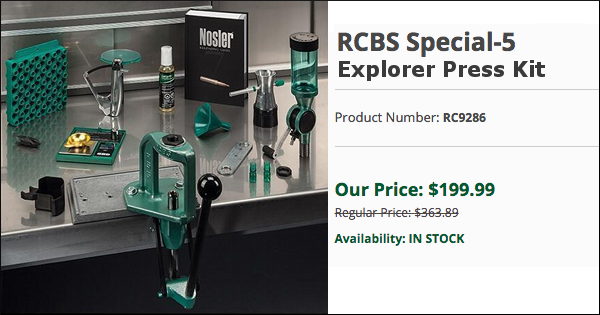
Looking for a great holiday gift for a family member getting started in metallic cartridge reloading? This RCBS Kit has everything a new reloader needs: single-stage press, powder measure, scale, powder trickler, priming tool, cartridge tray, “rocket” chamfer tool, case lube and more. This is an excellent entry-level reloading kit, on sale for just $199.99 at Natchez Shooters Supplies. We like the relatively compact Special 5 press for most reloading duties. Eventually you may want to add an additional, large heavy press, but this will get the job done. For the combined package, with all the tools one needs to hand-load quality ammo — this is a stunningly good deal at $199.99.
5. Amazon — Lyman Case Prep Xpress $103.99
The Lyman Case Prep Xpress lets you chamfer inside and out, brush your necks, clean/uniform primer pockets, and ream military crimps. On sale at Amazon.com with $103.99 Prime pricing, this is a good deal. Lyman’s Case Prep Xpress sells elsewhere for $130.00 or more. Here is a review from a Verified Purchaser: “The unit is quiet, sturdy, and the attachments do what they are supposed to do. It already has made a difference in my reloading speed, and most importantly, my comfort. I highly recommend this unit.” (Strafer, 4/7/14)
6. Amazon — Bushnell 1-4x24mm Scope for ARs, $119.99
The CMP and NRA now allow magnified optics (up to 4.5X max power) in service rifle matches. You can spend thousands on a high-end scope for your AR, but you just might find that a much cheaper optic will do the job. Consider the Bushnell 1-4x24mm riflescope with 0.1 Mil clicks and BDC reticle calibrated for .223/5.56 55-62 grain ammo. Right now at Amazon.com, you can get this 1-4x24mm Bushnell for just $111.99 with free shipping. That’s a steal — this scope sells elsewhere for up to $155.00. And actual scope owners tell us that this very affordable 1-4x24mm Bushnell holds its own vs. competitive optics costing 3-4 times as much.
7. Midsouth — 6.5mm 123gr Match Bullets, $20.49 per hundred
Do you shoot a mid-sized match cartridge, such as the 6.5×47 Lapua, or 6.5 Creedmoor? Then here’s a great deal. Right now you can get 123gr Nosler HPBT match bullets for just $20.49 per hundred. These are “factory seconds” with cosmetic blemishes, such as water spots. But they are otherwise fine bullets, and your targets will never notice the blemishes. Even if you currently shoot another brand of 6.5mm bullets, you should try these 123gr Noslers at just $20.49 per 100. That’s HALF the price of some other premium 120-130gr 6.5mm match bullets.
8. Midway USA — Vortex Viper 6.5-20x44mm Scope, $329.99
Here’s a great deal on a versatile Vortex Viper 6.5-20x44mm scope that can be used for target work, varmint hunting, or even tactical games. This scope features XD (low dispersion) glass, side-focus parallax, and a 30mm maintube. It offers 1/4-MOA clicks with 65 MOA of elevation adjustment and side-focus parallax control. Two reticle choices are offered: 1) Dead-Hold BDC, and 2) Mil-DOT. Backed by Vortex’s VIP Unconditional Lifetime Warranty, this Viper is on sale for just $329.99 at MidwayUSA, with free shipping.
9. NRA & MidwayUSA — NRA Life Membership, $600.00
Here’s the best deal going right now on an NRA Life Membership. This normally costs $1500.00, but if you CLICK HERE, you can get a life membership for just $600.00, thanks to an NRA/MidwayUSA promotion. You can also save on 1-year, 3-year, and 5-year NRA memberships. Note: This is a limited-time offer.



 It’s not easy to place a first shot on target at 1500 yards. You must measure the wind speed with precision, know your exact muzzle velocity, and have a sophisticated ballistics solver. In this short video from
 Guns of Grandfathers…


 Flat-bottomed stocks are great for benchrest shooting, but their geometry is not ideal for mounting conventional Harris bipods, which were originally designed for stocks with a curved underbelly. Long-time Forum member Mark S. wanted to know if there is a way to make a stud-mounted bipod more secure on a flat-bottomed stock: “I have started shooting some steel matches that require shooting from bipods. My best gun for the job is a 6BRX in a MBR benchrest stock. I have installed a stud, but the bipod is still wanting to turn sometimes. What do you use?”