Well folks, it’s July 1st already — the means we’re moving into “peak heat” summer conditions. It’s vitally important to keep your ammo at “normal” temps during the hot summer months. Even if you use “temp-insensitive” powders, studies suggest that pressures can still rise dramatically when the entire cartridge gets hot, possibly because of primer heating. It’s smart to keep your loaded ammo in an insulated storage unit, possibly with a Blue Ice Cool Pak if you expect it to get quite hot. Don’t leave your ammo in the car or truck — temps can exceed 140° in a vehicle parked in the sun.
To learn more about how ambient temperature (and primer choice) affect pressures (and hence velocities) you should read the article Pressure Factors: How Temperature, Powder, and Primer Affect Pressure by Denton Bramwell. In that article, the author uses a pressure trace instrument to analyze how temperature affects ammo performance. Bramwell’s tests yielded some fascinating results.
For example, barrel temperature was a key factor: “Both barrel temperature and powder temperature are important variables, and they are not the same variable. If you fail to take barrel temperature into account while doing pressure testing, your test results will be very significantly affected. The effect of barrel temperature is around 204 PSI per F° for the Varget load. If you’re not controlling barrel temperature, you about as well might not bother controlling powder temperature, either. In the cases investigated, barrel temperature is a much stronger variable than powder temperature.”
Powder Heat Sensitivity Comparison Test
Our friend Cal Zant of the Precision Rifle Blog recently published a fascinating comparison test of four powders: Hodgdon H4350, Hodgdon Varget, IMR 4451, and IMR 4166. The first two are Hodgdon Extreme powders, while the latter two are part of IMR’s new Enduron line of propellants.
The testers measured the velocity of the powders over a wide temperature range, from 25° F to 140° F. Hodgdon H4350 proved to be the most temp stable of the four powders tested.
The largest field target event in the country comes to upstate New York next weekend. On July 8-10, the Crosman All-American Field Target Championship (CAAFTC) will be held at the Rochester Brooks International Skeet and Trap Club in Rush, New York. 0ver 100 air rifle and air pistol competitors will participate in the event hosted by Crosman Corporation. This event attracts top Airgunners from across the nation (and some foreign countries). Along with regular Field Target matches, there will be specialty side matches, plus a factory tour. The event is free to the public.
The CAAFTC is sanctioned by the American Airgun Field Target Association and is a featured AAFTA Grand Prix event. The 120-shot match has competitive rifle divisions based on allowable gun and support equipment. Here are the main air rifle classifications:
Hunter Division – rifle fires at a maximum 20 foot pounds of energy (FPE), shooter may use a non-attached bipod, non-restrictive clothing, and sitting stool. Open Division - maximum 20 FPE maximum rifle, shooter may wear a body harness, no bipod, 6″ maximum height seat. World Field Target Federation (WFTF) – similar to Open but shooters compete according to international standard of maximum 12 fpe for rifles. Freestyle Division – 20 FPE maximum rifle, no other restrictions. (This is new for 2016).
The pistol competition includes similar divisions based on shooting styles. Both rifle and pistol divisions include sub-classes based on the air rifle powerplant: piston driven or precharged pneumatic.
“If you want to see some of the country’s finest airgun shooters, this is the hottest event of the summer and it’s free for the public,” says Chip Hunnicutt, Marketing Manager for Crosman. “Alongside the world-class shooters, we’ll have enthusiasts simply having a good time and even parents bringing their kids for some good fun outdoors.”
The weekend begins on Friday, July 8th with the PyramydAir Gunslynger match at noon followed by the Quigley Bucket Challenge at 2:00 pm. A facility tour will be available at 1:00 pm at Crosman’s world headquarters located at 7629 Routes 5 & 20 in Bloomfield. The first round of the rifle match begins Saturday at 9:00 am.
Tech Talk: Why the Big Side-Wheels on the Scopes?
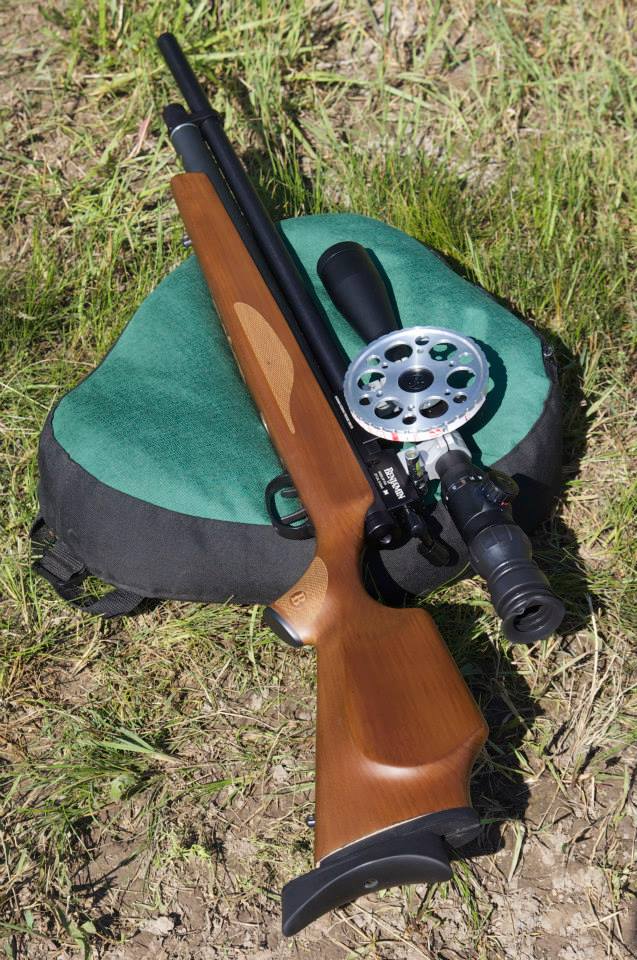
Field Target rifles shoot pellets propelled by compressed air. These light-weight, low-BC projectiles drop very quickly, with a looping trajectory. In order to hit targets at distances out to 50 yards or so, you have to adjust your scope to compensate for pellet drop. But you can’t set the scope correctly without knowing the precise range to the target. This is the function of the big wheels on the side of the scope. Field Target Competitors use the parallax adjustment on high-magnification scopes to determine target range. The big wheel allows quick, yet precise parallax adjustment. Markings on the wheel show the shooter the scope settings required for the distance “dialed-in” via the over-size parallax wheel.
Most gun guys know that the NRA publishes a monthly magazine called American Rifleman. What you may not know is that NRA also offers an American Rifleman television series on the Outdoor Channel. On each episode the hosts of American Rifleman TV review popular firearms (pistols, rifles, and shotguns). Most episodes include an historical segment. For example, in the 2016 Season Premiere, American Rifleman TV looks back at WWII, spotlighting The Men & Guns of the Pacific.
Highlights from other American Rifleman TV Episodes:
Springfield Armory M1A Review:
The Springfield Armory M1A is a civilian, semi-auto rifle based on the U.S. Military’s M14. Your Editor owned an M1A, and it was a fun gun. In High Power and Service Rifle competition, low-recoil 5.56 (.223) AR-platform rifles have displaced the M1A, but there is a hugely popular Springfield M1A Match every year at Camp Perry. The M1A Match at Perry offers over $25,000 in cash and prize awards each year.
Leupold Factory Tour:
Founded in 1907, Leupold & Stevens produces high-quality optics (with a legendary warranty) in Beaverton, Oregon. Leupold scopes are favorites for hunters as well as competitive shooters. In this episode, American Rifleman TV takes a tour of the Leupold & Stevens factory in Oregon.
Ruger American Rimfire Review:
Ruger offers both Standard and Compact models of its American Rimfire in two chamberings: .22 LR and .22 WMR. This rifle features a detachable, rotary magazine, like Ruger’s popular 10/22. The American Rimfire is a very affordable, yet reliable and surprisingly accurate rifle.
Reader Mike Etzel has come up with a simple, cost-effective way to apply moly or danzac coatings to your bullets. And you won’t need any expensive gear other than your regular vibratory tumbler and some small plastic containers.
Mike explains: “For a number of years I have been using a very convenient way of coating my projectiles with DANZAC in a tumbler. Instead of using a separate tumbler filled with DANZAC and stainless steel balls for coating applications, use small resealable plastic cake or pudding cups filled with stainless balls and DANZAC. Each cup will accommodate between 20 to 70 projectiles depending on caliber once the polishing balls and DANZAC are added. When I need to polish some cases, I insert the sealable plastic container(s) into the polishing material in the tumbler, add cases to the media, and in the process clean cases and coat the projectiles simultaneously in one tumbler. This does two operations in one session, saving on time and resources.”
While Mike uses DANZAC (Tungsten DiSulfide or WS2), you can use the same impact-tumbling-in-a-cup method to moly-coat your bullets, or to apply HBN (Hexagonal Boron Nitride).
TIPS for COATING your BULLETS, by “GS Arizona”
1. Start with Clean Bullets. This is simple enough, but some people overlook it and others overdo it. Get the bullets out of the box, wash them with warm water and dish soap and dry them. No need for harsh chemicals, after all, we’re only removing some surface dirt from shipping and maybe some left over lanolin from the forming process. Don’t handle them with bare hands once they’re clean, your skin oils will contaminate them.
2. Get Everything Hot — Real Hot. This is probably the single most important element in producing good-looking moly-coated bullets. I put the tumbler, the drum and the bullets out in the sun for at least 30 minutes before starting and then do all the tumbling in direct sunlight. On a summer day in Arizona, everything gets to the point that its uncomfortably hot to handle. If you are tumbling in the winter, you should heat the bullets in some form, a hair dryer can be useful, but they will cool off in the drum if you’re tumbling in cold temperatures. Your best bet is to plan ahead and do your coating in the summer. I coated about 3000 bullets in a couple of days recently to see me through our winter season (we’re a bit reversed from the rest of the country in terms of shooting season).
Location: Overlooking Columbia River in Colville, Washington area, (North of Spokane, WA)
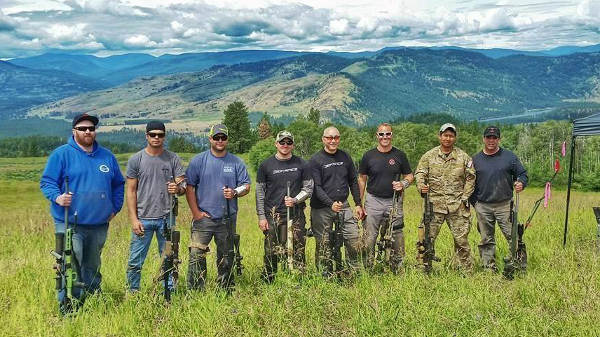
The annual precision tactical rifle event known as the Sniper’s Hide Cup (SHC) wrapped up on Sunday and it was quite an adventure this year. The match, held in a stunningly beautiful corner of Washington State, offered plenty of challenge for the competitors, along with memorable scenery. On the podium this year were: Nick Gadarzi (1st), 2nd Jesse Redell (2nd), and 3rd Brent Webley (3rd). Congrats guys!
These photos come from Frank Galli, Sniper’s Hide Founder, and our friend Steve Lawrence from 6.5Guys.com. Steve competed in Squad 8 with other members of the Northwest precision shooting community. Three members of the squad placed in the top 20. Steve placed 34th out of 148 shooters registered for the event.
Credit goes to Frank Galli of Sniper’s Hide, LLC, Mile High Shooting Accessories, and Carl Taylor of In Motion Targets for organizing, sponsoring, and hosting this event, as well as the dozens of Range Officers, volunteers, and companies who donated to the prize table which made this such a memorable match. The ‘Hide Cup will be featured on the Long Range Reality TV series.
Match Director’s Report — Sniper’s Hide Cup 2016
The 2016 Sniper’s Hide Cup was held in Colville, Washington in one of the most picturesque settings I have ever attended. We had 24 stages, 50 Range Officers, and 148 competitors at this year’s 2.5-day event. Starting off with heavy rain and fog, we quickly rolled in cool temps and partly sunny skies. It made for a great weekend of shooting.
Because Carl Taylor owns and operates In Motion Targets, we had 5 mover (moving target) stages. So every segment included a moving target stage, which was anywhere from 400 to 800 yards. This was a more traditional Field Course-type event, but the SHC was part of the PRS Series. Targets averaged from 300 to 1100 yards during the match, under challenging and unpredictable conditions thanks to the varied terrain. Competitors shot 360 degrees so they were subject to wind from every direction.
Congratulations to the Top 3, Nick Gadarzi, Jesse Redell, and Brent Webley. We thank key Sponsors Sig Optics, Swarovski, and Proof Research, along with Falkor, Prime Ammo, GA Precision, and Kasey Beltz with B&T Industries. They were Segment Sponsors.
We look forward to doing more in the Colville area next year. It was a laid back fun event.
— Frank Galli, Sniper’s Hide Cup Match Director
Steve Lawrence takes aim on a down-angle shot amidst the pines.
Steve (shown above) gave a shout-out to his sponsors: “We want to acknowledge the 6.5 Guys partners/sponsors who make it possible for us to bring viewers along with us on our precision rifle marksmanship quest. Travis Redell of R Bros Rifles who built me a superbly accurate, ultra-dependable match rifle, Jake Vibbert of JC Steel Targets, Glen Harrison and Mike Lee of Defiance Machine, Michael Ryan of Midsouth Shooters Supply, and Kevin Thomas and Adam Braverman of Lapua.
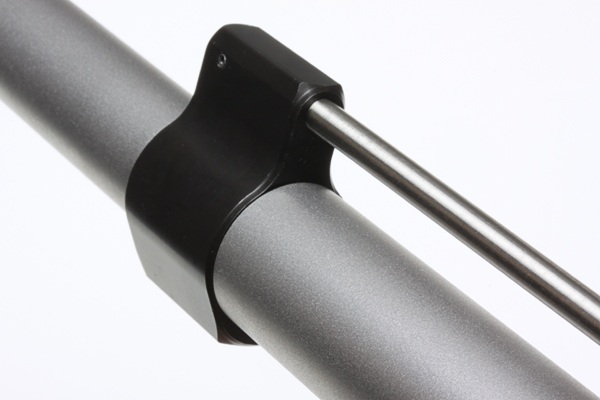
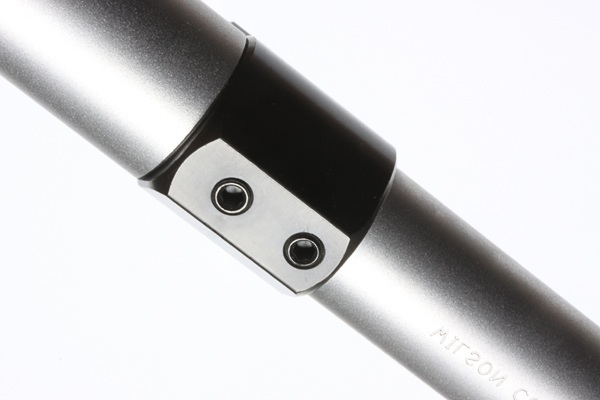
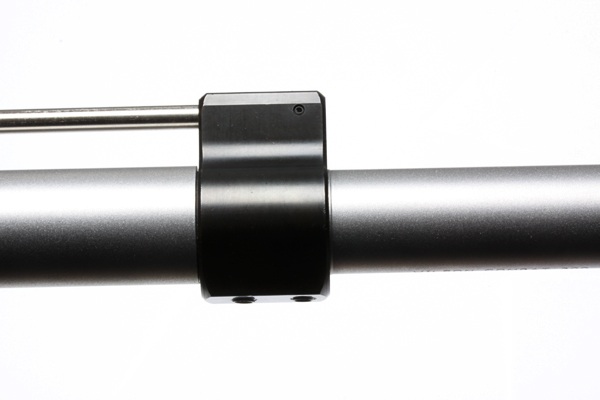
Wouldn’t it be cool if you could adjust the bolt cycling energy on your AR-platform rifle? Turn down the cycling rate for slow fire at the bench or varmint hunting. Crank up the energy for 3-Gun matches and rapid-fire disciplines. This IS possible with a handy accessory that fits on your barrel. Wilson Combat offers an Adjustable Lo-Profile AR Gas Block for direct gas impingement AR-type rifles. Wilson Combat’s adjustable gas block replaces a standard AR gas block and allows you to tune your AR’s gas system for smoother cycling and enhanced reliability. Wilson Combat explains: “Adjusting your rifle’s gas port will lower or increase your bolt’s cyclic rate. This tailors your rifle’s performance to your unique needs.”
A simple adjustment of the hex screw at the front of the block modulates the gas volume allowing you to tune your rifle’s function to your favorite loads. This is very handy when shooting non-standard AR calibers, unusual hand-loads, or suppressed rifles. Adjustable Gas Block systems are sold as complete kits starting at $74.95. Wilson Combat offers two diameters (.750″, .937″) and three lengths (Carbine Length, Mid-Length, & Rifle Length), so you can select the right dimensions for your rifle configuration and barrel diameter. The blocks are Chromoly steel with a Melonited finish.
Package Includes:
Adjustable Gas Block (Melonite Finish)
Adjustment Set Screw (Installed)
Straight Gas Tube (Installed, Gas Tube Pin Installed)
The King of 2 Miles Extreme Long Range (ELR) competition is underway at the NRA Whittington Center in Raton, New Mexico. Many of the nation’s top shooters are competing — aiming for hits on targets as far out as 3500 yards.
Day One went well. I was the third shooter this morning. Started out good with 4/5 hits at 1454 yards including a first-round hit which is worth a lot of points. The second target was only 100 yards further, but the wind cycled and I missed the first two shots. If you miss three shots on any target after the first, you’re out! So cautiously, and with help from my teammates/spotters Paul Phillips and Mitchell Fitzpatrick, I scored a third round hit at 1550 and was able to advance to the 1720-yard target. I manage to hit that 1720-yard target three out of three times.
The final target on Day One was at 2011 yards. Unfortunately I had three close misses. (Editor: Close only counts in horseshoes and hand grenades, Bryan…)
Twenty teams shot today and about 15 more will shoot the qualifying stage tomorrow then the top 10 from the two days will shoot on Thursday at over 3300 yards for the crown. My score of about 29,000 points is good. But I won’t know for certain if I’ve made the Top 10 until all tomorrow’s teams fire.
Mitchell Fitzpatrick hit every target on his first two shots and finished with 40,000 points on Day One. His farthest shots were just over 2000 yards.
So that’s my story so far, but that’s not THE story. Teammate Mitchell Fitzpatrick (with rifle above) topped the field today with a monster score, hitting all targets and racking up over 40,000 points! The prototype Berger .375-caliber, 400gr bullets and Mitch’s .375 Wildcat from Lethal Precision Arms LLC are a super high-performance combination that made short work of the ELR course.
Also, teammate Paul Phillips, who originally was only here to spot, has entered the competition. He’ll be shooting my .338 Edge tomorrow. Luckily I brought plenty of ammo!
Picture below is the full Applied Ballistics team with sponsor Kelly McMillan. Kelly has been great to our team and we’re looking forward to some future projects with him in ELR.
In all the King of 2 Miles event is very enjoyable. It’s a great place to come and learn from fellow ELR shooters what works and what doesn’t work at these ranges. The spirit of the match is education and growing the knowledge base and I think it’s doing a great job at that. We’re thrilled to be a part of it!
DAY 2 UPDATE: Top TEN Shooters
Results of King of 2 Miles After Day Two
The Top 10 listed below continue to Day Three. On this final day, the ten remaining competitors will engage targets from 1-2 miles. Paul Phillips reports: “I managed to finish today with the highest score of the day. That placed me 7th overall and allows me into the shoot-off tomorrow. Team Applied Ballistics place three shooters in the 10 Final: Michael Fitzpatrick, Bryan Litz, Paul Phillips.”
Virginia “Ginny” Thrasher, who will compete in the Rio Olympics this summer, showed continued dominance of her sport by winning the women’s national Air Rifle title last week at Fort Benning, Georgia, home of the USAMU. Mindy has been on fire in recent months. In April she won the 2016 U.S. Olympic Team Trials in Smallbore Rifle, securing a spot at the Rio Olympics. Prior to that, Ginny won individual NCAA titles in both air rifle and smallbore — as a freshman! This girl is a genuine phenom…
Thrasher, a member of the West Virginia University Mountaineers, has been on a tear of late. After winning the the Olympic Trials in Three-Position Rifle in April, she then earned two finals appearances at the Munich World Cup in May. Prior to that, Ginny’s sharpshooting earned her individual NCAA titles in air rifle and smallbore. With those performances, the talented freshman led West Virginia University to the collegiate team title and was named Top Performer of the 2016 NCAA Shooting Championship.
Her WVU coach, Jon Hammond, said Ginny has had an amazing run to Rio: “It’s an unbelievable freshman year to win NCAA championships and qualify for the Olympics. I would hazard she’s probably going to be one of the youngest members of the U.S. shooting team at the Olympics.”
Thrasher earned her way onto the national team with a stellar performance at the 2015 U.S. championships, where she won five medals, three in junior competition and two in open competition. That performance propelled her into her freshman season at West Virginia University.
This year’s USA Shooting National Championships includes more than 300 athletes vying for National Team selections and the upcoming Olympic and Paralympic Games in Rio De Janeiro, Brazil. Other shooters attending this year’s Nationals are looking ahead to the next Olympic Games — Tokyo 2020.
Mindy Miles (Weatherford, Texas) finished second at Nationals behind Thrasher in the women’s Air Rifle Event. Thrasher’s Team USA teammate at the Rio Olympics, Sarah Scherer (Woburn, Massachusetts), won the Final to finish third overall.
Annealing Made Perfect (AMP) Annealing Machine Review
Review by Bill Gravatt I had been following the progress of Alex and Matt Findlay with Annealing Made Perfect for almost three years as they pursued making the best annealing product for the private reloading market. The short explanation of why we anneal brass is to return the brass to a softer and consistent hardness after the brass has work-hardened from repetitive firing and sizing. As the President/co-owner of Sinclair International for over 21 years I saw a lot of products come through our doors that annealed brass but these products always seemed like they had very little supportive data and research behind them. Most of them were based on some type of torch system. The New Zealand-based father/son team of Alex and Matt spent these past three years addressing the challenging questions about annealing:
- What is the correct temperature to reach when annealing?
– How long should you take to get to that temp and how long should you remain there?
– How frequently should you anneal?
– Can you ruin your expensive brass?
– How do we make the process repeatable for the handloader?
– How do you accurately measure the case hardness?
They worked closely with the Electrical Engineering Department at the local University of Technology and invested a lot of capital into detailed metallurgical research. Their decision to use induction heating was because of its repeatability and the ability to reach exacting and consistent temperatures. Induction annealing is achieved by placing the cartridge in a magnetic field thereby inducing eddy currents within the brass and heating the brass without contacting the brass physically. To learn more, I suggest you visit the AmpAnnealing.com website. It is very informative.
Why should you anneal? If you are just a casual reloader, than annealing isn’t necessary but if you a serious wildcatter or competitive shooter you may want to consider it. More and more competitive shooters anneal their cases (not necessarily for adding life to the cases) to achieve more consistent pressures and velocities.
My first favorable impression was received by just opening the extremely well-packed shipping box. You could tell these guys take a great deal of pride in their product. The unit comes with three cartridge-specific pilots (you decide on which pilots), a shellholder collet, a power cord, a thorough, well-written, easy to follow instruction manual, and a USB cord for future software updates.
This machine is so easy to use that I was up and running within a few minutes. All I had to supply was the shells, the correct shell-holder and an aluminum pan to drop the hot cases into. I started annealing some unturned .308 Winchester cases (Lapua headstamp) that had four firings. First I screwed the pilot for .308 cases (#11) into the machine, placed my .308 shellholder into the supplied shellholder/collet and turned the power on. The display fired up right away and soon registered the program level that the machine was set to.
Since the machine uses induction heating, you need to set the heating level for the correct setting for the brass you are using. The alloy being used isn’t as important as the thickness or amount of brass in the neck and shoulder region. For example, Lapua and Norma have more brass in that area so the setting would be higher for these brands than Winchester brass. Also, if you have neck-turned brass, the setting would be reduced from the standard setting because there would be less mass in the air gap.
This manufacturer-produced video shows how the AMP annealing machine operates:
The settings are obtained by referring to the “Settings” section on the AMP website and are broken out by cartridge, brand, standard unturned cases, and then neck-turned cases with various amounts of wall thickness removed. A great service that AMP provides to the handloader is that you can send sample cases of your brass to them (U.S. location in Wolcott, Indiana) and they will test the hardness for you and send you the exact setting for your specific lot of brass.
My setting for unturned Lapua .308 Winchester brass was “92”. The buttons on the front of the machine allow you to adjust the setting quickly. After you set the program number, the setting is locked in after the first use until you change it again. I placed the first case in the shellholder, lowered the assembly down through the pilot and into position. I then hit the start button which illuminated immediately and then about 6 to 7 seconds later, the light went off signaling that heating was completed.
Now, be aware, these cases are extremely hot. I lifted the case out using the shellholder/collet and then dropped it into my aluminum pan. I then placed another case into the holder, put it into the machine and then repeated the process. Once I got the coordination down, I did 100 .308 Win cases in about 24 minutes. I did some 6mmBR cases later (Lapua) and annealed 100 cases in about 15 minutes at the “75” setting. I found myself raising my shop stool a little higher than normal so I was at a comfortable height in relationship to the top of the machine. Very easy to do — I actually had a student do a few cases with me and she had no problem at all following the instructions.
There is a thermal cut-off that prevents the machine from overheating. Depending on the setting, this can occur after 20 to 35 minutes of continuous use. When this has occurred, simply leave the machine on and the fans will cool it down so you can resume annealing. This isn’t surprising considering the amount of heat being generated.
All in all, I found this machine extremely easy to setup and operate. Now, does it work? I have test batches of brass that I am going to run over the chronograph in 10-round strings. I plan on running at least 10 strings of annealed brass and 10 strings of unannealed brass out of the same lot, same number of reloadings/firings and out of the same gun. I plan on alternating annealed strings and unannealed strings with a cooling off period every 20 rounds. When I do testing, I have my wife pre-label my batches as Batch A and B so I won’t know what rounds I am shooting until I get back from the range. I’ll make the results available as soon as I can. My expectation is that velocities will be more consistent based on my understanding of the lab results that the Findlays have achieved with their Annealing Made Perfect machine. For more information, visit their website at AmpAnnealing.com.
At the request of our readers, we provide select “Deals of the Week”. Every Monday morning we offer our Bargain selections. Here are some of the best deals on firearms, hardware, reloading components, and shooting accessories. Be aware that sale prices are subject to change, and once clearance inventory is sold, it’s gone for good. You snooze you lose.
1. Bullets.com — 6mm Dasher Brass from Norma
It’s finally here, ladies and gentlemen — factory-made Dasher brass. That means no more fireforming! This 6mm Dasher brass has been custom crafted by Norma exclusively for Bullets.com. A special blend of brass together with special treatment of the primer pockets has produced casings that will last for many firings under normal use. The necks have been specially lengthened and are .290″ from shoulder. Overall length is 1.598″ and neck walls are approximately .013″ thick. Available in packs of 100 ($109.95) or 500 ($529.95).
NOTE: This extra-sturdy brass has a thicker rim which may not work in your standard shell holder. Custom shell holder item BL12100 is designed to accommodate the heavy rim of these cases.
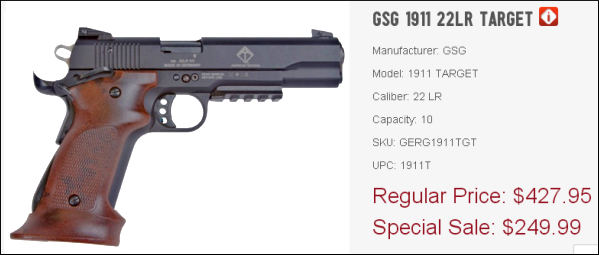
2. CDNN Sports — 1911-Type .22 LR Target Pistol
Everyone should have an accurate .22 LR target pistol. This German-made GSG 1911 22LR pistol shares the look, feel, and ergonomics of J.M. Browning’s classic model 1911 so it’s good for cross-training. We’ve tried this pistol and the trigger is pretty darn good — though don’t expect it be be as nice as a S&W Model 41. But consider that the GSG costs just $249.99. By contrast, MSRP on a new Model 41 is a steep $1369.00. For cross-training and target work the GSG is a very good value.
3. Monmouth Reloading — Sig Sauer Kilo 2000 LRF, $499.00
This excellent laser rangefinder rivals other premium LRFs selling for hundreds more. Head-to-head field tests with Leica, Zeiss, and Swarovski LRFs proved that the new Sig Sauer Kilo 2000 can play in that league, but at a much more affordable price point. Sig accomplishes that with tight beam divergence and state-of-the-art DSP technology which allows the Kilo 2000 to range faster (and more reliably) at longer distances. Optic magnification is 7X. The Kilo 2000 weighs 7.5 oz and measures 3″ x 4.2″ x 1.3″.
SAVE MORE: Right now you can save an additional $110 off every Rangefinder Monmouth Reloading sells, including the Sig Kilo 2000. To save an additional $110, use Coupon Code LRF 110. That will lower your cost to $389.00 for the Kilo 2000, which is a total steal. (Time-Limited Offer!)
4. Cabelas.com — Rock Chucker Supreme Reloading Kit
Everything you see above can be yours for just $225.00, after manufacturer’s rebate. Right now, Cabela’s is selling the Rock Chucker Supreme Master Reloading Kit for $300.00. That’s a good deal as this Reloading Kit sells elsewhere for up to $360.00. But he’s the real incentive — if you spend $300.00 on RCBS products in 2016, RCBS will send you a $75.00 rebate. With that REBATE, your net cost is just $225.00 for the entire Kit.
5. Amazon — Motorola Walkie Talkies, $42.56 per Pair
Walkie-Talkies are “must-have” items for long-range shooting. The 22-CH Motorola MH230R Two-Way Radio is Amazon’s #1 Best Seller in FRS/GMRS Handheld Radios. This under-$45.00 set offers 22 channels with a claimed range up to 23 miles (We’ve used them and they worked at 3 miles line of sight). The kit includes: 2 radios, 2 belt clips, 1 dual drop-in charger, 1 charging adapter, 2 NiMH rechargeable battery packs. Run-time is about 10 hours — plenty for a full day of shooting. There is also a newer version, the Motorola T260 for $59.00.
6. Amazon — Nikon 1-4x20mm M-223 Scope with BDC, $212.46
Under the CMP’s new Service Rifle Rules, you can use an optic with up to 4.5X magnification and 34mm objective. If you have money to burn, you could purchase the excellent new Nightforce 4.5x24mm SR scope for $1950.00. Or, if you would rather put your money into barrels, bullets, and brass, you can spend a whole lot less. This little Nikon 1-4x20mm M-223 can do the job and right now it’s on sale for under $215.00! You could buy NINE of these Nikons for the price of one Nightforce SR. That certainly makes you think about priorities.
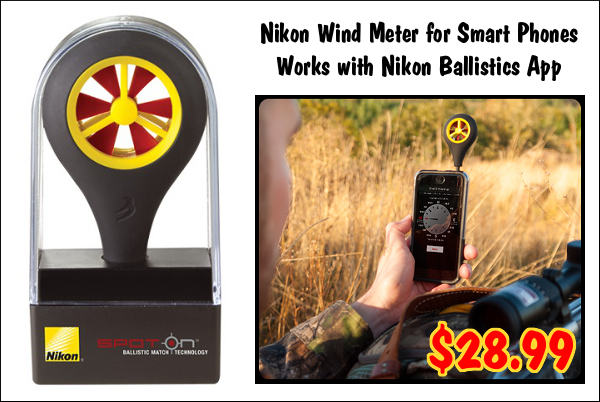
7. Grafs.com — NEW Nikon Wind Meter for SmartPhones, $28.99
Here’s a great new gadget for under $30.00. Nikon’s new Spot On™ Ballistic Wind Meter plugs directly into the headphone port on most popular smart phones. The Spot On Wind Meter reads both wind speed and direction and inputs the data directly into Nikon’s free Spot On Ballistics Mobile App (available for iOS and Android). This allows you to quickly determine and calculate wind drift corrections without needing a separate, dedicated wind meter. When not in use, the Nikon device easily fits in a pocket.
8. Amazon – Frankford Arsenal Master Tumbler Kit, $56.65
This Master Tumbler Kit contains everything you need to tumble rifle or pistol brass. Now on sale for $56.65, this Kit contains: Vibratory Tumbler, Rotary Media Separator, Plastic Bucket, 3 lbs. Cleaning Media, and 4 oz. Brass Polish. This product has received excellent reviews from verified purchasers.


 To learn more about how ambient temperature (and primer choice) affect pressures (and hence velocities) you should read the article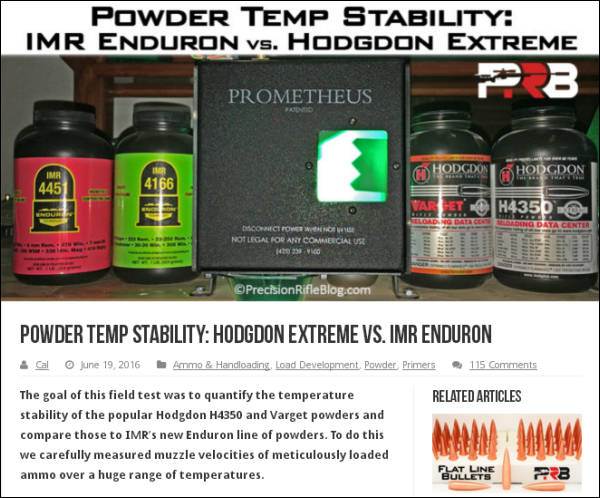





 Reader Mike Etzel has come up with a simple, cost-effective way to apply moly or danzac coatings to your bullets. And you won’t need any expensive gear other than your regular vibratory tumbler and some small plastic containers.
 2. Get Everything Hot — Real Hot. This is probably the single most important element in producing good-looking moly-coated bullets. I put the tumbler, the drum and the bullets out in the sun for at least 30 minutes before starting and then do all the tumbling in direct sunlight. On a summer day in Arizona, everything gets to the point that its uncomfortably hot to handle. If you are tumbling in the winter, you should heat the bullets in some form, a hair dryer can be useful, but they will cool off in the drum if you’re tumbling in cold temperatures. Your best bet is to plan ahead and do your coating in the summer. I coated about 3000 bullets in a couple of days recently to see me through our winter season (we’re a bit reversed from the rest of the country in terms of shooting season).





 Bryan Litz of


 I had been following the progress of Alex and Matt Findlay with