Graf & Sons, Inc., “The Reloading Authority”, is kicking off the official celebration of its 60th Anniversary in business with its Ultimate Reloading Give-Away Contest. Act soon — today’s the last day to sign up for Graf.com’s 60th Anniversary Reloading Give-Away.
Graf & Sons Founded in 1957
For 60 years, Graf & Sons has been devoted to providing knowledge, product and support to all enthusiasts of shooting and reloading. In 1957, Arnold Graf, his wife Velma, and their son Bob purchased a gasoline service station in Mexico, MO. With the Graf family’s love for shooting, they naturally expanded into reloading and now stock over 20,000 products.
“We’re proud of our history and know that our philosophy of treating everyone like family has allowed us to achieve this important milestone,” said Paul Siegfried, President. “This goes for our customers, our employees and our vendors, all of whom we invite to celebrate with us.”
The kick-off for the 60th Anniversary celebration kicks off January 27, 2017 for the drawing for the Ultimate Reloading package. The Winner Winner gets a Hornady Classic Reloading Kit plus a $400 Graf’s gift certificate. NOTE: Thursday, January 26, 2017 is the last day to enter!!
To enter submit a photo of your current reloading set-up or tell us why this package would be perfect for you via Graf’s Social Media Channels: Facebook, Twitter, and Instagram. Graf’s will pick the winner at random on January 27th. You must enter before January 26th, 11:59 p.m. CST on January 26, 2017. CLICK HERE for Contest Rules
On-Going Graf’s 60th Anniversary Promotions Throughout 2017
Graf’s year-long 60th Anniverary celebration will showcase 60 for 60 monthly saving specials (with featured products at 60% off), monthly give-a-ways of reloading supplies, t-shirts, and other swag, and more.
Customers, vendors and media are all invited throughout the year to join Graf & Sons in celebrating their 60th Anniversary. For more information, visit grafs.com or call 800-531-2666. Follow @grafandsons on Facebook, Twitter and Instagram.
At SHOT Show 2017, Nosler showcased a new .22-caliber cartridge designed for AR-platform rifles. Called the 22 Nosler, the new cartridge resembles a 6.8 SPC necked down to .22 caliber. Comparing Nosler’s ammo specs with Hodgdon load data, it looks like the 22 Nosler can deliver about 250-300 fps more velocity than the standard .223 Rem cartridge. That’s significant for varminters looking for higher performance from an AR15-type rifle. With a 55-grain bullet, highest possible velocity is 3500+ fps with a max load of Hodgdon CFE 223 powder, based on this Nosler Load Chart:
Nosler will produce 22 Nosler ammunition in various bullet weights, starting with 55 grain and 77 grain. To run the 22 Nosler, an AR owner will need a new upper and 6.8 SPC type magazines. This video explains how to convert your AR-platform rifle to run the 22 Nosler.
“Everything Old Is New Again…”
Examining the 22 Nosler cartridge, our friend Grant Ubl had a case of “deja vu”. He thinks the new 22 Nosler bears a striking resemblance to a wildcat from the 1960s: “The .22 Nosler looks like a throwback to the 1963-vintage .224 Winchester E5 experimental cartridge, right down to the rebated rim.” Here is an old Winchester print:
Another poster said this cartridge resembles the “.220 Thunderbolt” a wildcat devised by John Scandale in 2004. Posting on Facebook, Mr. Scandale said the designs were very similar. According to Keystone Accuracy, the .220 Thunderbolt’s “design origin came from the now largely popular 6mm Hagar in its infancy stage back in 2003.” While it looks very similar to a 6.8 SPC necked to .224, the .220 Thunderbolt is different because the 6mm Hagar brass is 0.100″ longer than 6.8 SPC. Read History of .220 Thunderbolt.
Neck-up the 22 Nosler to .25 Caliber?
Dan Z. has inspected in the 22 Nosler ammunition and he’d like to see a .25 Caliber version. On Facebook, Dan posted: “I got my hands on some of the ammo a couple weeks ago. It does look like a .223 that has its body diameter expanded to that of a 6.8. Consequently, it is longer than the 6.8 overall and in the body. I necked a piece of fired brass to 6.8 and it looked like it would provide some improvement in velocity. A more interesting idea might be to neck it to .25 as a .250 Savage performance clone in an AR-15 platform.”
Hornady® Manufacturing is sponsoring free reloading clinics on Thursday, February 2, 2017, during the Safari Club International (SCI) Convention in Las Vegas, NV. The clinics will include introductory and advanced reloading techniques. Hornady reloading specialist, Ben Syring, is the instructor for both classes. The clinics are free-of-charge, but participant space is available on a first-come first-served basis.The clinics will be held at the Mandalay Bay Convention Center, Lagoon Room A:
Hornady Reloading Clinic Schedule/Descriptions
Thursday, February 2, 2017 – Mandalay Bay, Lagoon Room A
Intro to Reloading Clinic, 9:30-11:00 p.m., discusses basic rifle and pistol reloading techniques, with an overview of the Hornady Classic reloading kit.
Advanced Reloading Clinic, 12:00-2:00 p.m., focuses on advanced techniques, with demonstrations of Hornady® precision tools including the headspace gauge, concentricity tool, and more.
SCI Convention Draws 18,000 Visitors
Widely considered as one of the premiere hunting-related events in the country, the Safari Club International Convention takes place February 1-4, 2017 at the Mandalay Bay Convention Center in Vegas, and features “six continents under one roof,” where attendees can book hunts, converse with hunting and shooting celebrities, and shop for the latest in hunting tools and equipment. The convention covers 650,000 square feet of exhibit space, and draws approximately 18,000 visitors from around the world.
For further information regarding Hornady® products visit www.Hornady.com.
Sen. Jeff Sessions photo by Gage Skidmore, Wikipedia, CC-BY-SA-3.0 attribution.
U.S. Senator Jeff Sessions (R-Alabama) took a firm position on Second Amendment rights during Congressional hearings on his nomination to be the next Attorney General of the United States. Sessions testified before the Senate Judiciary Committee on a wide range of topics. The former Attorney General for Alabama and U.S. Attorney for the Southern District of Alabama was clear that the Second Amendment would be respected as an individual right by the Trump administration.
“Well, I do believe the Second Amendment is a personal right,” Sessions said in response to questions. “It’s an historic right of the American people, and the Constitution protects that and explicitly states that. It’s just as much a part of the Constitution as any of the other great rights and liberties that we value. So my record is pretty clear on that.”
The National Shooting Sports Foundation urged Sessions’ confirmation based on his commitment to gun ownership rights and his strong track record as a U.S. Attorney. NSSF Senior VP and general counsel Lawrence Keane stated: “Through numerous attacks on our Second Amendment liberties, Senator Sessions has worked tirelessly to protect the rights of law-abiding citizens, including through his staunch support of the Protection of Lawful Commerce in Arms Act. We are confident that with Senator Sessions as the top law enforcement officer in the nation that our public will be safer, that criminals will be taken off the streets, that justice will be served, law enforcement priorities will take precedence over politics and the Second Amendment rights of law-abiding Americans will be respected.”
Sessions vowed to the Senate committee that scapegoating the firearms industry and lawful gun owners for the use of guns in crimes committed by individuals would come to an end: “The first and foremost goal I think of law enforcement would be to identify persons who are dangerous, who have a tendency or have been proven to be law breakers and been convicted and those who are caught carrying guns during the commission of a crime,” he explained.
“If I am confirmed, we will systematically prosecute criminals who use guns in committing crimes,” Sessions added. “As United States attorney, my office was a national leader in gun prosecutions nearly every year. We were partners with state and local law enforcement to take down these major drug trafficking cartels and dismantle criminal gangs.”
Biography of Sen. Jeff Sessions
Jess Sessions received a J.D. degree from the University of Alabama in 1973. Sessions served in the U.S. Army Reserve from 1973 to 1986, attaining the rank of Captain.
Sessions has had a distinguished legal career, first as a practicing attorney in Russellville, Alabama, and then in Mobile. Following a two-year stint as Assistant United States Attorney for the Southern District of Alabama (1975-1977), Sessions was nominated by President Reagan in 1981 and confirmed by the Senate to serve as the United States Attorney for Alabama’s Southern District, a position he held for 12 years. Sessions was elected Alabama Attorney General in 1995, serving as the state’s chief legal officer until 1997, when he entered the United States Senate.
As a United States Senator, Sessions has focused his energies on maintaining a strong military, upholding the rule of law, limiting the role of government, and providing tax relief to stimulate economic growth.
At the request of our readers, we provide select “Deals of the Week”. Every Monday morning we offer our Best Bargain selections. Here are some of the best deals on firearms, hardware, reloading components, and shooting accessories. Be aware that sale prices are subject to change, and once clearance inventory is sold, it’s gone for good. You snooze you lose.
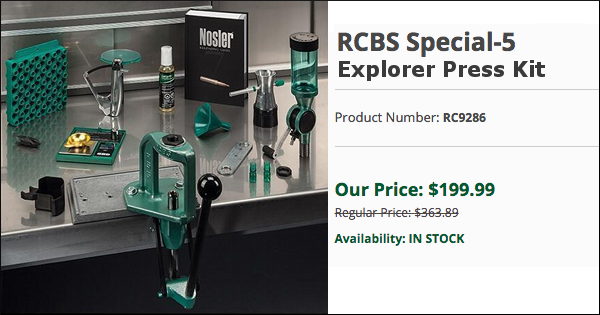
1. Natchez — Special 5 Reloading Press Kit, $199.99
This RCBS Kit has everything a new reloader needs: single-stage press, powder measure, scale, powder trickler, priming tool, cartridge tray, “rocket” chamfer tool, case lube and more. This is an excellent entry-level reloading kit, on sale for just $199.99 at Natchez Shooters Supplies. We like the relatively compact Special 5 press for most reloading duties. Eventually you may want to add an additional, large heavy press, but this will get the job done. For the combined package, with all the tools one needs to hand-load quality ammo — this is a stunningly good deal at $199.99.
2. Powder Valley — Reloder 16 Powder, 1-pound and 8-pound
Powder Valley now has Alliant Reloder 16 (RL16) in stock in both 1-lb ($23.95) and 8-lb ($178.95) containers. If you’re not familiar with this relatively new propellant, we can tell you that RL16 may be the best replacement yet for hard-to-find Hodgdon H4350. Burn rate is very similar to H4350, and RL16 is extremely temp-stable. Most importantly, our Forum members are reporting outstanding accuracy with Reloder 16. It is well suited for mid-sized cartridges such as 6XC, 6mm Creedmoor, 6.5 Creedmoor, 6.5×47 Lapua, and .260 Remington. If you like H4350, we recommend you try a pound of Alliant’s impressive Reloder 16.
3. EuroOptic.com — Tikka T3 Liquidation Sale, Huge Discounts
Looking for a great price on an excellent hunting rifle? Here is the Tikka Deal of the Decade. EuroOptic.com has received nearly 3,500 Tikka T3 rifles, which will be sold at deep discounts as part of an inventory clearance program by Beretta, Tikka’s parent company. The Tikka T3 is a good, stout rifle with a smooth action, crisp trigger, and quality barrel. Accuracy is typically well under 1 MOA (for three shots). T3 barreled actions also are a good “core” for a tactical build. The strong T3 action handles detachable magazines, and fits a variety of third-party stocks.
If you shoot long range, you need a scope level. This Discovery scope level is fully CNC-machined to close tolerances for a good fit. It is available with three inner diameters to fit scopes with 1″, 30mm, or 34mm main tubes. The 1″ version is just $12.95 while the 30mm model is $13.95 and the large 34mm version is $15.95. You could easily pay $35.00 or more for a 30mm scope level. Purchasers have praised this product: 89% of verified buyers rated this five stars.
5. CDNN Sports — Savage 17 WSM B.MAG Sporter, $289.99
Our friend Eric, Editor of Varminter.com, says the 17 WSM is probably his favorite rimfire option for small varmints. The modern Winchester Super Magnum Rimfire (WSM) cartridge is accurate, and it flies faster and hits harder than the 17 HMR. Right now you can get a nice Savage B.MAG rifle chambered in 17 WSM for just $289.99 at CDNN Sports. This rimfire rifle boasts features typically reserved for centerfire rifles. In order to maximize acuracy, Savage offers a thread-in barrel headspacing system, rear-locking lugs, and cock-on-close bolt.
6. Midsouth — Complete Case Tumbling Kit, $73.70
This brass tumbling system contains everything you need to clean your cartridge brass: Vibratory Case Tumbler, Rotary Media Separator, 6 lbs. of Corn Cob Media, and 8 oz. of Brass Polish. Right now this whole system is on sale at Midsouth for just $73.70. The case tumbler, which holds 450 .223 Rem cases or 1000 9mm cases, has a three-year motor warranty. This is a good deal for the package. You could pay $65.00 for a good vibratory Tumbler by itself.
Need quality .22 LR rimfire ammo at an affordable price? Consider Norma. Most folks think Norma only produces centerfire ammo and cartridge brass. As a result, people haven’t been looking for Norma rimfire ammo. Their loss is your gain. Accurate, reliable Norma .22 LR ammunition is in-stock right now at leading online vendors. This is good quality ammo, made in Europe. Bullets.com has Norma Tac-22 ammo in stock at $5.25 per 50-rd box (SKU: BL7819). In addition, Bullets.com offers Norma Match-22 ammunition at $7.50 per 50-rd box (SKU: BL11887).
8. Midsouth — Lyman Bleacher Loading Blocks
Lyman’s new Bleacher Block stepped cartridge holders are great. Use the different levels for sorting brass. Or, migrate the brass from top to bottom as you proceed through case prep stages. Made of durable polymer, Bleacher Blocks are molded in three sizes. The smallest size (with 0.388″-diam holes) fits .223 Rem-size case heads. The middle size (with 0.485″-diam holes) fits .308 Win-size case heads. The biggest Bleacher Block has 0.565″-diameter recesses for magnum-size cases. All three cartridge block sizes hold fifty (50) rounds. Purchase any size for just $5.90 per Block at Midsouth.
With all the blacktical rifles and tacticool camo gear on display at SHOT Show, it was nice to see some old style craftsmanship — hand-built rifles with colored case-hardened receivers, fine engraving, and beautiful wood. We found just that at the Shiloh Sharps booth. The heritage style of the Shiloh Sharps rifles harkens back to another era, when the West was still wild, and gifted smiths crafted rifles with pride, skill, and true artistry.
The cartridges shown in the photo (left to right above rifle) are: 45-110, 50-100, 45-90, and 40-70.
This video shows how Shiloh Sharps crafts its rifles, from “Foundry to Finish”:
Here’s a very clever way to store firearms securely. All an intruder will see is an innocent-looking wall mirror. But behind that artifice is a gun cabinet that will hold a rifle or shotgun, a pistol and more. For added security, the firearms in the cabinet are clamped by a rapid biometric locking system that releases the guns only for authorized users.
The patent-pending NRA Home Defense Cabinet is a covert gun cabinet featuring a sliding mirrored front and proprietary biometric securing system. The Cabinet is offered in both dual-firearm and single-firearm configurations. Slide open the cabinet and you can see the guns, securely clamped in place. When an authorized user successfully engages the biometric system, your firearms are unlocked and ready for use. The discrete cabinet doesn’t communicate “guns inside” like a bedside handgun safe. Also, the simple-looking mirror offers nothing to attract the attention of intruders or children.
The interior of the NRA Home Defense Cabinet Features a proprietary biometric locking system.
The NRA Home Defense cabinet is offered in a one-gun version (rifle/shotgun) for $750.00, or a two-gun version for $995.00. There is also a manual lock two-gun version for $549.00. Since this product is recessed into a wall, you also have to figure on installation costs. But if you are building a new house, this is an interesting new security option worth considering.
The U.S. Army has selected variants of the SIG Sauer P320 pistol to replace the venerable M9 pistol from Beretta. The Army will purchase the new 9mm striker-fired SIG handgun, designated the XM17, in both compact and full-size versions. The Army will purchase a minimum of 280,000 handguns, with options for another 212,000. This represents a huge contract, worth $580,000,000 through budget year 2027. According to American Rifleman: “The XM17 will likely lose the ‘X’ and be made by American workers in an American factory for American soldiers.”
In adopting the new SIG XM17, the U.S. Army has chosen its first new handgun in three decades. The lengthy Modular Handgun System (MHS) selection process took two years and $17 million, with twelve different candidates vying to be chosen as the Army’s new sidearm. SIG Sauer triumphed over other major pistol-makers (including Beretta, CZ, Glock, FNH, and S&W), by best fulfilling a complex set of requirements. According to Popular Mechanics: “The bureaucracy surrounding the M17 Modular Handgun System contract was oppressive. The Army’s Final Solicitation document, which spelled out the terms of the competition, was whopping 351 pages long. Senator John McCain of Arizona described the rules as ‘byzantine.’ Then-Secretary of Defense Robert Gates complained, ‘This is absurd — it’s a handgun for God’s sake’.”
The Army’s new XM17 is fully ambidextrous, with safety and slide release levers on both sides. Importantly, unlike Glock pistols, the new SIG XM17 can be taken down without pulling the trigger. In accordance with the XM17 design protocols, the new SIG features a front Picatinny rail for accessories, as well as interchangeable grip panels to fit various hand sizes. There will be threaded barrel options for use with a suppressor. The Army’s selection of the SIG Sauer XM17 was announced this past week at SHOT Show in Las Vegas.
The big news at Nightforce’s SHOT Show booth was a new First Focal Plane (FFP) ATACR with a five times zoom range. The new 7-35x56mm ATACR offers tactical and long range shooters the ability to go from a wide field of view at seven power, all the way up to very high 35X magnification. That makes this one scope that can truly “do it all” — from short-range moving targets to 1000 yards and beyond.
With a fat 34mm main tube, the 39.3 ounce 7-35x56mm ATACR offers 60 MOA of windage adjustment and a whopping 100 MOA of total elevation adjustment. The elevation turret includes a ZeroStop. Nightforce notes: “With parallax adjustment down to 10 meters and 100 MOA of elevation travel, precision is attainable from short range distances to … extreme long range[.] This riflescope offers an incredible field of view across the entire magnification range[.].”
The new 7-35X ATACR is offered with either 1/4 MOA or 0.1 Mil click values and three reticle choices: Mil-R F1, MOAR F1, TReMoR3 F1. The illuminated MIL-R and MOAR reticles are shown below. Note that the MOAR offers 80 MOA of hold-over below center.
Here is AccurateShooter’s Forum Boss with the Ruger Precision Rifle (RPR). The commercial success of this innovative firearm inspired other gun-makers to release their own “blacktical” bolt-guns.
It looks like 2017 will be the year of the metal-stocked, tactical-style bolt-action rifle. Inspired by the success of the Ruger Precision Rifle, other rifle-makers have built their own Blacktical Bolt-guns. These feature modular chassis systems with adjustable buttstocks. While optimized for PRS and tactical competition, these tough, versatile rifles can also be used for hunting. Popular chamberings are: 6mm Creedmoor, 6.5 Creedmoor, .260 Rem, and .308 Winchester. All the rifles showcased here retail for under $2000.00, so they can be campaigned in the new PRS Factory Class.
PRS Production Class Cost Limits
Production Division combined rifle and scope MSRP as listed on the company’s website shall not exceed $3,000 USD, the rifle shall not exceed $2,000 USD and the optic not exceed $2,000 USD. [Editor: For example, you could have a $2,000 rifle with a $1000.00 scope or vice-versa. The total system cannot exceed $3000. Rifle alone cannot exceed $2000.00 retail sale price.] Production Division rifles are not permitted to be altered or improved in any way from the original factory configuration.
Bergara B14 BMP Chassis Rifle
The Bergara B14 rifle features a modern, modular aluminum chassis. The buttstock assembly offers an adjustable comb and adjustable length of pull. Like Savages, the BMP employs a barrel nut so owners can quickly swap barrels. The new B14 features a good adjustable trigger. Current chamberings are 6.5 Creedmoor and .308 Winchester (both fed from AICS-type box mags). Our friends Ed and Steve (aka the 6.5 Guys) were impressed with the new Bergara: “Bergara has in-sourced chassis and triggers to produce very high-quality offerings at a very competitive price. Handling, shooting and cycling the bolt on the $1150 MSRP Hunting and Match Rifle would lead one to believe the price tag was a mistake (maybe the first digit should have been a 2). We felt the same when we got behind the $1,699 Bergara Match Precision Rifle.”
Howa HCR Modular Rifle
The new Howa HCR Chassis Rifle combines a Howa 1500 barreled action with a modern aluminum chassis and LUTH-AR MBA-3 stock. Length of pull is adjustable from 12.5″ to 16.75″. Comb height is also adjustable. Weight with a 24″ barrel is 10.2 pounds (before optics) so the Howa HCR is lighter that many of its competitors. The Howa’s MSRP is $1299.00, a good value in this category. These guns feature a smooth-running action plus excellent 2-stage HACT adjustable trigger. Available chamberings are: .223 Remington, .243 Winchester, 6.5 Creedmoor, and .308 Winchester. NOTE: If basic black’s not your color, this rifle is also offered with a rugged, Multicam CeraKote finish.
Tikka T3X TAC 1
We got a chance to handle the impressive new Tikka T3X TAC 1 at Media Day at the Range. The ergonomics are good and the rifle balances well. Bolt cycling is smooth and the T3X boasts an excellent, adjustable 2-stage trigger. The Tikka T3X has a nice folding stock, and the T3X accepts other AR-platform buttstock units and pistol grips. The T3X will be offered with choice of 16″, 20″, or 24″ barrels, all threaded at muzzle (factory muzzle brake is standard). There are three chamberings: 6.5 Creedmoor, .260 Remington, and .308 Winchester. MSRP is $1899.00, so the T3X is legal for PRS Production Class. We really liked the Tikka T3X, and so did GunsAmerica.com: “Chambered in 6.5 Creedmoor or .260 Remington, the barrel is a perfect balance of being thick enough to shoot seriously, while thin enough not to feel like a benchrest gun. It ships with three magazines, which is a bargain for anyone looking to shoot PRS. I see lots of guns at SHOT Show I want to test or review, but few I would write a check for in the booth. The Tikka T3 TAC A1 is an exception to that rule.”
Weatherby Vanguard Modular Chassis
Weatherby’s new Vanguard® Modular Chassis (VMC) rifle features a Modular Driven Technologies (MDT) aluminum stock, Luth AR MBA-1 buttstock, and 22″ heavy barrel. The Weatherby Vanguard action is fitted with an adjustable 2-stage trigger. Priced at $1519.00 MSRP, this rifle is offered in three chamberings: .223 Rem, 6.5 Creedmoor, and .308 Winchester.
Winchester Repeating Arms XPC
As reported in the NRA Blog: “The XPC Rifle from Winchester Repeating Arms is a full-house precision chassis rifle based on their proven XPR bolt action. The stock features a Cerakoted fully-machined alloy chassis frame paired with a Magpul PRS Gen III stock. A full-length Picatinny rail allows for mounting optics, and M-LOK and QD mounts grace the XPC for easy attachments. A Magpul MOE-K grip rounds out the furniture, and the rifle comes bundled with one 10-round Magpul AICS PMAG and one five-round MDT metal mag.” The barrel is threaded for muzzle brake or suppressors.