The movie “The Patriot” gave us the phrase “Aim small, miss small”. While that’s a good mantra, aiming strategies for long-range competition are a bit more complicated, as this article explains…
In our Shooters Forum, one newcomer wanted some advice on selecting a reticle for F-Class optics. He wondered about the advantage of Front (first) Focal Plane (FFP) vs. Second Focal Plane scopes and also wondered if one type of reticle was better for “holding off” than others.
In responding to this question, Forum regular Monte Milanuk provided an excellent summary of aiming methods used in F-Class. For anyone shooting score targets, Monte’s post is worth reading:
Aiming Methods for F-Class (and Long-Range) Shooting — by Monte Milanuk
F-Class is a known-distance event, with targets of known dimensions that have markings (rings) of known sizes. Any ‘holding off’ can be done using the target face itself. Most ‘benefits’ of Front (first) focal plain (FFP) optics are null and void here — they work great on two-way ranges where ‘minute of man’ is the defining criteria — but how many FFP scopes do you know of in the 30-40X magnification range? Very, very few, because what people who buy high-magnification scopes want is something that allows them to hold finer on the target, and see more detail of the target, not something where the reticle covers the same amount of real estate and appears ‘coarser’ in view against the target, while getting almost too fine to see at lower powers.
Whether a person clicks or holds off is largely personal preference. Some people might decline to adjust their scope as long as they can hold off somewhere on the target. Some of that may stem from the unfortunate effect of scopes being mechanical objects which sometimes don’t work entirely as advertised (i.e. one or two clicks being more or less than anticipated). Me personally, if I get outside 1-1.5 MOA from center, I usually correct accordingly. I also shoot on a range where wind corrections are often in revolutions, not clicks or minutes, between shots.
Some shooters do a modified form of ‘chase the spotter’ — i.e. Take a swag at the wind, dial it on, aim center and shoot. Spotter comes up mid-ring 10 at 4 o’clock… so for the next shot aim mid-ring 10 at 10 o’clock and shoot. This should come up a center X (in theory). Adjust process as necessary to take into account for varying wind speeds and direction.
Others use a plot sheet that is a scaled representation of the target face, complete with a grid overlaid on it that matches the increments of their optics — usually in MOA. Take your Swag at the wind, dial it on, hold center and shoot. Shot comes up a 10 o’clock ‘8’… plot the shot on the sheet, look at the grid and take your corrections from that and dial the scope accordingly. This process should put you in the center (or pretty close), assuming that you didn’t completely ignore the wind in the mean time. Once in the center, hold off and shoot and plot, and if you see a ‘group’ forming (say low right in the 10 ring) either continue to hold high and left or apply the needed corrections to bring your group into the x-ring.
Just holding is generally faster, and allows the shooter to shoot fast and (hopefully) stay ahead of the wind. Plotting is more methodical and may save your bacon if the wind completely changes on you… plotting provides a good reference for dialing back the other way while staying in the middle of the target. — YMMV, Monte
F-Class has become one of the fastest-growing types of mid-range and long-range rifle competition. Because of that popularity, a market for specialty equipment has been created, including stocks. McMillan Fiberglass Stocks offers a variety of stocks for both F-TR and F-Open disciplines. Shown above and below is the new Kestros*, McMillan’s upgraded, second-generation F-Open stock. This is an impressive offering, with good stiffness, a torque-taming low-profile design, and good adjustability for the shooter. Our friend Boyd Allen had the chance to test drive a Kestros recently.
McMillan Kestros “First Look” Range Review by Boyd Allen
McMillan’s first-generation F-Open stock was well-received, and this new GEN II Kestros includes some significant improvements, making it even better. To achieve increased stiffness, the fore-end was filled out and its fill density was increased. (F-Open rifles have a rather generous 22-lb. weight limit, so the slight increase in stock weight should not be a problem.)
Because F-Open Shooters typically shoot long, heavy bullets through fast-twist barrels, torque control is an issue, which is why the base of the front section of the fore-end is close to the barrel. This low-profile design counters torque. By maximizing the angle defined by the bottom corners of the stock and the bore’s centerline, this stock geometry increases resistance to roll.
As tested, this Kestros stock features a nice three-way adjustable butt, as well as an adjustable cheek piece. Symmetrical palm swells and the symmetrical cheek piece make the stock truly ambidextrous. We believe that the cheekpiece locking knob can be switched to either side, adapting to both lefties and righties.
Comments by Tester Boyd Allen
Wanting some visual pop for pictures, and knowing that this was to be a range-only rifle, I ordered a tri-color flame pattern gel coat, the most durable of stock finishes, because it is part of the stock rather than being an applied, surface-only finish.
McMillan has been in the stock business for a long time, and when you sit down behind this one, you understand why. This company really knows what it is doing. The Kestros is a real pleasure to shoot, tracking perfectly. As the saying goes, it falls readily to hand.
My test Kestros stock came very accurately CNC-inletted for my action, with the optional aluminum pillars. The fit is so good that I am doing a full load work-up before doing final bedding, so I can see just how much (if any) bedding improves accuracy. For this test I have chosen a 6PPC barrel (yes it does look short with this stock.) because it will allow me to make finer distinctions in this area. Later I will be working with other calibers (and longer barrels). So far I have been very impressed with this stock — ergonomics, tracking, stability, build quality, and inletting have all been excellent.
* The original Kestros (aka “Kestrosphendone” or “Cestrus”) was an ancient Greek military weapon, a type of sling used to hurl heavy, arrow-like finned projectiles.
On December 15, 2016, President-elect Donald Trump announced his intent to nominate U.S. Representative Ryan Zinke (R-Montana) to become Secretary of the Department of the Interior. Congressman Zinke is a patriot and an outdoorsman. He served as a Navy SEAL from 1986 until 2008, retiring with the rank of Commander.
The National Shooting Sports Foundation (NSSF) praised President-Elect Donald Trump’s selection of Commander Zinke to be the next Secretary of the Interior. “In Congressman Zinke we have a true friend of American sportsmen who believes in the inestimable value of our public lands. We are confident Congressman Zinke will work to preserve and promote our hunting and related outdoor traditions. He is an American hero, a lifelong hunter and angler, and a true conservationist in the tradition of Teddy Roosevelt,” said Lawrence G. Keane, NSSF Senior VP and General Counsel. “The Secretary of the Interior is arguably the nation’s single most important position with regard to the management of federal lands, wildlife habitat, and natural resources. Competing interests must be balanced with what will be in the best long-term interest of the nation. We look forward to enthusiastically supporting his nomination in Congress and then working with Secretary Zinke to help him achieve that mission.”
“I can still remember the first time dad took me out hunting. I think every kid should have that experience, which is why I oppose shutting down the forest to target shooting. Hunting and recreational shooting are two very important outdoor activities shared and enjoyed by residents and tourists alike,” — Rep. Ryan Zinke
At the request of our readers, we provide select “Deals of the Week”. Every Monday morning we offer our Bargain selections. Here are some of the best deals on firearms, hardware, reloading components, and shooting accessories. Be aware that sale prices are subject to change, and once clearance inventory is sold, it’s gone for good. You snooze you lose.
1.Sportsman’s Outdoor Superstore — Hunting Rifles on Sale
Looking for a quality hunting rifle at a very affordable price? Right now the Sportsman’s Outdoor Superstore has a wide selection of bolt-action hunting rigs at very attractive prices. Choose among Browning, Howa, Kimber, Ruger, Savage, and Thompson Center models. Rifle prices start under $250.00 (with applicable mfg. rebates). Many of the rifles come complete with scope. Here are some of the best deals:
Here’s the best deal we’ve found on an excellent product in high demand. The Lyman BoreCam is an electro-optical borescope with a digital display. You can record “stills” on a SD card. This is one of the hottest products on the market right now — and users really like the BoreCam (although some wish the digital view-screen was larger). Amazon.com now has the Lyman BoreCam for $197.19. Grab it while you can at that price. Other online vendors are charging a LOT more (e.g. MidwayUSA price is $259.99).
3. Bruno’s — 10% Off Gift Certificates (Use for Any Merchandise)
Now through December 25th (Christmas Day), you can purchase a Bruno Shooters Supply Gift Certficate at a ten percent discount. For example a $50.00 certificate costs $45.00 and a $100.00 certficate is just $90.00. NOTE: These certificates can be used to purchase ANY merchandise Bruno’s sells, including items on sale. In effect, this means the entire store is ten percent off, AND you get a discount on top of current sale prices. For example, powders are 10% off at Bruno’s through the end of the year. So you could purchase $111.00 worth of powder with a $100.00 gift certificate that only cost you $90.00 out of pocket — effectively saving you 20%. If you do the math, you’ll see this is a great opportunity if you combine the Gift Certificate with Sale offers. (Thanks to EdLongrange for the Tip.)
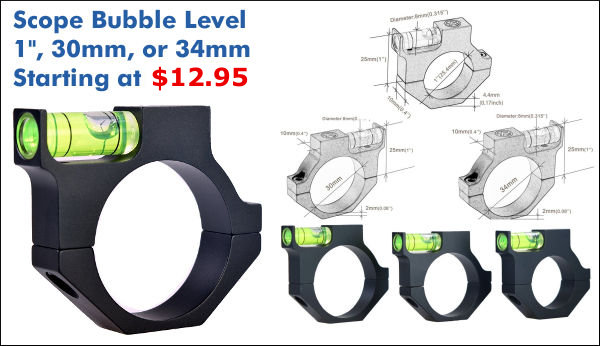
If you shoot long range, you need a scope level. This Discovery scope level is fully CNC-machined to close tolerances for a good fit. It is available with three inner diameters to fit scopes with 1″, 30mm, or 34mm main tubes. The 1″ version is just $12.95 while the 30mm model is $13.95 and the large 34mm version is $15.95. You could easily pay $35.00 or more for a 30mm scope level. Purchasers have praised this product: 89% of verified buyers rated this 4 or 5 stars.
5. Natchez — RCBS ChargeMaster Dispenser, $279.99
Here’s a very good deal on the popular RCBS ChargeMaster combo scale/powder dispenser. This unit sells elsewhere for up to $389.00. You may want to act quickly as sale pricing changes frequently and many other vendors have recently raised their prices. Grafs.com sells this for $369.99 now while the current Amazon.com price is $296.99. You can save a lot through Natchez right now. NOTE: There is an RCBS Rebate Program in effect now — if you spend at least $300.00 on “RCBS tools and accessories” you can get $75.00 back.
6. MidwayUSA — Pro Series Shooting Mat, $29.99
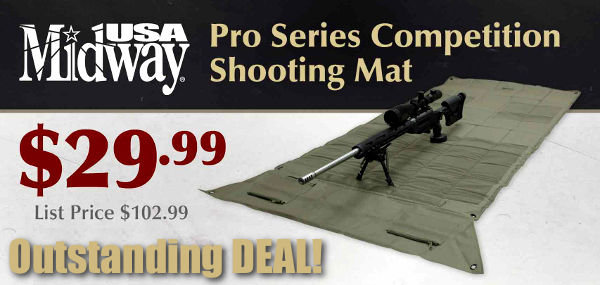
Here’s a heck of a deal on a very good shooting mat. MidwayUSA has slashed the price on its Pro Series Shooting Mat (in Olive Drab). You can get this 73.5″ x 35.5″ padded mat for just $29.99. This Mat has some very nice features, such as a Bipod Pre-load Web, 0.35″ thick padding, and multiple pockets. It’s easy to transport, rolling up to about nine inches in diameter and fitted with a nice carry strap. Midway normally sells this Pro Series Mat for about $70.00, so the $29.99 price is a total steal. If you need a good basic shooting mat check out this deal.
This is a very good spotting scope for the price. Yes it gives up some low-light performance to a spotter with an 80mm objective, but otherwise it is a good performer, and we can’t think of much that will touch this Vortex Diamondback spotting scope for anywhere near the $399.99 sale price. Choose from angled or straight version for the same $399.99 price, which includes the 20-60X zoom eyepiece.
8. Cabelas.com — Catch-All Gear Bag $9.99
This versatile bag holds lots of gear, and you can’t beat the price — just $9.99. At 16″x10″x6″ it’s big enough to hold rifle ammo, muffs, a Kestrel, and other accessories. It can also serve as a general utiling bag for car camping trips. Six exterior pockets, including zippered mesh pockets on top and side, provide multiple storage options. This Catch-All Gear Bag is available in Forest Green/Black and Dark Green/Camo. This a real bargain — the original price was $24.99.
The NRA has announced a new summer event — a trade show focused on licensed “carry”, self-defense, and home protection. The new NRA Personal Protection Expo (PPExpo) will be held August 25-27, 2017 at the Wisconsin Center in Milwaukee, Wisconsin. This is a 3-day educational and interactive experience for citizens interested in personal protection, concealed carry, and defense tactics. According to the NRA: “This all-new event will equip visitors with the products, training and mindset necessary to prepare and defend themselves and their loved ones when threats arise.”
Expo guests can attend educational protection/defense workshops taught by leading experts and instructors from across the country. The Expo’s Exhibit Hall will showcase firearms, shooting accessories, concealment gear, storage products, tactical gear, and home defense solutions.
The Expo’s concealed carry (CCW) workshops will cover concealment methods, holster selection, and tactics. Personal protection seminars will cover personal defense, situational awareness, product selection, and skills building. Home defense seminars will cover home defense plans, preventative security measures, and responding to intruders. For more information about the Personal Protection Expo, visit https://www.NRAPersonalProtectionExpo.org.
Want to upgrade your AR’s trigger? Shooting USA and Brownells have created a video tutorial that shows how to remove a factory AR trigger and replace it with an upgrade. This video illustrates the procedures to follow and the tools you’ll need. Step-by-step, the video explains how to swap the factory trigger group for a self-contained ‘box style’ drop-in trigger module or a traditional (multi-part) trigger system with enhanced performance.
Many AR-15s come from the factory with a military-type trigger that has a long, gritty, heavy pull. Replacing that trigger is one of the best ways to improve your AR’s performance. You’ll be rewarded with a smoother pull, shorter take-up, and reduced pull weight. You will also have a choice between a single-stage and a dual-stage trigger.
The box-style, self-contained drop-in systems from companies like AR Gold, CMC, Timney, and Wilson Combat are the easiest to install. John Scoutten explains: “These self-contained systems … are very simple to install. In fact, all you do is remove the factory parts, drop in the whole system, replace your pins, and you’re done.” Conventional two-piece trigger groups are offered by DPMS, Geissele, JP Enterprises, and Rock River.
The key points of the video tutorial are also explained on the Shooting USA website with text and still pictures. Before you start your trigger project, review Shooting USA’s AR Trigger Upgrade Page. You’ll find helpful close-up photos on that page.
A good sling is a vital accessory for a hunting or tactical rifle. Along with enabling over-the-shoulder carry, a good “tactical” sling will also provide support for shooting from hasty or improvised shooting positions. In fact, in many tactical/practical precision matches there will be at least one positional shooting stage or a stage where only a sling may be used for support (that means no bipod, no tripod, no sandbags, and no shooting sticks). The 6.5 Guys, Ed and Steve, recommend tactical slings that allow quick set-up and easy adjustment. The best slings allow shooters to quickly slip into them and then make rapid fine-tuning adjustments to build a stable shooting position.
Six Tactical/Practical Slings are Reviewed in this Video:
In this episode, Ed and Steve provide an overview and compare/contrast different designs and the functionality of six popular slings from these suppliers: Armageddon Gear, Tab Gear, Rifles Only, Hard Target Interdiction, Short Action Precision, and Accuracy International.
To learn more about tactical/practical shooting disciplines, or to access more shooting gear/accessories reviews by Ed and Steve, visit 65guys.com and subscribe to the 6.5 Guys’ YouTube Channel.
Video Tip from Boyd Allen. We welcome reader submissions.
Brux Barrels, based in Lodi, Wisconsin, has earned a reputation for producing great-shooting tubes. Brux-made barrels have won their fair share of matches, and set some notable records in the process. A few years back, Rodney Wagner shot the smallest five-shot, 600-yard group (0.336″) in the history of rifle competition, using a Brux barrel chambered for the 6mm Dasher.
Folks often ask us why Brux barrels shoot so well. “What’s the secret?” they ask. We can only answer with what Brux explains on its own website: “To make a cut-rifled barrel you have to start off with the proper ingredients: the best steel available, skill, and experience. Since there are really only two main suppliers of barrel-quality steel, the skill and experience is what really makes a barrel maker stand out.” Here is how Brux’s co-owners, Norman Brux and Ken Liebetrau, explain all the procedures involved in making a Brux cut-rifled barrel:
Brux Barrel-Making Process, Start to Finish
We start out with either 4150 chrome-moly or 416R stainless steel double stress-relieved bar stock. The bar stock starts out at 1-9/32″ in diameter and 20-24 feet long so we cut it to length.
Step two is to rough-contour the outside of the barrel blank in a lathe.
Thirdly, the blank gets mounted into a Barnes gun drill. The cutter bit has holes through which oil or coolant is injected under pressure to allow the evacuation of chips formed during the cutting process. This is called “oil-through” or “coolant-through”. Without this, you wouldn’t want to even attempt drilling a hole 30” long and under ¼” in diameter. The combination of a 3600rpm and good flushing allows us to drill a beautifully straight and centered hole .005” under “land” diameter at a rate of 1” per minute.
Clean the barrel.
Next the blank is sent back to the lathe to machine the finished contour of the outside.
Clean the barrel again.
Now, the blank is sent on to the Pratt & Whitney reamer in which an “oil through” reaming tool is used to cut away the extra .005” left in the drilling process. The reamer makes an extremely accurate bore size and after it is finished the bore will have a better surface finish and will be at the proper “land” diameter.
Clean the barrel again.
In the sixth step we hand lap each barrel to remove any slight tool marks that may have been left by the reamer and inspect every one with a bore scope. If the barrel doesn’t meet our standards for surface finish and tolerance it doesn’t get any further.
Clean the barrel again.
The barrels then go onto the rifling machine which is responsible for cutting the all so familiar grooves in the bore. A caliber/land configuration-specific rifling head is used to progressively shave away small amounts of steel to form the rifling grooves. This is accomplished by simultaneously pulling the rifling head through the reamed blank as the blank is spun at a controlled rate. After each cut, the blank is rotated 90 degrees (for a four-land configuration) and after one full rotation (360 degrees) the rifling head is slightly raised to shave off the next bit of material. This process is repeated until we reach groove diameter.
Clean the barrel again.
Lastly, the barrel is hand-lapped again (to ensure a smooth bore), and a final inspection is performed with the bore scope.
The barrel is cleaned one last time, wrapped, packed, and shipped to [the customer].
Anyone reading this detailed description of the Brux barrel-making process will doubtless come away with a new appreciation for the time, effort, and dedication required to produce a premium match-grade cut-rifled barrel. Obviously, there are no easy shortcuts and great attention to detail is required each step of the way. As shooters we’re lucky that we have barrel-makers so dedicated to their craft.
Credit James Mock for steering us to this Barrel Making 101 feature on the Brux website.
The Rockies, Great Lakes, and Northeast are bracing for a major storm this weekend, bringing cold winds, ice, and plenty of snow. Many Northern states have already seen lots of the white stuff. It seems like it will be a White Christmas for many. Does that mean there will be no more gun fun ’til spring? Heck no — just grab your snow shovel, load up your rifle, and go shooting. Here’s how Forum Member Nick (aka “ChevyTruck 83″) coped with winter’s fury back in 2012. Never underestimate the resourcefulness of a dedicated AccurateShooter Forum member….
We admire the fortitude of Forum Member Nick who braved wintry December weather to enjoy a day at the range in his native Pennsylvania. A little snow on the ground couldn’t stop this intrepid shooter, who brought snow shovel and arctic gear to his range session. Folks, here’s a true “hardcore” fan of shooting! Despite the “relentless snow”, Nick reports that “at least it wasn’t windy”. Nick shot a variety of long guns, including his .22LR rimfires, a .223 Rem, and a .308. Not daunted by the cold, Rick said it was fun to “play like a kid once in a while.” That’s the spirit!
Nick reports: “There was no wind to speak of — just relentless snow. I’ll tell you what — it’s awesome to get out and play like a kid once in a while.”
Nick’s foray into the winter wonderland really puts things in perspective for “fair-weather” shooters. After viewing Nick’s Forum thread about his snowy range session, fellow Forum member DennisH observed: “I will never complain about our super hot sugar cane fields in south Louisiana ever again! We can hold matches 12 months a year. I have NEVER had, owned, or used a snow shovel.”
Keystone Sporting Arms has created a new rimfire rifle that shares the looks and ergonomics of the Accuracy International AICS. Keystone’s new Crickett Precision Rifle (CPR) is a single-shot .22 LR bolt action rifle that uses the barreled action from the Crickett series of rifles. Trigger pull weight is 2.5-3.0 pounds. The AICS Classic-style stock is ambidextrous, but only a right bolt, right port version of the CPR is offered at this time, model KSA2150. Stock length of pull is adjustable (via spacers) from 11.5 to 13.5 inches, and there is an adjustable cheek-piece.
The Crickett Precision Rifle should be available in January 2017 and retail for approximately $310.00. This small .22 LR bolt action should appeal to Accuracy International fans who want a rimfire rifle for low-cost cross-training. This could also be a good first rifle for a young shooter. And if Dad owns a real Accuracy Int’l AICS rifle, the little AI clone would be a fun rimfire rig for son or daughter. That way the youngster(s) could shoot a smaller version of their parent’s rifle. Like father, like son (or daughter)!
Reader Boyd Allen likes this little rifle, which has a length of pull suitable for younger shooters: “I like seeing parents taking their kid(s) to the range, developing the next generation of shooters. For the price of what some guys spend on a set of fancy rings, you can purchase this little rifle and a youngster can enjoy shooting a rimfire that looks like the real-deal tactical rigs used by the ‘Big Boys’. That’s how you capture a kid’s interest.”


F-Class is a known-distance event, with targets of known dimensions that have markings (rings) of known sizes. Any ‘holding off’ can be done using the target face itself. Most ‘benefits’ of Front (first) focal plain (FFP) optics are null and void here — they work great on two-way ranges where ‘minute of man’ is the defining criteria — but how many FFP scopes do you know of in the 30-40X magnification range? Very, very few, because what people who buy high-magnification scopes want is something that allows them to hold finer on the target, and see more detail of the target, not something where the reticle covers the same amount of real estate and appears ‘coarser’ in view against the target, while getting almost too fine to see at lower powers.
Others use a plot sheet that is a scaled representation of the target face, complete with a grid overlaid on it that matches the increments of their optics — usually in MOA. Take your Swag at the wind, dial it on, hold center and shoot. Shot comes up a 10 o’clock ‘8’… plot the shot on the sheet, look at the grid and take your corrections from that and dial the scope accordingly. This process should put you in the center (or pretty close), assuming that you didn’t completely ignore the wind in the mean time. Once in the center, hold off and shoot and plot, and if you see a ‘group’ forming (say low right in the 10 ring) either continue to hold high and left or apply the needed corrections to bring your group into the x-ring.







 We admire the fortitude of Forum Member Nick who braved wintry December weather to enjoy a day at the range in his native Pennsylvania. A little snow on the ground couldn’t stop this intrepid shooter, who brought snow shovel and arctic gear to his range session. Folks, here’s a true “hardcore” fan of shooting! Despite the “relentless snow”, Nick reports that “at least it wasn’t windy”. Nick shot a variety of long guns, including his .22LR rimfires, a .223 Rem, and a .308. Not daunted by the cold, Rick said it was fun to “play like a kid once in a while.” That’s the spirit!


