Our friend Vince Bottomley and the Target Shooter Magazine team from the UK is in Germany this week for the IWA Outdoor Classics trade show, aka “Euro SHOT Show”. The big IWA outdoor Expo opened Friday in Nuremberg, Germany. Oh his first day at IWA, Vince already found some interesting products.
Here are a pair of German-engineered Turban reloading presses. Vince writes: “The [press] offered by Turban (Turban-cnc.de) is the ultimate. With this press you just wouldn’t want to stop reloading!” Turban makes presses for all sizes of cartridges. Look at the size of the die on the press on the right. Much like a Forster Co-Ax, the Turban’s priming system sends spent primers down a pipe to a cup.
Vince also discovered a very high-tech, ultra-light-weight F-TR bipod that is mostly carbon fiber. This looks like it belongs on a Formula 1 car. Vince says the Talon Mark 7 bipod is “super light and strong”. We like the arm design, but the feet need to be changed out. Those curved feet are like the Gen One SEB Joy-Pod feet. We’ve learned that flat, wide, ski-type feet work better — recoil is smoother with less hop. The longer, wider feet distribute rifle weight over a larger surface so you get less point-loading and less tendency to bounce with the energy pulse from each shot.
Here are other photos from the IWA Show, courtesy NürnbergMesse:
4944 Products in 2016 IWA Product Showcase
If you want to see all the guns and gear featured at the 2016 IWA show, visit the IWA Products Page on the web. There you’ll find descriptions of 4944 featured products, everything from ballistics software to safari rifles. Click on the “New Products” link to see 569 featured new items. You can browse all new products, or Choose Product by Category. For the main product categories (Such as Guns, Ammo, and Optics), you can further search by subcategory (e.g. Guns > Rifles, or Optics > Rangefinders).
Keanu Reeves, the A-List Hollywood actor who starred in The Matrix, Speed, Point Break, and other hit movies, is a talented shooter. For his role in the popular John Wick series of movies, Reeves has done extensive training with our friend Taran Butler, one of the nation’s top 3-Gun competitors. Check out this video showing Keanu Reeves running through some multi-gun stages. The actor’s speed on target is outstanding, and his transitions are very fast. We’ve run some multi-gun matches in the past. Trust us, it takes a lot of training and dedication to get this fast. You also need good equipment.
Watch Keanu Reeves Display Impressive Multi-Gun Speed in this Video:
Report by Vince Bottomley Victrix Armaments, an Italian company, has developed new technology that could be a major “game-changer” in the world of precision rifles in general, and F-Class in particular. Victrix’s leadership group knows all about excellence — and winning. Giuseppe Valtorta, CEO of Victrix Armaments, is a top competitive shooter who won Gold with his F-TR rifle at the 2015 European F-Class Championships.
A New Breed of F-Class Rifle
Turn back the clock half a century — George Farquharson is happily shooting a modified military rifle with iron sights and sling. He hasn’t even dreamt of F Class…
Benchrest however is beginning to gather momentum. Accuracy seekers are demanding the ultimate in precision engineering. They will go to their favorite gunsmith and, if they’re very lucky, procure one of the new custom actions from Hart or Shilen.
In the last 50 years, what’s changed? Benchrest is still with us but F-Class has emerged as a world discipline and, to some extent, brought new challenges to our accuracy rifle builders. But, whilst the rest of the planet has reveled in the speed and precision of CNC machining, we still love to place our faith in the gunsmith and his trusty old lathe!
But, of course, there is a reason for this. CNC equipment is expensive and geared towards the rapid multiple production of precision parts, whereas the custom gunsmith is dedicated to the ‘one-off’ build.
Also, even with a limited run, CNC does not readily lend itself to chambering our cut- or button-rifled barrels. Good as our barrels are, there are issues that have made CNC machine problematic. Each barrel demands loving care at the hands of our chosen gunsmith – if it is to perform to our expectations.
5-Axis CNC vs Manual Barrel Chambering
What if — What if the whole barrel-fitting and chambering process could be made “CNC compliant” and produce a rifle which would equal (or even exceed) the accepted standard. And do it every time, time after time! Cost could be reduced and also waiting times.
Good as our custom barrels are, they still need to be scrupulously checked — for uniformity of the bore, the lands, the grooves — for straightness, consistency of diameter, and concentricity. This could be achieved, using some pretty sophisticated measuring equipment — but that would be outside the realms of the custom gunsmith.
Even then, how could the barrel be easily accommodated in a CNC five-axis machining center to ensure a set-up for the best possible chamber and threading? Remember, bores are rarely concentric to the outside diameter and seldom straight, so the set-up would need to ensure that any deviation would be in the vertical plane when the barrel is screwed in the action and the chamber-section would need to be exactly aligned.
These are of course the issues faced every day by the custom gunsmith but currently, there are few CNC machines which could easily accommodate this requirement. But yes, there are a few….
Let me introduce you to Victrix, an Italian engineering company with an impressive multi-million euro factory crammed with the very latest in CNC machinery and a state of the art measuring laboratory. They already have a well-established background in the firearms manufacturing industry, at both military and sporting level. Never heard of Victrix? You soon will, for Victrix has chosen the prestigious 2016 IWA Show (Hall 9 – 423) to launch its new range of high-end rifles.
Victrix manufacturing facility in Italy is ‘crammed with the very latest in CNC machinery':
Whilst Victrix initially developed a range of tactical/military firearms — some of which will also be of interest to the sport shooter — the company has now turned its attention to the F-Class discipline. By working with those competing at the highest level of F-Class competition, Victrix has developed a range of “off the shelf” F-Class rifles that are “competition-ready” right out of the box. Incidentally, Victrix have chosen American barrel-maker Benchmark as its exclusive barrel supplier. Victrix has already perfected a way of accurately assessing barrels to adapt them to CNC working, and this is the key to the new project.
Victrix Target Trigger — Adjustable down to an Ounce
Victrix F-Class rifles will feature an advanced, new target trigger engineered by Victrix. This four-lever target trigger boasts an adjustment range of 1 to 2.5 ounces (30 – 70 grams). Another trigger (8 to 21 ounces pull weight), is used for the Victrix tactical rifles.
Victrix Action
For its new line of rifles, Victrix have developed its own proprietary actions. These actions employ some interesting ideas. The bolt is three-lug with a 60-degree lift and 105/105/150 degree lug-geometry. Testing verified that this arrangement provided a greater resistance to flexing in the locked position over the more traditional 120/120/120 geometry. This geometry also aids the pick-up and feeding of rounds from a magazine when used in a tactical configuration.
Above is Victrix’s new action. It’s impressive. Multiple configurations are offered: Right Bolt/Left Port, Right Bolt/Right Port and other variations. The action can be fitted with Victrix Target or Tactical trigger.
The action and bolt are machined from 17.4PH stainless steel and then hardened (body 48 Rockwell, bolt 45 Rockwell) and treated with PVD (physical vapor deposition). Finally the actions are coated with chromium nitride and nobium for wear-resistance and smooth operation. Tenon thread is M27x1.5 and of course, tolerances are ‘benchrest’ standard. Picatinny rails are screwed and pinned to the action.
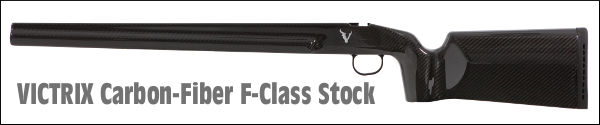
Victrix has certainly done its homework. The company will offer rifles for both F-Open and F-TR classes. Stocks will be offered in a variety of materials: wood, wood-laminate, aluminum, and carbon-fiber. The stocks share a no-nonsense, straight-forward design, specifically for shooting a rested rifle.
Whilst we are focusing on their F-Class rifles, we shouldn’t forget the Victrix tactical range. Although designed with military and police use, they will appeal to anyone who enjoys tactical-style shooting. There is no compromise on quality or accuracy so, expect the same build standard but with stocks CNC’d from 7075 mil-spec aluminum with a hard-anodized coating. The Victrix three-lever tactical trigger adjusts from 8 to 21 ounces (250 – 600 grams).
Victrix has chosen March Scopes UK (IWA Hall 3A – 110) as its business partner in launching the new Victrix F-Class rifles. This was a wise choice, as March Scopes UK proprietor Gary Costello is a former World F-Class Champion. Gary, well-known to F-Class competitors, continues to shoot with the Great Britain Team.
We look forward to taking a closer look at the Victrix F-Class rifles and hope to provide an in-depth range report in the not-too-distant future. Check out the Victrix website at www.Victrixarmaments.com.
Editor’s Comment: All long-range competitive shooters should watch this excellent video — whether you shoot with a team or as an individual. Three cameras were used so you can watch the shooter, the range flags, and the target simultaneously. After a discussion of scoring, the actual shooting starts at the five-minute mark in the video. Under the guidance of wind coach Gary Rasmussen, former U.S. F-Class Open Team Captain Shiraz Balolia shoots 100-7X for ten shots, following Gary’s wind calls. Shiraz is the President of Grizzly Industrial
Team Shooting with a Coach Shiraz tells us: “We come across a lot of shooters who have never shot under a coach. This video was produced to give shooters a basic understanding of shooting with a coach and the importance of releasing a good shot. In a team setting, you basically leave all the decision-making to the coach and aim where you’re told to aim. I’ve worked with Gary many times and it shows in the comfort level we have with each other. The coach plots the shots or a plotter advises the coach of any grouping that is not centered.”
Watch Gary Call the Wind and Shiraz Shoot 100-7X for Ten Shots
For best viewing, click the YouTube settings button to watch in 720p or 1080p HD (high definition).
Shiraz was shooting a 7mm F-Open rig: “My .284 Shehane rifle takes about 10 to 12 shots to settle down and that is probably why we made several scope adjustments while shooting. It is a great caliber and a step up from a straight .284 Winchester. The wind was relatively calm, but sometimes that slow wind with subtle angle changes can be very deceiving.”
The video was shot the first week of May 2013 at a range in Custer, WA located about 20 miles from Bellingham, Washington. The production team included Shiraz Balolia, Gary Rasmussen, three cameramen, and a target puller. Big Thanks to Grizzly Industrial for providing the camera crew and post-production talent.
It’s March 4th today, and that means St. Patrick’s Day is coming up in a couple weeks. To help celebrate that traditional day of Irish pride, parades, and green beer, the NRA has created two (2) fun targets you can download, print, and shoot.
The first target features a large four-leaf clover in the middle, with 17 other smaller three-leaf shamrocks around the outside. With five black bulls-eyes in the center graphic, that gives you a total of 22 aiming points for shooting fun. For added challenge we suggest you set this target at 100 yards for rimfire rifle and 200 years for a centerfire gun.
The second target offers the legendary Pot of Gold at the end of the rainbow. Along with a big bullseye on the pot, there are 15 shamrocks in gold circles, plus five small gold bars with tiny bullseyes. Those smallest bulls will be a challenge even at 100 yards. You’ll need a half-MOA (or better) rifle to “clean” this target, hitting the smallest red dots.
Whether you’re Irish or not, these targets will hopefully bring you a bit of luck. Click each image above to open a high-rez PDF file that you can print out. Then, this St. Patty’s day, wear your green, grab your gear, and head to range for some fun shooting.
CAPTION: LB Bar Ranch — South Fork, Cody, Wyoming. Photo circa 1953-1955, by Les Bowman.
Imagine having multiple “founding fathers” of the modern American gun industry all on the same hunting trip. Well it really happened. A few years back, the cover of the Huntington Die Specialties Catalog featured a wonderful vintage photo, taken in the early 1950s. You can see (left to right): Norm Williams, Bill Ruger, Warren Page, Joyce Hornady, and Claude Willey. Of course you’ve heard of Joyce Hornady, co-founder, with Vernon Speer, of Hornady Manufacturing. Bill Ruger co-founded Sturm, Ruger & Co. with Alexander Sturm in 1949. After Sturm died in 1951, Bill Ruger ran the company for five decades, before passing in 2002. Warren Page was a famous cartridge wildcatter, and Gun Editor of Field & Stream magazine. We couldn’t find information on Clyde Wiley or Norm Williams, and we certainly don’t know why Norm is wearing a bow-tie and top coat! Perhaps our readers can tell us more about Wiley or Williams.
Background of Hornady Manufacturing
Joyce Hornady was an ardent shooter who needed a steady supply of accurate bullets. While the bullets available in the late 1940s were usable, Joyce felt that better bullets could be made. During World War II, Joyce had taken a job in a guard training unit at the Grand Island Army Ammunition Plant. Following the war, shooters and hunters used some of the vast surplus of military ammunition for their sport shooting. This surplus ammunition however, did not offer the accuracy or performance needed for target shooting, big game or varmint hunting.
Joyce realized the need for better bullets and he responded to it. In 1949, he and his original partner Vernon Speer built a machine that converted spent .22 rimfire cases into bullet jackets, and then into bullets. These bullets sold well all over the country. Using a surplus bullet assembly press, he also began to produce a .30-caliber bullet that became a mainstay of Hornady’s bullet line. In 1958, the company moved to a larger 8,000-square-foot plant with a 200-yard underground testing facility. Before that underground range was completed, Joyce Hornady would drive to the Grand Island Rifle Range, winter and summer, rain or shine, to test each individual lot of bullets.
M-K IIA2 GEN2 Tactical Trigger from The Wisconsin Trigger Co.
Gear Review by Johnny Fisher
Do you shoot an AR-platform rifle? Here’s an excellent trigger upgrade option that has recently returned to the marketplace. The Wisconsin Trigger Company (WITC) has resumed production of the legendary Milazzo-Krieger M-K II trigger for the AR-platform rifles. Not merely marketing a replica of the original Milazzo-Krieger design, Wisconsin Trigger now offers an enhanced, drop-in version called the M-K IIA2. An easy install, the Milazzo-Krieger trigger drops in with no special tools or machining required (and no modification of the safety selector switch).
For those who are looking for an extremely crisp AR15 trigger that closely mirrors the “feel” of a finely tuned M1 / M14 trigger, this trigger might be the solution. The first stage is exceptionally clean and smooth due to a proprietary diamond-grinding process. I felt that the first stage travel was longer than a Geissele, but many guys will prefer that. Upon reaching the very noticeable and defined “wall” of the second stage, a further increase of pressure provides the instantaneous snap one looks for in a high-quality trigger — complete with a total absence of anything resembling creep or slop.
If you follow the instructions in the box and watch WITC’s informative how-to videos, installation of this trigger is extremely straightforward, requiring no special tools or fitting.
As supplied straight from the factory, the first stage requires about 2.25 pounds of take-up before encountering “the wall” of the second stage. For this purpose of this review and to ensure “making weight” in CMP Service Rifle Competitions, the (white) 5-lb. disconnector spring was used. The weight of the second stage came in right at an extremely repeatable 5 lb. 3 oz. (averaging +/- 1.5 oz.) for a ratio of about 40/60 between the two.
Upon release of the hammer, the disconnector reset is decidedly short. National Match shooters in particular will appreciate the very short but easy-to-recognize trigger reset during rapid-fire strings.
Tuning the Trigger Before Installation
As with most National Match-grade triggers on the market, the Millazo-Krieger utilizes proprietary pins that come supplied with this unit. They must be used for final installation and are purposely oversized to a specific diameter for a very snug fit. This is to ensure the trigger and hammer rotate solely on the pins, as opposed to the pins eventually rotating inside the receiver. It is best to use standard sized mil-spec trigger and hammer pins for the setting of tensions (trigger weight) before final installation to help avoid undue wear to the receiver pin holes. Final adjustment of second-stage pull weight must be done BEFORE final installation.
It is recommended to first set the amount of desired disconnector engagement by performing a very simple process that is detailed in the included installation instructions from the TOP of the trigger. The swapping out of disconnector springs and final tuning of the second stage can then be done, but only from UNDERNEATH a disassembled trigger.
The disconnector tensioning springs are easily swapped out by removing the spring plug from the bottom of the trigger housing that exposes the spring pocket. After inserting the desired weight spring, the spring plug must be installed at least flush with the bottom of the trigger housing. Installing it deeper will add trigger pull weight on the second stage. Installing it too shallow will interfere with trigger movement.
Transferable Warrnty:
The Wisconsin Trigger Company offers a full lifetime warranty to all unaltered parts of its triggers. This lifetime warranty is fully transferable when the trigger is sold to a new user! When have you heard of an AR component manufacturer with a transferable warranty — we’re impressed.
Not just a retailer, John Scandale of Keystone Accuracy is a distributor of these triggers. He currently has many in stock and for sale at a very special introductory price.
What Comes in the Box:
The $265.75 trigger kits come complete with everything you need: Trigger unit assembly, trigger return spring, full strength hammer spring, two proprietary oversized trigger & hammer pivot pins and three disconnector tensioning springs (3.25 lb., 4.5 lb., 5.0 lb.). Also included is a comprehensive installation manual, a color-coded disconnector spring selection chart, some promotional items, and the lifetime warranty card.
The U.S. House of Representatives. in a decisive 242-161 vote last week. passed H.R. 2406, the Sportsmen’s Heritage and Recreational Enhancement (SHARE) Act. Because the SHARE Act is the most important pro-sportsmen and pro-hunting legislation in a generation, this legislation was a top priority for the National Shooting Sports Foundation (NSSF). Twelve Democrats joined the Republican majority to ensure passage. Only four Republicans voted against the SHARE Act. All attempts to amend the legislation with unfavorable provisions were defeated. Favorable amendments were passed. Read the NSSF press release.
How about a game of “Cartridge Chess”, with chess pieces sourced from your own ammunition collection? We think the concept of a Cartridge Chess Set is pretty clever, and it’s bound to be a conversation-starter at home or at the hunting lodge. With a little creativity, our readers could make their own Chess Sets like this, using a variety of cartridge types.
Create Your Own Cartridge Chess Set
This is a 3-D rendering found on the Cheaper Than Dirt Facebook page. We’d like to see a chess set with actual cartridges (assembled without powder or primers), perhaps with .32 ACP pawns and the 50 BMG and .338 LM as King and Queen.
Challenge: How many cartridge and shotshell types can you identify? The Pawns look like 9mm or 40sw pistol cartridges, while the Rooks (Castles) are obviously 12ga shotgun shells.
What’s Wrong with This Picture?: How many of you sharp-eyed chessmasters noticed a mistake in the placement of the “Royals” in the Cheaper Than Dirt 3-D rendering. Hint — look at the grid layout (top left) for the correct placement of Kings and Queens.
Report by Johnny Fisher
Here’s something you don’t see very often — a fullbore shooter with a .223 Remington topped a field of talented .308 Win shooters. Not only that, he scored more points than any F-Class competitor (however, F-Classers shot a smaller target). Bob Gill’s performance proves that, even in an era of high-BC .308 bullets, the little .223 Rem cartridge can still hold its own in the hands of a great shooter.
At last weekend’s California State Fullbore Championships, Bob Gill bested over 30 competitors for the championship with a .223 Palma rifle, only dropping 7 points over the weekend for a 993-56X. The event was sponsored by the California Rifle & Pistol Association and hosted by the Coalinga Rifle Club.
Bob Gill Talks about the ‘Mental Game’
Conventional wisdom when shooting any match is to just stay focused on each and every shot and let the scores work themselves out after all firing is complete. “Two To The Mound” shooting changes all of that, as each competitor is not only aware of their own standings throughout the course of the match – but also of their closest competitor during these pair-fire strings. With this championship never further out than a 2-point lead throughout the weekend, stress was high and every once of mental focus needed to be tapped.
Bob recalls, “The entire match was neck and neck. After a few mental mistakes and a few wind mistakes, with three shots remaining the thought is three shots and a 1X lead. I need to shoot three 10s. Everything else goes away. Shoot three 10s and he can’t catch me.”
Three 10s later, Bob won the CA State Fullbore Championship by one point and one X. Well done!
Gun Specifications
Bob was shooting a 1970s-era .223 Remington B-40X action inside a Competition Machine R1 chassis. The barrel is a 30.5″ Heavy Palma taper, 1:7″-twist Brux with a Wylde chamber and .220 freebore done up by Randy Gregory at Accuracy Unlimited. The Tubb 7T7 two-stage trigger was set at 1 + 1 pounds.
.223 Remington Accuracy Load — Berger 90gr VLDS, Varget and BR4s
Gill loaded 90gr Berger VLDs in front of 25.0 grains of Hodgdon Varget powder, jumping 15 to 20 thousandths for a 2.708 COL with a BR4 primer inside Lapua brass. Bob uses a Redding Full-Length S-Die to push the shoulders back .004 to match that of new Lapua brass and a bushing chosen to achieve .004 neck tension. He sorts his brass by weight into 0.5 grain lots and each piece is trimmed on a Giraud trimmer after sizing because he says “it grows like crazy”.
Fullbore Course of Fire — Pair Firing on Day 2 at Coalinga
The Fullbore Course-Of-Fire for this match was squadded on the first day by classification for 15-shots string-fire at each yard-line: 300 / 600 / 900 / 1000 yards. These scores were then used to determine “two to the mound” squadding for the second day, when each competitor pair-fired with his closest competitor, and also kept score in between his own shots. In this “pair fire” arrangement, only 45 seconds are allowed between shots after a shooter accepts his shot score. This forces competitors to shoot through condition changes as opposed to waiting for a more favorable pattern.




 Shiraz tells us: “We come across a lot of shooters who have never shot under a coach. This video was produced to give shooters a basic understanding of shooting with a coach and the importance of releasing a good shot. In a team setting, you basically leave all the decision-making to the coach and aim where you’re told to aim. I’ve worked with Gary many times and it shows in the comfort level we have with each other. The coach plots the shots or a plotter advises the coach of any grouping that is not centered.”




 Transferable Warrnty:


 How about a game of “Cartridge Chess”, with chess pieces sourced from your own ammunition collection? We think the concept of a Cartridge Chess Set is pretty clever, and it’s bound to be a conversation-starter at home or at the hunting lodge. With a little creativity, our readers could make their own Chess Sets like this, using a variety of cartridge types.


