Digital editions of all four issues of SHOT Daily, the magazine printed each day of the SHOT Show, are available free in convenient Web eZine formats. You’ll find many product features plus articles that can benefit shooting club directors and range managers. Definitely check out the Day One Issue’s extensive coverage of new-for-2016 rifles. SHOT Daily is produced for NSSF by Bonnier Corp., publishers of Outdoor Life, Field & Stream, and many other magazines.
Highlights Day 1: New Rifles Lead Story, New Shotguns, New Handguns, Footwear, Winchester 150th Anniversary. Highlights Day 2: New Optics Lead Story, New Ammunition, Hunting Clothing, Suppressors, Savage, Hornady ELD Bullets.
Highlights Day 3: New Knives Lead Story, Lady Shooters, Shooting Accessories, Big Bore Airguns, Rimfire Challenge. Highlights Day 4 eZine: Timney Triggers, Synthetic Composite Bullets, Airguns, Millenial Hunters, Nikon, Beretta.
Editor: This article appears on the Criterion Barrels website. It provides good, conservative advice about barrel cleaning. Understand that cleaning methods may need to be adapted to fit the amount and type of fouling (and the particular barrel). In general, we do try to minimize brushing, and we follow the procedures Criterion recommends respecting the crown/muzzle. We have also had very good success using wet patches followed by Wipe-Out bore foam. Along with the practices outlined by Criterion below, you may want to try Wipe-Out foam. Just be sure to use a fitted cleaning rod bore guide, to keep foam out of the action recesses and trigger assembly.
What is the Best Way to Clean a Rifle Barrel?
We are asked this question quite frequently alongside requests for recommended break-in procedures. Improper barrel cleaning methods can damage or destroy a barrel, leading to diminished accuracy or even cause a catastrophic failure. When it comes to barrel maintenance, there are a number of useful techniques that we have not listed. Some techniques may work better with different barrel types. This series of recommendations is designed to incorporate a number of methods that the Criterion Barrels staff has used successfully both in the shop and on their personal rifles. Please feel free to to list your own recommendations in the below comments section.
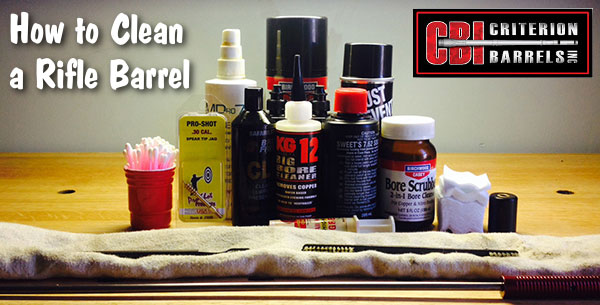
We recommend the use of the following components during rifle cleaning:
• Cloth patches (sized for the appropriate caliber)
• Brass jag sized properly for your bore
• One-piece coated cleaning rod
• General bore cleaner/solvent (Example: Hoppes #9)
• Copper solvent of your choosing (Example: Sweets/KG 12)
• Fitted cleaning rod bore guide
• Plastic AP brush or toothbrush
• Q-Tips
• Plastic dental picks
• CLP or rust preventative type cleaner
There are a number of schools of thought relating to the frequency in which a barrel should be cleaned. At minimum we recommend cleaning a barrel after each shooting session to remove condensation, copper, and carbon build-up. Condensation is the greatest immediate threat, as it can cause the barrel to rust while the rifle sits in storage. Copper and carbon build-up may negatively impact future barrel performance, increasing the possibility of a failure in feed or function. Fouling should be removed whenever possible.
The below tips will help limit the wear of different parts of your barrel during routine maintenance, helping extend the life of the barrel and improving its performance.
The Crown
The crown is the portion of the barrel where the bullet loses contact with the lands and grooves and proceeds to exit the firearm. The area most critical to accuracy potential is the angle where the bullet last touches the bore of the barrel.
Avoid damage to this area by using a plastic toothbrush and CLP type cleaner to scrub the crown from the exterior of the barrel. Even the most minimal variation in wear to the crown will negatively impact barrel performance, so be careful to avoid nicking or wearing away this part of the barrel.
Reducing Cleaning Rod Wear to the Crown
When running a patch through the barrel, place the muzzle about a ¼” from a hard surface that runs flat at a perpendicular angle to the cleaning rod’s direction of travel, like a wall or the edge of a work bench (pictured). When the jag impacts the hard surface, retract the cleaning rod and remove the patch.
By withdrawing the jag prior to its exit from the barrel, you are limiting the possibility of the brass dragging upon the crown if the rod is at all bent or misaligned. The soft cloth patch will continue to serve as the point of contact between the jag and the barrel, minimizing potential wear.
If possible, insert the rod through the chamber, pushing it forward toward the muzzle. Some rifles, such as the M1 Garand or M14, will require you to insert the cleaning rod through the muzzle. In these situations the use of a cleaning rod guide is recommended to limit the friction placed upon the crown.
Avoid using cleaning rod segments for scraping carbon from the recessed muzzle of an AR-15 barrel. We used this trick in the Marine Corps to impress the armorers and NCO’s with the cleanliness of our muzzles, but it likely played a significant role in reducing the service life of the rifle barrel in question.
Use a Q-Tip soaked in solvent to remove any copper or carbon residue from the recessed muzzle of an AR-15 barrel. A little bit of remaining carbon on the face of the muzzle will not negatively affect bullet travel so long as the crown edge remains consistent around the circumference of the bore.
The Lands and Grooves
This portion of the barrel may experience reduced efficiency due to copper fouling and cleaning rod damage. If copper fouling takes place during the initial break-in of the rifle, make sure to check our barrel break-in article.
For regular maintenance we suggest using a single piece coated cleaning rod rather than the traditional segmented rod or bore snake. While segmented rods and bore snakes may be convenient for field use, the corners between the segments may bow out and catch on the lands, scraping along the length of the rifling. Residual grit and particles from expended cartridges may also get caught between segments, resulting in an abrasive surface working its way down the length of the barrel. Most bore snakes will remove significant amounts of carbon fouling, but may fall short in the removal residual carbon buildup and copper fouling during deep cleaning. Good rods can be sourced from multiple manufacturers, but we have found good results using both Pro-Shot and Dewey brand products.
General cleaning requires the use of patches rather than nylon or brass bore brushes. Brass brushes may be required when aggressive cleaning is required, but can lead to unnecessary wear on the barrel if used frequently. This is not due to the nature of the soft brushes themselves, but from the abrasive particles of grit that become embedded in the material that is being run repeatedly through the bore. We recommend the use of bore guides when cleaning from both the muzzle and breech. These bore guides will help serve to protect the crown and throat from cleaning rod damage.
If significant resistance develops while running the cleaning rod through the bore, no attempt should be made to force it in further. Back the rod out and inspect the barrel to determine the cause of the resistance. The jag may be pushing between a bore obstruction and the rifling, digging a divot into the barrel before pushing the obstruction back through the muzzle. One way to minimize the risk of a stuck rod is by utilizing a slightly smaller patch during the initial push.
The process of cleaning the length of the rifling is relatively straightforward:
1. Check to make sure the rifle is safely unloaded.
2. Carry out any necessary disassembly procedures prior to cleaning.
3. Remove bolt (if possible) and insert fitted cleaning rod bore guide in action.
4. Soak a patch in bore solvent (similar to Hoppes #9).
5. Center and affix the patch on the brass jag, inserting it into the chamber end of the barrel. A misaligned patch may cause the jag to damage the lands of the rifling, so make sure the patch is centered on the jag.
6. Run the patch the full length of the barrel, retracting it upon reaching the end of the muzzle.
7. Let the solvent sit for a minute.
8. Continue to run patches through the bore until carbon residue is minimized.
9. Run a dry patch through the bore to ensure carbon residue has been removed.
10. Soak a patch in copper solvent (Sweet’s or KG-12).
11. Run the patch through the bore, leaving it to sit for 3-5 minutes (do not let solvent sit for more than 15 minutes.*)
12. Repeat this process until no blue residue remains on the patches.
13. Run a patch of Hoppes #9 and a dry patch through the bore to neutralize the copper solvent.
14. Inspect the barrel prior to reassembling the rifle, verifying that no bore obstructions remain.
*Please note that some ammonia-based copper solvents may prove to be corrosive if left sitting in the barrel for an extended period of time. It is essential that these solvents be removed within 15 minutes to avoid ruining the bore.
The Chamber
Proper cleaning of the chamber is a critical component of a general cleaning procedure. Carbon rings can build up near the neck and throat of the chamber wall, leading to feeding malfunctions and pressure spikes inside the chamber.
The chamber can be the trickiest part of the barrel to effectively clean, due to its fluctuation in size and the awkward ergonomics often required to remove carbon residue. Numerous chamber specific devices have been created to address this problem, and while some should be avoided (steel chamber brushes), others can be used to great effect (cleaning stars and plastic dental picks). The simplest approach to cleaning a chamber is to apply solvent to a couple patches, and use the cleaning rod to spin the wadded up patches inside the confines of the chamber. This should aid in removing any excess carbon. A Q-Tip can be used to reach portions of the chamber unreached by patches.
The Barrel Exterior
While the condition of the crown, rifling, and chamber are essential to firearm performance, the finish of the exterior should also be cleaned after handling. Condensation, humidity, direct water contact, and salt residue from skin contact can cause rust or corrosion. An application of anti-corrosion products is recommended when placing a firearm into deep storage for an extended period of time. [Editor: AccurateShooter.com recommends Corrosion-X or Eezox, but other products work well too.]
Finding Cleaning Components
While most cleaning components can be found at your local gun shop, some specialty items may need to be sourced through online retailers such as Brownell’s. Criterion utilizes both Dewey and Pro-Shot brand cleaning components during our day-to-day operations.
Do you have any rifle cleaning tips or tricks not mentioned in the above article? We’d love to hear about them. You can post your comments below.
British Lee-Enfield Model SHT’22/IV Rifle, courtesy www.iCollector.com.
This past week, at SHOT Show, we met up with our friend Dennis Santiago. We chatted about Dennis’s experiences as a technical advisor for History Channel’s Top SHOT TV show. One of the notable Top Shot episodes involved the “Mad Minute”, a marksmanship drill practiced by the British Army in the decades preceding World War I. Dennis observed that the Top Shot competitors didn’t fare too well in their “Mad Minute” attempts, not scoring many hits in the alloted one-minute time period. That prompted Dennis to give it a try himself — seeing how many hits he could score in one minute with an authentic Lee-Enfield rifle. So, a while back, Dennis ran the drill at a range in California.
Dennis Does the Mad Minute:
Dennis, an active high power rifle competitor and instructor, enjoyed his “Mad Minute” exercise, though he assures us that this takes practice to perfect. Dennis tells us: “Here is a ‘Mad Minute’ drill, done using a period correct Lee-Enfield (SMLE) No.1 Mk III rifle and Mk VII ammo. I got to the Queen’s Regulations (15 hits in one minute) on the second run and put a good group on the target at 200 yards. This is ‘jolly good fun’ to do every once in a while. This is ‘living history’ — experiencing a skill from a time when the sun never set on the British Empire.”
“Mad Minute” was a pre-World War I term used by British Army riflemen during training at the Hythe School of Musketry to describe scoring a minimum of 15 hits onto a 12″ round target at 300 yards within one minute using a bolt-action rifle (usually a Lee-Enfield or Lee-Metford rifle). It was not uncommon during the First World War for riflemen to greatly exceed this score. The record, set in 1914 by Sergeant Instructor Alfred Snoxall, was 38 hits. (From WikiPedia.)
History of the Mad Minute Commentary by Laurie Holland
The original military requirement of the “Mad Minute” saw the soldier ready to fire with a round in the chamber, nine in the magazine, safety on. This course of fire is still followed by the GB Historic Breechloading Arms Association and other bodies in their recreated “Mad Minute” competitions.
The first 10 would go quickly, but reloads were critical, this not done by a magazine change as in a modern tactical or semi-auto rifle, but through slick use of ‘chargers’. It is this aspect which fouls so many of my colleagues up as it is very easy to cause a jam and a large part of 60 seconds can go in sorting it out!
Charger clips were selected for those that just held the rounds firmly enough to stop then falling out, were sand-papered and polished with a stove / fireplace polish called ‘Zebrite’ so that the rimmed rounds would slip through the clips like corn through a goose.
If you’re unfamiliar with the cock-on-closing Enfield action, it seems clumsy. With intensive practice it is very smooth and can be operated incredibly quickly. The trick is to whip the bolt back onto its stop and initiate a rebound movement that takes it and the cartridge well into the chamber thereby reducing the effort required to close the bolt and chamber the round.
Our friend, trick-shot ace Kirsten Joy Weiss, will be featured on the NRA All-Access TV show next week. As a performance shooter (and modern-day Annie Oakley) Weiss has focused her efforts to “bring the fun, challenge, and joy of shooting to a mainstream audience” via social media.
Watch Preview of NRA All Access with Kirsten Joy Weiss
Kirsten wants to be a good ambassador for the shooting sports, “spreading the positive reality of shooting”. Kirsten explains: “The fun challenge and joy of shooting is important to me because I really wanted to be a positive example. So when the media says the ‘guns are a bad thing and nobody does anything good with guns’, they can say ‘Well, what about her [Kirsten]’?”
A gifted “natural” shooter, Kirsten started shooting fairly late — at age 16. Despite her relatively late start, she learned very quickly, and managed to earn a place on the University of Nebraska shooting team. That literally opened up a new world for Kirsten: “During the course of my career, I’ve had a lot of success. I’ve gone to World Cups… in Zagreb, Croatia, in Munich, Germany. I’ve won National Championships, and got on to the U.S. Olympic short list, so it’s been a good career.”
In 2012, Kirsten was the top USA athlete-shooter at the Munich World Cup. She won the 2012 NRA Three-Position Women’s Smallbore Championship and also won the Standing Position, while finishing as the National Overall Woman Champion.
Kirsten tells us: “A lot of people don’t think of shooting as a sport, but it absolutely is, and I would even go so far as to say that it is an art form.” We don’t know if this is art, sport, or magic, but very few shooters have the skill or flexibility to make this upside-down shot…
This animated GIF shows Kirsten cutting a card in half with a .22 LR bullet. Impressive!
Here’s a photo of the private range where a match was to be held…
“Local Shoot Cancelled, Everything Cancelled….” That was the report from Forum member “Dixie PPC”. He was planning to attend a 600/1000-yard match. Well, there was just a little bit too much of the white stuff this morning. The match was cancelled, and he told us “pretty much everything was cancelled”.
The local Interstate was closed down because of the snow…
Conditions were bleak and cold…
Despite the snow, things weren’t completely cancelled on DixiePPC’s farm: “My Farm was not shut down… Cattle gotta’ eat.”
SHOT Show, the firearms industry trade show, is a huge event. There are more guns and shooting accessories than you can possibly imagine. On Thursday we saw everything from a giant CADEX .50 BMG with a 24″-long suppressor to a tiny Kahr .380, the thinnest carry gun in production. Here are some highlights from Day Three, a combination of old and very, very new. McMillan has a new, as-yet-unnamed tactical stock, Walther showcased an amazing electronic trigger, and Uberti revived America’s Wild West heritage with a line of single-action revolvers.
CZ 455 Tactical/Varmint Rimfire Rifles
CZ USA still continues to offer some of the best .22 LR rifles for cross-training and tactical rimfire games. The CZ 455 Varmint Tacticool and Varmint Precision Trainer (Camo) feature proper, full-size stocks (with adult-scale ergonomics) so these rimfires look and feel like a centerfire tactical rig. CZ 455s have smooth actions and crisp triggers.
Walther LG400 Air Rifle with Electronic Trigger
Look carefully — this Walther LG400 Alutec air rifle is different than any gun you’ve ever shot. You see it has an ELECTRONIC trigger. This sophisticated, battery-powered trigger offers a super-precise, super-light release (it’s more a “touch” than a “pull”). For top-level international and Olympic shooters, the electronic trigger can offer a competitive advantage. Later this year Walther will offer an electronic trigger in its top-of-the-line smallbore rifle.
“Name This Stock” — New Tactical Stock from McMillan
Kelly McMillan, president of McMillan Fiberglass Stocks is holding the latest tactical stock from McMillan. It features a girder-style open fore-end that fits any barrel contour. At the rear, the stock boasts an adjustable cheekpiece along with a straight toe for riding a sandbag. Interestingly, this stock has no name (as yet). At SHOT Show, McMillan is running a “Name This Stock” contest. The winner will receive a free stock.
Giant Super-Sized Scope at Zeiss Booth
At its booth, Zeiss displayed what must be the world’s largest rifles-scope replica. This giant scope, as big as a totem pole, certainly did draw the attention of anyone who walked by. The big news at Zeiss this year is the Victory V8 line of scopes with 8X zoom ratio.
Uberti Classic Single Action Pistols
We love vintage-style revolvers. This year Uberti offered a beautiful array of single-action pistols in a variety of styles. Along with its line of “Wild West” repro pistols, Uberti makes excellent lever guns based on classic Winchester designs. This editor owns two Uberti lever-action rifles, and they are both beauties.
Anschutz Model 9015 Competition Air Rifle
Our friend Steve Boelter, President of Anschutz North America, showed us the latest and greatest competition rifles from the respected German gun-maker. In this photo, Steve is holding the new Anschutz 9015 air rifle. Above is the new, top-of-the-line Anschutz smallbore target rifle. In a week or so we’ll release a video showing the details of both these rifles.
SHOT Scenery — From Russia with Love
It wouldn’t be SHOT without a few Booth Babes, or should we say Booth Babe-bushkas. These charming young ladies really ARE from Russia. Yuliya, on the right, hails from far-away Vladivostok in Siberia. She said she appreciated the warmer weather in Las Vegas.
Tikka T3 Compact Tactical Rifle for the Canadian Rangers
On display at the SAKO booth was the Tikka T3 Compact Tactical Rifle which has been adopted by the Canadian Rangers. This will replace the Ranger’s beloved, but antiquated Lee-Enfield rifles. The Canadian Rangers, an element of the Canadian Armed Forces (CAF) Reserve, serve as the CAF’s eyes and ears in sparsely-settled northern and coastal areas of Canada. The Rangers have helped secure Canada’s hinterlands since 1947.
Browning “Hell’s Canyon” Gun Vaults
Browning showcased a series of large gun safes with much-enhanced fire-proofing and thicker steel walls. The new “Hell’s Canyon” Series of gun vaults offer 40% thicker steel plus 2 – 3 times the fire protection of typical gun safes. These “Hells Canyon”-series safes are impressive.
Kim Rhode — Olympic Gold Medal Winner
We had a chance to interview shotgun superstar Kim Rhode, who has won Gold Medals at multiple Olympic Games. She told us some very interesting facts. For example, did you know that roughly 70% of females are left-eye dominant? Kim revealed some techniques that right-handed, cross-dominant shooters can use to improve their scores. We’ll reveal that in an upcoming video interview with Kim, shown here at the autograph table with some of her Olympic medals.
We had a chance to meet with Jerry Miculek and his wife Kay at SHOT Show. These are very nice people who also happen to be superb shooters. They are great ambassadors for the shooting sports. We talked about Jerry’s many titles and match wins over recent decades. He explained: “It didn’t come easy… the winning comes after years of hard work”. Jerry’s name is synonymous with revolvers. But Jerry is also one heck of a rifleman, as he demonstrates in this video.
Three Shots Standing at 400 Yards in 4.37 Seconds
For those of use who usually shoot from the bench, hitting a silhouette target at 400 yards from an standing position (unsupported) would be a big challenge. Here Jerry Miculek makes it look easy.
In this video, Jerry hits not one but THREE c-zone targets at 400 yards. And — get this — he does this in under 4.4 seconds starting with his rifle laying on a support. It took Jerry two tries (on his first run he hit 2 out of 3 in 4.65 seconds). On the second attempt (see video starting at 2:19), it takes Jerry just 4.37 seconds to shoulder his rifle, aim, and fire three shots, each hitting a separate steel target. Wow. That’s truly remarkable. Most of us would need ten seconds (or more) just to get the scope on the first target.
Trust us folks, this ain’t easy. It takes remarkable marksmanship skills to shoot with this kind of precision at this kind of pace. As Jerry would say himself, “Not bad for an old guy who needs glasses”.
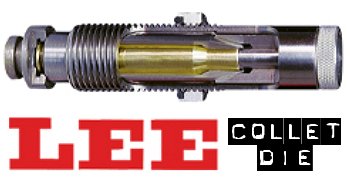
For those who prefer to neck-size their brass (rather than full-length-size), the LEE Collet Die is a popular, inexpensive option. It works by having collet tangs or “fingers” press the neck against a central mandrel. The benefit is that you get a very straight neck, which is sized consistently from top to bottom. Canadian shooter Jerry Teo explains: “LEE Collet Dies produce sized cases with very low runout (measured runout is under .001″ using a Sinclair concentricity gauge). You also don’t get the build-up of brass at the base of the neck, as can happen with bushing neck dies. The neck-shoulder junction stays nice and crisp.”
TIP ONE — Adjusting Tension
LEE Collet dies don’t have a specific mechanical adjustment for neck tension. But you CAN easily modify the die to provide more or less tension. If you want to adjust the neck tension using a Lee Collet die, you can simply chuck the mandrel in a drill and reduce the diameter with some sand-paper (to increase neck tension) or you can order a mandrel the next caliber larger and turn it to whatever diameter you want (the larger the mandrel diameter, the less the neck tension). You can also order custom mandrels from Lee sized to any diameter you want.
Lee also offers Custom Collet Dies, made from two fired cases. Lee offers custom standard collet dies for $78.00 and custom large collet dies for $160.00. CLICK HERE to ORDER.
TIP TWO — Polish and Tune for Easy Case Removal
Some users have complained that their Collet Dies grab the case-neck too firmly, making the case hard to remove. There are solutions to this problem. First inspect the collet fingers and smooth the inner surface up a bit with polishing compound or an extra-fine sanding pad. Second, you can open up the fingers a little bit. LEE recommends that if your Collet Die is sticking, take a steel punch and tap the fingers apart a little bit so that the natural “unloaded” position is wider. Lastly, you should lightly lubricate the outside of the collet fingers (see arrows) before you re-assemble the die. This will ensure they slide smoothly. Also, to prevent the collet fingers from closing too tight, never load up the die with your press without putting a case in place first. Without a case neck between the collet fingers and the mandrel, the collet can clamp itself too tight as you raise the ram.
TIP THREE — Size Twice and Spin Your Case 1/8th Turn
After reaching fully “down” on your press handle, withdraw the case about an inch and manually rotate it about 1/8th (NOT 1/4 or 1/2) turn while still in the shell-holder, then size again. This will place the die’s collet petals on the four “high spots” of the case neck and will result in a rounder, more evenly-sized neck with slightly more bullet tension. This takes only about one second more per case and is well worth the slight extra effort. (We thank reader Stonecreek for this smart tip).
Here are eleven of the more interesting products (and people) we saw on Day Two of SHOT Show. This is only the tip of the iceberg folks. With 12.5 miles of aisles, and over 1600 Exhibitor booths, we can only show a tiny fraction of the products on display. There are tactical rifles and gear everywhere in sight. We also found some interesting target systems and reloading tools. Stay tuned for more product previews tomorrow from SHOT Show at the Sands Convention Center.
Savage 10/110 BA Stealth
You asked for it — here it is — the new Savage 10/110 BA Stealth. This new rifle features a strong yet light aluminum chassis that accepts AR-compatible rear sections. Savage says the actions have been “factory blueprinted”. Available chamberings are: 6.5 Creedmoor, .308 Winchester, .300 Win Magnum, and .338 Lapua Magnum. We shot this rifle, in .308 Win, at Media Day and we liked the ergonomics.
NEW Alliant Reloder 16 Powder
Alliant’s engineers showed us “top-secret” data charts comparing various popular powders. This new Reloder 16 is one of the most temp-stable propellants ever created. Burn rate is slightly faster than H4350. Initial accuracy results have been very promising. AccurateShooter.com will be testing this powder very soon. Stay tuned.
Savage A17 in Laminated Thumbhole Stock
Here is the 17 HMR Savage A17 in new laminated, thumbhole stock. We want one. The wood-stocked A17 balances well and feels good. This is a definite upgrade over the original plastic stock.
Vortex 6-24x50mm FFP Razor HD
Vortex unveiled a very impressive new tactical scope, the 6-24x50mm Razor HD. Vortex says this top-of-line optics was engineered to compete with anything on the market — including the big-name German brands. The glass was excellent, and we loved the fact the elevation turret offers a full 25 MOA of elevation in one rotation. Great feature.
Pardini Competition Air Rifle
Design for Olympics-level competition, this new Pardini is one of the most sophisticated air rifles ever made. It has a very sophisticated loading system that allow you to load pellets without changing your hold on the rifle. It was designed with input from Olympic Champion shooters.
Ken Oehler and the New System 88
Chronograph Guru Ken Oehler explained the capabilities of his “enterprise-grade” System 88. This combines a proof-channel chronograph at the firing line with sonic sensors at 1000 yards (and other distances in between if desired). This allows very precise calculation of true bullet BCs.
$38,000 JANZ Multi-Barrel, Multi-Caliber Revolver
You are looking at the world’s most expensive wheelgun, the JANZ multi-caliber system. Custom-built for each customer, this amazing revolver shoots multiple cartridge types — even rimfire. As far as we know this is the only revolver in the world that shoots .22 LR rimfire as well as centerfire cartridges up to .500 SW. The builder, JANZ-Praszisionstechnik GmbH, will craft the gun with as many barrels and cylinders as the owner wants. As shown in the photo, the price is around $38,000.
New Bullets from Sierra
Sierra Bullets had its new Tipped MatchKings on display, and well as the very impressive new 7mm 183-grain MatchKings, which are “tip-uniformed” at the factory. Lester Bruno shot some of these 183-grainers and said they held amazing waterline at 1000 yards, indicating that the bullet-to-bullet BC is very consistent. Listed G1 BC for the 183gr MK, SKU #1983, is .707.
Jerry Miculek, World’s Fastest Wheelgunner
We met up with the legendary Jerry Miculek at the Hornady Booth. The world’s fastest wheelgunner (and a darned good rifleman too) had fans lined up for autographs. What’s the secret to Jerry’s success? Hard work, hands of steel, and a positive attitude.
New Throat Erosion Gauge from PT&G
Pacific Tool and Gauge had a bunch of new products on display. One item that caught our eye was an interesting Throat Erosion Gauge. Index marks on the main shaft let you determine, with precision, how much your throat has moved. Screw-on, caliber-specific pilots let you gauge all popular calibers.
Sig Sauer 5-25x52mm “Whiskey 5″ SFP Scope
We were very impressed with Sig Sauer’s optics, which offer a lot of capability for the price. The new 5-25x52mm Whiskey 5 optic offers positive controls and a nice illuminated reticle center (good for low light). The “street price” is around $1200.00 – $1300.00. READ Full Review Here.
At SHOT Show 2016 we visited the Sellier & Bellot pavilion. You may not have heard of this company, but it is one of Europe’s older ammunition manufacturers. The video below shows ammunition being made from start to finish, starting with raw materials. This is a fascinating video that is well worth watching. It shows some amazing machines in operation:
Based in in Vlašim, Czech Republic, Sellier & Bellot was founded in August 5, 1825 by a German businessman of French origins called Louis Sellier. His family were royalists who fled France during the French Revolution. Louis Sellier began manufacturing percussion caps for infantry firearms in a factory in Prague, Bohemia on the request of Francis I, the Emperor of Austria. Sellier was joined by his countryman Jean Maria Nicolaus Bellot.
At the S&B booth, we also saw an interesting CGI video that shows what happens inside a rifle chamber and barrel when a cartridge fires can’t be seen by the naked eye (unless you are a Super-Hero with X-Ray vision). But now, with the help of 3D-style computer animation, you can see every stage in the process of a rifle round being fired.
In this X-Ray-style 3D animation illustrates the primer igniting, the propellant burning, and the bullet moving through the barrel. The video then shows how the bullet spins as it flies along its trajectory. Finally, this animation shows the bullet impacting ballistic gelatin. Watch the bullet mushroom and deform as it creates a “wound channel” in the gelatin.
Watch Video – Cartridge Ignition Sequence Starts at 1:45 Time-Mark



 Lee-Enfield No. 4 Rifle (1943), courtesy


 A gifted “natural” shooter, Kirsten started shooting fairly late — at age 16. Despite her relatively late start, she learned very quickly, and managed to earn a place on the University of Nebraska shooting team. That literally opened up a new world for Kirsten: “During the course of my career, I’ve had a lot of success. I’ve gone to World Cups… in Zagreb, Croatia, in Munich, Germany. I’ve won National Championships, and got on to the U.S. Olympic short list, so it’s been a good career.”



 TIP TWO — Polish and Tune for Easy Case Removal


