After the Berger Southwest Nationals, we had a long chat with John Whidden, five-time NRA Long-Range National Champion, and a past SWN Sling Division winner. When the subject turned to reloading techniques, John reminded us that he uses a Dillon progressive presss to load much of his match ammo — with a system for much more precise control over powder charge weight. Yes John loaded his national-championship winning .243 Win ammo on a progressive. That may not work for the benchrest game, but John proved this method works well for his discipline — long range sling shooting.
John full-length sizes his match brass every time using a Whidden click-adjustable sizing die. The powder charge is dispensed with single-kernel precision using an Auto-Trickler and lab-grade force restoration scale. The process is completed on a Dillon XL 650 to produce more ammo in less time.
Whidden’s .243 Win Ammo is Loaded on a Dillon
John Whidden of Whidden Gunworks used the .243 Winchester cartridge to win the 2017 NRA Long Range Championship, his FIFTH LR title. John loaded his .243 Win ammo using a Dillon: “My loading process is different than many people expect. I load my ammo on a Dillon 650 progressive press using our own Whidden Gunworks dies. However powder charges are individually weighed with a stand-alone automated scale/trickler system from AutoTrickler.com (see below). Employing a high-end force restoration scale, this micro-processor controlled system offers single-kernel precision. The weighed charges are then dropped into the cases with a funnel mounted to the Dillon head.”
John Whidden Explains His Ammo-Loading Process
The Lapua .243 Win brass is full-length sized every time, and I run one of our custom-sized expanders in my sizer die. The expander measures .243″ which yields the desired .001″ neck tension. In my experience, the best way to get consistent neck tension is to run an expander in the case neck at some point. When sizing the case neck by a minimal amount such as is the case here, I don’t find any negative points in using an expander in the sizer die.
Championship-Winning Load: Berger Bullets, Lapua Brass, and Vihtavuori N160
For a load, currently I’m shooting Lapua brass, PMC primers (Russian, similar to Wolf), VihtaVuori N160 single-base powder, and Berger 105 grain Hybrid bullets. I switched to the Hybrid bullets at the beginning of the 2015 season. Previously I shot the 105gr Berger hunting VLDs, and in testing I found that the Hybrids were just as accurate without having to seat the bullet into the lands. The velocity of this combination when shot through the excellent Bartlein 5R barrels (32” length) is around 3275 FPS.
For my match ammo, I seat the Berger 105 Hybrids well off the lands — my bullets are “jumping” from .035″-.060″. I only use one seating depth for ammunition for multiple guns (I know some benchrest shooters will stop reading right here!) and the bullets jump further in the worn barrels than in the fresh barrels. The bullets are pointed up in our Bullet Pointing Die System and are moly-coated. The moly (molybdenum disulfide) does extend the cleaning interval a little bit, probably 20% or so. The Lapua .243 Win brass is all neck-turned to .0125″ thickness.
In my experience, the keys to accurate long range ammo are top quality bullets and the most consistent neck tension you can produce. From these starting points, the use of quality components and accurate powder measurement will finish out the magic.
Great Ballistics with 6mm 105s at 3275 FPS
Running at an impressive 3275 FPS, Berger 6mm 105 grain Hybrids deliver ballistics that are hard to beat, according to John Whidden:
“My .243 Win shoots inside a 6.5-284 with 142-grainers. Nothing out there is really ahead of [the .243], in 1000-yard ballistics unless you get into the short magnums or .284s and those carry a very significant recoil penalty. In the past I did shoot the 6.5-284. I went to the .243 Win because it had similar ballistics but had much less recoil. It doesn’t beat me up as much and is not as fatiguing.
With the .243 Win, there’s no tensing-up, no anticipating. With the reduced recoil (compared to a 7mm or big .308), I can break and shoot very good quality shots. I find I just shoot better shots with the .243 than I ever did with the 6.5-284.”
We were pleased to see our friend John Whidden featured in the October 2017 issue of Shooting Sports USA. John captured the 2017 NRA Long Range Championship this summer, his second LR title in a row, and fifth overall. This year was a bit different, as the competition was held in Indiana at Camp Atterbury. All John’s previous Long Range HP titles were earned at Camp Perry.
Whidden’s Perfect Palma Match
Whidden secured the 2017 LR Title by shooting “clean” (not dropping a point) in the tough Palma competition. In the NRA Palma match, rifles must be .223 Rem or .308 Winchester, with metallic sights (no scopes). The match is conducted at three yardages, 15 shots at each distance of 800/900/1000 yards, with unlimited sighters at 800 and two sighters at 900 and 1000.
SSUSA’s Editor John Parker writes: “On another note, this month’s cover feature highlights the very first NRA High Power Rifle Championships conducted at the match’s new home—Indiana’s Camp Atterbury. Located about 50 miles south of Indianapolis, this active Indiana National Guard base boasts over 60 ranges, making it the ideal new venue to continue the legacy of NRA High Power. Hundreds of competitors made the trek to continue the historic tradition of rifle competition at the National Matches.”
Another friend, Anette Wachter, is featured in this issue as well. That’s the 30CalGal herself in the upper right after winning the Andrus Trophy Match.
Sling Rifle Evolved: The Ultra-Accurate Hybrid Palma Rifle
Since John captured his fifth Long Range crown with a superb performance in the Palma match, we thought we’d give readers a look at John’s very special Palma rifle. This unique .308 Win prone rifle features a Barnard “P” action in a converted aluminum Anschutz “Precise” smallbore (rimfire) stock. The combo of Barnard action and Anschutz ergonomics is hard to beat, says John, who told us: “this is easily the best Palma rifle I’ve ever had.” John told us this gun handles like no other: “After recoil, with this Anschutz stock, the sights fall right back on target — better than any other prone rifle I’ve shot”.
As a bonus, the Barnard “drop-in” required no modification of the Anschutz Precise stock. This means John can actually swap in his rimfire barreled action and shoot smallbore with the same stock.
Whidden Palma Rifle
Action: Barnard “P” (three lugs, 60° bolt lift)
Barrel: Bartlein 32″, Light Palma contour, cryo-treated by 300 Below.
Stock: Anschutz Precise aluminum smallbore stock, set up for centerfire barreled action.
Trigger: Barnard Two-Stage adjustable
Whidden’s Wonder-Gun: German Stock, New Zealand Action, American Barrel
John built this Palma rifle in early 2016. With it, John won back-to-back long-range Championships in 2016 (Camp Perry) and 2017 (Camp Atterbury). The major components are: Barnard ‘P’ action, Anschutz Precise smallbore stock, and Bartlein barrel. The caliber is .308 Win, as dictated by the Palma rules. Palma matches are fired from 800, 900, and 1000 yards utilizing iron sights only. No optical sights are allowed.
We congratulate Norman Houle, the 2016 National High Power Champion, and John Whidden, the 2016 National Long Range Champion. Norm secured his win with an impressive 2384-130X score. Along with the title of National Champion, Norm received a Mumma Trophy Plaque, a National Champion Medallion, Krieger Barrels Certificate, Trijicon Scope, and Geissele Certificate. In second place was last year’s champion, SFC Brandon Green of the USAMU. Brandon, who won the 2015 and 2013 High Power Championships, finished with a score of 2381-120X. In third place was SGT Nick Mowrer with 2381-114X, a very impressive score with a Service Rifle. (SGT Mowrer won the Service Rifle Championship.)
John Whidden is always strong at Camp Perry (file photo from past event).
Whidden Wins Long Range Championship
In the Long Range Competition (Tompkins Trophy Match), John Whidden of Whidden Gunworks topped the field with a very strong 1240-77X performance. This victory secured John’s fourth Long Range National title. As in the High Power Championship, in the Long Range event SFC Brandon Green also finished in second place (1238-67X). Rounding out the Long Range podium was William Gelet with a 1238-57X tally. With his Long Range Championship win, Whidden took home a Tompkins Trophy Plaque, a Gold Championship Medallion, and a $500 Berger Bullets Certificate.
John campaigned three rifles he smithed himself. These feature Barnard actions in modified Anschutz smallbore stocks. For the open-caliber events, John shot .243 Win-chambered rifles with 6mm 105gr Berger Hybrids. For the Palma matches he shot a .308 Win with 155gr Berger Hybrids. John’s ammo was loaded on Whidden dies of course. During the Long Range cycle, matches were shot with both iron sights and scopes. John had two different .243 Win rifles, one fitted with iron sights, the other with a scope.
High Power Hardware: The Guns of Perry
We thought our readers would like to see some of the ultra-accurate rifles campaigned by High Power competitors at Camp Perry. Both bolt-action and self-loading rifles are popular. Among bolt guns, Tubb 2000s and Eliseo tubeguns are popular. Semi-auto AR platform “Space Guns” offer some advantages (particularly during rapid-fire and for standing position), and are favored by many of the top marksmen. Many Camp Perry High Power competitors are also shooting less exotic AR service rifles.
Tubb 2000 with a shortened handguard, and custom hand support bracket forward of mag well.
The modern AR Space Gun, scoped version. Note the side charging handle, and absence of forward assist. A block fitted under the handguard helps with the standing position. The scope is mounted on a “piggy-back” rail that extends forward of upper receiver’s built-in rail.
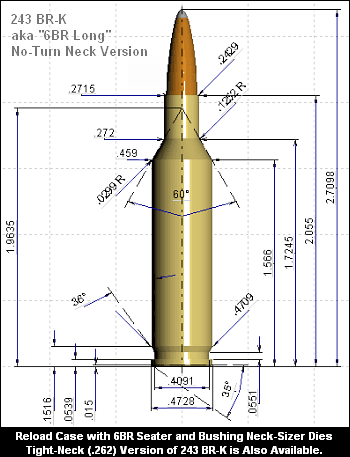
Gunsmith Mike Sosenko and long-time AccurateShooter Forum member John Adams have been using a modified .243 Winchester case with great success in Varmint Silhouette matches at the Pala Range in Southern California. Officially called the “.243 BR-K” (and informally dubbed the “6BR Long”), the wildcat is basically a .243 Winchester with less body taper and a 30-degree shoulder. The design essentially grafts a 6mmBR Norma “top end” to the .243 Winchester case. After fire-forming, Mike and John can reload this case using normal, unmodified 6BR neck-sizing and seater dies.
Compared to a .243 Winchester, the .243 BR-K’s body length is about .006″ longer, and the shoulder is about .0055″ wider. The main difference is the shoulder angle (30° vs. 20°), and the location of the neck-shoulder junction (“NSJ”). Based on reamer prints, the base to NSJ dimension is 1.718″ on the 6BR Long, compared to 1.804″ for the .243 Winchester. Neck length is a bit shorter because “the neck shrinks a little when the shoulder blows out” according to Sosenko. We’ve provided a mock-up diagram of the .243 BR-K, but you should check with Dave Kiff of Pacific Tool & Gauge for exact dimensions. Dave created the reamers for both the 6mm and 22-caliber versions of this wildcat. Ask for the “22 BR-K” or “.243 BR-K” reamer designs.
Wicked Velocity with Stable Brass
The main advantage of the .243 BR-K is serious velocity in a case that is very stable. Mike’s favorite load is the 95gr Berger VLD pushed by Reloader 22. With a stout load of RL22 and Federal 210m Primers, Sosenko is getting 3450 fps with the 95-grainer, with no bullet blow-ups. This is with a 1:8.5″ twist Broughton 5R barrel finished at 28.5″. The cases are holding up very well. Mike has a half-dozen loads on his brass and he hasn’t had to full-length size yet. Mike runs a .262″ tight neck, but there is also a no-turn version of the case (see illustration). Accuracy is excellent. Mike says the round delivers repeatable 1/4 MOA groups at 100 yards in testing. He has also experimented with N160, but, thus far, Reloader 22 has delivered smaller groups with better ES and SD.
John Adams shoots a no-turn (.274″) neck .243 BR-K with 105gr Berger VLDs. He’s getting about 3230 fps using Reloader 22. John says he can push the 105s faster, but 3220-3240 fps “seems to be the sweet spot.” John notes that “after about five reloadings on a case, it gets a little tight”. John then full-length sizes with a custom Hornady FL bushing die. “The Hornady custom shop dies work great” according to John. Adams also shoots a version of this wildcat necked down to 22-caliber. It has demonstrated outstanding velocity and good accuracy in initial testing with a 9-twist barrel. Using the 80gr Amax bullets, John is getting 3570+ fps speeds. John feels that his 22 BR-K needs some more development work. “The .243 BR-K is proven. We know what works. With the 22 I want to try different seating depths, experiment with a few different bullets, and fine-tune the velocity.”
Whitley’s 6mm Super X
Robert Whitley shoots a variant of the .243 Winchester he calls the 6mm Super X. This features a 30° shoulder, and slightly less body taper. He gains a little case capacity over the standard .243 Win, and he says the cartridge is extremely accurate with both 105-108 grain pills and the heavier 115s: “Here’s a picture of a .243 Win (left), a 6mm Super X (center), and a 6XC (right). All I can say is the 6mm Super X has been good to me and I have shot many a clean in 600-yard High Power matches with it with either DTAC 115s or Berger 115s.”
While Mike Sosenko and John Adams use their BR-Ks to push 95s and 105s at high velocities, Robert takes a different approach with his Super X. He shoots the high-BC 115s and keeps velocities under 3000 fps. A long-range High Power shooter, Robert demands consistency during long shot strings. That means backing off from max attainable speeds, at least with the 115s. Robert writes:
“You can get 3050 fps with H4831SC and the 115s with no problem, I did it in testing multiple times, but to me that also does not mean anything because I shoot loads where they are the most consistent and accurate over a 22+ shot string. I have never found that any of the 6mm cartridges I have used with 115s will stay consistent, tight and accurate the whole way at 3050 fps for 22+ shots straight. I have tried 115s in the .243 Win, the 6CM, the 6mm Super X, the 6XC, the 6-6.5 x 47 Lapua and none of them ever stayed consistent and tight for 22 shots straight with the 115s at that speed. Most of the time with all the 6mm cartridges, if you get the 115s much over 2975 fps, they won’t hold tight for 22+ shots straight. Now if you’re a bench rest shooter and you only need to do a few sighters then 5 or 10 shots for record, you can run 3050 fps or more and the groups will likely hold tight during your string, but not when you need to go 22+ shots straight with no break. I have shot many different 6mm cartridges and done a lot of testing with many different powders, moly and non-moly bullets. I don’t find the ‘consistent accuracy’ (for 22+ shots straight) at those higher velocities.”