This story appears courtesy NRABlog.com.
Looking to get started in Multi-Gun competition? The NRA Outdoors 3-Gun School is a two-day course covering all the skills you’ll need to compete in the 3-Gun game. The course, hosted at Peacemaker National Training Center in West Virginia, provides hands-on training for pistol, rifle, and shotgun. Participants experience a fast-paced mix of lessons and firing drills, including actual 3-Gun stages. For 2018, two sessions are scheduled: April 21-22, and June 16-17, 2018.
Video Shows Highlights from NRA Outdoors 3-Gun School Training Sessions:
You don’t even have to bring guns or load your own ammo. The NRA Outdoors 3-Gun School includes everything you need with the $1600.00 price of admission. You don’t need to bring any guns, ammunition or gear! The NRA Outdoors 3-Gun School provides all firearms, ammo and equipment used for the course, including Armalite AR-pattern rifles, Benelli shotguns customized by Hayes Custom Guns, SIG Sauer pistols, and Vortex Optics.
3-Gun Comps — What the Multi-Gun Game is All About
Most 3-Gun matches consist of 8 to 12 stages, with shooters engaging as many as 35 targets per stage. You’ll shoot at paper silhouettes as close as 10 feet away, and steel targets as far out as 600 yards. Time is of the essence — all stages are “on the clock”. You’re racing from station to station, your synapses firing as your transition from shotgun to rifle to pistol, close to long range, around corners, and over barriers.
You’ll encounter spinner wheels, swinging bowling pins and zooming clay pigeons, all while rushing through and around a bevy of walls, barrels, windows and even vehicles. Some 3-Gun matches are shot at night (see above), where the artificial illumination creates an entirely different set of challenges.
How to Participate
You can register now for the NRA Outdoors 3-Gun School. The first class of the year is scheduled for April 21-22, 2018, with another session later in mid-June. If you’re interested, register soon — these programs fill quickly.
CLICK HERE for more information about the NRA Outdoors 3-Gun School. Learn about other training courses by visiting the NRA Outdoors website or call (844) 672-6883.
Hardware for 3-Gun Competition — Guns & Gear
In this NSSF video, Top Shot Finalist Chris Cerino reviews the hardware you’ll need for multi-gun matches. Chris talks about carbine configurations — including barrel, handguard, and optics options. Cerino also demonstrates pistol techniques and explains the key features of a belt/holster rig.
Ellis Wins Three-Gun and Four-Gun Titles at 2017 Western CMP Games Story based on Report by Ashley Brugnone, CMP Writer
In a masterful showing of marksmanship, William Ellis of Langley, England won both the Three-Gun and Four-Gun Aggregate rifle competitions during the CMP Western Games in Phoenix last month. 2017 was a great year for Ellis, who first traveled to the Western Games in 2009. William’s 2017 performances earned him the second Distinguished Rifleman Badge by a non-U.S. citizen this past year.
Earning twin Aggregate Titles was a great accomplishment for Ellis, who had nearly won three years ago. In 2014, Ellis was the runner-up (second-place) in both 3-Gun and 4-Gun. But this was Ellis’s year — he was unstoppable. He shot superbly in the Arizona desert, taking the top spot in the Springfield Rifle Match along with second place in the Vintage Military Match. Those strong showings helped earn Ellis the 3-Gun and 4-Gun overall victories. To accompany his centerfire victories, Ellis shot great in the Rimfire Match, winning the Tactical Class. This was truly a masterful five days of shooting by Ellis.
Ellis Will Be Featured on Shooting USA
The media took notice of Ellis, who may have traveled farther than any other competitor at this year’s Western Games. Ellis will be featured in a Carbine Match video segment by Shooting USA TV, which filmed portions of the 2017 CMP Western Games for an upcoming episode.
Other Winners at CMP Western Games — Ben Avery Shooting Facility, October 13-17, 2017
Garand Match: Randall Dwornik, 287-3X
Vintage Military: William Fairless, 290-7X
Modern Military: Jeffrey Schneider, 293-6X
Vintage Sniper Team Match:
Manual Class: Michael Miller, Mike Barranco – 393-11X
Vintage Sniper Semi-Auto Class: SSG Steven Ophoff, Jeffrey Schneider – 364-8X
Training and Instruction at Western Games
Along with competitive events, Western Games also featured a Small Arms Firing School class, a Garand-Springfield-Military new competitor clinic, and a High Power Level II Range Officer class.
Hot Day-Time Temps and Wicked Night Winds at Ben Avery
2017 Western Games competitors experienced hot weather in Phoenix. Temperatures reached well into the 90s each day. The afternoon of the Sniper team match day saw temps topping out at 102° F. But the real weather problem was a gale-force wind that howled one night. The CMP’s 30 electronic targets were set up on the berm in front of the High Power rifle range pits wall. After the Small Arms Firing School was concluded, 40+ MPH overnight wind gusts toppled the entire target line. Thanks to the CMP staff and several competitors, the majority of the targets were reset, and all matches were fired upon them for the scheduled day and the remainder of the matches.
About the CMP Western Games at Ben Avery
The CMP Western Games include Garand, Springfield, Vintage Military, Modern Military, Rimfire Sporter, Carbine, and Vintage Sniper matches. The October Western Games event is the last of the CMP Travel Games events held each year. The other Travel Games, hosted in Oklahoma, North Carolina, and New England, feature both vintage and modern rifle and pistol events — recreational competition for both adults and juniors and all experience levels. The Western Games is the only Travel event for rifles only.
Here Todd Jarrett nails three steel targets and a pop-up orange clay bird. Watch full video below.
If you are a fan of 3-Gun competition, tune in to Shooting USA this week. The latest episode, which airs Tuesday October 3 and Wednesday October 4, features the 2017 USPSA Multi-Gun Nationals in Boulder City, Nevada. You can see many of the nation’s top 3-Gun shooters attacking some very challenging stages with pistols, rifles, and shotguns. CLICK HERE for TV Schedule.
Multi-gun competition has evolved considerably since it started 30 years ago. The firearms are more sophisticated, the optics are better, and the stage times are much faster. Still, the challenge remains the same: How fast can you shoot multiple targets, with the score determined by speed and accuracy? For the best in the sport, the answer is very fast indeed, but Match Director Pete Rinsing has a few tricks up his sleeve to challenge competitors on never-before-seen courses of fire at the USPSA Multi-Gun Nationals held in April 2017.
Todd Jarrett highlights from 2017 USPSA Multi-Gun Nationals. Check out 300-yard prone rifle at 00:30, and blazing rifle-pistol-shotgun transitions at 00:50:
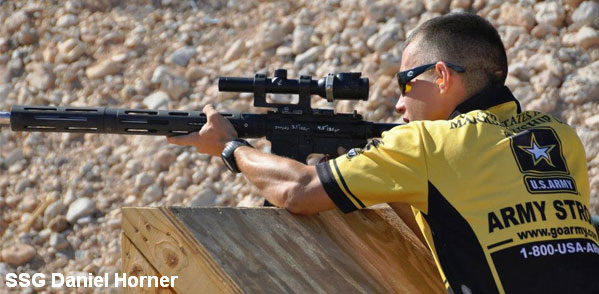
Most people compete in the Tactical Division, including 8-time Champion, SFC Daniel Horner of the U.S. Army Marksmanship Unit. Competitors in that division are not allowed a bipod, so many competitors utilize structures on the stage to stabilize their long gun. Regardless of division, the USPSA Multi-Gun Nationals is a true test of manipulating three different weapons, under pressure, on run-and-gun courses of fire. And the pressure is definitely on when a National Championship is on the line.
The 2017 Fort Benning Multi-Gun Challenge will be held November 16-19, 2017. This year there will be at least 12 stages, plus more than 40 guns on the prize table!
Rifle, pistol, shotgun. More guns = more fun. If you are curious about multi-gun matches, check out this video from Shooting USA. This episode covers the 3-Gun Match at Fort Benning, Georgia. This one-of-a-kind match is the only multi-gun competition where civilians can run-and-gun on an active U.S. Army installation. What’s more, at this match competitors get to ride in a Stryker armored vehicle and shoot Army weapons such as the M249 SAW and M203 Grenade launcher. The lure of playing with military hardware, along with the quality of the stages, makes this a hugely popular 3-Gun event which quickly sells out every year.
Interested in 3-Gun Shooting? Here’s an in-depth report on the Fort Benning Multi-Gun Challenge:
Getting Started in 3-Gun Competition
Thinking of getting started in 3-Gun competition? In this NSSF video, Top Shot Finalist Chris Cerino reviews the hardware you’ll need for multi-gun matches. Chris talks about carbine configurations — including barrel, handguard, and optics options. In reviewing shotguns, Chris discusses shotshell caddies and the high-capacity extended tubular magazines now available. Cerino also demonstrates pistol techniques and explains the key features of a belt/holster rig for 3-Gun competition.
SSG Dan Horner of the USAMU, a past winner of the 3-Gun Nation Championship, is one of the country’s best multi-gun competitors. Here Horner offers some tips on 3-Gun hardware, and safety procedures:
Adapting to New Equipment
There’s a lot of hardware in 3-Gun Competition. To succeed you need mastery of ALL the tools: “New competitors should know how to operate all their equipment. They should spend time getting familiar with their equipment. I spend exponentially more time ensuring the gear is right than I do shooting.”
Safety in 3-Gun Competition
Everyone practicing with shotguns, rifles and pistols must keep safety as top priority. “Obviously, safety is the No. 1 priority, but after that, the focus should be on developing specific skills,” noted Horner. A good three-gunner must not only be fast, but he or she must also be accurate and be able to adapt to a wide variety of shooting positions. And strategy is involved too. Successful 3-gunners develop a ‘plan of attack’ for each stage.
How’d you like to score a check for $25,000? That’s the winner’s pay-out for the 2017 NRA World Shooting Championship (WSC), which runs September 14-16 at the Peacemaker National Training Center in Glengary, WV. This event offers over $250,000 in cash awards and product prizes, making the WSC the richest combined shooting event in the USA (if not the world).
WSC Highlight Video with Competitor Interviews:
You can still Register for the WSC — though remaining spots are filling up fast. It ain’t cheap — Pros pay $395 while amateurs and juniors pay $325. Keep in mind though that all guns and AMMO are supplied. This unique 3-day multi-gun match tests competitors’ skills across twelve challenging stages involving nearly every major shooting discipline for rifles, shotguns, and pistols. REGISTER HERE.
All the Equipment is Supplied
“What makes this event very unique, especially to a professional shooter, is all the equipment is supplied. You have to leave your ego at home and just try to adapt as best you can to the equipment that you have supplied.” — Jerry Miculek
This major match attracts both sponsored Pros and “regular Joes”. For 2017, shooters will be split into two groups: a Professional Division for sponsored shooters, and the Amateur Division for non-sponsored competitors. All firearms, optics, and ammo will be provided by match sponsors for both divisions. “This year the NRA is going back to basics and returning the match to the original format of two divisions for professionals and amateurs, putting everyone on an even playing field”, said Cole McCulloch, NRA Competitive Shooting Director.
Video Shows 2014 World Shooting Champion SFC Daniel Horner in 3-Gun Stage
Cash Awards, Huge Prize Table, and New Random Drawings
The NRA World Shooting Championship will offer $250,000 in cash and prizes. Along with the $25,000 winner’s pay-out, there will be fat cash prizes for second and third place overall, High Lady, and High Amateur Junior. Then there are the prize tables — a real treasure trove. The designated Amateur prize table by itself will offer products and certificates topping $100,000 in value.
NEW Random Drawings — The WSC has added a new type of prize for 2017. Ten (10) Random Draw Prize Winners of $400 will be chosen during the WSC Awards Banquet. These random drawings give every competitor a chance to win cash, no matter what their event ranking.
Match entry fees are $395 for Professionals, $325 for Amateurs and Juniors. All firearms and ammunition are provided, and entry fees include one awards banquet ticket. For more information, visit WSC.NRA.org, call the WSC Coordinator at 703-267-1479, or email NRAhighpower@nrahq.org. On the official WSC.NRA.org you’ll find descriptions fo the 12 WSC stages. In addition, there is information about Peacemaker National Training Center and nearby lodging options.
How to Win the World Shooting Championship
“The format at the NRA World Shooting Championship is unique in that you don’t know what you have to shoot until you show up, so training for the event is a little difficult. My advice is to pack some good eye and ear protection, bring an open mind, be prepared to listen to the stage descriptions, figure out the best way you can take the guns they provide, and post the best score you can. When the match supplies all the guns and ammo, all you have to do is deal with ‘the performance’. This is the most level playing field in the shooting sports — anyone from around the world can come and play.” — Bruce Piatt, 2015 NRA World Shooting Champion
Competitors can register in one of two divisions: professional and amateur. The pro division is reserved for shooters who possess sponsorships, receive financial support for their competitive shooting or those who have been part of specialized firearms teams. All other shooters register in the amateur division. The playing field is completely level — every competitor uses the same guns, optics and ammunition. No competitors are allowed to bring their own gear, so everyone starts the match on equal footing.
For sheer “Fun with Firepower” it’s hard to beat a 3-Gun match at Raton, New Mexico. You get to play with lots of guns — rifles, pistols, and shotguns — while enjoying great views in one of North America’s most scenic shooting facilities. This past weekend many of the nation’s top 3-Gun aces were in Raton for the 2017 Rocky Mountain 3-Gun World Championship. This was held August 10-13 at the Whittington Center facility. Stages were conducted both on the designated rifle ranges as well as nearby hillsides.
In 3-gun matches, all stages are “on the clock”. Competitors need to be FAST and accurate.
There was a lot of Army black and yellow on the top of the podium, with USAMU shooters winning two divisions, along with the Team Event. SSG Joel Turner won the Open Division and SSG Tyler Payne won the Heavy Metal Scope Division. SFC Daniel Horner placed second in the Tactical Scope Division, while SFC Kyle McMaster finished second in the Tactical Irons Division. All four soldiers teamed up to win the Team Relay Shoot-Off competition to close out the event.
High-tech AR platform rigs are the rifles of choice for 3-Gun matches.
Who wouldn’t like a chance to shoot at the Whittington Ranges? What a backdrop!
Run ‘N Gun at 6000 feet
The Rocky Mountain 3-Gun (RM3Gun) is an action shooting match in the natural terrain of the NRA Whittington Center near Raton, NM. The riverbeds, mountains, trees and rocks provide props for the stages. There are 5 divisions: Open, Tactical Scope, Tactical Iron, He-Man Scope, and He-Man Iron.
RM3Gun is a very physical match, and Whittington’s 6000′ altitude makes things even tougher. The pace, thin air, and terrain challenge competitors’ fitness levels. The match has a healthy amount of long range rifle shooting. The match organizers state: “We try to strike a balance between rifle, shotgun and pistol, but you will definitely have lots of rifle because it’s one of the only places you can shoot as far in such a beautiful environment. Usually, we have some moving/aerial targets for the shotgun as moving targets are what the gun is designed for.”
On Ammoland.com, there’s an interesting article about the NSSF’s recent 3-Gun Fantasy Camp in Las Vegas. Author Duncan Johnson attended the Camp last month and wrote an “after action report”. He said the Camp was a great experience, and his shooting improved greatly with the expert tutoring from top pros: “If you have ever wanted to try a 3-Gun competition, just go do it, you will quickly find out why this is the fastest-growing shooting sport today. If you are new to shooting and or just getting started in 3-Gun, I 100% recommend you attend the NSSF Fantasy Camp.”
Here are Four Tips/Observations Duncan learned during the 3-Gun Fantasy Camp:
1. Use a Zoom Rifle Optic – “The LWRC 3-Gun ready rifle [provided for the Camp] was topped with a Leupold Mark 6 1-6x20mm riflescope, which made distance shooting much easier than the AimPoint optic [on my own AR]. 3-Gun competitions have rifle stages that can involve distance shooting out to ranges of 500 yards or more. For that reason, most shooters in the 3-Gun TacOps and Practical divisions use magnified riflescopes like the Leupold Mark 6 or the Vortex Strike Eagle.”
2. Use Your Quads and Core Muscles — “There are also a lot of little things that the pros teach you… For instance, some shooters instinctively bend their knees to enter their stance, but once they start firing they tend to follow the recoil with their shoulders and end up leaning back. In order to avoid that, use your quad muscles in your legs to get a solid stance that will absorb more recoil. Also use your core muscles to maintain a strong stance, especially in shotgun stages. The combination of strong quad and core muscles will contribute to controlling muzzle flip and moving onto your next target more easily.”
3. Vision-Based Target Transitions — “Another pro tip from Randi Rodgers on transitioning from target to target with a pistol was using your eyes rather than your sights to switch targets. So imagine it as pull the trigger, the slide starts to come back, using your eyes find the next target, then point with the front sight, find the sight picture, fire, and repeat.”
Editor’s Note: A few seasons back, I attended an action shooting seminar taught by Randi, and she explained the “move your eyes” technique. For multi-target stages, this really works. Move your eyes from target to target, and you’ll find your arms automatically “pull” the handgun into position. You still need to get the sights on target, but this method yields create smoother, faster stage runs.
4. Trigger Control and Use of Support Hand — If you don’t have good trigger control and pull straight back, you can move your sights during the shot. This is a common problem with novice pistol shooters. The solution is lots of dry fire training. Duncan found out he needed work: “In my case, the biggest area where I need improvement was shooting my pistol. There were two different things I was doing that will guarantee a missed shot every time with a handgun. When I pull/squeeze/depress my trigger I have a tendency to also pull the gun off target, resulting in a miss to the low left of a target. I [also] over-apply pressure with my shooting hand. According to the pros, pistol grip should be 40% shooting hand, and 60% supporting hand.”
This article originally appears on Ammoland.com, reprinted here under Creative Commons License.
Here’s the best reason to go to Las Vegas we know — to attend a shooting camp taught by some of the nation’s leading 3-Gun aces. In three weeks, the Clark County ranges will be ringing with the sounds of pistol, rifle, and shotgun rounds on steel…
April 20-23, 2017 NSSF presents its first-ever 3-Gun Shooting Sports Fantasy Camp, to be held at the world-class Clark County Shooting Complex in Las Vegas. This event features shooting instruction from some top pros, including Randi Rogers, Robert Vogel, Tommy Thacker, Dianna Muller, Ryan Muller, BJ Norris and Chris Cheng. You don’t even need to bring your bang-sticks — the program includes guns and all ammo (as well as meals and hotel accommodations). The April 2017 camp is sold out, but the NSSF plans more camps in the future.
During the 4-day session, “campers” will learn from the pros, practice techniques, have some friendly competitions, and, of course, enjoy Las Vegas nightlife (after the shooting stops).
Nevada’s Clark County Shooting Complex, located just North of Las Vegas, is the largest shooting facility in the United States. Opened in 2010, the modern 2,900-acre complex is a deluxe facility with multiple ranges, club-house, and even an RV park.
Hardware for 3-Gun Competition — Guns & Gear
In this NSSF video, Top Shot Finalist Chris Cerino reviews the hardware you’ll need for multi-gun matches. Chris talks about carbine configurations — including barrel, handguard, and optics options. Cerino also demonstrates pistol techniques and explains the key features of a belt/holster rig.
The year’s first Starlight 3-Gun Shootout, a unique night-time match, takes place March 10-11 at the Copperhead Creek Shooting Club near Marble Falls, Texas. When the sun comes down this Friday, March 10th, many of the world’s best 3-Gun shooters will add lights and lasers to their comp guns and compete for a trove of cash and prizes. This match is part of a series of night-time events to be held throughout the country in 2017.
Using laser sights and firearm-mounted lights, Starlight 3-Gun competitors will shoot seven stages over two nights, 4 stages Friday night and 3 stages Saturday. The Starlight 3-Gun Championship showcases spectator-friendly pyrotechnics and special effects. Match Director Chuck Anderson says “our goal isn’t just to create a challenging course of fire. We wanted to create a course of fire [with] lights, lasers, strobes, smoke and sound that would absolutely wow spectators, too.
The Starlight 3-Gun Match Series is the brainchild of Jim Shepherd, founder of the Outdoor Wire Digital Network. After Crimson Trace decided to “retire” its popular Midnight 3-Gun Invitational (M3GI) match in Oregon, Shepherd proposed taking the M3GI concept and growing it into a series of exciting night-time 3-gun events with eye-catching lighting effects.
Jim writes: “Shooting for speed and accuracy is challenging enough, but ‘doing it in the dark’ [is] far more impressive for spectators. Accuracy is part of the equation, but unlike precision shooting competitions, you’re racing the clock to shave tenths of seconds off your overall times.
We’ve described it as ‘drag racing with guns’. At the end of the competition, the lowest time wins. It’s a simple measurement system that makes it possible for spectators to actually know who’s leading the match at any given point. And that makes for engaged spectators. And that’s our goal — get people interested in shooting sports.”
One Hundred Men vs. One Hundred Women — get ready for the Battle of the Sexes at the Second Annual Babes with Bullets 3-Gun Challenge. The match takes place May 20th and 21st at the Miculek’s Shootout Range near Shreveport, LA. In this unique match, there will be an equal number of male and female participants, for a total of 200 competitors. The first place in men’s division will be a $2,000 check as will the first place in the ladies division. This match follows an “equal pay” philosophy rarely seen in the shooting sports. The prize tables, valued at over $50,000, will also be divided equally between men and women’s divisions. Each division will also have a junior and senior category.
Match directors state: “Our goal is to have an equal number of female and male participants. All competitors will shoot the same stages of fire, with the Women’s Domain and Men’s Domain scored separately. Equal play, equal pay!” Men’s and Women’s Domains will have separate prize tables with Tactical Optics Division winners guaranteed $2,000 cash OR first pick from the respective prize tables.
Otis Technology Sponsors Event Otis Technology, makers of gun cleaning products, is the presenting sponsor of the BWB 3-Gun Challenge. Otis’s Marketing Manager, Heather Pleskach, notes that “Last year’s inaugural match was a well-organized event that welcomed shooters from all experience levels. We couldn’t be more proud to continue our participation for 2017 and look forward to another successful event.” At this year’s 3-Gun Challenge, Otis Technology will partner up with Thompson Center/Smith & Wesson for an exciting side match at the event. Tracy and Lanny Barnes, former Olympic Biathletes, will be competing in the match on behalf of Otis.
About Babes with Bullets: Since 2004, Babes with Bullets have provided firearms handling and safety training for women. Co-founders Deb Ferns, camp director, and Kay Miculek, head instructor, have led these camps for almost thirteen years. See the 2017 camp schedule at BabeswithBullets.com.