|
|
April 18th, 2011
The .308 Winchester, a shortened version of the .30-06, has almost completely replaced the .30-06 in NRA competition. The .308 is required for Palma shooting, so it is also used by many Palma competitors in other long-range and mid-range prone matches. However, with the exception of M1 Garand matches, you won’t see many .30-06 rifles on the firing lines. Does that mean the .30-06 is obsolete? Is the .308 Win really much more accurate? Or does it just offer the advantages of reduced recoil and reduced powder consumption?

Cartridge photos courtesy Deuce45s.com, a leading source of specialized military cartridges.
In his Sibling Rivalry: .308 vs. .30-06 article on the Rifleman’s Journal site, German Salazar argues that the .30-06 remains a viable competition cartridge, particularly for the long-range game. This isn’t just a subjective opinion. German has data to back up the argument that the .30-06 can still do the job.
German compares the actual scores produced by his .308 Win rifles with the scores from his .30-06 rifles. German analyzes scores, over a two-year period, shot by “matched pair” rifles (one in each caliber) with similar actions, stocks, sights, and barrels. For comparison purposes, German also includes score data from his 6XC, a modern low-recoil chambering.

RESULTS: .308 Has Small Edge at Middle Distance, But .30-06 Is Better at Long Range
Surprisingly, the .30-06 performed nearly as well as the .308 at middle distances. The .30-06 delivered 99.2% of max possible scores vs. 99.5% for the .308 Win. Notably, at 1000 yards, the .30-06 racked up 97.7% of max scores vs. 97.3% for the .308 Win. So, at 1000 yards, the .30-06 actually proved superior to the .308 Win. German explains: “This isn’t too surprising when one considers [the .308’s] limited case capacity for the bullet weights typically used in Long-Range shooting. They just run out of steam and dip perilously close to the transonic range as they approach 1000 yards of flight. The extra 150 fps or so that can be safely obtained from the .30-06 case really pays off at 1000 yards.”
|
Mid-Range Comparison
In NRA Mid-Range matches (500 and 600 yards), the average score and percentage of possible score for each cartridge was as follows:
.308 – 597-36X (99.5%), 960 rounds fired
6XC – 596-35X (99.3%),1260 rounds fired
.30-06 – 595-31X (99.2%), 2580 rounds fired
If we look at the score averages, the .308 comes out on top at the Mid-Range distances… by 0.3% of the possible score. By the way, notice that the 6XC, as good as it is, simply straddles the .30 caliber cartridges; it is not the winner.
Long-Range Comparison
German rarely shoots the .308 in matches that are only 1000 yards; most of his 1000-yard .308 shooting is done in Palma matches which include 800, 900 and 1000 yards. To make the comparison useful, the Long-Range results are presented only as a percentage of the possible score and the 800- and 900-yard stages of Palma matches were NOT included.
In NRA Long-Range and Palma matches, the average percentage of possible score for each cartridge at 1000 yards was as follows:
6XC – 98.9%, 360 rounds fired
.30-06 – 97.7%, 460 rounds fired
.308 – 97.3%, 490 rounds fired
Editor’s Note: Among the three cartridges German studied, the 6XC actually proved best at 1000 yards, delivering 98.9% of the maximum possible scores. The .30-06 was second-best with 97.7%, slightly better than the .308 Win at 97.3%.
|
You’ll want to read German’s full Sibling Rivalry article, which includes an interesting history of the .30-06 and .308 in High Power shooting, along with tables showing German’s actual scores with his .30-06, .308 Win, and 6XC rifles.
March 17th, 2011
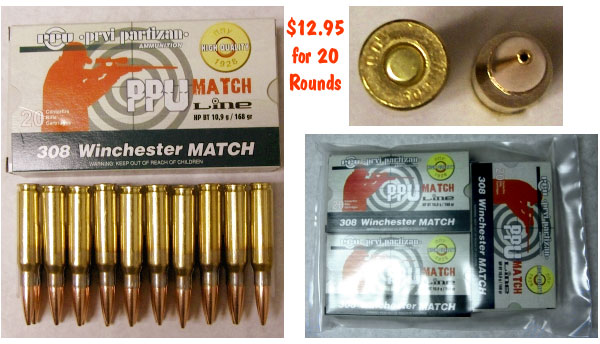
Need some quality factory-loaded ammo for your .308 Win? Wideners.com is offering a great deal right now on Prvi Partizan .308 Winchester Match ammunition, loaded with 168gr BTHP bullets. This is brand-new, 2009 production ammo with reloadable brass and boxer primers. There is no military crimp. Shooters using this ammo says it shoots to a similar point of impact as Federal Gold Medal match ammo. Accuracy-wise, we expect this could shoot 1.5 MOA or better in a good rifle. The price is just $12.95 for 20 rounds or $318.75 for 500 rounds. Compare that to $34.00 or more for a 20-round box of Federal Gold Medal Match loaded with 168gr SMKs (Midsouth price). If you have an M1A, the Prvi Partizan is a good choice for training ammo — just don’t expect accuracy on a par with the more expensive, American-made .308 Win ammo.
Story sourced by Edlongrange.
December 7th, 2009
Adam Braverman of Nammo-Lapua just confirmed that Lapua, at the behest of the U.S. Palma team, has been quietly developing a NEW version of the .308 Winchester cartridge that has a small BR-style primer pocket. That’s right, this is no joke. Lapua has crafted small primer pocket .308 Winchester brass that will be introduced at SHOT Show in Las Vegas (Jan. 19-22).

The new .308 variant is identical to Lapua’s current .308 match brass with the exception of the primer pocket. The brass will be head-stamped “.308 Win Lapua Palma”.
FLASH HOLES: The flash-hole size for the current pre-production .308 Lapua Palma brass is 1.5mm (.059″), the same as Lapua 6mmBR and 220 Russian brass. Lapua spokesmen were not certain if the flash hole size will change for the regular production brass. Note: if you have a Redding .308 die, you can ask Redding for a smaller decapping rod tip (.057″) to use with the new brass.
Tests Reveal Better ES and SD with Small Primers
Initial tests of the small primer pocket .308 by U.S. Palma team members have been very promising. The small primer pocket case seems to have advantages in both accuracy and the ability to handle high-pressure loads. However, the primary improvement found with the smaller primer is reduced ES and SD. Palma Team members have found that, with almost every brand of primer tested (small vs. large), the smaller version has yielded reduced Extreme Spread and Standard Deviation. This pays dividends in 1000-yard shooting. Also, some testers believe that small primers are more consistent and require less sorting — and that there are more varieties of small primers that seem to work really well in the .308 case. Moreover, the small primer types are more uniform, from lot to lot, than are large primers, according to some testers. More info will follow later today.
November 19th, 2009
SFC Emil Praslick III sent us this report on the U.S. Palma Team tryouts at Camp Butner, NC. You can read other reports from Coach Praslick on the U.S. National Rifle Team Blog.
Last Tryout in the Books… On to the National Team
By Coach Emil Praslick
It was a hardy and intrepid group of US Palma Team hopefuls that braved the last vestiges of Hurricane Ida last weekend at Camp Butner, North Carolina. Camp Butner is the home range of the North State Shooting Club, which hosted the US Palma Team’s third and final tryout session. Temperatures in the 40s, winds from 20-30 mph, and a driving rain tested the mettle of both coaches and shooters.
 US Team Captain, Dennis Flaharty flung his net across the entire United States in a search for the best team shooters. By adopting a regional format for the tryouts, and separating the country into three areas (West Coast, Midwest, and East Coast), the team maximized the potential for attracting the best shots our vast nation has to offer. The three venues were: Sacramento, CA; Lodi, WI; and Butner, NC. At each venue, the top performers were invited to become members of the United States National Developmental Team. US Team Captain, Dennis Flaharty flung his net across the entire United States in a search for the best team shooters. By adopting a regional format for the tryouts, and separating the country into three areas (West Coast, Midwest, and East Coast), the team maximized the potential for attracting the best shots our vast nation has to offer. The three venues were: Sacramento, CA; Lodi, WI; and Butner, NC. At each venue, the top performers were invited to become members of the United States National Developmental Team.
New Team Tryouts Format
The format for the tryouts was different than any ever conducted by the United States. In the past, these events were held very much like individual matches. Shooters were evalauated by the scores they shot in a series of matches. While this undoubtedly picked the best individual shooters, those who experienced difficulty doping the wind, or those who simply shot during more difficult conditions, were often deselected early in the process. The current procedures call for shooters to be supervised by coaches at all times. This not only removes a shooter’s ability to negotiate wind from the process, it also gives the team management the opportunity to evaluate prospective coaches and to work on firing line procedures. Shooters are graded on their ability to shoot “elevation”, their speed, and their overall performance as part of the team.
The intent of forming a National Developmental Team was to establish a pool of skilled, international-quality shooters; not only for the upcoming 2011 Palma Match in Australia, but as the nucleus for future teams. The US National Team has an ambitious schedule for 2010, with trips to Canada, Camp Perry, Raton (NM) for The Spirit of America Matches, and Australia.
 The next milestone for the US National Developmental Team is to finish the processing of the shooter’s elevation data, and to begin planning which shooters will represent the United States at the planned events. Shooters will then be evaluated in match conditions and recieve further training/evaluation prior to the final Palma Team selection in the Fall of 2011. The next milestone for the US National Developmental Team is to finish the processing of the shooter’s elevation data, and to begin planning which shooters will represent the United States at the planned events. Shooters will then be evaluated in match conditions and recieve further training/evaluation prior to the final Palma Team selection in the Fall of 2011.
I would like to thank all of the volunteers who assisted with the target pulling, scoring, running the firing line, and the host of myriad tasks that are necessary to conduct an event of this complexity. I would also like to thank the coaches who coached 400 rounds per day at 1000 yards with no complaint. It was a grueling (but very beneficial) exercise for them. We will announce the final US National Developmental team soon.
TWITTER: You can also follow the US National Team on Twitter. Visit www.twitter.com/usnationalrifle for the latest news.
|


