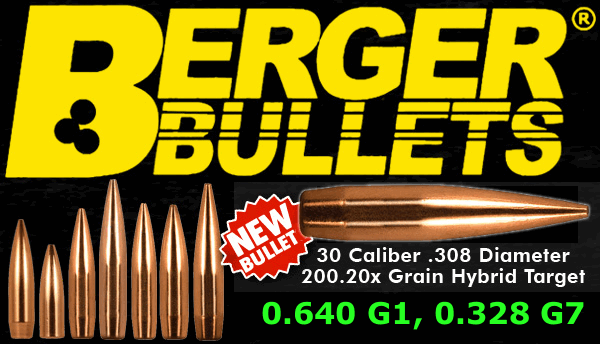
Got Bullets? Right now Midsouth Shooters Supply is running a big sale on Berger Bullets, including many Hybrid and VLD match projectiles in all the popular calibers. You can save $3-$5 on a 100-count box. CLICK HERE for BERGER BULLETS SALE.
Here are some of the best deals we found on some of the most popular Berger Bullets, caliber by caliber. Berger’s 7mm 180gr Hybrid is the bullet-to-beat in F-Open competition, and the new 200.20X is favored by many top F-TR shooters, including members of the world-championship-winning F-TR Team USA. The Berger 6mm 105gr Hybrid Target has long been a favorite of Benchrest, High Power, and PRS shooters, as loaded up in match rifles chambered for 6mmBR, 6mm Dasher, 6XC, or 6mm Creedmoor.
.20 Caliber 35gr Match Varmint HP, $24.43 marked down from $27.18 .22 Caliber 80gr Match Target VLD, $29.13 marked down from $32.40 .243 Caliber (6mm) 105gr Match Hybrid Target, $34.46 marked down from $38.32 .264 Caliber (6.5mm) 130gr Match Target VLD, $42.44 marked down from $47.21 .284 Caliber (7mm) 180gr Match Hybrid Target, $47.61 marked down from $52.96 .30 Caliber 200gr 200.20X Match Hybrid Target, $49.65 marked down from $55.22
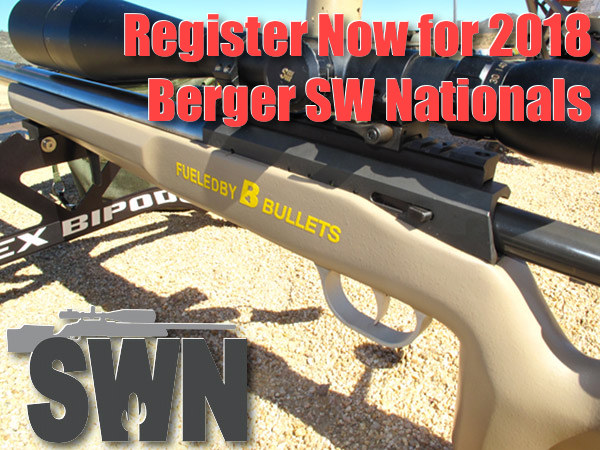
Registration has opened for the 2018 Berger Southwest Nationals at the Ben Avery Range in Phoenix, Arizona. This is a GREAT match, the best in the West by far. The match runs February 5-11, 2018. By all means, attend if you can. The Grand Agg filled up last year, so we recommend you register soon.
Berger’s SWN team reports: “Registrations for the 2018 Southwest Nationals open on Sunday, August 27th, at 6:00 am (PST). CLICK HERE for the Match Program (it is also available on the Desert Sharpshooters website and Berger Bullets website). We are also moving to an online registration this year, and entry fees will be paid online. Please note that due to our capacity limitations, each stage of the match is listed as a separate event. Please be sure to enter each of the stages you plan to participate in. This will allow us to include as many people as possible. If you have any questions, send email to michelle.gallagher [at] bergerbullets.com.”
Rekindle Old Friendships and Meet New Friends
Some shooters come to to the SW Nationals for the swag (the prize table is amazing). Others come for the sunshine (think warm 75-85° weather). And even more folks come to try out their shiny new toys and to test their skills against the nation’s best shooters.
But we’d say the number one reason most folks make the pilgrimage to Ben Avery every year is the camaraderie — the chance to connect with friends, rekindling connections that may go back decades. Fundamentally, then, the Berger SWN is about the people. For many of us, this is the only time of the year when we get a chance to meet fellow shooters from distant corners of the USA (and other nations).
Compete Against the Best
If you want to test your mettle against some of the best shooters in the world, get yourself to Ben Avery in February. Here you can compete, shoulder to shoulder, against the best Sling and F-Class shooters on the planet. Guys like Derek Rodgers (newly-crowned F-TR World Champion), John Whidden (reigning Long Range National Champion), Nancy Tompkins (the first women to win the National High Power Championship), and Kenny Adams (past World F-Open Class Champion). If you want to play in the Big Leagues, Ben Avery is the place. Having said that, novice shooters will enjoy the experience as well, because you’ll find that these top shooters are (almost universally) happy to share their knowledge.
Just to whet your appetite, here are videos from recent Berger SW Nationals. Yes, this match is as much fun as it looks!
Berger SW Nationals 2017
The North-by-Southwest team set new National Records in winning the 2017 F-TR team event.
Berger SW Nationals 2016
Berger SW Nationals 2015
The Brain Trust — Experts Galore
The best minds of the shooting world come to Ben Avery every year. Got a question about ballistics? Well, Ballistics Guru Bryan Litz (photo below) will be happy to answer your questions between relays. Want some expert advice about wind reading? Seek out Mid Tompkins (usually found hanging around the club-house) or Emil Praslick, one of the most knowledgeable wind coaches on the planet. And if you have a gunsmithing question, you’ll find some of the top barrel-fitters and stock makers, including Doan Trevor and Gary Eliseo.
John Whidden of Whidden Gunworks has won his fifth Long Range National Championship, his second title in a row (he also won the LR Title in 2016). This year, competing at Camp Atterbury in Indiana, Whidden pulled together a gritty, come-from-behind victory. John won the title by shooting a perfect 450-28X (not dropping a point) in the final Palma match on the last day of the Long Range Championship. While Whidden, who finished at 1246-91X, edged runner-up Phillip Crowe (1245-68X) by just one point, John enjoyed a huge X-Count margin. Finishing third was past High Power and Long Range National Champion Nancy Tompkins (1244-65X). Here are the Top Ten finishers:
Whidden’s Perfect Palma Match
Whidden secured the 2017 LR Title by shooting “clean” (not dropping a point) in the tough Palma competition. In the NRA Palma match, rifles must be .223 Rem or .308 Winchester, with metallic sights (no scopes). The match is conducted at three yardages, 15 shots at each distance of 800/900/1000 yards, with unlimited sighters at 800 and two sighters at 900 and 1000.
John liked the Camp Atterbury facility and he credited his equipment for his 2017 victory: “With the change to the new Camp Atterbury venue, many shooters were a little unsure how things were going to shake out. But it all turned out really well. All of my equipment shot fantastic all week long — that certainly made shooting a big score easier.”
Whidden’s Championship-Winning Rifle
Since John captured his fifth Long Range crown with a superb performance in the Palma match, we thought we’d give readers a look at John’s very special Palma rifle. This unique .308 Win prone rifle features a Barnard “P” action in a converted aluminum Anschutz “Precise” smallbore (rimfire) stock. The combo of Barnard action and Anschutz ergonomics is hard to beat, says John, who told us: “this is easily the best Palma rifle I’ve ever had.” John told us this gun handles like no other: “After recoil, with this Anschutz stock, the sights fall right back on target — better than any other prone rifle I’ve shot”.
As a bonus, the Barnard “drop-in” required no modification of the Anschutz Precise stock. This means John can actually swap in his rimfire barreled action and shoot smallbore with the same stock.
Sling Rifle Evolved: The Ultra-Accurate Hybrid Palma Rifle
by John Whidden
The mental component of Long Range competitive shooting is always challenging but having tremendous confidence in the accuracy of your equipment is a huge benefit. There’s nothing to start your Palma match off well like knowing that you are shooting the most accurate Palma rifle you’ve ever owned.
Whidden Palma Rifle
Action: Barnard “P” (three lugs, 60° bolt lift)
Barrel: Bartlein 32″, Light Palma contour, cryo-treated by 300 Below.
Stock: Anschutz Precise aluminum smallbore stock, set up for centerfire barreled action.
Trigger: Barnard Two-Stage adjustable
Whidden’s Wonder-Gun: German Stock, New Zealand Action, American Barrel
John built this Palma rifle in early 2016. With it, John won back-to-back long-range Championships in 2016 (Camp Perry) and 2017 (Camp Atterbury). The major components are: Barnard ‘P’ action, Anschutz Precise smallbore stock, and Bartlein barrel. The caliber is .308 Win, as dictated by the Palma rules. Palma matches are fired from 800, 900, and 1000 yards utilizing iron sights only. No optical sights are allowed.
The Anchutz Precise stock is so well-designed that once I finished adjusting the details, I realized that my hold was about 1/3 smaller than with the stocks I shot previously. While in recoil the gun will track vertically and fall back down right on my own target just as it should. In the past, with my other Palma rifles, it was frankly sometimes a struggle to get them to settle back on target after a shot.
Whidden Gunworks has installed a variety of different actions in the Anschutz Precise stocks. Though the stocks are designed for the .22 LR caliber 2013 action rifles, we’ve successfully installed Barnard, Kelbly, Bat, Nesika, and Remington clone actions into them. The Barnard Model P makes a particularly simple installation because there is no modification necessary to the stock at all. A competitor can then shoot both his centerfire rifle as well as his smallbore gun in the exact same stock. The location of the trigger and bolt handle on the Barnard are positioned just right to make this work. Other actions do require at least some amount of modification to the stock, and we have found the Barnard works the best.
Barnard manufactures several models of actions as part of their lineup. All of the actions in the lineup use three lug bolts which give a shorter 60-degree bolt lift when opening and closing. All of the critical surfaces are machined after heat treating. This means that they are exceptionally true and square, more so than other actions. The Model P action is most familiar to Palma and F-Class shooters and are commonly seen on the firing line. The fact that Model P actions include an excellent two-stage trigger makes also the pricing very attractive.
Based on my previous excellent experiences, I selected Bartlein barrels for this rifle. When shooting internationally in the Palma matches we are restricted to 155 grain .308 bullets, but I made the unusual choice of a 1-10″ twist for these bullets. I’ve shot this fast twist for some years with the 155s with good success and it’s pleasing to know that Bryan Litz is finding benefits in some cartridges to shooting faster twist rates than we previously thought we needed. The load is Vihtavuori N140 Powder with Berger 155gr Hybrid bullets. The chamber is the 2011 Palma and the barrel is a Light Palma contour finished at 32” length. The barrel was cryo-treated by 300 Below. The point of impact isn’t changed at all by barrel heating and the accuracy is incredible regardless of the temperature of the barrel. This can’t be said of all the barrels I’ve owned.
Get Your Own Whidden Wonder-Gun for $4500.00
Like what you see — but wonder how much it will cost? Whidden Gunworks can build you a rig like this, fitting a centerfire barreled action in the Anschutz Precise stock. John tells us: “The price of a rifle like this one but without sights or mounts would be just under $4500.00. We attempt to keep all of the parts except the stock in inventory, so lead time should be under eight (8) weeks.”
Stock Offers Great Adjustability One thing that is quickly noticed about the Anschutz Precise stock is its adjustability. The engineers did a very good job of allowing many of these adjustments to be made while in the shooting position, most notably the cheekpiece adjustments. When a shooter picks up a Precise stock for the first time they also notice how narrow the fore-end is. This really contributes to reducing the pain in the forward hand in prone when shooting with a sling. This stock is, by far, the most comfortable sling stock I’ve ever handled.
This rifle was very accurate right away and very comfortable to shoot. I’ve built some really good shooting Palma rifles but this is easily the best Palma rifle I’ve ever had. The Barnard action with its superb quality and excellent two-stage trigger has been the best choice I could have made. When you can go to the firing line knowing that you have the very best, the foundation for success has been set.
Some major players in the shooting world — Lapua and Berger Bullets, have joined forces under the Nammo AS umbrella. And now, along with Vihtavuori and SK, these businesses will be operated together as Capstone Precision Group, LLC. And Capstone will soon have a new facility in Missouri. A new 30,000-square-foot logistics center has been leased in Pettis County, outside Sedalia. From here, products will be sent to dealers and wholesalers throughout the USA. Capstone Precision Group will invest almost $1 million to launch the new facility.
Missouri’s Governor welcomed Capstone: “Capstone Precision Group’s decision to grow its business in Missouri is great news for families in rural Pettis County. This new distribution center means new quality jobs for hard working Missourians,” said Gov. Eric Greitens. “We’re grateful to Capstone Precision Group for recognizing that Missouri is open for business and our people are ready to work.” LINK: Missouri Department of Economic Development.
NEW Logistics Center for Capstone Precision Group
Nammo AS, an international aerospace and defense company headquartered in Norway, announced that the newly-formed Capstone Precision Group LLC will launch its U.S. logistics center in Pettis County, outside Sedalia. This facility will be the U.S. logistics center for Capstone Precision Group’s four commercial ammunition brands — Lapua, Berger, VihtaVuori, and SK. Additionally, ammunition, components, and smokeless powder will be imported from Finland and Germany and distributed in the U.S. and also exported, while projectiles from the company’s Mesa, Arizona, location will be shipped to Missouri for packaging and distribution.
We know many of our readers aren’t 100% clear on the difference between a secant ogive bullet and a tangent ogive bullet. Add the “blended” or “hybrid” ogive into the design equation and you add to the confusion. In this article, Berger Ballistician Bryan Litz, explains the characteristics of the three popular ogive types: tangent, secant, and hybrid.
In discussions of ballistics, you’ll see references to “tangent” and “secant” bullet shapes. For many readers, these terms can be confusing. To add to the confusion, bullet makers don’t always identify their projectiles as secant or tangent designs. This article provides a basic explanation of tangent and secant designs, to help you understand the characteristics of both bullet shapes.
Tangent vs. Secant vs. Hybrid
Most match bullets produced today use a tangent ogive profile, but the modern VLD-style bullets employ a secant profile. To further complicate matters, the latest generation of “Hybrid” projectiles from Berger Bullets feature a blended secant + tangent profile to combine the best qualities of both nose shapes. The secant section provides reduced drag, while the tangent section makes the bullet easier to tune, i.e. less sensitive to bullet seating depth position.
Berger Bullets ballistician Bryan Litz explains tangent and secant bullet ogive designs in a glossary section of his Applied Ballistics website, which we reprint below. Bryan then explains how tangent and secant profiles can be combined in a “hybrid” design.
How Bullet Ogive Curves are Defined
While the term “ogive” is often used to describe the particular point on the bullet where the curve reaches full bullet diameter, in fact the “ogive” properly refers to the entire curve of the bullet from the tip to the full-diameter straight section — the shank. Understanding then, that the ogive is a curve, how is that curve described?
LITZ: The ogive of a bullet is usually characterized by the length of its radius. This radius is often given in calibers instead of inches. For example, an 8 ogive 6mm bullet has an ogive that is a segment of a circular arc with a radius of 8*.243 = 1.952”. A .30-caliber bullet with an 8 ogive will be proportionally the same as the 8 ogive 6mm bullet, but the actual radius will be 2.464” for the .30 caliber bullet.
For a given nose length, if an ogive is perfectly tangent, it will have a very specific radius. Any radius longer than that will cause the ogive to be secant. Secant ogives can range from very mild (short radius) to very aggressive (long radius). The drag of a secant ogive is minimized when its radius is twice as long as a tangent ogive radius. In other words, if a tangent ogive has an 8 caliber radius, then the longest practical secant ogive radius is 16 calibers long for a given nose length.”
Ogive Metrics and Rt/R Ratio
LITZ: There is a number that’s used to quantify how secant an ogive is. The metric is known as the Rt/R ratio and it’s the ratio of the tangent ogive radius to the actual ogive radius for a given bullet. In the above example, the 16 caliber ogive would have an Rt/R ratio of 0.5. The number 0.5 is therefore the lowest practical value for the Rt/R ratio, and represents the minimum drag ogive for a given length. An ogive that’s perfectly tangent will have an Rt/R ratio of 1.0. Most ogives are in between an Rt/R of 1.0 and 0.5. The dimensioned drawings at the end of my Applied Ballistics book provide the bullets ogive radius in calibers, as well as the Rt/R ratio. In short, the Rt/R ratio is simply a measure of how secant an ogive is. 1.0 is not secant at all, 0.5 is as secant as it gets.
Hybrid Bullet Design — Best of Both Worlds?
Bryan Litz has developed a number of modern “Hybrid” design bullets for Berger. The objective of Bryan’s design work has been to achieve a very low drag design that is also “not finicky”. Normal (non-hybrid) secant designs, such as the Berger 105gr VLD, deliver very impressive BC values, but the bullets can be sensitive to seating depth. Montana’s Tom Mousel has set world records with the Berger 105gr VLD in his 6mm Dasher, but he tells us “seating depth is critical to the best accuracy”. Tom says a mere .003″ seating depth change “makes a difference”. In an effort to produce more forgiving high-BC bullets, Bryan Litz developed the hybrid tangent/secant bullet shape.
Bryan Litz Explains Hybrid Design and Optimal Hybrid Seating Depths
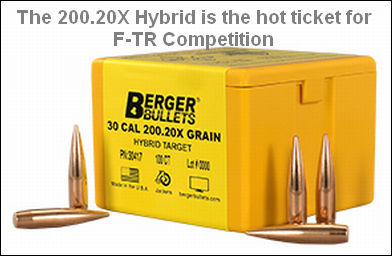
Berger Bullets’ much-awaited 200.20X bullet is now available at Midsouth Shooters Supply for $54.65 per 100*. That’s not inexpensive, but this new design could well prove to be the “bullet to beat” for F-TR competition with the .308 Win cartridge. With a high Ballistic Coefficient (0.640 G1, 0.328 G7), the new 200.20X Hybrid Target projectile (Part #30417) should have less wind drift than other .30-caliber bullets in its weight range. The new 200.20X is even more slippery than Berger’s own older 200gr Hybrid (Part #30427), which has a 0.316 G7 BC. The 200.20X bullet has a shorter bearing surface than Berger’s 200gr Hybrid, which should allow higher velocities, and (perhaps) enhanced barrel life. The shorter bearing surface also makes this bullet easy to load and shoot in standard chambers, which means you don’t need a special long-throated reamer to make it work.
The new 200.20X has a 0.328 G7 BC compared to 0.316 G7 for the older 200 grain .30 caliber Hybrid. That’s a significant, 4% reduction in drag. Recommended twist for the new bullet is 1:10″, same as with the earlier 200-grainer.
Tested and Endorsed by U.S. Rifle Team (F-TR)
Developed with extensive testing by U.S. Rifle Team members, Berger’s new 200.20X bullet is optimized for F-TR competition with the .308 Win cartridge. Compared to the standard 200 grain Hybrid Target, the 200.20X has a longer boat tail, longer nose, and a shorter bearing surface. The longer nose and tail of the 200.20X allow the bullet to fly with less drag and a higher BC, which means fewer points lost to wind. Like other Berger Hybrid designs, this bullet is more “forgiving” about seating depths that pure VLD designs. Shooters should find that the 200.20X works well at various OALs, both “jumped” and seated into the lands. Bryan Litz recommends starting with this bullet .020 or more off the lands. When the bullet is jumped a bit, the accuracy should hold pretty well even as the throat moves out.
After extensive field testing at 600-1000 yards, the U.S. Rifle Team (F-TR) has named the Berger 200.20X as the Team’s official bullet of choice. Shown above are Dan Pohlabel and Bill Litz (shooter).
*Grafs.com ($52.99/100) and PrecisionReloading.com ($53.99/100) will also sell this new bullet, but both these vendors are currently awaiting delivery. We’re told that supplies should arrive soon.
This is a very interesting development. Federal will produce a line of Federal Gold Medal ammunition loaded with Berger Bullets match projectiles and GM Match primers. The new Gold Medal Berger ammo will initially be offered for: .223 Remington, 6.5 Grendel, 6.5 Creedmoor, and .308 Winchester. We expect this ammo to attract the attention of tactical and PRS shooters — Berger projectiles are currently favored by top PRS competitors. Depending on caliber, three different high-BC bullet types will be used: BT Target, Hybrid OTM, or Juggernaut OTM. These all feature a boat-tail design with a high BC for bullet weight. The 6.5 calibers will use Berger’s popular 130gr Berger Hybrid OTM bullet while the .308 Win uses the 185gr Juggernaut.
This new Gold Medal Berger ammo uses Federal Gold Medal match primers, Federal brass, and specially-formulated propellants. All the ammo is well under SAAMI-spec max OALs to function 100% in magazines. Federal says this ammo will “adhere to Federal Premium’s strictest specifications for accuracy, pressure and velocity”. This new GM Berger ammo line could be a match-worthy alternative for guys who don’t want to hand-load. We’re going to try some in 6.5 Creedmoor and see how it performs in terms of accuracy, ES/SD, ballistics, and temp stability. Should be an interesting test…
FEATURES of Gold Medal Berger Ammo:
• Most popular bullets at Precision Rifle Series events
• High ballistic coefficient
• Less wind drift and drop (than typical factory ammo)
• Excellent long-range accuracy
• Gold Medal match primer
There’s a talented new team getting ready for the 2017 King of 2 Miles (KO2M) Competition in Raton, NM next month. The team features ace F-Class shooters Ian Klemm and Dan Pohlabel. Here’s a build report from X-Treme Shooting Products, which supplied the impressive XTSP action and two-stage trigger.
Big Gun for King of 2 Miles Event at Raton
XTSP: “It’s exciting — we’re getting closer to the 2017 King of 2 Miles match next month. Here are a few pictures of one of the rifles we will be shooting. Owned and built by Dan Pohlabel, it’s a .338 Lapua Magnum Improved. It has a 40° shoulder and we plan on shooting .338 Caliber 300 grain Berger OTM projectiles at around 3,100 fps.”
“We started off with an XTSP .338 Magnum receiver, custom-built as a single shot with a solid bottom for stiffness. We built +60 MOA rails for each of the rifles. Of course we’re using the XTSP two-stage trigger! We added a 34″-long Bartlein gain-twist barrel which is 1.450″ at the shank tapering to 1.2″ at the muzzle. At the end we added Piercision Rifles’ 3/4 x 24 slabbed 5-Port ‘Muscle Brake’. The action is bedded in a McMillan Super Magnum stock. On top sits a Vortex Optics HD Razor in Vortex 35mm rings. We’ll have another rifle just like it shortly with the machine work by Dan Pohlabel again. That second rifle will be finished up and shot by Ian Klemm of Vortex Optics.”
Here’s a file photo of a .338 Lapua Magnum Improved, alongside a standard .338 Lapua Magnum. We’re not sure about the shoulder angle on this particular example. For the XTSP project, the angle is 40 degrees (40°). Photo Courtesy LongRangeHunting.com.
Applied Ballistics has produced a series of YouTube videos about precision long range shooting. Featuring ace long-range shooter and professional ballistician Bryan Litz, these videos address various topics of interest to long-range marksmen. This featured video looks at Long Range mistakes — Bryan Litz reveals the most common ballistics-related shooting errors at Long Range. And then Bryan explains how to improve your shooting (and wind reading) to eliminate those common errors.
Watch Applied Ballistics Video about Common Mistakes in Long Range Shooting:
Bryan Litz of Applied Ballistics often hears the question: “What are the main reasons people miss their target at long range?” To answer that question, in this video, Bryan explains the most important variables in Long Range shooting. Bryan says: “Probably the number one thing is range — you have to have a [precise] range to your target because your bullet is dropping, and to hit the target you need to correct for bullet drop.” Distance may be indicated on the target bay (or berm), but for open ranges you should ascertain distance-to-target with a quality laser rangefinder. Even when the distance to target is shown with a sign or marker, you may want to confirm the distance with your rangefinder. (You may be surprised — we’ve seen marked target distances at commercial ranges off by 25+ yards!) Bryan says: “Get a good laser range to the target and you’ll be within a couple yards”.
After distance to target, the most important variable is the wind. This is the most challenging factor because the wind is constantly changing. Bryan explains: “After 300 or 400 yards, the wind [will] move your shots off the target if you don’t correct for it. The best way to account for the wind is to measure it at your location with a Kestrel. The Kestrel can give you the speed and direction of the wind at your location, which can baseline your wind call for your long-range shot.” Bryan acknowledges that there will still be variables: “The wind isn’t always blowing the same downrange as at your location… and the wind is always changing”. Bryan notes that you need to account for variances in wind between the time you gauge the wind angle and velocity and the time you actually you take your shot.
Berger Twist-Rate Stability Calculator
On the updated Berger Bullets website you’ll find a handy Twist-Rate Stability Calculator that predicts your gyroscopic stability factor (SG) based on mulitiple variables: velocity, bullet length, bullet weight, barrel twist rate, ambient temperature, and altitude. This very cool tool tells you if your chosen bullet will really stabilize in your barrel.
LIVE DEMO BELOW — Just enter values in the data boxes and click “Calculate SG”.
How to Use Berger’s Twist Rate Calculator
Using the Twist Rate Calculater is simple. Just enter the bullet DIAMETER (e.g. .264), bullet WEIGHT (in grains), and bullet overall LENGTH (in inches). On its website, Berger conveniently provides this info for all its bullet types. For other brands, we suggest you weigh three examples of your chosen bullet, and also measure the length on three samples. Then use the average weight and length of the three. To calculate bullet stability, simply enter your bullet data (along with observed Muzzle Velocity, outside Temperature, and Altitude) and click “Calculate SG”. Try different twist rate numbers (and recalculate) until you get an SG value of 1.4 (or higher).
Gyroscopic Stability (SG) and Twist Rate
Berger’s Twist Rate Calculator provides a predicted stability value called “SG” (for “Gyroscopic Stability”). This indicates the Gyroscopic Stability applied to the bullet by spin. This number is derived from the basic equation: SG = (rigidity of the spinning mass)/(overturning aerodynamic torque).




 One thing that is quickly noticed about the Anschutz Precise stock is its adjustability. The engineers did a very good job of allowing many of these adjustments to be made while in the shooting position, most notably the cheekpiece adjustments. When a shooter picks up a Precise stock for the first time they also notice how narrow the fore-end is. This really contributes to reducing the pain in the forward hand in prone when shooting with a sling. This stock is, by far, the most comfortable sling stock I’ve ever handled.
 We know many of our readers aren’t 100% clear on the difference between a secant ogive bullet and a tangent ogive bullet. Add the “blended” or “hybrid” ogive into the design equation and you add to the confusion. In this article, Berger Ballistician Bryan Litz, explains the characteristics of the three popular ogive types: tangent, secant, and hybrid.
 Hybrid Bullet Design — Best of Both Worlds?