With miles of aisles and thousands of new products, the annual SHOT Show in Las Vegas is a near-overwhelming circus. There is so much to see, with scores of new products from around the globe. For this story, we start off with the official SHOT Show 2020 Day 4 Highlights video, a revealing look at the SHOT Show experience. Following that you’ll find six videos covering notable new products. Check out new Berger bullets, a new custom rimfire action, plus the radical new $5000 Laugo Alien pistol.
New RimX Rimfire Action with Rem 700 Footprint
We are always interested in new custom rimfire actions. With the growth of the NRL22 rimfire series, and potent rimfire varmint cartridges such as the .17 HMR and .17 WSM, we think the interest in rimfire custom rifles is growing. This video features the new RimX rimfire action. This features a Remington 700 footprint so it can fit a wide variety of stocks made for Rem 700s and Rem clones. That allows PRS guys to cross-train with a rimfire rifle that duplicates the ergonomics and feel of their centerfire match rifle.
This RimX action has some very cool features, such as interchangeable bolt heads so it can shoot .22 LR, .17 HMR, and (soon) .17 WSM. RimX action MSRP is $1150.00. Each bolt face features a non-protruding extraction system that allows for a flat breach face barrel to be installed without the need for timed extractor relief. This will make barrel interchangeability and installation easier than ever
Berger Bullets — New LR Hybrid Target and Hunting Bullets
At SHOT Show 2020, the big news from Berger Bullets was the arrival of new Berger Long Range Hybrid Target (LRHT) bullets and hunting bullets. Berger now offers some seriously big LRHT Bullet. Before the show, Berger announced the 7mm 190gr LRHT. At SHOT on Tuesday Berger showcased two new High-BC .30-Caliber LRHTs — the new 208gr and 220gr projectiles. All these LRHTs feature formed meplats for ultra-consistent BCs. In addition Berger unveiled two new heavy-for-caliber hunting bullets: The 6.5mm 156gr EOL Elite hunter and the .30 Cal 245gr EOL Elite hunter. In this video, Emil Praslick III explains the features of the new LRHT projectiles.
Laugo Arms states that its Alien pistol has the lowest bore axis of current semi-auto handguns. The barrel is fixed — it does not tilt-up like most semi-autos. Having shot the Alien at Industry Day on 1/20/20, we can confirm that the low bore axis does reduce muzzle flip, allowing very fast follow-up shots. With a fixed center rib, only the sides of the slide move back and forth. Initially only 500 Alien Special Editions will be offered, at the insane price of $5000.00 per pistol. You read that right — $5000 USD. Of course, in a year or two standard models should be available for a fraction of that cost.
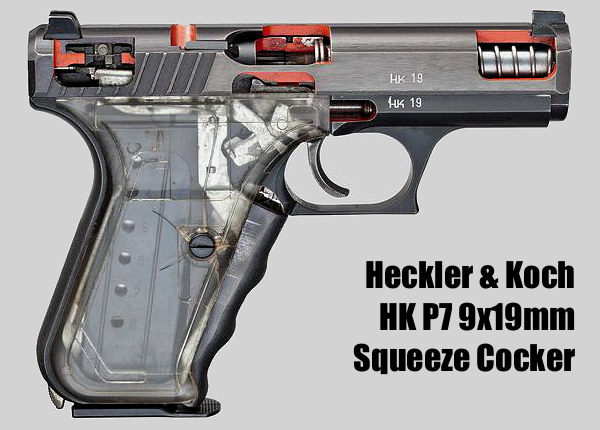
This Alien pistol has been hailed as revolutionary. However, the Heckler & Koch P7 series of pistols had most of the Alien’s notable features way back in 1976 — 44 years ago. Like the Alien, the P7m8 and PSP featured a fixed barrel, low bore axis, and gas-delayed blowback operated slide. The HK P7s also had a unique squeeze cocker grip that eliminated the need for a manual safety.
H&K unveiled fixed barrel, low bore axis P7 pistol in 1976, 44 years ago. Production began in 1979.
Nightforce Wedge Prism — Gain Elevation for ELR Shooting
The Nightforce Wedge Prism is offered in two variants, 50 MOA or 100 MOA, that install forward of the riflescope to increase the effective elevation travel. The Wedge Prism optically shifts the incoming image to the riflescope by a precise elevation value, which directly adds to the available elevation travel within the riflescope. The Wedge Prism is designed to work optimally with 56mm front objectives. Nightforce says you can position two Wedge Prisms in parallel for maximum effect — up to 200 MOA total. These NF Wedge Prisms are pricey — MSRP is $990.00 for either the 50 MOA or 100 MOA version.
Annealing Made Perfect — AMP Mark 2 and New Automated Press
Gavin Gear of UltimateReloader.com checked out the latest offerings from Annealing Made Perfect (AMP), the state-of-the-art microprocessor-controlled induction case annealer. AMP is a New Zealand company run by father and son team Alex and Matt Findlay. Alex has extensive experience in the firearms industry while Matt is a talented engineer and product designer. Along with the AMP Mark 2 and accessories, Alex and Matt showed an advanced, servo-motor bullet seating machine with pressure sensors.
Jerry Miculek with New Mossberg JM 940 Pro Shotgun
GunsAmerica.com Editor True Pierce met with legendary shooter Jerry Miculek at SHOT Show 2020. Jerry showed the notable features of his new scattergun, the JM 940 Pro. This shotgun features a clean-running gas system, nickel boron-coated internal parts, and a competition-level loading port, elevator, and follower. For more info, check out the full article on GunsAmerica.com.
Bonus — Ryan Cleckner Chats about Gun University
The Gun University Website is a new resource for firearms news and technical information. We recently highlighted Gun University’s report on important ITAR rule changes that will affect firearms manufacturers, parts makers, and gunsmiths. One of the key contributors to Gun University is Ryan Cleckner, a former Army Ranger sniper instructor, attorney, and author of the Long-range Shooting Handbook. In this video Ryan talks about Gun University, his NSSF video series, and his ideas for growing the shooting sports.
Just in time for the Berger SW Nationals, Berger has released a class-leading new 7mm bullet — the 190 Grain Long Range Hybrid Target (LRHT). The new 190-grainer boasts a “jump-tolerant” hybrid ogive profile along with formed meplat (bullet tip) for more consistent Ballistic Coefficient (BC). In fact, with its new MRT (Meplat Reduction Technology) nose, Doppler Radar testing confirms less than 1% BC variation from bullet to bullet. While a high BC is of course desirable for competitive shooting, shot-to-shot BC consistency is most critical when engaging targets to 600 yards and beyond. The new 7mm 190gr LRHT’s BC numbers are very impressive: 0.751 G1 and 0.384 G7.
Designed for F-Open competition, the 7mm 190gr LRHTs are optimized for cartridges such as .284 Winchester, 7mm WSM, 7mm SAUM, and 7mm Remington Magnum among others.
No you don’t need a new barrel to shoot the 190s. If you are running Berger 184s in a 1:9″ or faster twist you should be fine. Berger states: “The 190gr LRHT is complementary to the industry-leading Berger 184gr F-Open Target bullet with an identical stability factor and improved ballistics when launched from 1:9″-twist barrels.”
Meplat Reduction Technology for More Consistent BCs
Utilizing advanced and proprietary manufacturing processes, Berger’s innovative Meplat Reduction Technology (MRT) applies controlled pressure along the nose of each LRHT bullet. Berger states this delivers ” a homogeneous and repeatable profile for the industry’s most consistent Ballistic Coefficients”.
“With improved MRT consistency contributing to its superior ballistic coefficient and form factor, the 190 is one of our highest performance projectiles to date. They provide minimal dispersion and more hits on target for F-Open competitors, long range shooters and larger capacity 7mm enthusiasts.” said Garett Stoddard, Berger’s Lead Production Engineer.
The new Berger 7mm 190 Grain Long Range Hybrid Target Bullets are shipping now to Berger authorized retailers.
A hot new 6.5mm match bullet has arrived — the Berger 144-grain Hybrid. This new 144-grainer, officially called the Long Range Hybrid Target (LRHT), features a formed meplat (bullet tip) for more consistent Ballistic Coefficient (BC). With its new MRT (Meplat Reduction Technology) nose, the new 144gr LRHT boasts a high-BC, “jump-tolerant” hybrid ogive profile along with an extremely consistent BC. In fact, Doppler Radar testing confirms less than 1% BC variation from bullet to bullet. While a high BC is of course desirable for competitive shooting, shot-to-shot BC consistency is most critical when engaging targets to 600 yards and beyond. The 144’s BC numbers are very impressive for a 6.5mm bullet: 0.655 G1 and 0.336 G7.
AccurateShooter.com plans to test these new 144s very soon — we’ve sent some to championship-level shooters. The new 144s should prove very popular. These bullets are optimized for leading accuracy and long-range cartridges such as 6.5mm Creedmoor, 6.5×47 Lapua, Remington .260, 6.5-284, and 6.5 PRC among others. NOTE: Berger states that the new 144gr LRHT offers the same stability factor as Berger’s 140gr Hybrid Target. Accordingly, the new 144-grainer can be considered a “direct replacement” for the proven Berger 140gr Hybrids. And YES, the 144gr LRHT will work in 1:8″-twist barrels.
“The 6.5mm 144 Grain LRHTs offer several advantages”, said Bryan Litz, Berger’s Chief Ballistician. “The ultra-sleek profile provides a higher Ballistic Coefficient (BC) resulting in less wind drift at all ranges. The proprietary MRT manufacturing process also provides a higher and more consistent BC, important for reducing dispersion at long range.”
“During our initial Doppler Radar testing we concluded that the new 6.5mm 144gr Long Range Hybrid Target bullets consistently displayed ballistic coefficients with standard deviations far less than one percent of the documented average” reports Garett Stoddard, Berger Engineer. “Driven at muzzle velocities typical for today’s popular 6.5mm cartridges, that variation translates to only a 2″ vertical group dispersion at 1000 yards. [This demonstrates] the advantage of the Meplat Reduction Technology, as well as the importance of ballistic coefficient consistency.”
The new 6.5mm 144 Grain Long Range Hybrid Target is the latest offering in Berger’s impressive Long Range Hybrid Target (LRHT) product line, which also includes .224-Cal and 6mm projectiles:
Meplat Reduction Technology for More Consistent BCs
Berger’s new 6.5mm 144gr Long Range Hybrid Target is designed to provide Benchrest, F-Class, and PRS enthusiasts a class-leading level of precision and consistency. Utilizing advanced/proprietary manufacturing processes, Berger’s Meplat Reduction Technology™ (MRT™) System applies controlled pressure along the projectile nose, producing a homogeneous and repeatable bullet profile. This yields what Berger claims are “the industry’s most consistent Ballistic Coefficients (BC)”.
The Berger 6.5mm 144 Grain Long Range Hybrid Target™ Bullets will be available very soon at authorized Berger Retailers. Use the Berger Dealer Locator to find a store near you.
Figure 1. When the bullet is seated farther out of the case, there is more volume available for powder. This enables the cartridge to generate higher muzzle velocity with the same pressure.
Effects Of Cartridge Over All Length (COAL) And Cartridge Base To Ogive (CBTO) – Part 1 by Bryan Litz forBerger Bullets.
Many shooters are not aware of the dramatic effects that bullet seating depth can have on the pressure and velocity generated by a rifle cartridge. Cartridge Overall Length (COAL) is also a variable that can be used to fine-tune accuracy. It’s also an important consideration for rifles that need to feed rounds through a magazine. In this article, we’ll explore the various effects of COAL, and what choices a shooter can make to maximize the effectiveness of their hand loads.
Sporting Arms and Ammunition Manufacturers’ Institute (SAAMI)
Most loading manuals (including the Berger Manual), present loading data according to SAAMI (Sporting Arms and Ammunition Manufacturers’ Institute) standards. SAAMI provides max pressure, COAL and many other specifications for commercial cartridges so that rifle makers, ammo makers, and hand loaders can standardize their products so they all work together. As we’ll see later in this article, these SAAMI standards are in many cases outdated and can dramatically restrict the performance potential of a cartridge.
Bullet seating depth is an important variable in the accuracy equation. In many cases, the SAAMI-specified COAL is shorter than what a hand loader wants to load their rounds to for accuracy purposes. In the case where a hand loader seats the bullets longer than SAAMI specified COAL, there are some internal ballistic effects that take place which are important to understand.
Effects of Seating Depth / COAL on Pressure and Velocity
The primary effect of loading a cartridge long is that it leaves more internal volume inside the cartridge. This extra internal volume has a well known effect; for a given powder charge, there will be less pressure and less velocity produced because of the extra empty space. Another way to look at this is you have to use more powder to achieve the same pressure and velocity when the bullet is seated out long. In fact, the extra powder you can add to a cartridge with the bullet seated long will allow you to achieve greater velocity at the same pressure than a cartridge with a bullet seated short.
When you think about it, it makes good sense. After all, when you seat the bullet out longer and leave more internal case volume for powder, you’re effectively making the cartridge into a bigger cartridge by increasing the size of the combustion chamber. Figure 1 illustrates the extra volume that’s available for powder when the bullet is seated out long.
Before concluding that it’s a good idea to start seating your bullets longer than SAAMI spec length, there are a few things to consider.
Geometry of a Chamber Throat
The chamber in a rifle will have a certain throat length which will dictate how long a bullet can be loaded. The throat is the forward portion of the chamber that has no rifling. The portion of the bullet’s bearing surface that projects out of the case occupies the throat (see Figure 2).
The length of the throat determines how much of the bullet can stick out of the case. When a cartridge is chambered and the bullet encounters the beginning of the rifling, known as the lands, it’s met with hard resistance. This COAL marks the maximum length that a bullet can be seated. When a bullet is seated out to contact the lands, its initial forward motion during ignition is immediately resisted by an engraving force.
Seating a bullet against the lands causes pressures to be elevated noticeably higher than if the bullet were seated just a few thousandths of an inch off the lands.
A very common practice in precision reloading is to establish the COAL for a bullet that’s seated to touch the lands. This is a reference length that the hand loader works from when searching for the optimal seating depth for precision. Many times, the best seating depth is with the bullet touching or very near the lands. However, in some rifles, the best seating depth might be 0.100″ or more off the lands. This is simply a variable the hand loader uses to tune the precision of a rifle.
At the request of our readers, we provide select “Deals of the Week”. Every Sunday afternoon or Monday morning we offer our Best Bargain selections. Here are some of the best deals on firearms, hardware, reloading components, optics, and shooting accessories. Be aware that sale prices are subject to change, and once clearance inventory is sold, it’s gone for good. You snooze you lose.
1. Sportsman’s Warehouse — Great Gun Sale (100 guns on sale)
If you’re in the market for a new handgun, rifle, or shotgun, then head over to the Sportsman’s Warehouse Great Gun Sale. There are 100 different firearms on sale — hunting rifles, shotguns, defensive pistols — you name it. There are so many options, we decided to link the full sale page, so you can pick your own favorites from 100 different gun options.
2. EuroOptic.com — Vortex Scope Clearance Sale, Save Hundreds
Vortex scopes have become very popular for good reason. Vortex scopes deliver great performance for the price and Vortex offers a rock-solid lifetime warranty. Right now at EuroOptic.com you can save hundreds on Vortex Viper, Razor, and Strike Eagle riflescopes. Six of the deals are shown above, but there are more options on EuroOptic’s Vortex Close-Out Sale Page.
3. Grafs.com — Berger .22-Cal 85.5 gr Bullets, $37.99
Did you read our recent article on the new Meplat Reduction Technology (MRT) that Berger is incorporating into their bullets and couldn’t wait to grab some? Grafs.com now has the 85.5 gr 22-caliber (.224) bullets in stock. This high-BC .22 caliber bullet could potentially be a game-change for F-TR and Palma shooters. The BC is very consistent and initial testing has shown great accuracy potential.
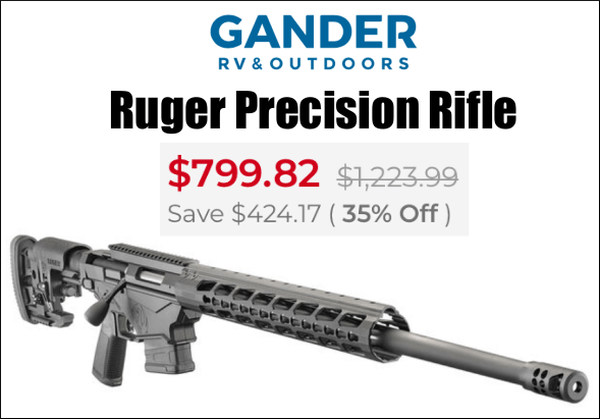
The Ruger Precision Rifle (RPR) is hard to beat for the price among entry-level chassis rifles. And here is one of the best prices for an RPR that we’ve ever seen. If you’re in the market for an RPR, grab this .308 Win RPR for a just $799.82. If you’re looking for a 6mm version, check out this Ruger Precision Rifle in 6mm Creedmoor for $1071.99.
5. Bruno’s — RCBS ChargeMaster Combo, $259.95
Newer, App-controlled powder scale/dispensers have recently entered the marketplace, but the original RCBS ChargeMaster Combo Powder Dispenser continues to be a reliable workhorse preferred by many dedicated hand-loaders. Grab one of these ChargeMaster Combos for just $259.95 at Bruno’s. That’s a steal — other vendors are charging $348.00 or more! This ChargeMaster will provide years of reliable service. We do recommend using the check weights before each loading session to calibrate the scale.
6. Bruno’s — Flavio Fare Triggers Now in Stock
If you’re looking for a trigger that is amazingly crisp and has the lightest, most reliable trigger pull on the market, then check out Flavio Fare Triggers. These triggers are used by some of the top shooters in the country. If you looking for a competitive advantage, grab one and see what the hype is about.
7. Amazon — BOG-POD Field Bi-Pod, $38.68
If you’re looking for a versatile, stable and easy-to-carry field support, check out the latest BOG-POD Camo Bipod. Featuring adjustable legs with a 40-degree max angle, the BOG-POD Bipod can be used while sitting, standing, or kneeling. This kid of support is highly recommended for shooting on hills where a conventional bipod doesn’t offer enough elevation. Watch the video below to see the BOG-POD in action.
8. Amazon — Scent Safe Travel Bag, $26.81
Here’s a valuable product for hunters. This Scent-Safe product helps mask odors that give away your location to your prey. Store your gear in the Hunter Specialties Scent Safe Travel Bag to help ensure a successful hunt. As one reviewer said, “I use these to store my bow hunting clothes during and between seasons, after washing with them scent control soap, to keep outside scents away. I add a few earth scented wafers to the inner pockets which does a good job adding a cover scent. Take the whole bag with me on hunts and just remove what I need for each hunt. What I don’t use stays in the bag and scent free for the next hunt.”
9. CHL Targets — Official Competition Targets and Fun Targets
Finding quality competition targets (at a good price) can be challenging if you don’t need 300 at a time. CHL Targets has a very complete selection of targets at great prices. CHL sells official NRA, IBS, and NBRSA match targets. In addition, CHL Targets offers splatter-type reactive targets. All competition, sight-in, and fun targets are sold at very competitive prices. Quantity discounts are offered for ranges and clubs.
Here’s a great deal for varmint shooters with 17 HMR rifles. Midsouth has the Hornady 17 HMR brick of 500 for a low price of $89.99. That works out to just 18 cents per round — cheap enough that you can blast sage rats all days long and never worry about running out of ammo.
This could be big news for F-TR and Palma competition, where cartridge options are limited to .223 Rem and .308 Win. Berger is introducing a NEW, very high-BC, 22-caliber Long Range Hybrid Target Bullet. Stated Ballistic Coefficents (BCs) are: 0.524 G1 and 0.268 G7. That’s near the top among .22-cal bullets and makes this 85.5 grain projectile a very viable long-range option. Want to try some? These should be available very soon. Pre-order now from Creedmoor Sports, MidwayUSA, and other vendors.
This new 85.5gr bullets boast smaller, more uniform meplats, giving them a higher long-range BC. The meplat enhancement is achieved with “Meplat Reduction Technology” (MRT). Berger Engineer Garett Stoddard, who spearheaded the MRT project, explains: “Every bullet nose is formed with optimal swage pressure determined by force instead of length. In addition to reducing a projectile’s drag by shrinking its meplat diameter, this technique takes the inherent meplat inconsistencies that plague OTM style projectiles and brings them closer to the rotational axis. This is a key factor to the consistent balance of the bullet in flight.” The new 85.5s, like all other Berger projectiles, are made with precise Berger/J-4 bullet jackets which boast +/- .0003″ jacket TIR (total indicated runout).
7-Twist Barrels Recommend for new 85.5gr MRT Berger
The 85.5gr Long Range Hybrid Target Bullet’s G7 BC of .268 is achieved with optimal stability from a 1:7″-twist barrel. Berger says “Excellent accuracy may also be attained with 1:8″-twist rifle barrels, resulting in a slightly decreased BC value”.
Initial Test Results Are Very Positive
A third party tester, shooting the new 85.5-grainer in Arizona, reported excellent performance at 1000 yards: “The projectile performed extremely well at 1000 yard in spite of only being driven to ~2800 to 2850 fps. This projectile is clearly competitive at 1000 yards in a Palma rifle as tested. With a slightly longer throat and a faster-twist barrel, I am confident the 85.5 Hybrid would be a viable option for those looking to shoot .223 Rem in Long Range competitions.”
Meplat Reduction Technology Enhances Shot-to-Shot Consistency
Berger says: “Utilizing advanced and proprietary manufacturing processes, Berger’s innovative Meplat Reduction Technology (MRT) System applies controlled pressure along the projectile nose, producing a homogeneous and repeatable bullet profile for the industry’s most consistent Ballistic Coefficients (BC). While a high BC is desirable to competitive shooters, shot-to-shot BC consistency is critical when engaging targets to 1000 yards and beyond.”
Over the past 12 months, this article was one of the TOP TEN most-read Daily Bulletin features. We’re reprising it today for those who may have missed it the first time. The above diagram comes from a TiborasurasRex YouTube Video comparing G1 and G7 BC models. CLICK HERE to watch the video.
The better, up-to-date ballistics programs let you select either G1 or G7 Ballistic Coefficient (BC) values when calculating a trajectory. The ballistic coefficient (BC) of a body is a measure of its ability to overcome air resistance in flight. You’ve probably seen that G7 values are numerically lower than G1 values for the same bullet (typically). But that doesn’t mean you should select a G1 value simply because it is higher.
Some readers are not quite sure about the difference between G1 and G7 models. One forum member wrote us: “I went on the JBM Ballistics website to use the web-based Trajectory Calculator and when I got to the part that gives you a choice to choose between G1 and G7 BC, I was stumped. What determines how, or which one to use?”
The simple answer is the G1 value normally works better for shorter flat-based bullets, while the G7 value should work better for longer, boat-tailed bullets.
G1 vs. G7 Ballistic Coefficients — Which Is Right for You?
G1 and G7 refer both refer to aerodynamic drag models based on particular “standard projectile” shapes. The G1 shape looks like a flat-based bullet. The G7 shape is quite different, and better approximates the geometry of a modern long-range bullet. So, when choosing your drag model, G1 is preferrable for flat-based bullets, while G7 is ordinarily a “better fit” for longer, boat-tailed bullets.
Drag Models — G7 is better than G1 for Long-Range Bullets
Many ballistics programs still offer only the default G1 drag model. Bryan Litz, author of Applied Ballistics for Long Range Shooting, believes the G7 standard is preferrable for long-range, low-drag bullets: “Part of the reason there is so much ‘slop’ in advertised BCs is because they’re referenced to the G1 standard which is very speed sensitive. The G7 standard is more appropriate for long range bullets. Here’s the results of my testing on two low-drag, long-range boat-tail bullets, so you can see how the G1 and G7 Ballistic coefficients compare:
G1 BCs, averaged between 1500 fps and 3000 fps:
Berger 180 VLD: 0.659 lb/in²
JLK 180: 0.645 lb/in²
The reason the BC for the JLK is less is mostly because the meplat was significantly larger on the particular lot that I tested (0.075″ vs 0.059″; see attached drawings).
For bullets like these, it’s much better to use the G7 standard. The following BCs are referenced to the G7 standard, and are constant for all speeds.
Many modern ballistics programs, including the free online JBM Ballistics Program, are able to use BCs referenced to G7 standards. When available, these BCs are more appropriate for long range bullets, according to Bryan.
[Editor’s NOTE: BCs are normally reported simply as an 0.XXX number. The lb/in² tag applies to all BCs, but is commonly left off for simplicity.]
At the request of our readers, we provide select “Deals of the Week”. Every Monday morning we offer our Best Bargain selections. Here are some of the best deals on firearms, hardware, reloading components, optics, and shooting accessories. Be aware that sale prices are subject to change, and once clearance inventory is sold, it’s gone for good. You snooze you lose.
This Stack-On Sentinel Security Cabinet holds 18 rifles up to 54″ tall or nine firearms with extra storage. Adjustable, padded shelves can be placed on either right or left side. This unit features a 3-point locking system for greater security. No this safe is NOT as strong or secure as a quality, thick-walled gun-vault, but this 55″x21″x18″ Security Cabinet can work well as a secondary safe for your workroom, vacation cabin, or even an RV. Right now Walmart has “Roll-Back” pricing — $159.99 with FREE delivery. That’s right — pay just $159.99 for the safe delivered to your home or the nearest Walmart.
2. Bruno Shooters Supply — Berger Bullets at Great Prices
Match season is in full swing — so make sure you don’t run short on bullets. One of our go-to sources for reloading components is Bruno Shooters Supply. Bruno’s just recently updated its website, so you should check out the new features. While you’re there, look at Bruno’s selection of Berger bullets advertised at “lowest prices on the internet”. Berger match bullets are in high demand, but Bruno’s is offering great prices on many popular calibers and bullet weights.
3. EuroOptic — Sale on Vortex Strike Eagles, $299.99
Need a good basic optic for your hunting or varmint rifle? Have a tight budget but still need good glass and adjustable parallax? Then check out these Vortex Strike Eagles. Save $140-$150 now at EuroOptic.com. Sale price is just $299.99 for the 4-24x50mm and also $299.99 for the 3-18x44mm. EuroOptic’s Jason says these scope are a “killer value” with “target turrets, parallax adjustment close enough for rimfire, and good zoom range”. These Strike Eagles are also fairly short and light-weight, so they are good for hunters. Both these Second Focal Plane scopes offer 1/4-MOA clicks and nice EBR-4 illuminated reticles.
4. Bullet Central — Kelbly Atlas Tactical Action, $895
Kelbly actions are excellent. The Atlas series are rugged actions for practical/tactical and hunting use. This action features a Black Nitride finish so you can run minimal lubrication. The Atlas action comes with +20 MOA integral Picatinny Rail plus a nice fluted bolt. We also like the super-reliable TG mechanical ejector. This mag-fed Kelbly Atlas action takes Accuracy International and AI-type single-stack magazines. This fine Kelbly Atlas Tactical Action is now on sale at Bullet Central for the low price of $895.00.
Versatile and totable, this compact Samsung Galaxy 7″ tablet computer is just what you need at the range to run your Ballistics Apps, get WiFi images from your Target Cam, or “talk” to your LabRadar. The Galaxy Tab A 7.0 inch can also get internet weather reports and email. This is a modern device with myriad capabilities — all for under $130.00. It has a micro-SD slot so you can easily add more storage. You won’t find more bang for the buck in a digital device, and it even comes with free Tech support. NOTE: This is WiFi only — it is NOT a like a cellphone. It works via an internet connection (and blue-tooth).
6. Walther — PPQ and PPS Pistols, 30-Day Money Back Guarantee
We’ve heard of money-back guarantees on household products, and even pizzas. But never firearms. This is quite a unique offer. Walther is so confident that you will fall in love with Walther PPQ or PPS pistols that the German gun-maker is offering a 30-Day Money Back Guarantee.
Shoot it, if you like it, keep it. But if you don’t, you can send it back to Walther for a full refund. Walther even pays shipping! For more info visit www.WaltherArms.com. This offers applies to ALL Walther PPQ and PPS models.
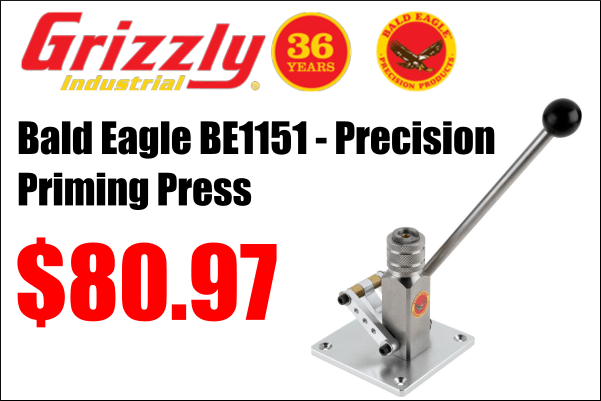
7. Grizzly — Bald Eagle Priming Press, $80.97
Any serious competitor will tell you that consistent primer seating is one of the most critical steps in reloading. There are lots of choices out there for bench and hand-held primers but NONE of then match the Grizzly priming press which can be found for $80.97. It features a beautifully-made system that is click adjustable to .002″ and incredibly repeatable. If you’re in the market for something that’s easy on the hands and works like units that cost hundreds more give this one a look.
If you have been waiting to get a Magnetospeed… wait no longer. Priced at just $153.74 at MidwayUSA, the Magnetospeed Sporter model costs less than half as much as Magnetospeed’s V3 models. This chronograph attaches directly to your barrel so you don’t have to go downrange to position tripods and set up skyscreens. For most people the Sporter Model contains all the features they need. Using Magnetospeed’s XFR adapter (sold separately), data can be transferred easily from the display module to your mobile device. READ Magnetospeed Sporter Review. NOTE: You need to add the item to cart to see the $153.74 price. This typically sells elsewhere for around $180.00.
This versatile funnel system works with nearly all cartridge types, from 17 Remington up to 500 S&W. Even if you have a fancy metal funnel, it’s worth having one of these RCBS Kits on your reloading bench. The RCBS Quick Change Powder Funnel Kit features five (5) adapters that match case mouth diameter for specific cartridge ranges: 17-20 caliber, 22-264 caliber, 27-284 caliber, 30-375 caliber, 40 caliber and higher. The Funnel Kit includes a handy 4-inch drop tube. Price is $11.04 at Amazon with free shipping on orders over $25 total.
10. Amazon — Two Rolls of 3″ Neon Target Stickers, $12.99
We like these bright, Neon EasyShot 3″ target stickers. They are big enough to see easily at 600 yards, giving you a 1/2 MOA target center at that distance. For $12.99 at Amazon.com, you get 250 3″-diameter self-adhesive centers (125 targets per roll) that stick to almost any surface The high-contrast fluorescent red/orange color provides an excellent HI-VIZ aiming point, along with good contrast for bullet holes that fall within the 3″ circle. To help line up your reticle cross-hairs, the target centers feature black markers at 3, 6, 9, and 12 0’Clock. NOTE: These stickers qualify for FREE Shipping.
Emil Praslick III is widely recognized as one of the greatest wind wizards on the planet — a master at identifying wind value and direction, and predicting wind cycles. As coach of the USAMU and top civilian teams, Emil has helped win many high-level championships. In the three videos we feature today, Emil, who works with Capstone Precision Group (Berger, Lapua, SK, Vihtavuori) and Team Applied Ballistics, explains how to determine wind direction and velocity using a variety of indicators. Praslick, now retired from the U.S. Army, was an 18-time National and 2-time World Champion coach with the USAMU.
Video ONE: Wind Theory Basics — Understanding “Wind Values”
In this video from UltimateReloader.com, Emil explains the basics of modern wind theory. To properly understand the effect of the wind you need to know both the velocity of the wind and its angle. The combination of those variables translates to the wind value. Emil also explains that the wind value may not be constant — it can cycle both in speed and velocity. Emil also explains some of the environmental conditions such as mirage that can reveal wind conditions.
Video TWO: Determining the Direction of the Wind
Key Point in Video — Find the Boil
Emil explains how to determine wind direction using optic. The method is to use spotting scope, riflescope, or binoculars to look for the “Boil” — the condition in mirage when the light waves rising straight up. The wind will generate that straight-up, vertical boil in your optics when it is blowing directly at you, or directly from your rear. To identify this, traverse your scope or optics until you see the boil running straight up. When you see that vertical boil, the direction your optic is pointing is aligned with the wind flow (either blowing towards you or from directly behind you).
Video THREE: The No Wind Zero Setting
In this second video, Emil defines the “No-Wind Zero”, and explains why competitive shooters must understand the no-wind zero and have their sights or optics set for a no-wind zero starting point before heading to a match. In order to hit your target, after determining wind speed and direction, says Emil, “you have to have your scope setting dialed to ‘no wind zero’ first.”
Coach of Champions — Emil Praslick III
SFC Emil Praslick III, (U.S. Army, retired) works with Berger Bullets and Applied Ballistics. Emil served as the Head Coach of the U.S. National Long Range Rifle Team and Head Coach of the USAMU for several years. Teams coached by Emil have won 33 Inter-Service Rifle Championships. On top of that, teams he coached set 18 National records and 2 World Records. Overall, in the role of coach, Praslick can be credited with the most team wins of any coach in U.S. Military history.
Berger Twist-Rate Stability Calculator
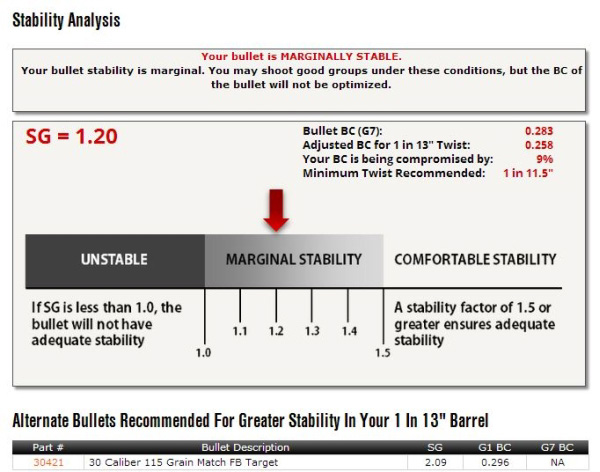
On the Berger Bullets website you’ll find a handy Twist-Rate Stability Calculator that predicts your gyroscopic stability factor (SG) based on mulitiple variables: velocity, bullet length, bullet weight, barrel twist rate, ambient temperature, and altitude. This cool tool tells you if your chosen bullet will really stabilize in your barrel.
How to Use Berger’s Twist Rate Calculator
Using the Twist Rate Calculator is simple. Just enter the bullet DIAMETER (e.g. .264), bullet WEIGHT (in grains), and bullet overall LENGTH (in inches). On its website, Berger conveniently provides this info for all its bullet types. For other brands, we suggest you weigh three examples of your chosen bullet, and also measure the length on three samples. Then use the average weight and length of the three. To calculate bullet stability, simply enter your bullet data (along with observed Muzzle Velocity, outside Temperature, and Altitude) and click “Calculate SG”. Try different twist rate numbers (and recalculate) until you get an SG value of 1.4 (or higher).
Gyroscopic Stability (SG) and Twist Rate
Berger’s Twist Rate Calculator provides a predicted stability value called “SG” (for “Gyroscopic Stability”). This indicates the Gyroscopic Stability applied to the bullet by spin. This number is derived from the basic equation: SG = (rigidity of the spinning mass)/(overturning aerodynamic torque).
If you have an SG under 1.0, your bullet is predicted not to stabilize. If you have between 1.0 and 1.1 SG, your bullet may or may not stabilize. If you have an SG greater than 1.1, your bullet should stabilize under optimal conditions, but stabilization might not be adequate when temperature, altitude, or other variables are less-than-optimal. That’s why Berger normally recommends at least 1.5 SG to get out of the “Marginal Stability” zone.
In his book Applied Ballistics For Long-Range Shooting, Bryan Litz (Berger Ballistician) recommends at least a 1.4 SG rating when selecting a barrel twist for a particular bullet. This gives you a safety margin for shooting under various conditions, such as higher or lower altitudes or temperatures.
Story idea from EdLongrange. We welcome reader submissions.




 Effects Of Cartridge Over All Length (COAL) And Cartridge Base To Ogive (CBTO) – Part 1




 The better, up-to-date ballistics programs let you select either G1 or G7 Ballistic Coefficient (BC) values when calculating a trajectory. The ballistic coefficient (BC) of a body is a measure of its ability to overcome air resistance in flight. You’ve probably seen that G7 values are numerically lower than G1 values for the same bullet (typically). But that doesn’t mean you should select a G1 value simply because it is higher.
 Drag Models — G7 is better than G1 for Long-Range Bullets