If you want smoother bullet seating, inside neck lube can help. Forum member Ackleyman II likes to add a little Mica powder inside his case necks before seating bullets. This is easily done with the Forster three-brush neck lube kit. Ackleyman tells us: “Many loads that I have will not shoot well with a dry neck compared to a neck that is cleaned and lubed with this [Forster Dry Lubricator] — the best $15 you have ever spent.”
The Forster Case Neck Lubricator features three brushes attached to a tough, impact-resistant case with holes for bench mounting. The brushes accommodate all calibers from 22 to 35 caliber. The kit includes enough “motor mica” to process 2000 to 3000 cases and has a cover to keep dust and grit from contaminating the mica. By moving the case neck up and down on the correct mica-covered brush, the neck can be cleaned and lubricated at the same time.
Function: Lubricate case necks for easier resizing
Contents: Kit with base, lid, and three nylon brushes
Lubricant: Includes 1/10 oz. of Motor Mica, enough to process 2000-3000 cases
Shown is the Redding Model 15-P Competition Piloted Inside Chamfering Tool with pilot rod that centers in the case flash hole. Also shown is a Forster 45° Rocket Tool.
There are a wide variety of reloading tools designed to cut a slight chamfer in case necks and deburr the edge of the case mouth. You don’t need to spend a lot of money for an effective tool. A basic “rocket-style” 45° chamfering tool, such as the Forster, actually does a pretty good job taking the sharp edge off case mouths, particularly if you use a little scotch-pad (or steel wool) to smooth the edge of the cut. The Forster chamfer tool, shown below, is a nicely-made product, with sharper cutting blades than you’ll find on most other 45° chamferers. It costs $17.99 at Brownells.com.
Redding sells a handy piloted chamfering tool with a 15° inside cutting angle and removable accessory handle. This Redding Model 15-P chamferer works really well, so long as you have consistent case OALs. The pilot rod (which indexes in the flash hole) is adjustable for different cartridge types (from very short to very long). This ensures the concentricity of the inside neck chamfer to the case mouth. This quality tool works with cases from .22 to .45 Caliber.
Sinclair International offers a 28° carbide chamferer with many handy features (and sharp blades). The $29.99 Sinclair Carbide VLD Case Mouth Chamfering Tool will chamfer cases from .14 through .45 caliber. This tool features a removable 28° carbide cutter mounted in the green plastic Sinclair handle. NOTE: A hex-shaft cutter head power adapter can be purchased separately for $14.99 (Sinclair item 749-002-488WS). This can be chucked in a power screwdriver or used with the Sinclair Case Prep Power Center when doing large volumes of cases.
Many folks feel they can get smoother bullet seating by using a tool that cuts at a steeper angle. We like the 22° cutter sold by Lyman. It has a comfortable handle, and costs just $10.75 at MidsouthShooterssupply.com. The Lyman tool is an excellent value, though we’ve seen examples that needed sharpening even when new. Blade-sharpening is easily done, however.
K&M makes a depth-adjustable, inside-neck chamferer (“Controlled Depth Tapered Reaper”) with ultra-sharp cutting flutes. The latest version, which costs $47.00 at KMShooting.com, features a central pin that indexes via the flash hole to keep the cutter centered. In addition, the tool has a newly-designed handle, improved depth-stop fingers, plus a new set-screw adjustment for precise cutter depth control. We caution, even with all the depth-control features, if you are not careful, it is easy to over-cut, slicing away too much brass and basically ruining your neck. We think that most reloaders will get better results using a more conventional chamfer tool, such as the Forster or Redding 15-P.
One last thing to note — tools like the K&M and the Sinclair chamferer are often described as VLD chamferers. That is really a misnomer, as bullets with long boat-tails actually seat easily with very minimal chamfering. In reality, these high-angle chamferers may be most valuable when preparing brass for flat-base bullets and bullets with pressure rings. Using a 22° or 28° chamferer can reduce the risk of cutting a jacket when using VLD bullets though — so long as you make a smooth cut.
Every serious hand-loader can use a powered Case Prep station. This multi-function device saves time and avoids repetitive manual labor (that can be downright painful after 50+ cases). Now you can get the Lyman Case Prep Xpress for a crazy low price. Midsouth just slashed its price on the Case Prep Express, and this unit also qualifies for a sweet $25 Rebate from Lyman. That puts your net cost at just $84.99. Hard to argue with that. Your wrists and fingers will thank you.
The Case Prep Xpress lets you chamfer inside and out, brush case-necks, clean/uniform primer pockets, and ream military crimps. However, the unit does NOT trim cases. The motor is powerful and the Xpress is easy to clean. On sale at MidSouth for $109.99 ($84.99 after Rebate), this is a great deal. You can also purchase at Amazon for $107.71 with free Prime Shipping ($82.71 after Rebate).
The Lyman Case Prep Xpress comes with all the necessary tools (listed above), so you don’t have to purchase extra accessories. The five (5) gear-driven heads on the unit are powered by a high torque, low-speed motor ideal for case prep operations. Lyman’s Case Prep Xpress features handy storage areas for accessories, a removable brass shavings dump pan, and a handy clean-up brush.
Sinclair Int’l video clearly illustrates all case prep functions. Worth watching.
In the four years that this product has been on the market it has been a strong seller. If you’re prepping hundreds of cases, this unit will save considerable time and reduce hand/finger fatigue. While the Case Prep Xpress is not as sturdy as the metal-bodied Hornady prep center, the Lyman unit offers a lot of functionality for the money.
Lyman Case Prep Xpress Pros and Cons
GOOD Features
Quite Affordable (under $120)
Compatible with RCBS and Redding Tool-heads
Removable Bin for Shavings
Four Brush Sizes: .25, .30, .38, .45
Compact Footprint
Not-So-Good Features
Tool-heads Not Particularly Sharp
No Case Trim Function
No Flash-hole Uniformer
No Top Dust-Cover
Only 1-Year Warranty
Reviews by Verified Purchasers
“Case prep is the most tedious and boring aspect for hand loading in my opinion. The process center makes all the steps in prepping the case very quick and with consistent results. It has reduced the time required to do these steps with separate tools by easily 50% if not more. Highly recommended.” — Brandon G.
“Quiet and capable. Worth every penny. I adapted a Lee Cutter and Lock Stud, to cut case lengths, and I can fly through my brass. I can do so much more brass without getting the sore, cramped-up hands.” — Dean Ellis
“This unit has plenty of torque, and my unit is very quiet. This unit will also work with tools made by RCBS and Hornady, or anything else with 8-32 threads. My Redding tools (specifically, my primer pocket uniformers) do in fact fit on this machine. This unit is certainly worth the money, and will revolutionize the way you reload by saving you massive amounts of time and wear on your hands/fingers.” — Mule
He who dies with the most toys wins — right? Well Sinclair has another interesting gadget you can add to your reloading bench. The Sinclair Case Neck Sorting Tool lets you quickly sort brass by neck-wall thickness. For those who shoot “no-turn” brass, sorting your cases helps achieve more uniform neck tension and, thereby, more consistent bullet seating. Large variances in neck-wall thickness can cause inconsistent neck “grip” on the bullet. Generally, we’ve found that more consistent neck tension will lower ES and (usually) improve accuracy.
Get Better Results with No-Turn Brass
We know some guys who shoot no-turn 6mmBR brass in competition with considerable success — but their secret is pre-sorting their brass by neck-wall thickness. Cases that are out-of-spec are set aside for sighters (or are later skim-turned).
Watch Case Neck Sorting Tool Operation in Video (May not load on mobile devices)
How the Case Neck Sorting Tool Works
Here’s how the Sinclair tool works. Cases are rotated under an indicator tip while they are supported on a case-neck pilot and a support pin through the flash hole. The unit has a nice, wide base and low profile so it is stable in use. The tool works for .22 through .45 caliber cases and can be used on .17- and .20-caliber cases with an optional carbide alignment rod. The MIC-4 pin fits both .060 (PPC size) and .080 (standard size) flash holes. Sinclair’s Case Neck Sorting Tool can be ordered with or without a dial indicator. The basic unit without indicator (item 749-006-612WB) costs $59.99. Complete with dial indicator (item 749-007-129WB), the tool costs $89.99. IMPORTANT: This tool requires caliber-specific Case Neck Pilots (sold separately).
Editor’s Comment: The purpose of this Sinclair tool is rapid, high-quantity sorting of cartridge brass to ascertain significant case-neck-wall thickness variations. Consider this a rapid culling/sorting tool. If you are turning your necks, you will still need a quality ball micrometer tool to measure neck-wall thickness (to .0005) before and after neck-turning operations.
In our feature article on Case Neck Tools we explained the importance of case neck uniformity and reviewed the best tools for measuring case neck thickness. But having uniform case neck walls is only part of the accuracy equation. You also want your cases to exhibit minimal run-out, as measured by a precision tool. For this reason, a quality concentricity gauge belongs on your loading bench if you are looking for the Nth degree of accuracy.
We’ve worked with quite a few concentricity gauges. They all have their strengths and weaknesses, but some just didn’t perform well at all with very short cases like the 6BR and 6PPC. One of our regular readers suggested we check out the H&H Concentricity Gauge, made by Bill Herron in Oregon. So far we are very impressed. A 6BR or PPC case doesn’t tip or rock, causing the needle to jump. We were able to get good, repeatable readings off a seated bullet, which wasn’t easy at all with some of the other units. Our friend agreed with our positive assessment of the H&H, saying: “I have four concentricity gauges. Among these tools, the H&H is the least expensive and the easiest to use of those designed for loaded round measurement AND bullet straightening. It is also built like a brick. However, the Sinclair is [probably] the best for looking at the case alone due to the bearing balls and their adjustability.”
The H&H uses an indicator block to eliminate off-center indicator readings. It will accept .22 PPC through .375 length cases. A reversible spindle acts as a pilot for checking neck thickness. Bill Herron says the unit can also re-align bullets, but we didn’t try out that capability. For more info, visit the H&H Industries website, or call Bill at (541) 327-1411.
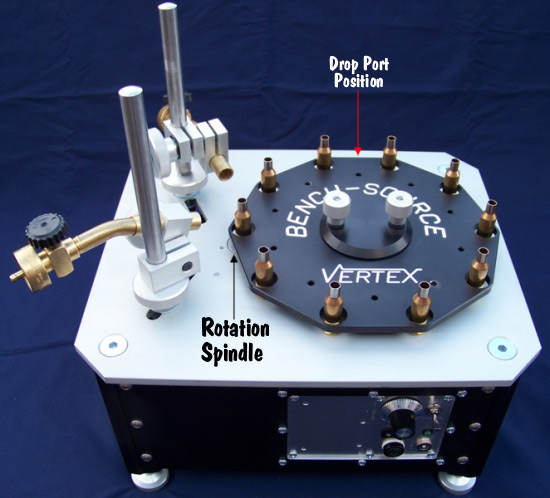
Now that Zephyr Dynamics’ “Brass-O-Matic” rotary case annealer is no longer in production (Zephyr Dy’s owner received a “job offer he couldn’t refuse”), we were excited to learn that Bench-Source is bringing out an all-new, micro-processor-controlled, automated annealing machine. Bench-Source, based in Mississippi, currently produces high-quality scope bases for Savage target actions. The annealing machine is a new direction for Bench-Source, but it displays the company’s trademark attention to detail and superb machining.
The new Bench-Source automatic case neck annealing machine processes 500-600 cartridges per hour, from 22 Hornet up to the big magnums. Heating time from 1.5 to 10 seconds is precisely controlled by a microprocessor with both a manual mode and “Automatic” mode. Note that the cartridge spins in place when it is at the annealing position, giving a uniform anneal. After annealing, the case exits via a gravity-fed drop port, so you don’t have to handle hot cases. Note: In the video below, the flame you see on some cases is burn-off of temp-indicating marker. Watch carefully and you can see that the case being annealed spins while being heated.
You can use either one or two heat sources. Torch tips are adjustable in height, angle, distance and vertical tilt by two clamp knobs. Unlike some other units, the flame height is quickly and easily adjustable. We were pleased to see all the top surfaces are metal (no plastic to warp or melt). The solid aluminum table top and index plate are also cooled by a 50-cubic-feet-per-minute fan — they will not heat up significantly during use. Additionally, the table acts as a heat sink to maintain hardness in the cartridge case head.
The unit goes on sale in March 2010. Anticipated retail price is $449.50. To order, visit Bench-Source.com, or contact Vertex Mfg. at (662) 895-0803.


 How the Case Neck Sorting Tool Works
 We’ve worked with quite a few concentricity gauges. They all have their strengths and weaknesses, but some just didn’t perform well at all with very short cases like the 6BR and 6PPC. One of our regular readers suggested we check out the
 The new Bench-Source automatic case neck annealing machine processes 500-600 cartridges per hour, from 22 Hornet up to the big magnums. Heating time from 1.5 to 10 seconds is precisely controlled by a microprocessor with both a manual mode and “Automatic” mode. Note that the cartridge spins in place when it is at the annealing position, giving a uniform anneal. After annealing, the case exits via a gravity-fed drop port, so you don’t have to handle hot cases. Note: In the video below, the flame you see on some cases is burn-off of temp-indicating marker. Watch carefully and you can see that the case being annealed spins while being heated.