by Tony Chow
In recent years, the use of electronic trainer systems has revolutionized training in all disciplines of position shooting. By capturing (and illustrating) key performance variables like the steadiness of a shooter’s hold, accuracy of aiming, and the timeliness of trigger release, these devices can offer tremendous insights into the strengths and weakness of a shooter’s position and technique, making high-level marksmanship training less voodoo and more of a science.
Until now, electronic trainers all suffered from one critical limitation: the inability to be used outdoors in live fire training. Now, however, SCATT has introduced the next-generation MX-02 electronic trainer, a product that can finally support outdoor live firing in broad daylight, as well as dry firing indoors. In addition, the MX-02 is the first electronic trainer to support centerfire rifles. It goes without saying that, when we at AccurateShooter.com were offered an MX-02 test unit to review, we jumped at the opportunity.
How the SCATT MX-02 Works
The SCATT sensor mounted on the end of the barrel has a digital camera that “sees” the black bullseye in the target, even in broad daylight outdoors. Using the bullseye as a reference, the SCATT software tracks the movement of the muzzle relative to the center of the target. The unit can plot these movements as a continuous trace, which appears on a monitor as a squiggly, colored line. Data points from the trace are also available in a tabular spreadsheet format. This allows the shooter to “crunch the numbers”, revealing strengths and weaknesses in his gun-handling and aiming technique.
In our testing, we confirmed that, like SCATT’s earlier indoor-only WS-01, the MX-02 offers excellent support for indoor dry-fire training, which will continue to be the primary means through which position shooters sharpen their fundamental skills. Since the new SCATT uses the same familiar Windows software for data capture and analysis as its predecessors, shooters and coaches upgrading to MX-02 will have no learning curve to overcome, and newcomers to the SCATT platform can tap into the wealth of institutional knowledge accumulated over the years by the shooting community on how to interpret shot data.
It’s in the support for outdoor live firing, however, that SCATT MX-02 distinguishes itself from its predecessors and the competition. Shot trace data captured by MX-02 during live firing turned out to be every bit as valuable (and revealing) as we had hoped. The ability to correlate SCATT tracing with real shots on target gave us a better understanding of the shooting process, and helped the reviewer, already a high-level smallbore prone shooter, uncover a significant problem in his shooting. SCATT MX-02’s outdoor capability is therefore an invaluable feature, particularly for experienced shooters aspiring to world-class performance.
In summary, SCATT MX-02 is an outstanding product that delivers on its promises. We heartily recommend it, both for first-time users of electronic training aids, and also for those shooters who may wish to upgrade their current electronic training system. The MSRP for SCATT MX-02 is $1,799, $500 more than its predecessor, the SCATT WS-01, which is still available. In my view, the $500 premium for the MX-02 is justified by the MX-02’s enhanced capabilities, making it a better long-term investment.
Our complete, 3600-word MX-02 review of the SCATT MX-02 can be accessed through the link below. This full review contains many more photos plus detailed field test results. For the time being, the review only covers our experience with the product in smallbore shooting. An upcoming addendum to the review will include test results from centerfire shooting. Those attending SHOT Show in Las Vegas next week can examine SCATT MX-02 in person. SCATT will have the MX-02 on display at Booth 111.
High-Tech Hits the Road
The Civilian Marksmanship Program (CMP) has a portable air gun range that travels around the country in trailer rigs. The CMP’s new $425,000 mobile range features 60 electronic targets, automated target lifts, target monitors (for 60 stations), and jumbo viewing screens for spectators. Positioned on tables along the firing line (photo below), the 60 MEGALink color screens show scores in real time. The high-tech electronic targets provide quick and accurate results, and spectators can watch a “live feed” on eight big-screen LED television monitors. The entire system is controlled by a trio of computers which do the scoring and operate the targets, lifts, and TVs.
The CMP’s state-of-the art, mobile air gun range boasts 60 electronic MEGAlink targets produced in Norway. MEGAlink is the same target system used at CMP North and South stationary air ranges. The MEGAlink target “boxes” are each connected to a lift system than can raise and lower the targets for 3-position shooting. All of the components are designed so that the range can be quickly constructed using as few as three people. A large trailer can haul all 60 targets plus all the related monitors, computers, tables, chairs, and hardware in one load-out.
“With travel being difficult for competitors to make it to Ohio or Alabama, the idea of the mobile range arose to transport electronic targets to the shooters instead of them coming to us,” said James Hall, CMP Program Outreach Supervisor. Because of its versatile design, the range can be used as either a 60-point range or broken down into three sets of 20 targets or two sets of 30 targets. “The range can be set up in almost any combination of targets, which allows small gyms and conference centers to host a match with maximum target use,” said Hall.
The first “trial” match of the Mobile Range was at the Montgomery Bell Classic in Nashville, TN in October 2012. “The match was a success, not only for the Montgomery Bell Academy, but also for the CMP,” Hall said. “The targets ran well, and we received a positive response from spectators.” Other CMP events where the range has been put to the test include the 5th Brigade Championship in Kerrville, TX in December 2012 and the Bass Pro 600 in Leeds, AL in January 2013.
All packed up and ready to go, the CMP’s Mobile Range will roll on to future events, including the JROTC Service Championship in Salt Lake City, UT, 4H Nationals in Grand Island, NE, the American Legion Championship in Colorado Springs, CO and various CMP summer camps and clinics. “The Mobile Range has generated a great response,” Hall admitted. “We hope it continues to give shooters out west and other areas of the United States a chance to compete.”
We live in a digital, electronic era. The very story you’re reading right now consists of digital data packets transmitted electronically around the globe. Because of cost factors, 99+% of shooting matches in the USA still rely on old-fashioned manual scoring methods. However, target scoring can be done faster and more precisely with electronic scoring systems. Olympic and international CISM shooting competitions now employ electronic target systems. And electronic scoring is widely used in Europe. Virtually all the rifle and pistol events at the recent ISSF World Championships in Munich featured electronic scoring — complete with large, overhead digital displays so the audience could track the action, shot for shot.
Below is a video showing an electronic scoring system developed by Norway’s Kongsberg Mikroelektronikk AS. Watch as a prone shooter puts five rounds on a 300m target. You can see the group form on the video screen at his shooting station. He’s a good shooter (with an accurate rifle). The first three shots are touching.
As you can see from the video, viewing shots on the monitor is easier than using a spotting scope and waiting for targets to be marked. And, electronic targets eliminate the need for target pullers in the pits.
The Kongsberg target systems, like the electronic systems produced by Sius Ascor of Switzerland, do more than just display shot locations to the shooter. The target units automatically calculate scores, which are transmitted to a central computer. This can provide updated competitor rankings, and can even display the results to event spectators on large view screens.
CLICK HERE for a longer streaming Flash VIDEO showing how electronic target systems work. This video, produced by Sius Ascor, shows Olympic target systems in action.
Tomorrow, May 19, you can try out the electronic targets used in the Olympics at the Peacemaker National Training Center in Gerrardstown, WV. The event is a part of the NRA’s effort to increase awareness of Electronic Target Systems and their use for recreational shooting. Provided by ShotResponse (a dealer for the Swiss SIUS AG company), the electronic targets instantly record and score every shot fired down-range. The new NRA Portable Box Target provides a 4′ x 4′ scoring zone (with multiple target options) and remote display at the shooter’s location. The wireless version works out to 1,000 yards without a signal repeater.
Next Target Demo in Williamsport, PA
The next demonstration of the SIUS electronic targets will be September 8, 2012 at the Original Pennsylvania 1000 Yard Benchrest Club, in Williamsport, PA. CLICK HERE to learn more about the Williamsport event this fall. If your club is interested in hosting an electronic target event in the future, contact NRA Range Services at (877) NRA-RANGE or email range@nrahq.org.
About the Equipment
The SIUS Portable Bullet Sensor (PBS) is a Portable Single Lane RF (wireless) automatic electronic precision target scoring system. SIUS PBS employs Acoustical Projectile Locating (detection). Accuracy is 1 – 2mm at the target center and 5 – 7mm at outer scoring zones. Any small arms firearms from .22-caliber to .308 caliber can be used with the system. It works with both subsonic and supersonic projectiles. The ShotResponse NRA Box targets with multiple target “skins”, including standard bullseye targets along with deer and boar hunting targets. There are 12 different Target Facings with Firing Exercise Software plus the Rifle Grouping/Zeroing Exercise.
The PBS system consists of a collapsible Precision Target with an RF (wireless) Battery Pack, a Target carrying/shipping case and a Shooter’s RF Wireless Control Unit/Monitor with Keypad, Battery Pack, Carrying/Shipping Case and a Laptop computer for downloading and printing of firing data. This portable system employs technology developed by SIUS, the official supplier of electronic targets for the Olympic Games and ISSF competition. CLICK HERE for SIUS video.
The video below shows a variety of SIUS/ShotResponse indoor and outdoor electronic targets in use. There are systems for airguns and pistols as well as rimfire and centerfire rifles.


 Story based on report by Ashley Brugnone for


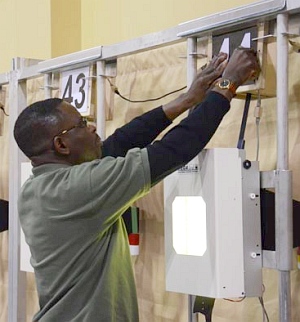 “With travel being difficult for competitors to make it to Ohio or Alabama, the idea of the mobile range arose to transport electronic targets to the shooters instead of them coming to us,” said James Hall, CMP Program Outreach Supervisor. Because of its versatile design, the range can be used as either a 60-point range or broken down into three sets of 20 targets or two sets of 30 targets. “The range can be set up in almost any combination of targets, which allows small gyms and conference centers to host a match with maximum target use,” said Hall.
 We live in a digital, electronic era. The very story you’re reading right now consists of digital data packets transmitted electronically around the globe. Because of cost factors, 99+% of shooting matches in the USA still rely on old-fashioned manual scoring methods. However, target scoring can be done faster and more precisely with electronic scoring systems. Olympic and international CISM shooting competitions now employ electronic target systems. And electronic scoring is widely used in Europe. Virtually all the rifle and pistol events at the recent ISSF World Championships in Munich featured electronic scoring — complete with large, overhead digital displays so the audience could track the action, shot for shot.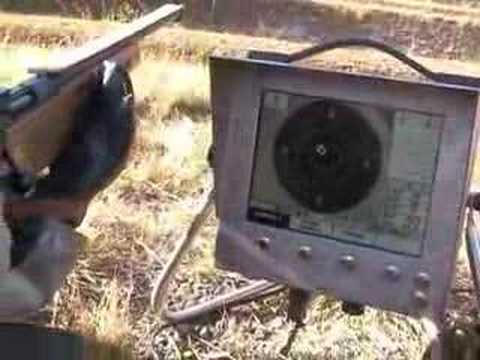


 Tomorrow, May 19, you can try out the electronic targets used in the Olympics at the


